Lyudmila Pavlichenko: The Woman the Nazis Called “Lady Death”
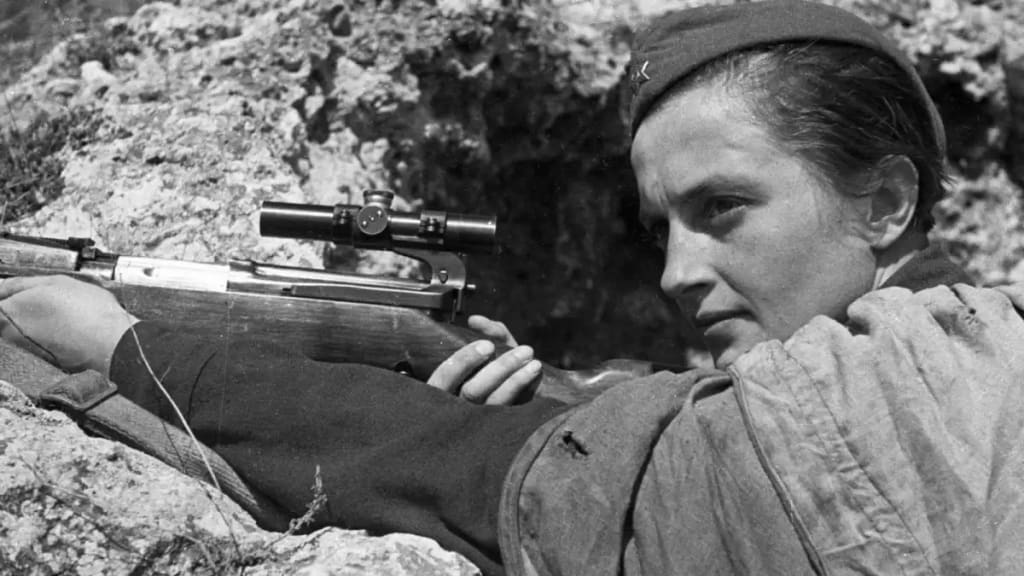
Some wartime legends grow larger with repetition. Others remain powerful because the facts are already extraordinary enough. Lyudmila Pavlichenko belongs to the second category. She was not a fictional symbol built after the war to flatter memory. She was a real combatant, a real sniper, and one of the most formidable marksmen of the Second World War. By the time she left the front lines, she had 309 confirmed kills, making her widely recognized as the most successful female sniper in history.
That number alone would make her memorable. But Pavlichenko’s life matters for more than her kill count. She stood at the crossroads of several histories at once: the Nazi invasion of the Soviet Union, the brutal sieges of Odessa and Sevastopol, the role of women in combat, wartime propaganda, and even Soviet-American diplomacy. In 1942, after being wounded and pulled from frontline duty, she traveled to the United States and Canada as part of a Soviet mission to push the Allies toward opening a second front. During that trip, she became the first Soviet citizen received by a U.S. president, meeting Franklin D. Roosevelt, and later toured with Eleanor Roosevelt.
That is what makes her story so gripping. She was at once a soldier, a symbol, and a survivor. To some, she was a propaganda icon. To others, she was proof that women could fight and kill with the same precision and resolve as men. To the Nazis, she became known as “Lady Death.” To history, she remains one of the clearest examples of how war can drag ordinary ambition into extraordinary violence.
Early Life: Before the Rifle
Lyudmila Mikhailovna Pavlichenko was born in 1916 in Belaya Tserkov, in what is now Ukraine. Smithsonian notes that she grew up just outside Kyiv, the daughter of a factory worker and a teacher, and described herself as competitive from an early age. She did not want boys doing anything better than she could. That instinct matters, because it helps explain one of the central threads of her story: she did not drift into marksmanship accidentally. She entered it with ambition.
Before the war, Pavlichenko studied at Kyiv University, where she was in her fourth year as a history student when Nazi Germany invaded the Soviet Union in June 1941. That is one of the most striking contrasts in her life: on one side, the world of books, archives, and scholarship; on the other, one of the bloodiest fronts in modern history. War did not merely interrupt her education. It transformed her completely.
Joining the Red Army
When Germany launched Operation Barbarossa, Pavlichenko did not choose the safer or more expected route. According to the National WWII Museum and Smithsonian, she volunteered for the Red Army and insisted on combat service despite pressure to become a nurse. That moment has become almost legendary in retellings of her life because it captures both wartime sexism and her refusal to be sidelined by it. She had already completed marksmanship training and brought that proof with her.
She was eventually assigned to the 25th Rifle Division, one of roughly 2,000 women who served as Soviet snipers. The National Park Service notes that only about 500 of those women survived the war. That statistic alone should stop any romanticization. Sniper work was deadly, isolating, and physically exhausting, especially on the Eastern Front, where the war became a vast machine of attrition. Pavlichenko was not joining a glamorous elite unit. She was entering one of the most merciless theaters of combat in modern history.
Odessa and Sevastopol
Pavlichenko first saw major combat during the siege of Odessa, then later during the siege of Sevastopol. These campaigns were savage even by the standards of the Eastern Front. Her official record of 309 confirmed kills was built largely in those brutal months. The National WWII Museum says that total included 36 enemy snipers, a number that is especially important because sniper-vs.-sniper engagements were among the most dangerous and psychologically intense assignments imaginable.
This is one reason Pavlichenko’s reputation became so large. Many soldiers kill in war, but snipers accumulate a different kind of fearsome aura. Their work is personal, patient, and deliberate. There is no artillery’s distance, no pilot’s altitude, no anonymous mechanization in the moment of the shot. Sniping requires stillness, concealment, focus, and the ability to wait through discomfort, fear, and opportunity. It is both military skill and psychological endurance. Pavlichenko possessed enough of both to become one of the war’s most formidable marksmen.
Her public image often emphasizes the neat number — 309 kills — but the more revealing point is what that number implies: months of survival under relentless pressure, often in the open, often in ruined urban landscapes, always knowing that enemy snipers were trying to do the same to her. The glamour of legend tends to hide the ugliness of the work. Pavlichenko’s greatness as a sniper was built not on mythic talent alone, but on the ability to keep functioning in conditions designed to destroy human nerves.
“Lady Death”
The nickname “Lady Death” is one of those wartime labels that sounds almost too perfect to be real, but it stuck because it captured how her enemies and allies alike understood her. She was not merely a woman in uniform. She was a battlefield terror and a propaganda gift at once. The National WWII Museum uses the name directly, and it remains the label most commonly attached to her legacy in English-language history writing.
Yet the nickname also risks flattening her into an archetype. It makes her sound like a comic-book figure or a war poster with no interior life. In reality, Pavlichenko was not born as “Lady Death.” She became that figure through a combination of skill, violence, political usefulness, and survival. That distinction matters because it restores something human to the legend. She was not war itself. She was a young woman consumed by war and remade into one of its deadliest specialists.
The Allied Tour: From the Front to the White House
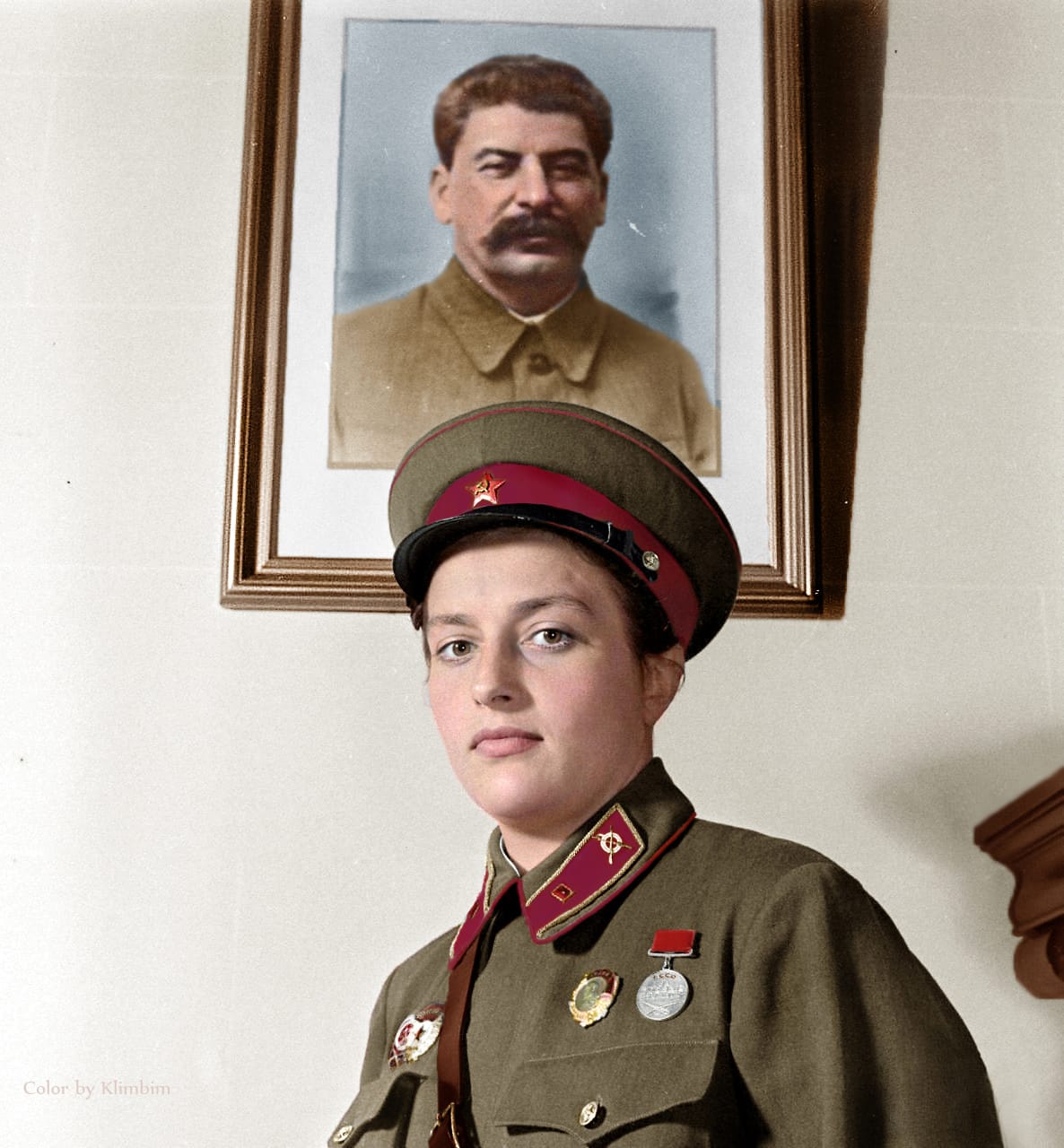
In 1942, Pavlichenko’s front-line career was halted after she was wounded. Instead of returning immediately to combat, Soviet authorities sent her abroad as part of a publicity mission. This phase of her life is often overshadowed by the battlefield narrative, but it is just as historically interesting.
Wikipedia notes that she went to the United States and Canada to help persuade the Western Allies to open a second front against Nazi Germany. She became the first Soviet citizen received by President Franklin D. Roosevelt, and Eleanor Roosevelt later accompanied her on a speaking tour. Smithsonian’s piece on the two women describes how the First Lady found Pavlichenko fascinating and helped translate her battlefield credibility into a wider American audience.
This was not an easy tour for Pavlichenko. American reporters often treated her with a mix of fascination and condescension. Smithsonian recounts how she faced questions not just about war, but about her clothes, appearance, and femininity. She famously answered with cutting confidence. One of her best-known lines came in Chicago, where she rebuked American men by saying she was 25 years old and had killed 309 fascist invaders, then asked how long they intended to hide behind her back. Whether remembered as speech, rebuke, or challenge, the point was unmistakable: she refused to let celebrity turn her into spectacle.
That moment helps explain why Pavlichenko still resonates today. She was not only lethal. She was articulate, proud, and unwilling to perform softness for foreign comfort. In a media environment that often wanted to turn her into a novelty — the “girl sniper” — she insisted on being treated as what she was: a soldier.
After the War
After the war, Pavlichenko returned to a quieter life, though “quiet” is always relative for someone who had become internationally famous during conflict. The National Park Service notes that she completed her education and later worked as a historian and research assistant for the Soviet Navy. She also remained involved in veterans’ affairs.
That final career turn feels strangely fitting. Before war interrupted her studies, she had been a history student. After surviving the battlefield and becoming part of global wartime memory, she returned to the world of research and historical work. In a sense, she moved from making history to studying it.
She died in 1974 and is buried at Novodevichy Cemetery in Moscow, a burial place associated with many distinguished Russians and Soviets. Her legend, however, never stayed buried. She remained part of Soviet memory, then post-Soviet and global military history, and eventually became newly visible to broader audiences through books, articles, and the 2015 film Battle for Sevastopol, which dramatized her life. (Why Her Story Still Matters
Lyudmila Pavlichenko’s life still matters for several reasons.
First, she is one of the clearest historical corrections to the lazy assumption that women in war were always peripheral. The Soviet Union used large numbers of women in combat and support roles, and Pavlichenko remains one of the strongest examples of just how decisive those roles could be.
Second, her story forces us to think about how propaganda and truth can coexist. The Soviet state undoubtedly used her as a symbol. But symbols are not always fabricated. Sometimes a real person is simply extraordinary enough that propaganda does not need to invent much. Pavlichenko was both authentic and useful, which is why she became so powerful as a wartime figure.
Third, she complicates the way we talk about heroism. It is easy to admire her courage, skill, and resolve. It is harder — and perhaps more honest — to sit with the deeper moral reality: her fame rests on being exceptionally good at killing. That tension does not reduce her achievement. It makes it more serious. Great soldiers are often easiest to praise when history cleans them into icons. Pavlichenko resists easy cleaning. She was brilliant at a terrible craft in a terrible war.
Lyudmila Pavlichenko was not just a Soviet sniper. She was one of the defining military figures of the Eastern Front: a history student turned battlefield specialist, a woman who refused to be sidelined, and the deadliest female sniper ever recorded with 309 confirmed kills. She fought at Odessa and Sevastopol, survived wounds that ended her front-line service, then crossed the Atlantic to challenge Allied hesitation in person. Along the way, she became “Lady Death,” a Soviet hero, and a symbol of women’s combat service that still carries force nearly a century later.
What remains most striking is not just the number attached to her name. It is the scale of the transformation. A young woman studying history in Kyiv became one of history’s most feared marksmen, then became a diplomatic voice, then returned to scholarship. Few wartime biographies carry that much tension between intellect, violence, politics, and legend. That is why Lyudmila Pavlichenko still matters. She was not merely part of the war’s machinery. She became one of its unforgettable faces.
FAQ
Who was Lyudmila Pavlichenko?
Lyudmila Pavlichenko was a Soviet Red Army sniper during World War II and is widely recognized as the most successful female sniper in history.
How many confirmed kills did she have?
She is credited with 309 confirmed kills, including 36 enemy snipers.
Why was she called “Lady Death”?
That nickname reflected her fearsome reputation as a sniper and her exceptional lethality on the battlefield.
Where did she fight?
She fought primarily during the siege of Odessa and the siege of Sevastopol on the Eastern Front.
Did Lyudmila Pavlichenko visit the United States?
Yes. In 1942, she traveled to the United States and Canada as part of a Soviet delegation urging the Allies to open a second front.
Was she the first Soviet citizen received by a U.S. president?
Yes. She was received at the White House by Franklin D. Roosevelt, making her the first Soviet citizen to receive that honor.
What was her profession before and after the war?
Before the war she was a history student at Kyiv University. After the war, she completed her education and worked as a historian and research assistant for the Soviet Navy.
Why is Lyudmila Pavlichenko historically important?
She is important not only for her sniper record, but also as a major example of women in combat, wartime propaganda, and Soviet-American wartime diplomacy.