The Nuclear Bomb Lost Off Georgia: The Tybee Bomb Mystery
Somewhere beneath the mud and water near Tybee Island, Georgia, one of America’s strangest Cold War secrets may still be resting in silence.
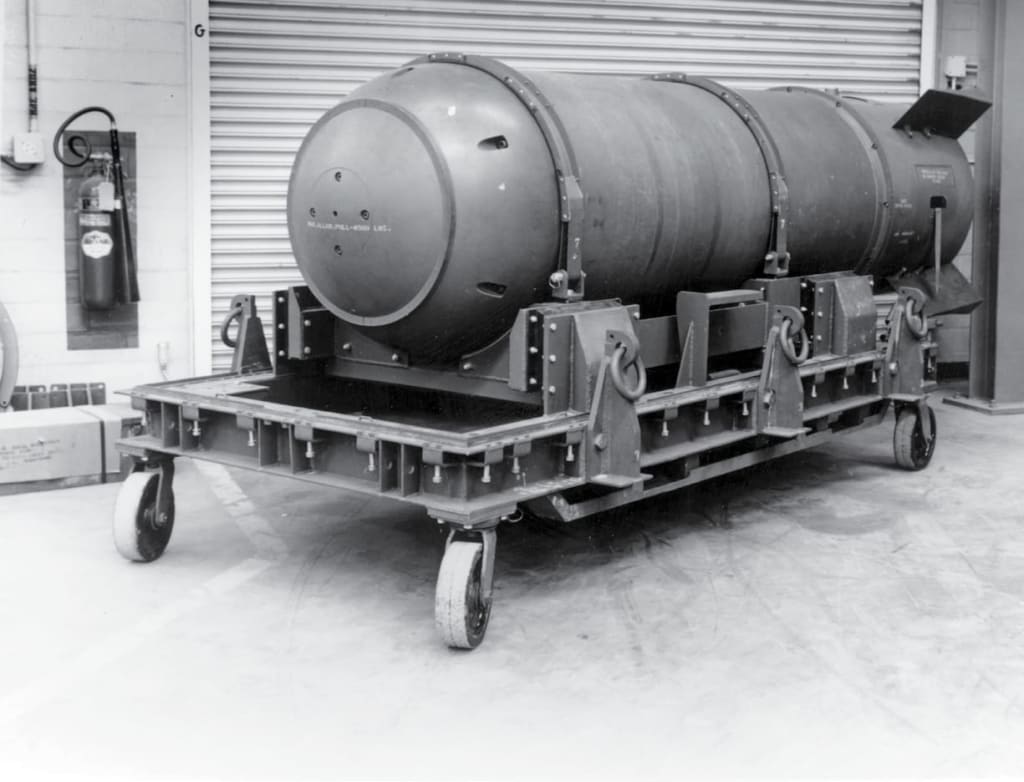
It is known as the Tybee bomb: a lost Mark 15 thermonuclear weapon jettisoned by a damaged U.S. Air Force B-47 Stratojet after a mid-air collision in 1958. The bomber survived. The crew survived. The fighter pilot survived. But the bomb disappeared into Wassaw Sound and was never recovered.
The story sounds like a thriller, but it is real.
On February 5, 1958, a B-47 bomber carrying a 7,600-pound Mark 15 nuclear bomb collided with an F-86 Sabre during a training mission. With the bomber damaged and the crew worried that landing with the bomb might cause a conventional explosion, the weapon was released into the waters near Tybee Island before the aircraft made a safe emergency landing at Hunter Air Force Base near Savannah.
The Air Force has long maintained that the bomb had no nuclear arming capsule, which means it could not have produced a nuclear detonation. But because the weapon was never found, and because later testimony appeared to contradict that claim, the Tybee bomb has become more than a lost military object. It has become a lingering symbol of Cold War secrecy, nuclear risk, and unanswered questions.
What Happened Over Tybee Island in 1958?
The accident happened during a simulated combat training mission at the height of the Cold War. A Boeing B-47 Stratojet, one of Strategic Air Command’s sleek jet bombers, was carrying a Mark 15 thermonuclear weapon. During the mission, a North American F-86 Sabre fighter accidentally collided with the bomber. The Center for Arms Control and Non-Proliferation identifies the F-86 pilot as Lt. Clarence Stewart and the B-47 pilot as Col. Howard Richardson, explaining that Stewart did not see the bomber on radar and descended into it.
The collision was severe. The F-86 was badly damaged, and Stewart ejected safely. The B-47 also suffered damage, including to its fuel tanks, but Richardson and his crew managed to keep the aircraft in the air. That survival was remarkable by itself. A loaded strategic bomber, damaged in mid-air, carrying a nuclear weapon, had to be brought under control before it could even attempt to land.
The crew faced a terrifying decision: try to land with the bomb still onboard, or release it.
Richardson feared that if the weapon broke loose during landing or if the aircraft crashed, the bomb’s conventional high explosives could detonate. The Air Force later stated that the pilot requested permission to jettison the weapon, received approval, and dropped it into Wassaw Sound near Tybee Island.
The bomber then landed safely.
The bomb did not explode.
And then it vanished.
What Was the Mark 15 Nuclear Bomb?
The Mark 15 was not a small weapon. It was a thermonuclear bomb from the early Cold War period, weighing roughly 7,600 pounds. The Center for Arms Control and Non-Proliferation describes the missing weapon as a Mark 15 hydrogen thermonuclear bomb with a yield of up to 3.8 megatons, about 190 times more powerful than the Fat Man bomb dropped on Nagasaki.
That “up to” matters.
Different Mark 15 variants had different yields, and some accounts identify the Tybee weapon as a lower-yield version. This is why public descriptions vary. When people say it was “roughly 250 times Hiroshima,” they are usually comparing the upper Mark 15 yield range to the roughly 15-kiloton Hiroshima bomb. It is a dramatic comparison, but it should be handled carefully because the exact configuration of the lost bomb remains part of the controversy.
Still, even the lower-yield Mark 15 variants were enormously powerful by human standards.
That is why the story feels so unsettling: this was not a lost crate of ammunition. It was a lost thermonuclear weapon from the most dangerous period of U.S.-Soviet nuclear competition.
Key Takeaway
The Tybee bomb was real, large, and militarily significant. But its actual nuclear danger depends on the unresolved question of whether it carried the nuclear capsule needed for a thermonuclear detonation.
The Nuclear Capsule Controversy
The most important question is simple:
Could the Tybee bomb explode as a nuclear weapon?
The Air Force’s official position has been reassuring. In a 2004 Air Force article, officials stated there had “never been a danger of a nuclear explosion” because the bomb had no arming capsule. The same Air Force report noted that the 400 pounds of conventional explosives inside the bomb were the pilot’s immediate concern before landing.
In other words, according to the Air Force, the bomb could not produce a nuclear detonation because a necessary component had been removed.
But the story does not end there.
The Center for Arms Control and Non-Proliferation notes that later-released 1966 congressional testimony complicated the narrative by suggesting that the weapon may have been a complete bomb with a plutonium pit. The same source also explains the opposing position: if the bomb contained a dummy core, it would be incapable of a nuclear blast but could still produce a conventional explosion.
That contradiction is why the Tybee bomb remains so famous.
If the Air Force is correct, the lost weapon is alarming but not a nuclear detonation threat. If the 1966 testimony is correct, the risk profile becomes more serious, even though accidental nuclear detonation would still not be simple. Nuclear weapons are not supposed to detonate merely because they are dropped, submerged, or damaged. They require precise arming and firing sequences.
But uncertainty is the fuel of every great Cold War mystery.
The Search for the Missing Tybee Bomb
The search began almost immediately.
According to the Center for Arms Control and Non-Proliferation, a team of about 100 Navy personnel used handheld sonar and cable sweeps in an effort to locate the bomb. The search continued for more than two months and ended on April 16, 1958, without success.
The Air Force later stated that Wassaw Sound is shallow and that the 7,500-pound weapon may have burrowed as much as 15 feet into the mud. After 10 weeks of searching, officials listed the bomb as irretrievable.
That detail is important because the bomb may not be sitting exposed on the seabed like a movie prop. It may be buried under layers of silt and sediment. If so, it could be extremely difficult to detect without disturbing the surrounding environment.
In 2001, a hydrographic survey suggested that the bomb was buried under five to 15 feet of silt. Later, in 2004, retired Air Force pilot Derek Duke reported unusual radiation readings offshore, prompting another interagency review. The Air Force, Navy, Defense Threat Reduction Agency, Department of Energy, and national laboratory experts took samples, but later reporting summarized by the Center for Arms Control and Non-Proliferation says the elevated radiation was attributed to naturally occurring minerals, not the bomb.
So the official practical answer became: leave it alone.
Is the Tybee Bomb Dangerous Today?
This is where the story becomes less cinematic but more important.
The Air Force position is that there is no nuclear detonation risk because the bomb lacked the necessary arming capsule. It also stated that if tests suggested the bomb was located, officials would consult local, state, and federal authorities before deciding what to do. The Air Force acknowledged that while there was no danger of nuclear detonation, the conventional explosives inside the weapon could be unstable.
That means the danger question has three layers.
First, there is the nuclear detonation question. Based on the Air Force’s account, that risk is effectively ruled out.
Second, there is the conventional explosives question. The bomb contained hundreds of pounds of high explosives. Even if no nuclear explosion were possible, disturbing an old weapon with degraded explosive material could be risky.
Third, there is the environmental question. If the weapon contains radioactive or toxic components, recovery might create more danger than leaving it buried. Even without a nuclear capsule, the weapon may contain materials that require careful handling.
That is why “why don’t they just recover it?” is not as simple as it sounds.
Recovering a buried Cold War thermonuclear bomb from coastal mud would require precise location, environmental planning, explosive ordnance expertise, radiation monitoring, and public communication. And if the official risk assessment says the bomb is safer left undisturbed, recovery may not be worth the danger.
Pro Tip
With lost military ordnance, “find it” and “safely recover it” are two very different problems. A buried weapon can sometimes become more dangerous when disturbed than when left alone.
The Tybee Bomb as a Broken Arrow
The Tybee incident belongs to a larger category of nuclear weapons accidents often called Broken Arrow incidents. Atomic Archive defines a Broken Arrow as an unexpected event involving nuclear weapons that results in accidental launching, firing, detonation, theft, or loss of a weapon, and notes that several U.S. nuclear weapons have been lost and never recovered.
The term sounds almost casual, but the reality behind it is terrifying.
The Cold War required constant readiness. Bombers flew training missions. Weapons were moved, loaded, inspected, and maintained. Aircraft crashed. Systems failed. Humans made mistakes. The United States built elaborate safety protocols, but the nuclear age introduced a scale of risk that had never existed before.
The Tybee bomb is remembered because it sits at the intersection of two facts:
America built systems powerful enough to destroy cities.
And those systems were operated by people, machines, and procedures that could fail.
Why the Story Still Fascinates America
The Tybee bomb remains fascinating because it is unfinished.
Most historical accidents have an ending. A wreck is found. A report is issued. A memorial is built. A cause is identified. The story settles.
But the Tybee bomb never settled.
It is still missing. It may still be buried somewhere in Wassaw Sound. The official line says it cannot detonate as a nuclear weapon. Yet the unresolved capsule dispute leaves just enough uncertainty to keep historians, locals, journalists, and nuclear policy experts returning to the case.
There is also a symbolic reason the story endures. The lost bomb is a physical reminder of Cold War anxiety. It represents a period when nuclear weapons were not distant abstractions locked in missile silos. They were carried in aircraft, flown over land and water, and sometimes lost in accidents.
For residents near Tybee Island, the story is not just history. It is local legend. Somewhere offshore, under mud and tide, the Cold War may still be sleeping.
What Really Happened?
The most reasonable summary is this:
A B-47 carrying a Mark 15 nuclear bomb collided with an F-86 during a training mission in 1958. The bomber was damaged but controllable. To reduce the danger of landing with the weapon onboard, the crew jettisoned the bomb into Wassaw Sound. Recovery teams searched for weeks but failed to find it. The Air Force concluded the weapon was irretrievable and has maintained that it had no nuclear arming capsule, meaning no nuclear detonation risk. Later testimony created public controversy over whether the bomb was complete, but no recovered weapon has ever settled the question.
So, is there a lost nuclear bomb off Georgia?
Yes.
Is it likely to explode as a nuclear weapon?
Based on the official Air Force account, no.
Is the story still disturbing?
Absolutely.
Because even when the most frightening version is unlikely, the core fact remains extraordinary: during the Cold War, the United States lost a thermonuclear bomb in shallow coastal waters—and never got it back.
Conclusion
The Tybee bomb is one of the strangest and most unsettling nuclear accidents in American history.
In 1958, a B-47 Stratojet and an F-86 Sabre collided during a training mission. The damaged bomber survived, but the crew faced a nightmare decision. Rather than attempt an emergency landing with a 7,600-pound Mark 15 nuclear bomb onboard, they released it into Wassaw Sound near Tybee Island, Georgia.
The bomb vanished into mud and water.
The Air Force says the weapon had no nuclear capsule, meaning it could not produce a nuclear detonation. That is the most important safety point. But the later controversy over whether the bomb was complete keeps the mystery alive.
More than six decades later, the Tybee bomb remains a Cold War ghost: not quite myth, not fully resolved, and not forgotten. It reminds us that nuclear history is not only about strategy, deterrence, and superpower politics. It is also about accidents, human judgment, imperfect machines, and the frightening reality that even the most powerful weapons ever built could still be lost.
Frequently Asked Questions
What is the Tybee bomb?
The Tybee bomb is the nickname for a Mark 15 thermonuclear bomb lost by the U.S. Air Force in 1958 after a B-47 Stratojet collided with an F-86 Sabre near Georgia’s coast. The bomb was jettisoned into Wassaw Sound near Tybee Island and was never recovered.
When was the nuclear bomb lost off Georgia?
The incident happened on February 5, 1958, during a training mission involving a B-47 bomber and an F-86 fighter jet.
Why did the crew drop the bomb?
The bomber had been damaged in a mid-air collision. The pilot feared that landing with the bomb onboard could cause the weapon’s conventional explosives to detonate, so he requested and received permission to jettison it into Wassaw Sound.
Was the Tybee bomb a real nuclear bomb?
Yes, it was a Mark 15 thermonuclear bomb. The unresolved debate is whether it had its nuclear capsule installed. The Air Force says the capsule had been removed; later-released congressional testimony complicated that claim.
Could the Tybee bomb explode today?
According to the Air Force, there is no danger of nuclear detonation because the bomb had no arming capsule. However, officials have acknowledged that the conventional explosives inside the bomb could be unstable if disturbed.
How powerful was the Mark 15 bomb?
The Mark 15 family had yields up to 3.8 megatons, which the Center for Arms Control and Non-Proliferation describes as about 190 times more powerful than the Nagasaki bomb. Some retellings compare the upper yield range to Hiroshima and describe it as roughly 250 times more powerful.
Was the bomb ever found?
No. Search teams looked for the bomb for more than two months after the accident, but it was not recovered. The Air Force later considered it irretrievable, possibly buried under mud and silt.
Where is the bomb believed to be?
It is believed to be somewhere in or near Wassaw Sound, off the coast of Tybee Island, Georgia. A 2001 survey suggested it may be buried under five to 15 feet of silt.
Why not recover the Tybee bomb now?
Recovery could be risky and expensive. If the weapon is buried in silt, disturbing it could create explosive, environmental, or public-safety risks. The official position has generally been that leaving it undisturbed is safer than trying to recover it.
What is a Broken Arrow?
A Broken Arrow is a military term for an accident involving a nuclear weapon, including loss, accidental launching, firing, or detonation. The Tybee bomb is commonly discussed as part of this broader history of nuclear weapons accidents.