Tattoo Art Trends: Minimalist Line Work
Tattoo culture has never been only about ink.
It is about identity, memory, rebellion, beauty, grief, belief, transformation, and the desire to carry something meaningful on the body. For some people, a tattoo is loud and impossible to miss. For others, it is quiet, private, almost secret. It can be a tribute, a reminder, a symbol, a date, a word, a flower, a line, a tiny shape, or a design that only makes sense to the person wearing it.
That is why minimalist line work tattoos have become one of the most enduring tattoo trends of the 2020s and continue to dominate style conversations in 2026.
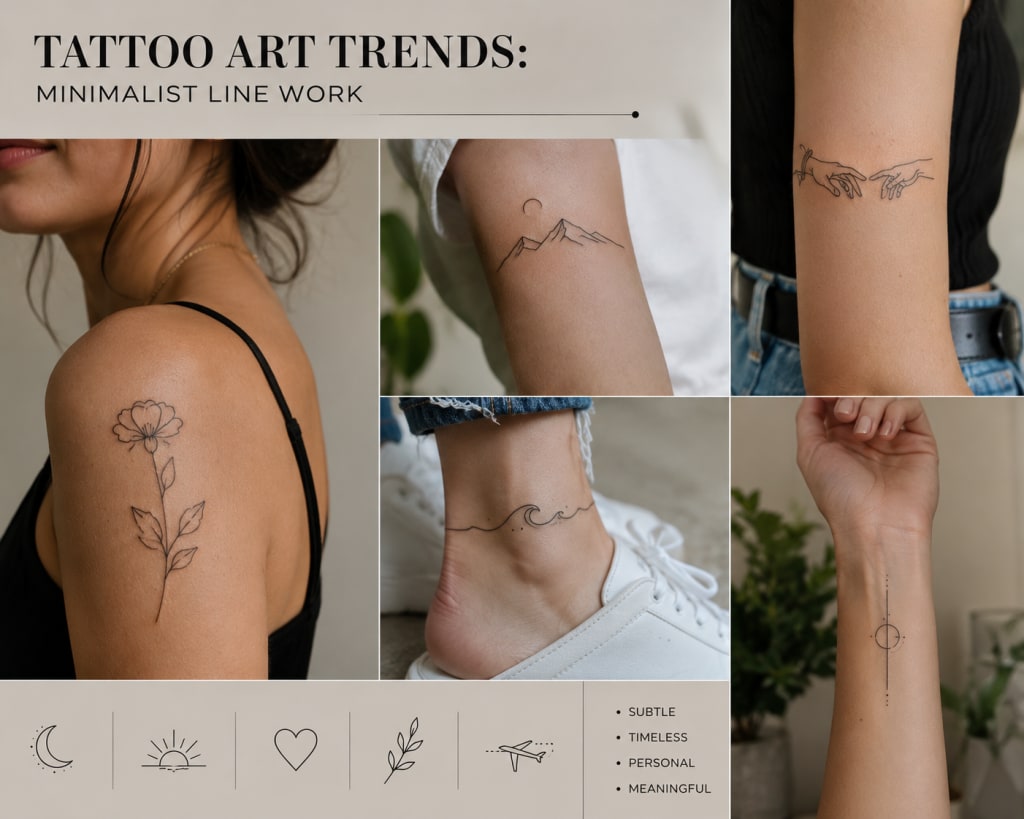
Unlike bold traditional tattoos packed with heavy outlines, saturated color, and dramatic shading, minimalist line work focuses on restraint. Thin lines. Clean shapes. Delicate outlines. Small symbols. Fine script. Subtle florals. Abstract silhouettes. Tiny celestial signs. Simple geometry. Designs that whisper instead of shout.
The style is often called fine line tattooing, and it uses thin needles—sometimes even single-needle techniques—to create soft, detailed designs with a lighter visual footprint than classic tattoo styles. Tattoo studios and style guides commonly describe fine line tattoos as delicate, intricate, and subtle, often relying on thin continuous lines rather than heavy shading or thick borders.
The appeal is easy to understand. Minimalist tattoos feel modern, elegant, and personal. They work for first-time tattoo clients who want something small. They fit people with professional lifestyles who prefer discreet body art. They suit those who want symbolism without visual heaviness. And they photograph beautifully for social media, especially when placed on wrists, fingers, ribs, collarbones, ankles, behind the ear, or along the arm.
But minimalist line work is not as simple as it looks.
A tiny tattoo can be technically demanding. A thin line can blur over time. A delicate script can age badly if placed too small. A design that looks perfect on Pinterest may need adjustment for real skin. That is why the trend is both beautiful and misunderstood.
Minimalist tattooing proves that less ink does not mean less skill.
Sometimes, the smallest tattoos demand the sharpest hand.
What Is Minimalist Line Work Tattooing?
Minimalist line work is a tattoo style built around simplicity, precision, and negative space.
Instead of using thick outlines and heavy shading, it relies on clean, fine lines to create a design. The result is often subtle and elegant. A minimalist tattoo may be as simple as one continuous line forming a face, a tiny star on a finger, a single flower stem on the arm, a handwritten word near the ribs, or a small geometric shape behind the ear.
Fine line tattooing can involve very thin needles and careful control. Some artists use single-needle techniques, while others use small needle groupings depending on the design, placement, and desired longevity. The goal is not always to make the thinnest possible line, but to create a line that looks delicate while still healing well.
That distinction is important.
A tattoo does not end when it is posted online. It has to heal. It has to settle into the skin. It has to survive years of sun exposure, friction, skin renewal, and natural aging. A beautiful minimalist tattoo is not only pretty on day one. It must be designed with the future in mind.
Good minimalist line work has:
Clean line consistency.
Enough spacing between details.
Balanced composition.
Correct sizing for the body part.
Placement that suits the skin.
A design that can age gracefully.
This is why choosing the right artist matters. Minimalist tattoos may look effortless, but effortlessness is often the result of serious technique.
Why Minimalist Tattoos Are So Popular in 2026
Minimalist tattoos fit the way many people express identity today.
Modern style is often about small personal details rather than one giant statement. People wear delicate jewelry, neutral wardrobes, clean makeup, capsule fashion, subtle piercings, and curated accessories. A minimalist tattoo fits into that aesthetic perfectly.
The trend also reflects how people now think about self-expression. Not everyone wants a full sleeve or a large back piece. Many want a tattoo that feels intimate: something they can show when they choose and hide when they want. A tiny flower on the ankle, a word near the heart, or a date on the wrist can feel powerful precisely because it is not trying to impress everyone.
Tattoo studios tracking 2026 trends often highlight micro tattoos, fine line florals, script, minimalist symbols, and subtle personal designs as major areas of demand. Fine line tattoo demand is frequently linked to clients wanting flexibility, subtlety, and personal symbolism in a way that fits modern professional and social life.
There is also a social-media reason. Minimalist tattoos photograph well. A clean little design on soft skin, paired with simple jewelry or a beautiful outfit, looks elegant in close-up images. Pinterest, Instagram, and TikTok have helped turn tiny tattoos into visual mood boards.
But the trend is not only aesthetic.
Minimalist tattoos are popular because they feel approachable. For someone nervous about pain, cost, permanence, or social judgment, a small line work tattoo feels like a gentle entry point into body art.
It says: I want a tattoo, but I want it on my terms.
The Rise of Fine Line Florals
One of the strongest minimalist tattoo trends is the fine line floral.
Flowers have always been part of tattoo culture, but minimalist line work has changed how they appear. Instead of bold roses with deep shading, many clients now choose single-stem wildflowers, tiny bouquets, botanical outlines, lavender sprigs, poppies, ferns, olive branches, daisies, cherry blossoms, lilies, birth flowers, or delicate vines wrapping around the arm or ankle.
Floral line work is popular because it balances beauty and meaning. Flowers can represent growth, grief, femininity, rebirth, family, softness, resilience, memory, or a specific person. A birth flower tattoo can honor a child, parent, partner, or month of personal significance. A tiny wildflower can feel romantic without being overly sentimental.
Many 2026 tattoo style guides point to botanical and micro-floral designs as key fine line trends, especially designs that feel organic, soft, and naturally placed along the body.
Fine line florals also age relatively gracefully when designed well. Because plants are naturally delicate, slight fading can still look beautiful. A flower does not need razor-sharp perfection forever to remain meaningful.
The best floral minimalist tattoos avoid overcrowding. Leaves, stems, petals, and tiny details need breathing room. If the design is too small and too detailed, it may blur into a gray patch over time.
Good floral tattoos know when to stop.
That is the art of minimalism.
Tiny Symbols With Big Meaning
Minimalist tattoos often use small symbols because symbols carry emotional weight without needing explanation.
Common designs include:
Hearts.
Stars.
Moons.
Suns.
Waves.
Mountains.
Arrows.
Crosses.
Angel numbers.
Initials.
Zodiac signs.
Tiny animals.
Butterflies.
Feathers.
Coordinates.
Semicolons.
Infinity signs.
Small abstract marks.
These designs may look simple, but they can hold deep personal meaning. A wave can represent survival, travel, calm, grief, or love of the ocean. A tiny moon can represent cycles and change. A star can represent hope. A semicolon can symbolize mental health survival. Coordinates can mark a birthplace, home, or meaningful location.
The power of minimalist tattoos lies in compression. A whole story becomes a small mark.
That is why tiny tattoos are not necessarily less meaningful than large ones. Sometimes they are more personal because they invite privacy. The wearer knows what it means. The world does not need the full explanation.
But tiny symbol tattoos require careful design. If a symbol is too small, it may lose shape over time. Finger tattoos, in particular, can fade quickly because hands are exposed to constant movement, washing, sunlight, and friction. Clients should understand that some placements need touch-ups or may never stay as crisp as they look online.
A tiny tattoo can be beautiful.
But skin is not paper.
Script and Handwriting Tattoos
Fine line script remains one of the most requested minimalist tattoo styles.
A word, phrase, name, date, lyric fragment, prayer, mantra, or handwritten message can feel incredibly intimate. People choose script tattoos to remember loved ones, honor children, mark recovery, express identity, or carry a private reminder.
Popular script ideas include:
One-word affirmations.
Names.
Dates.
Roman numerals.
Short quotes.
Handwritten notes from family.
Tiny initials.
Coordinates.
Religious phrases.
Personal mottos.
Soundwave-style line tattoos.
Fine line tattoo studios often describe names, texts, sound waves, and minimalist graphics as natural fits for this style because thin line work creates a soft, discreet effect.
But script tattoos are one of the easiest minimalist styles to get wrong.
Letters need enough size and spacing to remain readable. Very tiny cursive can blur together as the tattoo ages. Thin strokes may fade. Areas like fingers, sides of hands, feet, ribs, and inner arms may heal differently depending on skin, friction, and aftercare.
A good artist may recommend making the script slightly larger than the client originally imagined. That is not to ruin the aesthetic. It is to protect the tattoo’s future.
The best script tattoos feel effortless because the artist planned spacing, weight, and placement carefully.
A meaningful word deserves to stay readable.
One-Line Tattoos and Continuous Line Art
Continuous line tattoos are a beautiful branch of minimalist tattooing.
These designs use one flowing line to create a face, body, animal, flower, hand, couple, abstract figure, or symbolic object. The style is inspired by line drawing and modern illustration. It feels artistic, fluid, and elegant.
One-line tattoos are especially popular for:
Faces.
Female silhouettes.
Couples embracing.
Hands touching.
Cats and dogs.
Flowers.
Birds.
Abstract bodies.
Mother-child designs.
Minimal portraits.
The charm is in the movement. The line does not try to show everything. It suggests form with restraint. It allows the viewer’s eye to complete the image.
This style works well on arms, shoulders, upper backs, ribs, calves, and collarbone areas. It needs enough space for the line to move naturally. If compressed too much, the elegance can disappear.
Continuous line work also suits people who want artistic tattoos without heavy ink coverage. It feels modern, gallery-like, and personal.
It is tattooing as sketch.
A permanent drawing that still feels light.
Geometric Minimalism
Geometric minimalist tattoos are clean, balanced, and quietly powerful.
They use shapes such as circles, triangles, squares, lines, dots, grids, arrows, mandalas, or abstract patterns. Some designs are purely aesthetic. Others carry symbolic meaning: triangles for strength or change, circles for wholeness, lines for direction, sacred geometry for spiritual order, or minimalist constellations for cosmic identity.
Geometric tattoos require precision. A crooked line or uneven circle is immediately visible. This style may look simple, but technical execution is unforgiving.
Good geometric minimalist tattoos often use:
Symmetry.
Negative space.
Fine dotwork.
Clean spacing.
Balanced placement.
Subtle repetition.
They work well on forearms, sternum, upper back, wrists, ankles, and spine placements. Some people also combine geometric line work with florals, animals, or celestial designs for a softer effect.
Geometric minimalism appeals to people who like order, structure, and modern design. It feels less romantic than florals and less emotional than script, but it can be just as meaningful.
Sometimes a simple line is not simple at all.
It is balance made visible.
Cybersigilism and Sharp Fine Line Aesthetics
One related trend that has grown among Gen Z is cybersigilism.
This style uses sharp, spiky, futuristic line work that blends gothic, tribal, digital, and mystical influences. It often looks like a hybrid of cyberpunk symbols, occult markings, Y2K tribal revival, and abstract body ornamentation. While not always minimalist in the soft sense, it often relies heavily on fine line precision and negative space.
The New York Post described cybersigilism as a Gen Z update to earlier tribal tattoo trends, with sharp, intricate line work and futuristic or mystical themes gaining visibility through TikTok and celebrity adoption.
Cybersigilism is important because it shows how minimalist line work is evolving. Not all fine line tattoos are dainty flowers or tiny hearts. Some are darker, sharper, more aggressive, and more futuristic.
This style often appears on:
Lower backs.
Ribs.
Spines.
Hands.
Hips.
Shoulders.
Necks.
Arms.
It can be visually striking, but clients should be careful. Trend-heavy tattoos can age culturally as well as physically. What feels futuristic today may feel very 2026 later. That is not necessarily bad—tattoos are time capsules—but it is worth considering.
Minimalist does not always mean timeless.
Sometimes it means extremely now.
Best Placements for Minimalist Line Work
Placement is everything in minimalist tattooing.
A design can look beautiful on a digital mockup but fail on a body if the placement is wrong. Thin lines need skin that can hold detail, heal cleanly, and avoid excessive friction.
Popular placements include:
Wrist.
Inner arm.
Forearm.
Collarbone.
Ribs.
Ankle.
Behind the ear.
Upper arm.
Shoulder.
Spine.
Back of neck.
Hip.
Finger.
Sternum.
Side of hand.
Each placement has pros and cons.
Wrists are visible and elegant but exposed to sun. Ribs are private and beautiful but painful. Fingers look stylish but fade quickly. Ankles are subtle but experience friction from shoes. Behind-the-ear tattoos are discreet but small. Collarbone tattoos are elegant but highly visible depending on clothing.
Fine line tattoos often work best in areas with relatively stable skin and less constant friction. Hands, fingers, feet, and elbows are riskier for longevity.
A good artist will explain this honestly.
A trendy placement is not always a durable placement.
Do Fine Line Tattoos Hurt Less?
Many people assume minimalist tattoos hurt less because they are smaller and use thinner lines.
Sometimes that is true. A small line work tattoo may take less time than a large shaded piece, and less time often means less overall discomfort. Fine line tattooing may also feel less intense than heavy saturation or repeated shading.
But pain depends on placement, skin sensitivity, artist technique, and personal tolerance.
A tiny rib tattoo can hurt more than a larger forearm tattoo.
A fine line finger tattoo can feel sharp.
A sternum tattoo can be intense even if the design is delicate.
A small ankle tattoo may feel surprisingly painful near bone.
The good news is that many minimalist tattoos are quick. A tiny symbol may be finished in minutes. A detailed floral piece may take longer but still less time than heavily shaded work.
Clients should not choose fine line only because they think it will be painless. Tattoos involve needles. There will be discomfort.
But for many first-timers, minimalist work feels manageable.
The Longevity Question
The biggest concern with minimalist line work is longevity.
Fine lines can fade, spread, blur, or soften over time. This happens because tattoo ink sits in skin, and skin changes. Sun exposure, aging, immune response, friction, placement, aftercare, and artist technique all affect how a tattoo heals and ages.
This does not mean fine line tattoos are bad. It means they must be designed intelligently.
A tattoo that is too tiny, too detailed, and too lightly applied may look perfect in a fresh photo but lose clarity later. Social media often shows fresh tattoos, not healed tattoos after five years. That can create unrealistic expectations.
Good fine line artists understand line weight, spacing, and skin behavior. They may advise making a design bigger, simplifying detail, or using slightly stronger lines than the client expected. This is not a lack of skill. It is responsible tattooing.
Clients should ask artists to show healed work, not only fresh work.
A fine line tattoo’s real quality is revealed after healing.
Not five minutes after wiping.
Aftercare for Minimalist Tattoos
Aftercare matters for every tattoo, but it is especially important for fine line work because small details can be affected by poor healing.
Basic aftercare usually includes:
Keeping the tattoo clean.
Following the artist’s covering instructions.
Avoiding soaking.
Avoiding swimming.
Avoiding direct sun.
Not picking scabs.
Using recommended moisturizer.
Avoiding tight clothing over the area.
Avoiding heavy friction.
Letting the tattoo heal fully before intense exposure.
The artist’s instructions should always come first because aftercare can vary depending on bandage type, climate, skin, and tattoo style.
Sun protection is especially important long-term. UV exposure fades tattoos. Fine line tattoos already have less ink density than bold traditional tattoos, so they can be more vulnerable to fading.
A minimalist tattoo may be small, but it still deserves care.
Think of aftercare as part of the artwork.
Why Artist Choice Matters So Much
Minimalist tattoos expose mistakes.
A shaky line has nowhere to hide. A bad curve is obvious. Uneven script looks messy. A tiny flower with poor spacing may blur. A geometric design with imperfect symmetry can look amateur.
This is why artist selection is critical.
Clients should look for an artist who specializes in fine line or minimalist work. A brilliant traditional tattoo artist may not automatically be the best fine line artist. Different styles require different techniques.
Before booking, check:
Healed work.
Line consistency.
Experience with your desired placement.
Reviews.
Studio hygiene.
Whether the artist explains aging honestly.
Whether they are willing to modify designs for longevity.
Whether their style matches your idea.
Do not choose based only on price. Cheap fine line work can become expensive later if it needs correction, cover-up, or laser removal.
Minimalist tattoos may be small.
But they are permanent.
Choose the artist carefully.
Minimalist Tattoos and Professional Life
One reason minimalist line work has grown is that it fits modern professional life.
Many people want tattoos but still work in industries where visible body art may be judged. Minimalist tattoos offer a middle path. They can be placed discreetly, hidden under clothing, or designed to look elegant rather than provocative.
This is especially appealing to people in corporate, healthcare, education, legal, hospitality, and client-facing roles. A tiny wrist tattoo, rib script, ankle symbol, or behind-the-ear design can feel personal without creating professional anxiety.
Of course, workplace attitudes toward tattoos have changed significantly. Many industries are more accepting now than in past decades. But visible tattoos can still carry stigma in some settings.
Minimalist line work gives wearers control.
They can choose when the tattoo is public and when it remains private.
That flexibility is part of the trend’s power.
Matching Minimalist Tattoos
Matching tattoos are also evolving.
Instead of large matching designs, people now choose tiny shared symbols: a small star, line, date, flower, initial, wave, heart, or abstract mark. Couples, siblings, best friends, parents and children, travel partners, or chosen family members may use minimalist tattoos to represent connection.
The appeal is subtlety. A matching tattoo does not need to announce the relationship loudly. It can be meaningful because it is small and shared.
Popular matching ideas include:
Tiny moons.
Coordinates.
Initials.
Half-and-half symbols.
Birth flowers.
Shared dates.
Minimal animals.
Matching dots.
Micro hearts.
Small waves.
One-word phrases split between two people.
As always, caution is wise. Relationship tattoos can become complicated if relationships change. Minimalist matching tattoos are easier to live with than large names, but they are still permanent.
The best matching tattoos are meaningful even if the relationship evolves.
A symbol is safer than a name.
Minimalist Tattoos as Memory Objects
Many people choose fine line tattoos as memorials.
A small handwritten word from a loved one.
A birth date.
A death date.
A tiny flower linked to a person.
A pet outline.
A paw print.
A sound wave.
A constellation from a meaningful night.
A simple symbol only the wearer understands.
Minimalism works beautifully for grief because grief is often private. Not everyone wants a large memorial tattoo. Some want something quiet that they can touch when they need to remember.
A delicate line can hold enormous emotion.
This is one of the reasons minimalist tattooing should not be dismissed as shallow or trendy. Many of these tattoos carry deeply personal stories. The fact that they are small does not make them less powerful.
Sometimes grief needs a whisper.
Not a monument.
Minimalist Tattoos and Gender
Minimalist line work is often marketed heavily toward women, especially with florals, delicate script, and tiny symbols. But the style is not gender-specific.
Men also choose minimalist tattoos: geometric lines, small symbols, coordinates, fine script, abstract shapes, meaningful dates, animal outlines, mountain lines, waves, and spiritual marks. Non-binary and gender-fluid clients often use minimalist tattoos for identity expression because the style can avoid heavily gendered tattoo clichés.
The rise of minimalist tattooing reflects a broader shift away from rigid tattoo categories. A tattoo does not need to be “masculine” or “feminine” to be meaningful. It can be personal, elegant, sharp, soft, strange, symbolic, or purely aesthetic.
The best minimalist tattoos belong to the person wearing them, not to a gender rule.
Ink is identity.
Not a stereotype.
The Influence of Celebrity and Pop Culture
Celebrity tattoos have helped normalize minimalist line work.
Many celebrities choose tiny tattoos, delicate script, fine line symbols, finger tattoos, and small hidden designs. These tattoos often become inspiration for fans because they feel stylish and achievable.
A celebrity’s tiny tattoo may not be technically complex, but it can create massive trend momentum. Once a star appears with a micro heart, neck script, delicate floral, or fine line symbol, similar requests may flood studios.
Social media then amplifies the effect. A tattoo does not need a magazine spread anymore. One close-up image can become a global reference overnight.
But clients should be careful with celebrity-inspired tattoos. What looks good on one person may not fit another body, lifestyle, or skin type. A good tattoo should be adapted, not copied.
Inspiration is useful.
Imitation can feel empty.
Minimalist Tattoo Regret: Why It Happens
Minimalist tattoos are often seen as low-risk, but regret still happens.
Common reasons include:
Choosing a design too quickly.
Following a trend without personal meaning.
Getting a tattoo too small to age well.
Poor artist selection.
Bad placement.
Relationship changes.
Misspelled script.
Unclear symbols.
Fading on fingers or hands.
Expecting the tattoo to stay razor-sharp forever.
The good news is that minimalist tattoos are often easier to cover or remove than large, heavily saturated pieces. But that does not mean clients should treat them casually.
Small does not mean temporary.
Before getting a minimalist tattoo, sit with the idea. Print it. Place it on your body. Imagine it in five years. Ask whether it still feels like you without the social-media aesthetic around it.
A tattoo should survive the trend that inspired it.
How to Make Minimalist Tattoos More Timeless
To make a minimalist tattoo age better culturally and physically, keep a few principles in mind.
Choose personal meaning over trend pressure.
Avoid overcrowded detail.
Use enough size for the design.
Pick a stable placement.
Work with a skilled fine line artist.
Ask to see healed photos.
Think about future body changes.
Protect it from sun.
Avoid copying viral designs exactly.
Do not rush the appointment.
The most timeless minimalist tattoos often feel simple but not generic. They are personal enough to matter and clean enough to age with the wearer.
A tiny tattoo can be timeless if it is chosen with care.
Minimalism is not about having less meaning.
It is about removing everything unnecessary.
Why Minimalist Line Work Will Last
Some tattoo trends burn out quickly. Minimalist line work has more staying power because it is not only a single design trend. It is a whole visual language.
There will always be people who want subtle tattoos. There will always be people who prefer clean lines. There will always be demand for script, florals, symbols, and small meaningful designs. The exact motifs may change, but the desire for understated body art will remain.
In 2026, the trend continues because it matches larger cultural values: personalization, elegance, discretion, flexibility, and emotional symbolism.
Minimalist tattoos are not replacing bold tattoo traditions. Traditional, Japanese, blackwork, realism, neo-traditional, ornamental, tribal revival, and color tattoos all remain powerful. Minimalism is simply one branch of the larger tattoo tree.
Its strength is quietness.
And quiet things can last.
Final Verdict
Minimalist line work tattoos remain one of the defining tattoo art trends of 2026 because they combine elegance, personal meaning, and modern subtlety. Fine line florals, tiny symbols, script tattoos, continuous line art, geometric designs, and micro tattoos all appeal to people who want body art that feels intimate rather than overwhelming.
The style’s popularity is tied to its flexibility. It works for first-time clients, professionals, collectors, minimalists, romantics, and people who want tattoos that are easy to hide or reveal. Tattoo trend guides continue to highlight micro tattoos, fine line florals, script, and minimalist symbols as major directions for 2026.
But minimalist tattoos require more care than many people realize. Thin lines can fade or blur, tiny details may not age well, and placement matters. The best results come from skilled artists who understand healed line work, proper sizing, and long-term skin behavior.
Minimalist tattooing proves that body art does not need to be large to be powerful.
A single line can hold a memory.
A tiny flower can carry grief.
A small symbol can mark a turning point.
And sometimes, the quietest tattoo says the most.