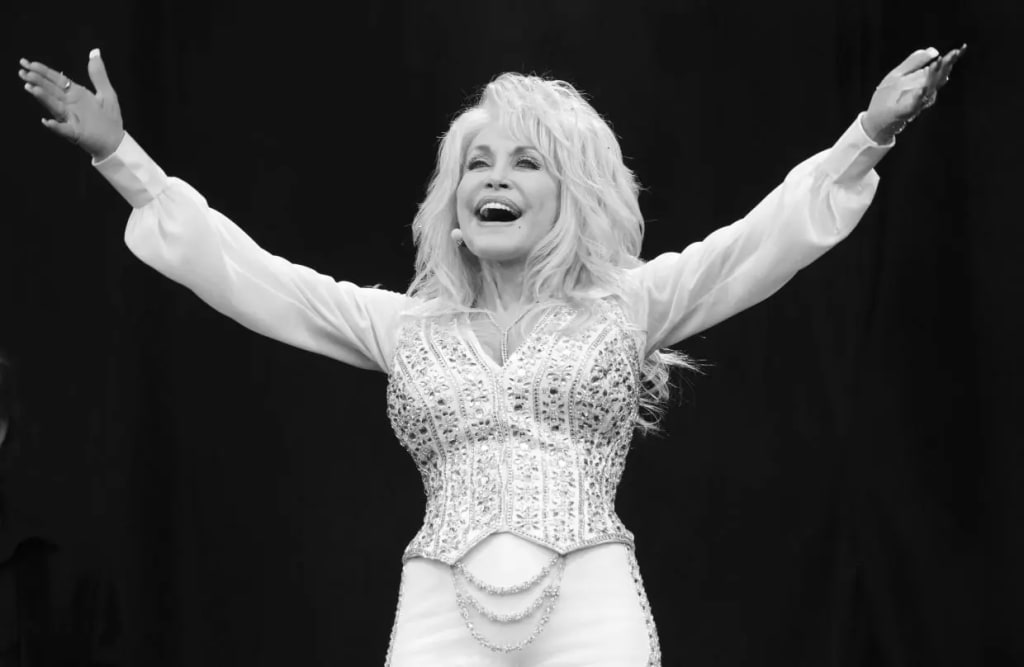
Dolly Parton: A Tribute to the Woman Behind the Rhinestones
Dolly Parton spent a lifetime making herself impossible to overlook.
There was the enormous blonde hair, the rhinestones, the unmistakable Tennessee voice, the quick jokes and the theatrical clothes she wore with complete confidence. But behind all that sparkle was one of America's most accomplished songwriters, a fiercely independent businesswoman and a philanthropist whose most enduring work may ultimately be measured not in records sold, but in children who learned to love books.
Dolly Rebecca Parton died on August 25, 2026, at age 80 after a brief battle with cancer. Her death brought tributes from musicians, actors, institutions, communities in Tennessee and millions of listeners who felt as though they had lost someone they personally knew.
That reaction says something unusual about her place in popular culture.
Dolly Parton was enormously famous.
Yet fame never seemed to be the most important thing about her.
She could write a devastating song about poverty, turn around and make a joke about her appearance, negotiate ownership of her work, star in a Hollywood comedy, build one of Tennessee's largest tourist attractions and then quietly use her money to send books to children she would never meet.
Her story was filled with contradictions that somehow fit perfectly together.
She looked artificial and sounded deeply authentic.
She was sentimental without being naïve.
She came from poverty but understood business extraordinarily well.
She became a symbol of country music while crossing into pop, movies, Broadway, bluegrass and rock.
She was capable of making herself the center of a room and equally capable of making other people feel important.
That may explain why the tributes following her death have felt less like the passing of a celebrity and more like the loss of a cultural institution.
Dolly Parton Died on August 25, 2026
Parton's death was announced by her family on August 25.
Her nephew Bryan Seaver shared the news publicly, while representatives confirmed that she had died in Nashville following a brief battle with cancer.
She was 80 years old.
A short final message attributed to Parton was also shared through her official channels:
“I will always love you.”
The words could hardly have been more appropriate.
They were already inseparable from her career.
But after her death, they became something else: a farewell.
Tennessee Immediately Began Mourning Its Most Famous Daughter
Parton's connection to Tennessee was much deeper than birthplace.
She grew up in the Smoky Mountains.
She built businesses there.
She invested there.
She established charitable programs there.
She returned to its imagery throughout her songwriting.
And she spent decades transforming the way outsiders viewed the Appalachian region that had shaped her.
Dollywood issued a statement on the day of her death describing Parton as its beloved "Dreamer-in-Chief" and saying that her wish had always been for the park to remain a place of joy rather than mourning.
The park stayed open, in keeping with what its leadership described as Dolly's belief that "the show must go on."
That response felt entirely consistent with the woman herself.
Dolly Parton was rarely interested in solemn self-importance.
Even grief, in her world, could coexist with laughter.
The Grand Ole Opry Had Known Her Since She Was 13
Dolly's relationship with the Grand Ole Opry reached back almost to childhood.
She first appeared there in 1959.
She was only 13.
Johnny Cash introduced the young singer from East Tennessee, and she performed George Jones' "You Gotta Be My Baby."
The audience demanded three encores.
It was a remarkably appropriate beginning.
Long before the rhinestones became famous, before "Jolene," before Hollywood, before Dollywood, before the Imagination Library, there was a girl from the mountains standing on the Opry stage trying to make people listen.
They did.
And for the next six decades, they kept listening.
After her death, the Opry dedicated its August 29, 2026 show to her, with part of ticket proceeds benefiting the Imagination Library.
She Came From a Childhood She Never Tried to Erase
Dolly Rebecca Parton was born on January 19, 1946, in Locust Ridge, Tennessee.
She was the fourth of 12 children.
Her family had very little money.
Their Appalachian upbringing later became central to the mythology surrounding Parton, but she did not generally romanticize poverty itself.
She remembered affection.
She remembered music.
She remembered family.
She also remembered embarrassment, scarcity and the determination to create a different future for herself.
The Country Music Hall of Fame notes that those experiences became material for some of Parton's most emotionally precise songs.
That distinction helped make her songwriting believable.
She did not write about rural poverty as an outsider observing picturesque mountain life.
She had lived it.
“Coat of Many Colors” Turned Humiliation Into Art
Few songs explain Dolly Parton better than "Coat of Many Colors."
The song tells the story of a coat her mother made from scraps of fabric because the family could not afford something new.
Young Dolly proudly wore it to school.
Other children laughed at her.
What might have remained a painful childhood memory became one of the most beloved songs in country music.
That transformation was one of Parton's greatest gifts.
She could take something intimate and specific and make strangers recognize themselves inside it.
The Country Music Hall of Fame describes "Coat of Many Colors" as a direct reflection of her childhood and the ridicule she endured because of her family's poverty.
Parton never needed to pretend that hardship was beautiful.
She found beauty in the people who loved her through it.
She Wanted Out of the Mountains—But Never Abandoned Them
Dolly loved East Tennessee.
She also wanted to leave.
Those two facts were never contradictory in her music.
The Smoky Mountains represented home, family and cultural identity.
They also represented the limits she was determined to exceed.
After graduating from high school in 1964, Parton moved to Nashville.
She was 18.
She wanted to write songs professionally.
The Country Music Hall of Fame records that she arrived immediately after graduation and began pursuing the career she had envisioned since childhood.
She became one of the great examples of ambition without disowning origin.
Success did not require her to become less Appalachian.
Instead, she took Appalachia with her.
Nashville First Recognized Her as a Songwriter
Long before Dolly Parton became an international celebrity, Nashville understood that she could write.
That mattered deeply to her.
Parton consistently described songwriting as central to her identity.
The glamorous public persona could sometimes make people underestimate the precision of the writer behind it.
But songs such as:
- "Jolene"
- "Coat of Many Colors"
- "I Will Always Love You"
- "The Bargain Store"
- "My Tennessee Mountain Home"
- "Light of a Clear Blue Morning"
- "9 to 5"
show a songwriter capable of compressing complete emotional narratives into a few minutes.
Her songs rarely needed complicated language.
They needed the right words.
Porter Wagoner Changed Her Career
In 1967, Parton joined The Porter Wagoner Show.
It became the breakthrough that introduced her to a much larger country audience.
Wagoner and Parton recorded duets, toured and became one of country music's recognizable partnerships.
But Dolly's solo ambitions continued growing.
Eventually, she wanted to leave.
The separation was professionally difficult and emotionally complicated.
Her response was not an angry press conference.
She wrote a song.
“I Will Always Love You” Was Not Originally a Romantic Breakup Song
This is one of the most fascinating facts in Dolly Parton's career.
"I Will Always Love You" has become one of the world's most famous declarations of romantic love.
Parton originally wrote it as a farewell to Porter Wagoner when she decided to leave their professional partnership.
The Country Music Hall of Fame describes the 1974 song as her personal farewell to him.
The genius of the song lies in its emotional maturity.
It does not say:
You hurt me, so I hate you.
It says:
I have to leave, and loving you does not change that.
That combination of affection and independence became one of Parton's recurring strengths.
She could be kind without surrendering control over her own life.
Elvis Presley Wanted “I Will Always Love You”—But Dolly Said No
One of the most famous stories in Parton's career concerned Elvis Presley.
According to Parton's repeated telling, Presley wanted to record "I Will Always Love You."
But his management typically expected a share of publishing rights.
Parton refused.
It was reportedly an agonizing decision because having Elvis record her song would have been enormous.
But she kept ownership.
Years later, Whitney Houston recorded "I Will Always Love You" for The Bodyguard.
Houston's version became a global phenomenon.
Parton's decision to protect her publishing became legendary not only because of the money involved, but because it illustrated her business instincts.
The elaborate hair and jokes sometimes encouraged people to underestimate her.
That was usually their mistake.
“Jolene” Became a Song Bigger Than Country Music
"Jolene" is almost impossibly simple.
A woman addresses another woman whom she fears could take the person she loves.
There is no elaborate production necessary for the story to work.
The narrator does not attack Jolene.
She describes her beauty.
She admits her fear.
She asks for mercy.
That vulnerability makes the song more interesting than ordinary jealousy.
"Jolene" became one of Parton's signature compositions and one of the songs most frequently associated with her internationally.
The Rock & Roll Hall of Fame identifies it among the recordings that demonstrate her ability to create songs with vivid narrative detail and timeless melody.
Its influence stretched across genres and generations.
She Understood That Image Could Be Armor
Dolly Parton's appearance became almost as famous as her music.
She openly embraced exaggerated femininity:
- enormous blonde wigs;
- long nails;
- bright makeup;
- rhinestones;
- fitted costumes;
- high heels.
She was also in on the joke.
Parton frequently made fun of herself before anyone else had the opportunity.
That self-awareness made criticism difficult.
You could not expose Dolly Parton as artificial when she had already announced the artificiality herself.
The paradox was that the obviously constructed appearance allowed her personality to feel more authentic.
She controlled the image.
The image did not control her.
People Underestimated Her at Their Own Risk
Parton understood that some people looked at her clothes and assumed she was unintelligent.
She often seemed amused by that mistake.
Behind the public persona was an artist who made calculated decisions about:
- publishing;
- recording;
- licensing;
- television;
- film;
- tourism;
- intellectual property;
- philanthropy.
Her business interests eventually grew into a substantial commercial empire while allowing her to retain unusually strong control over her artistic identity.
The Rock & Roll Hall of Fame describes Parton as a formidable businesswoman who established high standards for artistic control.
She did not succeed despite the Dolly Parton persona.
She designed it.
She Crossed From Country Into Pop Without Becoming Someone Else
By the late 1970s, Parton deliberately pursued a wider audience.
Here You Come Again became a major crossover success.
She appeared on mainstream television.
She reached listeners who did not consider themselves country fans.
Some traditional country listeners objected.
But Parton continued moving.
That pattern repeated throughout her career.
When the industry wanted her to fit one category, she usually found another.
Country.
Pop.
Bluegrass.
Gospel.
Film.
Television.
Broadway.
Rock.
Her willingness to cross boundaries eventually became part of her identity.
The Rock & Roll Hall of Fame cited precisely that genre-crossing ability when describing her cultural impact.
Then Came 9 to 5
Parton's film career became another improbable success.
She starred alongside Jane Fonda and Lily Tomlin in the 1980 workplace comedy 9 to 5.
The movie tackled sexism, workplace inequality and abusive management through broad comedy.
Parton also wrote and performed its title song.
"9 to 5" became one of her defining hits.
The song transformed the frustrations of ordinary office workers into an irresistible pop-country anthem.
It was funny.
It was catchy.
And underneath the humor was anger.
The song remains an example of Parton's ability to communicate a social message without turning the song itself into a lecture.
Dolly Parton Made Kindness Look More Radical Than Anger
One of the reasons she became beloved across unusually broad audiences was that Parton rarely seemed interested in humiliating people.
She could disagree.
She could defend herself.
She could set boundaries.
But she did not build her public identity around cruelty.
That sometimes caused people to mistake kindness for softness.
Her career tells a different story.
She left professional relationships when she needed independence.
She protected her publishing.
She entered industries dominated by men.
She built businesses under her own name.
She resisted attempts to define her.
Her style of strength was simply less interested in making enemies than many public figures are.
Her Marriage to Carl Dean Was Almost the Opposite of Her Career
Dolly Parton lived publicly.
Carl Dean largely did not.
They met in Nashville in 1964, shortly after Dolly arrived.
They married in 1966.
Their marriage lasted nearly six decades until Dean's death in March 2025.
Dean became famous partly for avoiding fame.
While his wife performed around the world, he remained largely outside public view.
Parton often joked that spending time apart helped their marriage.
But she also spoke consistently about the depth of their bond.
After Dean died, she wrote one more song for him.
“If You Hadn’t Been There” Was Dolly’s Final Great Love Letter to Carl
In March 2025, after Carl Dean's death, Parton released "If You Hadn't Been There."
The song thanked him for the life they shared and the support he gave her throughout her career.
Parton wrote that she had fallen in love with Carl when she was 18 and that their great love story would continue through memory and song.
The tribute feels especially poignant now.
For decades, the public knew Dolly.
Carl knew the private person underneath the public construction.
After his death, she used the form she understood best to speak to him.
A song.
Dolly Did Not Have Children—So She Sent Books to Millions of Them
Perhaps no project better illustrates Parton's philanthropy than the Imagination Library.
She launched the program in 1995.
The idea was beautifully simple.
Children enrolled in participating communities receive free, age-appropriate books mailed directly to their homes from birth until age five.
Parton created the program partly in honor of her father, Robert Lee Parton, who could not read or write.
What began in her home county in Tennessee expanded across the United States and eventually internationally.
By the end of 2025, the program had gifted more than 304 million books since its creation.
By 2026, the Imagination Library described itself as operating across the United States, Canada, the United Kingdom, Australia and the Republic of Ireland, with the overall total continuing past 300 million books.
That is not celebrity charity in the superficial sense.
It is infrastructure.
Why the Imagination Library May Be Her Greatest Legacy
Songs can live for generations.
So can literacy.
Every book delivered by the Imagination Library enters a home.
A parent may read it to a child.
A child may learn new words.
A bedtime routine may form.
A family that cannot afford a large home library may begin building one.
The effect multiplies across millions of households.
Parton managed to attach her celebrity not simply to fundraising but to a repeatable system that continues operating.
After her death, her family and organizations associated with her encouraged people who wanted to honor her to support the Imagination Library.
That request makes sense.
Flowers eventually disappear.
Books keep being opened.
She Also Put Money Into Medical Research
Parton's philanthropy extended beyond literacy.
In 2020, during the COVID-19 pandemic, she donated $1 million to Vanderbilt University Medical Center's coronavirus research efforts.
Vanderbilt later explained that her contribution helped support research connected to the Moderna vaccine development effort.
Parton herself did not claim to have invented a vaccine.
She simply provided money to researchers because she believed helping was worthwhile.
That understated approach was typical of her philanthropy.
She often made giving look uncomplicated.
See a problem.
Help if you can.
She Helped Her Home Region After Disaster
Parton also responded when wildfires devastated communities around the Great Smoky Mountains in 2016.
Through her foundation and related efforts, she supported families whose homes had been destroyed.
Her connection to East Tennessee was not ceremonial.
She repeatedly used her wealth and organizations to support the region economically and socially.
The AP's retrospective on her impact in Sevier County notes that her projects helped shape tourism, employment, education and disaster relief throughout the region.
Dollywood Changed East Tennessee
When Dollywood opened under that name in 1986, it could easily have become a giant monument to celebrity vanity.
Instead, the park developed into a major regional employer and tourism engine.
It celebrated Appalachian crafts, food, music and mountain culture while still functioning as a major amusement destination.
The AP reported after Parton's death that Dollywood had become Tennessee's top tourist attraction and a major economic force in Sevier County.
Parton understood something many celebrity entrepreneurs miss.
The best way to make a business about yourself is sometimes to make it useful to everyone else.
She Changed the Way Appalachia Could Be Seen
American popular culture has often reduced Appalachia to stereotypes.
Poor.
Backward.
Uneducated.
Isolated.
Dolly Parton never denied the poverty of her childhood.
But she refused to accept the idea that poverty meant a lack of intelligence, creativity, dignity or ambition.
She took Appalachian speech, music, family stories and imagery into global popular culture without apologizing for them.
She could stand on an international stage covered in rhinestones and still sound unmistakably like East Tennessee.
That was cultural confidence.
She Became One of Country Music’s Most Important Women
Country music history contains many extraordinary women.
Parton's career emerged alongside figures such as Loretta Lynn and Tammy Wynette, who were redefining the subjects female country singers could address.
Parton wrote about:
- sexuality;
- poverty;
- motherhood;
- ambition;
- jealousy;
- independence;
- divorce;
- working women;
- social judgment.
The Country Music Hall of Fame argues that women including Parton, Lynn and Wynette revolutionized country music during the 1960s and 1970s through songs that expressed strong female perspectives.
Dolly's difference was that she then carried that independence into multiple other industries.
Awards Eventually Became Almost Too Numerous to Define Her
Parton accumulated extraordinary institutional recognition.
She entered the Country Music Hall of Fame in 1999.
She entered the Songwriters Hall of Fame in 2001.
She received the National Medal of Arts in 2005.
She became a Kennedy Center Honoree in 2006.
She received the Recording Academy's Lifetime Achievement Award in 2011.
And in 2022, she was inducted into the Rock & Roll Hall of Fame.
The awards mattered.
But they increasingly seemed like institutions catching up with something audiences already understood.
Dolly Parton had become larger than any one musical category.
She Initially Tried to Decline the Rock & Roll Hall of Fame
Even her 2022 Rock Hall induction became characteristically Dolly.
When nominated, Parton initially expressed discomfort because she did not consider herself a rock artist.
She eventually accepted the honor after learning more about the Hall's broader definition.
Then she responded in the most Dolly Parton way possible:
She made a rock album.
Her eventual induction placed her alongside artists from genres far removed from traditional country, reinforcing how broadly her influence had spread.
Her Humor Was Part of Her Intelligence
Parton possessed an exceptional ability to disarm people with humor.
She joked about:
- her hair;
- her body;
- cosmetic surgery;
- money;
- marriage;
- fame;
- clothing.
The humor was often self-directed.
But it was rarely self-degrading.
There is a difference.
She was controlling the joke.
By laughing first, she prevented others from deciding what should embarrass her.
That gave her unusual freedom.
She could discuss serious issues without becoming solemn.
She could be glamorous without pretending the glamour was natural.
She could admit insecurity without surrendering confidence.
Dolly Made Authenticity Look Different
Authenticity in celebrity culture is often associated with stripping away performance.
No makeup.
No costume.
No public persona.
Dolly Parton challenged that definition.
She was obviously performing Dolly Parton.
She also seemed deeply authentic.
The wigs were real because she genuinely liked wigs.
The rhinestones were real because she genuinely enjoyed rhinestones.
The accent was hers.
The humor was hers.
The stories were hers.
The contradictions were hers.
Authenticity did not require looking natural.
It required being honest about what she loved.
Her Songs Could Be More Radical Than Her Public Persona
Dolly's friendly image sometimes hid how sharp her songwriting could be.
"9 to 5" criticizes workplace exploitation.
"Just Because I'm a Woman" confronts sexual double standards.
"Down from Dover" tells a devastating story about pregnancy, abandonment and social judgment.
"The Bridge" approaches despair with remarkable darkness.
"Coat of Many Colors" examines class shame.
"Jolene" exposes vulnerability without demonizing another woman.
The Rock & Roll Hall of Fame noted that Parton wrote about subjects others might prefer to ignore and often gave voice to people without much cultural power.
The sweetness of the voice could disguise the sharpness of the observation.
Whitney Houston Gave Dolly’s Song Another Life
When Whitney Houston recorded "I Will Always Love You" for The Bodyguard in 1992, Dolly Parton's composition reached an audience far beyond country music.
Houston transformed the song dramatically.
Parton's original is intimate and restrained.
Houston's version becomes enormous.
Yet the emotional structure survived because the underlying song was so strong.
For Parton, the success became further proof that songwriting could transcend performer and genre.
The Country Music Hall of Fame describes Houston's recording as one of the great later triumphs of Parton's catalog.
Millions of listeners who did not know the song's country origins still knew Dolly's words.
Her Influence Crossed Generations
Parton's influence can be heard in artists who followed her across country, pop, Americana and rock.
The Rock & Roll Hall of Fame lists artists including:
- Emmylou Harris;
- Alison Krauss;
- Kacey Musgraves;
- Lainey Wilson;
- P!nk;
- Taylor Swift;
- Jack White
among musicians connected to her broad influence.
You did not have to sound like Dolly to learn from her.
You could learn:
how to write.
how to own your identity.
how to cross genres.
how to control your work.
how to build a public persona without letting it consume the private person.
Miley Cyrus Lost More Than a Musical Hero
Among the most personal tributes after Parton's death came from Miley Cyrus.
Parton was Cyrus's godmother and had known her throughout her life.
Their relationship eventually became visible to the public through appearances on Hannah Montana, concerts and televised performances.
After Parton's death, Cyrus described the loss as deeply personal and reflected on Dolly's role as a source of guidance and love.
That relationship illustrated another part of Parton's legacy:
mentorship.
She did not merely accumulate younger admirers.
She encouraged them.
The Tributes Came From Everywhere
Following her death, Parton's music surged dramatically on streaming services.
Her songs returned to global charts.
Listeners played:
- "Jolene";
- "9 to 5";
- "Islands in the Stream";
- "I Will Always Love You"
in enormous numbers.
AP reported that her U.S. on-demand audio streams jumped from roughly 1.2 million before her death to more than 30 million on the day she died, followed by even larger numbers the next day. Globally, she became the most streamed artist in the world during the immediate period of mourning.
That kind of surge happens after many famous musicians die.
But with Dolly, it felt particularly appropriate.
Her life had always been archived in songs.
People mourned her by returning to them.
The Grand Ole Opry’s Tribute Brought the Story Back to Where It Began
On August 29, four days after Parton's death, the Grand Ole Opry dedicated its show to her.
Artists gathered on the stage where a 13-year-old Dolly Parton had first stunned an audience in 1959.
A portion of the proceeds supported the Imagination Library.
The symbolism was difficult to miss.
A girl enters the Opry.
She earns three encores.
Decades pass.
She becomes one of the biggest figures in country music history.
After her death, the institution gathers to sing her songs—and sends part of the money toward children's books.
That is an unusually complete circle.
Her Legacy Cannot Be Reduced to “Country Singer”
Calling Dolly Parton a country singer is true.
It is also inadequate.
She was:
- a songwriter;
- singer;
- musician;
- actress;
- producer;
- author;
- businesswoman;
- theme-park entrepreneur;
- philanthropist;
- literacy advocate;
- cultural ambassador for Appalachia.
The Country Music Hall of Fame's memorial description emphasizes precisely this expansion from songwriting and singing into business, acting and philanthropy.
Very few careers successfully contain that many identities.
Dolly made them feel like parts of the same person.
She Was Famous Without Becoming Unreachable
Many celebrities become increasingly distant as their stature grows.
Dolly's public persona moved in the opposite direction.
The bigger she became, the more accessible she seemed.
Part of that was performance.
No public figure is identical to the person known privately by family.
But people who worked with her repeatedly described the same qualities audiences believed they saw:
warmth.
humor.
discipline.
attention.
generosity.
Longtime producing partner Sam Haskell said after her death that Parton had a way of making people feel seen and never forgot where she came from.
That may be one of the greatest compliments a celebrity can receive.
What Made Dolly Parton So Universally Loved?
No person is literally universally admired.
But Parton came unusually close for a figure of her fame.
One reason was her refusal to demand ideological loyalty from her audience.
She often emphasized compassion over confrontation.
She spoke about equality and dignity.
She supported communities that did not always agree with one another.
She understood that celebrity gave her a platform but did not require her to turn every interaction into a political argument.
That allowed people from very different backgrounds to recognize something they admired in her.
Her appeal was not based on standing for nothing.
It was based on communicating values in a way that felt personal rather than punitive.
She Was a Model of Feminine Power Without Rejecting Femininity
Parton's career is also significant because she never accepted the idea that a powerful woman had to become less feminine in order to be taken seriously.
She did not abandon:
- glamour;
- flirtation;
- beauty;
- fashion;
- humor.
She amplified them.
And underneath that presentation was a woman exercising control over:
- her songs;
- her money;
- her career;
- her image;
- her businesses.
She demonstrated that femininity and authority were not opposites.
The same woman who joked about her measurements could walk into a business negotiation knowing exactly what her intellectual property was worth.
Her Career Was Really About Ownership
One of the deepest themes in Dolly Parton's life was ownership.
Ownership of songs.
Ownership of image.
Ownership of ambition.
Ownership of origins.
Ownership of mistakes.
Ownership of success.
She left the mountains without letting outsiders redefine what those mountains meant.
She left Porter Wagoner without pretending the relationship had meant nothing.
She crossed into pop without apologizing for being country.
She turned an exaggerated stereotype of femininity into intellectual property.
And she used wealth generated from that ownership to fund causes she cared about.
That is a much more interesting legacy than simple celebrity.
What Happens to Dolly Parton’s Legacy Now?
Her songs will continue.
The recordings already exist.
The covers will continue.
Young country artists will rediscover her catalog.
Film audiences will continue watching 9 to 5 and Steel Magnolias.
Tourists will continue entering Dollywood.
Children will continue receiving books from the Imagination Library.
The institutions she created were designed to survive her.
That may be the clearest sign of long-term thinking.
Parton's death ends a life.
It does not end the systems she put into motion.
The Best Tribute May Be the One She Already Designed
After her death, Dollywood suggested that people wishing to honor Parton consider supporting the Imagination Library.
That request feels more meaningful than another statue.
Dolly Parton spent much of her life creating an image large enough to become a monument.
But when it came to doing good, she usually preferred action.
A child getting a book is action.
A family reading together is action.
A researcher receiving funding is action.
A wildfire survivor receiving assistance is action.
A job created in East Tennessee is action.
Her legacy was built from these small, practical consequences repeated millions of times.
The Bottom Line
Dolly Parton died on August 25, 2026, at the age of 80.
But reducing her life to a date, a record total or a list of awards misses what made her extraordinary.
She was born into poverty in the mountains of East Tennessee and became one of the most recognizable entertainers on Earth.
She wrote songs that transformed intensely personal experiences into universal stories.
She turned "Jolene" into an immortal portrait of jealousy and insecurity.
She turned an old coat into a story about love and dignity.
She turned a professional goodbye into "I Will Always Love You."
She turned workplace frustration into "9 to 5."
She turned an exaggerated blonde country-girl persona into one of the smartest brands in entertainment.
She turned a theme park into an economic engine for the region she came from.
And she turned her father's inability to read into an international program that has delivered hundreds of millions of books to children.
The awards followed.
Country Music Hall of Fame.
Songwriters Hall of Fame.
National Medal of Arts.
Kennedy Center Honors.
Recording Academy Lifetime Achievement Award.
Rock & Roll Hall of Fame.
But none of those titles explain why people cried when Dolly Parton died.
They cried because she seemed to represent something increasingly rare.
Ambition without contempt.
Success without shame about where she came from.
Femininity without weakness.
Humor without cruelty.
Faith without self-righteousness.
Wealth without forgetting poverty.
Celebrity without surrendering humanity.
The Grand Ole Opry remembered the 13-year-old girl from East Tennessee who walked onto its stage in 1959 and earned three encores.
The world eventually gave her a few more.
Perhaps that is how Dolly Parton should be remembered.
Not standing silently beneath a monument.
But somewhere under the stage lights, covered in rhinestones, guitar in hand, making one more joke before beginning one more song.
And when the song ends, leaving behind the words she had already written for goodbye:
I will always love you.
Frequently Asked Questions
When did Dolly Parton die?
Dolly Parton died on August 25, 2026, in Nashville. She was 80 years old.
How did Dolly Parton die?
Her representatives said she died following a brief battle with cancer.
How old was Dolly Parton when she died?
She was 80. Parton was born January 19, 1946, and died August 25, 2026.
What was Dolly Parton’s final public message?
A message shared through her official channels after her death read, “I will always love you.”
Where was Dolly Parton born?
She was born in Locust Ridge, Tennessee, in the Great Smoky Mountains region.
How many brothers and sisters did Dolly Parton have?
Parton was one of 12 children and was the fourth child in the family.
Was Dolly Parton really poor as a child?
Yes. Her family lived with significant financial hardship in rural East Tennessee. Those experiences later became central themes in songs including "Coat of Many Colors."
When did Dolly Parton first perform at the Grand Ole Opry?
She first appeared at the Grand Ole Opry in 1959 at age 13. Johnny Cash introduced her, and she received three encores.
What was Dolly Parton’s first major career breakthrough?
Joining The Porter Wagoner Show in 1967 significantly expanded her audience and helped establish her as a major country performer.
Why did Dolly Parton write “I Will Always Love You”?
She originally wrote the song as a farewell to Porter Wagoner when she decided to leave their professional partnership and pursue greater independence.
Was “I Will Always Love You” originally a romantic breakup song?
No. Although it became famous as a love song, Dolly originally wrote it about ending her professional partnership with Porter Wagoner.
Who made “I Will Always Love You” a global pop hit?
Whitney Houston recorded the song for The Bodyguard soundtrack in 1992, turning Parton's composition into an enormous international hit.
Did Dolly Parton write “Jolene”?
Yes. Parton wrote and recorded "Jolene," which became one of her most famous compositions.
Did Dolly Parton write “9 to 5”?
Yes. She wrote and performed the title song for the 1980 movie 9 to 5, in which she also starred.
Was Dolly Parton an actress?
Yes. Her films included 9 to 5, The Best Little Whorehouse in Texas, Rhinestone and Steel Magnolias.
Was Dolly Parton married?
Yes. She married Carl Dean in 1966. They remained married until his death in March 2025.
Who was Carl Dean?
Carl Dean was Dolly Parton's longtime husband. Unlike his internationally famous wife, he largely avoided publicity and remained outside the entertainment spotlight.
Did Dolly Parton write a song for Carl Dean after he died?
Yes. She released "If You Hadn't Been There" in March 2025 as a tribute to their nearly six-decade relationship.
Did Dolly Parton have children?
No. Parton did not have children of her own, but she often spoke affectionately about children and devoted much of her philanthropy to childhood literacy.
What is Dolly Parton’s Imagination Library?
It is a book-gifting program established by Parton in 1995. Participating children receive free books mailed to their homes from birth until age five.
Why did Dolly Parton start the Imagination Library?
She was strongly influenced by her father, who could not read or write, and wanted to encourage literacy among young children.
How many books has Dolly Parton’s Imagination Library donated?
By the end of 2025, the program reported more than 304 million books gifted since its creation, and the total continued rising in 2026.
Which countries have the Imagination Library?
The program operates in the United States, Canada, the United Kingdom, Australia and the Republic of Ireland.
Did Dolly Parton help fund COVID-19 vaccine research?
Parton donated $1 million to Vanderbilt University Medical Center's COVID-19 research fund in 2020. Vanderbilt later said her contribution supported research connected with development and testing that contributed to the Moderna vaccine effort.
What is Dollywood?
Dollywood is a major theme park in Pigeon Forge, Tennessee, closely associated with Parton. It became an important employer and tourism destination in the Great Smoky Mountains region.
Did Dollywood close after Dolly Parton died?
Dollywood said it would remain open in accordance with Parton's wish that it continue as a place of joy, hope and family togetherness.
How did the Grand Ole Opry honor Dolly after her death?
The Opry dedicated its August 29, 2026 performance to Parton and directed a portion of ticket proceeds to the Imagination Library.
Was Dolly Parton in the Country Music Hall of Fame?
Yes. She was inducted in 1999.
Was Dolly Parton in the Songwriters Hall of Fame?
Yes. She was inducted in 2001.
Did Dolly Parton receive the National Medal of Arts?
Yes. She was named a 2005 National Medal of Arts recipient.
Was Dolly Parton a Kennedy Center Honoree?
Yes. She received the Kennedy Center Honors in 2006.
Was Dolly Parton in the Rock & Roll Hall of Fame?
Yes. She was inducted as a performer in 2022.
Why was Dolly Parton inducted into the Rock & Roll Hall of Fame if she was a country singer?
The Rock Hall recognized her broad influence on popular music, songwriting and culture. Her career crossed country, pop, bluegrass, gospel and eventually rock.
How many Grammy Awards did Dolly Parton win?
The Recording Academy's artist database lists 10 competitive Grammy wins and 55 nominations, in addition to her Lifetime Achievement Award.
What made Dolly Parton such an important songwriter?
Her songs combined simple language with vivid storytelling. She frequently transformed personal experiences involving poverty, love, jealousy, work and independence into stories that listeners from very different backgrounds could understand.
Why was Dolly Parton considered a successful businesswoman?
She protected ownership of important intellectual property, developed business ventures around entertainment and tourism, maintained substantial control over her public identity and helped build Dollywood into a major regional business.
Why did so many people love Dolly Parton?
Her popularity extended beyond music because audiences associated her with humor, humility, generosity, self-awareness and kindness. She also maintained a clear connection to her Appalachian roots despite enormous fame.
What happened to Dolly Parton’s music after her death?
Her streaming numbers rose dramatically. AP reported that her songs experienced enormous increases in both U.S. and global listening immediately after her death, briefly making her the world's most streamed artist.
What song best represents Dolly Parton?
There is no single answer. "Jolene," "Coat of Many Colors," "9 to 5" and "I Will Always Love You" each represent different parts of her career.
What is Dolly Parton’s greatest legacy?
Her music will likely remain the most visible part of her cultural legacy, but the Imagination Library may become her most significant humanitarian achievement because it continues putting books directly into the hands of millions of children.
How can people honor Dolly Parton?
Organizations associated with Parton encouraged supporters to consider donating to Dolly Parton's Imagination Library, the literacy program she founded and championed for more than 30 years.
Why will Dolly Parton be remembered?
Because she managed to combine artistic excellence, business independence, humor and philanthropy without losing the connection to the place and people from which she came. Her songs became part of American culture, while the institutions she built ensured that her influence would continue beyond her lifetime.