Haunted Histories Behind America’s Landmarks: Crime and Ghost Stories Intertwined
America’s landmarks are not always bright monuments of pride.
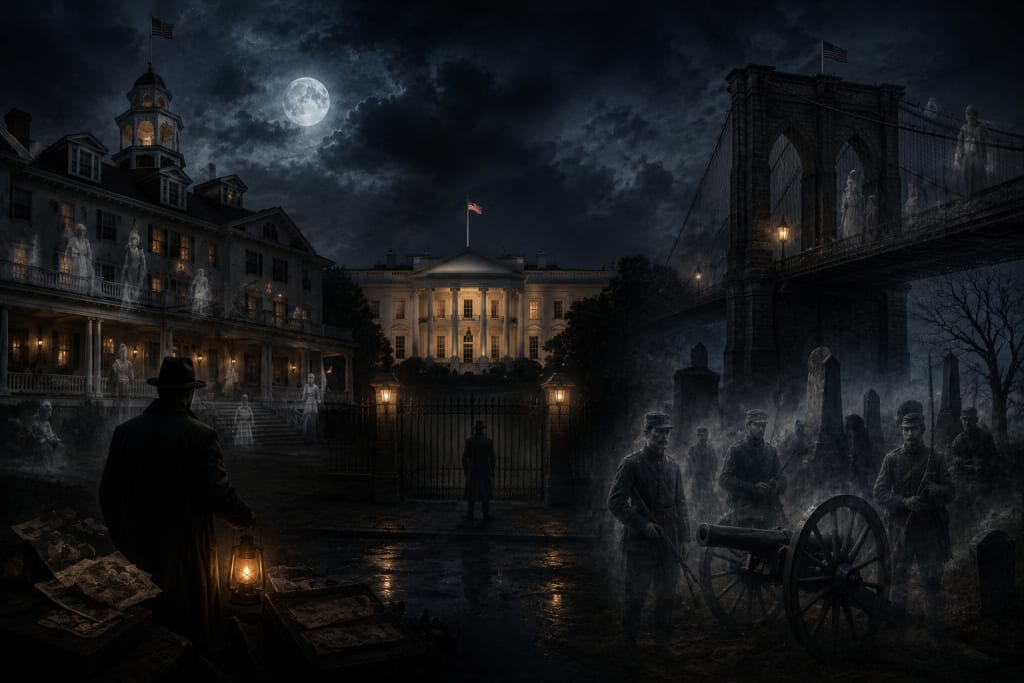
Some are beautiful. Some are historic. Some are architectural wonders. Some are patriotic symbols. Some are tourist destinations visited by millions. But beneath the polished plaques, guided tours, souvenir shops, national-park signs, restored rooms, and famous photographs, many American landmarks carry darker stories.
Prisons where men disappeared into punishment. Battlefields where thousands died in days. Houses shaped by grief, rumors, and violence. Hotels connected to death, scandal, and strange sightings. Islands once used to isolate the unwanted. Mansions where wealth could not protect anyone from tragedy. Courthouses, forts, plantations, lighthouses, and hospitals where history left behind more than records.
These are the places where true crime, national memory, and ghost stories overlap.
A haunting is rarely only about a ghost. Often, it is about a wound that refuses to close. A violent death, a public execution, a battlefield, a prison cell, a mysterious disappearance, a murder house, or a site of mass suffering can become haunted because people feel that something terrible should not simply vanish into history. The ghost story gives emotion a shape. It turns guilt, grief, fear, and unfinished justice into footsteps, cold spots, voices, apparitions, and shadows.
America’s haunted landmarks are powerful because they sit at the intersection of fact and folklore. The crimes, punishments, deaths, and tragedies are real. The ghost stories are harder to prove. But whether one believes in spirits or not, the emotional truth is clear: some places feel heavy because human suffering happened there.
From Alcatraz Island to Gettysburg, from Eastern State Penitentiary to the Winchester Mystery House, America’s haunted landmarks remind us that history is not always clean. Sometimes the past does not stay behind glass. Sometimes it rattles the cell door, whispers in the hallway, appears on the battlefield, or waits at the edge of a tour route after the lights go out.
Why Crime and Ghost Stories Often Merge
Crime and ghost stories are natural companions because both are built around unresolved disturbance.
A crime breaks the expected order of life. It creates a before and after. Someone is harmed. Someone is blamed. Someone disappears. A room becomes a crime scene. A road becomes infamous. A building becomes known for what happened inside it. Even after the legal case ends, the emotional shock can remain attached to the location.
Ghost stories often appear where people feel that ordinary explanation is not enough. A murder may be solved, but grief remains. A prison may close, but punishment lingers in memory. A battlefield may become a national park, but the dead still seem too numerous to be silent. A mansion may become a tourist attraction, but its strange architecture still invites rumor.
This is why many haunted landmarks are not simply “old.” Age helps, but it is not enough. A place becomes haunted in public imagination when history feels morally charged. Violence, injustice, suffering, isolation, secrecy, and sudden death all create the kind of atmosphere that ghost stories need.
The supernatural does not replace the historical record. It grows around it.
A ghost story says: something happened here, and people still feel it.
Alcatraz Island: The Rock That Would Not Let Men Go
Few American landmarks combine crime, punishment, escape, and ghost lore as powerfully as Alcatraz Island.
Located in San Francisco Bay, Alcatraz served many roles over time, including military fortification, military prison, federal penitentiary, and later a site of Native American occupation and national-park interpretation. But in popular imagination, it is still “The Rock,” the isolated federal prison that held some of America’s most notorious inmates.
The federal penitentiary operated from 1934 to 1963. The Federal Bureau of Prisons notes that Alcatraz never held more than a small fraction of the federal prison population, with an average population of around 260 to 275 prisoners, and some inmates even requested transfer there because each man had his own cell and conditions were seen by some as better than other federal prisons. Still, its reputation became one of extreme isolation, discipline, and psychological pressure.
The true crime history of Alcatraz is full of violence, attempted escapes, and famous criminals. But no story defines the island more than the June 1962 escape by Frank Morris and brothers John and Clarence Anglin. The FBI’s official history describes how the men used handmade tools, dummy heads, ventilation grates, and a concealed workshop area to break out of the prison and vanish into the bay. Their fate remains one of America’s most famous escape mysteries.
That mystery feeds the haunting. Alcatraz is already atmospheric: cold water, fog, rusting bars, empty corridors, echoing cells, and a skyline of freedom visible across the bay. A prison built in sight of a city but separated by deadly water is psychologically brutal. Hope is visible but unreachable.
Ghost stories at Alcatraz often involve voices in empty cell blocks, clanging doors, cold spots, shadow figures, and the feeling of being watched. Some visitors and paranormal accounts focus on solitary confinement areas, where isolation was most intense. Whether those reports are supernatural or products of atmosphere, expectation, and suggestion, the setting itself does much of the haunting.
Alcatraz is a landmark where crime history and ghost lore do not need to compete. The real story is already chilling: men locked away from society, desperate attempts to escape, mysterious disappearances, and an island that became a symbol of punishment. The ghost stories are the emotional afterimage of that history.
Eastern State Penitentiary: Reform Dream Turned Gothic Nightmare
In Philadelphia stands one of America’s most visually haunting landmarks: Eastern State Penitentiary.
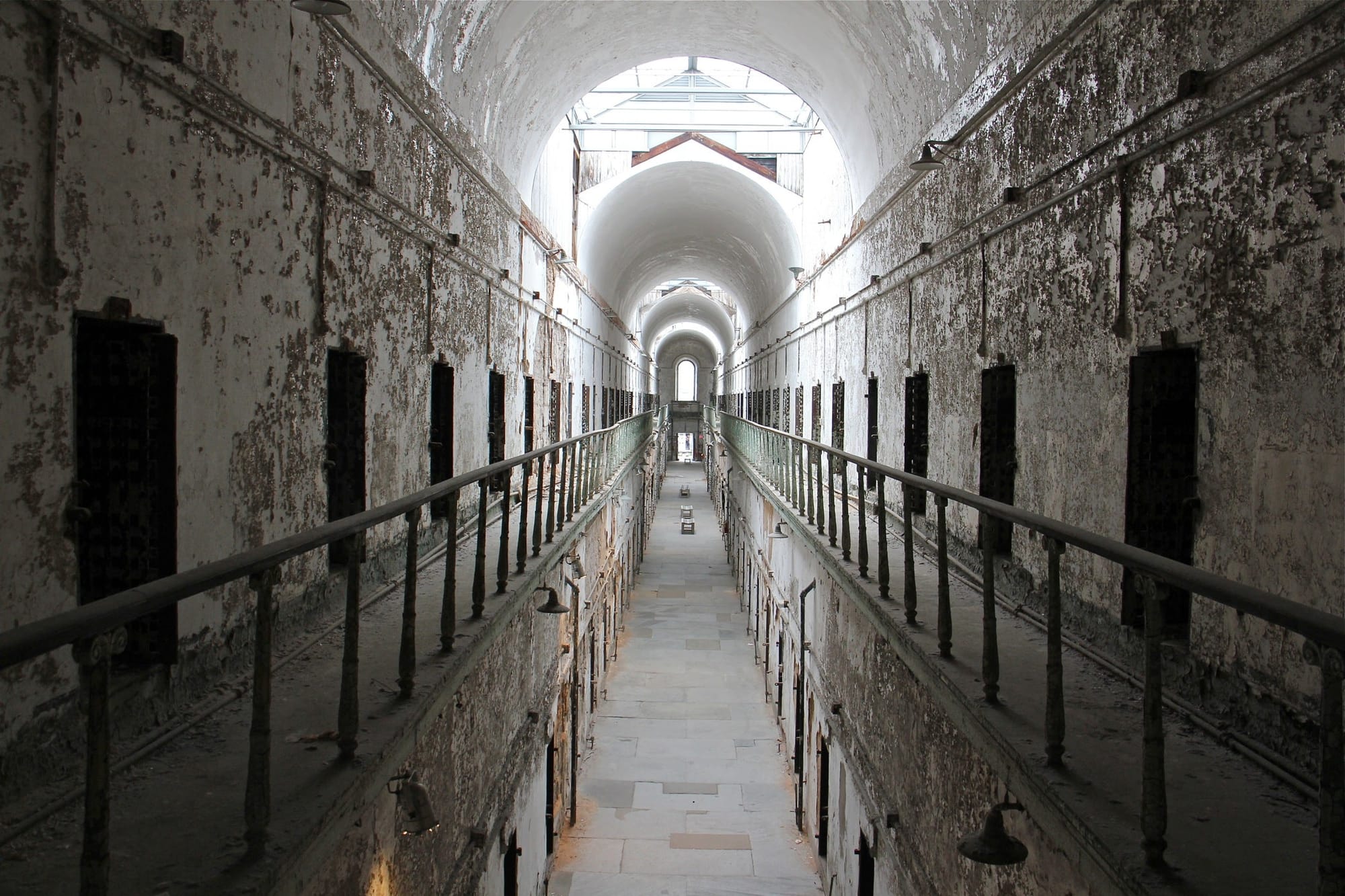
Opened in 1829, Eastern State was designed as a revolutionary prison meant to inspire penitence and moral reform. Its system emphasized isolation, reflection, labor, and separation from other prisoners. Architecturally, it was astonishing: radial cell blocks, vaulted ceilings, heavy doors, and a design that influenced prison architecture around the world.
But the idea of reform through isolation carried psychological darkness. Prisoners were separated, controlled, and often cut off from ordinary human contact. What began as a humanitarian experiment now looks, to many modern visitors, like a monument to loneliness.
Modern haunted-tour culture has made Eastern State one of America’s most famous prison ghost sites. The former prison has hosted major Halloween attractions and has been featured in numerous paranormal television programs. Even mainstream summaries note that its ominous appearance, gloomy atmosphere, and long history have made it a frequent location for programs about hauntings.
The crime history here is not one single murder but an entire system of confinement. Eastern State held thousands of prisoners over its long life, including the famous gangster Al Capone. Stories of suffering, madness, violence, punishment, and isolation became embedded in the building’s identity.
Ghost stories at Eastern State often include disembodied footsteps, whispers, shadowy figures, cell-door sounds, and presences in abandoned blocks. The ruin-like condition of the site adds to the effect. Peeling walls, broken skylights, rusted doors, and empty corridors create a feeling that the prison is not fully dead.
Eastern State is frightening because it asks a moral question: when does punishment become haunting?
The prison was built to reform souls. Its ghost stories suggest that some souls never left.
Gettysburg: A Battlefield Too Full of the Dead
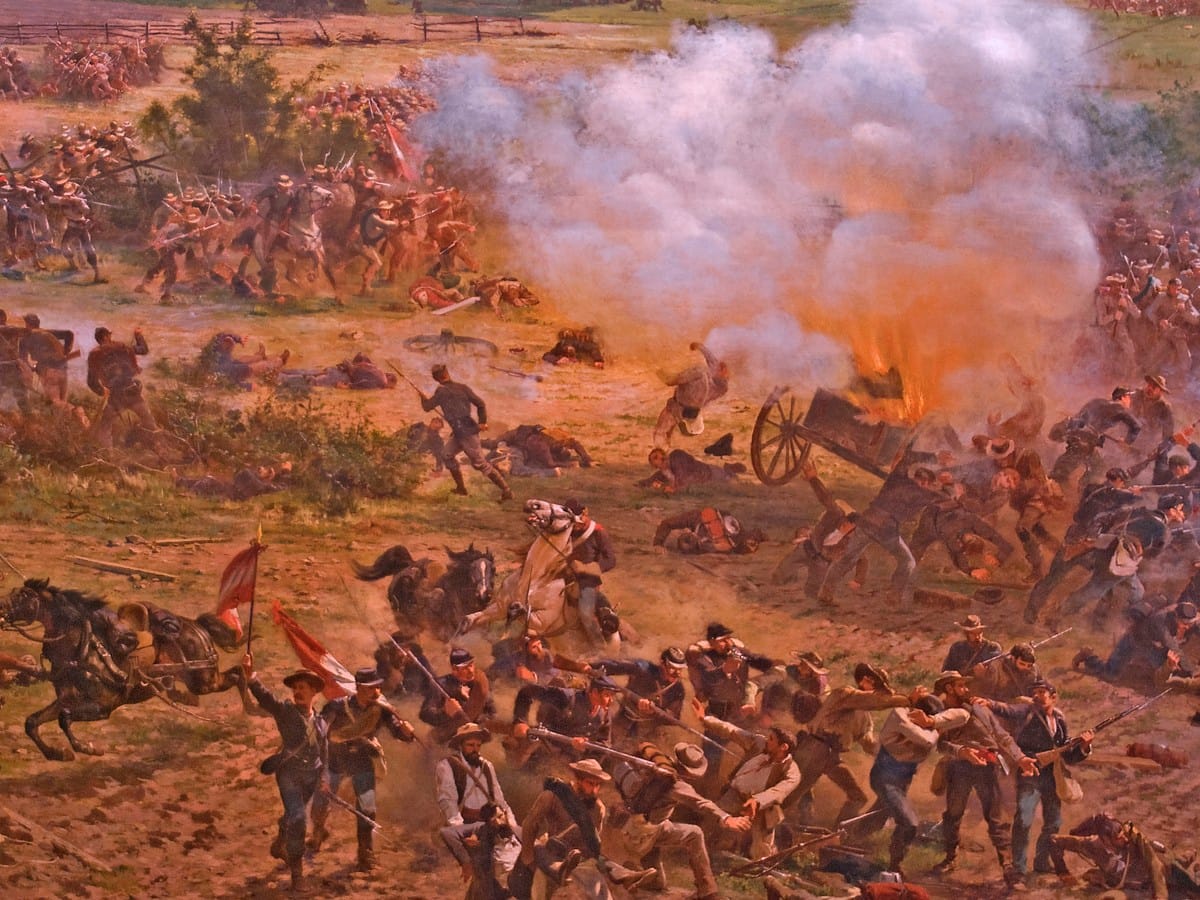
Some landmarks are haunted not by one crime, but by mass death.
Gettysburg National Military Park in Pennsylvania preserves the site of one of the most important and devastating battles of the American Civil War. Fought from July 1 to July 3, 1863, the Battle of Gettysburg left tens of thousands killed, wounded, captured, or missing. It became a turning point in the war and one of the most emotionally charged landscapes in the United States.
Battlefields often become haunted because they compress death into geography. A field, ridge, road, barn, house, or stone wall becomes associated with a specific moment of fear. Soldiers fell there. Surgeons worked there. Families searched there. Bodies were buried there. Later generations walk through the same spaces and sense that history is not fully past.
Gettysburg’s ghost lore is enormous. Visitors have reported phantom footsteps, ghostly drumbeats, distant musket fire, apparitions of soldiers, strange photographs, and voices on the battlefield. History.com notes that for more than a century, visitors have claimed to hear phantom footsteps, ghostly drumbeats, and echoes of musket fire at Gettysburg.
Unlike a prison or murder house, Gettysburg is not haunted by crime in the ordinary legal sense. It is haunted by national violence. War is organized killing, sanctioned by governments, remembered by monuments, and mourned through ceremony. But the dead were still young men in terror, pain, and confusion. Their suffering does not become less human because it was historical.
The ghost stories of Gettysburg often feel less like horror entertainment and more like historical grief. A soldier seen crossing a field may not seem malicious. A drumbeat heard at night may feel like memory replaying itself. A cold spot near a battlefield hospital may feel like the body remembering pain.
Gettysburg’s haunting comes from scale. The land holds too many stories for any plaque to contain.
The Winchester Mystery House: Grief, Guns, and Ghost Architecture
The Winchester Mystery House in San Jose, California, is one of America’s strangest haunted landmarks. It is famous for its maze-like design, stairways that seem to lead nowhere, doors that open into walls or empty space, and a sprawling architectural layout that has inspired decades of ghost stories.
The house was the residence of Sarah Lockwood Pardee Winchester, widow of William Wirt Winchester and heiress to part of the Winchester repeating-arms fortune. The official history of the house notes that Sarah suffered deep personal tragedies: her infant daughter died of illness, and her husband later died of tuberculosis.
The legend says Sarah Winchester built endlessly because she was haunted by the spirits of those killed by Winchester rifles, or because a medium told her construction must never stop. It is one of America’s most famous haunted-house stories. But the historical picture is more complicated. History.com notes that sensational journalism after Sarah’s death helped cement the mansion’s reputation as a “spirit house,” and that by the time it opened to the public in the 1920s, the ghostly backstory was already a major attraction.
This makes the Winchester Mystery House especially fascinating. The crime connection is indirect but powerful. The house is tied to the Winchester firearms fortune, and its legend is built around guilt, death, and the imagined victims of gun violence. Whether Sarah truly believed she was haunted by rifle victims remains debated, but the story became irresistible because it connected architecture, grief, wealth, and blood money.
The house itself feels like a physical expression of psychological unease. Hallways turn strangely. Rooms multiply. Architectural logic breaks. It looks like a home built by someone trying to manage grief through construction.
The ghost stories may be folklore, but the emotional foundation is real: a woman surrounded by loss, wealth linked to weapons, and a house that became America’s great monument to haunted guilt.
The Stanley Hotel: Luxury, Isolation, and Haunted Imagination
The Stanley Hotel in Estes Park, Colorado, is one of America’s most famous haunted hotels, partly because it helped inspire Stephen King’s The Shining. Its grand architecture, mountain setting, and long corridors make it an ideal haunted landmark.
The hotel is not primarily known for a famous murder in the way some landmarks are. Its haunting reputation comes more from atmosphere, isolation, celebrity storytelling, and decades of reported paranormal experiences. Guests and staff have reported piano music, apparitions, children’s laughter, footsteps, and strange activity in rooms.
The Stanley shows that a landmark does not need one defining crime to feel haunted. Sometimes architecture, remoteness, and story are enough. A hotel is already a place of temporary lives: strangers sleep, leave, return, celebrate, argue, grieve, and disappear into anonymity. Hotels collect human emotion without belonging to any one family.
When a hotel becomes haunted, the ghost is often a symbol of unfinished occupancy. Someone checked in and never truly checked out.
The Stanley’s link to The Shining also shows how fiction can strengthen a real place’s haunted identity. Once a landmark becomes associated with horror, visitors arrive expecting atmosphere. That expectation shapes experience. A creak becomes meaningful. A cold hallway becomes suspicious. A shadow becomes a possible apparition.
This does not make the haunting fake. It shows how haunted landmarks are created through a mixture of architecture, history, media, and visitor imagination.
The Lizzie Borden House: Murder, Nursery Rhyme, and Tourist Haunting
Few American crime landmarks are as infamous as the Lizzie Borden House in Fall River, Massachusetts.
In 1892, Andrew and Abby Borden were brutally killed with a hatchet-like weapon inside their home. Andrew’s daughter Lizzie Borden was charged and later acquitted. The case became one of America’s most famous unsolved or disputed domestic murder stories, transformed into a macabre rhyme and endless speculation.
The house is now a museum and bed-and-breakfast, and it is often described as haunted. Visitors report footsteps, voices, apparitions, and unsettling feelings. But the real haunting begins with the crime itself: a family home turned into a scene of extreme violence, followed by a trial that never fully settled public suspicion.
The Lizzie Borden House is important because it shows how true crime can become folklore almost immediately. The rhyme simplified the case into something memorable and chilling. Over time, Lizzie became not only a defendant but a cultural character: accused daughter, possible killer, wronged woman, Victorian mystery, and ghost-story figure.
The house’s haunting reputation reflects the unresolved nature of the crime. People still ask: did Lizzie do it? If not, who did? What happened in that family? What kind of tension existed behind those walls?
Ghost stories often grow where legal closure fails. The Borden case has a verdict, but not emotional certainty. That gap keeps the house alive in American imagination.
The Villisca Axe Murder House: A Landmark of Unthinkable Domestic Horror
The Villisca Axe Murder House in Iowa is another landmark where true crime and haunting are inseparable.
In 1912, eight people, including six children, were murdered in the house. The crime was horrific, and despite investigations and trials, the case remains unsolved. The home later became a paranormal destination, with visitors reporting voices, children’s sounds, moving objects, and oppressive sensations.
Villisca is difficult to discuss because the crime was so brutal. Haunted tourism around such locations can feel uncomfortable, especially when children were victims. But the reason the house draws attention is also clear: unresolved violence in an ordinary home is one of the deepest fears in true crime.
Like the Borden House, Villisca turns domestic space into horror. A home is supposed to be the safest place. When violence invades it, the emotional order of the world breaks. The ghost story becomes a way of saying that the violation still matters.
The haunting is not just about whether spirits remain. It is about whether a house can ever become ordinary again after what happened inside it.
The Queen Mary: Ocean Liner, Wartime Service, and Ghost Ship Legend
The RMS Queen Mary, permanently docked in Long Beach, California, is one of America’s most famous haunted landmarks despite being born as a British ocean liner. Its history includes luxury travel, wartime service, accidents, deaths, and decades as a floating hotel and tourist attraction.
Ships become haunted easily because they are enclosed worlds surrounded by water. People live, work, die, celebrate, and suffer in confined spaces. The sea adds danger and isolation. A ship’s corridors, engine rooms, cabins, pools, and lower decks create natural ghost-story settings.
The Queen Mary’s haunted reputation includes stories of ghostly crew members, a “lady in white,” children near the pool area, unexplained knocks, and figures seen in engine spaces. Some stories are tied to reported deaths aboard the ship, while others are part of broader maritime folklore.
The crime element here is less central than tragedy and accident, but the emotional structure is similar. Death in a confined landmark creates location-based memory. Tourists walk where people once worked under pressure, crossed oceans, or faced wartime danger.
A ship is always between places. A haunted ship is between worlds.
The LaLaurie Mansion: Atrocity Behind Elegant Walls
In New Orleans, the LaLaurie Mansion is one of America’s darkest haunted landmarks. Its reputation comes not from legend alone but from historical accounts of horrific abuse of enslaved people by Madame Delphine LaLaurie and her household in the nineteenth century.
The mansion’s ghost stories include screams, apparitions, and reports of tortured spirits. But the true horror is the documented violence of slavery and cruelty hidden behind elite respectability.
This landmark shows why haunted histories can be ethically complicated. It is easy for ghost tours to turn suffering into entertainment. But places like the LaLaurie Mansion demand seriousness. The haunting should not distract from the real victims. It should force attention back to them.
In American haunted history, slavery is one of the deepest sources of unresolved moral haunting. Plantations, mansions, markets, prisons, and urban sites connected to slavery often attract ghost stories because the violence was systemic, intimate, and often hidden beneath architecture of wealth and refinement.
The LaLaurie Mansion is frightening because it reveals the horror behind the façade. The ghost story is not the main terror. History is.
Salem: Witch Trials, Wrongful Death, and Haunted Memory
Salem, Massachusetts, is not one landmark but a landscape of accusation, fear, wrongful execution, and memorialization.
The Salem witch trials of 1692 led to the execution of twenty people and the deaths of others in jail. The sites associated with the trials, including memorials, old houses, burial grounds, and museums, have become some of America’s most famous dark-history destinations.
Salem’s hauntings are different from ordinary ghost stories because the crime was communal and legal. The victims were not killed by a hidden murderer. They were condemned through fear, testimony, religious panic, and authority. The injustice was public.
Ghost stories in Salem often involve accused witches, restless spirits, old houses, and sites of execution or imprisonment. But Salem’s deeper haunting is social: how could a community convince itself that neighbors deserved death?
That question still resonates. Salem is a landmark of moral panic, false accusation, and deadly belief. Its ghosts are not only figures in old clothing. They are warnings about hysteria, scapegoating, and the danger of certainty without evidence.
Why Haunted Landmarks Become Tourist Destinations
Haunted landmarks attract visitors because they offer a controlled encounter with fear.
A person can tour a prison, walk a battlefield, sleep in a murder house, visit a haunted hotel, or join a ghost walk. The danger is gone, but the atmosphere remains. This creates a powerful emotional experience: history becomes physical.
Dark tourism can be meaningful when handled respectfully. It can educate visitors, preserve sites, and keep difficult history alive. But it can also become exploitative when suffering is reduced to thrills.
The challenge is balance. A haunted tour at Alcatraz or Eastern State can discuss punishment, isolation, and prison history. A Gettysburg ghost tour can honor the dead while exploring folklore. A murder-house attraction can easily cross ethical lines if it forgets victims.
The best haunted landmarks do not use history as decoration. They let the ghost stories lead visitors back to the facts.
Skepticism and the Power of Atmosphere
Not everyone believes these landmarks are literally haunted. Many ghostly experiences can be explained through architecture, expectation, darkness, sound, drafts, old buildings, emotional suggestion, and the power of story.
At the Winchester Mystery House, for example, some skeptical interpretations point to the effects of publicity, rumor, wind, temperature changes, and the natural sounds of a large old house. Even summaries of its hauntings note that investigators have argued many reported phenomena may come from suggestion or ordinary building conditions.
But skepticism does not erase atmosphere. A place can feel haunted even if no ghost appears. The feeling may come from knowing what happened there. A cell at Alcatraz feels different because of its history. Gettysburg at dusk feels different because of the dead. A murder house feels different because domestic safety was destroyed there.
The human mind responds to place through memory and story. Haunted landmarks are powerful because facts and feelings reinforce each other.
Why America’s Haunted Landmarks Matter
America’s haunted landmarks matter because they reveal what the country remembers uneasily.
Prisons force questions about punishment. Battlefields force questions about war. Murder houses force questions about domestic violence and unresolved justice. Plantation mansions force questions about slavery. Witch-trial sites force questions about hysteria and wrongful death. Haunted hotels force questions about memory, celebrity, and tourism.
Ghost stories are not always distractions from history. Sometimes they are signs that history still hurts.
The danger is when ghost stories replace truth. The value is when they pull people toward truth.
A good haunted history does not ask only, “Is this place haunted?”
It asks, “What happened here that made people need a ghost?”
Final Verdict
America’s haunted landmarks are where true crime, tragedy, folklore, and national memory collide. Alcatraz is haunted by punishment, escape, and isolation. Eastern State Penitentiary is haunted by the failed dream of reform through solitude. Gettysburg is haunted by mass death and battlefield grief. The Winchester Mystery House is haunted by loss, rumor, architecture, and the shadow of gun violence. The Lizzie Borden and Villisca houses are haunted by domestic murder and unresolved questions. The Queen Mary is haunted by maritime death and shipboard memory. Salem is haunted by accusation, panic, and wrongful execution.
Whether one believes the ghost stories literally or sees them as folklore, these landmarks remain powerful because their histories are real. The crimes, deaths, injustices, and tragedies happened. The hauntings grew from the emotional pressure those events left behind.
That is why people keep visiting. They are not only looking for ghosts. They are looking for contact with the past.
America’s haunted landmarks remind us that history is not always safely behind us. Sometimes it stays in the walls, on the battlefield, inside the cell, beneath the staircase, or at the end of a dark hallway where visitors pause, listen, and wonder whether what they heard was only the building settling—or something still asking to be remembered.