

The Mystery of Salvator Mundi: Leonardo's $450 Million Painting That Vanished
Imagine paying almost half a billion dollars for a painting—only for it to disappear from public view. That is the extraordinary mystery of Salvator Mundi, a centuries-old image of Jesus Christ attributed to Leonardo da Vinci. Once dismissed as a copy and sold for just £45, it became the most expensive painting ever sold at auction in 2017.
But the record-breaking price is only one chapter. Experts still disagree about how much of the artwork Leonardo actually painted, its restoration remains controversial, and its precise location has not been publicly verified. The story of Salvator Mundi is part art history, part financial thriller, and part modern-day disappearance.
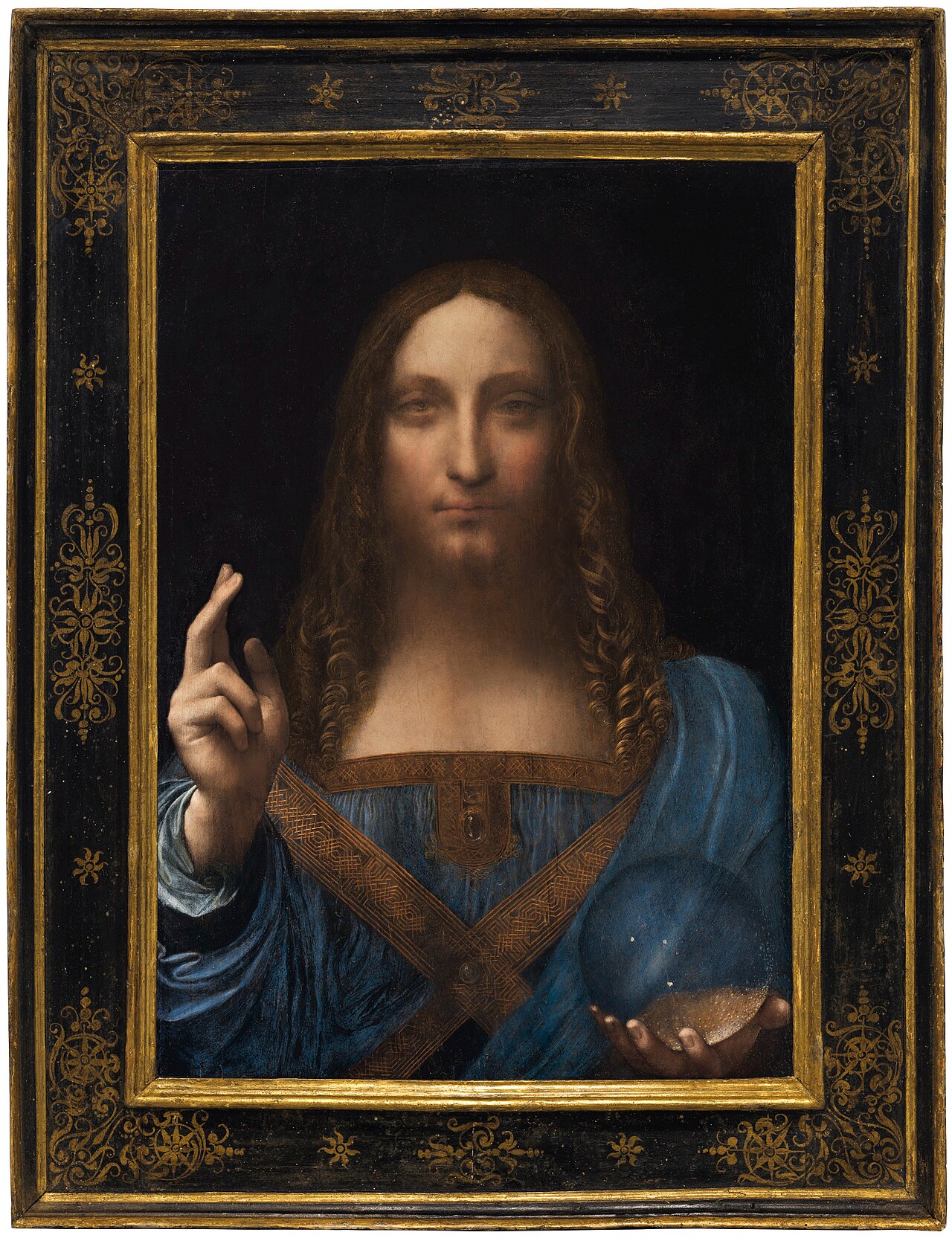
What Is Salvator Mundi?
Salvator Mundi is Latin for “Savior of the World.” The oil painting, created around 1500 on a walnut panel, shows Christ looking directly at the viewer. His right hand is lifted in blessing, while his left supports a translucent orb symbolizing the world or cosmos.
At approximately 65.7 by 45.7 centimeters (25.9 by 18 inches), the work is surprisingly small for an object that has attracted such enormous attention. Its blue robes, delicate curls, enigmatic expression, and shadowy background invite comparisons with Leonardo's better-known portraits, particularly the Mona Lisa.
The painting is often described in headlines as the “last Leonardo” in private hands. Yet that label rests on the very question experts have spent years debating: is it entirely Leonardo's work, a collaboration with his studio, or predominantly the work of a talented follower?
How a Forgotten Painting Became a $450 Million Sensation
A possible royal past—and a long trail of uncertainty
Supporters of the Leonardo attribution connect Salvator Mundi to the English royal collection of Charles I in the 17th century, sometimes tracing an earlier commission to France. However, the historical record has gaps, and the identification of the surviving panel with references in old inventories is not universally accepted.
By 1900, the painting had entered the Cook Collection in Britain, where it was treated as a work associated with Leonardo's followers. In 1958, Sotheby's sold it for a mere £45, catalogued as a copy after Giovanni Antonio Boltraffio, one of Leonardo's pupils. For decades, it attracted little attention.
The extraordinary 2005 rediscovery
In 2005, art dealers including Robert Simon and Alexander Parish acquired the heavily overpainted work at a small auction in the United States for approximately $1,175. Under darkened varnish and previous repainting, they suspected there might be something far more valuable than the auction listing suggested.
Conservator Dianne Dwyer Modestini undertook years of meticulous examination and restoration. As later additions were removed, details of the underlying painting emerged. Specialists began investigating whether the work could be an original connected directly to Leonardo.
London, 2011: the painting returns to the spotlight
In 2011, London's National Gallery displayed the painting in its exhibition Leonardo da Vinci: Painter at the Court of Milan. Its inclusion was a watershed moment. The presentation helped bring the proposed attribution to a global audience, but it did not permanently settle every scholar's doubts.
In the years that followed, the painting passed through high-value private transactions. Russian billionaire Dmitry Rybolovlev acquired it in 2013 for about $127.5 million through art dealer Yves Bouvier—a transaction that became entangled in wider disputes over art-market pricing.
The Night Salvator Mundi Sold for $450.3 Million
On November 15, 2017, Christie's offered Salvator Mundi in New York. After an intense telephone bidding contest, the hammer fell at $400 million. Including the buyer's premium, the final price was $450,312,500—a world record for a painting sold at auction.
The sum was astonishing even by elite art-market standards. Buyers were not simply competing for an image of Christ. They were competing for the possibility of owning a painting by one of history's most famous artists, an object with a dramatic rediscovery story and a level of rarity that money almost never buys.
Yet the sale also raised an uncomfortable question: how can a painting's monetary value be so certain when its attribution is not?
Did Leonardo da Vinci Really Paint Salvator Mundi?
The case for Leonardo's hand
Scholars who support Leonardo's authorship point to the subtle modelling of Christ's face, the delicate treatment of parts of the hands, the relationship to historical drawings, and technical evidence of changes made during painting. Such alterations, known as pentimenti, can suggest an artist developing a composition rather than simply copying a finished image.
Technical analysis has explored the pigments, layers, and working methods. A peer-reviewed materials study published in Heritage Science in 2020 documented characteristics relevant to how the image was made, although technical evidence alone cannot identify an artist with complete certainty.
Why other experts remain unconvinced
Other Leonardo specialists argue that parts of the painting are inconsistent in quality. The hands, facial features, and drapery have drawn competing interpretations, while centuries of damage and extensive restoration make direct judgments especially difficult.
Art historian Carmen Bambach has questioned the full Leonardo attribution, proposing substantial work by his pupil Boltraffio. Scholar Frank Zöllner has argued that the design likely originated with Leonardo but that its execution may be only partly his. These are scholarly interpretations—not proof that the painting is a fake.
The distinction matters. An artwork made in Leonardo's workshop around 1500 could be historically significant even if much of the brushwork belonged to an assistant. But “painted entirely by Leonardo” and “made by Leonardo's circle” have very different implications for scholarship, public trust, and price.
The Crystal Orb: A Scientific Clue Hidden in Plain Sight
One of the most intriguing elements is the transparent sphere resting in Christ's hand. Critics have asked why the robe behind it appears less distorted than a solid glass sphere might produce. For an artist fascinated by optics, would such an apparent inconsistency make sense?
A 2026 peer-reviewed study in npj Heritage Science offered a fresh interpretation. Researchers Juan Manuel García-Ruiz and Dianne Modestini examined the orb's tiny painted flecks, reflections, and geometry. They argued that these features are consistent with an attempt to depict rock crystal, rather than an ordinary glass ball, and that the supposed optical mistakes are less straightforward than they initially appear.
The study makes the orb an especially interesting piece of the puzzle, but it does not conclusively prove who painted the entire panel. Modestini was also the painting's modern restorer, a relevant connection when weighing interpretations of its authorship.
The Louvre Controversy: Why Was It Missing in 2019?
The mystery deepened when Salvator Mundi failed to appear in the Louvre's major Leonardo exhibition in Paris in 2019. Reports later described disagreements surrounding the terms of a potential loan, including claims about how the painting would be attributed and displayed. Those accounts were disputed and cannot be treated as a single established explanation.
Adding a twist, reporting by The Art Newspaper described an unpublished Louvre study prepared after scientific examinations. Its reported text supported attribution to Leonardo, despite other claims that officials viewed the painting as a studio collaboration. The booklet was withdrawn when the painting did not appear in the exhibition.
Far from ending the argument, the Louvre episode showed how complicated the question had become. Art history, institutional reputations, diplomacy, and an extraordinary price were now intertwined.
Where Is Salvator Mundi Now?
The last confirmed public viewing of the painting was in the period surrounding its 2017 Christie's auction. A planned unveiling at the Louvre Abu Dhabi in September 2018 was postponed, and the picture has not returned to a confirmed public exhibition.
Multiple reports have linked the purchase to Saudi Crown Prince Mohammed bin Salman, although the complete ownership arrangements have never been fully transparent to the public. Speculation has placed the painting aboard a luxury yacht, in secure storage, or in preparations for a future Saudi museum. None of those possibilities should be confused with a verified public sighting.
In August 2024, reports citing Princeton professor Bernard Haykel said the painting was in storage in Geneva and might eventually be displayed in Riyadh. In October 2025, The Art Newspaper reported that it was understood to be destined for a planned museum in Riyadh. As of November 2026, its precise location, condition, and public exhibition date have not been independently confirmed.
That uncertainty is remarkable: a work famous enough to command nearly half a billion dollars has effectively remained invisible to the public for almost a decade.
Why the Mystery of Salvator Mundi Matters
At its heart, this is not merely a story about an expensive painting. It is about how cultural value is established, how scientific evidence interacts with expert judgment, and what happens when works of enormous public interest disappear into private ownership.
The most important unanswered questions are simple: Who painted which parts? How much original paint survives beneath restoration? Where is the panel being kept? And will it ever be available for researchers and the public to examine again?
For now, the mystery of Salvator Mundi remains unresolved. A blessing hand, a crystal globe, and an elusive face continue to ask the same question the art world cannot answer unanimously: are we looking at a lost Leonardo masterpiece—or at a masterpiece of art-world belief?
Frequently Asked Questions About Salvator Mundi
What does Salvator Mundi mean?
It means “Savior of the World” in Latin. The painting depicts Jesus Christ blessing the viewer while holding a transparent orb.
How much did Salvator Mundi sell for?
It sold for $450,312,500 at Christie's New York on November 15, 2017, including the buyer's premium—the highest confirmed auction price for a painting.
Is Salvator Mundi definitely by Leonardo da Vinci?
No unanimous scholarly conclusion exists. Some experts attribute it to Leonardo, while others believe it was partly or largely executed by artists in his workshop.
Who owns Salvator Mundi?
Reporting has linked the purchase and subsequent control of the painting to Saudi Crown Prince Mohammed bin Salman. Publicly accessible documentation does not fully clarify every aspect of the ownership arrangement.
Where is Salvator Mundi in 2026?
Its exact location has not been independently verified. Reports have suggested storage in Geneva and a possible future display in Riyadh, but no confirmed public exhibition has been announced.
Why is the crystal orb important?
The orb symbolizes the world and is central to debates about the artist's knowledge of optics. A 2026 scientific study argues that its painted details may represent rock crystal and that its optical depiction is more sophisticated than critics assumed.
Sources and Further Reading
- Christie's: Historic 2017 auction results
- Christie's: Original Salvator Mundi lot essay
- The Art Newspaper: Provenance and controversy timeline
- npj Heritage Science (2020): Materials and techniques study
- npj Heritage Science (2026): Scientific analysis of the orb
- The Art Newspaper: Louvre scientific study reporting
- The Art Newspaper (2025): Possible Riyadh museum plans
- Wikimedia Commons: Public-domain artwork reproduction
