Devil’s Pool & Alkimos: Australia’s Cursed Waters
Australia is a land of spectacular coastlines, ancient rainforests, dangerous reefs, powerful rivers, and stories that seem to rise out of the landscape itself. Some places are beautiful in the ordinary way: a clear creek, a tropical swimming hole, a beach, a reef, a shipwreck slowly breaking apart under the sea. But others carry a darker reputation. They are places where beauty and danger live too close together.
Two of the most chilling examples are Babinda’s Devil’s Pool in Far North Queensland and the Alkimos shipwreck off the coast of Western Australia. One is a rainforest swimming hole surrounded by granite boulders and Aboriginal legend. The other is the remains of a World War II-era merchant ship whose unlucky history has made it one of Australia’s most famous haunted wrecks.
At first, the two places seem completely different. Devil’s Pool is inland, hidden in lush rainforest near Babinda, south of Cairns. The Alkimos is maritime, rusting and disintegrating in the waters north of Perth. One is tied to drowning, rapids, and a ghostly woman said to lure men into the water. The other is tied to shipwreck, misfortune, fires, strange sounds, ghostly figures, and stories of a cursed vessel that refused to leave the coast.
Yet both places share the same unsettling power: they remind us that water can be beautiful, sacred, deadly, and haunted all at once.
The Dark Pull of Cursed Waters
Water has always been central to ghost stories. Rivers carry bodies away. Oceans swallow ships. Lakes hide secrets. Waterfalls drown out screams. A calm surface can conceal violent currents below. This is why haunted-water legends feel so convincing. They begin with a real danger that everyone understands.
At Devil’s Pool, the danger is immediate and physical. The water looks inviting, but the surrounding sections of Babinda Boulders contain fast currents, slippery rocks, underwater traps, and powerful hydraulics. According to a Cairns Regional Council safety review, there have been 21 recorded deaths since 1916 in the dangerous sections of Babinda Boulders near Devil’s Pool and nearby lookout areas. The review also noted that three of those deaths occurred in 2020 and 2021.
At Alkimos, the danger is historical and maritime. The ship was wrecked along Western Australia’s hazardous coast after a series of mishaps in 1963 and later became famous not only as a wreck but as a vessel surrounded by ghost stories. Western Australia’s State Heritage Office describes the SS Alkimos wreck as representative of the many shipwrecks along the Western Australian coast and notes its strong association with the Alkimos community as the namesake of the suburb.
These places are not haunted only because people say they are haunted. They are haunted because tragedy, danger, memory, and landscape have fused together. The legends grow from real risk.
Babinda’s Devil’s Pool: Beauty With a Fatal Reputation
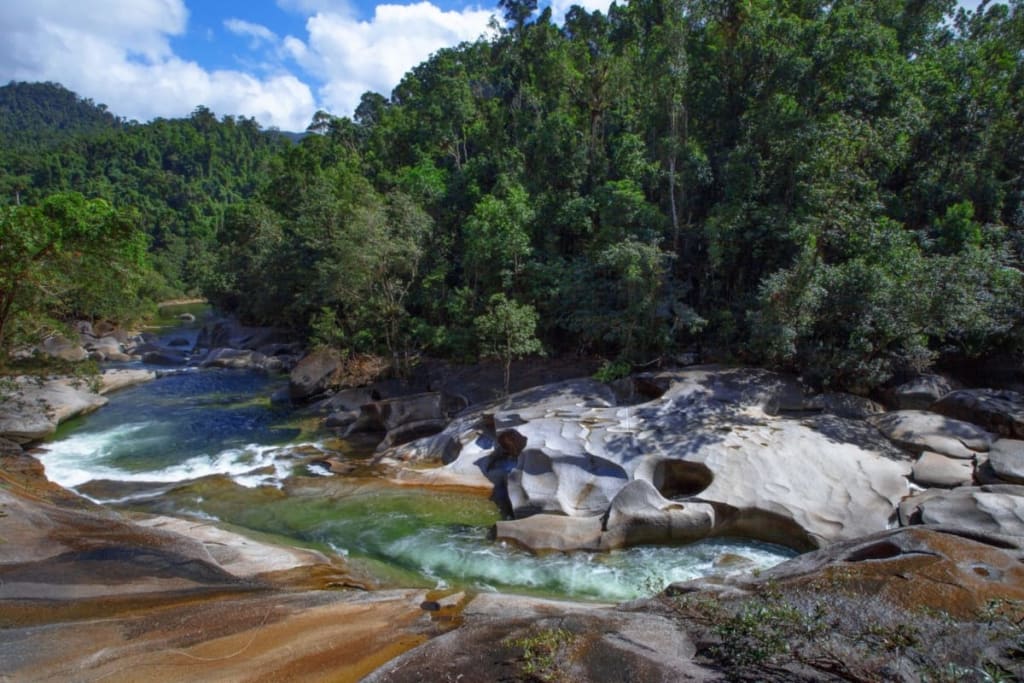
The Babinda Boulders are among Far North Queensland’s most visually striking natural sites. Smooth granite boulders sit in clear water beneath rainforest canopy. The creek rushes through narrow channels, over rock shelves, and into deep pools. It is easy to understand why visitors are drawn to the area. It looks like the kind of place where nature has created a perfect tropical escape.
But Devil’s Pool is not simply a scenic swimming hole. It is one of Australia’s most notorious danger spots.
The safe swimming area at Babinda Boulders is separate from the deadly restricted sections. The danger increases around Devil’s Pool, The Chute, and The Washing Machine, where the water can move with extreme force. The problem is that the same landscape that makes the place beautiful also makes it hazardous. The polished rocks are slippery. The channels are narrow. The currents can pull swimmers into places where escape becomes nearly impossible.
ABC News reported in 2025 that warning signs at the site state 21 people have died there since 1916, with the most recent death listed as occurring in 2021. The report also noted that many of the victims were young men, with 84 percent of those who died being male and 53 percent aged between 18 and 24.
Those numbers give the legend a painful seriousness. Devil’s Pool is not just “spooky.” It has taken lives.
The Legend of Oolana
The most famous story connected to Devil’s Pool is the Aboriginal legend of Oolana, a young woman whose grief is said to haunt the water. Versions of the story vary, and they should be approached with respect because they are connected to local Indigenous cultural memory rather than simple tourist folklore.
In the commonly told version, Oolana was a young woman who fell in love with a man she could not be with. Their love ended in tragedy, and Oolana threw herself into the waters. Her spirit is said to remain at Devil’s Pool, calling to young men and pulling them beneath the surface.
ABC’s Brisbane Drive program summarized the local belief in 2020, reporting that Aboriginal folklore links the area to the ghost of a young woman waiting for her lover to return. The same report noted that Devil’s Pool had claimed at least 17 lives over the previous 60 years at that time.
The story has endured because it gives emotional shape to danger. A current becomes a calling. A whirlpool becomes grief. A drowning becomes part of a larger pattern. Whether one reads the tale literally, symbolically, spiritually, or culturally, the legend warns people to respect the water.
That warning is central. In many traditional stories, dangerous landscapes are not described as empty physical spaces. They are places with memory, spirit, and consequence. The legend of Oolana makes Devil’s Pool feel alive—not in a comforting way, but in a watchful and sorrowful one.
Why Devil’s Pool Feels Haunted
Part of Devil’s Pool’s haunting reputation comes from contrast. The place is beautiful. The rainforest is lush. The water can appear clear and inviting. But beneath that beauty is danger. That contradiction creates unease.
Many haunted places are frightening because they look abandoned, ruined, or obviously sinister. Devil’s Pool is different. It can look peaceful. That makes the stories more disturbing, because the danger is not immediately visible to everyone.
The phrase “cursed waters” often sounds dramatic, but at Devil’s Pool it reflects how people experience the place. The water has a pattern of tragedy. Young men have died there repeatedly. Locals warn visitors. Signs warn visitors. Safety barriers and no-go zones exist for a reason. Yet people are still drawn toward the dangerous sections.
That repeated attraction becomes part of the legend. Why do people keep risking it? Is it overconfidence? Is it the beauty of the place? Is it the thrill of forbidden water? Is it, as folklore suggests, the pull of something unseen?
From a safety perspective, the answer is clear: fast water, slippery rocks, hidden hazards, and risky behavior are enough to explain many tragedies. But folklore does not replace physical explanation. It sits beside it. The scientific danger and the ghost story strengthen each other.
The result is one of Australia’s most eerie natural sites: a place where the water is both physically deadly and mythologically charged.
The Real Danger Behind the Myth
It is important not to romanticize Devil’s Pool’s deaths. Behind every legend is a family that lost someone. The site’s fatal history is not entertainment. It is a warning.
The Cairns Regional Council safety review describes the dangerous sections around Devil’s Pool and nearby areas and records the long history of deaths at the site. It also notes safety actions over the years, including the introduction of a no-go zone covering high-risk areas.
The danger comes from water movement through rock formations. When water is forced into narrow channels, it gains strength. A swimmer can be pushed, pinned, pulled under, or trapped. Smooth granite may offer little grip. Once someone is caught in a hydraulic or underwater channel, rescue becomes extremely difficult.
This is why warnings should be taken seriously. The safe swimming area exists for a reason. The restricted zones are not simply dramatic tourist warnings. They are based on repeated tragedy.
In that sense, Devil’s Pool’s legend serves a practical purpose. It tells people, in emotional language, what safety signs tell them in official language: do not underestimate this water.
The Alkimos Shipwreck: Australia’s Haunted Wreck
On the other side of the country, off the Western Australian coast, the SS Alkimos developed a very different but equally chilling reputation. Unlike Devil’s Pool, the Alkimos is not a natural swimming hole. It is a wreck—a man-made object that became trapped in the landscape and transformed into legend.
The ship began its life during World War II as part of the Liberty ship program. It was launched in 1943 under the name Viggo Hansteen before later becoming the Greek-owned Alkimos. In March 1963, while traveling from Jakarta to Bunbury, it struck a reef off the Western Australian coast. After repairs and further complications, the ship eventually broke free and was driven onto the shore near present-day Alkimos, where salvage hopes faded.
Australia Geographic describes the SS Alkimos as one of the country’s most haunted maritime legends, noting that paranormal interest intensified around the wreck after it snapped a towline on May 31, 1963, while being towed from Fremantle toward Hong Kong for repairs. Wild weather then drove it ashore near Yanchep, north of Perth.
The ship’s story reads almost like a curse narrative. It was damaged, repaired, moved, stranded, refloated, abandoned, and wrecked again. Each attempt to control its fate seemed to fail. Eventually, the Alkimos became less a vessel than a presence.
A ship is meant to travel. A wreck is a ship trapped in death.
Why Shipwrecks Become Ghost Stories
Shipwrecks are naturally haunted objects. They represent failed journeys, violent weather, human vulnerability, and unfinished movement. A ship has a crew, a purpose, a route, and a destination. When it wrecks, that story is interrupted.
The Alkimos is especially suitable for ghost lore because of its strange post-wreck history. It did not simply sink and disappear. It lingered. It remained visible for years. People saw it from the coast. Divers visited it. Salvage workers approached it. Its remains slowly deteriorated, becoming part of local identity.
Western Australia has a long history of shipwrecks, and the State Heritage Office places the Alkimos within that broader maritime context, describing it as representative of the many documented wrecks along the WA coast and the challenges of navigation in hazardous weather and geography.
But the Alkimos also became more than a maritime artifact. Stories grew around it: ghostly figures, strange noises, unexplained fires, cursed luck, and an atmosphere of unease that made people call it haunted.
Shipwreck legends often form this way. The wreck becomes a stage. People project fear, memory, and mystery onto it. The sea adds uncertainty. Rusting metal, shifting tides, marine growth, broken compartments, and underwater shadows all invite imagination.
The Alkimos was not just wreckage. It was a haunted silhouette.
The Curse of the Alkimos
The most famous stories about the Alkimos describe it as cursed. According to legend, misfortune followed the ship even before its final wrecking. Some versions claim workers died during construction after being trapped inside sealed compartments, though this specific claim is often repeated as part of the haunting lore and is difficult to verify with confidence.
What is better established is the ship’s sequence of mishaps. It struck a reef, was repaired, left under tow, lost its towline, ran aground, was refloated, became caught in further legal and logistical complications, and eventually wrecked again at Eglinton Rocks. The historical pattern alone is enough to make the vessel seem unlucky.
In ghost stories, repeated misfortune becomes evidence of a curse. A single accident may be chance. A chain of accidents becomes narrative. The human mind looks for meaning, especially when a large object like a ship appears to resist every attempt to save it.
The Alkimos also developed stories involving salvage attempts. Some accounts say fires disrupted salvage work and that workers experienced strange events around the wreck. Whether read as paranormal legend or maritime rumor, these stories helped turn the ship into a local ghost icon.
A cursed ship is frightening because it suggests that disaster is not over. The wreck is not simply the result of bad weather or human error. It is a source of continuing unease.
Ghostly Sightings Around the Wreck
Reports and legends around the Alkimos include apparitions, unexplained sounds, shadowy figures, and eerie feelings experienced by people near the wreck. Divers and visitors have described the wreck as unsettling, partly because underwater wrecks naturally create strange sensory conditions.
Visibility can be poor. Light moves differently underwater. Sounds become distorted. Broken metal shapes resemble figures. Marine life appears suddenly from dark openings. A diver’s own breathing can sound loud and unnatural. In such conditions, the imagination does not need much help.
But the Alkimos legend is not limited to divers. Its haunted reputation grew on land as well, while the wreck was still visible and accessible in parts. People saw it as a cursed object sitting offshore, slowly decaying but refusing to disappear.
This is a crucial part of the story. Many shipwrecks vanish beneath deep water, but the Alkimos remained part of the visual landscape. It could be pointed to, visited, photographed, discussed, feared, and mythologized. A visible wreck becomes a local character.
The name Alkimos itself now belongs to the nearby suburb, which gives the wreck a lasting social presence. The State Heritage Office notes the wreck’s strong association with the Alkimos community because of this namesake connection.
A haunted wreck becomes even more powerful when its name lives on in ordinary daily life.
Devil’s Pool and Alkimos: Two Very Different Hauntings
Babinda’s Devil’s Pool and the Alkimos shipwreck represent two different types of haunted-water legends.
Devil’s Pool is intimate. It is a place where individuals enter the water and do not return. The danger is immediate, physical, and tragic. Its legend centers on a ghostly feminine presence, grief, longing, and the repeated deaths of young men. The haunting feels personal.
The Alkimos is monumental. It is a wrecked ship with a long unlucky history. Its legend centers on cursed machinery, maritime failure, ghostly presences, and the stubborn survival of a damaged object. The haunting feels industrial and historical.
Devil’s Pool is about being pulled under.
Alkimos is about being unable to move on.
One is a natural place transformed by folklore. The other is a man-made object transformed by the sea. One is hidden in rainforest. The other belongs to the coastline. One warns swimmers. The other fascinates divers, ghost hunters, maritime historians, and local storytellers.
Together, they show how Australian haunted legends often grow from landscape itself. The country’s geography is not passive. Rainforest creeks, reefs, estuaries, beaches, and offshore wrecks all become part of the story.
The Psychology of Dangerous Beauty
Both Devil’s Pool and the Alkimos wreck are examples of dangerous beauty. They attract because they are visually powerful. Devil’s Pool has clear water, granite, rainforest, and a sacred atmosphere. The Alkimos has the romance of maritime ruin, rust, wreckage, and underwater mystery.
People are drawn to places like this because they make danger feel aesthetic. A tragic swimming hole looks like paradise. A wreck looks like adventure. The camera sees beauty before it sees risk.
That is why such places become famous online. Images travel faster than warnings. A person may see a dramatic photo and imagine the experience before understanding the danger. This is especially true at natural swimming holes, cliffs, waterfalls, abandoned buildings, and shipwreck sites.
Folklore can help counter that by restoring seriousness. A cursed legend says: this place has history. This place has taken people. This place must be respected.
In the best sense, ghost stories are not only entertainment. They are cultural warning systems.
The Role of Indigenous Story at Devil’s Pool
The story of Oolana should not be treated as a simple spooky tale detached from culture. It belongs to a broader tradition of place-based storytelling. In many Indigenous cultures, stories explain the moral, spiritual, and practical meaning of landscapes. They are not just “legends” in the casual sense. They can encode law, warning, memory, and responsibility.
At Devil’s Pool, the story has often been retold for visitors as a haunting. But it also functions as a warning about powerful water and the consequences of disrespecting place, love, community, and natural forces.
Modern tourism sometimes flattens these stories into ghost content. A more respectful reading recognizes that Devil’s Pool is not just a “haunted swimming hole.” It is a culturally significant landscape with a deadly physical reality and a story that has endured because it speaks to both grief and danger.
This matters because the most meaningful haunted places are rarely only about fear. They are about memory.
The Maritime Memory of the Alkimos
The Alkimos also deserves more than a simple “ghost ship” label. It is part of Western Australia’s maritime history. The coast is beautiful but dangerous. Navigation, weather, reefs, salvage, and shipping routes all shape the story.
The State Heritage Office describes the Alkimos wreck as demonstrating the dangers of maritime navigation along the Western Australian coast through difficult weather and geography. That historical context matters. The curse legend did not appear in a vacuum. It grew from a real ship, real damage, real salvage attempts, and real coastal hazards.
Like many wrecks, the Alkimos is both object and symbol. It represents global war production, post-war trade, maritime risk, and local identity. Its ghost stories make it more famous, but its historical value exists even without them.
A haunted shipwreck asks two questions at once: what happened here, and why does the story refuse to sink?
Why These Legends Endure
The legends of Devil’s Pool and the Alkimos endure because they combine four powerful elements: location, tragedy, repetition, and mystery.
Location gives the story atmosphere. Devil’s Pool has rainforest, boulders, rushing water, and isolation. Alkimos has sea, wreckage, coastline, and underwater decay.
Tragedy gives the story emotional weight. Devil’s Pool has a documented fatal history. Alkimos has a troubled maritime record and wreck history.
Repetition gives the story pattern. Repeated deaths at Devil’s Pool make people ask why. Repeated misfortune around Alkimos makes people speak of a curse.
Mystery gives the story life. A ghostly woman in the water. A cursed wreck offshore. Unexplained sightings. Strange feelings. Warnings that seem to come too late.
These ingredients make legends survive for generations. They are easy to retell because they feel meaningful. They turn facts into stories and stories into warnings.
Final Verdict
Babinda’s Devil’s Pool and the Alkimos shipwreck are two of Australia’s most chilling haunted-water legends because both are rooted in real danger. Devil’s Pool is a breathtaking rainforest site with a documented history of drowning deaths and a powerful Aboriginal legend of a ghostly woman said to haunt the water. The Alkimos is a World War II-era ship whose unlucky wrecking history and eerie reputation made it one of Western Australia’s most famous haunted maritime sites.
Their stories are different, but their message is the same: water remembers.
At Devil’s Pool, the water moves through granite channels with deadly force, while folklore speaks of grief, longing, and a spirit that calls from below. At Alkimos, the sea holds the remains of a ship that seemed unable to escape misfortune, leaving behind a wreck surrounded by ghost stories and cursed reputation.
Whether one believes in ghosts or not, both places deserve respect. Their legends are not harmless decorations. They are attached to real landscapes, real deaths, real danger, and real memory.
Australia’s cursed waters remind us that beauty can mislead, history can haunt, and some places should never be treated casually. The rainforest pool may sparkle in the sun. The shipwreck may sleep beneath the waves. But the stories remain, rising again and again like a warning from deep water.