
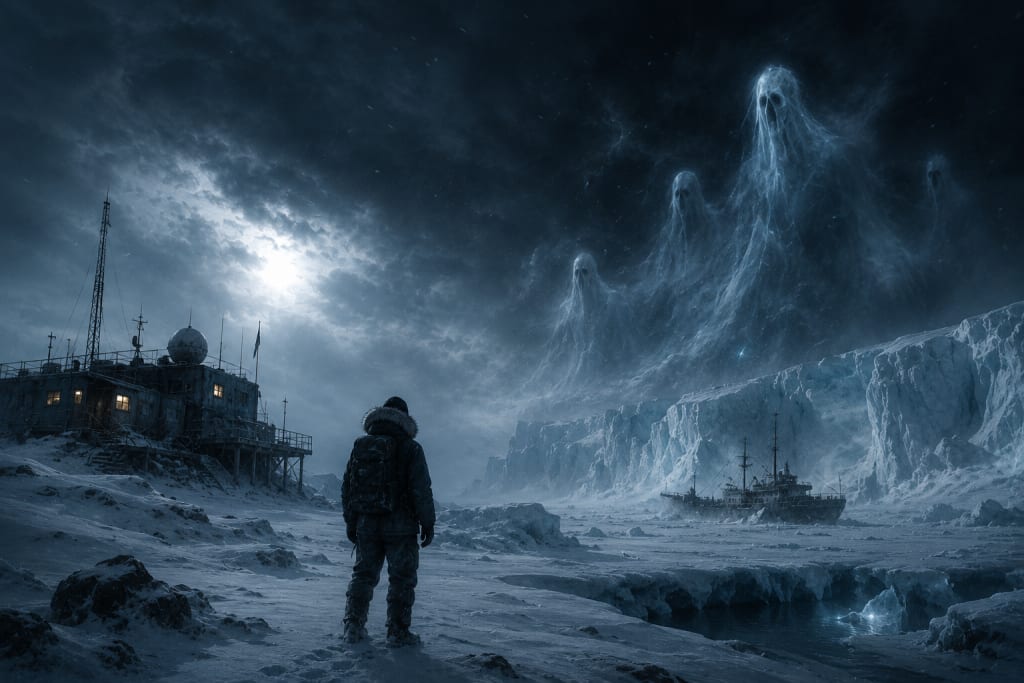
Ghosts of the Frozen Frontier: Paranormal Tales From Antarctica
Antarctica is the closest thing Earth has to another planet. It is vast, white, silent, hostile, and almost completely indifferent to human life. There are no native cities, no ancient villages, no forests, no permanent civilian population, and no familiar rhythm of ordinary civilization. There is ice, wind, darkness, mountains, research stations, abandoned huts, frozen machinery, buried memories, and a horizon that can seem endless enough to disturb the mind.
It is no surprise that Antarctica has gathered ghost stories.
Every haunted place begins with atmosphere, and Antarctica has atmosphere in its most extreme form. A person standing on the ice is surrounded by a landscape that feels both beautiful and threatening. The continent can be dazzling in sunlight and terrifying in darkness. It can feel pure, empty, sacred, alien, or dead. The weather can erase tracks within minutes. The cold can turn a simple mistake into a fatal event. The silence can become so intense that people begin listening for things that may not be there.
This is why the paranormal tales of Antarctica feel different from haunted-house stories. There are no creaking staircases in ancient manor homes, no village churchyards under moonlight, no old roads lined with black trees. Antarctic ghost stories belong to a harsher category. They are stories of polar isolation, doomed explorers, abandoned research stations, phantom footsteps in frozen huts, air disaster memories, the “Third Man” presence, and strange sensations that blur the line between survival psychology and the supernatural.
Some tales are folklore. Some come from explorers, travelers, and station workers. Some are attached to real tragedies. Some are probably shaped by exhaustion, darkness, sensory deprivation, grief, and fear. But in Antarctica, that distinction is part of the mystery. When a person is alone in the coldest, windiest, most isolated continent on Earth, a whisper in the dark does not need to be proven to be powerful.
It only needs to be heard.
Why Antarctica Feels Haunted
Antarctica is not haunted in the same way as an old castle. Its ghosts do not need walls. The landscape itself creates the haunting.
The first factor is isolation. Antarctica is separated from the rest of the world by the Southern Ocean, extreme weather, long travel routes, and strict logistical control. Even today, with aircraft, satellites, radio communication, and modern survival gear, being stationed there can feel like leaving ordinary life behind.
The second factor is darkness. During winter, parts of Antarctica experience weeks or months without sunrise. Human beings are not built for endless darkness. Sleep changes. Mood changes. Time feels unstable. A station can become a small artificial island floating inside a black, frozen universe.
The third factor is silence. In a city, the world is never truly quiet. In Antarctica, silence can be overwhelming. Then the wind arrives and replaces silence with something almost animal. It screams around buildings, shakes walls, and turns loose objects into sudden noises. A person inside a remote station may hear bangs, scrapes, whistles, and footsteps that have perfectly natural causes—but at 3 a.m., in polar darkness, the imagination does not stay calm.
The fourth factor is history. Antarctica’s heroic age of exploration left behind stories of starvation, frostbite, failed expeditions, impossible journeys, and men who died within sight of safety. The huts of early explorers still contain objects that seem abandoned only yesterday: food tins, bunks, boots, equipment, and traces of ordinary life frozen in time.
The fifth factor is death. Antarctica’s environment preserves, conceals, and distorts death. Bodies may be lost in crevasses, snow, aircraft wreckage, or sea ice. Some places are associated with disasters so overwhelming that the landscape itself seems to hold memory.
This combination—extreme environment, human vulnerability, preserved history, and psychological pressure—makes Antarctica one of the most naturally haunted places on Earth.
Scott’s Hut: A Frozen Room Full of Absence
One of Antarctica’s most famous haunted locations is Scott’s Hut at Cape Evans on Ross Island. Built for Robert Falcon Scott’s British Antarctic Expedition of 1910–1913, the hut is one of the most emotionally charged historic sites on the continent. Scott and his men used it before setting out on the tragic journey to the South Pole, a journey from which Scott and several companions never returned.
The hut is not simply a ruin. It is a preserved time capsule. Food tins, equipment, bunks, clothing, tools, scientific materials, and everyday objects remain inside, held by the cold in a state that feels almost unnatural. Visitors often describe the sensation that the men have only stepped away and may return at any moment.
That feeling is central to the haunting.
Several travel and polar-history accounts describe Scott’s Hut as a site linked to eerie impressions, including feelings of dread, shadowy figures, unexplained noises, and the sensation of being watched. Polar Latitudes notes that visitors have reported unease, shadowy figures, and strange sounds inside the hut.
The power of the story does not depend on proving a ghost. The hut itself is almost ghostly by design. It is a room full of interrupted life. The explorers’ things remain, but the explorers are gone. In most places, time moves forward and erases traces. In Antarctica, time can seem to stop.
Scott’s Hut is haunted by incompletion. The men left, hoping for triumph, and the world remembers their suffering. The hut is not frightening because it is evil. It is frightening because it is intimate. It holds the ordinary details of people who faced extraordinary danger: meals, sleeping places, supplies, notes, and tools. The mundane objects make the tragedy more human.
A shadow in such a place does not need to move much to disturb the heart.
Robert Falcon Scott and the Weight of Polar Tragedy
Robert Falcon Scott’s final expedition remains one of the defining stories of Antarctic history. Scott and his party reached the South Pole in January 1912, only to discover that Roald Amundsen’s Norwegian team had arrived first. The return journey became a disaster. Scott, Edward Wilson, Henry Bowers, Lawrence Oates, and Edgar Evans all died on the ice.
Their deaths became part of British imperial myth, polar history, and the tragic imagination of Antarctica. The story contains everything that feeds haunting: ambition, disappointment, endurance, starvation, cold, sacrifice, and final messages written in impossible conditions.
Ghost stories around Scott’s Hut often draw emotional power from this background. The hut was not the place where Scott died, but it was the base from which his hopes began. It stands as a physical connection to a doomed journey. That is enough for the imagination.
A haunted house is often haunted by a death inside it. Scott’s Hut is haunted by departure.
That is a different kind of ghost. It is the ghost of people leaving with confidence and never coming back.
Shackleton’s Hut: The Mecca of Antarctic Memory
Another legendary polar site is Shackleton’s Hut at Cape Royds on Ross Island. It was built during Ernest Shackleton’s Nimrod Expedition of 1907–1909 and remains one of the most iconic early expedition huts in Antarctica.
Shackleton is often remembered differently from Scott. Where Scott’s story is tragic, Shackleton’s is frequently told as a story of survival leadership, especially because of the later Endurance expedition. Yet Shackleton’s Antarctic world was also full of danger, hunger, cold, exhaustion, and near-death experience.
The hut at Cape Royds has inspired its own supernatural stories. Some accounts claim it is haunted by Shackleton’s presence, and popular paranormal summaries even connect the site to stories of Sir Edmund Hillary sensing or seeing Shackleton’s ghost, though such claims should be treated as legend rather than carefully documented historical fact.
Even without accepting that claim literally, Shackleton’s Hut has a powerful atmosphere. In a New Yorker profile of Henry Worsley, the hut is described as a place where the debris of the Nimrod expedition remained in the dimness “as if the party had momentarily stepped away.”
That phrase captures the entire haunting of Antarctic explorer huts. They feel paused, not abandoned. Their objects do not look like museum displays in the ordinary sense. They look like evidence of lives that were interrupted by the continent itself.
Shackleton’s Hut is haunted by endurance. Scott’s Hut is haunted by tragedy. Together, they form a frozen archive of human ambition at the edge of survival.
The Third Man Factor: Antarctica’s Invisible Companion
One of the most fascinating paranormal-like experiences linked to polar exploration is the Third Man factor, also known as the sensed presence. It is the feeling that an unseen companion is nearby during extreme stress, isolation, exhaustion, or danger.
This phenomenon is famously associated with Ernest Shackleton’s 1916 crossing of South Georgia, after the Endurance expedition became trapped and destroyed by ice. Shackleton, Frank Worsley, and Tom Crean crossed the island’s mountainous interior in desperate conditions to reach help. Shackleton later wrote that he felt there were four people on the journey, not three.
The CrimeReads essay on supernatural experiences in Antarctica notes that the “Third Man” phenomenon is named for Shackleton and his companions’ experience during the 1916 crossing of South Georgia. This is one of the most haunting ideas in polar history because it sits perfectly between psychology and the supernatural. Was the “extra presence” a survival mechanism created by an exhausted brain? Was it a spiritual guardian? Was it the mind externalizing hope? Was it a hallucination? Or was it something genuinely unexplained?
The answer depends on interpretation. But the experience itself has been reported by many people in extreme situations, including mountaineers, polar explorers, sailors, and survivors of disaster.
In Antarctica, the Third Man factor feels almost natural. The continent is so vast and indifferent that the mind may create companionship to survive. Yet to the person experiencing it, the presence can feel intensely real.
This is not a ghost that rattles chains. It is a ghost that walks beside you when you should be alone.
McMurdo Station and the Echo of Disaster
Modern Antarctica has its own ghost stories, especially around research stations. McMurdo Station, the largest U.S. Antarctic research station, is one of the most important human settlements on the continent. It is not ancient, but its isolation, industrial architecture, harsh weather, and connection to tragedy have created plenty of folklore.
One of the darkest sources of McMurdo-related ghost stories is the 1979 Mount Erebus disaster. On November 28, 1979, Air New Zealand Flight 901 crashed into Mount Erebus during a sightseeing flight over Antarctica, killing all 257 people on board. It remains one of New Zealand’s worst disasters.
Some ghost stories claim that passengers and crew from the crash have been sensed or seen around McMurdo, and that certain facilities are haunted because of their connection to the recovery effort. Oceanwide Expeditions summarizes the legend, noting claims that bodies were stored at the American research station and that visitors have reported voices, presences, and unexplained footprints, while also saying their own passengers have not reported such experiences.
These stories should be treated respectfully because they are tied to a real tragedy involving many families. Disaster folklore often emerges when grief cannot be neatly contained. A crash site in Antarctica is not like a crash site near a city. It is remote, difficult, frozen, and emotionally overwhelming. The landscape itself makes closure harder.
Whether or not one believes the ghost stories, the Erebus disaster remains a deeply haunting chapter in Antarctic history. The idea of voices, footprints, or presences around McMurdo is a way of expressing the magnitude of loss in a place where death feels both distant and impossibly close.
Ghost Stations and Abandoned Antarctic Outposts
Antarctica is scattered with abandoned or semi-abandoned structures: research stations, field camps, huts, depots, fuel drums, machinery, and old shelters. Some have been removed for environmental reasons. Others remain as historic sites or frozen remnants of past scientific programs.
These places are often described as “ghost stations,” not always because they are believed to contain spirits, but because they look like human life suddenly stopped.
An abandoned Antarctic station can be more unsettling than an abandoned building elsewhere. In a normal city, decay is familiar. Paint peels, plants grow, windows break, dust settles. In Antarctica, abandonment is frozen. Objects may remain eerily preserved. A chair, a boot, a mug, a radio, a bed, or a notebook can sit in place for years, making the station feel not ruined but paused.
Recent popular features have described abandoned Antarctic stations as frozen time capsules, with silent buildings and equipment left to the elements. A 2025 article on Antarctica’s abandoned “ghost huts” highlights how old outposts can feel haunted because they preserve the legacy of isolation, hardship, and sacrifice.
The supernatural quality comes from the mismatch between human objects and inhuman landscape. A kitchen table belongs to domestic life. A bed belongs to rest. A radio belongs to communication. Put those things inside a frozen, empty building at the end of the world, and they become uncanny.
Abandoned stations are haunted by human absence. They say: people were here, and now they are not.
Deception Island: Volcano, Whalers, and Ruins in the Ice
One of Antarctica’s most atmospheric places is Deception Island, a volcanic island in the South Shetland Islands. It has a flooded caldera, black volcanic beaches, old whaling remains, abandoned buildings, and a landscape that feels almost apocalyptic. Steam, ash, ice, rust, and sea all meet there.
Deception Island is not always presented as a classic ghost site, but it has all the ingredients: industrial ruins, violence against nature, volcanic danger, abandonment, and a long history of human exploitation. Whaling stations once operated in the region, and the Southern Ocean’s whaling history is grim.
The Antarctic and Southern Ocean Coalition notes that between 1904 and 1978, more than 1.3 million whales were killed in Antarctic waters, and describes places such as South Georgia and Deception Island as haunted-looking ruins of the whaling era.
That history creates a different kind of haunting. It is not only human ghosts that linger in Antarctic imagination. There are also ecological ghosts: the memory of slaughtered whales, abandoned processing stations, rusted machinery, oil tanks, bones, and industrial silence.
Deception Island feels haunted because the landscape itself seems wounded. It is one of the few Antarctic places where the ground can steam and the beach can feel volcanic underfoot. The contrast between fire and ice gives it a mythic quality. It feels like a gateway place, somewhere not entirely stable.
If Antarctica is the frozen frontier, Deception Island is one of its dark doors.
South Georgia: Shackleton, Whaling, and Bone Beaches
Although South Georgia is not part of the Antarctic continent, it belongs deeply to the wider Antarctic imagination. It was central to Shackleton’s survival story, and it holds some of the most haunting remnants of Southern Ocean history.
The abandoned whaling stations of South Georgia, especially Grytviken, are often described as ghostly. Rusted structures, old machinery, empty buildings, and whale bones create an atmosphere of industrial death. The island is spectacularly beautiful, but its human history is soaked in extraction and violence.
Shackleton is also buried at Grytviken, giving South Georgia an additional layer of polar memory. For many Antarctic travelers, the island feels like a shrine to both survival and loss.
The ASOC description of “bone beaches” and abandoned whaling ruins captures why these places feel haunted even without traditional apparitions.
The ghosts here are not only explorers. They are animals, industries, vanished communities, and an era when the Southern Ocean was turned into a killing ground.
This expands the meaning of Antarctic haunting. Ghosts do not always wear human faces. Sometimes they are the remains of what humans have done.
The Ningen: Antarctica’s Modern Ice Cryptid
No discussion of Antarctic paranormal tales would be complete without mentioning the Ningen, a modern internet-born cryptid said to inhabit Antarctic or subantarctic waters. The creature is usually described as a huge pale humanoid or whale-like being, sometimes with arms, legs, or a human-shaped body.
Unlike older explorer ghost stories, the Ningen is a product of modern digital folklore. It is commonly traced to Japanese internet culture in the mid-2000s, especially anonymous message boards and later paranormal magazines. Wikipedia summarizes the Ningen as a modern Japanese folklore creature said to inhabit Antarctic waters and ice sheets, with its first appearance in online culture around 2005.
The Ningen is fascinating because it shows that Antarctica continues to generate myths even in the satellite age. We live in a world of maps, drones, scientific surveys, and global communication, yet the Antarctic ocean remains vast enough to hold imagined monsters.
The creature’s design is also telling. It is white, large, humanoid, and marine—almost a person-shaped iceberg or a whale transformed into a ghost. It reflects the uncanny nature of polar water, where visibility is limited, scale is difficult to judge, and ordinary animals can appear strange under extreme conditions.
The Ningen is unlikely to be a real animal, but as folklore, it is perfect. It belongs to Antarctica because Antarctica still feels like the world’s blank space, even when science tells us it is not blank at all.
Polar Madness and the Psychology of Haunting
Many Antarctic ghost stories can be read through the lens of psychology. Extreme isolation, cold, darkness, monotony, danger, and confinement can affect perception. People in polar environments may experience sleep disruption, anxiety, depression, irritability, sensory distortions, and a heightened sense of presence.
This does not mean people are “making things up.” It means the brain is trying to survive an environment far outside ordinary human experience.
In an Antarctic station, small sounds matter. A pipe expanding in the cold may sound like a knock. Wind may sound like a voice. A loose door may resemble footsteps. Shadows move differently under artificial light. Snow can create strange reflections. Fatigue can turn uncertainty into certainty.
The “sensed presence” phenomenon is especially important. A person under stress may strongly feel that someone is nearby, even when alone. In a haunted house, that might be called a ghost. In a survival situation, it might be called the Third Man factor. In a research station, it might become a story told quietly during winter.
Antarctica does not need to create supernatural events to feel supernatural. It creates the conditions in which the mind naturally reaches for them.
The Sound of the Ice
One of Antarctica’s most unsettling features is that the ice is not always silent. It cracks, shifts, groans, and moves. Glaciers calve. Sea ice breaks. Wind scours surfaces. Snow squeaks underfoot. Buildings contract and expand. Metal screams under stress.
To someone unfamiliar with polar environments, these sounds can feel alive.
In many ghost stories, sound is more frightening than sight. A voice without a body, footsteps without a person, tapping from an empty room, crying across the wind—these are classic haunting elements. Antarctica supplies them naturally.
A person inside a hut or station may hear a sound and search for its source. If no source appears, the mind fills the gap. That is how places become haunted. Not because every sound is supernatural, but because unexplained sound demands meaning.
The ice itself becomes a storyteller. It speaks in cracks, thuds, and groans. Whether those sounds are geological, meteorological, structural, or paranormal depends on who is listening—and how long they have been alone.
Why Antarctic Ghost Stories Are So Powerful
Antarctic ghost stories endure because they are not cheap scares. They are tied to extreme reality.
Scott’s Hut is frightening because Scott’s expedition really ended in death. Shackleton’s invisible companion is powerful because Shackleton’s survival ordeal really happened. McMurdo’s ghost stories are somber because the Mount Erebus disaster was real. Abandoned stations feel eerie because people really lived in isolation there. Whaling ruins feel haunted because mass killing really occurred in Southern Ocean waters.
The paranormal grows from historical weight.
That is why Antarctica’s ghost stories feel different from invented campfire tales. Even when a specific apparition is uncertain or legendary, the emotional truth behind it is strong. The continent has witnessed suffering, endurance, loneliness, failure, courage, and death. Those things leave marks in human memory.
A ghost story is often a way of saying: something happened here, and it still matters.
The Frozen Frontier as a Mirror
Antarctica is often described as empty, but that is misleading. It is empty of cities, but not empty of meaning. It reflects whatever humans bring to it: ambition, science, greed, courage, loneliness, imagination, fear, and wonder.
Explorers saw glory and danger. Scientists see climate data, ice cores, astronomy, biology, and planetary systems. Tourists see beauty and remoteness. Folklore sees ghosts.
The frozen frontier becomes a mirror because it strips away distractions. In Antarctica, human presence is small and temporary. A station light in winter becomes fragile. A footprint vanishes. A hut survives only because the cold preserves it. A radio signal becomes a lifeline. A human voice in the wind becomes precious.
This is why the continent inspires both science and superstition. The more extreme a place is, the more meaning people attach to it.
Final Verdict
Antarctica’s paranormal tales are not ordinary ghost stories. They are colder, lonelier, and more psychologically intense. They come from explorer huts where time seems frozen, research stations where darkness lasts for months, disaster sites where grief has nowhere familiar to rest, abandoned outposts that look paused between life and death, and icy waters imagined to hold strange creatures.
The ghosts of Antarctica may be spirits, memories, hallucinations, survival mechanisms, folklore, or the emotional residue of history. Perhaps they are all of these at once.
Scott’s Hut feels haunted because it preserves the beginning of a doomed journey. Shackleton’s Hut feels haunted because endurance itself seems to linger there. The Third Man factor feels paranormal because invisible companionship appears at the edge of human survival. McMurdo’s ghost stories carry the sorrow of the Erebus disaster. Deception Island and South Georgia are haunted by the industrial ghosts of whaling. The Ningen proves that even modern minds still imagine monsters in Antarctic waters.
The frozen frontier does not need castles, graveyards, or ancient villages. Its hauntings are made of wind, ice, darkness, memory, and isolation. In Antarctica, the dead do not have to rise from the ground. They can remain in the cold, in the silence, in the abandoned huts, in the stories told by those who have heard something moving outside when no one should be there.
At the end of the world, the line between history and haunting becomes thin. And when the polar night closes in, even the most rational mind may begin to wonder whether Antarctica is truly empty—or whether something has been walking beside us all along.


