Chimera Cats: The Fascinating Genetics Behind the Famous “Two-Faced” Feline
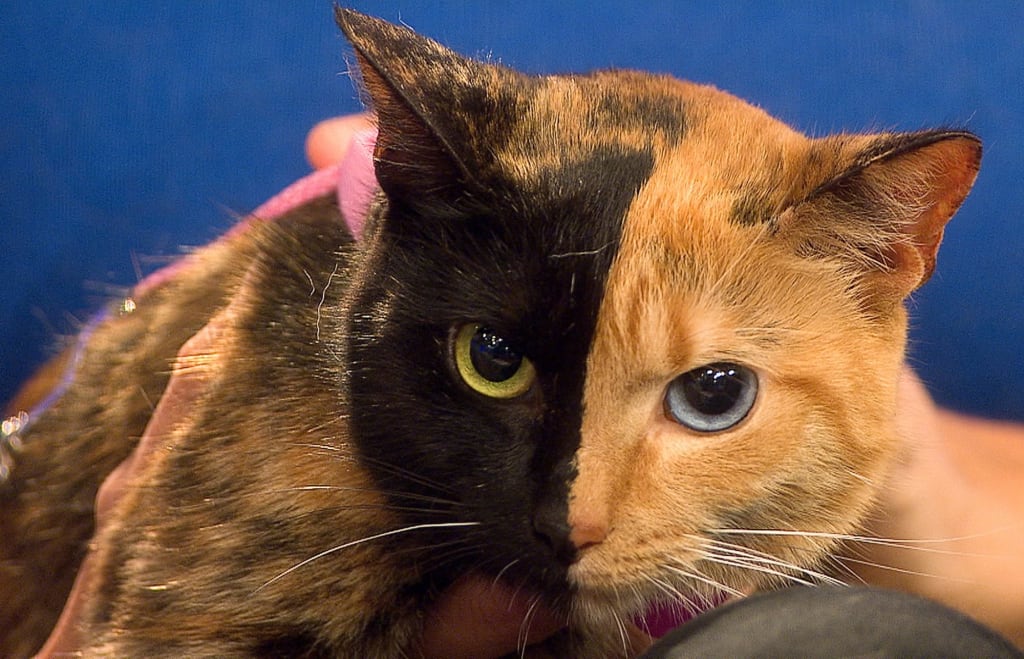
A cat with one half of its face orange and the other half black can look almost impossible.
Sometimes the dividing line runs nearly perfectly down the middle of the nose. One eye may be blue while the other is green or amber. The contrasting colors can make the animal appear as though two completely different cats were combined into one.
Social media usually has an immediate explanation:
“It’s a chimera cat.”
And genuine chimera cats absolutely do exist.
In biological terms, a chimera is an individual containing two genetically distinct populations of cells originating from different embryos. One way this can happen is when two early embryos fuse and continue developing as a single animal. The resulting individual can carry two different genomes within one body.
But here is the important correction:
A split-colored face does not prove that a cat is a chimera.
In fact, many spectacular “chimera cats” shared online are probably ordinary tortoiseshell or calico cats whose coat patterns arose through completely normal feline genetics.
The distinction between chimerism and mosaicism makes the real story even more fascinating.
And recent genetic research has finally solved a mystery scientists spent decades trying to understand: why cats become orange in the first place.
What Is a True Chimera Cat?
A biological chimera contains cells derived from more than one fertilized egg, or zygote.
Imagine that two eggs are fertilized independently.
Ordinarily, they might develop into two separate kittens.
But during very early embryonic development, the two embryos fuse.
Instead of producing two animals, development continues as one.
Some tissues descend from embryo A.
Other tissues descend from embryo B.
The resulting animal therefore contains two genetically distinct cell populations. Veterinary geneticists at the University of California, Davis describe chimerism precisely this way: an animal can carry two distinct sets of DNA, often as a result of early fusion between twin embryos.
That is the real biological meaning of a chimera.
It has nothing inherently to do with having half an orange face and half a black face.
A chimera could potentially look completely ordinary.
Why Is It Called a “Chimera”?
The scientific term comes from Greek mythology.
The mythological Chimera was a creature composed of parts from different animals, traditionally described as combining features of a lion, goat and serpent.
Biologists later borrowed the term for organisms composed of genetically distinct cell populations.
The comparison is imperfect, of course.
A chimera cat is not literally composed of two visible animals stitched together.
Its different genetic populations are mixed together during development at the cellular level.
Could One Cat Really Have Two Different DNA Profiles?
Yes.
That is exactly what makes true chimerism so extraordinary.
Suppose one embryo carries:
DNA profile A
while another carries:
DNA profile B.
After fusion, cells derived from both embryos can persist.
A cheek swab might sample mainly one genetic population.
Blood might contain another.
Hair follicles from different coat patches might potentially reveal different genotypes.
This is why confirming chimerism can require testing multiple tissues rather than taking one DNA sample.
The genetic difference is real, but its distribution through the body may be uneven.
Scientists Have Confirmed Chimerism Through Different-Colored Hair
A beautiful veterinary example comes not from a cat but from a Labrador Retriever named Tiger.
Tiger was born with unusual black and yellow coat patches.
Researchers sampled hairs from the differently colored areas and found that the black and yellow follicles carried different genotypes.
The evidence showed that Tiger contained two distinct genetic cell populations, consistent with fusion of embryos that could separately have developed into black and yellow Labradors. UC Davis uses the case as an example of confirmed animal chimerism.
That is the kind of evidence required before confidently calling an animal a true chimera.
Appearance alone is not enough.
The Biggest Chimera Cat Myth
The most persistent misconception is:
A cat whose face is divided into two colors must be a chimera.
That is false.
A dramatically divided face can occur in an entirely ordinary tortoiseshell or calico female.
Why?
Because those cats are already genetic mosaics.
And mosaicism is not the same thing as chimerism.
Chimera vs. Mosaic: What Is the Difference?
This distinction is the key to understanding these cats.
Chimera
A chimera contains genetically different cell populations that originated from different zygotes.
Think:
two embryos → one animal
Mosaic
A mosaic contains genetically or functionally different cell populations that originated from the same zygote.
Think:
one embryo → different cell populations during development
Tortoiseshell cats provide one of biology's classic examples of mosaicism.
Their orange and black patches generally do not require two embryos at all.
They arise because of something called X-chromosome inactivation.
Why Tortoiseshell Cats Are Orange and Black
Female mammals typically have two X chromosomes.
But cells do not generally need two fully active copies of most X-linked genes.
Early in embryonic development, one X chromosome in each cell becomes largely inactive.
Which X gets switched off is mostly random.
Once a cell makes that decision, its descendants generally maintain the same inactive X.
Cornell University's genetics material explains this beautifully using tortoiseshell cats. Each black or orange patch can represent a clone of cells descended from an embryonic cell in which a particular X chromosome was silenced.
That produces patches.
And in 2025, scientists finally identified the long-mysterious genetic change responsible for feline orange coloration.
Scientists Finally Solved the Orange Cat Mystery in 2025
For decades, geneticists knew that the orange-color locus was located on the cat's X chromosome.
But they did not know exactly which gene was responsible.
That changed in 2025.
Two research groups linked orange coloration to a roughly 5-kilobase deletion affecting regulation of the X-linked gene ARHGAP36.
The mutation changes gene activity in pigment-producing melanocytes and influences the pathway controlling production of dark versus reddish-yellow pigment.
The discovery solved a long-standing puzzle in feline genetics.
It also reinforced why tortoiseshell cats are such extraordinary living demonstrations of X-chromosome biology.
How the Patchwork Forms
Consider a female kitten with:
one X chromosome carrying the orange variant,
and
one X chromosome carrying the non-orange version.
Early during development, different embryonic cells randomly silence different X chromosomes.
In some cells:
the X carrying orange remains active.
Those cells eventually contribute to orange fur.
Elsewhere:
the other X remains active.
Those cells contribute to black or brown fur.
As those early cells multiply, they produce larger groups of pigment cells.
The result is a living genetic patchwork.
The cat is not necessarily two embryos.
She is one embryo whose cells express different X chromosomes.
That is mosaicism.
Why Can the Face Look Perfectly Split?
This is where appearances become deceptive.
Pigment-producing cells spread and multiply while an embryo develops.
Because the mammalian body develops with bilateral organization—left and right sides forming around a central body axis—pigment-cell populations can sometimes produce remarkably sharp boundaries.
By chance, a major boundary between orange-producing and black-producing cell populations may run almost directly along the middle of the face.
The result looks intentional.
One side orange.
One side black.
A line down the nose.
It practically screams:
“two cats fused together.”
But the appearance can emerge from ordinary tortoiseshell mosaicism.
There is no biological rule stating that embryo fusion must create a neat vertical division down the face.
Likewise, there is no rule preventing a non-chimeric tortoiseshell from developing one.
A Real Chimera Might Not Look Split at All
This is the flip side of the misconception.
A genetically confirmed chimera might show:
subtle coat differences,
mixed blood-cell populations,
unusual reproductive genetics,
or no obvious outward difference whatsoever.
UC Davis specifically notes that chimerism is not always visible from an animal's appearance.
So the famous “two-faced cat” appearance is neither necessary nor sufficient for diagnosing chimerism.
That makes photographs fascinating—but scientifically inconclusive.
What About Cats With Two Different Eye Colors?
Another feature often associated with so-called chimera cats is heterochromia, meaning differently colored eyes.
One blue eye and one green or amber eye certainly makes a split-faced cat look even more extraordinary.
But heterochromia does not automatically indicate chimerism either.
Eye color depends on pigment development and genetics, and differently colored eyes can occur independently of embryo fusion.
So:
split face + different-colored eyes ≠ confirmed chimera.
It may be visually suggestive.
It is not a DNA test.
Calico Cats Add Another Layer
Calico cats use essentially the same orange-versus-dark X-linked system as tortoiseshell cats.
The major visual difference is white spotting.
A typical tortoiseshell displays intermingled orange and black patches.
A calico generally has larger, more clearly separated orange and dark patches against areas of white.
Modern genetic research explains that white spotting changes how pigment-producing melanocytes populate the developing skin, allowing the surviving orange and dark clones to occupy larger regions.
Again, spectacular patchwork does not require chimerism.
Normal developmental genetics is already capable of producing extraordinary designs.
Why Are Most Tortoiseshell and Calico Cats Female?
The explanation again comes from the X chromosome.
Typical female cats have:
XX
Typical males have:
XY
Because the orange-color system is X-linked, an ordinary female can carry an orange version on one X chromosome and a non-orange version on the other.
Random X inactivation then produces orange and black patches.
A typical XY male has only one X chromosome.
He normally expresses one version across his coat:
orange,
or
non-orange.
That is why tortoiseshell and calico cats are overwhelmingly female.
But nature, as usual, has exceptions.
Male Tortoiseshell Cats Are Especially Interesting
A male tortoiseshell or calico is unusual enough that geneticists often take notice.
Several mechanisms can produce one.
One is an XXY chromosome complement, analogous in broad chromosomal terms to Klinefelter syndrome in humans.
An XXY male possesses two X chromosomes, allowing the same X-inactivation process that creates tortoiseshell coloration in females.
A published case examining a male tortoiseshell cat found exactly that: a 39,XXY karyotype. The cat was sterile because normal sperm production was absent.
But XXY is not the only explanation.
Chimerism can create male tortoiseshell cats too.
A Confirmed Fertile Male Chimera
Researchers have documented an especially fascinating Maine Coon tomcat with tortoiseshell coloration.
Genetic testing found multiple alleles across tissues including blood, hair roots and testes, demonstrating true chimerism even though his basic chromosome complement appeared male.
Remarkably, the cat was fertile.
And research published in 2026 provided another remarkable example.
Scientists examined a fertile tortoiseshell Maine Coon male and identified both XX and XY cell populations.
DNA from blood, hair follicles and saliva confirmed the coexistence of those genetically distinct cell lines, with different proportions appearing in different tissues.
This is true chimerism—not merely a visually dramatic coat.
How Can Scientists Confirm a Chimera Cat?
A veterinarian cannot simply look at a split face and diagnose chimerism.
Genetic confirmation may involve comparing DNA from different tissues.
Possible samples include:
- blood
- cheek cells
- saliva
- hair follicles from differently colored patches
- skin
- reproductive tissue
Scientists may use:
DNA markers,
chromosome analysis,
microsatellite testing,
short tandem repeat analysis,
or more advanced molecular techniques.
The critical evidence is finding genetically distinct cell populations that cannot be explained simply by ordinary X-chromosome inactivation or another form of mosaicism.
The 2026 Maine Coon study, for example, used cytogenetic testing together with molecular analysis of blood, hair follicles and saliva to demonstrate both XX and XY populations.
Why One DNA Test Might Miss Chimerism
Suppose most cells collected from a cheek swab come from genetic lineage A.
The result may look completely ordinary.
But perhaps much of the cat's blood comes from lineage B.
Or one section of skin contains a larger proportion of lineage B.
Testing only the cheek could therefore miss the second genome.
This is why researchers studying suspected chimerism often test more than one tissue.
A chimera's two cell populations do not necessarily occur in equal proportions throughout the body.
Does a Chimera Have “Two Complete Sets of DNA”?
Popular explanations often say:
“A chimera has two sets of DNA.”
That is broadly useful but can create the wrong mental picture.
It does not mean every cell contains two complete genomes simultaneously.
Rather, the body contains different populations of cells.
Some cells carry one genotype.
Other cells carry another.
Different tissues may contain different mixtures.
That distinction is important.
A chimera is not one cell somehow carrying the full genomes of two cats.
It is one organism constructed from cells belonging to different genetic lineages.
Are Chimera Cats Rare?
True whole-body embryo-fusion chimerism is considered unusual, but assigning a reliable number such as “one in a million” would be misleading.
There is a major detection problem.
Many chimeras may look completely ordinary.
Unless something unusual prompts genetic testing, there may be no reason ever to discover the condition.
Research in mammals and humans suggests that naturally occurring chimerism can go unnoticed, particularly when the fused embryos have similar genetic characteristics.
So scientists can confidently call chimerism uncommon.
Determining exactly how uncommon it is in domestic cats is much harder.
Are Chimera Cats Healthy?
Another popular claim says:
“Chimera cats are completely healthy just like any other cat.”
That can be true—but it should not be presented as a universal rule.
Chimerism itself does not automatically make an animal sick.
A cat whose embryos fused early in development may live a normal life and never know, biologically speaking, that anything unusual happened.
But health consequences depend on what genetic cell populations are involved and which tissues they contribute to.
For example, sex-chromosome chimerism can sometimes influence reproductive development.
Conversely, the recent fertile XX/XY male Maine Coon demonstrates that even striking chromosomal chimerism can sometimes occur in an otherwise normally developed animal.
So the most accurate statement is:
Many chimeric animals can be healthy, but chimerism does not guarantee either perfect health or disease.
It depends on the individual.
Does Chimerism Affect a Cat's Personality?
There is no scientific reason to expect a chimera cat to have “two personalities.”
That idea comes from the visual metaphor of two animals combined into one.
Genes influence aspects of biology and behavior, but having two genetic cell populations does not create two minds.
A chimera cat has:
one brain,
one nervous system,
one life history,
and one individual personality.
It may be affectionate.
Independent.
Playful.
Quiet.
Chaotic.
Obsessed with cardboard boxes.
Or convinced that 4:37 a.m. is the ideal time to run across someone's face.
Those are cat characteristics—not evidence that two embryos are arguing over control.
Does a Chimera Cat Have Two Blood Types?
Possibly, but not necessarily.
There is a form of chimerism called blood or hematopoietic chimerism, where genetically distinct blood-cell populations coexist.
This can happen when fetal blood-producing cells pass between twins through shared placental blood vessels.
However, simply finding feline blood type AB does not prove chimerism.
Research into the feline AB blood-group system established that type AB is a genetically inherited blood phenotype rather than automatically resulting from blood chimerism.
This is another useful reminder:
Biology rarely allows us to infer a complicated genetic mechanism from one dramatic-looking trait.
Mosaicism Can Be Just as Fascinating as Chimerism
Calling a spectacular tortoiseshell “not a true chimera” does not make the cat less extraordinary.
Quite the opposite.
A tortoiseshell coat is a visible map of events that happened when the animal consisted of only a tiny developing embryo.
Each large orange patch traces back to early cell populations.
Each dark patch traces back to others.
The pattern records which X chromosome became inactive in ancestral pigment-producing cells, followed by their expansion across the developing skin.
You are essentially looking at developmental genetics written directly onto fur.
That is remarkable whether two embryos were involved or not.
The Orange Cat Gene Mystery Took Decades to Solve
The history behind orange coloration makes the subject even better.
Scientists had known for generations that orange fur was linked to the X chromosome.
Calico and tortoiseshell cats had even helped scientists understand the fundamental concept of random X inactivation.
Yet the actual molecular identity of the feline orange mutation remained unknown.
Then, in 2025, researchers identified the regulatory deletion involving ARHGAP36.
The work showed that the mutation changes expression of ARHGAP36 specifically in pigment-producing cells and suppresses genes involved in dark eumelanin production, shifting pigmentation toward reddish-yellow pheomelanin.
A household cat's fur had been demonstrating one of mammalian genetics' most famous principles for decades—
while still hiding the gene responsible.
Why These Cats Fascinate Scientists
Chimerism and feline mosaicism touch several major areas of biology.
Embryonic development
They reveal how tiny groups of early cells eventually contribute to different tissues.
Genetics
They show that one visible animal can contain more genetic complexity than expected.
Epigenetics
Tortoiseshell cats famously demonstrate how X-chromosome inactivation changes gene expression without changing the underlying DNA sequence.
Pigment biology
Their coats reveal the migration and expansion of melanocytes during development.
Reproductive biology
Rare male tortoiseshells can expose XXY chromosomes, XX/XY chimerism and other unusual genetic situations.
Veterinary medicine
Chimerism can occasionally complicate genetic tests, blood analysis or reproductive assessment.
Few ordinary pets provide such a visually striking introduction to developmental genetics.
Can Humans Be Chimeras Too?
Yes.
Natural human chimerism is documented.
Early embryos can fuse, producing a person with cell populations derived from two zygotes.
Other forms of chimerism can occur through exchange of blood-producing cells between twins.
Pregnancy can also create microchimerism, where small numbers of fetal cells persist in the mother or maternal cells persist in the child.
A review of natural human chimerism notes that many cases probably remain undetected because they produce no obvious outward abnormality.
There have even been unusual medical and forensic cases where DNA sampled from one tissue did not match DNA from another as expected.
So the phenomenon that makes a “chimera cat” fascinating is not uniquely feline.
It is part of the strange possibilities built into mammalian development.
Could Two Embryos Really Become One Without Anyone Knowing?
Yes.
This may seem astonishing because we imagine an embryo as a miniature finished animal.
Very early embryos are nothing like that.
At the earliest stages, development involves small groups of cells whose eventual identities are not yet completely fixed.
If genetically distinct early embryonic populations combine at an appropriate stage, they can sometimes contribute to a single developing organism.
The body then organizes itself using both populations.
By the time the animal is born, there may be no obvious sign of the event.
No extra limbs.
No visible dividing line.
No health problem.
Just two cellular lineages quietly sharing one body.
Why “Two-Faced Cat” Is a Fun Description—but a Bad Diagnosis
There is nothing wrong with enjoying the dramatic appearance.
A perfectly divided tortoiseshell face genuinely looks like nature painted two cats onto one head.
But scientifically, photographs cannot tell us whether we are looking at:
a true chimera,
an ordinary tortoiseshell mosaic,
a calico,
heterochromia,
another pigment variation,
or a combination of these.
Calling every split-faced cat a chimera turns a complicated genetic phenomenon into a visual label.
The actual science is much better.
What Would Make Scientists Strongly Suspect Chimerism?
Researchers become especially interested when an animal displays biological combinations difficult to explain through ordinary inheritance.
Examples could include:
genetically incompatible coat characteristics appearing in separate regions,
unexpected sex-chromosome patterns,
different genetic markers detected among tissues,
or a male tortoiseshell whose chromosome analysis does not fit the ordinary XXY explanation.
Even then, laboratory testing is required for confirmation.
The Most Important Difference
Here is the entire subject in two lines:
Tortoiseshell mosaicism:
One fertilized egg → different X chromosomes active in different cell populations.
Embryonic chimerism:
Two fertilized eggs → two genetically distinct cell populations combined into one animal.
Both can produce visually remarkable cats.
Only the second is a true chimera.
The Bottom Line
The popular description of chimera cats contains a real biological phenomenon wrapped in a common misconception.
Yes, true chimera cats can exist.
A genuine chimera contains two genetically distinct cell populations, potentially produced when two embryos fuse very early in development.
Yes, that can sometimes influence coat appearance.
And yes, researchers have genetically confirmed chimerism in cats, including unusual male tortoiseshell individuals. A 2026 study documented a fertile Maine Coon carrying both XX and XY cell lines in multiple tissues.
But:
A perfectly divided face is not proof of chimerism.
Most female tortoiseshell and calico cats already possess patchwork coloration because of random X-chromosome inactivation, making them mosaics rather than chimeras.
Different-colored eyes are not proof either.
And a true chimera may show no obvious outward sign at all.
That makes the reality even more extraordinary than the viral version.
A spectacularly divided cat might be carrying the cellular descendants of two fused embryos.
Or it might simply be displaying one of the most beautiful consequences of mammalian X-chromosome biology.
You cannot reliably tell by looking.
Sometimes the secret is hidden not in the face—
but in the DNA.
Frequently Asked Questions About Chimera Cats
What is a chimera cat?
A true chimera cat contains two or more genetically distinct cell populations that originated from different zygotes or embryos.
How does a chimera cat form?
One mechanism is the fusion of two separately fertilized embryos very early in development, after which cells from both contribute to a single kitten.
Does a chimera cat literally have two sets of DNA?
Its body contains cells belonging to two distinct genetic lineages. It does not mean every individual cell contains two complete genomes.
Does a split face mean a cat is a chimera?
No. Ordinary tortoiseshell and calico cats can develop dramatic split-face patterns without chimerism.
Why do tortoiseshell cats have orange and black patches?
The orange-color system is X-linked. In heterozygous females, random X-chromosome inactivation causes different groups of cells to express either the orange or non-orange version.
What gene makes cats orange?
Research published in 2025 connected orange coloration to a regulatory deletion affecting the X-linked ARHGAP36 gene.
What is the difference between a chimera and a mosaic cat?
A chimera's genetically distinct populations originate from different zygotes. A mosaic's different cell populations arise from a single zygote.
Are tortoiseshell cats chimeras?
Usually, no. Typical female tortoiseshell cats are genetic mosaics produced by random X-chromosome inactivation.
Are calico cats chimeras?
Usually not. Their orange-and-dark pigmentation is generally produced through X inactivation, combined with white spotting.
Why are most calico and tortoiseshell cats female?
Females normally have two X chromosomes, allowing them to carry both orange and non-orange versions and express them in different cellular patches through X inactivation.
Can a male cat be tortoiseshell?
Yes, but it is uncommon.
How can a male tortoiseshell exist?
Possible explanations include an XXY chromosome complement and true chimerism involving genetically distinct cell populations.
Are male tortoiseshell cats always sterile?
No. XXY males are commonly sterile, but genetically confirmed fertile chimeric male tortoiseshell cats have been reported.
Has a true chimera cat ever been scientifically confirmed?
Yes. Genetic studies have confirmed chimerism in cats, including cases where different genetic cell populations were found across blood, hair, saliva or reproductive tissues.
How can a veterinarian test for chimerism?
Confirmation may involve DNA analysis of multiple tissues, chromosome analysis and molecular markers that reveal genetically distinct cellular populations.
Would an ordinary pet DNA test detect chimerism?
Not necessarily. A sample from only one tissue may contain predominantly one cell lineage and miss the other.
Do chimera cats always look unusual?
No. Some chimeras may have no obvious external signs.
Do all chimera cats have faces split down the middle?
No. There is no rule requiring chimerism to produce bilateral facial coloration.
Can a non-chimera have a perfectly split face?
Yes. Tortoiseshell mosaicism can produce sharp facial boundaries.
Do different-colored eyes prove chimerism?
No. Heterochromia can arise independently and does not diagnose chimerism.
Are chimera cats unhealthy?
Not necessarily. Many can be healthy, although particular forms of chimerism—especially involving different sex chromosomes—may sometimes affect reproductive development.
Do chimera cats have two personalities?
No. They are single animals with one nervous system and one individual personality.
Can a chimera have two blood types?
Some forms of chimerism can involve genetically distinct blood-cell populations, but feline blood type AB by itself does not establish chimerism.
Are chimera cats extremely rare?
True chimerism appears uncommon, but the exact frequency in cats is unknown because many animals may never show obvious signs or undergo genetic testing.
Can humans be chimeras?
Yes. Natural human chimerism is documented, including embryo-fusion chimerism and blood-cell chimerism between twins.
What is the most surprising fact about chimera cats?
Probably this:
The cat that looks most like a chimera may not actually be one, while a genuine chimera could be sitting beside you looking completely ordinary.
The only reliable way to tell is not by staring at the colors on its face.
It is by looking deeper—
into its cells and DNA.