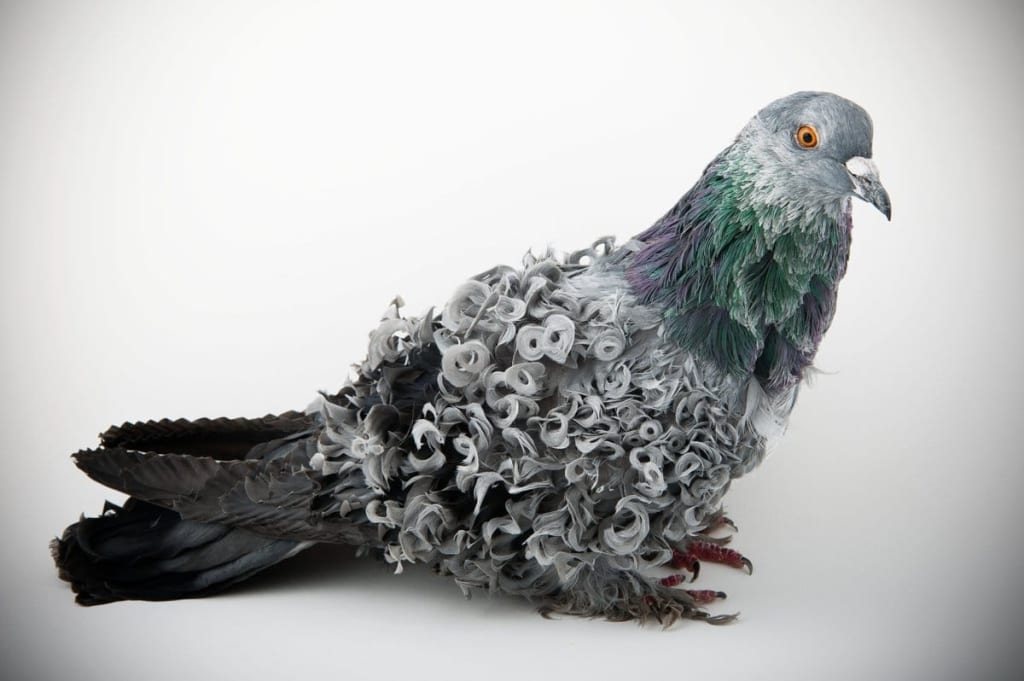
Frillback Pigeon: Meet the Extraordinary Bird With Naturally Curled Feathers
At first glance, the Frillback Pigeon looks as though someone carefully styled every feather with a tiny curling iron.
Rows of soft ringlets rise across its wings. Individual feathers bend, twist, and turn back on themselves, creating patterns that can resemble sculpted fabric, flower petals, or carefully arranged curls of hair.
The effect is completely real.
Frillbacks are not digitally altered birds, and their feathers have not been manually styled. The curls grow naturally as an inherited characteristic of the breed. However, “natural” should not be confused with “wild.” The appearance was developed and strengthened through generations of selective breeding by pigeon fanciers.
A properly developed Frillback carries its most impressive curls across the wing shields—the broad areas covering the folded wings. Curled or wavy feathering may also appear around the feet, while the main flight and tail feathers generally show wrinkles or waves rather than the same tight ringlets.
No two birds display their curls in precisely the same arrangement. The direction, size, density, closure, and symmetry of the feathers can vary, giving every Frillback a slightly different sculpted appearance.
This combination of biological inheritance, human selection, and individual variation has made the Frillback one of the most recognizable fancy pigeon breeds in the world.
Frillback Pigeon Quick Facts
- Common name: Frillback Pigeon
- Scientific classification: Domestic form of Columba livia
- Breed type: Fancy or exhibition pigeon
- Defining feature: Curled wing-shield feathers
- Ancestry: Domestic Rock Dove
- Origin: Uncertain; historical sources frequently connect it with Europe and parts of the wider “Orient”
- Head varieties: Plain-headed and shell-crested
- Leg feathering: Usually feathered, with curls or waves desirable in the muffs
- Flight ability: Capable of flight, but not bred primarily as a racing or performance pigeon
- Common uses: Exhibition, ornamental aviaries, breeding, and companionship
- Temperament: Varies by the individual, socialization, environment, and breeding line
- Most important exhibition trait: Quality and coverage of the curls
All domestic pigeon breeds, including the Frillback, belong to the same species as the Rock Dove. Centuries of selective breeding have produced enormous variation in pigeon color, body shape, feather structure, flight behavior, voice, and ornamentation.
What Is a Frillback Pigeon?
The Frillback is a domesticated fancy pigeon distinguished by feathers that curl upward and backward across the wing shields.
When the bird folds its wings normally, these curled covert feathers remain visible along its back and sides. Instead of lying flat and forming a smooth surface, they create raised rows of ringlets.
The visual result can change dramatically depending on the bird’s color.
On a white Frillback, the feathers may resemble layers of carved ivory or folded lace.
On a black bird, the curls can create shadows and flashes of green or purple iridescence.
Blue, silver, red, yellow, and grizzle varieties reveal contrasting feather edges that make the spiral structure especially visible.
Although social-media descriptions sometimes claim that Frillbacks have tight curls over their entire bodies, this is an exaggeration. The breed’s defining curls are concentrated on the wing shields. Exhibition standards also call for curled or wavy feathering around the feet and definite waviness in the primary and tail feathers.
Are the Frillback’s Curly Feathers Real?
Yes. The feathers are real, and the curls develop as the plumage grows.
They are not:
- Permed
- Glued
- Heat-styled
- Cut into spirals
- Artificially attached
- Created with grooming products
- A result of disease or injury
Artificial alteration is specifically prohibited in exhibition standards. The curled appearance must come from the bird’s natural feather growth.
The feathers bend because their two sides do not develop evenly. Historical research on Frillback inheritance described unequal growth within the feather as producing twisting to the left or right and an upward curl at the tip.
This means the feather is already developing into a curved structure while it grows.
A human breeder influences which birds reproduce, but the breeder does not physically create each curl.
Natural Does Not Mean the Breed Developed in the Wild
Calling the feathers “naturally curled” can be slightly misleading without further explanation.
The feathers grow naturally from the bird’s body. However, Frillbacks did not become a recognized breed because a large wild population independently evolved perfectly arranged curls.
Like Fantails, Pouters, Jacobins, Tumblers, and many other fancy pigeons, the Frillback was shaped through selective breeding.
At some point, people noticed pigeons with unusual feather growth. They bred birds expressing the desired trait and continued selecting offspring with stronger, broader, or more consistent curls.
Across generations, the characteristic became increasingly established.
Selective breeding did not invent feathers from nothing. It increased the frequency and intensity of inherited variation that already existed among domestic pigeons.
Why Is It Called a Frillback?
The name describes the bird’s most visible feature.
“Frill” refers to the unusual reversed or curled feathering.
“Back” refers to the region where the effect is most easily seen when the wings are folded across the bird’s back.
The curls actually arise mainly from the covert feathers covering the wing shields rather than from every feather on the anatomical back.
The name is also useful because it separates the breed from pigeons whose ornamental feathering occurs on the chest, neck, hood, or tail.
A Frillback is recognized first by the curled surface of its folded wings.
The Frillback’s Curls Are More Complex Than They Look
A high-quality curl is not simply a messy or fluffy feather.
Pigeon-show standards evaluate several details, including:
- Curl coverage
- Feather length
- Curl size
- Density
- Ringlet formation
- Closed curl endings
- Symmetry
- Feather strength
- Coverage near the shoulders
- Continuity across the wing
The curls should cover the wing shield without obvious bald-looking gaps or large smooth sections.
The feathers should be sufficiently long and firm to create a recognizable shape. A weak feather may look fluffy without forming a proper curl. An excessively straight feather will fail to produce the breed’s characteristic ringlet.
In the archived National Pigeon Association standard, curl quality accounts for 50 points out of a possible 100—more than the head, color, body, or foot feathering. That weighting demonstrates how completely the identity of the breed depends on its feather structure.
Every Frillback Looks Slightly Different
The breed standard may define an ideal, but living birds do not emerge from identical molds.
The precise appearance of a Frillback can differ according to:
- Genetics
- Age
- Molting stage
- Feather quality
- Nutrition
- Health
- Sex
- Breeding line
- Environmental wear
- Individual development
One bird may have large, open curls that create dramatic loops.
Another may have tighter, more densely arranged ringlets.
Some feathers turn strongly upward. Others twist to one side before closing.
Even the left and right wings of the same bird may not be perfectly identical.
That variation is part of the breed’s appeal. The plumage follows a recognizable biological pattern, but each bird receives its own arrangement.
The effect is comparable to naturally curly human hair: the trait can be inherited, yet the direction and exact form of individual curls remain unique.
What Does a Proper Frillback Look Like?
The curls attract immediate attention, but exhibition standards assess the entire bird.
A well-balanced Frillback should have a substantial but elegant appearance, with a broad breast, strong wings, a relatively low stance, and a body carried slightly horizontally.
The standard describes the body as somewhat boat-shaped, with broad shoulders and a gently sloping back. The wings should be wide and strong, with their ends resting over the tail without crossing excessively.
The tail is relatively long but should remain proportionate to the rest of the bird.
The legs are short and sturdy. The foot feathering creates a fuller silhouette near the ground.
These features give the bird enough physical substance to support its elaborate plumage. Without a balanced body, even excellent curls may appear awkward or poorly presented.
Plain-Headed and Shell-Crested Frillbacks
Frillbacks occur in two major head styles.
Plain-Headed Frillback
The plain-headed variety has a smooth, rounded head without an ornamental crest.
According to the American standard, the head should appear slightly oval, with a rounded forehead and a noticeable transition where the forehead meets the wattle.
This version keeps visual attention focused on the wing curls and body.
Shell-Crested Frillback
The shell-crested variety has a raised formation of feathers across the rear of the head.
A desirable shell crest should:
- Stand upright rather than lying flat
- Appear full and thick
- Extend evenly across the back of the head
- Include small rosettes at the sides
- Remain proportionate to the bird
The crest adds another decorative element without replacing the wing curls as the breed’s defining feature.
Historical accounts show that both plain-headed and shell-crested Frillbacks have existed for centuries. Early birds were also seen with both feathered and clean legs, although modern standards differ according to country and organization.
The Feathered Feet and Muffs
Many Frillbacks have conspicuous feathering around their feet.
Pigeon fanciers commonly call this feathering a muff.
Under the American show standard, desirable muffs are approximately two to three inches long, full, and arranged in an arc around the feet. The feathers should show definite waviness and end in a visible curl or frill.
The foot curls visually connect the lower body with the wing shields.
However, heavily feathered feet require practical care. Long foot feathers can become:
- Muddy
- Broken
- Soiled by droppings
- Tangled
- Worn on rough flooring
- Contaminated in wet housing
The bird’s living environment therefore matters as much as appearance. Clean, dry flooring and properly designed perches help protect both feather condition and foot health.
Frillback Colors and Patterns
Frillbacks occur in a wide variety of colors and markings.
Historically recognized varieties include:
- White
- Black
- Red grizzle
- Yellow grizzle
- Blue grizzle
- Silver grizzle
Additional modern lines may include:
- Red
- Yellow
- Blue bar
- Silver bar
- Shield-marked patterns
- Mottled birds
- Rosewing patterns
- Whitesides
- Pied or splashed birds
- Rare-color projects
Recognition differs among national standards and breed clubs. A color accepted in one country or organization may be placed in a rare-color or any-other-color category elsewhere.
Color is important in exhibition, but it remains secondary to curl development.
A brilliantly colored bird with weak, incomplete frilling will not represent the breed as successfully as a well-curled bird with correct overall balance.
Why the Curls Look Different on Different Colors
Feather shape remains the central characteristic, but color changes how the human eye perceives it.
White Frillbacks
White plumage reflects light across every raised edge.
The absence of pattern makes the bird appear clean, soft, and sculptural. Shadows beneath the curls reveal the three-dimensional structure.
Black Frillbacks
Black feathers create deeper shadows between each ringlet.
Iridescent green or purple areas may become visible as the bird moves beneath changing light.
Grizzle Frillbacks
Grizzle feathers contain mixtures or sprinklings of white and colored areas.
This makes individual curls easier to distinguish because each feather may display its own contrast.
Barred and Shield-Marked Birds
Bars and markings interact with the direction of the curls, breaking straight patterns into waves and spirals.
This can produce an especially dramatic appearance, although exhibition markings must still meet the relevant standard.
Where Did the Frillback Pigeon Come From?
The breed’s exact geographical origin remains uncertain.
Historical accounts have connected it with the “Orient,” Asia Minor, Germany, England, the Netherlands, Belgium, Hungary, and other parts of Europe. These descriptions do not all agree, and surviving records do not identify one undisputed birthplace.
The safest conclusion is that the breed is old and was established in European pigeon culture several centuries ago, possibly after earlier movement from farther east.
The British Frillback Club’s historical account notes that Frillbacks were being bred in England during the first half of the eighteenth century. It cites a reference from 1735 and later descriptions from nineteenth-century pigeon writers.
An archived American standard similarly states that the breed’s original home is unknown while referring to eighteenth-century breeding in England and Germany and later development across continental Europe.
Claims that the Frillback definitely originated in one specific modern country should therefore be treated cautiously.
Is the Frillback an Ancient Breed?
It is certainly an old fancy-pigeon breed, although “ancient” is sometimes used too loosely in online descriptions.
Documentary references place Frillbacks in European pigeon literature by the eighteenth century. The breed was known to nineteenth-century writers, illustrators, and pigeon fanciers.
Charles Darwin was also familiar with fancy pigeons and reportedly kept a pair of white crested Frillbacks for a period. Historical accounts describe his birds as clean-legged, illustrating how earlier forms sometimes differed from modern exhibition examples.
The breed therefore has a documented history spanning centuries, even though the first occurrence of the curl mutation is unknown.
How Are the Curly Feathers Inherited?
The inheritance of Frillback feathering appears more complicated than a simple one-gene dominant or recessive trait.
A historical breeding study crossed Frillbacks with smooth-feathered pigeons and found several degrees of feather development, including:
- Fully frilled
- Partly frilled
- Ruffled
- Nearly smooth
- Smooth
The researcher concluded that at least two important cumulative factors were probably involved, with additional modifying factors affecting the strength of the curl.
Educational genetics material from the University of Utah similarly notes evidence that variations involving two genes may work together in producing the Frillback phenotype.
This helps explain why breeding two curly birds does not necessarily produce offspring whose feathers all look exactly alike.
The birds may inherit different combinations of factors affecting:
- Curl strength
- Feather width
- Twist direction
- Ringlet closure
- Coverage
- Development speed
- Final appearance after molting
Modern genomic research may eventually identify the precise molecular variants involved, but the visible trait has long been recognized as genetically complex.
Why the Curls May Become Stronger After Molting
Young Frillbacks may not immediately display the same dramatic curls seen in mature exhibition birds.
The historical inheritance study observed that the strength of the frilling often increased after the first molt. Some birds that initially appeared only slightly ruffled later developed more recognizable curled feathering.
Molting replaces older feathers with newly grown plumage.
The final shape of a feather depends on its genetically directed development as well as the bird’s condition while the feather is forming.
Young birds should therefore not always be judged too early. Their mature feather quality may become clearer after they replace their first plumage.
Do Frillbacks Need Their Feathers Curled by Hand?
No.
A genuine Frillback’s curls should develop without manual shaping.
Show preparation may include ordinary husbandry such as:
- Safe bathing
- Clean housing
- Gentle removal of dirt
- Protecting feathers from breakage
- Appropriate nutrition
- Allowing complete molt development
However, the defining ringlets should not be manufactured.
Attempts to glue, chemically treat, cut, or artificially reshape feathers would misrepresent the bird and violate the principle that exhibition characteristics must result from natural growth.
Can Frillback Pigeons Fly?
Yes. Frillback Pigeons are capable of flight.
They should not be described as flightless.
Their wing and tail feathers may be waved or wrinkled, and their bodies are not selected primarily for racing performance. They are therefore unlikely to match the speed, endurance, or navigational specialization of a purpose-bred racing homer.
Nevertheless, the breed standard calls for wide, strong wings, and historical breeder accounts describe Frillbacks as capable flyers when necessary.
Their practical flight ability can vary according to:
- Feather development
- Body type
- Physical fitness
- Age
- Health
- Individual breeding line
- Available exercise
- Degree of foot feathering
A heavily ornamented exhibition bird should never be released outdoors on the assumption that it will fly and navigate like a trained homing pigeon.
Its ability to leave the ground does not guarantee that it can avoid predators, return from a distance, or survive independently.
Are Frillbacks Good Homing Pigeons?
Frillbacks are not generally bred as homing or racing pigeons.
All domestic pigeons may retain some orientation and flocking behavior, but reliable long-distance homing performance requires generations of specialized selection and training.
A Frillback’s primary breeding goals are:
- Curl quality
- Feather structure
- Color
- Body shape
- Crest formation
- Foot feathering
- Exhibition balance
A racing pigeon is selected for a very different group of traits, including endurance, navigation, cardiovascular performance, wing efficiency, and motivation to return to its loft.
A Frillback should therefore be appreciated as an ornamental and companion breed rather than tested as a long-distance athlete.
Are Frillback Pigeons Rare?
The answer depends on location.
Frillbacks are internationally recognized and have dedicated breeders, but they are far less common than feral pigeons or widely kept utility and racing breeds.
In some countries, experienced Frillback breeders regularly exhibit high-quality birds.
In others, only a small number of birds may be available, and good bloodlines can be difficult to obtain.
Certain colors and markings are considerably rarer than the breed itself.
A white or grizzle Frillback may be easier to locate than a carefully developed rare-color or shield-marked example.
The bird’s viral popularity online can create the impression that it is commonly available everywhere. In reality, photographs are often repeatedly shared from a limited number of breeders and collections.
Are Frillbacks Friendly?
Pigeon behavior varies significantly among individuals.
A well-socialized Frillback raised in a calm environment may become comfortable with its caretaker, learn household or loft routines, accept food from the hand, and enjoy spending time near familiar people.
Another bird may remain cautious or prefer the company of other pigeons.
Temperament can be influenced by:
- Early handling
- Genetics
- Previous experiences
- Housing
- Health
- Flock relationships
- Breeding condition
- The caretaker’s behavior
It is more accurate to describe domestic pigeons generally as social, observant birds than to guarantee that every Frillback will be naturally affectionate.
Trust should be built gradually rather than forced.
Can Frillbacks Be Kept as Pets?
Yes, provided their social, physical, veterinary, and housing needs can be met.
A pet Frillback needs far more than an attractive enclosure for photographs.
Pigeons are social birds. Welfare guidance recommends social housing, sufficient space, opportunities to fly, varied perches, bathing, foraging, and environmental enrichment.
A pet pigeon may live:
- In a secure outdoor aviary
- In a well-designed pigeon loft
- Indoors with a large home enclosure and supervised exercise
- With a compatible pigeon companion
- With substantial daily human interaction when appropriate
A permanently isolated bird left alone inside a small cage would not receive an adequate quality of life.
The owner must also have access to an avian veterinarian or a veterinarian experienced with pigeons.
Housing a Frillback Pigeon
A suitable enclosure should be:
- Dry
- Clean
- Secure from predators
- Well ventilated
- Large enough for movement and wing exercise
- Protected from harsh weather
- Designed to prevent feather damage
- Equipped with appropriate perches
- Easy to clean
Long, narrow aviaries can provide more useful flying space than tall but cramped cages.
Solid flooring with clean substrate is generally preferable to wire grids, which restrict natural foraging and may be uncomfortable or damaging to feathered feet.
Frillbacks with large muffs particularly benefit from clean surfaces.
Mud, damp litter, and accumulated droppings can quickly damage the foot feathers.
Outdoor enclosures must be protected against:
- Cats
- Rats
- Snakes
- Birds of prey
- Foxes
- Other local predators
- Escape
- Extreme heat
- Driving rain
Decorative plumage should never be prioritized over physical security.
Do Frillbacks Need Special Perches?
A stable, comfortable perch is preferable to a narrow or rough surface that places unnecessary pressure on the feet or damages the muffs.
Show breeds with extensive foot feathering may require modified perch arrangements to reduce soiling and breakage. Veterinary bird-care guidance notes that fancy pigeons may need perch designs adapted to their feathering.
Useful options may include:
- Broad shelf perches
- Smooth box perches
- Wide platforms
- Clean nesting shelves
- Low-access resting areas
Perches should be positioned so droppings from one bird do not fall continuously onto another.
Each pigeon should have sufficient resting space to reduce competition and bullying.
Bathing and Feather Maintenance
Pigeons generally enjoy bathing, and regular access to clean bathing water supports normal feather maintenance.
A Frillback does not need shampoo, styling products, or a beauty treatment.
It needs the opportunity to maintain its plumage through normal bird behavior.
A shallow, stable bathing container should allow the pigeon to enter and leave safely. The environment should remain warm enough for the bird to dry without becoming chilled.
After bathing, the curls may initially appear wet and flattened. As the feathers dry and the bird preens, their inherited structure reappears.
Owners should inspect the plumage regularly for:
- Broken feathers
- Parasites
- Excessive dirt
- Skin irritation
- Tangled debris
- Signs of poor molt
- Loss of normal feather quality
Sudden changes in plumage may indicate nutritional, environmental, or medical problems and should not be dismissed as cosmetic.
Feeding a Frillback Pigeon
Frillbacks require a nutritionally complete pigeon diet, not only bread, rice, or random household scraps.
Domestic pigeon diets commonly include appropriate combinations of:
- Pigeon grains
- Seeds
- Formulated pellets
- Minerals
- Calcium
- Clean water
- Green foods where suitable
- Veterinary-guided supplementation when needed
The correct balance depends on the bird’s age, activity, breeding status, health, and primary diet.
Birds eating whole seeds or grains may require suitable grit and mineral support. A seed-only diet can become nutritionally incomplete if it is not carefully formulated.
Nutrition is especially important during molt because the bird must manufacture an entire new set of feathers.
Weak nutrition can contribute to poor feather quality, delayed molt, brittle plumage, reduced breeding condition, and general illness.
Owners should consult an avian veterinarian rather than copying unverified feeding formulas from social media.
Frillback Health and Welfare
The curly-feather trait should not automatically be described as a disease.
A healthy Frillback can eat, walk, socialize, reproduce, preen, and fly.
However, all breeders have an ethical responsibility to ensure that selection for appearance does not compromise function.
Animal-welfare guidance recognizes that some traits selected in fancy pigeon breeds can create welfare concerns. Birds should be evaluated according to their ability to perform normal behaviors and live comfortably—not merely according to how dramatically they meet an aesthetic standard.
Responsible breeders should avoid producing birds whose features severely interfere with:
- Flight
- Vision
- Feeding
- Walking
- Mating
- Parenting
- Preening
- Temperature regulation
- Breathing
- General mobility
For Frillbacks specifically, owners should pay attention to:
- Feather and skin parasites
- Broken muffs
- Dirty foot feathering
- Restricted exercise
- Poor feather development
- Obesity
- Respiratory symptoms
- Injuries from unsafe free flight
- Nutritional deficiencies during molt
A bird should never be considered a successful example of the breed if its beauty depends on preventable discomfort.
Do the Curls Hurt the Pigeon?
There is no reason to assume that a normal, well-developed curl is itself painful.
Feathers are keratin structures. Once fully grown, the visible feather does not contain living sensation in the same way skin does.
However, growing feathers contain blood and can be sensitive. Damage to a developing blood feather can cause pain and bleeding.
Problems may also arise indirectly if extreme plumage:
- Becomes repeatedly broken
- Traps dirt
- Encourages poor hygiene
- Reduces functional flight
- Interferes with normal preening
- Results from irresponsible breeding
The correct question is therefore not merely whether curled feathers “hurt.”
It is whether the individual bird can remain clean, active, socially engaged, physically capable, and free from avoidable injury.
Do Frillbacks Have Shorter Lives Than Other Pigeons?
There is no reliable universal lifespan figure specific to every Frillback line.
A pigeon’s longevity depends on many factors, including:
- Genetics
- Diet
- Veterinary care
- Housing
- Predator protection
- Infectious disease
- Parasite control
- Exercise
- Breeding intensity
- Environmental hygiene
Claims that every Frillback necessarily has an unusually short life because of its curls are not adequately supported.
Likewise, no responsible source can guarantee a very long lifespan for an individual bird.
A well-cared-for domestic pigeon may live for many years, but ownership should be approached as a long-term commitment.
Can Frillbacks Live With Other Pigeon Breeds?
They can often live in a mixed pigeon group when introductions, enclosure design, and individual compatibility are carefully managed.
Owners should monitor for:
- Bullying
- Competition at feeders
- Aggressive mating behavior
- Feather damage
- Larger birds blocking smaller ones
- Dominant birds taking the best perches
- Incompatible breeding pairs
The enclosure needs enough space, food access, water stations, perches, and retreat areas for all birds.
A heavily feathered Frillback may be less agile than a highly athletic breed, so the keeper should make sure it is not being disadvantaged.
Quarantine is important before introducing any new pigeon to an established flock.
A veterinarian can advise on disease screening and safe introduction procedures.
Frillbacks as Exhibition Birds
Frillbacks are frequently shown in fancy-pigeon exhibitions, where judges compare each bird with the relevant breed standard.
Judging may consider:
- Curl coverage
- Curl closure
- Feather length
- Ringlet shape
- Muff quality
- Crest quality
- Head shape
- Eye color
- Beak
- Body balance
- Wing carriage
- Tail
- Color
- Markings
- Overall condition
The curls dominate the score because they are the feature that separates the Frillback from every smooth-feathered breed.
Preparation for showing should center on excellent husbandry rather than cosmetic manipulation.
A clean, healthy bird with undamaged natural feathers represents the breed more honestly than an artificially altered pigeon.
Why Frillbacks Are So Popular Online
The Frillback has become a natural subject for viral photographs and videos because its appearance challenges what many people think a pigeon should look like.
Urban feral pigeons are familiar enough to be overlooked.
The Frillback uses the same fundamental pigeon body but covers it with a texture associated more readily with:
- Curly hair
- Roses
- Lace
- Ribbon
- Sculpted fabric
- Decorative frosting
- Ocean waves
That contrast immediately captures attention.
The bird looks both familiar and impossible.
Unfortunately, viral posts often remove important context. Images may be captioned as though the bird is a newly discovered wild species, an unexplained genetic accident, or an animal that has been manually groomed.
The truth is more interesting.
It is a historic domestic breed illustrating the extraordinary variation humans have developed from the Rock Dove.
Frillback Pigeon Versus an Ordinary Feral Pigeon
The Frillback and the familiar city pigeon belong to the same species.
Their differences are comparable to the variation found among domestic dog breeds, although pigeons have their own distinct breeding history.
A feral pigeon usually has:
- Smooth, efficient contour feathers
- Little or no ornamental foot feathering
- Strong practical flight ability
- A body shaped by survival and mixed domestic ancestry
- Variable but generally functional plumage
A Frillback typically has:
- Curled wing-shield feathers
- Wavy flight and tail feathers
- Decorative foot feathering
- A body selected for exhibition balance
- More controlled color and head varieties
- Reduced emphasis on high-performance flight
The two birds remain biologically close enough to reproduce with each other.
Their striking visual difference demonstrates the power of selective breeding.
Frillback Versus Frizzle Chicken
Frillback Pigeons are sometimes compared with Frizzle chickens because both have feathers that turn away from the body.
However, they are different species with separately developed traits.
A Frizzle chicken generally displays outward-curving plumage across much of the body.
A Frillback Pigeon is judged particularly for organized curls across the wing shields, with waves or curls in other specified feather regions.
The appearance may look similar at a distance, but the feather pattern, genetics, breed history, and show standards are not the same.
Frillback Versus Oriental Frill
The Frillback and Oriental Frill are separate pigeon breeds.
The name “frill” can cause confusion.
In a Frillback, the defining ornament is the curled plumage covering the folded wings.
In an Oriental Frill and related owl pigeons, the term often refers to reversed feathering on the chest, along with a different head, beak, body, and color pattern.
A Frillback should therefore not be identified simply by seeing any pigeon with decorative reversed feathers.
The location and structure of those feathers matter.
How to Identify a Genuine Frillback
Look for the following combination:
- Curled feathers covering much of the wing shields
- Visible ringlet-like endings rather than simple fluffiness
- Wavy or wrinkled flight and tail feathers
- Feathered feet in many modern exhibition lines
- A broad, balanced fancy-pigeon body
- Either a plain head or an upright shell crest
- Plumage that grows into curls without artificial styling
Not every curly pigeon will meet a formal show standard.
A bird may be a Frillback cross, a pet-quality Frillback, or a purebred bird with weaker curl development.
Breed identity and exhibition quality are related but not identical.
What Makes an Excellent Frillback?
An excellent Frillback combines beauty with structure and health.
The ideal bird should have:
- Broad curls
- Strong feather texture
- Extensive wing coverage
- Clearly closed ringlets
- Balanced left and right wings
- Clean and well-curled muffs
- Correct body proportions
- Healthy feather quality
- Clear eyes
- Clean breathing
- Confident movement
- No artificial alteration
- No feature so extreme that it compromises welfare
The curls should appear organized rather than chaotic.
A good Frillback looks as though the feathers have arranged themselves into repeating patterns while remaining unmistakably alive and natural.
Should You Buy a Frillback Pigeon?
A Frillback may be suitable for someone who:
- Understands pigeon care
- Can provide social companionship
- Has secure housing
- Can maintain clean feather-friendly flooring
- Has access to an avian veterinarian
- Accepts a long-term commitment
- Values the bird beyond its appearance
- Can protect it from predators
- Is prepared for regular cleaning
It may not be suitable for someone who:
- Wants a decorative animal requiring little care
- Plans to keep one bird permanently alone
- Has only a small cage
- Cannot manage feather cleanliness
- Wants an outdoor bird that can simply be released
- Has no access to veterinary care
- Is purchasing impulsively because of a viral video
Before buying, visit the breeder if possible.
Observe the birds walking, breathing, feeding, flying, and interacting—not only standing for photographs.
Ask about:
- Parent birds
- Health records
- Diet
- Molting
- Temperament
- Flight ability
- Housing
- Parasite prevention
- Breeding goals
- Any known problems in the line
A responsible breeder should discuss limitations as honestly as desirable features.
The Frillback Is a Living Bird, Not an Ornament
The breed’s extraordinary beauty can make it easy to focus only on appearance.
Behind the curls is an intelligent, social animal with ordinary pigeon needs.
A Frillback must still:
- Eat
- Drink
- Exercise
- Bathe
- Preen
- Socialize
- Rest
- Explore
- Avoid predators
- Receive medical care
- Live in a clean environment
The bird should never be handled as a decorative object or bred solely to create more extreme photographs.
The most impressive Frillback is not necessarily the bird with the wildest curls.
It is the one whose distinctive appearance exists alongside good health, comfortable movement, normal behavior, and responsible care.
Final Verdict
The Frillback Pigeon is one of the most visually extraordinary results of domestic pigeon breeding.
Its feathers grow into curls because of inherited developmental differences that cause the feathers to twist and turn upward. Generations of selective breeding transformed that unusual characteristic into the defining feature of an internationally recognized fancy breed.
The most important curls cover the wing shields.
Additional waves and frills may appear across the muffs, flight feathers, and tail. Plain-headed and shell-crested birds exist, while colors range from pure white and deep black to red, yellow, blue, silver, grizzle, and complex marked varieties.
Its precise birthplace remains uncertain, but written evidence shows that Frillbacks were known in Europe by the eighteenth century. Over time, breeders refined the size, closure, strength, and coverage of the ringlets.
Every bird still develops a slightly different pattern.
That individuality is what makes the Frillback appear almost sculpted while remaining unmistakably alive.
Its beauty should also be viewed responsibly.
Curled plumage does not eliminate the bird’s need for companionship, exercise, secure housing, a balanced diet, bathing, clean foot feathering, and veterinary care. Breeding decisions should preserve normal function rather than pursuing ornamentation at any cost.
The Frillback is not a fictional creature, a recently discovered wild species, or a pigeon that has visited a salon.
It is something more fascinating:
A familiar Rock Dove transformed through centuries of human selection into a bird whose feathers grow as natural spirals.
Frequently Asked Questions About the Frillback Pigeon
What is a Frillback Pigeon?
A Frillback is a domesticated fancy pigeon breed known for naturally growing curled feathers across its wing shields.
Are Frillback Pigeon feathers naturally curly?
Yes. The curls develop naturally as the feathers grow. However, the trait was preserved and intensified through selective breeding.
Are the feathers curled by humans?
No. A genuine Frillback’s curls are inherited and should not be created through artificial grooming or manipulation.
Why do Frillback feathers curl?
Uneven growth across the feather causes it to twist and curl upward. Genetic evidence suggests that more than one inherited factor influences the strength of the trait.
Is the Frillback a separate pigeon species?
No. It is a domestic breed belonging to the same species as the Rock Dove and ordinary feral pigeon.
What is the Frillback’s scientific name?
As a domestic pigeon, it is generally classified under Columba livia domestica or as a domestic form of Columba livia.
Where are the curls located?
The strongest curls cover the wing shields. Curled or wavy feathers may also occur around the feet, while the flight and tail feathers should show visible waves or wrinkles.
Does every feather curl?
No. The breed is not normally covered from head to tail in identical ringlets. The wing-shield curls are the main defining characteristic.
Do all Frillbacks have the same curl pattern?
No. Curl direction, size, density, coverage, and shape vary among individuals.
Why are some Frillbacks curlier than others?
Differences can result from genetics, age, molt, feather quality, health, nutrition, and breeding line.
Do young Frillbacks have full curls?
Not always. Curl development may strengthen after the first molt.
What is a wing shield?
The wing shield is the broad visible surface formed by the covert feathers when a pigeon folds its wings against its body.
What is a Frillback muff?
The muff is the decorative feathering around the pigeon’s feet. Exhibition Frillbacks often have muffs with wavy or curled endings.
Do all Frillbacks have feathered feet?
Modern standards commonly favor feathered feet, but historical birds also existed in clean-legged forms. Standards can differ between countries and organizations.
Do Frillbacks have crests?
Some do. The breed includes both plain-headed and shell-crested varieties.
What is a shell crest?
A shell crest is an upright row of feathers across the rear of the head, often ending in small side rosettes.
What colors do Frillbacks come in?
Common and historical colors include white, black, red grizzle, yellow grizzle, blue grizzle, and silver grizzle. Additional patterns and rare colors also exist.
What is a grizzle Frillback?
A grizzle bird has colored feathers mixed or patterned with lighter or white areas, creating a sprinkled appearance.
Where did the Frillback originate?
Its exact origin is unknown. Historical sources connect it with Europe and possibly earlier eastern regions. It was documented in England by the eighteenth century.
Is the Frillback an old breed?
Yes. Written descriptions and illustrations show that the breed has been known for several centuries.
Did Charles Darwin keep Frillbacks?
Historical accounts from the British Frillback Club state that Darwin kept a pair of white crested Frillbacks for a time.
Can Frillback Pigeons fly?
Yes. They can fly, although they are not bred for racing performance and should not be assumed to have the abilities of trained homing pigeons.
Are Frillbacks flightless?
No. Describing them as completely flightless is inaccurate.
Are Frillbacks good racing pigeons?
No. Their breeding emphasizes feather structure and exhibition appearance rather than speed, endurance, and navigation.
Can a Frillback survive in the wild?
A domestic Frillback should not be intentionally released. Ornamental plumage, limited survival experience, predators, weather, and inability to find a loft can place it in serious danger.
Are Frillback Pigeons friendly?
Many can become calm and trusting with consistent, gentle care, but temperament varies among individual birds.
Can Frillbacks become tame?
Yes. Domestic pigeons can learn routines, recognize caretakers, take food by hand, and form social bonds.
Are Frillbacks good pets?
They can be rewarding pets for owners able to provide companionship, space, cleanliness, exercise, secure housing, and veterinary care.
Can one Frillback live alone?
Pigeons are social animals. A compatible pigeon companion is generally preferable unless the bird receives substantial appropriate interaction and professional guidance.
Can Frillbacks live indoors?
Yes, with a sufficiently large home enclosure, safe supervised exercise, regular cleaning, and social companionship.
Can Frillbacks live outdoors?
Yes, in a secure, weather-protected loft or aviary that prevents predator access and keeps the plumage dry and clean.
What should a Frillback eat?
It should receive an appropriate, balanced pigeon diet based on quality grains, seeds, or formulated feeds, with necessary minerals, grit, and veterinary-guided supplementation.
Can Frillbacks eat bread?
Bread should not form the basis of a pigeon’s diet. It does not provide the balanced nutrition required for long-term health and feather development.
Do Frillbacks need baths?
Yes. Access to safe bathing water allows normal feather maintenance and supports healthy preening behavior.
Do owners need to brush the curls?
No. The plumage should generally be maintained through bathing, preening, clean housing, and gentle inspection rather than styling.
Will water remove the curls?
No. Wet curls may temporarily flatten, but the feather’s inherited shape reappears as it dries.
Do the curls hurt?
Normal mature curls should not themselves be painful. However, damaged growing feathers, poor hygiene, parasites, or extreme breeding can cause welfare problems.
Are Frillbacks unhealthy?
The breed should not automatically be considered unhealthy. Individual welfare depends on breeding quality, function, nutrition, housing, hygiene, and medical care.
Do curly feathers affect flight?
They may make the plumage less aerodynamically efficient than that of specialized racing pigeons, but healthy Frillbacks remain capable of flight.
Do Frillbacks need special housing?
They need especially clean, dry flooring and suitable perches because extensive foot and wing feathering can become damaged or soiled.
Can Frillbacks live with other pigeons?
Yes, when the birds are compatible and the enclosure provides enough space, feeders, water, perches, and retreat areas.
Are Frillbacks aggressive?
There is no universal temperament for the entire breed. Individual behavior is influenced by sex, breeding condition, socialization, space, and flock dynamics.
Are male and female Frillbacks easy to distinguish?
Not always. Males may be larger or display stronger courtship behavior, but visual sexing can be unreliable. DNA testing or breeding behavior may provide greater certainty.
Do both male and female Frillbacks have curls?
Yes. The defining feather trait occurs in both sexes.
Do Frillback parents raise their own young?
Many pigeons can incubate and feed their own offspring, but reproductive success depends on the individual birds, plumage, health, pairing, and breeding line.
What do pigeon parents feed their babies?
Both male and female pigeons produce crop milk for newly hatched young before gradually introducing softened food.
What makes a show-quality Frillback?
Judges look for extensive curl coverage, broad feathers, closed ringlets, quality muffs, correct body form, appropriate color, good condition, and overall balance.
What is the most important show feature?
The curls are the most heavily weighted feature. An archived American standard awards half of the total available points to frill quality.
Are fluffy feathers the same as proper curls?
No. A show-quality Frillback should have structured curls and ringlet endings rather than merely loose or fluffy plumage.
Are rare-color Frillbacks different breeds?
No. They are color varieties or breeding projects within the Frillback breed.
Why do Frillbacks look like they have been permed?
Their feathers twist during growth, producing raised curls that resemble styled human hair.
Is the viral curly pigeon real?
Yes. Most genuine images show Frillback Pigeons, although some online photographs may be heavily edited or mislabeled.
Is a Frillback the same as a Frizzle chicken?
No. They are separate bird species with independently inherited curly-feather characteristics.
Is a Frillback the same as an Oriental Frill?
No. The Oriental Frill is a different pigeon breed with different feather ornamentation, body type, and head structure.
Are Frillbacks rare?
They are uncommon compared with feral pigeons, but established breeders keep and exhibit them in several countries. Some colors are much rarer than others.
How much does a Frillback cost?
Prices vary greatly according to location, age, pedigree, health, curl quality, color, and exhibition record. A high price does not automatically guarantee a healthy or ethically bred bird.
Where should someone buy a Frillback?
A prospective owner should seek an experienced, transparent breeder or reputable pigeon rescue and should inspect the bird’s health, movement, housing, and history before committing.
Can Frillbacks be rescued?
Yes. Fancy pigeons sometimes escape, become lost, or are abandoned. A Frillback found outdoors may need help because it may not possess the survival skills of a feral flock.
What should you do if you find a Frillback outdoors?
Keep the bird safe from traffic and predators if possible, provide clean water and appropriate seed temporarily, and contact a pigeon rescue, avian veterinarian, local breeder club, or animal-welfare organization.
Why is the Frillback Pigeon special?
It combines an ordinary pigeon’s familiar body with an inherited feather structure found in no typical city pigeon. Its naturally developing ringlets make every bird appear individually sculpted.