
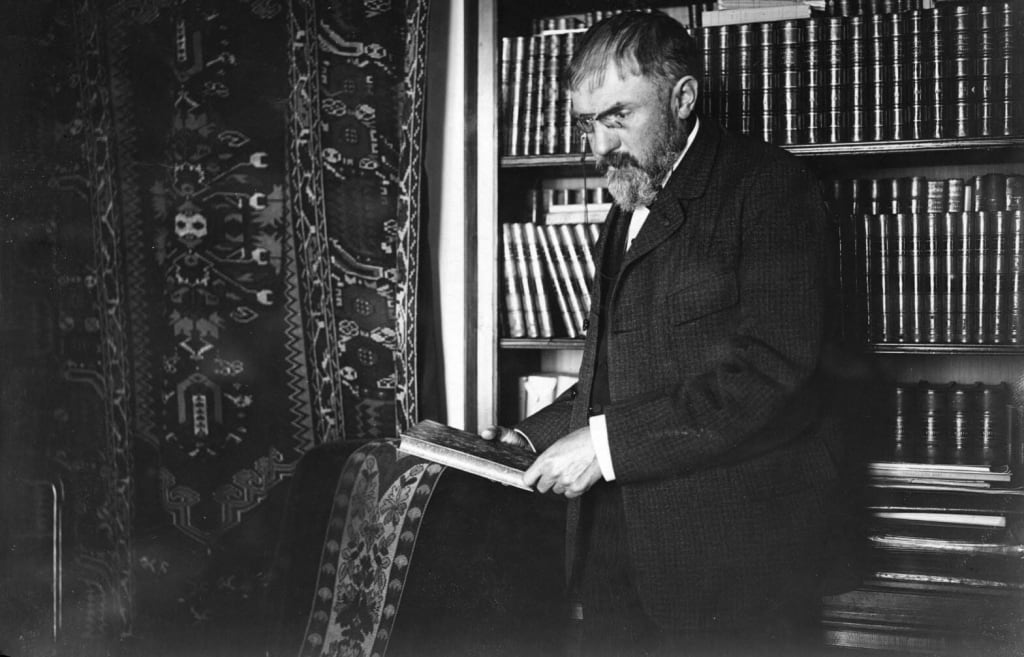
Are Mathematicians Born or Made? Henri Poincaré’s Famous Claim Revisited
“The mathematician is born, not made.”
More than a century later, Henri Poincaré’s sentence still has the power to irritate, fascinate and divide.
It sounds like a declaration that mathematical genius cannot be taught—that some people simply arrive in the world equipped to see structures, abstractions and relationships that others never will.
But Poincaré’s actual argument was subtler.
He was not saying education was useless. He was trying to explain why equally trained mathematicians could approach the same problem in radically different ways: one advancing through rigorous logical steps, another seeming to see the architecture of the solution almost instantly.
And Poincaré believed he knew this difference from experience.
He once spent days struggling with a mathematical problem, abandoned it temporarily, travelled on a geological excursion, stepped onto an omnibus in the French town of Coutances—and suddenly knew the answer.
No visible chain of reasoning.
No calculation.
Just an idea arriving fully formed, accompanied by what he called “perfect certainty.”
That episode became one of history’s most famous descriptions of mathematical intuition.
It also raises a question that psychology, neuroscience and education research are still trying to answer:
Are exceptional mathematical minds born—or can they be made?
First, One Important Correction About the Famous Quote

The phrase is real, but it is often attached to the wrong Poincaré book.
Poincaré did not originally write “The mathematician is born, not made” in Science and Method in 1908.
The sentence appeared earlier in his essay on mathematical intuition in La Valeur de la Science, published in French in 1905 and translated by George Bruce Halsted as The Value of Science in 1907. (gutenberg.org)
There Poincaré wrote that mathematicians seemed to divide into two broad mental types.
Some were dominated by logic.
Others by intuition.
And he argued that this distinction could not simply be explained by education:
“The mathematician is born, not made.”
He immediately added that the mathematician seemed to be born either a geometer or an analyst.
The famous Coutances omnibus story, however, appears in a different work: Science et Méthode of 1908, translated into English by Francis Maitland as Science and Method in 1914.
The two ideas are closely related.
But they come from different texts.
That distinction actually makes Poincaré’s theory more interesting, because across several years he was developing a much broader account of how mathematical discovery works.
Poincaré Believed There Were Two Kinds of Mathematical Minds
Poincaré begins his discussion with something many mathematicians still recognize.
Two people can understand the same mathematics and yet appear to think in completely different ways.
One mathematician proceeds carefully.
Definition.
Lemma.
Proof.
Consequence.
Every step follows the previous one.
Poincaré compared this type of thinker to a military engineer advancing trench by trench toward a fortified position.
The other type sees relationships first.
The proof may come later.
This mathematician jumps ahead, recognizes a pattern, forms an analogy or mentally visualizes an entire structure before every logical gap has been filled.
Poincaré compared these thinkers to cavalry charging ahead of the main army.
He called the first tendency analytic or logical.
The second was geometric or intuitive.
But the distinction was not really about whether somebody studied algebra or geometry.
Poincaré emphasized that an intuitive mathematician could remain intuitive while doing analysis, while a logical mathematician could remain logical while doing geometry.
The difference was in the mind, not the subject.
Logic Proves. Intuition Discovers.
Poincaré was not hostile to logic.
Far from it.
He believed rigorous logic was indispensable because it establishes certainty.
But he did not think logic alone could explain mathematical creation.
His famous formulation was essentially this:
Logic is the instrument of demonstration. Intuition is the instrument of invention.
A completed mathematical proof may look like a perfect chain of reasoning.
But that does not mean the mathematician discovered it by walking through that chain from beginning to end.
The finished proof and the process that created it may be completely different things.
That distinction is crucial.
A textbook shows mathematics after the mess has been removed.
Every theorem appears to follow naturally.
The false starts vanish.
Failed ideas disappear.
The sudden guesses are replaced with clean derivations.
The result can create the illusion that mathematics itself is produced exactly the way it is presented.
Poincaré thought that was psychologically false.
The final proof may be logical.
The discovery often is not.
Poincaré’s Own Career Gave Him a Powerful Example
He described the process in extraordinary detail in the chapter “Mathematical Creation” from Science and Method.
Poincaré had been trying to understand mathematical objects he would later call Fuchsian functions.
For about 15 days, he worked consciously on the problem.
He sat at his desk.
He tried combination after combination.
Nothing worked.
Then one evening he drank black coffee and could not sleep.
Ideas began arriving rapidly.
He described them as colliding and combining until certain arrangements became stable.
By morning, he had obtained an important result. (gutenberg.org)
But an even stranger moment came later.
The Omnibus at Coutances
Poincaré temporarily left mathematics behind to join a geological excursion organized by the School of Mines.
Travel distracted him from the problem.
Then the group arrived at Coutances, in Normandy.
They were boarding an omnibus.
Poincaré put his foot on the step.
And suddenly an idea appeared.
The transformations he had been using to define Fuchsian functions were connected with the transformations of non-Euclidean geometry.
There had been no immediately preceding calculation.
No conscious chain of deductions.
The thought seemed to arrive from nowhere.
He did not even stop to check it.
He continued the conversation he had been having.
Yet, he later wrote, he felt “a perfect certainty.”
When he returned to Caen, he verified the idea carefully.
It was correct.
For Poincaré, this was evidence that something had been happening beneath conscious awareness.
The Strange Pattern Happened Again
The omnibus incident was not isolated.
Poincaré described repeatedly reaching dead ends, turning his attention elsewhere and then experiencing sudden illumination.
After struggling with another part of the problem, he spent several days by the sea.
While walking along a bluff one morning, another important mathematical connection suddenly appeared.
Later, during military service at Mont-Valérien, he encountered yet another flash of insight while walking down the street.
Again, the missing idea seemed simply to present itself.
Only afterward did conscious reasoning organize and verify it.
From these experiences, Poincaré developed a theory of mathematical creativity that now sounds surprisingly modern.
He Thought the Unconscious Mind Was Still Working
Poincaré did not believe the brain simply stopped working on a difficult problem when conscious attention moved elsewhere.
Instead, he proposed that unconscious processes continued combining ideas.
Most combinations were useless.
A tiny number were mathematically fruitful.
Eventually, one of those useful combinations crossed into consciousness.
That was the sudden flash.
The “Eureka” moment.
Poincaré explicitly interpreted sudden illumination as evidence of long unconscious prior work.
This is why the story is often cited today in discussions of incubation in creativity.
You struggle with a problem.
You stop.
You walk.
Sleep.
Travel.
Talk about something else.
Then the answer arrives when you are apparently no longer trying.
Anyone who has worked deeply on mathematics, programming, engineering, writing or science may recognize the experience.
But the Omnibus Story Does Not Prove That Genius Requires No Work
This is where Poincaré is often misunderstood.
The idea may have appeared instantly.
But the preparation did not.
Before stepping onto the omnibus, Poincaré had spent substantial time learning mathematics, building new theories, exploring failed approaches and consciously manipulating the exact objects involved in the eventual insight.
His subconscious mind did not invent non-Euclidean geometry from nothing.
It had raw material.
Years of knowledge.
Recent failed attempts.
Analogies.
Definitions.
Technical machinery.
The sudden insight was the final visible moment of a much longer process.
This distinction is essential when interpreting “born, not made.”
Poincaré was describing differences in the way minds organize mathematical thought.
He was not saying a person could become a great mathematician without education or effort.
Invention, Poincaré Said, Is Really Selection
One of Poincaré’s most interesting insights was that mathematical creativity cannot simply mean producing combinations of ideas.
There are effectively endless possible combinations.
Most are worthless.
The creative mathematician somehow notices the useful ones.
As Poincaré put it:
“Invention is discernment, choice.”
This changes the problem.
The mystery is not:
How does a mathematician generate possibilities?
The deeper mystery is:
How does the mathematician know which possibility deserves attention?
Why does one analogy feel profound while another feels irrelevant?
Why does an expert look at a difficult problem and immediately suspect that one representation will work?
Why does a particular pattern stand out?
Poincaré believed mathematical intuition performed that filtering.
The Expert Does Not Necessarily Calculate More
Poincaré even used himself as evidence against a simplistic view of mathematical genius.
He admitted that he was poor at routine calculation.
He claimed he could make mistakes even while adding numbers.
He also thought he would be a poor chess player because he might recognize a danger, consider several alternatives and then forget the original danger before making his move.
Yet he could follow extraordinarily complicated mathematical reasoning.
Why?
Because he did not remember every step individually.
He remembered the structure.
He described possessing a feeling for the general movement of a mathematical argument—an intuition of order that allowed him to see where each component belonged. (gutenberg.org)
That is a very different skill from raw calculation speed.
And modern research provides some support for this broader conception of mathematical ability.
What Does Modern Research Say About Mathematical Giftedness?
The first answer is surprisingly unsatisfying:
We still do not understand exceptional mathematical ability nearly as well as people assume.
A major review of 40 studies examining mathematically gifted children and adults found numerous cognitive characteristics associated with high mathematical performance.
Two appeared particularly often:
spatial processing
and
working memory.
But the authors also warned that much of the research used small samples, making strong conclusions difficult. They specifically cautioned against treating correlations or brain-imaging differences as proof of causation. (frontiersin.org)
That already complicates any simple idea of a single “math gene” or one identifiable mathematical brain.
Exceptional mathematics appears to involve multiple cognitive systems.
Spatial Ability Seems Particularly Important
One of the strongest recurring findings concerns spatial thinking.
The ability to rotate objects mentally, understand relationships in space or represent structures visually is consistently associated with mathematical performance.
A 2022 meta-analysis covering 45 articles found a moderate positive relationship between spatial and mathematical skills.
Even after accounting for broader reasoning abilities, a distinct relationship remained. (pubmed.ncbi.nlm.nih.gov)
This is fascinating in light of Poincaré.
His “geometer” was not necessarily someone who literally drew geometric shapes.
It was someone inclined to perceive relationships globally, through structure and intuition.
Modern spatial-cognition research is not proving Poincaré’s philosophical categories.
But there is an intriguing resemblance.
Working Memory Matters Too
Working memory allows someone to hold and manipulate information while solving a problem.
That obviously matters in mathematics.
A difficult proof may require keeping several assumptions, intermediate results and possible transformations active simultaneously.
Reviews of mathematical giftedness repeatedly identify working memory as one characteristic associated with high performance.
That sounds closer to Poincaré’s logical mathematician.
But again, mathematical excellence does not reduce cleanly to one cognitive dimension.
Different people may reach extraordinary performance through somewhat different combinations of abilities.
Poincaré may have been exaggerating when he proposed two distinct types.
But his deeper intuition—that mathematicians possess different cognitive styles—has aged surprisingly well.
What About Genetics?
This is where “born versus made” discussions become dangerous if the terminology is sloppy.
Twin studies indicate that variation in mathematical performance is influenced partly by genetic differences.
But that statement does not mean mathematical ability is fixed at birth.
One large study involving more than 4,000 pairs of 12-year-old twins estimated the heritability of the mathematical measures at around 44% on average.
Environmental factors accounted for the majority of variance at that age.
The same study found that genetic factors contributed to the relationship between spatial and mathematical abilities, while shared and individual environmental experiences also made substantial contributions. This requires an important explanation.
Heritability Is Not Destiny
If a trait is 44% heritable in one studied population, it does not mean 44% of one person's mathematical ability is genetic.
Heritability is a population statistic.
It describes how much of the variation between people in a particular environment is statistically associated with genetic variation.
Change the environment and the number can change.
A trait can be highly heritable and still strongly influenced by training.
Height is the classic example.
Genes strongly influence height.
Nutrition still matters enormously.
The same logic applies to cognitive skills.
Biology may influence how easily particular mathematical abilities develop.
Education and experience influence whether that potential develops at all.
Training Can Improve Abilities Associated With Mathematics
Spatial ability is particularly useful here because researchers can actually train it.
A 2022 meta-analysis examined 29 controlled studies involving 3,765 participants and found that spatial training produced measurable improvements in mathematics performance.
The average effect was modest but meaningful, with Hedges' g = 0.28. Spatial thinking itself improved more strongly.
That finding sits awkwardly beside an extreme interpretation of Poincaré's phrase.
If important components of mathematical performance can be improved through targeted experience, then mathematical capability clearly is not simply handed out at birth in finished form.
Some of the machinery can be developed.
Practice Matters, but Practice Is Not the Whole Story Either
The opposite extreme is equally misleading.
It became fashionable in some discussions of expertise to suggest that sufficient deliberate practice could produce elite performance almost regardless of initial differences.
Research does not support such a simple conclusion either.
Reviews of expertise have found that sustained, structured practice is unquestionably important.
But cognitive differences—including abilities such as working memory—can continue to predict expert performance even after experience is considered.
A later review of the deliberate-practice literature argued for a multifactorial model of expertise rather than treating practice as the sole explanation.
That is probably much closer to reality.
People begin with different cognitive profiles.
They encounter different environments.
They receive different instruction.
They practice different amounts.
They develop different interests.
They meet different mentors.
And all of those things interact over years.
Studies of Mathematically Precocious Children Tell a Similar Story
One of the most important long-term research projects in this area is the Study of Mathematically Precocious Youth, or SMPY.
Researchers followed thousands of intellectually talented young people across decades.
The results suggest that high early mathematical ability matters.
But mathematical reasoning alone does not determine who eventually contributes at the highest levels of science and technology.
Spatial ability, interests and values also help predict later educational and occupational outcomes.
In other words, talent is multidimensional.
Two students with similarly strong mathematical test scores may develop very different careers because they possess different spatial strengths, motivations, interests and opportunities.
Poincaré might have appreciated that result.
Even Mathematical Prodigies Complicate the Myth of Pure Innate Genius
The 2017 review of mathematical giftedness noticed something unexpected.
Studies of prodigies often failed to find extraordinary superiority across every cognitive dimension.
Instead, some exceptional performances—especially rapid calculation or extraordinary retention of mathematical information—appeared closely tied to intensive sustained practice and long-term memory development.
This matters because being a calculation prodigy is not necessarily the same thing as becoming a creative mathematician.
Poincaré himself made exactly that distinction.
He did not consider extraordinary memory or calculation speed sufficient to explain mathematical invention.
The central faculty, for him, was recognizing hidden relations.
Perhaps Poincaré Was Talking About Style More Than Ability
This may be the most useful way to rescue his famous statement from oversimplification.
When Poincaré wrote:
“The mathematician is born, not made,”
he was not directly presenting a genetic theory.
Genetics in its modern scientific form barely existed.
He was talking about temperament and cognitive orientation.
Why did Félix Klein naturally reach for physical and geometric models?
Why did other mathematicians insist on formal logical construction?
Why could two people educated in almost the same intellectual environment develop completely different mathematical instincts?
Poincaré's answer was that some part of this orientation belonged to the natural organization of the mind.
That is a much narrower—and much more defensible—claim than saying:
Either you are born good at mathematics or you never will be.
Poincaré Himself Shows Why “Born Versus Made” Is the Wrong Question
Think again about the omnibus.
The insight was spontaneous.
But everything required for the insight had been built beforehand.
Without years of mathematical education, there were no Fuchsian functions to think about.
Without knowledge of non-Euclidean geometry, there was no connection to discover.
Without days of failed work, perhaps the relevant combinations would never have been activated.
Without conscious verification afterward, the flash of intuition would not have become mathematics.
The discovery required at least four stages:
Preparation
Poincaré acquired enormous technical knowledge and consciously attacked the problem.
Incubation
He stopped working directly on it while travelling.
Illumination
The relationship suddenly appeared while he stepped onto the omnibus.
Verification
He later returned to Caen and checked that the idea was correct.
The famous moment lasted seconds.
The process behind it took years.
Intuition Is Not Magic
The word intuition can make mathematical genius sound mystical.
But expert intuition often reflects compressed experience.
A beginner sees many separate facts.
An expert sees one pattern.
Consider chess.
A novice may need to inspect individual pieces one after another.
A grandmaster can look at a realistic board position and immediately perceive meaningful structures.
Medicine works similarly.
Experienced physicians sometimes recognize a pattern before consciously articulating every clue.
Programming does too.
An experienced engineer may see a system failure and immediately suspect the correct subsystem.
That judgment feels instantaneous.
But the intuition was trained over thousands of previous encounters.
Mathematical intuition may work partly the same way.
The mind has accumulated structures.
Then, when confronted with a new problem, it recognizes relationships that would require far more conscious processing for someone less experienced.
But Experience Alone May Not Explain Why Some People Become Exceptional
This is where Poincaré's challenge remains alive.
Give two people the same teacher.
The same textbooks.
The same hours.
The same problems.
They will not necessarily emerge with the same abilities.
Modern cognitive science gives us good reasons to expect differences in:
- working memory
- spatial ability
- processing speed
- attention
- pattern recognition
- motivation
- curiosity
- persistence
- tolerance for abstraction
- sensitivity to structure
Some of these characteristics have biological components.
Many are also shaped by environment and learning.
And they interact.
That interaction makes the question “born or made?” almost impossible to answer with one word.
A Better Model Is Born and Made
Modern evidence points toward a much less dramatic conclusion than Poincaré's slogan.
Mathematicians are not simply born.
Nor are they simply manufactured by training.
They develop from an interaction between initial dispositions and prolonged experience.
A natural spatial advantage may make geometry easier.
Success may make mathematics more enjoyable.
Enjoyment leads to more practice.
More practice develops stronger representations.
Those representations create better intuition.
Better intuition produces more success.
Over years, small initial differences can become very large differences in expertise.
The reverse can also happen.
A child with substantial potential can receive weak instruction, develop mathematical anxiety, avoid advanced courses and never discover what they might have been capable of doing.
Potential does not automatically become achievement.
Mathematical Education Still Matters Enormously
Poincaré's phrase can be harmful if interpreted as educational policy.
A student struggling with mathematics at age 10 should not be told that mathematicians are born rather than made.
That would turn one philosopher's observation about elite cognitive styles into a verdict on a developing child.
Research clearly shows that mathematical performance can improve.
Instruction matters.
Practice matters.
Curriculum matters.
Feedback matters.
Spatial skills can be trained.
Anxiety can interfere with performance.
Opportunities matter.
And cognitive abilities continue developing across childhood and adolescence.
Poincaré was discussing professional mathematical invention.
He was not designing a school system.
There Is Another Reason the Phrase Survives
Despite all these qualifications, working mathematicians often recognize something in Poincaré's description.
Some people do seem to move differently through abstract problems.
They see analogies other people miss.
They know which calculation is worth attempting.
They sense that two apparently unrelated structures belong together.
They abandon an unproductive direction earlier.
They choose a useful representation almost instinctively.
They cannot always explain how they knew.
That phenomenon is real enough to demand explanation.
Poincaré's mistake—if it was a mistake—may have been to frame the source too sharply as something fixed at birth.
His observation itself was powerful.
The Omnibus Moment May Be the More Important Legacy
In fact, the sentence “The mathematician is born, not made” may be less important than what Poincaré wrote three years later about his own discovery process.
The omnibus story gives us a dynamic model rather than a fixed one.
Conscious effort supplies material.
Unconscious processing reorganizes it.
A promising configuration suddenly becomes conscious.
Intuition identifies it as significant.
Logic tests it.
That is not a story of effortless genius.
It is a story of different mental processes cooperating.
Poincaré eventually concluded that sudden illumination was evidence for preceding unconscious work.
And crucially, he never trusted intuition alone.
After Coutances, he returned home and verified the result.
That may be the perfect summary of his philosophy.
Intuition finds.
Logic checks.
So, Are Mathematicians Born or Made?
The modern answer is:
both—and neither in the simplistic sense.
People are born different.
Cognitive abilities differ.
Temperaments differ.
Spatial skills differ.
Working-memory capacities differ.
Interests differ.
Those differences can influence who finds advanced mathematics unusually natural.
But nobody is born knowing topology.
Nobody is born understanding complex analysis.
Nobody is born recognizing Fuchsian groups.
Mathematical knowledge has to be built.
And even abilities linked to mathematical success show meaningful environmental influence and, in some cases, responsiveness to training.
Poincaré's genius therefore does not demonstrate that education is irrelevant.
It demonstrates something more subtle.
Education gives a mind its mathematical language.
Experience fills that mind with structures.
Practice makes relationships familiar.
But once all of that material is there, different minds may still navigate it in radically different ways.
One advances step by step.
Another sees the destination before knowing the path.
And occasionally, after days of failure, one of those minds steps onto an omnibus in Coutances and suddenly understands something nobody had understood before.
That is why Poincaré's line survives.
Not because modern science has proven that mathematicians are simply born.
It has not.
The phrase survives because it captures the unsettling possibility that expertise is not merely a question of how much a person knows.
Sometimes the decisive difference is how a mind sees what it knows.


