
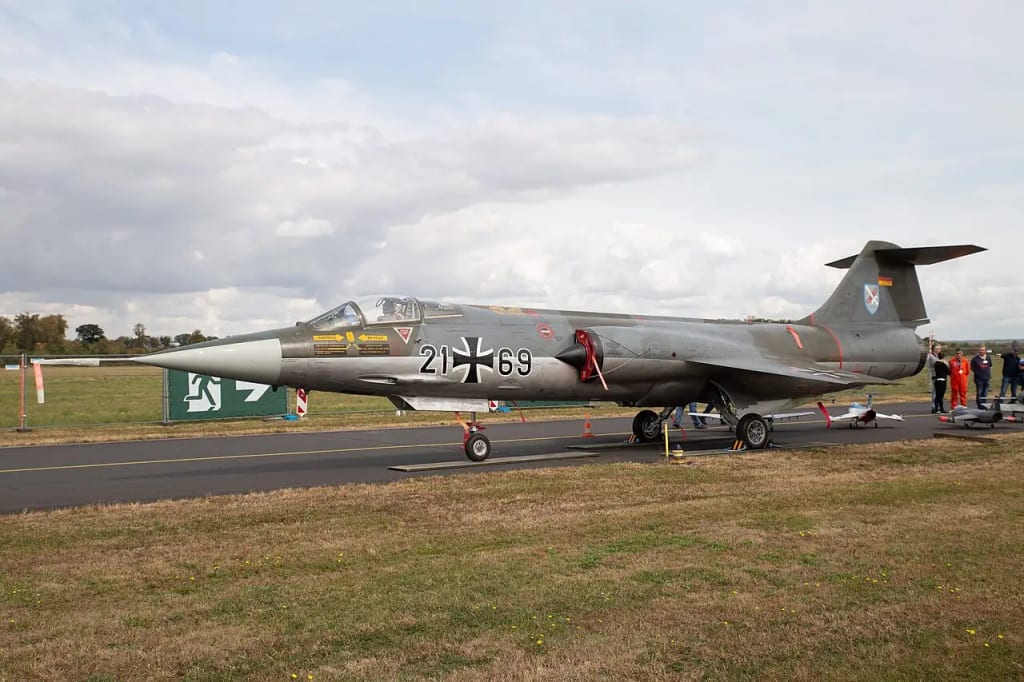
Rescue One: The Night Germany Sent a Supersonic Starfighter Through a Winter Storm to Save One Child
At 1:50 in the morning on January 22, 1982, a West German fighter pilot pushed the throttle forward on one of the most feared aircraft in his country's military history.
The runway beneath him was covered in ice.
Only a narrow strip down its center had been cleared.
The taxiways were effectively unusable.
Even with its engine running at low power, the Lockheed F-104G Starfighter threatened to slide across the frozen surface.
Inside the cockpit sat Oberleutnant Jürgen Gundling.
And somewhere aboard the fighter was something far more important than a bomb or missile:
A desperately needed experimental antiviral medicine.
Hundreds of kilometers to the south, on the Italian island of Sardinia, a critically ill child named Jessica was running out of time. Doctors in Cagliari believed the German drug might be her final chance, but the medicine was available only from its manufacturer near Munich.
Ordinary transportation had become almost useless.
Freezing rain and ice had paralyzed roads, railways and airports across parts of Germany. Helicopters could not simply launch into the conditions. A conventional scheduled flight could not move the medicine fast enough.
So an extraordinary chain of people—doctors, military personnel, police officers, diplomats, air-traffic controllers, ground crews and Italian authorities—turned a combat aircraft into an emergency medical courier.
The Starfighter was assigned the callsign:
Rescue One.
Gundling accelerated along the partially cleared runway at Memmingen, lit the afterburner and disappeared into cloud within seconds.
Roughly an hour later, he would face another problem.
The runway waiting for him in Sardinia had no functioning lights.
Yet Rescue One landed.
The medicine reached the hospital.
And Jessica survived.
The story sounds almost too cinematic to be true.
But the basic mission is well documented in German aviation accounts, Sardinian reporting and a later interview with Gundling himself. One detail remains inconsistent: some retrospective accounts describe Jessica as three years old, while Sardinian reporting and a 2022 German profile of Gundling identify her as eight. The available sources agree on the central event—the emergency, the Starfighter flight, Gundling's role and the child's survival—but not on her age.
That discrepancy is worth acknowledging because the real story does not need embellishment.
A fighter designed for Cold War combat really was turned into a flying ambulance for a medicine bottle.
And the aircraft chosen for the job was the notorious F-104 Starfighter.
January 22, 1982 Was Almost the Worst Possible Day for an Emergency Flight
The crisis unfolded during severe winter weather in West Germany.
Austrian aviation journalist Andreas Fecker's account, republished for the mission's 40th anniversary, describes freezing rain turning roads and cities into sheets of ice. Airports were badly disrupted, trains were affected by frozen infrastructure and helicopters were unable to offer an easy solution.
At a pediatric hospital in Cagliari, Jessica's medical condition had deteriorated dramatically.
Her doctor reportedly remembered reading about an experimental antiviral medicine under development in Germany.
It might help.
But it was not sitting in an Italian pharmacy.
The available supply had to be obtained from the manufacturer in the Munich area.
Today, an urgent specialist drug might be moved through an established medical courier network, private jet charter, helicopter service or international logistics operation.
In 1982, late on a Friday night, during a major ice storm, those options were far more limited.
The doctor therefore turned toward an institution not normally associated with pediatric pharmaceutical delivery:
The military.
The First Critical Decision Happened at Decimomannu Air Base
Southwest of Cagliari lies Decimomannu Air Base, an important military aviation facility used extensively for NATO training.
The doctor contacted the German military presence associated with the base and asked for help.
It was Friday evening.
Most personnel who might ordinarily coordinate such a request were no longer present.
A duty officer could easily have treated the request as somebody else's problem.
Instead, he began passing the emergency up the German military chain.
That decision triggered a remarkable sequence.
The Bundeswehr's central pharmaceutical system was contacted to determine whether the drug existed and where it could be found.
The answer created another problem.
The medicine was reportedly available only from its manufacturer near Munich.
The factory was not conveniently sitting open with an emergency package waiting beside the door.
Someone with authority to access it had to be found.
German Police Reportedly Pulled a Pharmaceutical Executive Out of an Evening Performance
According to the detailed German account, police located an authorized company representative while he was attending an opera or theatrical performance.
They collected him, brought him to the pharmaceutical facility and obtained the medication.
Then came the next race:
Munich to Memmingen.
The distance was roughly 130 kilometers, and the roads were coated with ice.
Police organized a relay to move the medicine toward the Luftwaffe base as quickly as possible.
Every part of the journey now depended on the next part being ready before the medicine arrived.
The drug could not reach Memmingen and then wait hours while somebody searched for an aircraft.
A runway had to be opened.
A plane had to be prepared.
A pilot had to volunteer.
Diplomatic permission had to be obtained.
Airfields along the route had to be available in case something went wrong.
And all of it had to happen in the middle of the night.
Why Memmingen?
The Luftwaffe selected Jagdbombergeschwader 34, Fighter-Bomber Wing 34, at Memmingen.
The wing operated the F-104G Starfighter.
Historical records confirm that JaboG 34 had converted to the F-104G beginning in the 1960s and remained a Starfighter unit into the 1980s.
Memmingen offered something vital:
Ground crews believed they had a chance of opening enough runway to launch a high-performance aircraft despite the ice.
That did not mean clearing the whole airfield.
There was no time.
Crews reportedly concentrated on creating a usable strip along the center of the runway.
The taxiways remained too icy, so the Starfighter and the equipment needed to start it were towed directly onto the runway.
Now they needed a pilot willing to take it.
Jürgen Gundling Volunteered
Oberleutnant Jürgen Gundling accepted the mission.
Four decades later, German newspaper Südwest Presse interviewed Gundling and described him as the Starfighter pilot who carried the medicine to Sardinia under extreme weather conditions. The same profile preserved evidence that his mission had already been reported in a German magazine on March 31, 1982.
This matters because much of the Rescue One story now circulates through retrospective aviation histories.
The 2022 interview helps anchor it directly to the pilot at the center of the event.
Gundling was not being asked to fly a normal military sortie.
There was no enemy.
No target.
No training objective.
The mission existed solely because a child needed a medicine faster than conventional transportation could deliver it.
The F-104 Was an Extraordinary Choice for a Medical Courier
If someone designed an aircraft specifically for carrying emergency medicine, it would not look much like a Starfighter.
The F-104 was extremely narrow.
Its wings were astonishingly small.
Its cockpit accommodated essentially one pilot in the single-seat version.
Cargo capacity was not its purpose.
Comfort certainly was not.
It had been conceived as an exceptionally fast fighter.
The German F-104G evolved into a more complex multi-role aircraft capable of all-weather operations and strike missions.
According to the Deutsches Museum, the F-104G could reach approximately Mach 2.2 at 11,000 meters, with a maximum takeoff weight around 13 tonnes and a General Electric J79-derived turbojet producing more than 70 kilonewtons of thrust.
For moving a small, critically important package over a long distance very quickly, however, its disadvantages suddenly mattered less.
The medicine weighed almost nothing compared with military stores.
What mattered was speed.
The Starfighter Had Another Reputation Entirely
By 1982, Germans knew the F-104 for reasons far darker than speed.
West Germany acquired 916 Starfighters.
According to the Deutsches Museum, 292 were lost in accidents and 116 pilots died during the type's German service.
The Bundesarchiv explains that the early accident crisis had multiple causes, including the complexity of the modified German aircraft, insufficient experience among pilots and technicians, maintenance challenges and infrastructure problems. The German F-104 had been adapted substantially from the original American concept to satisfy a broad range of Luftwaffe operational requirements.
The public and press gave the aircraft brutal nicknames.
The Bundeswehr itself records that newspapers called it “Witwenmacher”—the widowmaker—and “fliegender Sarg,” the flying coffin.
The Deutsches Museum still uses the “Witwenmacher” label when discussing the aircraft's troubled history.
That history makes Rescue One unusually poignant.
An aircraft remembered for the pilots it killed was about to be used to keep a child alive.
Before Gundling Could Leave Germany, Austria Had to Say Yes
The fastest route toward Sardinia crossed Austria.
But Austria was neutral.
A West German military combat aircraft could not simply blast across Austrian airspace because someone at Memmingen decided it was convenient.
Diplomatic clearance was required.
The rescue account says the German military attaché in Vienna was awakened and asked to obtain emergency authorization.
Austria granted permission for the military overflight.
This part of the story reveals how many things had to work simultaneously.
One bureaucratic refusal could have delayed the flight.
One unreachable official could have delayed it.
One argument about jurisdiction could have delayed it.
Instead, people treated time as the enemy.
Italy Quietly Prepared Backup Airfields
The route still carried substantial risk.
The Starfighter could encounter worsening weather.
It could suffer a technical failure.
Gundling might be unable to reach Decimomannu.
So Italian military airfields along or near the possible route were reportedly kept available overnight as emergency alternates.
Accounts list facilities including Trapani, Sigonella, Grosseto, Grazzanise and Gioia del Colle.
Gundling reportedly did not even know the full scale of the safety network being assembled beneath him.
The mission looked like one pilot carrying one medicine.
In reality, it was becoming an international operation.
At 1:35 A.M., the Medicine Reached Memmingen
The police relay arrived at the airbase at approximately 1:35 a.m.
Fifteen minutes later, around 1:50 a.m., the medication was handed into Gundling's cockpit.
The Starfighter's engine was started.
The runway remained treacherous.
A conventional high-power engine check was reportedly impossible because the surface was so slippery that the aircraft was already inclined to move at low power.
Ground cables and hoses came away.
The tower cleared the flight.
The memorable opening of the clearance was simple:
“Rescue One … cleared for takeoff.”
Then the chocks were removed.
The Afterburner Lit on a Strip of Ice
The F-104's J79 turbojet could produce dramatic acceleration with afterburner.
On a normal runway, that was one of the machine's greatest strengths.
On a partially cleared runway during an ice storm, acceleration had to be controlled with extraordinary precision.
According to Fecker's account, Gundling kept the fighter centered on the narrow usable strip, reached rotation speed and lifted away.
Within about five seconds, Rescue One disappeared into cloud.
Behind him was a frozen German airfield.
Ahead was Austria, the Alps, Italy and the Mediterranean.
And the clock in a Cagliari hospital was still running.
The F-104 Was Built for Exactly This Kind of Speed—Just Not This Kind of Mission
The Starfighter began life from Lockheed designer Clarence “Kelly” Johnson's pursuit of a lightweight, high-performance fighter.
Its form looked radically different from many other aircraft of its era.
It had:
- A long, needle-like fuselage
- Tiny, razor-thin wings
- A powerful J79 engine
- Exceptional acceleration
- Supersonic performance above Mach 2
The Deutsches Museum lists a top speed of Mach 2.2 at altitude and a service ceiling approaching 17.7 kilometers for its F-104G example.
The design sacrificed many qualities associated with larger transport aircraft in favor of performance.
That made it an awkward military workhorse in some German roles.
On January 22, 1982, however, one quality dominated every calculation:
Time.
A cargo aircraft carries more.
A helicopter can land almost anywhere.
A car is simpler.
But very few transportation systems available that night could take a tiny package from southern Germany toward Sardinia at fighter-jet speed once the aircraft was airborne.
Rescue One Was Not Simply Flying as Fast as Possible
The popular retelling sometimes reduces the mission to:
“Germany sent a Mach 2 fighter to deliver medicine.”
That makes a good headline but oversimplifies real aviation.
An F-104 capable of Mach 2 did not mean Gundling spent the entire trip flying at twice the speed of sound.
Flight profile, fuel consumption, weather, routing, air-traffic restrictions and the requirement to land safely all mattered.
The available accounts establish that he departed Memmingen at approximately 1:50 and reached Decimomannu around 3:00 a.m.—an extraordinarily rapid international delivery, but not evidence of a continuous maximum-speed dash.
The dramatic part is not that the throttle stayed at maximum.
It is that the entire system got a fighter airborne at all.
Sardinia Had a New Disaster Waiting for Him
While Rescue One moved south, personnel at Decimomannu discovered that the destination presented its own severe problem.
Days of heavy rain had flooded electrical infrastructure associated with the approach and runway lighting.
The runway was dark.
Gundling was approaching during the night, in rain and low cloud, toward an airfield without normal illumination.
There was no time for a sophisticated repair project.
So people improvised.
They Used Vehicle Headlights to Mark the Runway
According to the surviving accounts, personnel gathered civilian and military vehicles and positioned them around the runway.
Their headlights provided improvised visual guidance.
A radar controller had been called back to duty and guided Rescue One toward the field.
At approximately 3:00 a.m., the F-104 approached at around 380 kilometers per hour according to Fecker's account.
The controller talked Gundling down toward the runway.
The fighter landed.
The most dangerous part of the medical supply chain was over.
But Jessica still did not have the drug.
The Carabinieri Were Waiting
Italian Carabinieri received the medicine immediately after Rescue One's arrival.
A vehicle rushed it from Decimomannu toward the pediatric hospital in Cagliari.
There, it was delivered to Jessica's doctor.
The medicine was administered.
Jessica survived.
From a doctor's desperate idea to the final handoff, the rescue had crossed:
- A pharmaceutical company
- German police
- Frozen roads
- A Luftwaffe base
- Austrian diplomatic airspace
- Italian military aviation infrastructure
- A dark Sardinian runway
- The Carabinieri
- A pediatric hospital
The Starfighter was the fastest link.
But it was only one link.
Was Jessica Three Years Old or Eight?
This is one of the few details where modern sources conflict significantly.
Austrian Wings' republished account by aviation writer Andreas Fecker describes Jessica as three years old. A 2026 aviation retelling repeats that age.
However, Sardinian newspaper L'Unione Sarda describes Jessica as eight years old, as does the 2022 Südwest Presse profile based around Jürgen Gundling himself.
Because the contemporary hospital record or original January 1982 Sardinian report is not readily available in searchable primary-source form, the safest historical treatment is to acknowledge the discrepancy rather than silently choose whichever age makes the story more dramatic.
It does not affect the mission's central facts.
Jessica was a critically ill child in Cagliari.
A drug unavailable locally was urgently needed.
Gundling flew it to Sardinia.
She survived.
What Disease Did Jessica Have?
Modern retellings generally describe the required medicine as an experimental antiviral drug.
The readily available accounts examined here do not consistently identify either Jessica's diagnosis or the exact medicine by name.
That gap is important.
Online retellings of historical rescue stories often become more detailed over time, with later writers filling unknowns using plausible-sounding specifics.
Those details should not be presented as fact without evidence.
What the source record supports is narrower:
Her condition had become critical.
Her doctor believed a German antiviral medicine represented her remaining therapeutic hope.
The drug was obtained.
It reached Cagliari.
She survived.
Did the Medicine Definitely Save Her?
Historical sources commonly describe the medicine as life-saving and credit the delivery with Jessica's survival.
From the perspective of modern clinical evidence, however, one should be careful about interpreting an individual medical outcome.
Without detailed medical records, diagnosis, treatment timeline and comparison evidence, it is impossible to scientifically quantify how certain death would have been without the medication or exactly how much of her recovery was attributable to that drug alone.
Historically, the relevant point is that her treating doctors believed the medicine was urgently necessary and the child survived after it arrived.
The rescue mission was organized on that medical judgment.
Was Rescue One an Official Aircraft Name?
“Rescue One” was the mission callsign used for Gundling's flight, not the permanent name of the F-104 itself.
The aircraft remained a Luftwaffe Starfighter assigned to JaboG 34 at Memmingen. Contemporary-style retellings preserve the radio call as Rescue One, including the takeoff clearance from Memmingen tower.
That distinction matters because stories often phrase it as though Germany possessed a special rescue aircraft named Rescue One.
It did not.
A combat aircraft became Rescue One because of the mission it was performing that night.
How Many People Participated?
Fecker estimated that approximately 1,000 people became involved in some way.
That estimate should not be treated as a meticulously audited personnel count.
Another Sardinian account simply describes hundreds of people being mobilized.
Either description illustrates the real scale.
The story is often told as one heroic pilot.
But no pilot could have completed it alone.
Someone answered the first telephone.
Someone located the drug.
Someone found the pharmaceutical executive.
Someone opened the factory.
Police drove across frozen roads.
Ground crews reopened part of Memmingen.
Someone fueled and prepared the Starfighter.
A diplomat obtained Austrian clearance.
Italian personnel kept diversion airfields available.
Radar controllers returned to work.
Drivers lit the runway.
Carabinieri drove the final leg.
Doctors administered the treatment.
Rescue One was a network disguised as a single airplane.
The Most Remarkable Decisions Were Made Below the Highest Levels of Government
One feature of Fecker's account is particularly interesting.
Many of the decisions were reportedly made not by cabinet ministers or generals but by duty officers, deputies and middle-ranking personnel who were willing to assume responsibility rather than wait for perfect authorization.
Think about what was happening.
A West German combat aircraft needed to be launched internationally in terrible weather.
A neutral country's airspace needed to be crossed.
Foreign military airfields needed to remain open.
Police resources were being redirected.
A private pharmaceutical company had to be accessed during the night.
Normal procedures mattered.
But time mattered more.
The people involved appear to have understood the difference between recklessness and urgency.
Why Did the Story Become So Little Known?
According to Fecker, Sardinian press coverage immediately afterward was remarkably modest—a short piece noting German assistance in obtaining medicine rather than the expansive heroic story later told in aviation circles.
A German magazine did cover Gundling's mission in March 1982, and Gundling retained a clipping decades later.
But Rescue One never became a globally famous Cold War story.
There was no battle footage.
No political victory.
No enemy aircraft.
No medals ceremony that entered international history.
A military machine had simply been used for something humane.
Then everyone returned to work.
The Irony of the Widowmaker Becoming a Lifesaver
Few aircraft generate stronger disagreement than the F-104.
To admirers, the Starfighter remains one of the most beautiful and technically extraordinary fighters ever built.
To critics of West Germany's procurement program, it symbolizes a disastrous mismatch between aircraft, mission requirements, training and institutional readiness.
Both views contain truth.
The F-104 was extremely capable.
Germany also suffered catastrophic losses.
The Bundeswehr's own history notes that 26 Starfighters crashed in 1965 alone, killing 15 pilots, helping produce a national political and safety crisis.
Across the entire German program, 292 aircraft were lost and 116 pilots died.
Then came January 1982.
For one night, none of the Starfighter's weapons mattered.
Its speed did.
Why Germany’s F-104 Accident Record Was So Bad
The Starfighter's reputation is often simplified into one sentence:
“The aircraft was inherently terrible.”
The real history is more complicated.
The German government wanted one platform to perform numerous missions.
The F-104G was therefore substantially adapted from the original lightweight interceptor concept.
The Bundesarchiv identifies multiple contributors to the accident problem:
- Limited initial experience with the complex aircraft
- Training deficiencies
- Maintenance challenges
- Infrastructure shortcomings
- Technical problems
- Increased complexity associated with Germany's broad requirements
Many problems were subsequently addressed through training improvements, technical modifications and changes to operational procedures.
The aircraft remained in German service for decades.
JaboG 34 itself continued operating the Starfighter until the late 1980s before transitioning to the Panavia Tornado.
Rescue One Shows Why Aircraft Reputations Can Be Misleading
Machines are neither heroes nor villains.
They are systems with capabilities and limitations.
The same characteristics can produce opposite outcomes depending on the mission.
A demanding high-performance aircraft can punish mistakes brutally.
That same performance can become priceless when time is measured in hours.
The F-104's tiny wings and tremendous speed contributed to its unforgiving flying characteristics.
But on the Rescue One mission, its ability to take one pilot and one tiny payload across Europe rapidly was exactly what the situation required.
The F-104 did not become safer because it carried medicine.
Its risks became worth accepting.
The Mission Also Happened During the Cold War
January 1982 was not an era when military aviation existed in a peaceful strategic vacuum.
Europe was divided.
NATO and the Warsaw Pact faced each other across heavily militarized borders.
West German fighter-bomber wings trained for missions that could become unimaginably destructive during a major war.
The F-104G itself had been central to NATO's Cold War strike posture.
Yet here was one of those aircraft crossing Europe not because war had begun, but because a pediatrician had made a telephone call.
The contrast is difficult to miss.
The same infrastructure built for national defense could be repurposed, within hours, for humanitarian action.
Could This Mission Happen the Same Way Today?
Probably not exactly.
Modern emergency medicine has access to logistics networks that did not exist in the same form in 1982.
Specialist medical couriers routinely transport:
- Organs
- Antivenoms
- Experimental therapies
- Rare drugs
- Blood products
- Biological samples
Civilian charter aircraft can be activated quickly.
Military medical evacuation systems are more sophisticated.
Satellite communications and digital logistics can locate inventory almost instantly.
But extreme cases still occasionally require military assistance.
The principle remains unchanged:
When the medical value of time becomes enormous, a transportation system designed for another purpose may suddenly become the only tool fast enough.
Fighter Jets Make Poor Ambulances but Excellent Emergency Couriers
A fighter cannot accommodate a normal medical team or patient.
But if the critical object weighs a few kilograms—or a few grams—the calculation changes.
The aircraft's weaknesses disappear:
No passenger cabin needed.
No stretcher.
No cargo pallet.
No loading equipment.
Just get the object inside the aircraft and move.
In that narrow scenario, speed can outweigh almost everything else.
Rescue One is an extreme example of a logistics principle:
The most appropriate vehicle is not always the one designed for the cargo. It is the one capable of meeting the deadline.
Why the Frozen Runway May Have Been More Dangerous Than the Cruise
The public naturally imagines the dramatic part as a supersonic flight over the Alps.
Operationally, the most dangerous moments may have been much less glamorous.
Takeoff from ice.
Landing at an inadequately illuminated airfield.
Aircraft accidents frequently happen during takeoff and landing because those phases combine:
- Low altitude
- High workload
- Limited time for recovery
- Rapid configuration changes
- Restricted maneuvering options
An F-104 already demanded respect in normal conditions.
Rescue One began and ended in abnormal ones.
That makes Gundling's willingness to volunteer especially notable.
The Runway at Decimomannu Was Essentially Rebuilt With People and Cars
The improvised lighting solution is one of the most memorable elements of the story because it reveals how emergencies strip technology back to fundamentals.
The proper electrical lighting system did not work.
So they asked:
What does a pilot actually need?
A way to see the runway.
What produces light?
Cars.
Vehicles were positioned to create enough visual reference for the arriving aircraft while radar guidance helped bring Gundling toward the landing path.
It was not elegant.
It did not need to be.
The Rescue Was a Triumph of Redundancy
One pilot flew the aircraft.
But nearly every crucial step had a backup or supporting layer.
If Sardinia's weather worsened, alternative Italian bases had reportedly been alerted.
If the direct route required neutral airspace, diplomats obtained clearance.
If roads were too dangerous for one uninterrupted journey, police organized a relay.
If the runway lights failed, vehicles provided light.
If normal airport operations were unavailable, military infrastructure replaced them.
This is what resilient emergency systems look like.
Not one perfect solution.
Many imperfect solutions connected fast enough to prevent a single failure from ending the mission.
The Drug Was the Smallest Part of the Operation
Physically, the medicine was tiny.
The infrastructure required to move it was enormous.
A pharmaceutical facility.
Police vehicles.
A military airbase.
A supersonic fighter.
International diplomacy.
Radar controllers.
Italian airfields.
Ground vehicles.
A hospital.
That asymmetry makes Rescue One such a compelling story.
A medicine bottle can weigh almost nothing.
But when it is the only medicine available to a dying child, its logistical value becomes almost infinite.
The Mission Challenges How We Think About Military Cost
Military aircraft are extraordinarily expensive machines.
Fuel.
Maintenance.
Training.
Runway crews.
Air-traffic support.
Thousands of staff hours.
Measured purely in money, sending an F-104 across international borders for one child's medicine might appear irrational.
But emergency medicine routinely creates situations where the value calculation changes.
What is a human life worth?
What is the acceptable cost of trying?
Fecker's retrospective account emphasizes that the people involved were not asking whether the rescue was economically efficient.
They had a tool.
They had time.
They had a chance.
They used it.
Rescue One Was Heroic Because It Was Collective
Jürgen Gundling deserves a central place in the story.
He volunteered.
He accepted the takeoff risk.
He flew the route.
He landed in terrible conditions.
But turning Rescue One into a one-man legend would miss what makes the event unusual.
The hero of the story is almost an organization.
Not one organization, either.
Several.
German civilians and military personnel.
Austrian authorities.
Italian military personnel.
Police.
Carabinieri.
Medical staff.
People who probably never met one another worked toward the same outcome.
A child they did not know was alive at the end of the chain.
The F-104’s Finest Mission May Have Been One It Was Never Designed to Perform
Lockheed designed the Starfighter to fight.
West Germany adapted it to intercept, strike and perform demanding NATO missions.
It was capable of carrying weapons that represented some of the darkest possibilities of the Cold War.
Its German career became synonymous with crashes, political controversy and dead pilots.
Yet machines acquire meaning from what humans ask them to do.
On January 22, 1982, a Starfighter was given perhaps the simplest mission in its career:
Get this medicine there before it is too late.
No target had to be destroyed.
Nothing needed to be intercepted.
No territory needed defending.
The mission ended when someone placed a package in the hands of a doctor.
Rescue One succeeded.
Frequently Asked Questions About Rescue One and the 1982 Starfighter Mission
Was Rescue One a real 1982 mission?
Yes.
German aviation histories, Sardinian reporting and a later interview with pilot Jürgen Gundling document the January 1982 mission in which a Luftwaffe F-104 Starfighter carried urgently needed medicine from Germany toward Sardinia for a critically ill child.
When did the Rescue One mission take place?
The emergency flight took place during the night of January 22, 1982.
Who flew Rescue One?
The pilot was Oberleutnant Jürgen Gundling of the West German Luftwaffe.
He volunteered for the mission.
What aircraft was Rescue One?
It was a Lockheed F-104G Starfighter operated from Jagdbombergeschwader 34 at Memmingen.
Was Rescue One the aircraft's permanent name?
No.
Rescue One was the callsign used for the emergency mission.
The aircraft itself remained a Luftwaffe F-104G Starfighter.
Who was Jessica?
Jessica was a seriously ill child hospitalized in Cagliari, Sardinia, whose doctor urgently sought an experimental antiviral drug available in Germany.
How old was Jessica?
Available historical retellings disagree.
Austrian Wings and some aviation histories say she was three.
L'Unione Sarda and a 2022 German profile of Jürgen Gundling say she was eight.
The age discrepancy is unresolved in the readily available documentation.
What illness did Jessica have?
The accessible sources examined here do not consistently provide a verified diagnosis.
They describe her as critically ill and say her physician believed an experimental antiviral medicine available in Germany offered a final or urgent treatment option.
What medicine did the Starfighter carry?
The accounts describe it as an experimental antiviral drug.
The exact medication is not consistently identified in the strongest readily available sources, so attaching a specific drug name without additional documentation would be speculative.
Where was the medicine located?
It was reportedly available only from its manufacturer near Munich.
German authorities therefore had to locate an authorized pharmaceutical company representative and retrieve it during the night.
Did police really collect a pharmaceutical executive from an opera?
The detailed German account says police located an authorized company representative during an opera performance, brought him to the company and obtained the medicine.
How did the medicine reach Memmingen?
Police transported it approximately 130 kilometers over ice-covered roads using an urgent relay toward the Luftwaffe base at Memmingen.
Why couldn't Germany simply use a normal airplane?
Severe freezing rain and ice had badly disrupted transportation and aviation.
The urgent deadline made conventional options impractical, while JaboG 34 at Memmingen believed it could clear enough runway to launch a Starfighter.
Was the Memmingen runway frozen?
Yes.
Accounts say only a central strip could be cleared in time.
Taxiways remained unusable enough that the aircraft and starting equipment were towed directly onto the runway.
What time did Rescue One take off?
The medicine reached the aircraft shortly before departure, and Rescue One became airborne at approximately 1:50 a.m.
What time did Rescue One reach Sardinia?
The aircraft reportedly landed at Decimomannu at approximately 3:00 a.m.
Did Rescue One fly over Austria?
Yes.
The route required emergency diplomatic permission for a West German military aircraft to cross neutral Austrian airspace.
Austria granted the requested authorization.
Why was Austrian permission necessary?
Austria was a neutral state.
A foreign military combat aircraft could not simply cross its airspace without appropriate authorization.
Were other Italian airbases kept open?
According to the rescue account, several Italian military airfields—including Trapani, Sigonella, Grosseto, Grazzanise and Gioia del Colle—were kept available in case Rescue One needed to divert.
Were the runway lights at Decimomannu really broken?
Yes, according to multiple accounts.
Heavy rain had flooded infrastructure associated with the airfield lighting, leaving the runway without normal illumination.
How did Gundling land without runway lights?
Personnel positioned civilian and military vehicles around the runway so their headlights could provide improvised illumination.
A radar controller also guided Gundling toward the field.
How fast was the Starfighter approaching the runway?
Fecker's account describes the approach at approximately 380 km/h.
Who transported the medicine from Decimomannu to the hospital?
The Italian Carabinieri collected the medicine after the Starfighter landed and rushed it to the pediatric hospital in Cagliari.
Did Jessica survive?
Yes.
The historical accounts agree that Jessica survived after the medicine reached Cagliari.
Did the medicine definitely cause her recovery?
Historical reporting credits the urgent treatment with saving her.
However, without detailed clinical records it is not possible to independently quantify how certain the outcome was or how much of her recovery can be attributed to the medication alone.
How many people participated in the rescue?
Accounts vary.
Fecker estimated roughly 1,000 people were involved in some way, while Sardinian reporting describes hundreds participating in the mobilization.
These figures should be understood as estimates rather than audited personnel counts.
Why was the F-104 Starfighter so controversial in Germany?
Germany suffered a very high number of Starfighter accidents, especially during the program's earlier years.
The Deutsches Museum records 292 aircraft losses and 116 pilot deaths from the 916 Starfighters operated by the Bundeswehr.
Was the Starfighter really called the Widowmaker?
Yes.
German newspapers and the public used names including Witwenmacher, meaning “widowmaker,” and fliegender Sarg, meaning “flying coffin,” because of the accident crisis.
Was the F-104 simply a badly designed airplane?
That is too simplistic.
German authorities heavily modified the aircraft for numerous roles, increasing complexity.
The Bundesarchiv identifies a combination of training, maintenance, infrastructure, operational and technical factors in the accident crisis.
How fast could the F-104G fly?
The Deutsches Museum lists a maximum speed of approximately Mach 2.2 at 11,000 meters for the F-104G.
Did Rescue One fly at Mach 2 all the way to Sardinia?
There is no good evidence that Gundling flew continuously at maximum speed.
The aircraft was capable of Mach 2-class performance, but actual flight speed would have depended on routing, weather, fuel and operational restrictions.
Why use a fighter instead of a transport plane?
The payload was tiny and time was critical.
Under the extreme weather conditions, the military could prepare the Starfighter at Memmingen and use its exceptional performance to move the drug quickly.
Did Jürgen Gundling receive recognition?
The mission received some press attention in 1982, and Gundling kept a German magazine article about it.
The event nevertheless remained relatively obscure compared with the Starfighter's military and accident history.
Is Jürgen Gundling still alive?
A 2022 Südwest Presse profile interviewed Gundling at age 68 and reported that he was still flying business jets at the time.
Was Jagdbombergeschwader 34 based at Memmingen?
Yes.
JaboG 34 was based at Memmingen and operated F-104G Starfighters before later converting to the Panavia Tornado.
Did Germany operate many F-104s?
Yes.
The Bundeswehr operated 916 Starfighters between 1960 and 1991 when test and other continuing operations are included.
Did the Rescue One aircraft carry weapons during the mission?
The available accounts focus on the medicine and emergency flight rather than its weapon configuration.
There is no reason to embellish the story with claims about combat armament unless documentation for that particular aircraft and sortie is available.
Was the mission secret?
It does not appear to have been classified as a secret operation.
It received limited press coverage afterward, including a German magazine story in March 1982.
Why isn't Rescue One more famous?
The mission occurred without combat, political confrontation or major media spectacle.
Contemporary coverage appears to have been relatively modest, and later knowledge of the story has largely circulated through aviation history and retrospective reporting.
Is every dramatic detail in online versions of Rescue One verified?
No.
The central rescue is well supported, but some details differ between sources.
Jessica's age is the clearest example.
The exact medicine and diagnosis are also not consistently documented in readily accessible sources.
Responsible retellings should distinguish well-established facts from details that have accumulated through later storytelling.
What makes Rescue One historically remarkable?
Because it inverted the purpose of one of the Cold War's most intimidating machines.
The F-104 Starfighter was designed around combat performance.
West Germany's experience with it became associated with military readiness, political controversy, aircraft crashes and lost pilots.
But in January 1982, those associations temporarily became irrelevant.
A pediatrician in Sardinia needed a medicine.
A duty officer answered a telephone.
Police raced across frozen Germany.
Ground crews scraped a strip through the ice.
A diplomat woke someone in Austria.
Italian airbases stayed ready.
Cars became runway lights.
A pilot climbed into a fighter.
And the callsign changed everything:
Rescue One.
The Starfighter that night did not intercept a bomber.
It did not launch a missile.
It did not attack a target.
It carried a package small enough to fit inside a cockpit.
But somewhere in Cagliari, that package represented the difference between hope and giving up.
For an aircraft remembered in Germany as the Widowmaker, it was an extraordinary reversal.
On one winter night in 1982, the Starfighter's speed was used for the one mission no fighter designer could have predicted:
Getting medicine to a child before time ran out.


