Why Gothic Beauty Keeps Summoning the Occult
The romantic gothic aesthetic is no longer living at the edge of fashion culture. It has moved inward, become more wearable, and started influencing not just how people dress, but what they search for, save, buy, and believe is worth exploring. That is why this trend matters more than a simple “goth is back” headline suggests. What is resurging is not just black lace, berry lipstick, or Victorian mood. It is a broader visual culture where beauty styling keeps nudging people toward myth, ritual, divination, paranormal symbolism, and occult-coded self-presentation. Vogue’s late-2025 coverage of the “soft goth” return framed the look as a polished, mood-first alternative to clean minimalism, while its 2026 beauty trend reporting described a broader move away from restraint and toward expressive, “soft alt” experimentation.
That shift helps explain why the trend feels bigger than makeup or fashion alone. Once a style language becomes saturated with symbols of mystery—moons, veils, relic-like jewelry, cathedral silhouettes, blood-dark lips, tarot palettes, witchy fragrance naming, dramatic tailoring, and mournful romance—it does more than decorate the body. It opens a search pathway. Someone arrives for eyeliner inspiration and leaves looking up tarot decks, moon rituals, crystal meanings, “witchy” perfumes, Samhain traditions, or the newest paranormal-coded interiors. Vogue’s 2025 reporting on tarot and oracle deck popularity connected the rise directly to growing uncertainty and declining trust in traditional authority, while its coverage of Etsy witches and 2025 TikTok culture showed how esoteric language had become mainstream enough to move from subculture to commerce.
That is the real story. Romantic gothic beauty is not just dressing like a vampire, a witch, or a dark fairy. It is a style system that makes mythic and occult search behavior feel adjacent, aesthetic, and socially legible. Once the visual culture becomes beautiful enough, the old symbolic material stops feeling fringe and starts feeling aspirational.
Why Romantic Gothic Style Feels Fresh Again
One reason this aesthetic has returned so strongly is that it solves a mood problem in contemporary fashion. After years of hyper-clean beauty, quiet-luxury understatement, and algorithmically neat presentation, dark romanticism feels rich, symbolic, and emotionally loaded. Harper’s Bazaar argued in early 2025 that the era of quiet luxury was fading in favor of more singular, expressive dressing, while Vogue’s 2026 eye-trend report described a broader turn toward bolder self-presentation and a reaction against the long-dominant “clean girl” look.
Romantic gothic style also benefits from its emotional complexity. It is not only “dark.” It is elegant, melancholy, erotic, ceremonial, nostalgic, and theatrical without necessarily becoming costume. That gives it unusual flexibility. A sheer black blouse, a cool-toned contour, or an antique-looking ring can signal the aesthetic without committing to full subcultural goth. ELLE’s coverage of the witchy-chic and gothic-fashion wave made exactly that point: the new look works because it translates gothic elements into high-fashion, socially wearable codes rather than Halloween literalism.
This is why the trend now reaches people who would never have identified with older goth subcultures. The contemporary version is modular. It can be luxury-tailored, soft-beauty-coded, bridal, editorial, alt-pop, or quietly romantic. Vogue’s piece on Jenna Ortega and Ann Demeulemeester showed this version perfectly: gothic tailoring, feathers, tulle, smoky glam, and a literary Poe-like mood transformed into red-carpet polish.
How Beauty Culture Feeds Mythic Search Behavior
Beauty culture has always done more than sell products. It sells ritual, and ritual is exactly where style culture starts feeding mythic and occult curiosity.
Consider the basic mechanism. A user sees:
- a “soft goth” makeup tutorial
- a witchy fragrance with ritual language
- a moon-phase beauty routine
- a Samhain-inspired nail board
- a crystal shelf styled like skincare decor
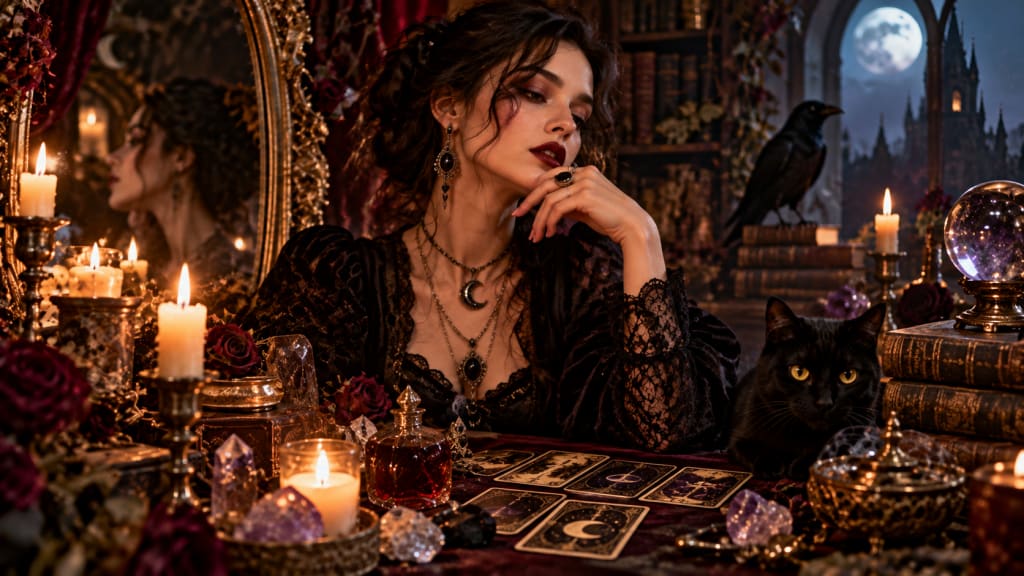
- a velvet, candlelit vanity setup with tarot cards nearby
At that point, the aesthetic is already doing conceptual work. It is teaching the user that mystery, magic, symbolism, and self-transformation belong inside the same universe as beauty. Vogue’s 2025 article on tarot and oracle decks said U.S. searches for “tarot cards” and “how to read tarot cards” rose by more than 30% during the pandemic, while the deck market was projected to keep growing. The same article explicitly linked the appeal to uncertainty, spirituality, and the search for meaning beyond traditional institutions.
Beauty brands have noticed this connection too. Vogue’s “Etsy witch” piece described how fragrance and wellness-adjacent brands now market products through explicitly ritual, energetic, or witchy language, citing examples like botanical blends, aura mists, manifestation tools, and perfumes named for intuition, courage, or “witchy” charisma. Once that language enters beauty retail, the movement from style to myth-search becomes even easier.
This does not mean everyone buying a black cherry lip stain secretly believes in spellwork. It means the aesthetic normalizes an interest in symbolic systems. It turns the occult from a doctrinal commitment into a desirable visual and emotional atmosphere. That is a huge cultural shift.
Why the Occult Now Feels Searchable, Not Taboo
A major reason this trend has traction is that modern platforms reward curiosity that feels semi-serious and semi-playful at the same time. Tarot, crystal healing, Etsy spells, moon rituals, and witchy style cues can now circulate as beauty-adjacent lifestyle content rather than openly transgressive belief. ELLE’s reporting on viral Etsy witches in 2025 showed exactly how casual this can look in practice: people treated magical intercession not necessarily as a formal religion, but as one more thing to try in an emotionally charged life moment.
The same pattern appears in Vogue’s year-end TikTok recap, which casually grouped “hire an Etsy witch” with other culture-shaping platform behaviors. That tone matters. It suggests that paranormal-coded exploration is no longer always treated as fringe. It can now function as a social-media-native form of curiosity, irony, experimentation, and identity play all at once.
Romantic gothic style accelerates that normalization because it gives the search behavior a beautiful front door. A dark floral corset, a velvet ribbon choker, or a polished plum lip does not announce “belief system.” It announces taste. From there, the jump to mood-board terms like “occult fashion aesthetic,” “paranormal decor,” “witchy perfume,” or “gothic romance altar” becomes culturally frictionless.
The Mood Board: What the Aesthetic Is Actually Made Of
To understand why this look feeds mythic and occult interest, it helps to break the mood board into its core components.
1. Romanticism, Not Just Darkness
The modern version is less about harsh industrial goth and more about romantic decay: lace, tulle, antique silver, sheer layers, old-world silhouettes, oxidized textures, feathers, veiling, faded florals, and a sense of emotional excess. Vogue’s coverage of soft goth and Jenna Ortega’s tailored gothic dressing both emphasize polish, softness, and refinement rather than raw grunge.
2. Occult-Coded Symbols
Beauty and fashion mood boards increasingly pull from moons, stars, cathedrals, saints, mourning jewelry, tarot imagery, candles, crystals, spell bottles, ravens, corsetry, and antique devotional aesthetics. Even when these are used superficially, they still train visual attention toward mythic frameworks. Vogue’s crystal-healing guide and Samhain feature are good examples of how ritual language now sits comfortably beside lifestyle and beauty coverage.
3. Dark Fantasy Instead of Pure Horror
This trend is less “scary” than enchanted. It overlaps with vampire romance, forest folklore, haunted femininity, and dark fairy-tale worlds. That is one reason it converts so well into wearable style. You are not dressing as a monster. You are dressing as someone who looks like she belongs to a world where myth is ambient.
4. Beauty as Atmosphere
The face is central. Vogue’s soft-goth reporting highlighted cool-toned contour, dark berry or greige lips, muted blush, and intentional mood over perfection. Its 2026 eye-trend report added burgundy liner, expressive shadows, and soft-alt energy to the current makeup landscape. Beauty is not supporting the aesthetic here. Beauty is carrying half of it.
From Mood Board to Wearable Interpretation
This is where the trend either becomes interesting or becomes costume. The smartest version of modern gothic beauty works by translation, not imitation.
Wearable Makeup
A mood-board version might feature corpse-pale skin, elaborate Victorian mourning, and full vamp theatrics. The wearable version tones that down into:
- cool-toned contour instead of bronzed warmth
- a blurred berry, oxblood, or taupe lip
- softly smoked liner rather than graphic costume black
- luminous but not glossy skin
- muted blush or almost-no blush
- washed charcoal, mauve, or bruised-plum shadows
That translation keeps the emotional code while making the look livable. Vogue’s soft-goth piece specifically framed the style as a modernized, five-minute-to-editorial spectrum rather than a cosplay exercise.
Wearable Hair
Mood boards lean toward Pre-Raphaelite waves, ritual braids, crimped darkness, dramatic middle parts, or storm-tossed lengths. The practical version might mean one controlled element:
- inky shine
- a deep side part
- softly undone waves
- ribbon or velvet hair ties
- a single braid detail
- a deliberately severe bun with romantic makeup
The point is contrast: elegance with unease.
Wearable Fashion
A fully styled board may include corsets, cathedral sleeves, mourning veils, antique relics, lace gloves, and floor-sweeping velvet. The everyday version distills that into:
- one sheer black blouse
- a bias-cut dark slip dress
- a long tailored coat
- lace or satin inserted into an otherwise minimal look
- silver talisman-style jewelry
- square-toe or pointed boots
- deep burgundy, charcoal, forest, eggplant, and old-ivory tones
ELLE’s 2025 trend coverage made this translation explicit, arguing that witchy and gothic style now works precisely because it can be glamorous without looking theatrical.
Wearable Symbolism
This is where search behavior really grows. Once people start wanting the “energy” of the mood board, they often move toward small symbolic objects:
- moonstone or onyx jewelry
- signet rings
- rosary-adjacent but secular beadwork
- tarot-inspired nail art
- crystal vanity objects
- celestial charms
- antique-looking lockets
- perfume names with mystical associations
These objects are easy gateways into broader mythic interest because they carry meaning without demanding total commitment.
Why This Aesthetic Converts So Well to Commerce
Romantic gothic style is especially powerful in beauty culture because it monetizes beautifully at every level.
It works as:
- makeup trend
- fragrance story
- nail aesthetic
- jewelry category
- home decor mood
- bridal subtrend
- social-media identity package
Vogue’s 2026 bridal coverage about mermaid gowns and broader romantic dressing, along with ELLE’s witchy-fashion positioning, shows how dark romance can extend well beyond alt fashion into bridal and occasionwear culture. Meanwhile, beauty media can translate the same mood into soft goth makeup, Halloween-chic nails, or crystal-coded wellness.
This makes the aesthetic unusually “search fertile.” A single look can branch into dozens of adjacent consumer paths: “witchy scent,” “goth wedding dress,” “Samhain ritual,” “tarot manicure,” “dark feminine makeup,” “occult ring stack,” “vampy lip combo,” “moon water beauty ritual,” or “paranormal bedroom decor.” Once a style ecosystem behaves like that, it stops being a microtrend and starts becoming a cultural funnel.
Why This Is More Than Costume Culture
One easy mistake is to treat the trend as another seasonal flirtation with Halloween. That misses the point. Halloween chic is one outlet, but the broader movement is more durable because it answers a current emotional appetite: people want style that feels symbolic, romantic, and slightly enchanted. ELLE’s witchy-fashion piece framed the look as “fashion” rather than costume, and Vogue’s soft-goth coverage likewise placed the style within mainstream beauty evolution rather than novelty dressing.
What makes the trend durable is that it lets people inhabit mood, not masquerade. The wearer does not need to say, “I believe in the paranormal.” It is enough to say, visually, “I am drawn to mystery, intensity, ritual, and beautiful darkness.” That makes the aesthetic socially flexible. It can be ironic, sincere, spiritual, romantic, literary, sensual, or simply stylish.
That flexibility is why it keeps feeding mythic and occult search behavior. The style does not force one reading. It invites exploration.
Final Verdict
Romantic gothic aesthetics are pulling myth and paranormal search into beauty culture because style now acts as a gateway to symbolic curiosity. What begins as a makeup look or fashion mood board often expands into tarot, crystal, moon, ritual, or witch-adjacent search behavior—not because everyone suddenly becomes an occult believer, but because the aesthetic makes mystery feel elegant, purchasable, and emotionally relevant. Vogue’s coverage of soft goth, tarot’s popularity, Etsy witches, crystals, and 2026 beauty experimentation shows how thoroughly these worlds now overlap.
The smartest reading of the trend is not that beauty culture has become paranormal. It is that beauty culture has become a symbolic interface—a place where mood, identity, ritual, and commerce now blend so smoothly that mythic language feels native to style again. The mood board is only the beginning. The real story is how easily it turns into something wearable, searchable, and culturally persuasive.
FAQ
1. What is the romantic gothic aesthetic?
It is a modern dark-romantic style language built from gothic mood, soft drama, antique-coded details, and polished beauty rather than pure costume or subcultural extremity. Vogue and ELLE’s recent coverage place it in the mainstream trend cycle through “soft goth,” witchy chic, and high-fashion gothic dressing.
2. Why is gothic beauty trending again?
Because fashion and beauty are moving away from minimalist sameness toward more expressive, emotionally charged style. Current reporting ties this to a broader reaction against “clean girl” beauty and quiet luxury.
3. How does style culture feed occult or mythic search behavior?
Once beauty and fashion start using tarot, moon, crystal, ritual, or witchy language, users often move from visual inspiration to informational searching. Vogue’s tarot, Etsy witch, and crystal features show these adjacent interests growing together.
4. Is this just Halloween fashion?
Not really. Seasonal Halloween content overlaps with it, but current trend coverage frames gothic and witchy dressing as chic, year-round, and socially wearable rather than costume-only.
5. What makes the look wearable instead of theatrical?
Translation. Instead of full costume styling, people adopt one or two romantic-gothic signals at a time: a berry lip, sheer black fabric, silver talisman jewelry, a tailored dark coat, or cool-toned contour.
6. What beauty details define the trend?
Cool-toned contour, dark berry or taupe lips, smoky or burgundy eyes, subdued blush, and an emphasis on mood over glossy perfection are central to the current soft-goth wave.
7. Why do tarot and crystals keep appearing near beauty culture?
Because modern beauty and wellness media increasingly package symbolic tools as lifestyle objects tied to self-care, intuition, ritual, and meaning. Vogue’s tarot and crystal coverage makes that crossover explicit.
8. Is paranormal style the same as occult belief?
No. Many people participate at the level of aesthetics, mood, or symbolic curiosity rather than formal belief. The cultural overlap matters even when the commitment remains light or exploratory.
9. Which celebrities are shaping this look?
Current trend coverage repeatedly points to figures like Jenna Ortega, Charli XCX, and others who translate gothic and witchy elements into polished mainstream fashion.
10. What is the simplest way to think about the trend?
It is the moment when dark fantasy styling stopped being niche and started acting like a gateway between beauty culture, symbolic self-presentation, and curiosity about mythic or occult-coded meaning.