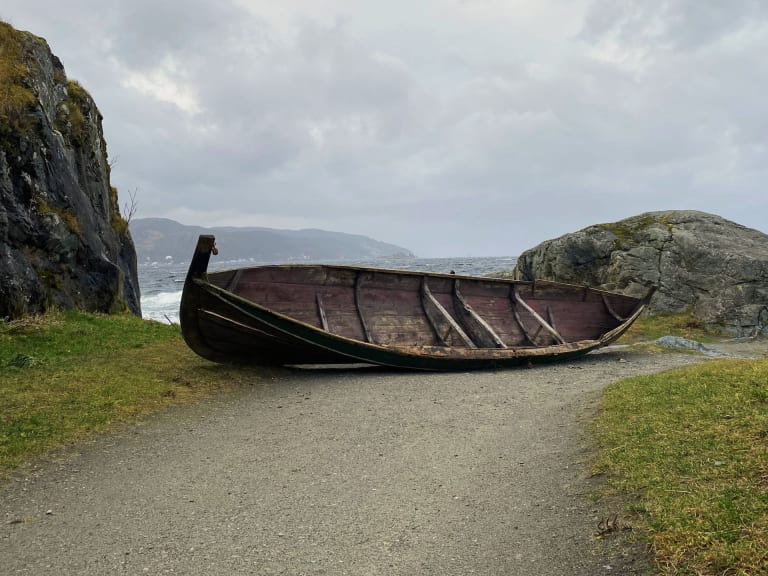
Before Columbus: How the Norse Reached North America Nearly 500 Years Earlier
For generations, schoolchildren were taught a simple sentence:
Christopher Columbus discovered America in 1492.
It was memorable.
It was easy to place on a timeline.
It was also deeply incomplete.
The Americas were not empty lands waiting for Europeans to find them. Indigenous peoples had lived across North and South America for thousands of years, creating sophisticated societies, trade networks, languages, political systems and cultural traditions long before any European ship appeared on the horizon.
Columbus was also not the first known European to reach North America.
Nearly five centuries before his voyage, Norse sailors crossed the North Atlantic from Greenland and established a small encampment on the northern edge of Newfoundland.
Today, the archaeological site known as L’Anse aux Meadows provides undeniable physical evidence of that journey.
The Norse had reached North America by 1021 CE.
Their settlement was temporary, their wider expeditions remain partly mysterious, and their voyages did not produce the lasting colonisation that followed Columbus. Yet their achievement permanently changed our understanding of early Atlantic history.
The story of L’Anse aux Meadows is not merely about deciding which European arrived first.
It is about archaeology overturning a simplified historical narrative.
It is about extraordinary maritime skill.
It is about the relationship between legend and evidence.
And it is about remembering that history is far more complex than the stories generations inherit from textbooks.
America Was Never Waiting to Be Discovered
Before discussing Columbus or the Norse, one point must be made clearly:
The Americas had already been discovered by the ancestors of Indigenous peoples.
Human communities had lived throughout the Western Hemisphere for millennia before European arrival. By the time Norse sailors reached Newfoundland, Indigenous cultures occupied environments ranging from the Arctic and eastern woodlands to the Great Plains, deserts, rainforests and major urban centres farther south.
These communities were not background figures in a European story.
They were the peoples of the continent.
For this reason, saying that either Leif Erikson or Christopher Columbus “discovered America” repeats a Eurocentric idea in which land only becomes historically important after Europeans become aware of it.
A more accurate description is that the Norse made the earliest currently confirmed European crossing to North America.
Columbus’s later voyage initiated sustained contact between Europe and the Caribbean, leading to conquest, colonisation, forced labour, epidemics and enormous demographic and political transformation.
The Norse voyage was different.
It created a temporary Atlantic outpost rather than a permanent European empire.
The Norse Expansion Across the Atlantic
The journey to North America did not begin with a single dramatic leap from Scandinavia.
Norse expansion moved westward in stages.
During the Viking Age, Scandinavian sailors developed vessels capable of crossing open seas, transporting settlers and navigating coastal waters. They travelled through the British Isles, settled Iceland and eventually established communities in Greenland.
Each new settlement extended the Norse world farther into the North Atlantic.
Iceland was colonised beginning in the late ninth century.
Greenland’s Norse settlements followed near the end of the tenth century under the leadership traditionally associated with Erik the Red.
From Greenland, the eastern coast of North America was no longer unimaginably distant.
It was the next landmass beyond the western horizon.
Norse sailors were already experienced in reading winds, waves, cloud formations, seabirds and the behaviour of marine life. They possessed practical knowledge accumulated through generations of seafaring.
Their ships combined flexibility, shallow drafts and ocean-going strength. These vessels could cross open water while also approaching beaches and navigating shallower coastal environments.
Reaching North America was still dangerous.
But it was not an accidental miracle performed by people blindly drifting across the sea.
It was the result of a highly developed maritime culture.
Who Was Leif Erikson?
Leif Erikson was the son of Erik the Red, the Norse explorer associated with establishing settlements in Greenland.
Medieval Icelandic narratives known as the Vinland sagas describe voyages west of Greenland to lands called Helluland, Markland and Vinland.
According to these stories, Leif travelled to Vinland around the beginning of the 11th century and established a base there. Later expeditions involved other Norse explorers and settlers, including Thorfinn Karlsefni.
The sagas describe landscapes containing forests, resources and unfamiliar peoples. They also recount conflict, exploration and attempts to establish settlements.
However, these narratives must be read carefully.
They were written down centuries after the events they describe, drawing from older oral traditions. They combine historical memory, family reputation, storytelling and literary structure.
They are valuable evidence, but they are not modern eyewitness reports.
Archaeology confirms that Norse people reached Newfoundland.
It does not prove beyond doubt that Leif Erikson personally lived at L’Anse aux Meadows.
The site may have been connected to his expeditions or to later voyages inspired by them. Parks Canada describes it cautiously as a possible location of Leif’s short-lived Vinland camp.
The distinction matters.
History becomes stronger when evidence and tradition are respected without pretending they reveal more than they actually do.
The Discovery of L’Anse aux Meadows
For centuries, many scholars treated the Vinland sagas as an intriguing mixture of history and legend.
That changed during the 20th century.
Norwegian explorer Helge Ingstad and archaeologist Anne Stine Ingstad searched the North American coastline for evidence of Norse occupation. In 1960, local resident George Decker directed them toward a group of unusual grassy mounds near the village of L’Anse aux Meadows on Newfoundland’s Great Northern Peninsula.
To an untrained observer, the mounds could easily have appeared natural.
Excavations revealed something extraordinary.
Beneath the grass lay the remains of timber-framed, turf-walled buildings constructed in a style associated with Norse settlements in Iceland and Greenland.
The site contained multiple structures, including halls and workshops. Archaeologists also found evidence of ironworking, woodworking and boat-related repair activity.
Small artifacts helped confirm the site’s cultural identity.
These included objects associated with Norse domestic life and craftsmanship, together with ironworking remains unlike technologies used by local Indigenous communities at that time.
The sagas had described Norse journeys westward.
Now physical evidence proved that such voyages had actually reached North America.
The Oldest Confirmed European Site in the Americas
L’Anse aux Meadows is recognised as the earliest confirmed European settlement in North America and the only officially authenticated Norse site on the continent.
UNESCO designated it a World Heritage Site in 1978.
The settlement included timber-and-sod structures resembling buildings used by Norse communities elsewhere in the North Atlantic. The construction required planning, skilled labour and significant resources.
This was not merely the campsite of a few sailors stranded for a night.
It was an organised base.
Researchers believe the settlement could accommodate several dozen people. Its buildings may have provided living areas, workshops, storage and space for repairing ships or processing materials.
The presence of ironworking is particularly significant.
Norse workers produced iron from local bog ore, likely creating nails or fittings needed to repair vessels.
For people operating at the farthest western edge of their known sailing world, maintaining ships would have been essential.
A damaged vessel could mean being unable to return home.
The Exact Year: 1021 CE
For decades, archaeologists knew that L’Anse aux Meadows belonged to approximately the year 1000.
Traditional radiocarbon dating could place the settlement within a broad period, but not identify a precise year.
Then researchers found a remarkable chronological marker hidden inside pieces of wood.
A powerful cosmic-radiation event occurred in 992 or 993 CE, producing a measurable increase in atmospheric carbon-14. Trees growing at that time absorbed the signal and preserved it inside a particular annual ring.
Researchers identified this marker in three pieces of wood from L’Anse aux Meadows.
The wood had been cut with metal tools, linking it to Norse activity rather than local Indigenous woodworking practices of the period.
Scientists counted the growth rings from the cosmic-radiation marker outward to the bark edge.
There were 28 additional rings.
That meant the trees had been cut in 1021 CE.
For the first time, researchers possessed a precise calendar year for confirmed European activity in the Americas before Columbus.
The date does not tell us when the Norse first arrived or how long they remained.
It proves that they were actively cutting wood at L’Anse aux Meadows in 1021.
What Was L’Anse aux Meadows Used For?
The settlement was probably not intended to become a large, self-sufficient farming colony like those in Iceland or Greenland.
Its northern Newfoundland environment offered challenges, and the archaeological evidence suggests relatively short-term or intermittent occupation.
L’Anse aux Meadows may have functioned as a base camp.
From there, expeditions could explore surrounding coastlines and travel farther south in search of timber and other resources.
Wood was particularly valuable to the Greenland Norse.
Greenland offered limited access to large construction timber, while the forested regions of North America possessed abundant supplies.
The site’s woodworking and iron-repair activity supports the idea of a strategic expedition base.
It may have served several functions:
A temporary winter settlement.
A ship-repair station.
A storage location.
A starting point for southern exploration.
A base for collecting timber and other resources.
The people who lived there were likely not isolated adventurers. They were part of organised expeditions connected to Norse Greenland.
Was L’Anse aux Meadows Vinland?
The sagas call the North American region explored by the Norse Vinland.
Whether L’Anse aux Meadows itself was the principal Vinland settlement remains debated.
Some descriptions in the sagas refer to resources and environmental conditions that appear more consistent with regions south of northern Newfoundland.
For example, the meaning of the name Vinland has been debated, sometimes interpreted as a reference to wine grapes and sometimes connected to pasture or meadows.
Wild grapes do not naturally grow around L’Anse aux Meadows.
However, archaeological finds suggest that Norse travellers may have explored significantly farther south. The Newfoundland settlement could have been the northern gateway to a much broader region known collectively as Vinland.
L’Anse aux Meadows may therefore have been a staging point rather than the final destination described in every saga account.
The Norse world named large regions based on environmental features.
Helluland may correspond to areas around Baffin Island.
Markland is often associated with Labrador.
Vinland may have included parts of Newfoundland and the Gulf of St. Lawrence region or lands farther south.
No archaeological site beyond L’Anse aux Meadows has yet received the same level of universal acceptance as a Norse settlement.
The search continues.
Encounters With Indigenous Peoples
The Norse were not entering an uninhabited continent.
The sagas describe encounters with Indigenous inhabitants, whom the Norse called Skrælingar. This was an outsider’s label rather than the name those peoples used for themselves.
The identities of the specific communities encountered remain debated.
Different Indigenous peoples occupied the Arctic, Labrador, Newfoundland and the Gulf of St. Lawrence regions during this period.
Some saga accounts describe trade.
Others describe fear, misunderstanding and violent conflict.
These stories suggest that Norse expeditions faced a reality far different from establishing settlements on previously uninhabited North Atlantic islands.
North America already contained organised communities familiar with their lands, resources and routes.
The Norse were a small, distant expedition group operating far from Greenland and even farther from Europe.
Indigenous resistance and the difficulty of maintaining supply connections may have contributed to the failure of permanent Norse settlement.
The Norse possessed metal weapons and ocean-going vessels.
Local communities possessed numbers, regional knowledge and established networks.
The newcomers were not automatically dominant.
Why Did the Norse Leave?
No single explanation completely accounts for the abandonment of L’Anse aux Meadows.
Several factors probably worked together.
The settlement was extremely distant from the Norse homeland and difficult to supply.
Greenland itself contained only a small Norse population.
The Atlantic crossing remained dangerous.
The economic benefits may not have justified repeated voyages.
Conflict or tense relations with Indigenous communities made permanent occupation riskier.
Internal disagreements may also have affected the expeditions.
The Norse had successfully colonised Iceland and Greenland partly because those regions had either no permanent inhabitants at the time of settlement or populations distributed differently from those encountered in North America.
Vinland presented another situation entirely.
The land contained resources, but holding territory would have required far more people, ships and sustained commitment than Greenland’s small settlements could provide.
Eventually, the Norse withdrew.
Their buildings collapsed.
Turf and vegetation covered the walls.
The settlement disappeared from European awareness, surviving mainly through the sagas until archaeology brought it back into history.
Why Columbus Became More Famous
If the Norse reached North America first, why did Columbus dominate the historical narrative?
The answer is consequence rather than chronology.
The Norse voyages did not create permanent, sustained contact between Europe and the Americas. Their settlement remained small and temporary, and their knowledge did not transform European politics or trade on a continental scale.
Columbus’s 1492 voyage initiated something much larger.
His arrival in the Caribbean was followed by repeated voyages, Spanish conquest, European colonisation, forced conversion, slavery, epidemics and the movement of plants, animals, diseases and people across the Atlantic.
This became known as the Columbian Exchange.
The consequences transformed societies throughout the world.
Columbus was therefore not the first European known to reach the Western Hemisphere.
His voyage became historically decisive because it opened an age of continuous European imperial expansion.
That distinction allows history to recognise the Norse achievement without minimising the enormous consequences of 1492.
The Problem With the Word “Discover”
The language of discovery shapes how people understand history.
Saying Columbus discovered America places Europe at the centre and makes Indigenous people appear invisible.
Saying Leif Erikson was the true discoverer improves the European timeline but leaves the deeper problem unchanged.
It still suggests that a continent only became real when a European reached it.
A better historical vocabulary focuses on contact, arrival, exploration and documented presence.
The Norse crossed the Atlantic and established the earliest confirmed European settlement in the Americas.
Columbus reached the Caribbean in 1492 and initiated sustained European colonisation.
Indigenous peoples had populated and shaped the Americas long before either event.
All three statements can be true without forcing history into a simplistic contest over who “discovered” land already inhabited by millions of people.
Vikings Were More Than Raiders
Popular culture often portrays Vikings primarily as raiders wearing armour, attacking monasteries and carrying weapons.
Raiding was certainly part of Viking Age history.
But Norse societies were also composed of farmers, merchants, craftspeople, navigators, settlers, political leaders and explorers.
Their ships transported livestock, families, tools and trade goods as well as warriors.
They established settlements over extraordinary distances.
Norse merchants travelled through river networks toward the Byzantine and Islamic worlds.
Settlers crossed the North Atlantic to Iceland and Greenland.
Explorers reached the shores of North America.
Their success depended on shipbuilding, environmental knowledge, cooperation and the ability to create communities under difficult conditions.
The people at L’Anse aux Meadows were not simply raiders on a quick attack.
They built structures.
Repaired ships.
Worked iron.
Cut timber.
Prepared to remain through at least part of the year.
Their settlement reveals the practical and organised side of Norse expansion.
Women May Have Joined the Expeditions
Archaeological objects discovered at L’Anse aux Meadows suggest that women may have been present.
A spindle whorl, used in textile production, is among the finds often connected with women’s domestic work in Norse society.
The sagas also describe women participating in Vinland expeditions.
Their presence would indicate that at least some travellers considered more than a temporary male exploration mission. Families or mixed groups may have crossed the Atlantic, even if permanent colonisation never succeeded.
Women played essential roles in Norse settlement life.
They produced textiles, managed households, preserved food, maintained social networks and contributed to the survival of communities.
Recognising their likely presence changes the image of the North American voyages.
This was not necessarily a story of only armed men stepping from ships.
It may also have included families attempting to create a functioning outpost at the western edge of their world.
The Sagas and Archaeology
The discovery of L’Anse aux Meadows did not prove every detail of the Vinland sagas.
It demonstrated that the central claim behind them was rooted in reality.
Norse people did cross the Atlantic from Greenland.
They did reach North America.
They did build a settlement.
The sagas had preserved a historical memory for centuries, even though their details were shaped through oral retelling and literary composition.
This relationship between archaeology and storytelling is fascinating.
Legends may preserve genuine events while changing names, chronology, motivations and dramatic details.
Archaeology can test those traditions.
Sometimes the physical evidence contradicts them.
Sometimes it reveals that a story dismissed as fantasy contained a remarkable core of truth.
L’Anse aux Meadows reminds historians not to accept ancient narratives uncritically—but also not to dismiss them simply because they contain dramatic storytelling.
A Quiet Site With an Enormous Meaning
L’Anse aux Meadows does not resemble the ruins of a giant city.
There are no monumental stone temples.
No towering fortifications.
No vast royal tombs.
The original structures survive mainly as low outlines beneath the landscape. Reconstructed turf buildings help visitors imagine how the settlement may have appeared.
Its physical modesty makes its historical importance even more striking.
A small group of buildings on a remote Newfoundland coast provides proof of one of humanity’s greatest maritime journeys.
At this place, travellers from the European side of the Atlantic reached a continent whose peoples had originally arrived through entirely different migrations thousands of years earlier.
The site marks a moment when human movement had effectively connected the world’s major inhabited landmasses.
It is both a local archaeological site and a landmark in global history.
How Archaeology Rewrote the Textbooks
The Viking presence in North America was once treated as uncertain.
Stories of Vinland seemed possible, but without a confirmed settlement, scepticism remained reasonable.
Excavation changed that.
Buildings, artifacts, ironworking remains and scientific dating turned a saga tradition into established history.
The precise date of 1021 made the evidence even stronger.
History did not change because someone formed a new opinion.
It changed because new evidence allowed scholars to replace an incomplete explanation with a better one.
This is one of archaeology’s greatest contributions.
It restores people and events that written histories ignored.
It can challenge political myths.
It can reveal trade, migration and cultural contact where no surviving document exists.
It can show that the past was more connected and complicated than later societies imagined.
What Else May Be Waiting to Be Found?
L’Anse aux Meadows may not represent the full extent of Norse activity in North America.
Evidence suggests its inhabitants explored beyond the immediate settlement. Materials discovered there may have originated in regions farther south.
The Vinland sagas also describe multiple locations and expeditions.
Yet no second North American Norse settlement has been confirmed with the same archaeological certainty.
That leaves an extraordinary possibility.
Other camps, repair stations or temporary landing places may still exist beneath forests, coastal soil or settlements around the North Atlantic shoreline.
They may have left only faint traces.
Temporary explorers do not always build monuments. Wood decays, coastlines erode and sea levels change. Small camps can disappear almost completely.
Future discoveries could clarify how far south the Norse travelled, how frequently they returned and how they interacted with Indigenous communities.
But claims require evidence.
Objects without secure archaeological context, disputed inscriptions and sensational theories cannot replace careful excavation and scientific analysis.
L’Anse aux Meadows became accepted because multiple forms of evidence supported the conclusion.
Any future site must meet the same standard.
Rewriting History Responsibly
Correcting the Columbus myth does not require replacing it with another oversimplification.
The most responsible version of the story recognises several truths.
Indigenous peoples were the original inhabitants of the Americas.
Norse sailors made the earliest confirmed European crossing and settlement around the beginning of the 11th century.
Leif Erikson is associated with these voyages through medieval saga traditions, though his direct presence at L’Anse aux Meadows is not archaeologically proven.
Columbus was not the first European in the Western Hemisphere, but his 1492 voyage initiated sustained European colonisation with devastating and transformative consequences.
History becomes richer when these truths are placed together.
It does not need a single heroic discoverer.
It needs evidence, context and respect for the many peoples whose lives shaped the continent.
Final Thoughts
Christopher Columbus did not become the first European to reach North America in 1492.
By 1021 CE, Norse sailors had already built timber-and-sod structures at L’Anse aux Meadows in Newfoundland.
They crossed the North Atlantic from Greenland using remarkable shipbuilding knowledge, practical navigation and generations of seafaring experience.
Their settlement was temporary.
Their exact routes remain partly unknown.
The personal connection between Leif Erikson and the archaeological site cannot be proven with certainty.
Yet their presence is no longer legend.
It is archaeology.
The remains of buildings, workshops and artifacts prove that Norse explorers stood on the North American continent nearly five centuries before Columbus crossed the Atlantic.
But the most important correction goes deeper than replacing Columbus with Leif Erikson.
America was not waiting for either man to discover it.
Indigenous peoples had lived across the continents for thousands of years, building histories of their own long before European contact.
L’Anse aux Meadows therefore represents not the discovery of America, but the earliest confirmed meeting point between the Norse Atlantic world and an already ancient inhabited continent.
Its quiet grassy ruins changed what we know about global exploration.
They proved that stories preserved through sagas could contain genuine historical memory.
They showed that the Atlantic was crossed earlier than generations of textbooks claimed.
And they remind us that every accepted version of history remains open to evidence.
A single archaeological discovery can rewrite an entire chapter.
The remarkable question is how many more chapters remain beneath the ground, waiting to be read.
#LeifErikson #Vikings #LAnseAuxMeadows #NorseHistory #BeforeColumbus #Vinland #Newfoundland #Archaeology #IndigenousHistory #VikingExploration #WorldHistory #AncientExplorers
Frequently Asked Questions
Did the Vikings reach America before Columbus?
Yes. Archaeological evidence proves that Norse explorers occupied L’Anse aux Meadows in Newfoundland by 1021 CE, approximately 471 years before Columbus’s 1492 voyage.
Did Leif Erikson discover America?
The Vinland sagas associate Leif Erikson with early Norse voyages to North America. However, Indigenous peoples had already inhabited the Americas for thousands of years, and archaeology cannot prove that Leif personally occupied L’Anse aux Meadows.
What is L’Anse aux Meadows?
L’Anse aux Meadows is an archaeological site on Newfoundland’s Great Northern Peninsula containing the remains of an 11th-century Norse encampment.
How do scientists know the Vikings were there in 1021?
Researchers identified a known cosmic-radiation signal inside tree rings from wood cut by Norse metal tools. Counting the rings to the bark edge established that the trees were felled in 1021 CE.
Is L’Anse aux Meadows the oldest European settlement in North America?
It is the earliest authenticated European settlement and the only officially recognised Norse site in North America.
Was L’Anse aux Meadows a permanent colony?
Probably not. Evidence suggests it was a temporary or intermittently used base camp associated with exploration, ship repair and resource collection.
What was Vinland?
Vinland was the name used in medieval Norse sagas for lands explored west of Greenland. Its exact geographical boundaries remain debated.
Why did the Norse leave North America?
Distance, limited population, supply difficulties, uncertain economic rewards and conflict with Indigenous communities may all have contributed.
Did Columbus know about the Norse voyages?
There is no conclusive evidence that Columbus possessed reliable knowledge of the L’Anse aux Meadows settlement or used Norse information to plan his voyage.
Why is Columbus still historically important?
His 1492 voyage initiated sustained contact, conquest and colonisation between Europe and the Americas, producing global consequences very different from the temporary Norse expeditions.
Did Vikings and Indigenous peoples meet?
The sagas describe encounters with Indigenous inhabitants, including trade and conflict. Archaeology confirms that Indigenous peoples lived in the region, although the precise details of individual encounters remain uncertain.
Could other Viking settlements exist in North America?
It is possible. The Norse likely explored beyond L’Anse aux Meadows, but no other North American settlement has yet been confirmed with comparable archaeological evidence.