Kamikaze Files, Part I: The Divine Wind That Became a Death Sentence
The final letters rarely began with hatred.
They began with Mother.
A young pilot might thank her for raising him. He might apologize for dying before repaying her kindness. He might ask her not to cry, knowing that she would. He might tell her that he was calm, proud and prepared—even when the trembling handwriting suggested that calmness had become another military duty.
Outside the barracks, officers prepared the aircraft.
A bomb was fixed beneath the fuselage. Fuel was sometimes limited to what the mission required. Mechanics inspected an engine expected to function only until impact. Girls from nearby schools arrived with flowers or cherry-blossom branches. Photographers recorded young men smiling beneath white headbands.
The image was carefully arranged.
Japan’s “divine wind” was about to rise again.
But this time, the wind was made from human bodies.
Between late 1944 and Japan’s surrender in August 1945, thousands of Japanese servicemen died in special-attack operations intended to destroy Allied ships. One Smithsonian estimate places the number of dead tokkō pilots at 3,913, although totals vary according to which branches and forms of special attack are counted.
They are commonly remembered as fanatics eager to die for the emperor.
That image is convenient.
It allows the dead to become symbols instead of people.
The surviving diaries, letters and testimony reveal something far more disturbing: there was no single kamikaze personality. Some believed intensely in their mission. Some embraced death through patriotism, loyalty or desperation. Some hoped their sacrifice might protect their families. Others doubted the war, distrusted their commanders and understood that Japan was approaching defeat.
Many were called volunteers only after the military had created a world in which refusing was almost impossible.
Their tragedy was not simply that they died.
It was that before they died, an entire political and military system taught them to describe their destruction as privilege.
The Kamikaze Files: A Three-Part Descent Into Japan’s Final War
This first article explores the creation of the kamikaze idea: the ancient “divine wind,” the wartime transformation of myth into policy, the reality behind supposed volunteering, the psychological torture of waiting for a predetermined death and the letters young pilots left for their mothers.
The second part will enter the Battle of Okinawa, where special attacks reached industrial scale and the sea became a graveyard for Japanese airmen, American sailors and Okinawan civilians. It will also examine the relationship—and crucial differences—between kamikaze attacks, military suicide, seppuku and hara-kiri.
The final part will confront the aftermath: surviving pilots, postwar shame, memorial museums, cinema, historical revisionism and the tragic irony of men celebrated as immortal spirits by leaders who had treated their physical lives as disposable.
Before “Kamikaze” Meant a Suicide Attack
The Japanese characters 神風 can be read as kamikaze or shinpū.
They mean divine wind or wind of the gods.
The expression became associated with the Mongol attempts to invade Japan in 1274 and 1281. Storms struck invading fleets, especially during the second campaign, contributing heavily to the destruction of the forces sent under Kublai Khan’s empire.
In later Japanese memory, the storms became evidence that the islands possessed supernatural protection.
Japan had faced invasion.
The gods had raised a wind.
The enemy had disappeared beneath the sea.
By the twentieth century, this memory had grown beyond medieval weather. It had become a national myth: Japan could suffer, bend and appear surrounded—but at the final moment, providence would preserve it. The belief gained particular nationalist force during the decades leading into the Pacific War.
The Storms Were Real; the Simpler Myth Came Later
The Mongol fleets were genuinely struck by destructive weather.
But the popular story in which helpless Japan was saved exclusively by a miraculous typhoon simplifies a more complicated military campaign.
Japanese warriors resisted the landings. Mongol-led forces faced logistical and command problems. The invading fleets contained vessels constructed under different conditions and standards. Defensive walls, raids against ships and the difficulties of maintaining a huge overseas invasion also mattered.
The “divine wind” became powerful precisely because it compressed all that complexity into one unforgettable message:
Japan survived because heaven chose Japan.
Modern scholarship describes the absolute, divinely delivered victory as a later historical construction rather than a complete account of the invasions.
That distinction became deadly in 1944.
A medieval storm had been transformed into a promise.
When conventional strategy failed, Japan’s military leaders would attempt to manufacture another divine wind themselves.
By 1944, the Japanese Empire Was Bleeding to Death
The kamikaze strategy did not emerge during Japan’s early victories.
It emerged from collapse.
By the autumn of 1944, the Imperial Japanese Navy had lost much of the experienced aircrew that had made it so dangerous during the opening stages of the Pacific War. Aircraft quality, pilot training, fuel availability and industrial production were deteriorating. American carrier forces could place enormous numbers of aircraft over Japanese positions, while Japan struggled to replace both machines and skilled aviators.
The empire’s territorial perimeter was shrinking.
The United States had crossed the central Pacific.
The Mariana Islands had fallen, bringing the Japanese home islands within range of B-29 bombers.
American forces were returning to the Philippines.
Japanese leaders faced an enemy with overwhelming advantages in ships, aircraft, radar, fuel, logistics and industrial capacity.
Under those conditions, conventional attacks increasingly seemed incapable of producing enough damage.
A pilot might attempt to release a bomb or torpedo and escape.
He could be shot down before reaching the target.
He might miss.
His weapon might fail to strike at the necessary angle.
The military’s brutal calculation was that a pilot deliberately guiding his bomb-carrying aircraft into a ship could increase the chance of a hit.
The solution to Japan’s shortage of effective weapons was to merge the weapon with the operator.
The Birth of the Organized Special-Attack Units
Vice Admiral Takijirō Ōnishi, commanding the First Air Fleet in the Philippines, is closely associated with the formal organization of large-scale aerial special attacks.
On October 19, 1944, with his command reduced to roughly 40 operational aircraft, Ōnishi supported the formation of the first organized Tokubetsu Kōgekitai—Special Attack Unit, commonly shortened to tokkōtai.

Two dozen naval aviators initially volunteered.
On October 25, pilots carrying 250-kilogram bombs launched successful coordinated attacks against American ships during the Battle of Leyte Gulf. The escort carrier USS St. Lo was sunk, while several other vessels were damaged and hundreds of sailors were killed or wounded.
The tactical results appeared to validate the idea.
A weakened air force had damaged several ships using a relatively small number of aircraft.
To military leaders trapped inside a losing war, that looked like efficiency.
The special attack stopped being an emergency experiment.
It began becoming doctrine.
The Japanese Military Usually Called Them Tokkō, Not Kamikaze
The first formal naval unit was named the Shinpū Special Attack Corps, using an alternative reading of the characters commonly pronounced kamikaze in English.
American codebreakers and Allied reporting popularized the reading kamikaze, which became the dominant term outside Japan. Within the Japanese military, the broader expression was often tokkō—“special attack.”
The euphemism mattered.
“Special attack” sounded operational.
Technical.
Almost clean.
It avoided saying plainly what the mission required:
The pilot was expected to die.
Language performed an anesthetic function. It allowed commanders to discuss human sacrifice with the vocabulary of organization and strategy.
A man was not being ordered toward self-destruction.
He had been “selected.”
His death was not waste.
It was a “special attack.”
His aircraft was not a coffin with wings.
It was a weapon of national salvation.
Myth Versus Reality: Were Kamikaze Pilots Fanatics?
The most persistent image is of a smiling young man intoxicated by nationalism, desperate to die for the emperor and incapable of feeling ordinary human fear.
Some pilots undoubtedly possessed intense patriotic or imperial convictions.
Some volunteered early and sincerely. Some accepted the military’s belief that sacrifice could protect their families or force the Allies into negotiations. Some appear to have found genuine meaning in dying beside their comrades.
But treating all kamikaze pilots as identical fanatics is historically indefensible.
Their backgrounds, beliefs and degrees of consent varied widely.
The majority were not elite career officers formed through Japan’s highest military academies. Historian Yuki Tanaka’s analysis shows that most dead kamikaze pilots were young noncommissioned officers and petty officers, many drawn from junior flight-training programs. In the Army, 708 noncommissioned officers died in these attacks compared with 621 officers. In the Navy, the figures were 1,732 petty officers and 782 officers.
Many were teenagers.
Others were university students whose academic deferments had ended as Japan’s manpower needs became desperate.
They had studied philosophy, literature, economics and law.
Some had read Marx, Kant, Kierkegaard, Goethe and Descartes.
They did not enter the aircraft without thoughts.
Their thoughts were simply inconvenient to the system sending them.
The Student Pilots Left a Different Record
Educated university conscripts left behind diaries and correspondence that complicate wartime propaganda.
Anthropologist Emiko Ohnuki-Tierney’s research into these writings found anguish, fear, political doubt and opposition to Japan’s imperialism alongside expressions of duty and sacrifice. A significant number of student pilots were drafted and then placed under intense pressure to “volunteer” for missions from which survival was not expected.
The younger enlisted pilots left fewer extensive written records.
That imbalance matters.
The most articulate surviving voices belong disproportionately to university-educated men, while many teenage aviators remain visible only through photographs, service records and a few formal farewell sentences.
History hears some of the dead more clearly because they had been taught how to write.
Others vanished with almost no private language preserved.
The Cruel Fiction of Volunteering
The military preferred the appearance of voluntary sacrifice.
An explicit order to die created moral and institutional complications. A volunteer, by contrast, could be praised as the living embodiment of national spirit.
But volunteering within an authoritarian wartime military was not the same as freely choosing between equal alternatives.
Pilots might be assembled and asked to step forward.
In some cases, the process was reversed: anyone unwilling to join had to identify himself while his comrades remained together.
Some men were blindfolded before being asked to raise their hands, supposedly to reduce peer pressure. Yet they could hear uniforms moving around them as other arms rose.
They understood what hesitation could mean.
Cowardice.
Disloyalty.
Dishonor to one’s unit.
Dishonor to one’s family.
Failure before the emperor.
Ohnuki-Tierney’s work describes how pressure from commanders combined with solidarity among comrades. A man might not believe in the mission, yet still find himself unable to preserve his own life while watching friends surrender theirs.
No guard needed to place a gun against every pilot’s head.
The system had already placed the gun inside his social world.
Three Answers That Did Not Offer Three Real Choices
Selection procedures varied between units, branches and stages of the war.
Some questionnaires reportedly allowed men to indicate that they:
fervently desired assignment,
simply desired assignment,
or did not desire assignment.
On paper, this resembled choice.
In practice, a young serviceman completing such a form knew that officers might read it, comrades might learn of it and refusal could mark him as someone unwilling to share the fate demanded of others.
The question was not merely:
“Do you want to die?”
It was:
“Will you admit, before your superiors and companions, that you want to live more than they do?”
That is not ordinary consent.
It is moral captivity.
The Military Turned Survival Into Shame
Every healthy organism struggles to remain alive.
The Japanese wartime state needed young men to override that instinct.
It therefore built a moral universe in which self-preservation could appear selfish and death could appear pure.
The emperor was presented as the father of a national family.
Soldiers owed him a debt resembling—and ultimately superseding—the debt owed to their biological parents.
To die for the nation was framed as the completion of filial duty.
To survive defeat could be framed as humiliation.
To surrender was worse.
By the final years of the war, schools, military training, newspapers, radio, patriotic organizations and public ceremony had all helped normalize the idea that death for imperial Japan was not merely unavoidable but beautiful.
The result was not that fear disappeared.
It was that men learned fear had to be concealed.
A Man Could Be Terrified and Still Smile for the Photograph
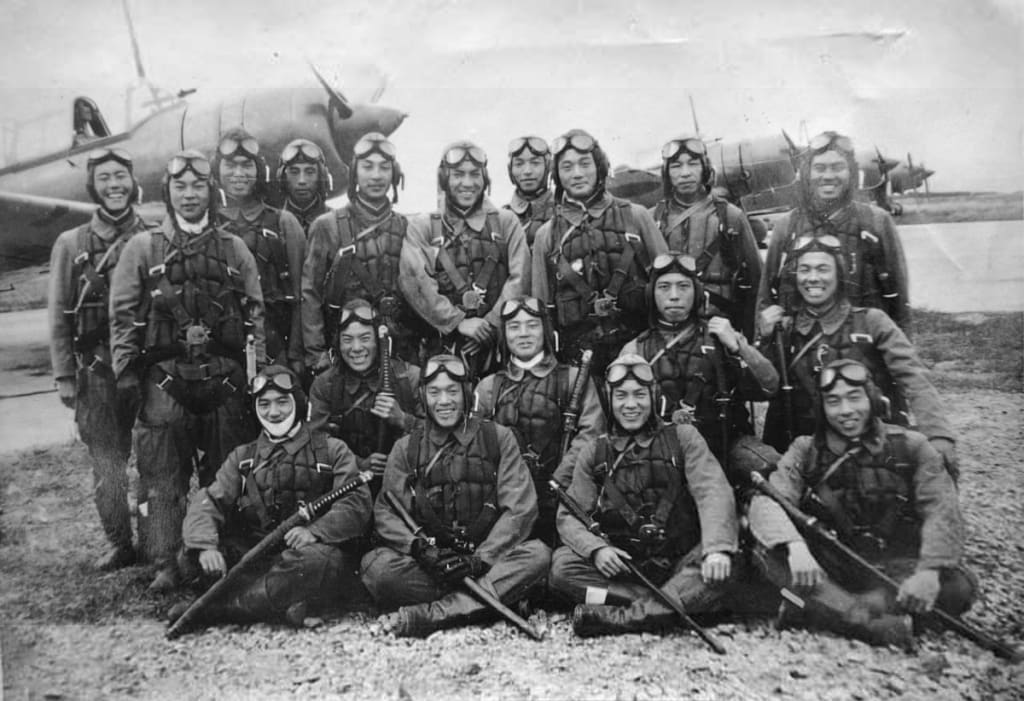
Many famous photographs show kamikaze pilots smiling.
The smile is frequently treated as proof of enthusiasm.
But a photograph records a fraction of a second, often in the presence of commanders, journalists, comrades and civilians trained to celebrate the mission.
A man might smile because he believed.
He might smile to comfort his friends.
He might smile because the photograph would reach his family.
He might smile because failing to smile would reveal terror.
He might smile because he had no remaining language for refusal.
Haruo Araki, a 21-year-old Army pilot, was photographed smiling before his May 1945 mission from Chiran. Yet his final letter to his wife spoke of regret, separation and the pain of imagining the long life she would have to live without him. He had been married for only a month.
The smiling photograph and grieving letter do not contradict one another.
Together they show the performance demanded from the condemned.
The Cherry Blossom: Death Made Beautiful
Japanese wartime propaganda frequently connected the young pilots with cherry blossoms.
The symbolism was perfectly suited to the state’s needs.
Cherry blossoms are beautiful.
They appear briefly.
They fall while still delicate rather than withering slowly on the branch.
The pilot could therefore be imagined as a blossom at the height of youth, falling magnificently for Japan.
This aesthetic language transformed premature death into completion.
It suggested that these young men had not been robbed of their futures.
They had achieved their proper season.
The metaphor was seductive because it concealed violence beneath beauty.
A blossom does not scream.
A blossom does not have a mother waiting for footsteps that will never return.
A blossom does not spend the night wondering whether the aircraft will burn before reaching the target.
A blossom has no unfinished degree, unborn child, fiancée or secret wish to see another spring.
Human beings do.
The Psychological Torture Began Before the Final Flight
Death in a kamikaze mission was not always immediate after selection.
Some pilots waited days or weeks.
They watched other squadrons leave.
They heard engines fading toward the sea.
Empty beds accumulated in the barracks.
Photographs of dead friends appeared in newspapers.
The survivors understood that their turn was approaching.
The military surrounded them with ceremonial certainty while operational uncertainty continued.
Weather might cancel a mission.
A mechanical failure might prevent takeoff.
The target might not be found.
The aircraft might be forced to return.
None of these outcomes meant release.
It meant the pilot had to prepare to die again.
Returning Alive Could Become Another Punishment
Imagine the mental preparation required to enter an aircraft expecting no return.
The pilot writes his final letters.
Distributes possessions.
Drinks a ceremonial cup.
Says goodbye.
Starts the engine.
Takes off.
Then clouds hide the target.
Or the engine fails.
Or the fleet is not where intelligence claimed.
He returns to the base.
The men who watched him depart see him alive again.
He may feel relief.
Then shame for feeling relief.
He may wonder whether others think he turned back unnecessarily.
Mechanics repair the aircraft.
Officers schedule another mission.
The farewell ceremony may happen again.
A National WWII Museum account notes that pilots sometimes launched, failed to locate a target and had to return before preparing again for what was supposed to be certain death.
This was not a single moment of courage.
It could become repeated psychological execution.
The body returned.
The sentence remained.
The Farewell Ritual Was Both Comfort and Control
Before departure, pilots might receive food, sake, flowers or headbands.
Schoolgirls and local residents sometimes waved branches as aircraft taxied away.
Comrades gathered.
Photographers captured the scene.
These rituals may have offered genuine tenderness. Civilians could sincerely mourn the pilots. Young women waving flowers were themselves trapped inside the same wartime ideology and facing bombing, hunger and possible invasion.
But the ceremonies also made retreat nearly impossible.
Once an entire community had assembled to witness a man’s glorious death, how could he step out of the aircraft and say:
“I have changed my mind”?
Ritual converted the private instinct to survive into a public betrayal.
It gave the condemned affection—but only on the condition that he continue toward death.
The Letters to Their Mothers
Among the most painful surviving documents are letters addressed to mothers.
This is unsurprising.
Most pilots were unmarried young men.

Their mothers represented childhood, home, food, forgiveness and the life that existed before uniforms and imperial orders.
Military propaganda called the emperor the father of the nation.
But as death approached, many pilots wrote to the woman who had actually raised them.
The letters often express gratitude.
Apology.
Concern that the mother will grieve.
Instructions regarding siblings.
Requests that parents remain healthy.
Assurances that death will be honorable.
The pilots frequently attempt to reverse the natural order of comfort. The son sentenced to die becomes the person consoling the mother who must continue living.
Minoru Nakamura: “Mother, Mother, Now I Go”
Second Lieutenant Minoru Nakamura was 20 years old when he departed Chiran on April 7, 1945, as a member of the 29th Shinbu Special Attack Squadron.
His final letter repeatedly returns to one word:
Mother.
Near its end, he wrote, “Mother, Mother, now I go.”
He asked her to come quickly when he called, whether from beyond mountains or distant clouds.
The language of military honor surrounding the letter cannot hide its emotional center.
A 20-year-old about to die was calling for his mother.
Not the emperor.
Not a general.
Not an abstract nation.
His mother.
Ichizō Hayashi: Duty and Grief in the Same Letter
Ensign Ichizō Hayashi studied at Kyoto Imperial University before entering the Navy’s reserve-student aviation program.
He was 23 when he departed Kanoya Air Base on April 12, 1945, flying a Zero carrying a 250-kilogram bomb toward the waters near Okinawa.
His letters reveal the double language of the special-attack pilot.
He wrote that he was happy to have been selected.
But he also wrote that he was “moved to tears” when thinking of his mother.
He regretted dying without having done enough to bring her happiness or peace. He could not honestly demand that she rejoice in his supposedly splendid death.
This is not the writing of a man without fear or attachment.
It is the writing of someone trying to place public duty and private love inside the same final page.
They do not fit.
That failure to reconcile them is where the tragedy lives.
Haruo Araki: A Marriage Lasting One Month
Haruo Araki had been married to Shigeko for approximately one month when he wrote his last letter from Chiran on May 10, 1945.
He apologized for having been emotionally cold.
He asked her to forgive him.
He urged her to live happily after his death and care for his father.
The following morning, he led his unit toward the fleet off Okinawa. His exact fate remains uncertain, although his mission coincided with the devastating strikes against USS Bunker Hill on May 11.
Shigeko later learned that she was pregnant.
The military could call his death eternal.
His child would know him only through stories and photographs.
Can the Letters Be Read as Pure Truth?
The farewell letters are invaluable, but they must be read carefully.
They were not written in complete psychological freedom.
The writers lived inside a military system governed by censorship, surveillance, patriotic expectation and self-discipline. Some knew their letters might be read by officers, preserved by relatives or used as evidence that they had died properly.
Even private diaries cannot automatically be treated as untouched access to the innermost self. Scholarship on Japanese wartime diaries emphasizes intended audiences, self-censorship and the way writers constructed disciplined versions of themselves on the page.
A patriotic sentence may reflect genuine belief.
It may also reflect what the pilot believed his parents needed to hear.
Or what the military permitted him to say.
Or what he needed to tell himself to enter the aircraft.
The contradiction should not be resolved too easily.
A man could love Japan and hate the mission.
He could oppose the war and still refuse to abandon his companions.
He could fear death and wish to appear brave.
He could resent his commanders while believing his mother might become safer if he succeeded.
Human beings are capable of holding incompatible truths.
The letters preserve that fracture.
Why So Many Letters Contain No Open Protest
Readers sometimes ask why a coerced pilot did not simply write:
“I do not want to die. The officers are murdering us.”
The answer lies in what such words could do.
A letter might be intercepted.
The writer’s family could be humiliated.
His parents might be accused of raising a disloyal son.
His unit could suffer.
His final memory might become shame rather than honor.
Even when censorship was not physically present at the desk, it existed inside the writer’s understanding of consequences.
Silence protected the family.
A performance of courage could become the last gift a son believed he was capable of giving his mother.
This makes the letters even darker.
The absence of complaint does not necessarily prove the absence of terror.
Sometimes it proves that terror had no safe vocabulary.
There Was No Single Kamikaze Mind
It would be equally misleading to replace one stereotype with another.
Not every pilot was secretly opposed to the mission.
Not every volunteer was forced in precisely the same way.
Not every patriotic statement was propaganda.
Some pilots appear to have believed deeply in sacrifice for emperor and country. Some thought special attacks might save Japan from invasion. Some wished to die alongside friends who had already departed. Some accepted the military values in which they had been educated.
Others doubted.
Others obeyed.
Others were too young to have fully formed political convictions.
Others may have shifted between pride and terror from hour to hour.
The category “kamikaze pilot” describes a military function.
It does not describe a uniform inner life.
Recognizing that complexity does not romanticize the attacks.
The pilots killed thousands of Allied sailors and inflicted horrific injuries. Aircraft carrying bombs and fuel crashed into ships crowded with human beings. The victims were burned, crushed, dismembered or trapped in smoke-filled compartments.
Understanding the pilot does not require forgetting the sailor.
Both were consumed by the same collision.
Kamikaze Pilots Were Not the Same as Modern Terrorist Attackers
The term kamikaze is now casually applied to terrorists, reckless drivers, political extremists and anyone engaging in apparently self-destructive behavior.
That broad usage can obscure important historical differences.
The Japanese pilots were uniformed members of a state military operating during a declared international war. Their intended targets were generally Allied warships and military personnel.
That does not make the tactic humane.
It does mean the historical phenomenon should not be carelessly collapsed into every later form of suicide attack against civilians.
Scholars studying the comparison emphasize both the shared feature of deliberate self-destruction and major differences in political structure, target selection, military status and wartime context.
The word has become shorthand for irrational death.
The actual history is more specific—and more horrifying.
It concerns a modern state systematically converting its young servicemen into guidance systems.
The Tragic Irony of the “Divine Wind”
The original divine wind was remembered as an outside force.
It arrived from the sky.
It destroyed the invader.
It saved Japan without requiring the Japanese people to destroy themselves.
The twentieth-century version reversed the story.
No miraculous storm appeared.
The military took young men and declared that they would become the storm.
The myth promised divine protection.
The strategy revealed institutional abandonment.
Japan’s leaders described the pilots as proof of national spiritual superiority because they could no longer provide enough aircraft, fuel, training, radar, ships or coherent strategy to compete conventionally.
The pilots were told that their willingness to die made Japan powerful.
In reality, their missions demonstrated how powerless the empire had become.
The Men Ordering Death Usually Remained on the Ground
Another cruelty lies in the separation between sacrifice and authority.
Young pilots were praised for surrendering the future.
Senior leaders made the plans.
The language of Bushido, emperor worship and beautiful death flowed downward through the hierarchy.
The aircraft did not carry the politicians who had expanded the war.
They did not carry the senior strategists who had miscalculated American industrial strength.
They carried students.
Teenagers.
Newly married men.
Sons writing to mothers by dim light.
The state celebrated equality in death while preserving hierarchy in survival.
Some senior officers eventually died by suicide, including Ōnishi after Japan’s surrender.
But their final acts could not return the thousands of young men whose deaths had already been scheduled by command.
Did the Kamikaze Strategy Work?
At a tactical level, special attacks inflicted severe losses.
Kamikaze aircraft sank ships, damaged hundreds more and killed thousands of Allied personnel. Their effectiveness per aircraft could exceed that of conventional attacks under certain conditions because pilots continued guiding their weapons until impact.
At a strategic level, they failed.
They did not stop the American return to the Philippines.
They did not prevent the capture of Iwo Jima.
They did not drive the Allied fleet away from Okinawa.
They did not reverse Japan’s collapse.
They did not save the empire.
Japan’s leaders could destroy individual ships.
They could not destroy the industrial and military system replacing those ships.
The “divine wind” caused terror and grief.
It did not produce victory.
That failure is essential to the story.
Without it, the pilots can be remembered as tragic heroes who achieved a meaningful national purpose.
With it, the darker truth emerges:
Many died in operations that inflicted terrible suffering but could not alter the conclusion their leaders increasingly understood was approaching.
A Few Ordinary Objects Left Behind
The dead left watches.
Pens.
Photographs.
Locks of hair.
School notebooks.
Uniform buttons.
Letters folded into envelopes.
Some left instructions regarding debts or belongings.
Some asked younger siblings to study.
Some apologized for being troublesome sons.
Some worried about crops, aging parents or wives who would have to remarry.
These objects destroy the grand image of the fearless human weapon.
A weapon does not apologize.
A weapon does not remember its mother’s cooking.
A weapon does not ask whether its fiancée will be lonely.
The state required them to function as machines.
The surviving objects prove they remained human until the end.
The Darkest Myth Was Not That They Could Win
The darkest myth was that they had freely chosen everything.
Calling every pilot a willing martyr releases the institution from responsibility.
It allows commanders to disappear behind the enthusiasm of the dead.
It transforms pressure into patriotism.
It turns fear into weakness the pilots supposedly never felt.
It makes every smile literal and every patriotic sentence complete.
The historical reality is far less comforting.
Some believed.
Some volunteered.
Some were coerced.
Many existed somewhere between those categories, moved by loyalty, shame, friendship, fear and the knowledge that Japan’s military had made ordinary survival morally unbearable.
The question was never simply whether a pilot wished to die.
It was whether the world around him still permitted him to say that he wished to live.
The Divine Wind Was Manufactured
The kamikaze did not descend from an ancient warrior instinct untouched by modern politics.
The phenomenon was constructed.
It required an unwinnable military position.
A state ideology glorifying death.
An emperor-centered national identity.
Military institutions that treated surrender as disgrace.
Propaganda that turned youth into cherry blossoms.
Peer pressure that converted refusal into betrayal.
Ceremonies that transformed private death into public spectacle.
And language soft enough to call a suicide mission a “special attack.”
Once all of that had been built, the final step appeared almost natural.
Place a young man inside the aircraft.
Fix the bomb beneath him.
Tell his mother that he had been honored.
The Last Night Before the Flight
It is tempting to imagine the final night as dramatic.
A storm outside.
A speech.
A revelation.
But death often approached through ordinary details.
A pilot polished his boots.
Someone repaired a torn uniform.
Someone borrowed paper.
Someone joked badly.
Someone ate.
Someone failed to sleep.
One man wrote to his mother beneath weak barracks light.
Another tried to explain to a woman he loved that she must stop living in the past because he would soon cease to exist in the physical world.
Beyond the walls, mechanics worked on machines that were not expected to return.
Morning approached with complete indifference.
The birds sang.
The sky brightened.
The engines started.
The young men climbed inside.
And the state called the sound divine.
The Bottom Line
The kamikaze phenomenon began as Japan’s military position became increasingly desperate in late 1944.
The term means divine wind, recalling the storms associated with the failure of Mongol invasions centuries earlier. Twentieth-century nationalism transformed that historical memory into a promise that Japan possessed special protection against foreign conquest.
Large-scale organized aerial special attacks began during the Philippines campaign in October 1944. Early tactical successes encouraged Japanese commanders to expand the practice.
Approximately 4,000 Japanese pilots died in aerial special attacks, depending on definitions and accounting methods. Most were young petty officers and noncommissioned personnel rather than senior professional officers.
Some genuinely volunteered and believed in the mission.
Others were drafted, selected or pressured to volunteer through military authority, group solidarity, shame and a national ideology that treated survival as morally suspect. The surviving writings of student pilots reveal fear, ambivalence, political doubt and grief that conflict sharply with the stereotype of the thoughtless fanatic.
Their letters to mothers are among the darkest records of the war.
Young men attempted to comfort parents whose grief they could already imagine. They expressed gratitude, apology and love while using the patriotic language expected of those chosen to die.
The letters do not prove that every pilot opposed the mission.
They prove something more important:
They remained individuals.
The state could schedule their deaths.
It could photograph their smiles.
It could compare them with falling blossoms.
It could call them gods after they were gone.
But it could not completely erase the frightened son beneath the uniform.
The original divine wind was said to have saved Japan by destroying an invading fleet.
The wartime divine wind demanded that Japan destroy its own youth.
That is the central tragedy of the kamikaze story.
Not that thousands of men were born wanting death.
But that a collapsing empire learned how to make living feel like betrayal—and then called the resulting silence voluntary.
Frequently Asked Questions About Kamikaze Pilots
What does kamikaze mean?
Kamikaze means “divine wind” or “wind of the gods.” It refers historically to storms associated with the failure of Mongol invasions of Japan and later became the internationally recognized name for Japanese special-attack pilots during World War II.
Did the Japanese military call the pilots kamikaze?
The Japanese commonly used tokkō or tokkōtai, meaning special attack or Special Attack Corps. The first formal naval unit used the name Shinpū, an alternative reading of the characters pronounced kamikaze. Allied usage helped popularize “kamikaze” internationally.
When did organized kamikaze attacks begin?
Large-scale organized attacks began in October 1944 during the Philippines campaign. The first successful coordinated missions on October 25 sank USS St. Lo and damaged several other vessels.
Who organized the first official kamikaze units?
Vice Admiral Takijirō Ōnishi is closely associated with forming the first organized naval Special Attack units in the Philippines in October 1944.
How many kamikaze pilots died?
Estimates vary, but approximately 4,000 Japanese pilots died in aerial special-attack missions. Higher totals may include other forms of tokkō, such as human torpedoes, explosive boats and related suicide operations.
Were all kamikaze pilots volunteers?
No. Some volunteered genuinely, especially among the early formations. Others were drafted, assigned or subjected to intense institutional and social pressure to “volunteer.” Consent differed substantially between individuals and units.
How were pilots pressured to volunteer?
Methods included public selection, military authority, peer pressure, shame, patriotic indoctrination and the expectation that refusal would dishonor one’s comrades, family or emperor.
Were most kamikaze pilots elite military officers?
No. The majority were young petty officers and noncommissioned personnel, many from junior flight-training programs. University students drafted into reserve-officer aviation programs formed an influential but smaller group.
How young were kamikaze pilots?
Many were in their late teens or early twenties. Preserved records include pilots who died at 17, 18, 19 and 20 years old.
Did kamikaze pilots have enough fuel to return?
Practices varied. Some aircraft carried fuel calculated primarily for the mission, but pilots could and sometimes did return because of weather, mechanical problems or failure to locate a target. Returning generally did not release them from future assignment.
Why did returning pilots feel ashamed?
The official culture portrayed the mission as glorious and voluntary. A pilot returning after a failed sortie might fear being suspected of cowardice, even when weather, mechanical failure or absence of a target had forced him back.
Did kamikaze pilots write final letters?
Yes. Many left letters, wills, poems, diaries and other writings. The Chiran Peace Museum preserves and displays a large collection, including numerous letters addressed to parents, wives, children and fiancées.
Why were so many letters addressed to mothers?
Most pilots were young and unmarried. Their mothers represented their closest emotional connection to home, childhood and family. Farewell letters frequently thanked mothers for raising them and attempted to prepare them for the news of death.
Were the pilots’ letters censored?
Military censorship and social expectations shaped wartime correspondence. Writers also practiced self-censorship because criticism could harm their families or stain the memory they left behind. Not every patriotic statement should therefore be interpreted as a complete record of private belief.
Did kamikaze pilots really smile before departure?
Photographs show many smiling, but the images cannot reveal a pilot’s complete mental state. A smile could express belief, pride, solidarity, concern for family, obedience to ceremony or an effort to conceal fear.
Were they drugged before flying?
There is no evidence that all kamikaze pilots were routinely drugged into carrying out missions. Some received ceremonial sake, but the widespread image of pilots being universally intoxicated or chemically controlled is unsupported.
Were kamikaze pilots trained?
Yes, although training quality declined severely as Japan lost experienced aviators and rushed younger pilots through wartime programs. Some had substantial flight experience; others received only enough instruction to operate basic or obsolete aircraft.
Was a kamikaze aircraft always a Zero fighter?
No. Numerous aircraft types were used, including fighters, trainers and bombers. Japan also developed purpose-built special-attack weapons such as the rocket-powered Ohka, effectively a human-guided missile.
Did the pilots believe they would become gods?
Wartime ideology taught that those who died for the emperor would be enshrined and honored, particularly at Yasukuni Shrine. Individual beliefs varied, and not every pilot interpreted these teachings literally.
Were kamikaze attacks effective?
They were tactically dangerous and inflicted extensive casualties and ship damage. Strategically, however, they failed to stop the Allied advance or prevent Japan’s defeat.
Why did Japan use suicide attacks?
Japan faced severe shortages of experienced pilots, modern aircraft, fuel and conventional military options. Commanders believed deliberately guided crashes could improve the chance of striking Allied ships and impose enough casualties to slow the advance or force negotiations.
Were kamikaze pilots the same as modern suicide terrorists?
No. Important differences include military status, declared warfare and the targeting of combatant ships. Comparisons can examine shared self-destructive tactics, but treating them as identical erases major historical and legal distinctions.
Did the pilots shout “Banzai” during impact?
There is no way to know what most pilots said in their final seconds. Wartime imagery often presented them shouting patriotic phrases, but aircraft noise, combat conditions and the deaths of the pilots leave little direct evidence.
What is the greatest myth about kamikaze pilots?
The greatest myth is that they were all identical fanatics who eagerly chose death without fear or doubt.
The evidence reveals genuine believers, reluctant participants, coerced “volunteers,” frightened teenagers and educated critics of the war—all forced into the same historical image after death.
What is the darkest truth behind the divine wind?
The ancient story described a wind that arrived to save Japan.
In 1944 and 1945, Japan’s leaders could no longer wait for a miracle.
So they placed young men inside aircraft and ordered them to become one.