Kamikaze Files, Part II: Okinawa—The Island Where Death Became Strategy
At sea, sailors stared into the sky.
On land, families disappeared into caves.
Above them, young pilots approached through clouds of antiaircraft fire, carrying bombs they were never expected to release.
Behind them, one of the largest battleships ever built sailed south on a mission its commanders understood was almost certainly useless.
The Japanese called the mass air attacks Kikusui—“Floating Chrysanthemums.”
It was a beautiful name for something designed to produce burning ships, mutilated bodies and rows of photographs sent home to grieving mothers.
By the spring of 1945, the kamikaze was no longer an improvised weapon used by a desperate force in the Philippines. It had become a system. Aircraft, pilots, training fields, farewell ceremonies and military language were organized around the assumption that human life could be converted directly into explosive force.
Okinawa became the place where that system reached its most terrifying scale.
From April to June 1945, nearly 2,000 Japanese suicide aircraft were committed against Allied forces around the island. Ten major waves struck the fleet, accompanied by smaller attacks, conventional bombers, rocket-powered human-guided weapons and manned torpedoes. Thirty-six American ships and smaller craft were sunk, hundreds were damaged, and thousands of sailors died or were wounded.
Yet even these figures represent only one layer of Okinawa’s tragedy.
The battle killed more than 200,000 soldiers and civilians. More than 100,000 civilian residents died—some beneath American bombardment, others from hunger and disease, and others after being killed or driven toward suicide by Japanese forces that had transformed their homeland into a defensive sacrifice zone.
Okinawa was not merely a battlefield.
It was a place where almost every form of death cultivated by Imperial Japan met at once:
the kamikaze pilot descending from the sky,
the sailor trapped inside a burning ship,
the soldier ordered never to surrender,
the civilian holding a grenade inside a cave,
the battleship sent toward its own destruction,
and the general who chose ritual suicide after ordering everyone beneath him to continue dying.
This is where the language of beautiful sacrifice finally encountered its physical meaning.
 Imrul
Imrul
Okinawa Was Chosen to Absorb the End of the War
Okinawa lies between Japan’s main islands and Taiwan.
Its position made it strategically invaluable. Airfields on the island could support operations against Japan, while its harbors and surrounding waters could serve as staging areas for a possible invasion of the home islands.
For the United States, capturing Okinawa would move the war closer to its final objective.
For Japan, losing Okinawa would expose the homeland.
American forces began landing on the main island on April 1, 1945, in Operation Iceberg. More than 60,000 soldiers and Marines came ashore during the initial assault. The landing beaches were surprisingly quiet because Japanese commanders had chosen not to destroy their forces in a hopeless defense at the waterline.
Instead, Lieutenant General Mitsuru Ushijima’s 32nd Army built a defense in depth across the rugged southern portion of the island.
Caves, tunnels, ridges, tombs and reinforced positions were transformed into a connected system designed to survive bombardment and force American troops into repeated close-range battles.
The goal was not a realistic military victory.
Japan’s commanders hoped to prolong the campaign, inflict such horrifying losses that the United States might hesitate before invading the main islands, and purchase additional time for Japan to prepare its final defenses.
Okinawa’s people would pay for that time.
The Island Was Treated as a Barrier, Not a Home
Japan’s wartime leadership spoke of Okinawa as part of the sacred national territory.
Its strategic plans treated it as expendable.
The Japanese army mobilized local residents, including students and civilians recruited into support and defense units. Families were displaced from their homes. Caves used as shelters could be seized for military purposes. Civilians became trapped between Japanese troops who distrusted them and American bombardment that could not distinguish every soldier from every refugee.
The Okinawa Prefectural Peace Memorial Museum describes a battle in which civilians died not only from shells and air attacks but also from starvation, malaria, killings by retreating Japanese troops and suicides produced by military coercion and terror.
The island was told that it was being defended.
In practice, it was being consumed.
Operation Kikusui: The Floating Chrysanthemums
The largest organized kamikaze campaign of the war began on April 6.
Japan named it Kikusui, usually translated as “Floating Chrysanthemum.”
The chrysanthemum was associated with imperial authority. It appeared on the imperial seal and carried connotations of loyalty, endurance and sacred national identity.
The name transformed mass suicide into a floral image.
Pilots became blossoms floating toward the enemy.
The ships they struck did not experience flowers.
They experienced aircraft breaking through antiaircraft fire at hundreds of miles per hour, followed by exploding fuel, bombs, severed electrical systems, burning aviation gasoline and fires spreading through compartments packed with men.
Kikusui No. 1
The first and largest mass attack unfolded on April 6 and 7.
Japan committed approximately 355 kamikaze aircraft—230 naval and 125 army planes—alongside hundreds of conventional attackers and escorts. The operation struck 33 American ships and sank several vessels, including destroyers and smaller craft.
The aircraft did not always arrive in one easily recognizable formation.
Some came in groups.
Others approached alone.
Some attacked at dawn or dusk, when visibility made interception more difficult. Others used clouds, low altitude or the confusion produced by conventional raids.
The result was a threat that rarely seemed to end.
A sailor could survive one alarm, return to his duties and hear another alarm minutes later.
He could watch one aircraft fall into the sea and discover that another was already approaching from a different direction.
He could fire until his gun overheated and still see the enemy growing larger.
The Ten Waves
Nine additional mass attacks followed.
Three more occurred during April, four during May and two during June. Around 1,500 kamikaze aircraft were committed during the ten major Kikusui operations, with approximately 400 additional planes used in smaller attacks.
Each operation became smaller as Japan exhausted aircraft and pilots.
But smaller did not mean harmless.
One aircraft reaching one crowded flight deck could kill hundreds.
One pilot striking the correct section of a destroyer could break the ship apart.
One human-guided bomb could arrive too quickly for defensive guns to track.
The military value of the attacks came from their ability to concentrate enormous destruction into a single successful impact.
Their psychological value came from something even darker:
Every approaching aircraft had to be treated as though the pilot had no intention of surviving.
The Radar Picket Ships Waited First
The most exposed vessels were often destroyers stationed around Okinawa as radar pickets.
Their task was to detect incoming raids early and direct fighter aircraft toward them before the attackers reached transport ships and aircraft carriers closer to the island.
That made the picket destroyers the outer nervous system of the fleet.
It also made them the first ships many inexperienced Japanese pilots encountered.
Some kamikaze aviators had limited navigation and combat training. Rather than continuing through heavy defenses toward aircraft carriers, they attacked the first visible target.
That target was often a relatively small destroyer sitting at an isolated station.
The picket crew knew what its position meant.
Their radar might provide the first warning that saved the main fleet.
The same radar transmission could confirm that death was already coming toward them.
Bush and Colhoun
During the first Kikusui attack, the destroyer USS Bush was struck repeatedly while serving at a northern radar picket station.
After one aircraft hit the ship, another arrived while rescue and damage-control efforts were underway. A third attack helped break the already crippled vessel apart.
USS Colhoun, which came to assist, was then attacked and sunk as well.
The sequence captured the cruelty of the campaign.
A ship could not safely remain alone.
But another vessel attempting to rescue it entered the same killing zone.
Sailors were forced to choose between abandoning men in the water and exposing another crew to the aircraft still circling overhead.
USS Laffey: A Ship That Refused to Sink
On April 16, USS Laffey endured one of the most famous kamikaze assaults of the war.
The destroyer was struck by multiple suicide aircraft and bombs during a prolonged attack. Thirty-two men were killed and 71 were wounded, but the surviving crew kept the vessel afloat.
Laffey’s survival became a story of extraordinary damage control.
But heroic language can obscure the lived reality.
Men fought fires beside the bodies of friends.
Wounded sailors remained at guns because replacing them was impossible.
Compartments filled with smoke.
Communication systems failed.
The deck became a mixture of shattered metal, fuel, seawater and blood.
To say that the ship “survived” describes the vessel.
It does not describe what survival felt like to the people inside it.
The Sailors Began Fearing the Sky Itself
Traditional naval combat offered at least the hope that an attacking aircraft would release its weapon and attempt to escape.
Kamikaze tactics removed that expectation.
A damaged aircraft could become more dangerous rather than less.
A pilot whose engine was failing might continue toward a ship because he no longer needed enough power to return home.
Gun crews learned that hitting an aircraft was not sufficient.
They had to destroy it early enough that momentum, debris or the attached bomb would not carry it into the vessel.
American reports described aircraft continuing through intense gunfire while pieces broke away from them.
A pilot might already be mortally wounded and remain capable of moving the control column for a few final seconds.
Those seconds were enough.
The Fear Continued After the Aircraft Was Hit
A flaming plane falling toward the sea might change direction.
A wing could detach and strike the deck.
A bomb could separate from the fuselage and continue forward.
An aircraft shot down only yards away could explode beside the hull.
There was no clean boundary between success and disaster.
A gunner could watch an attacker break apart and still not know whether he had saved the ship.
The human nervous system was forced to remain at maximum alert for hours, then days, then weeks.
Sleep came in fragments.
False alarms felt almost as violent as real ones because the body prepared for death before discovering that nothing was there.
The kamikaze’s most persistent weapon was anticipation.
The Ohka: A Man Placed Inside a Missile
Some Japanese weapons removed nearly every remaining distinction between aircraft and bomb.
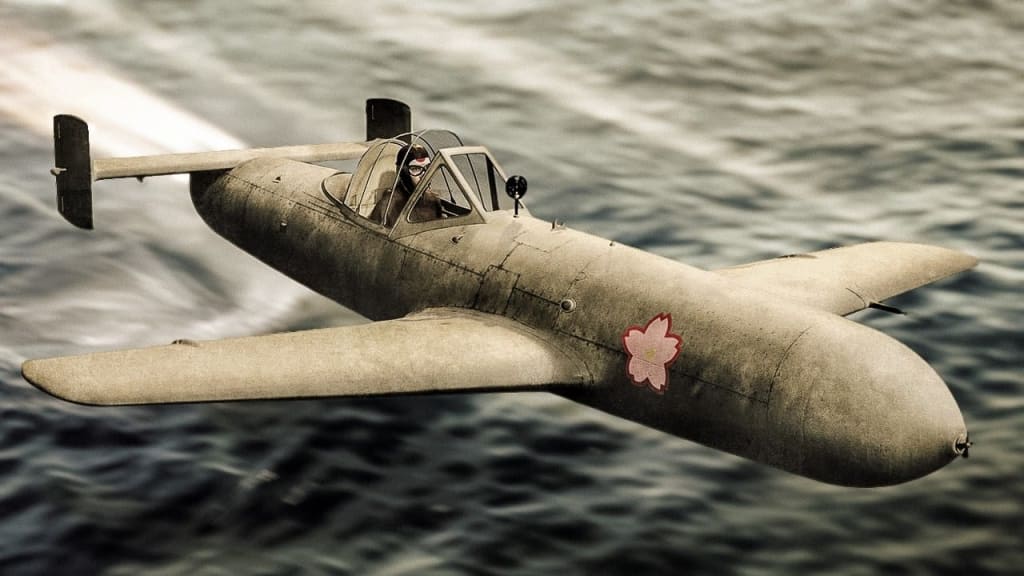
The Yokosuka MXY7 Ohka was a small rocket-powered attack aircraft carried beneath a larger bomber.
The bomber transported it toward the target area. The Ohka pilot was then released and attempted to glide close enough to ignite rocket engines for a final high-speed dive.
The Japanese name meant cherry blossom.
American sailors called it the Baka bomb, using a Japanese word meaning foolish or stupid.
Neither name described the human being enclosed inside it.
The Ohka had no landing gear for ordinary operational recovery after launch.
Once released, the pilot’s relationship with the weapon was final.
He was not carrying the bomb.
He occupied the space where a guidance mechanism would exist in a later missile.
The Sinking of Mannert L. Abele
On April 12, destroyer USS Mannert L. Abele became the first ship sunk by an Ohka.
The weapon approached at high speed near the waterline and struck with enough force to help split the destroyer apart. Eighty-four sailors died.
The Ohka demonstrated both the potential and the limitations of Japan’s suicide technology.
Its speed during the final approach made interception extremely difficult.
But the bomber carrying it was slow, vulnerable and forced to approach Allied air defenses before releasing the weapon.
Many carrier aircraft were shot down before their Ohkas could launch.
The pilot inside the missile could spend the flight waiting beneath the bomber, unable to control whether he would ever be released.
He might die when Allied fighters destroyed the carrier aircraft.
He might be ordered to return because the target could not be reached.
Or he might feel the mechanism release and understand that the remaining portion of his life could now be measured in minutes.
USS Bunker Hill: A Floating City Becomes an Inferno
On May 11, 1945, aircraft crowded the flight deck of the carrier USS Bunker Hill.
They were fueled, armed and preparing for operations.
That made the ship a concentration of aviation gasoline, bombs, ammunition and human beings.
Two kamikaze aircraft struck in quick succession.
The first crashed through the flight deck, and its bomb exploded below.
The second hit near the carrier’s island structure as fires and explosions were already spreading.
A total of 396 crew members were killed, making it the deadliest kamikaze attack suffered by a single American ship.
The carrier survived.
Hundreds of men did not.
A Successful Attack Did Not End at Impact
The pilot’s death occurred in an instant.
The sailors’ ordeal continued.
Fire traveled through aviation fuel.
Armed aircraft exploded on the deck.
Smoke entered compartments.
Men below could become trapped because passageways were blocked or because opening a hatch might feed oxygen to the flames.
Damage-control teams moved toward the fire while others attempted to escape it.
Some sailors jumped into the sea.
Others were transferred to nearby ships through smoke and wreckage.
The aircraft that struck Bunker Hill disappeared at the moment of collision.
Its consequences remained throughout the ship.
This was the central imbalance of a successful kamikaze attack:
One man died immediately.
Hundreds of others could spend minutes or hours burning, suffocating, bleeding or searching for people who would never answer.
Operation Ten-Go: Yamato’s Final Voyage
While Kikusui No. 1 attacked from the air, the Imperial Japanese Navy attempted one final surface operation.
The battleship Yamato, light cruiser Yahagi and eight destroyers departed Japan on April 6.
Their mission was called Operation Ten-Go, or Heaven One.
The force was expected to reach Okinawa, attack American shipping and then beach surviving ships. Their crews would continue fighting from shore until they were destroyed.
The mission was understood as a surface special attack—a suicide operation in naval form.
Yamato was one of the most heavily armed battleships ever constructed.
It represented the power, ambition and prestige of the Imperial Japanese Navy.
By April 1945, that symbol was being sent into battle without meaningful air cover against an enemy whose carrier forces dominated the sky.
Some Commanders Called the Mission Wasteful
The plan was not accepted enthusiastically by every senior officer.
Commanders argued that the operation could not succeed. One described it as comparable to throwing an egg against a rock.
The American fleet possessed overwhelming air power and already knew much of the Japanese plan because communications had been intercepted and decoded.
The Japanese ships sailed anyway.
Obedience transformed strategic absurdity into operational reality.
Sailors who had not designed the war’s failed strategy were placed aboard ships expected to perform the final proof of loyalty.
Once again, the language of spiritual courage was used to compensate for material hopelessness.
Yamato Never Reached Okinawa
On April 7, hundreds of American carrier aircraft attacked the Japanese force north of Okinawa.
Bombs and torpedoes struck Yamato repeatedly. Flooding produced a growing list. Damage-control systems failed. Fires spread, and the ship eventually capsized.
A catastrophic magazine explosion followed.
Only a fraction of its crew survived. Yamato sank hundreds of miles before reaching the battlefield it had supposedly been sent to save.
The world’s largest battleship did not fire its enormous guns at the invasion fleet.
It became a tomb before completing the journey.
Yamato and the Kamikaze Shared the Same Logic
A kamikaze aircraft carried one or two men.
Yamato carried thousands.
The scale was different.
The underlying logic was similar.
Military equipment that could no longer produce a realistic strategic victory was given symbolic value through destruction.
The aircraft became meaningful because the pilot would die inside it.
The battleship became meaningful because the crew was willing to sail without a credible path home.
In both cases, sacrifice began replacing strategy.
The mission could fail militarily while succeeding as a demonstration of spirit.
That is one of the most dangerous transformations a military institution can undergo.
Once dying bravely becomes an acceptable substitute for achieving an objective, failure can perpetuate itself indefinitely.
Every defeat becomes evidence that greater sacrifice is required.
Every dead man becomes an argument for sending another.
Okinawa’s Civilians Had No Place to Escape
While aircraft struck ships offshore, civilians moved through a landscape being systematically destroyed.
American naval guns, aircraft, artillery, mortars and flamethrowers were used against deeply fortified Japanese positions.
The bombardment became known in Okinawan memory as the Typhoon of Steel.
Hills changed shape.
Villages disappeared.
Fields became cratered mud.
Caves filled with wounded soldiers and terrified families.
The Okinawa Prefectural Peace Memorial Museum records that more than 200,000 people died in the campaign, including more than 100,000 civilians. Some estimates place Okinawan civilian deaths as high as approximately 150,000.
Numbers cannot describe what happened inside a cave.
The Caves Became Worlds Without Morning
A family sheltering underground could hear artillery for days.
Air became foul.
Water disappeared.
Children cried.
Wounded soldiers entered and demanded space.
Military authorities feared that civilians who surrendered might provide information to American forces.
Some residents were forced out of shelters.
Others were killed by Japanese troops.
Some were told that capture would mean rape, torture or execution.
The outside world contained explosions.
The inside contained fear, hunger and propaganda.
The distinction between shelter and grave gradually disappeared.
The Okinawa museum describes southern Okinawa during the final retreat as an inferno in which civilians and soldiers moved desperately between caves while bombardment, starvation, military violence and coerced suicide destroyed entire groups.
The Myth of Death Before Capture Reached Civilians
Imperial Japanese military ideology treated surrender as disgrace.
Soldiers were instructed to resist capture, and many civilians had been taught to expect unspeakable treatment from American troops.
In several places, civilians died in group suicides, sometimes after receiving grenades from Japanese forces or being pressured to believe death was the only honorable escape.
The phrase “mass suicide” can misleadingly suggest a collection of freely chosen personal decisions.
The reality included military coercion, terror, false information and the complete destruction of any imaginable safe future.
A mother holding a grenade beside her children was not making a calm philosophical choice.
She was acting within a world deliberately constructed to make continued life appear worse than death.
The same mechanism that turned pilots into willing-looking weapons operated among civilians in another form:
Fear was created.
Escape was removed.
Then death was presented as voluntary.
Okinawa Was Caught Between Two Empires of Violence
The suffering of Okinawan civilians cannot be explained by one side alone.
American military power subjected populated areas to overwhelming bombardment because Japanese defensive positions had been embedded in the island’s terrain and settlements.
Japanese forces prolonged resistance, mobilized civilians, seized shelters, killed suspected collaborators and encouraged or compelled suicide rather than surrender.
Okinawans were crushed between the invading force attempting to seize the island and the imperial military claiming to defend it.
They were Japanese subjects but had a distinct Ryukyuan history, language and culture. The state demanded absolute loyalty while treating their homeland as a delaying position for the protection of the main islands.
This created Okinawa’s most enduring tragic irony:
The island was told to die as part of Japan—
because it was considered less valuable than the Japan it was dying to protect.
Seppuku and Hara-Kiri: Are They the Same Thing?
The words seppuku and hara-kiri generally refer to the same underlying act: suicide through cutting the abdomen.
They use closely related Japanese characters arranged in different readings.
Hara-kiri literally evokes “belly cutting” and is the more colloquial expression widely recognized outside Japan.
Seppuku is the more formal term traditionally associated with the ritualized practice of the samurai class.
In Western popular culture, the two words are sometimes presented as entirely separate procedures.
That distinction is too rigid.
The difference is primarily one of linguistic register, cultural context and emphasis rather than two completely unrelated forms of death.
What Traditional Seppuku Involved
The precise form changed across historical periods.
In its highly ritualized form, a samurai might prepare himself, wear formal clothing, compose a death poem and sit before witnesses.
He would cut his abdomen with a short blade.
An assistant known as a kaishakunin could then deliver a sword stroke to end the suffering and complete the ceremony.
Seppuku could function as:
a method of punishment,
an alternative to execution,
a response to defeat,
an act of protest,
an attempt to restore honor,
or an expression of loyalty to a dead lord.
British Museum records and historical artworks preserve examples of samurai ordered to perform the ritual or choosing it following defeat.
But even in its classical context, seppuku was not always a completely free act.
A condemned samurai permitted to die through seppuku had been given an honorable form of execution.
The ceremony might preserve status.
The death remained compulsory.
Kamikaze Attacks Were Not Seppuku
A kamikaze mission was not technically an act of seppuku.
The pilot did not perform ritual abdominal cutting.
He carried out a military attack in which his death was expected to guide a weapon into an enemy target.
The intended object was not primarily personal purification, atonement or preservation of samurai status.
It was destruction of enemy personnel and equipment.
The aircraft was both transport and weapon.
The death of the pilot was built into the method.
Seppuku and kamikaze therefore belong to different historical and operational categories.
The Connection Was Ideological, Not Procedural
The two practices were linked through a broader culture of honorable death.
Wartime militarists drew selectively from stories about samurai loyalty, sacrifice and refusal to accept disgrace.
They connected these stories with emperor-centered nationalism, military discipline and the belief that Japanese spiritual strength could overcome an enemy possessing superior resources.
Scholars examining kamikaze ideology have emphasized that the attacks emerged from a modern military and political crisis—not from an unchanged ancient samurai tradition. Wartime institutions reshaped selected images of Bushido for propaganda and discipline.
The kamikaze was not a medieval samurai transported into an aircraft.
He was a modern conscript placed inside a modern weapon by a twentieth-century state.
The sword provided imagery.
The bureaucracy prepared the mission.
Bushido Was Rewritten for Total War
The word Bushido, usually translated as “the way of the warrior,” is often treated as a single ancient rulebook followed uniformly by every samurai.
Historical reality was far more complicated.
Ideas about warrior conduct changed across centuries. Loyalty, practicality, political survival, family interests, religious thought and service to a lord could all shape behavior.
Samurai surrendered.
Samurai changed masters.
Samurai negotiated.
Samurai fled losing battles.
The ideal of the warrior who welcomed death without hesitation was only one strand within a far more varied history.
Imperial Japan simplified that complexity.
It selected the parts useful for obedience:
loyalty,
self-sacrifice,
contempt for surrender,
and readiness to die.
The state then applied those ideals to millions of people who were not samurai.
Factory workers.
Students.
Farmers.
Conscripted soldiers.
Teenage pilots.
Okinawan civilians.
A code once associated with a limited warrior class was converted into a national obligation.
The Ritual Made Violence Look Voluntary
Both seppuku and the kamikaze ceremony could transform compelled death into a performance of personal choice.
A samurai ordered to perform seppuku appeared to take his own life.
A pilot selected within an authoritarian military appeared to volunteer.
The individual physically completed the action.
The institution controlling the available choices became less visible.
This is why ritual mattered so much.
The white clothing.
The final cup.
The death poem.
The headband.
The photograph.
The flowers beside the runway.
The solemn officers.
These elements did not merely honor death.
They organized its interpretation.
The audience was instructed to see agency, purity and courage.
The pressure, strategic failure and institutional violence disappeared behind the ceremony.
General Ushijima and General Chō Chose Seppuku
By June, Japanese resistance on Okinawa was collapsing.
The defensive system had been shattered.
Supplies were gone.
Communication between units had broken down.
Survivors were scattered through southern caves and ruins.
On June 19, General Ushijima sent a farewell message and ordered remaining troops to continue fighting and die rather than surrender.
Around June 22 or 23, Ushijima and his chief of staff, Lieutenant General Isamu Chō, performed ritual suicide at the Japanese headquarters near the island’s southern end.
Their deaths symbolically marked the collapse of organized Japanese command, although isolated resistance continued.
The Commanders Left the Battle Through Death
In traditional military memory, the generals’ suicides could be presented as the final honorable acts of leaders sharing the fate of their men.
But the timing creates a darker interpretation.
They died only after thousands of soldiers and civilians had already been consumed.
They possessed the authority to prolong resistance.
They ordered remaining troops to die.
Then they chose a ceremonial death that prevented them from experiencing surrender, interrogation, captivity or the long work of accounting for what had happened.
Their deaths protected honor.
They did not protect Okinawa.
The Soldier Was Told to Fight Without Command
After the generals died, the ideological order remained.
Scattered troops had been told not to surrender.
Some continued fighting even after organized resistance had effectively ended.
The command structure disappeared, but its prohibition against survival remained inside the men.
This reveals another cruelty of death-centered military culture.
An officer could end his own life and consider his responsibility complete.
The ordinary soldier inherited the command to keep dying.
The Difference Between Their Deaths and the Pilots’ Deaths
Ushijima and Chō made their final decision as senior commanders after the defeat had become unavoidable.
Many kamikaze pilots were young men whose choices had been shaped by orders, selection procedures, military pressure and the impossibility of refusing without disgrace.
The generals possessed authority.
The pilots lived beneath it.
Both groups were later absorbed into the same language of sacrifice, but the moral positions were not equal.
A commander deciding to die after sending others into hopeless missions is not performing the same act as a conscript who has been told that refusing his mission would dishonor his family.
Ritual can make both deaths look identical.
Power makes them profoundly different.
The Cruelest Irony: Survival Was Treated as Failure
Military systems normally seek to preserve trained personnel so they can fight again.
Imperial Japan increasingly reversed that logic.
A pilot who survived because his engine failed could feel shame.
A soldier who surrendered could be regarded as spiritually dead.
A civilian who entered American custody might believe she had betrayed the emperor.
A commander who remained alive after defeat risked being judged less honorable than one who killed himself.
This meant survival no longer functioned as the natural objective.
It became a moral problem requiring explanation.
Death needed none.
Colonel Yahara Was Ordered to Live
Colonel Hiromichi Yahara, the senior Japanese operations officer on Okinawa, survived the battle.
When Ushijima and Chō prepared to die, Yahara reportedly requested permission to join them. Ushijima refused because someone needed to survive and preserve an account of the campaign.
Yahara later became one of the most important Japanese witnesses to the battle.
His survival required an order.
That fact reveals the complete inversion of normal human value.
Dying was considered natural.
Living needed authorization.
Did the Kamikaze Attacks Save Okinawa?
No.
They inflicted devastating losses.
They sank ships.
They damaged carriers, destroyers, transports and support vessels.
They killed almost 5,000 U.S. Navy personnel during the wider Okinawa campaign and wounded thousands more.
But they did not drive the Allied fleet away.
They did not prevent American forces from maintaining supplies.
They did not stop the collapse of the Shuri defensive line.
They did not save Okinawa.
The island fell.
Japan surrendered less than two months after organized fighting ended.
Tactical Success Became Strategic Nothingness
This is the tragic contradiction of the kamikaze campaign.
Individual attacks could be militarily effective.
The overall strategy was incapable of reversing the war.
One pilot might destroy a ship and kill hundreds.
Japan’s enemy could construct new ships, train new crews and continue advancing.
Japan could not replace the aircraft, fuel or human beings at the same rate.
The empire spent lives to produce temporary damage against a military system far larger than itself.
Every successful strike proved the bravery of one pilot.
None proved the wisdom of the policy.
The Americans Also Paid a Psychological Price
It would be wrong to discuss the pilots’ suffering while treating their targets as machinery.
American sailors were often very young.
They had mothers waiting for letters.
They also experienced terror, helplessness and survivor’s guilt.
A sailor who watched a kamikaze approach might see the pilot’s face for a fraction of a second.
Then the aircraft became fire.
Survivors later remembered friends disappearing inside explosions, men trapped in compartments and bodies recovered after fires were extinguished.
The pilot had been ordered to die for Japan.
The sailor had been ordered to remain at his position and stop him.
Neither had created the political decisions that brought them together.
One young man’s final duty required the death of the other.
Movies and Documentaries to Watch After Part II
Films cannot replace historical research.
They can, however, give emotional form to experiences that statistics flatten.
These titles approach kamikaze missions, Okinawa and seppuku from very different perspectives.
Wings of Defeat
Wings of Defeat is one of the most valuable documentaries about surviving kamikaze pilots.
Rather than presenting them as uniform fanatics, it allows former pilots to discuss fear, coercion, survival, regret and the difference between the heroic mythology and the human beings inside it.
PBS describes the film as an examination of young men sent into a futile effort to reverse a war Japan had already effectively lost.
Watch it for: survivor testimony and the destruction of the fearless-pilot stereotype.
Battle of Okinawa
Kihachi Okamoto’s 1971 film Battle of Okinawa—Gekidō no Shōwashi: Okinawa Kessen—reconstructs the campaign largely from the Japanese perspective.
It is broad, severe and often overwhelming.
Like most war films, it should not be treated as a perfectly neutral historical record. Its value lies in the scale of its Japanese-side portrayal and its refusal to turn the battle into a simple adventure.
Watch it for: the military collapse, Okinawa’s destruction and the suffocating sense of inevitable defeat.
Harakiri
Masaki Kobayashi’s 1962 masterpiece Harakiri is not about the kamikaze or the Pacific War.
It is essential because it attacks the hypocrisy behind ritualized honor.
The story concerns a desperate samurai confronting a clan that uses the language of tradition to conceal cruelty and protect its reputation. Criterion describes it as a confrontation between individual agency and a corrupt hierarchical system.
The film exposes how institutions praise honor most loudly when demanding that powerless people suffer for it.
That makes it one of the most important companion films to the kamikaze story.
Watch it for: seppuku, institutional hypocrisy and the violence hidden beneath honorable ceremony.
The Eternal Zero
The Eternal Zero follows a modern man investigating the life of his grandfather, a pilot remembered as a reluctant kamikaze.
The film contains powerful aerial sequences and explores the contradiction between a pilot’s desire to survive and the military culture demanding his death.
It has also been criticized for ideological omissions and for sentimentalizing aspects of Japan’s wartime experience.
It should therefore be viewed critically rather than accepted as straightforward history.
Watch it for: grief, memory and the modern struggle over how kamikaze pilots should be remembered.
Hacksaw Ridge
Hacksaw Ridge tells the story of American medic Desmond Doss during the Okinawa campaign.
The film approaches the battle from the American ground perspective and uses heavily stylized, graphic combat to portray the violence of the Maeda Escarpment.
It offers little insight into Okinawan civilian experience or the internal world of kamikaze pilots.
Its power lies elsewhere: in showing one man attempting to preserve life inside a battle organized around industrial killing.
Watch it for: the American combat experience and a moral contrast between saving life and glorifying death.
Okinawa Was Not a Victory Story
The United States captured the island.
Japan failed to defend it.
Those statements describe the military result.
They do not contain the meaning of what happened.
A victory in which more than 12,000 American servicemen were killed or missing was not clean.
A defense that killed tens of thousands of Japanese soldiers and more than 100,000 civilians was not noble.
A kamikaze strike that sank a destroyer was not meaningless to the sailors who died.
But it was meaningless as a path toward Japanese victory.
The battle produced tactical achievements inside a strategic graveyard.
The Floating Chrysanthemums Fell Into Fire
The Kikusui name suggested elegance.
The reality was machines descending through smoke while frightened men fired upward.
The cherry blossom symbol suggested youth falling beautifully at the perfect moment.
The actual pilots burned, drowned, exploded or disappeared into the ships they struck.
Seppuku was described as a restoration of honor.
At Okinawa, the generals’ ritual deaths did nothing to restore the villages, children, soldiers or sailors already destroyed.
Yamato was sent as the final expression of naval spirit.
It sank without reaching the enemy fleet.
The Japanese army claimed it was protecting Okinawa.
Its strategy helped transform Okinawa into a cemetery.
Every symbol failed when placed beside the human body.
The Tragic Irony of Okinawa
Japan sacrificed Okinawa to delay an invasion of Japan.
It sacrificed aircraft to protect a navy that could no longer control the sea.
It sacrificed pilots because it could no longer train enough pilots capable of surviving conventional missions.
It sacrificed civilians in the name of defending national territory.
It sacrificed soldiers after their command structure had collapsed.
It sacrificed Yamato because leaving the battleship alive in port appeared more shameful than wasting it at sea.
And when the sacrifice failed, the generals used seppuku to preserve the dignity of the institution that had demanded it.
That is the darkest irony.
The people with the least power were required to prove the greatest loyalty.
The people with the greatest authority could escape judgment through death.
The Bottom Line
The Battle of Okinawa began with American landings on April 1, 1945, and continued until late June.
Japan defended the southern portion of the island through caves, tunnels, fortified ridges and a prolonged strategy of attrition intended to delay the anticipated invasion of the home islands.
Offshore, the Japanese launched ten mass kamikaze operations called Kikusui.
Approximately 1,500 suicide aircraft were committed during those major waves, with hundreds more used in smaller attacks. The campaign sank dozens of American vessels, damaged hundreds and killed or wounded thousands of sailors.
The attacks included ordinary aircraft converted into suicide weapons and purpose-built systems such as the rocket-powered Ohka.
Radar picket destroyers bore a particularly severe burden because inexperienced pilots often attacked the first ships they encountered.
USS Mannert L. Abele was split apart by an Ohka.
USS Laffey survived repeated impacts.
USS Bunker Hill lost 396 crew members after two kamikazes struck its crowded flight deck.
At the same time, Yamato and its escorts were dispatched on the effectively one-way Operation Ten-Go.
The battleship was destroyed by American carrier aircraft before reaching Okinawa.
On land, more than 200,000 people died in the wider battle.
More than 100,000 of the dead were Okinawan civilians and locally mobilized residents. They died from bombardment, starvation, disease, military killings and suicides shaped by coercion and propaganda.
Seppuku and hara-kiri generally refer to the same underlying method of ritual abdominal suicide, with seppuku functioning as the more formal term.
Kamikaze missions were not seppuku.
They were military attacks in which the operator’s death formed part of the weapon.
The connection lay not in procedure but in the manipulated ideal that death was preferable to shame, defeat or surrender.
Near the end of the battle, Generals Mitsuru Ushijima and Isamu Chō committed ritual suicide.
Before doing so, Ushijima ordered his surviving troops to continue fighting and die.
Their deaths ended their personal participation in the war.
Their orders continued killing others.
That is why Okinawa cannot be remembered simply as the greatest kamikaze campaign or the final major land battle of the Pacific War.
It was the point at which Imperial Japan’s mythology of beautiful death became impossible to separate from the bodies it had destroyed.
The divine wind did not save the island.
The floating chrysanthemums did not stop the fleet.
The world’s greatest battleship did not reach its destination.
The generals’ swords did not restore honor.
Only the dead remained—
inside ships beneath the sea,
inside unnamed caves,
beneath fields that later became green again,
and inside letters that families continued reading long after the empire that demanded them had disappeared.
Frequently Asked Questions About Kamikaze Attacks and Okinawa
When did the Battle of Okinawa begin?
American forces landed on the main island of Okinawa on April 1, 1945.
When did the Battle of Okinawa end?
Organized Japanese resistance largely ended around June 22–23, although isolated fighting and mop-up operations continued afterward.
Why was Okinawa strategically important?
Its location provided potential airfields, harbors and staging areas for operations against Japan’s main islands.
What was Operation Kikusui?
Kikusui was the name given to ten major Japanese mass kamikaze attacks against Allied naval forces around Okinawa.
What does Kikusui mean?
It is commonly translated as “Floating Chrysanthemum.”
The name drew upon imperial symbolism while disguising the violence of the attacks behind a beautiful image.
How many kamikaze aircraft attacked during the Okinawa campaign?
Around 1,500 were used in the ten major Kikusui waves, with approximately 400 more committed in smaller attacks.
How many ships were sunk at Okinawa?
American accounts generally report 36 ships and smaller craft sunk, with hundreds more damaged during the campaign.
Why were destroyers attacked so often?
Radar picket destroyers were stationed outside the main fleet to detect incoming aircraft.
They were often the first ships inexperienced kamikaze pilots encountered.
What was the deadliest single kamikaze attack?
The May 11 attack on USS Bunker Hill killed 396 crew members, the highest death toll inflicted by kamikazes aboard a single American ship.
What was an Ohka?
The Ohka was a small rocket-powered, human-guided attack aircraft carried toward its target by a bomber.
Once launched, it had no conventional recovery method.
What does Ohka mean?
It means “cherry blossom.”
Which ship was sunk by an Ohka?
USS Mannert L. Abele was sunk by an Ohka on April 12, 1945. Eighty-four sailors died.
What was Operation Ten-Go?
It was the final major Japanese naval sortie, involving battleship Yamato, cruiser Yahagi and eight destroyers.
The force was expected to attack the Okinawa invasion fleet and fight until destroyed.
Was Yamato deliberately sent on a suicide mission?
The operation was understood as a surface special attack with little realistic possibility of survival.
The ships were intended to beach themselves near Okinawa if they reached the island.
Did Yamato reach Okinawa?
No. American carrier aircraft sank it on April 7, 1945, hundreds of miles from the island.
Were Yamato’s commanders confident in the mission?
No. Several officers regarded it as strategically futile and wasteful but carried out the order.
How many people died during the Battle of Okinawa?
Estimates vary, but more than 200,000 soldiers and civilians died.
How many Okinawan civilians died?
More than 100,000 civilian residents and locally mobilized Okinawans died. Some broader estimates reach approximately 150,000.
Why did Okinawan civilians commit suicide?
Some acted after being subjected to propaganda portraying capture as worse than death. In several locations, Japanese military pressure, orders, distributed grenades and terror contributed to group suicides.
These deaths should not be treated as simple, freely chosen acts.
Did Japanese soldiers kill Okinawan civilians?
Yes. The Okinawa Prefectural Peace Memorial Museum records killings of civilians by Japanese troops, along with forced or coerced suicides, starvation and other forms of suffering.
What was the Typhoon of Steel?
It was an Okinawan description of the enormous American bombardment that devastated the island during the battle.
Are seppuku and hara-kiri the same?
They generally describe the same act of abdominal suicide.
Seppuku is the more formal expression, while hara-kiri is more colloquial and became especially familiar outside Japan.
How was traditional seppuku performed?
A participant cut the abdomen with a short blade. In formal ceremonies, an assistant could then deliver a sword stroke intended to end the suffering.
Practices differed across periods and circumstances.
Was seppuku always voluntary?
No.
It could be imposed as a formal method of execution or used under extreme social and political pressure.
Was every kamikaze pilot committing seppuku?
No.
Kamikaze missions were suicide attacks against military targets. Seppuku was a particular method and ritual of self-inflicted death.
Why are kamikaze attacks associated with samurai culture?
Wartime propaganda used selected ideas of Bushido, loyalty and honorable death to justify modern military suicide tactics.
The kamikaze system was nevertheless a modern creation shaped by industrial war, bureaucracy and Japan’s worsening strategic position.
Did General Ushijima commit seppuku?
Yes. General Mitsuru Ushijima and his chief of staff, Isamu Chō, performed ritual suicide near the end of organized resistance.
Did Ushijima order his soldiers to surrender first?
No. He ordered surviving forces to continue fighting and die rather than surrender.
Why did Colonel Yahara survive?
Ushijima reportedly ordered him to live so that someone could preserve the Japanese account of the battle.
Did the kamikaze campaign work?
It inflicted severe tactical damage and casualties.
Strategically, it failed to prevent the capture of Okinawa or Japan’s defeat.
What is the best documentary about kamikaze survivors?
Wings of Defeat is an excellent starting point because it includes testimony from pilots who survived and challenges simplified myths about willing fanaticism.
What is the best film for understanding seppuku?
Masaki Kobayashi’s Harakiri is one of the strongest films about the cruelty and hypocrisy that can hide beneath ritualized language of honor.
What is the greatest tragedy of Okinawa?
The island was supposedly defended as sacred national territory while being deliberately used to absorb destruction and delay the defeat of Japan’s main islands.
It was protected by being sacrificed.
End of Kamikaze Files, Part II