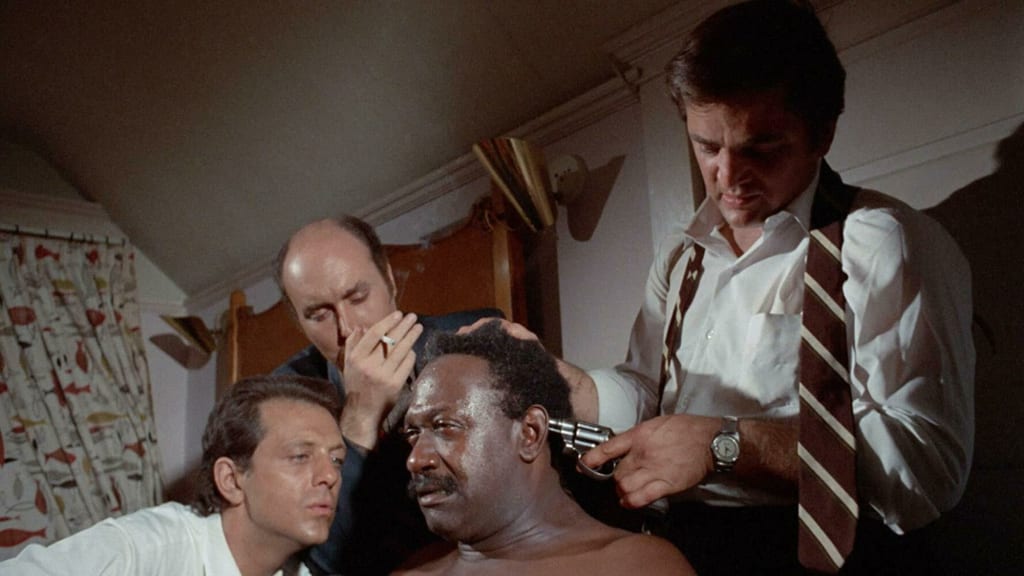
The Shocking History of Sweet Sweetback's Baadasssss Song: The Indie Movie That Shocked Hollywood
In 1971, Hollywood received a message it could not comfortably ignore.
A fiercely independent filmmaker named Melvin Van Peebles had made a movie outside the studio system about a Black man who attacks racist police officers, survives a massive manhunt, escapes across the Mexican border, and—most shockingly for American audiences of the period—does not die, surrender, apologize, or wait for a white institution to save him.
The film was called Sweet Sweetback's Baadasssss Song.
It was sexually provocative, politically confrontational, stylistically chaotic, commercially risky, and made on a tiny budget compared with mainstream Hollywood productions. Van Peebles wrote it, directed it, produced it, edited it, composed its music, financed much of it, and played its almost silent protagonist.
Hollywood had little reason to believe the film would succeed.
Then audiences showed up.
What followed helped prove that Black moviegoers represented an enormous market that studios had underestimated. The film became a landmark of American independent cinema, helped trigger the 1970s cycle later called blaxploitation, influenced generations of filmmakers, and turned Van Peebles into one of the most important rebels in American film history.
More than five decades later, Sweet Sweetback's Baadasssss Song remains difficult, provocative, and deeply controversial.
That may be exactly why its history still matters.
Before Sweetback, Hollywood Had a Serious Representation Problem
To understand why Sweet Sweetback's Baadasssss Song felt explosive in 1971, it is necessary to understand what mainstream American cinema had offered Black audiences before it.
Hollywood had certainly featured Black performers.
But control was another matter.
For decades, the industry's most powerful studios were overwhelmingly controlled by white executives, producers, financiers, distributors, and theater owners. Black characters were frequently relegated to servants, comic relief, criminals, stereotypes, supporting roles, or carefully respectable figures designed not to threaten white audiences.
There had been important exceptions.
Independent Black filmmakers such as Oscar Micheaux had created films for Black audiences decades earlier. Performers including Paul Robeson, Dorothy Dandridge, Lena Horne, Harry Belafonte, and Sidney Poitier challenged Hollywood limitations in different ways.
By the 1960s, Poitier had become one of America's biggest movie stars.
Yet even progress created another problem.
The respectable, controlled, morally exemplary Black protagonist increasingly seemed disconnected from the anger emerging within parts of Black America.
The United States had undergone:
- The civil rights movement
- The assassination of Malcolm X
- The Watts uprising
- The rise of Black Power
- The founding of the Black Panther Party
- Widespread confrontations over police violence
- Urban rebellions across numerous American cities
- The assassinations of Martin Luther King Jr. and Robert Kennedy
- The Vietnam War
- Intensifying distrust of government institutions
American culture was changing rapidly.
Hollywood's representations of Black life were not changing nearly fast enough.
Then Melvin Van Peebles arrived.
Who Was Melvin Van Peebles?
Van Peebles did not enter Hollywood through the conventional path.
His career moved through military service, San Francisco, Europe, literature, journalism, theater, music, and independent filmmaking.
After making short films in the United States, he found a more receptive artistic environment in France. There he wrote novels, worked in journalism, and acquired the credentials needed to direct a feature film.
His first feature, The Story of a Three Day Pass, was made in France and released in 1967.
The film attracted enough attention that Hollywood eventually became interested in him.
That opportunity led to Watermelon Man in 1970.
The movie told the story of a racist white insurance salesman who wakes up one morning to discover that he has become Black.
It was a studio film.
And that experience taught Van Peebles something important.
He could work inside Hollywood.
But working inside Hollywood meant Hollywood could exert control.
Film scholar Michael B. Gillespie notes that Van Peebles' experiences at Columbia Pictures included frustrations over studio supervision, script restrictions, and limitations surrounding who could be hired. Those frustrations became part of the context from which Sweet Sweetback emerged.
For his next project, Van Peebles wanted something radically different.
He wanted ownership.
He wanted control.
Most importantly, he wanted to make the film without asking Hollywood what Black audiences were supposedly prepared to see.
Van Peebles Decided to Go Around Hollywood
The logic behind Sweet Sweetback's Baadasssss Song was almost as revolutionary as the movie itself.
Van Peebles did not simply want to make a Black film.
He wanted to control the means by which it was made.
That meant taking responsibility for virtually everything.
He served as:
- Writer
- Director
- Producer
- Editor
- Composer
- Lead actor
- Major financial backer
MoMA has emphasized just how extraordinary this degree of creative control was, comparing Van Peebles' achievement with the legacy of pioneering independent Black filmmaker Oscar Micheaux.
Van Peebles used money he had earned working on Watermelon Man to help finance the project.
The production eventually cost an estimated $150,000, an extremely modest figure even for 1971.
When the production needed additional financing, comedian and entertainer Bill Cosby reportedly loaned Van Peebles $50,000.
Cosby did not take an ownership stake.
Van Peebles retained control.
That detail is crucial.
If the movie succeeded, the filmmaker would not simply receive a directing fee while a studio controlled the property.
He owned the thing he had created.
The Movie Was Built Around a Radical Idea
The plot of Sweet Sweetback's Baadasssss Song sounds deceptively simple.
Sweetback is a Black performer working in a Los Angeles sex club.
Police officers take him into custody as part of an arrangement intended to make it appear that they are actively pursuing suspects.
While in police custody, Sweetback witnesses officers brutally beating a young Black revolutionary named Moo Moo.
Something changes.
Sweetback attacks the officers.
From that moment onward, he becomes a fugitive.
The police search for him through Los Angeles.
Sweetback receives assistance from different members of the Black community, repeatedly escapes capture, survives physical exhaustion, evades police dogs, and eventually makes his way toward Mexico.
Then comes the ending.
He escapes.
That may sound ordinary to a modern audience accustomed to antiheroes defeating corrupt authorities.
In 1971, it was not ordinary.
The Black outlaw survives.
He does not receive salvation from a sympathetic white authority figure.
He does not discover that the system basically works.
He does not die as punishment for challenging institutional power.
He gets away.
The Library of Congress describes the film as a work that deliberately mixed commercial ingredients with ideological intent and notes that it triggered a wave of Black features after its success.
For audiences accustomed to Hollywood's established racial narratives, that ending carried tremendous symbolic force.
“Starring: The Black Community”
Van Peebles announced his intentions before the story had even properly begun.
The movie opens with a dedication to Black viewers who have had enough of “the Man.”
Its credits famously position the Black community itself as the star.
That was not merely marketing.
The film's narrative depends on community networks.
Sweetback survives because institutions do not operate exactly as police expect.
People refuse to cooperate.
Information does not travel smoothly upward to authority.
Individuals distract police.
Others provide assistance.
Community opacity becomes a survival mechanism.
The film therefore transforms the conventional police chase.
In mainstream crime cinema, the fugitive is often isolated while law enforcement represents a massive coordinated structure.
Here, the structure has power, vehicles, weapons, radios, officers, helicopters, dogs, and institutional legitimacy.
Sweetback has something else.
People.
This was one of the aspects Black Panther Party cofounder Huey P. Newton would later emphasize when he embraced the film as revolutionary.
Sweetback Barely Speaks
One of the strangest things about the movie is its protagonist.
Sweetback is not a conventional charismatic action hero.
He barely speaks.
There are no polished speeches explaining his ideology.
He does not begin the film as a political organizer.
He is not introduced as a revolutionary intellectual.
For much of the movie, he runs.
And runs.
And keeps running.
The BFI has noted that Van Peebles' protagonist delivers remarkably little dialogue and frequently appears more like a fugitive figure in perpetual motion than the conventional action heroes who followed him.
That silence is important.
Sweetback is less a psychologically detailed character than a figure onto whom political meanings can be projected.
He becomes:
- Fugitive
- Sexual symbol
- Outsider
- Survivor
- Folk hero
- Rebel
- Fantasy
- Nightmare
- Political symbol
That ambiguity explains both the film's power and many of the criticisms directed against it.
The Filmmaking Looked Nothing Like Polished Hollywood
The radical politics of Sweet Sweetback receive much of the attention, but the movie's visual style was equally disruptive.
Van Peebles used filmmaking techniques that could make the movie feel unstable, fractured, hypnotic, and sometimes hallucinatory.
The film contains:
- Jump cuts
- Freeze frames
- Superimpositions
- Repeated images
- Optical effects
- Unusual color treatments
- Handheld photography
- Rapid montage
- Split imagery
- Slow motion
- Abrupt rhythmic transitions
- Distorted sound
- Repetition of dialogue
- Experimental editing
This was not simply because the film was inexpensive.
Van Peebles deliberately turned formal instability into part of the experience.
The audience does not merely watch Sweetback become hunted.
The film itself begins to feel hunted.
Images collide.
Time becomes elastic.
Noise interrupts.
Movement becomes frantic.
The city becomes hostile territory.
Criterion describes the film's form as inseparable from its politics, while the BFI has emphasized the dreamlike instability produced by its superimpositions, dissolves, still images, and other techniques.
In other words, Sweet Sweetback was not simply radical because of what happened.
It was radical in how the story was told.
Making the Film Outside Hollywood Created Strange Advantages
Low-budget filmmaking normally creates problems.
Van Peebles turned some of those problems into opportunities.
One involved labor.
According to Criterion's historical account, Van Peebles presented the production in a way that helped him work outside standard Hollywood union structures, allowing him to assemble a more racially diverse crew at a time when film-industry unions remained heavily segregated.
The film was shot quickly, reportedly over roughly 19 days.
The approach was risky.
But it demonstrated something fundamental about independent filmmaking.
When the existing industry refuses to provide access, independence can become more than an artistic preference.
It can become a practical method of bypassing the gatekeepers.
Then Came the X-Rating Controversy
Sweet Sweetback's Baadasssss Song contained explicit sexual imagery, nudity, violence, and material that made mainstream distribution difficult.
Its association with an X rating became one of the most famous parts of the movie's marketing.
Van Peebles turned the stigma into a weapon.
The advertising declared:
“Rated X by an All-White Jury.”
Whether treated as provocation, satire, or guerrilla marketing, the phrase was brilliant.
An X rating would normally make a movie harder to sell.
Van Peebles reframed the rating as evidence that the same establishment challenged by the movie was now attempting to judge it.
Criterion's historical account notes an important technical detail often lost in retellings: the X classification was tied to Van Peebles' refusal to submit the film through the conventional ratings process, after which he transformed that situation into marketing.
The campaign turned censorship into publicity.
Instead of:
“This movie may be too extreme.”
The implication became:
“They don't want you to see this.”
Few phrases sell a rebellious movie better.
The Film's Most Serious Controversy Begins in Its Opening Minutes
Not everything provocative about Sweet Sweetback should be romanticized.
The film opens by depicting young Sweetback being sexually initiated by an adult woman.
A young Mario Van Peebles plays the child.
Whatever symbolic intention Van Peebles attached to the sequence, contemporary audiences have strong reason to find it disturbing. A child cannot meaningfully consent to sexual activity with an adult, and modern discussions of the scene appropriately recognize the power imbalance rather than treating it casually as an uncomplicated transition into manhood.
The sequence was controversial even in 1971.
Historian and Ebony executive editor Lerone Bennett Jr. attacked the movie's sexual politics and rejected attempts to treat such imagery as revolutionary liberation. Criterion's historical analysis specifically contrasts Bennett's reaction with Huey Newton's much more enthusiastic interpretation.
This disagreement matters because it destroys a convenient myth about the film.
Black America did not respond to Sweetback with one unified voice.
The movie triggered a debate.
Huey P. Newton Saw a Revolutionary Film
One of Sweetback's most influential supporters was Huey P. Newton, cofounder of the Black Panther Party.
Newton interpreted the movie politically.
To him, Sweetback's transformation from relative political passivity to active resistance represented something significant.
The protagonist witnesses police brutality.
Then he acts.
The community subsequently becomes essential to his survival.
Newton argued that the film demonstrated resistance and Black unity and treated it as a genuinely revolutionary work. Criterion documents his enthusiastic June 1971 assessment of the movie and its relationship to revolutionary struggle.
The Black Panther newspaper devoted considerable attention to the film.
Its political endorsement gave Sweetback cultural legitimacy within radical circles that no traditional Hollywood advertising campaign could have purchased.
This was not merely movie promotion.
The film had become part of a political argument about what Black cinema should be.
Lerone Bennett Jr. Saw Something Very Different
Where Newton saw revolution, Lerone Bennett Jr. saw dangerous fantasy.
Bennett's criticism was devastating.
He objected to the film's sexual politics, its representation of Black life, its glorification of individual escape, and what he viewed as recycled stereotypes packaged as liberation.
His central objection raised a difficult question:
What exactly has Sweetback liberated?
He survives.
He escapes.
But has he built a movement?
Changed an institution?
Created a political strategy?
Organized collective resistance?
Or has one extraordinary individual simply escaped?
Bennett argued that the film substituted fantasy for meaningful revolutionary politics.
Criterion summarizes the conflict clearly: Newton viewed Sweetback as a model of revolutionary struggle, while Bennett rejected its claim to genuine revolutionary or Black liberation politics.
That disagreement remains one of the most interesting debates surrounding the movie.
Is Sweetback a Liberated Black Hero or a Racial Stereotype?
Another problem concerned Sweetback's sexuality.
The character possesses almost superhuman sexual potency.
To some audiences in 1971, this represented a dramatic reversal.
For decades, Hollywood had frequently neutralized Black male sexuality, particularly when presenting characters intended for mainstream white audiences.
Sweetback did the opposite.
He was aggressively sexual.
Confident.
Physically powerful.
Desired.
For some viewers, this was liberating.
For others, it reproduced one of America's oldest racist fantasies: the hypersexual Black male.
Film critics have repeatedly wrestled with this contradiction.
The BFI cites criticism that Van Peebles' hero risks reproducing the racist stereotype of Black masculinity as inexhaustibly sexual rather than escaping it.
That tension cannot be resolved simply by declaring the film progressive or offensive.
It can be both transgressive and trapped inside inherited stereotypes.
That contradiction is part of what makes the movie historically important.
Nobody Wanted to Show It
Finishing Sweetback did not solve Van Peebles' biggest problem.
He still needed theaters.
The movie had no major studio behind it.
Its politics were explosive.
Its sexual material was difficult.
Its protagonist attacked police.
Its style was unconventional.
Its target audience had been neglected by mainstream Hollywood executives who were often skeptical that Black-centered films could generate major profits.
Distribution was therefore extremely difficult.
Only a tiny number of theaters initially agreed to screen the movie.
Historical accounts frequently cite initial engagements in Detroit and Atlanta as the crucial openings from which the film began building momentum.
For most filmmakers, that situation would have looked like commercial death.
Van Peebles needed another strategy.
He found one in music.
Earth, Wind & Fire Helped Create One of Cinema's Most Innovative Marketing Campaigns
Today, releasing a soundtrack alongside a movie seems completely normal.
Movie songs become singles.
Singles promote trailers.
Spotify playlists support films.
Music videos generate awareness.
In 1971, Van Peebles recognized the promotional potential of a soundtrack in a particularly inventive way.
He could not afford conventional national advertising.
Radio exposure, however, could reach audiences repeatedly.
So he treated the soundtrack as a marketing engine.
The musicians involved included a young group that had not yet become internationally famous:
Earth, Wind & Fire.
Van Peebles composed the music despite not being conventionally trained in musical notation. Accounts of the production describe him developing his own method for communicating musical ideas and working with the band to create the score.
The result was not background decoration.
Music drives the film.
Gospel.
Funk.
Soul.
Jazz.
Chants.
Rhythmic repetition.
Police noise.
Voices.
Sound and image attack the audience together.
Van Peebles then released the soundtrack as a promotional tool.
The music could travel where the film initially could not.
Radio became advertising.
That was independent filmmaking ingenuity decades before modern filmmakers began talking about “growth hacking.”
Then the Movie Exploded Commercially
The strategy worked.
Word spread.
Audiences attended.
The movie expanded.
A film made for roughly $150,000 eventually generated millions of dollars.
Historical estimates commonly place its theatrical gross at approximately $15 million, although—as with many older independent films—precise accounting varies by source and methodology. Contemporary retrospectives consistently agree on the crucial point: Sweetback produced an extraordinary return relative to its tiny production budget.
That financial success changed the conversation in Hollywood immediately.
Studio executives may not have understood Van Peebles' politics.
They understood money.
Black audiences had demonstrated purchasing power.
And Hollywood noticed.
Sweetback Helped Trigger the Blaxploitation Boom
The term “blaxploitation” is now commonly associated with stylish 1970s movies featuring Black protagonists, funk soundtracks, urban settings, crime, sex, action, flamboyant fashion, and anti-establishment themes.
But the word was originally critical.
Junius Griffin of the Hollywood–Beverly Hills branch of the NAACP used the term while condemning a wave of films that he believed exploited Black audiences through sensational representations involving crime, drugs, violence, and sexuality.
Criterion notes that the term began circulating after Sweetback had already demonstrated the commercial potential of Black-oriented genre filmmaking.
The distinction matters.
Van Peebles did not sit down and say:
“I am going to invent a genre called blaxploitation.”
He made Sweetback.
Hollywood saw that it made money.
Then the imitation machine accelerated.
Shaft Arrived the Same Year
One of the most important films to follow was Gordon Parks' Shaft.
Released by MGM in 1971, Shaft starred Richard Roundtree as private detective John Shaft.
The movie was smoother than Sweetback.
More conventional.
More accessible.
More obviously compatible with commercial genre cinema.
Isaac Hayes' iconic soundtrack added enormously to its cultural impact.
Where Sweetback felt like cinema created outside the gates and fired back toward Hollywood, Shaft demonstrated that a major studio could successfully package a Black action hero for broad commercial audiences.
The two films became central reference points for the emerging cycle.
But they were not the same.
The BFI has specifically cautioned against treating Sweetback as merely an early version of Shaft. Van Peebles' film is stranger, more experimental, more politically unstable, and far less interested in conventional heroic storytelling.
Hollywood could imitate the surface.
The deeper radicalism was harder to reproduce.
Hollywood Learned the Most Convenient Lesson
What lesson did studios take from the success of Sweetback?
Not necessarily:
“Black filmmakers should control their stories.”
Not necessarily:
“We should fundamentally restructure who receives financing and ownership.”
Not necessarily:
“Independent Black cinema deserves institutional support.”
The lesson was much simpler:
There is money here.
Soon theaters filled with Black-oriented genre films.
Some were directed by Black filmmakers.
Some provided extraordinary opportunities for Black performers and musicians.
Some became classics.
Others were cynical.
Films such as:
- Shaft
- Super Fly
- Foxy Brown
- Coffy
- Black Caesar
- Blacula
- Truck Turner
- The Mack
- Cleopatra Jones
helped define the period.
The cycle created stars including Pam Grier, Richard Roundtree, Fred Williamson, and Ron O'Neal.
It produced unforgettable soundtracks.
It gave Black actors leading roles that mainstream Hollywood had rarely provided.
But it also intensified concerns over stereotypes involving pimps, drug dealers, prostitutes, gangsters, hypersexuality, and urban violence.
That contradiction is embedded in the word itself.
Black representation.
Black exploitation.
Sometimes simultaneously.
Van Peebles' Achievement Was Bigger Than Blaxploitation
Describing Sweet Sweetback only as the first or foundational blaxploitation film can actually diminish its importance.
Its influence extends much further into independent cinema.
Van Peebles demonstrated a model:
If studios do not understand your audience, make the movie anyway.
If traditional financing refuses you, find different financing.
If normal distribution fails, use alternative theaters.
If advertising is too expensive, invent another marketing channel.
If Hollywood will not provide creative control, retain ownership yourself.
That philosophy echoes through later independent film history.
It can be seen in different ways in:
- Spike Lee's early career
- John Singleton's generation
- Robert Townsend's self-financed filmmaking
- Julie Dash's independent production
- Charles Burnett's work outside mainstream Hollywood structures
- Hip-hop-era independent filmmaking
- Guerrilla digital cinema
- Microbudget filmmaking
- Direct-to-audience distribution
- Crowdfunded productions
The specifics changed.
The philosophy survived.
Spike Lee Inherited Part of the Van Peebles Tradition
When Spike Lee emerged during the 1980s, Hollywood again confronted a Black filmmaker determined to control tone, authorship, politics, casting, and representation.
Lee's work is very different from Van Peebles'.
But the broader lineage is unmistakable.
A Black filmmaker making culturally specific work does not require permission to translate every aspect for a presumed white audience.
That principle is one of Sweetback's most important contributions.
MoMA has emphasized that the film's power partly comes from its lack of interest in constantly referencing or explaining itself through white culture.
That choice was radical.
The movie assumed the existence of an audience Hollywood routinely treated as secondary.
Hip-Hop Culture Also Inherited Something From Sweetback
The film's influence extends beyond narrative cinema.
Its sound collage, repetition, spoken language, gospel fragments, street voices, funk rhythms, and aggressive editing anticipate techniques that later became familiar within hip-hop aesthetics.
Not because Van Peebles somehow invented hip-hop.
He did not.
But his multimedia approach belongs to a broader Black artistic tradition in which existing sounds, cultural memory, religious material, street language, rhythm, politics, and performance collide.
The movie feels sampled before sampling became one of the defining production techniques of popular music.
Its style says:
Take what exists.
Cut it.
Repeat it.
Recontextualize it.
Make it yours.
That aesthetic helped the movie remain culturally alive long after many more polished 1971 releases became historical footnotes.
Mario Van Peebles Eventually Made a Movie About Making the Movie
The extraordinary production story eventually became a film itself.
In 2003, Mario Van Peebles directed Baadasssss!, dramatizing his father's struggle to create Sweet Sweetback's Baadasssss Song.
Mario played Melvin.
That choice created an unusual circle.
As a child, Mario had appeared in his father's controversial film.
Decades later, he played his father while recreating the circumstances under which that movie had been made.
Criterion includes Baadasssss! within its broader presentation of Melvin Van Peebles' cinematic legacy.
The existence of the later film underscores just how legendary the original production became.
The making of Sweetback is almost as significant as Sweetback itself.
The Film Became Part of the National Film Registry
A movie once treated as vulgar, dangerous, pornographic, inflammatory, and commercially marginal eventually received one of America's highest institutional recognitions for film heritage.
In 2020, the Library of Congress selected Sweet Sweetback's Baadasssss Song for preservation in the National Film Registry.
Films selected for the Registry are recognized as culturally, historically, or aesthetically significant.
Think about the transformation.
In 1971, the film struggled for screens.
Decades later, the United States officially recognized that preserving it mattered to the history of American cinema.
That does not mean every criticism disappeared.
Institutional recognition does not sanitize the movie.
It confirms its significance.
Those are different things.
Why Sweetback Is Still Uncomfortable to Watch
Historical importance should never require pretending that a movie has no flaws.
Sweet Sweetback's Baadasssss Song contains material that remains deeply troubling.
Its sexual politics are difficult.
Its treatment of women has been heavily criticized.
The opening involving young Sweetback is particularly disturbing.
Its conception of revolutionary masculinity can feel bound to stereotypes.
Its storytelling can be deliberately obscure.
Its experimental editing can be exhausting.
Its protagonist is psychologically thin by conventional standards.
Its politics are contradictory.
And that is precisely why reducing the film to a celebratory slogan would be dishonest.
A serious historical assessment has to hold multiple ideas simultaneously.
Sweetback can be:
- A breakthrough in Black independent filmmaking
- A landmark in American independent cinema
- A politically radical cultural intervention
- A commercial exploitation film
- A work containing troubling sexual representation
- A challenge to Hollywood racism
- A film that sometimes reproduces racial and gender stereotypes
- An extraordinary financial success
- A formally innovative piece of filmmaking
None of those descriptions automatically cancels the others.
Was Sweetback Really the First Blaxploitation Movie?
This question produces considerable debate.
Some histories call Sweet Sweetback's Baadasssss Song the film that launched blaxploitation.
Others point toward earlier movies such as Ossie Davis' Cotton Comes to Harlem, released in 1970.
The answer depends on how “first” is defined.
If the question is:
“Was Sweetback literally the first commercially released movie featuring Black protagonists, crime, action, and exploitation elements?”
No.
Black cinema has a much longer history.
But if the question is:
“Did Sweetback's enormous independent success help convince Hollywood that Black-oriented genre films could become highly profitable and accelerate the cycle later called blaxploitation?”
Absolutely.
Criterion describes the film as rightfully considered a major catalyst for the movement, while the Library of Congress credits it with touching off a wave of imitative Black features.
That is the more historically useful claim.
The Movie Shocked Hollywood Because It Changed Who Held the Power
The most shocking thing about Sweet Sweetback may not have been the sex.
Or the violence.
Or the anti-police storyline.
It may have been the business model.
Hollywood's power depended on controlling access.
Access to money.
Access to cameras.
Access to professional crews.
Access to theaters.
Access to advertising.
Access to audiences.
Van Peebles demonstrated that enough of those systems could be bypassed to produce a commercial phenomenon.
That is dangerous to any gatekeeping industry.
A rejected filmmaker is easy to dismiss.
A rejected filmmaker who makes millions is much harder to dismiss.
Independent Cinema Changed Because Success Became Proof
Hollywood executives could argue that unconventional Black cinema was commercially dangerous.
Then Sweetback existed.
They could argue that Black audiences were too limited to support theatrical features.
Then Sweetback made money.
They could argue that unconventional filmmaking needed studio supervision.
Then an aggressively unconventional movie became a phenomenon.
This does not mean Sweetback single-handedly invented independent cinema.
John Cassavetes, exploitation filmmakers, underground artists, race-film pioneers, documentary filmmakers, and many others had already demonstrated alternative production models.
But Van Peebles combined independence with Black cultural politics and extraordinary commercial results in a way that Hollywood could not ignore.
That combination made the film particularly disruptive.
Why the Ending Was So Powerful
After everything Sweetback endures, the police fail to capture him.
He reaches Mexico.
The authorities lose.
And the film does not frame this as temporary luck.
Its closing threat suggests unfinished business.
Sweetback may have escaped today.
But he is not finished.
In conventional narrative terms, the ending is simple.
Historically, it carried enormous symbolic weight.
The American legal system had spent generations functioning not merely as an imperfect protector of Black citizens but, in many contexts, as an active instrument of racial control.
A Black protagonist defeating that machinery—even in fantasy—could provide a kind of cinematic release mainstream audiences had rarely been offered.
That helps explain why some viewers responded so passionately.
It also explains Bennett's criticism.
Escape can feel revolutionary.
But escape is not the same as structural liberation.
The film leaves that contradiction unresolved.
The Real Revolution Was Creative Ownership
Perhaps the clearest revolutionary element of Sweetback was not anything Sweetback himself did.
It was what Melvin Van Peebles did.
He made a movie on his terms.
He owned it.
He controlled its politics.
He controlled its aesthetics.
He controlled its soundtrack.
He found money.
He found audiences.
He transformed censorship into advertising.
He turned music into promotion.
He demonstrated demand that Hollywood had failed to recognize.
And when studios rushed to copy the commercial formula, the original remained his.
That may be Sweetback's most durable lesson for independent filmmakers.
Representation matters.
But representation without ownership can still leave power somewhere else.
Why Sweet Sweetback's Baadasssss Song Still Matters
The film remains essential not because everyone should admire every scene.
It remains essential because American cinema cannot be fully understood without it.
Before Sweetback, Hollywood could more easily dismiss independently controlled Black cinema as marginal.
After Sweetback, doing so required ignoring money, audiences, and cultural impact.
The movie exposed several realities simultaneously:
Black audiences had economic power.
Black filmmakers could create commercially successful work outside traditional Hollywood structures.
Films did not need to reassure white audiences to find an audience.
Experimental filmmaking and popular filmmaking did not have to be opposites.
Soundtrack marketing could become a powerful promotional strategy.
Independent distribution could overcome institutional rejection.
And politically confrontational movies could become commercially viable.
That is why the movie's importance extends far beyond blaxploitation.
It belongs to the larger history of filmmakers taking power away from institutions that told them no.
The Final Irony of Sweetback
Hollywood eventually absorbed many of the movie's lessons.
Black action heroes became marketable.
Urban Black stories became marketable.
Funk soundtracks became marketable.
Anti-establishment cool became marketable.
Afros became marketable.
Leather became marketable.
Revolutionary aesthetics became marketable.
Even rebellion could become a product.
That is one of capitalism's most reliable talents.
It can take opposition and sell it back as style.
Van Peebles had demonstrated the existence of an audience.
Hollywood then attempted to industrialize the discovery.
Yet Sweetback remains harder to absorb than many films that followed.
It is too strange.
Too rough.
Too contradictory.
Too sexually uncomfortable.
Too formally unstable.
Too politically unresolved.
Too clearly the work of one filmmaker refusing to behave.
That may ultimately be why it has endured.
Polished studio imitations can become period pieces.
Rebellions retain their scars.
Frequently Asked Questions About Sweet Sweetback's Baadasssss Song
What is Sweet Sweetback's Baadasssss Song about?
Sweet Sweetback's Baadasssss Song follows a Black Los Angeles performer who attacks police officers after witnessing them brutalize a young Black revolutionary.
He becomes a fugitive and spends much of the film escaping police while receiving assistance from members of the Black community.
Who made Sweet Sweetback's Baadasssss Song?
Melvin Van Peebles was the central creative force behind the film.
He wrote, directed, produced, edited, scored, financed much of, and starred in Sweet Sweetback's Baadasssss Song. MoMA has highlighted the extraordinary degree of creative control he exercised over the production.
When was Sweet Sweetback's Baadasssss Song released?
The film was released in 1971.
Its appearance came during a period of major political and cultural upheaval in the United States, including the Black Power movement, conflicts over police brutality, and widespread demands for greater Black cultural autonomy.
How much did Sweet Sweetback's Baadasssss Song cost?
Historical sources commonly estimate the production budget at approximately $150,000.
Van Peebles financed much of the project himself and received a reported $50,000 loan from Bill Cosby to help complete it.
How much money did Sweet Sweetback's Baadasssss Song make?
The film is widely reported to have grossed roughly $15 million against its approximately $150,000 production budget, although precise figures for older independent releases can vary depending on accounting methods.
Its profitability was extraordinary and helped demonstrate the commercial strength of underserved Black movie audiences.
Did Bill Cosby finance Sweet Sweetback's Baadasssss Song?
Bill Cosby provided Van Peebles with a reported $50,000 loan during production.
Accounts of the arrangement indicate that Cosby sought repayment rather than ownership in the film, allowing Van Peebles to retain control.
Was Sweet Sweetback the first blaxploitation movie?
It is frequently described as the film that launched or catalyzed the blaxploitation movement, although earlier Black-centered films such as Cotton Comes to Harlem complicate any claim that it was literally the first.
Its extraordinary commercial success helped trigger the wave of Black-oriented genre films that followed.
What does “blaxploitation” mean?
Blaxploitation refers to a cycle of primarily 1970s films centered on Black characters and audiences, often combining action, crime, sexuality, urban settings, funk and soul music, and anti-establishment themes.
The term originally carried a negative meaning and was used by critics including NAACP official Junius Griffin to condemn what they saw as Hollywood's exploitation of Black audiences and stereotypes.
Why was Sweet Sweetback's Baadasssss Song controversial?
The movie was controversial because of its sexual content, nudity, violence, anti-police narrative, unconventional filmmaking, racial politics, and representations of masculinity.
Its opening depiction of a child being sexually initiated by an adult woman has also remained a serious source of ethical criticism.
Why did the film use the phrase “Rated X by an All-White Jury”?
Van Peebles transformed the movie's association with an X classification into a provocative marketing slogan.
The campaign framed institutional judgment of the movie as another example of white authority attempting to regulate Black cultural expression. Criterion notes that the classification became part of Van Peebles' advertising strategy.
Did Earth, Wind & Fire perform the soundtrack?
Yes.
A young Earth, Wind & Fire performed music for the movie before the group achieved the enormous mainstream success that would later make it one of the most celebrated bands in American popular music.
Van Peebles composed the score and used the soundtrack as an innovative promotional tool.
Why was the soundtrack so important?
Van Peebles lacked the money required for a conventional national advertising campaign.
Releasing the soundtrack allowed the film's music to receive radio exposure and generate awareness before the movie had widespread theatrical distribution.
It was an unusually creative solution to a major independent-film marketing problem.
Did the Black Panthers support Sweet Sweetback?
Huey P. Newton, cofounder of the Black Panther Party, strongly supported the film and interpreted it as a representation of revolutionary resistance and Black communal unity.
The movie consequently gained major visibility within radical Black political culture.
Did all Black critics support the film?
No.
The response was intensely divided.
Historian and Ebony editor Lerone Bennett Jr. attacked the film's sexual politics, stereotypes, individualistic heroism, and claims to revolutionary significance.
The disagreement between Bennett and Huey Newton remains central to serious historical analysis of the movie.
Why does Sweetback speak so little?
Sweetback functions less like a conventional dialogue-driven protagonist and more like a symbolic or mythic figure.
His silence allows the film to emphasize movement, physical survival, observation, sound, montage, and the responses of the community around him.
Why is Sweetback constantly running?
Running becomes the film's central visual metaphor.
Sweetback is escaping not simply individual police officers but an entire system capable of mobilizing surveillance, vehicles, communications, dogs, and institutional authority against him.
His continuous movement turns Los Angeles into a landscape of pursuit and resistance.
Did Sweetback influence Shaft?
Both films appeared in 1971 and became foundational to the commercial boom in Black-oriented genre cinema.
Sweetback demonstrated enormous independent commercial potential, while MGM's Shaft translated the emerging Black action hero into a more conventional studio format.
They are historically related but aesthetically very different.
Why is Sweet Sweetback's Baadasssss Song important to independent filmmakers?
The movie demonstrated that a filmmaker rejected by traditional gatekeepers could finance a project independently, retain creative control, find alternative distribution, create unconventional marketing, identify an underserved audience, and achieve major commercial success.
That model remains highly relevant to independent filmmaking.
Is Sweet Sweetback's Baadasssss Song preserved by the Library of Congress?
Yes.
The Library of Congress selected the film for the National Film Registry in 2020, recognizing its cultural, historical, or aesthetic significance.
Is Sweet Sweetback's Baadasssss Song still controversial today?
Yes.
Its importance to Black independent cinema is widely recognized, but debates continue around its treatment of women, sexuality, masculinity, childhood sexual abuse, stereotypes, individualism, and revolutionary politics.
Its historical significance does not require ignoring those criticisms.
What was Melvin Van Peebles' biggest achievement with Sweetback?
His greatest achievement may have been proving that creative independence, cultural specificity, ownership, and commercial success could coexist.
He did not merely put a rebellious Black protagonist on screen.
He built a rebellious production model behind the screen.
How did Sweet Sweetback's Baadasssss Song change Hollywood?
It provided undeniable commercial evidence that Black audiences represented a powerful theatrical market and that films centered on Black characters could generate substantial profits.
Hollywood rapidly expanded production of Black-oriented genre films afterward, contributing to the blaxploitation boom of the 1970s.
What is the lasting legacy of Sweet Sweetback's Baadasssss Song?
Its legacy lies at the intersection of Black cinema, independent filmmaking, political filmmaking, exploitation cinema, experimental film, music culture, and entrepreneurial distribution.
The movie remains controversial because it refuses to fit comfortably into a single category.
That discomfort is part of its historical power.
Sweet Sweetback's Baadasssss Song did more than shock Hollywood with what appeared on screen.
It shocked Hollywood by demonstrating that a filmmaker the industry did not fully control could create a movie for an audience the industry had underestimated, distribute it through unconventional channels, turn rejection into publicity, retain ownership, and make millions.
Hollywood could copy the clothes.
It could copy the music.
It could copy the swagger.
It could copy the violence.
What it could not easily copy was the reason the movie existed in the first place:
Melvin Van Peebles had stopped waiting for permission.