FDA Approves Lipfendra, the First Daily Oral PCSK9 Cholesterol Drug
The U.S. Food and Drug Administration has approved Lipfendra, also known by its generic name enlicitide, as the first oral medication to block PCSK9—a biological target previously addressed only through injectable cholesterol-lowering treatments.
The once-daily tablet is approved alongside diet and exercise to reduce low-density lipoprotein cholesterol, commonly called LDL or “bad” cholesterol, in adults with hypercholesterolemia. This includes adults with heterozygous familial hypercholesterolemia, an inherited condition that can cause dangerously high cholesterol from an early age.
In two Phase 3 clinical trials involving 3,207 adults already receiving maximally tolerated statin therapy, Lipfendra reduced LDL cholesterol by an average of 56% to 59% compared with placebo after 24 weeks.
The approval is a genuine milestone in cardiovascular medicine. It combines the powerful LDL-lowering mechanism of injectable PCSK9 drugs with the familiarity of a daily tablet.
However, several details need careful clarification.
Lipfendra has been proven to lower LDL substantially, but it has not yet been proven in its own cardiovascular-outcomes trial to prevent heart attacks, strokes or cardiovascular death. That large outcomes study is still underway. It should also not be described simply as a replacement for statins: many patients will use it in addition to existing cholesterol therapy, depending on their medical history and LDL target.
What Is Lipfendra?
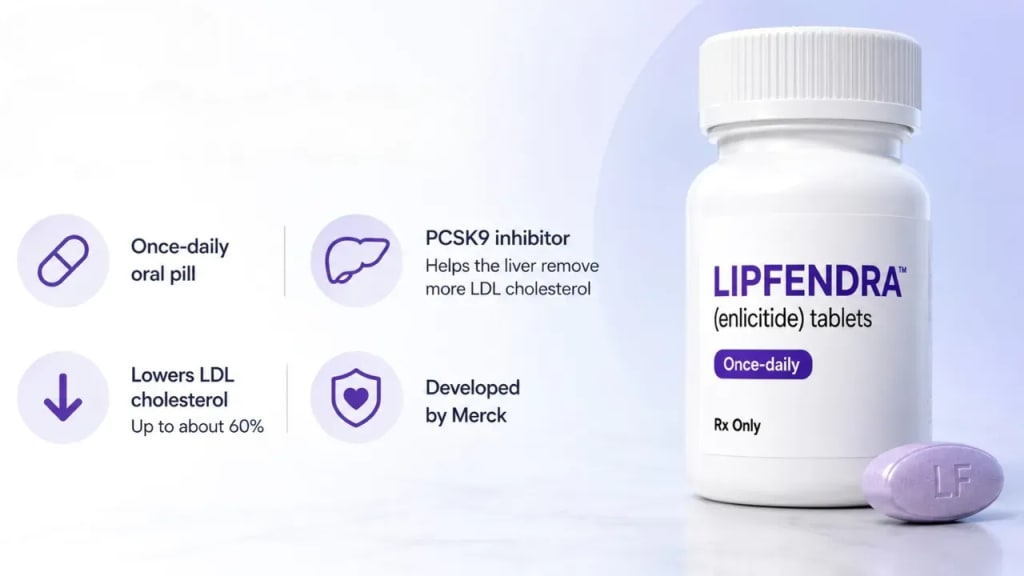
Lipfendra is the brand name for enlicitide, a 20-milligram oral PCSK9 inhibitor developed by Merck.
It is a macrocyclic peptide designed to survive oral administration and bind to PCSK9, preventing that protein from interfering with the liver’s ability to remove LDL cholesterol from the bloodstream.
The FDA approved it for adults with hypercholesterolemia, including those with heterozygous familial hypercholesterolemia.
The official indication describes Lipfendra as an adjunct to:
- Diet
- Exercise
- Other appropriate cholesterol-management measures
The medication is taken once daily by mouth.
 Imrul
Imrul
Why Is This Approval Important?
Before Lipfendra, therapies directly targeting PCSK9 were administered through injections.
These include monoclonal-antibody drugs such as evolocumab and alirocumab. Another injectable cholesterol-lowering therapy, inclisiran, reduces the production of PCSK9 through an RNA-based mechanism.
Injectable therapies can lower LDL dramatically, but their use may be limited by:
- Fear or dislike of injections
- Prior-authorization requirements
- Limited access to specialists
- Insurance restrictions
- Cost
- The inconvenience of storing or administering injectable medication
A daily tablet may be easier for some patients and primary-care practices to incorporate into long-term treatment.
Lipfendra does not make injections obsolete. Some people prefer infrequent injections over remembering a pill every day, and the established injectable PCSK9 antibodies already have cardiovascular-outcomes evidence.
The new drug expands choice rather than eliminating existing options.
What Is PCSK9?
PCSK9 stands for proprotein convertase subtilisin/kexin type 9.
Despite the complicated name, its role in cholesterol regulation is relatively straightforward.
The liver removes LDL cholesterol from the blood using structures called LDL receptors. These receptors capture LDL particles and bring them into liver cells, allowing cholesterol to be cleared from circulation.
After completing that task, many LDL receptors return to the cell surface and are used again.
PCSK9 disrupts this recycling process.
When PCSK9 binds to an LDL receptor, the receptor is more likely to be destroyed rather than returned to the liver-cell surface. Fewer available receptors mean the liver removes less LDL cholesterol from the blood.
Blocking PCSK9 protects more LDL receptors.
The result is:
- More functioning LDL receptors on liver cells
- Greater removal of LDL particles from the bloodstream
- Lower circulating LDL cholesterol
This is why PCSK9 inhibition can produce LDL reductions beyond those commonly achieved with statins alone.
How Is Lipfendra Different From Statins?
Statins and PCSK9 inhibitors lower LDL through different biological pathways.
Statins
Statins reduce the liver’s production of cholesterol by inhibiting an enzyme called HMG-CoA reductase.
The liver responds by producing more LDL receptors, allowing it to remove more LDL from the blood.
Statins have decades of clinical evidence showing that they reduce the risks of heart attack, stroke and cardiovascular death in appropriate patients.
Lipfendra
Lipfendra blocks PCSK9, helping preserve the LDL receptors the liver already produces.
This allows more receptors to remain available for clearing cholesterol.
The two mechanisms can complement each other.
A statin encourages the liver to produce more LDL receptors, while a PCSK9 inhibitor helps prevent those receptors from being destroyed.
That is why Lipfendra will often be considered as an add-on treatment, especially when statins alone do not reduce LDL sufficiently.
Is Lipfendra a Replacement for Statins?
Not generally.
Statins remain the foundation of treatment for many people with elevated cardiovascular risk because they:
- Lower LDL
- Have extensive long-term safety data
- Reduce cardiovascular events
- Are widely available as inexpensive generics
- Can be taken orally once daily
Lipfendra may be particularly useful for patients who:
- Need substantially greater LDL reduction
- Remain above their treatment target despite statin therapy
- Have familial hypercholesterolemia
- Cannot tolerate an adequate statin dose
- Prefer an oral PCSK9 option over injections
- Face difficulty accessing injectable treatment
A clinician may prescribe Lipfendra alongside a statin, alongside other treatments such as ezetimibe, or in another individualized combination.
Patients should not stop prescribed statins or other cholesterol medication after hearing about the new pill.
Treatment decisions depend on overall cardiovascular risk, existing disease, other medications and individual response.
How Effective Was Lipfendra in Clinical Trials?
The FDA based its approval primarily on two randomized, double-blind, placebo-controlled Phase 3 trials.
Together, the studies included 3,207 adults with severe hypercholesterolemia who were already taking maximally tolerated statin therapy.
Trial One: ASCVD or High Cardiovascular Risk
The first trial included adults with established atherosclerotic cardiovascular disease or a high risk of developing it.
Participants began with an average LDL level of approximately 96 mg/dL.
After 24 weeks, Lipfendra produced an average 56% placebo-adjusted reduction in LDL cholesterol.
Trial Two: Familial Hypercholesterolemia
The second trial enrolled adults with heterozygous familial hypercholesterolemia.
Their average starting LDL level was approximately 119 mg/dL.
After 24 weeks, Lipfendra produced an average 59% placebo-adjusted reduction.
Merck also reported reductions in other atherogenic markers, including non-HDL cholesterol and apolipoprotein B.
Does It Lower LDL to 50 or 60 mg/dL?
It can in many patients, but that result is not universal.
Consider someone beginning with an LDL level of 100 mg/dL.
A reduction of approximately 56% would theoretically bring the level to around 44 mg/dL, although the actual result would vary between individuals.
Someone beginning at 140 mg/dL might fall to approximately 62 mg/dL after a similar proportional reduction.
The final value depends on:
- Starting LDL level
- Adherence
- Other cholesterol medications
- Genetics
- Diet and health conditions
- Individual biological response
Therefore, saying that Lipfendra “brings LDL down to 50 or 60” is a reasonable illustration for some patients, but not a guaranteed outcome for everyone.
Is an LDL Level Below 100 Always Necessary?
There is no single ideal LDL target for every adult.
Treatment goals depend heavily on risk.
A person without cardiovascular disease may receive different recommendations from someone who has:
- Experienced a heart attack
- Had an ischemic stroke
- Undergone coronary stenting
- Developed peripheral artery disease
- Familial hypercholesterolemia
- Diabetes with additional risk factors
- Multiple major cardiovascular risks
Higher-risk patients are often treated more aggressively and may have targets far below 100 mg/dL.
The purpose of intensive treatment is not merely to produce an impressive laboratory number. It is to reduce the amount of cholesterol available to enter artery walls and contribute to atherosclerotic plaque.
Why Does LDL Matter?
LDL particles transport cholesterol through the bloodstream.
Cholesterol itself is necessary for cell membranes, hormones and several normal biological functions.
The problem develops when too many LDL particles circulate for too long.
They can enter the artery wall, where cholesterol becomes retained and contributes to inflammation and plaque formation.
Over time, this process can narrow arteries and restrict blood flow.
If an unstable plaque ruptures, it can trigger a clot that blocks blood flow to the heart or brain, causing a heart attack or stroke.
High LDL commonly causes no symptoms.
A person may feel completely healthy while atherosclerosis progresses silently over many years.
That is why cholesterol testing and risk assessment are important.
Does Lipfendra Prevent Heart Attacks and Strokes?
This is the most important limitation to understand.
Lipfendra has demonstrated powerful LDL reduction.
However, its own cardiovascular-outcomes trial has not yet reported whether taking the drug reduces:
- Heart attacks
- Strokes
- Cardiovascular deaths
- Hospitalization for cardiovascular disease
Merck states that a large outcomes study involving more than 14,500 participants is ongoing. The company explicitly notes that it is not yet known whether Lipfendra reduces cardiovascular morbidity and mortality.
This does not mean the drug is unlikely to help.
Lowering LDL is strongly associated with lower cardiovascular risk, and other PCSK9 inhibitors have demonstrated reductions in cardiovascular events.
But evidence from related drugs cannot replace direct outcomes data for Lipfendra itself.
The distinction is:
- Proven: Lipfendra lowers LDL substantially.
- Not yet directly proven: Lipfendra reduces heart attacks, strokes or death.
Patients deserve to understand both facts.
What Side Effects Were Reported?
In the trial involving adults with cardiovascular disease or high cardiovascular risk, the overall frequency of adverse reactions was similar between Lipfendra and placebo.
In the familial hypercholesterolemia trial, the most common adverse reactions occurring more frequently with Lipfendra were:
- Diarrhea: 7% with Lipfendra versus 2% with placebo
- Dizziness: 9% with Lipfendra versus 4% with placebo
The proportion of participants who discontinued treatment because of adverse reactions was similar between the active-treatment and placebo groups.
These results are encouraging, but they cover the duration and population studied.
Rare side effects may become clearer only after a medication is used by a much larger number of people over longer periods.
FDA approval does not mean a drug is free from risk. It means available evidence supports a favourable benefit-risk balance for the approved use.
Does Lipfendra Cause Muscle Pain?
Muscle pain is commonly associated with statin intolerance, although not every symptom occurring during statin therapy is necessarily caused by the drug.
Lipfendra acts through a different pathway and did not produce a prominent muscle-symptom signal in its pivotal trials.
That may make it valuable for some people who cannot tolerate effective statin doses.
However, patients should not assume that Lipfendra is automatically the best replacement for a statin.
Clinicians often evaluate:
- The nature of the previous symptoms
- Which statins were tried
- Whether lower or intermittent dosing is possible
- Other causes of muscle symptoms
- The patient’s LDL level and cardiovascular risk
- Alternative drugs and combinations
How Must Lipfendra Be Taken?
Lipfendra is taken as a once-daily oral tablet.
Patients should follow the official prescribing instructions and the directions given by their healthcare professional.
Published reports indicate that the medication must be taken under fasting conditions, with patients waiting before consuming food. This administration requirement may be important because peptide-based oral drugs can be difficult for the body to absorb reliably.
A daily pill is convenient for many people, but timing requirements may affect adherence.
Taking a medication every day is not automatically easier than receiving an injection every few weeks or months. The most practical option will differ between patients.
How Much Will Lipfendra Cost?
Merck announced a U.S. list price of approximately $10.50 per day, or about $315 for a 30-day supply.
The list price is not necessarily the amount a patient will pay.
Actual out-of-pocket cost may depend on:
- Insurance coverage
- Deductibles
- Copayments
- Prior authorization
- Pharmacy-benefit policies
- Patient-assistance programmes
- Eligibility for manufacturer discounts
- Government insurance rules
Describing Lipfendra as definitively cheaper for every patient than an injectable therapy would be premature.
Some injectable PCSK9 medications have negotiated prices, insurance coverage or assistance programmes that reduce patient costs substantially.
The relevant comparison is not simply one list price against another. It is what a particular patient must actually pay and whether coverage is approved.
Will Insurance Cover It?
Coverage policies are likely to develop as insurers assess:
- The FDA-approved indication
- Trial evidence
- Price
- Cardiovascular risk
- Existing treatment alternatives
- Whether a patient has tried statins or ezetimibe
- Whether the patient has familial hypercholesterolemia
- Whether LDL remains above recommended thresholds
Because Lipfendra is new, early access may vary considerably.
Insurers may require documentation showing that a patient needs additional LDL lowering despite other therapy.
Its oral formulation could eventually make prescribing easier, but it does not automatically eliminate prior-authorization barriers.
Why Were PCSK9 Drugs Previously Injectable?
PCSK9 has historically been targeted using large biological molecules such as monoclonal antibodies.
These molecules are highly effective at binding to PCSK9 but would normally be broken down in the digestive tract if swallowed.
That is why they must be administered through injection.
Enlicitide is a specially engineered macrocyclic peptide.
Its structure was designed to bind PCSK9 effectively while making oral administration possible.
Developing an orally available drug capable of disrupting the protein-to-protein interaction between PCSK9 and the LDL receptor has been a significant pharmaceutical challenge.
Lipfendra’s approval is therefore important not only for cholesterol treatment but also as evidence that some biological targets once considered suitable only for injections may eventually be addressed with oral macrocyclic medicines.
Who May Benefit Most?
Potential candidates may include adults with:
Established Atherosclerotic Cardiovascular Disease
People who have already experienced cardiovascular disease may require aggressive LDL lowering to reduce future risk.
Heterozygous Familial Hypercholesterolemia
This inherited condition causes high LDL and can produce premature cardiovascular disease if inadequately treated.
Persistently High LDL Despite Statins
Some patients remain above their recommended level even while taking an effective statin dose.
Difficulty Using Injectable Treatments
Injection anxiety, access problems or administration concerns may prevent otherwise eligible patients from using existing PCSK9 therapies.
Statin Intolerance
Some patients cannot tolerate enough statin therapy to achieve adequate LDL reduction, although treatment must still be individualized.
Lipfendra is not intended for everyone with mildly elevated cholesterol.
Its value will be greatest where the expected benefit from major LDL reduction justifies cost, treatment burden and uncertainty.
Can It Be Used Without a Statin?
The FDA indication is not limited exclusively to patients taking statins, but the pivotal trials enrolled participants receiving maximally tolerated statin therapy.
That means the strongest Phase 3 evidence concerns its use on top of established treatment.
Some patients may be unable to take statins or may use Lipfendra with other medications.
A clinician must determine the most appropriate combination.
Patients should not interpret the approval as evidence that statins are outdated or unnecessary.
What Is Familial Hypercholesterolemia?
Familial hypercholesterolemia, or FH, is an inherited disorder that impairs the body’s ability to remove LDL cholesterol effectively.
People with the heterozygous form inherit one affected gene copy.
They may have very high LDL from childhood and an increased risk of premature coronary artery disease.
Because the exposure begins early, lifetime cholesterol burden can be substantial.
Management may require several medications, including:
- High-intensity statins
- Ezetimibe
- PCSK9-targeted therapy
- Other specialized treatments in severe cases
A drug lowering LDL by nearly 60% could be particularly meaningful for people whose levels remain high despite combination therapy.
Could Easier Treatment Improve Adherence?
Possibly.
A tablet may appeal to patients who avoid injections or have difficulty visiting clinics.
However, adherence depends on more than dosage form.
People may also stop oral medicines because of:
- Forgetfulness
- Cost
- Side effects
- Complex schedules
- Lack of symptoms
- Doubt about long-term benefit
- Insurance interruptions
High cholesterol is often silent, which can make adherence especially difficult. Patients do not usually feel an immediate difference when their LDL improves.
Clinicians will need to explain the long-term purpose of treatment and help patients choose a regimen they can realistically maintain.
Does Medication Replace Diet and Exercise?
No.
The FDA approved Lipfendra as an adjunct to diet and exercise.
Lifestyle measures remain important because cardiovascular risk is influenced by more than LDL.
Helpful measures may include:
- Avoiding tobacco
- Maintaining regular physical activity
- Managing blood pressure
- Treating diabetes
- Eating more fibre-rich foods
- Replacing some saturated fats with unsaturated fats
- Maintaining an appropriate body weight
- Sleeping adequately
- Following prescribed medication
Lifestyle changes may not lower genetically driven cholesterol enough by themselves, especially in familial hypercholesterolemia.
Medication and lifestyle should not be presented as competing choices.
They address different parts of risk.
Is Extremely Low LDL Dangerous?
Very low LDL levels can sound alarming because cholesterol has important biological functions.
However, blood LDL is not the body’s only cholesterol supply. Cells can produce the cholesterol they need.
Trials of intensive LDL-lowering treatments have produced very low levels in some patients without revealing the widespread harms once feared.
Nevertheless, treatment should be supervised.
Clinicians may monitor:
- LDL response
- Side effects
- Medication adherence
- Other lipid measurements
- Overall cardiovascular risk
- Whether treatment remains appropriate
The goal is not to make the laboratory number as low as possible without context. It is to achieve the level considered appropriate for the patient’s risk profile.
Why the Approval Could Change Cardiovascular Care
Lipfendra removes one of the most visible barriers separating powerful PCSK9 inhibition from routine oral treatment.
That could have several consequences.
Greater Primary-Care Use
Clinicians may feel more comfortable prescribing a tablet than initiating an injectable biologic.
More Patient Choice
People can compare daily oral treatment with less-frequent injections and choose what best fits their lives.
Increased Competition
A successful oral PCSK9 medicine could pressure manufacturers and insurers to reconsider pricing and access across the wider cholesterol market.
Earlier Intensification
Some clinicians may add a second or third treatment more quickly when statins do not achieve the required LDL reduction.
More Attention to Familial Hypercholesterolemia
The approval may increase awareness of inherited high cholesterol and the need for family screening.
Its long-term impact will depend on coverage, adherence, safety monitoring and cardiovascular-outcomes data.
What the Original Claim Gets Right
The widely shared description is accurate on several major points:
- The FDA has approved Lipfendra.
- The generic name is enlicitide.
- It is the first oral PCSK9 inhibitor.
- It is taken once daily.
- It lowered LDL by close to 60% in Phase 3 trials.
- Its list price is approximately $315 per month.
- Adverse-reaction rates were broadly similar to placebo in one pivotal trial.
- It may provide an important alternative for patients who dislike or cannot access injections.
These claims are supported by the FDA, Merck and contemporary reporting.
What Needs More Context
Several statements require qualification.
“An Alternative to Statins”
Lipfendra is an additional treatment option, but it will often be used alongside statins rather than replacing them.
“It Will Prevent Heart Attacks”
That remains biologically plausible but not yet directly proven for Lipfendra. Its cardiovascular-outcomes trial is ongoing.
“Minimal Side Effects”
The short-term trial profile was favourable, but diarrhea and dizziness occurred more frequently in the familial-hypercholesterolemia trial, and long-term post-marketing data remain limited.
“It Is Cheaper Than Injections”
The list price may be lower than some published injectable prices, but real patient costs depend on insurance and discounts.
“It Will Dramatically Expand Access”
It may improve access, but insurer policies, fasting instructions, prescribing habits and daily adherence could still limit use.
What Patients Should Do
People concerned about cholesterol should not begin, stop or switch medication based on headlines alone.
Useful questions for a healthcare professional include:
- What is my LDL level?
- What is my overall cardiovascular risk?
- Do I have established atherosclerotic disease?
- Could I have familial hypercholesterolemia?
- What LDL reduction do I need?
- Am I taking the most appropriate statin dose?
- Would ezetimibe or another treatment be suitable?
- Would an oral or injectable PCSK9 therapy fit me better?
- What would my actual cost be?
- How should Lipfendra be timed around meals and other medicines?
A lipid result should be interpreted within the person’s complete medical history.
Final Thoughts
The FDA approval of Lipfendra represents a major pharmaceutical and cardiovascular milestone.
For the first time, patients can receive direct PCSK9 inhibition through a once-daily oral tablet rather than an injection.
In Phase 3 trials, the drug reduced LDL cholesterol by approximately 56% to 59% when added to maximally tolerated statin therapy. Its short-term safety profile was generally favourable, with diarrhea and dizziness appearing more frequently in one trial involving familial hypercholesterolemia.
The pill may become especially important for adults with cardiovascular disease, inherited high cholesterol or LDL levels that remain too high despite existing treatment.
Yet approval is the beginning of the story, not the end.
Researchers still need to establish whether Lipfendra itself reduces heart attacks, strokes and cardiovascular death. Clinicians and insurers must determine how it fits alongside inexpensive statins, ezetimibe and established injectable PCSK9 drugs.
Patients will also need to decide whether a daily tablet—with its administration requirements—is more practical than a less-frequent injection.
Lipfendra does not replace every existing cholesterol therapy.
It adds a powerful new option.
For millions of people who need greater LDL reduction but have resisted or struggled to access injectable treatment, that option could prove genuinely transformative.
Frequently Asked Questions
Has the FDA approved Lipfendra?
Yes. The FDA approved Lipfendra, or enlicitide, for adults with hypercholesterolemia, including heterozygous familial hypercholesterolemia.
When was Lipfendra approved?
The FDA’s public approval announcement was issued in July 2026.
What kind of drug is Lipfendra?
It is the first FDA-approved oral PCSK9 inhibitor.
What is enlicitide?
Enlicitide is the generic name of Lipfendra. It is a macrocyclic peptide that blocks PCSK9 from binding to LDL receptors.
What dose was approved?
Merck announced approval of a 20-milligram tablet taken once daily.
How much can Lipfendra lower LDL?
It lowered LDL by an average of 56% in one pivotal trial and 59% in a trial involving heterozygous familial hypercholesterolemia.
How quickly does it work?
The pivotal FDA results were assessed at 24 weeks. LDL-lowering effects may begin earlier, but patients should follow the monitoring schedule recommended by their clinician.
Is Lipfendra better than statins?
They are different treatments with different evidence and mechanisms. Statins remain first-line therapy for many patients and have extensive proof of cardiovascular-event reduction.
Can Lipfendra replace a statin?
Some patients may use it when statins are not tolerated, but many will take it in addition to statin therapy.
Does Lipfendra prevent heart attacks?
It has not yet directly demonstrated cardiovascular-event reduction in its own completed outcomes trial. A large outcomes study is ongoing.
What are its common side effects?
Diarrhea and dizziness occurred more frequently than placebo in the familial-hypercholesterolemia trial. In the other pivotal trial, overall adverse-reaction frequency was similar to placebo.
Does it cause muscle pain?
Muscle pain was not highlighted as a leading adverse reaction in the pivotal approval trials.
How much will Lipfendra cost?
Merck announced a list price of approximately $10.50 per day, or about $315 for 30 days.
Will insurance cover it?
Coverage will vary between insurers and may require prior authorization or evidence that existing treatment has not achieved adequate LDL reduction.
Is it cheaper than injectable PCSK9 inhibitors?
Its announced list price may be lower than some published injectable prices, but actual patient costs depend on insurance, rebates and assistance programmes.
Who is Lipfendra approved for?
It is approved for adults with hypercholesterolemia, including heterozygous familial hypercholesterolemia, alongside diet and exercise.
Is it approved for children?
The current approval described by the FDA is for adults.
What is familial hypercholesterolemia?
It is an inherited condition that causes unusually high LDL cholesterol and increases the risk of premature cardiovascular disease.
How does blocking PCSK9 lower cholesterol?
Blocking PCSK9 prevents the destruction of LDL receptors, allowing the liver to remove more LDL cholesterol from the blood.
Are all PCSK9 drugs pills now?
No. Several established PCSK9-targeting treatments remain injectable. Lipfendra is the first oral option.
Is Lipfendra taken with food?
Patients must follow the official prescribing instructions, which include timing requirements related to food. A pharmacist or prescriber should explain exactly how to take it.
Can someone stop exercising after starting it?
No. The drug was approved as an adjunct to diet and exercise, and cardiovascular health depends on several risk factors beyond LDL.
Should patients stop their current cholesterol medicine?
No. Medication should not be stopped or changed without guidance from a qualified healthcare professional.
What is the most important limitation?
Lipfendra has demonstrated strong LDL reduction, but direct evidence that it reduces heart attacks, strokes and cardiovascular deaths is still being collected.
What is the overall significance?
It provides the potent LDL-lowering mechanism of PCSK9 inhibition in a daily tablet, potentially expanding treatment options for patients who need greater cholesterol reduction.