Guinea Worm: The Terrifying Parasite That Grows Inside Your Body for a Year Before Emerging Through Your Skin
Imagine drinking a glass of water on an ordinary afternoon.
It looks harmless. It tastes normal. Nothing about it suggests danger.
You finish the water, continue with your day, and forget about it.
Weeks pass. Then months.
You remain unaware that something extraordinary is developing inside your body.
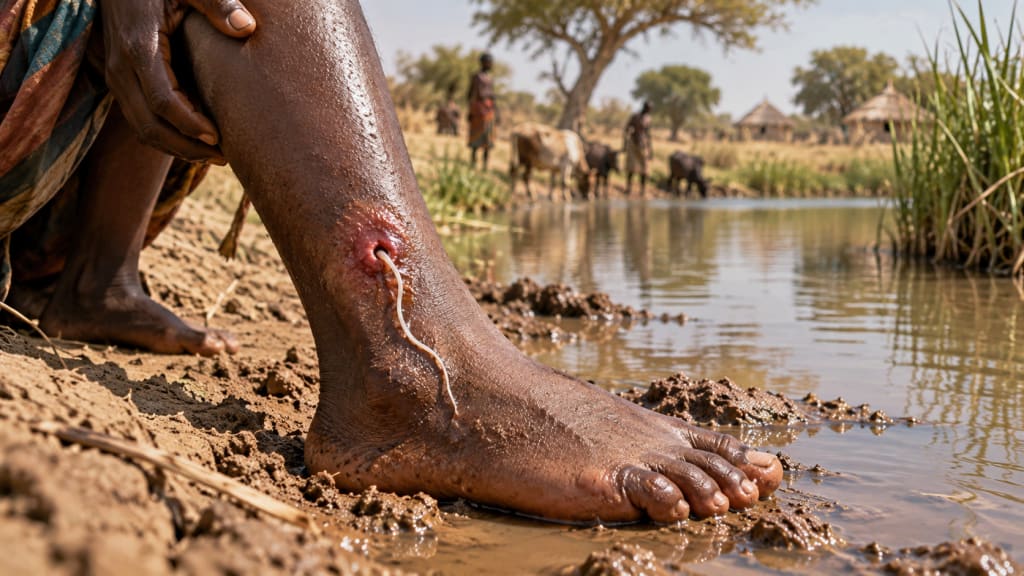
Almost a year later, a painful, burning blister appears on your foot.
The skin becomes swollen and tender. Walking becomes difficult. Cooling the affected area with water might seem like the most natural way to relieve the pain.
Then something horrifying happens.
A thin, pale worm begins emerging through the skin.
And it keeps coming.
The parasite can reach approximately three feet—or one meter—in length.
Even more unsettling, removing it safely may take days or weeks.
This is not a scene from a science-fiction horror movie.
It is Guinea worm disease, a real parasitic infection caused by the nematode Dracunculus medinensis.
For centuries, the disease caused severe pain and disability in communities that depended on unsafe drinking water.
But its modern story contains an extraordinary twist.
Humanity has brought Guinea worm disease to the brink of global eradication without developing a vaccine or a drug that reliably eliminates the adult parasite.
In 1986, an estimated 3.5 million people contracted Guinea worm disease each year.
In 2025, only 10 human cases were reported worldwide, the lowest annual total on record.
That remarkable reduction makes Guinea worm one of the most fascinating stories in modern public health.
It is a story about a parasite with an almost unbelievable life cycle, an ancient method of extraction, and a global campaign demonstrating that even a devastating disease can sometimes be stopped through clean water, education, and determined community action.
What Exactly Is Guinea Worm Disease?
Guinea worm disease, medically known as dracunculiasis, is a parasitic infection caused by the roundworm Dracunculus medinensis.
Unlike many familiar intestinal parasites, Guinea worm does not simply remain inside the digestive tract.
After infection, the parasite develops in the body, with the mature female eventually migrating toward the skin.
Approximately 10–14 months after infection, she creates a painful lesion and begins emerging, usually from a lower limb.
Despite its frightening appearance, Guinea worm disease is rarely directly fatal.
Its greatest danger lies in pain, secondary infections, impaired mobility, and the disruption of everyday life.
In communities dependent on subsistence farming, a disabling infection can affect an entire family's ability to work and obtain food.
How Does Guinea Worm Enter the Human Body?
The infection begins with something almost invisible.
Tiny freshwater crustaceans called copepods, commonly known as water fleas, can carry infective Guinea worm larvae.
These copepods live in ponds and other stagnant freshwater environments.
When people drink untreated water containing infected copepods, they can swallow the parasite without realizing it.
Water Fleas Are the Hidden Carriers
The water fleas involved are extremely small.
They are not insects, and they do not bite their way into the human body.
Instead, they act as intermediate hosts for the Guinea worm larvae.
Inside these tiny organisms, the larvae develop into a stage capable of infecting humans or other suitable hosts.
When contaminated water is swallowed, the copepods are digested and the larvae are released.
This begins the next stage of the parasite's life cycle.
Why People Usually Don't Notice the Infection
During the early stages, Guinea worm infection generally produces no obvious symptoms.
The parasite can remain undetected for many months.
A person may continue walking, farming, traveling, and carrying out everyday activities without realizing they are infected.
By the time a painful blister appears, the parasite has already undergone much of its development.
That delay is one reason the disease historically proved difficult to track and control.
The Guinea Worm Life Cycle: An Extraordinary Biological Strategy
Official CDC illustration of the Dracunculus medinensis life cycle, including infected copepods, human infection and larval release. Public domain. Image hosted on Cloudinary.
The life cycle of Guinea worm is remarkable because it links the parasite's development inside a host to contact with freshwater.
Stage 1: Contaminated Water Is Swallowed
A person drinks water containing infected copepods.
The copepods are digested, releasing the Guinea worm larvae.
The larvae penetrate the intestinal wall and enter deeper tissues.
Stage 2: The Worms Develop and Mate
Inside the body, the larvae mature into adult worms.
Male and female worms mate.
The male subsequently dies, while the fertilized female continues developing.
Her body becomes filled with large numbers of larvae.
Stage 3: The Female Migrates Toward the Skin
Over the following months, the female worm grows significantly.
She eventually migrates toward the skin, most frequently in the lower legs or feet.
The body responds with inflammation and blister formation.
This is often when the infected person first becomes aware of the parasite.
Stage 4: The Blister Becomes Intensely Painful
The blister can produce a severe burning sensation.
Swelling, pain, and sometimes systemic symptoms may occur.
The discomfort can become so intense that placing the affected area in cool water seems like an obvious form of relief.
But that response plays directly into the parasite's reproductive strategy.
Stage 5: Water Triggers the Release of Larvae
When the blister or emerging worm contacts water, the female releases a fluid containing hundreds of thousands of larvae.
Those larvae enter the water.
Freshwater copepods can then ingest them.
If another person drinks water containing the newly infected copepods, the cycle begins again.
In effect, the parasite's emergence and the host's instinctive desire to soothe the burning wound can combine to create an opportunity for transmission.
This is why preventing affected individuals from entering communal drinking-water sources is one of the most important control measures.
Why Does the Guinea Worm Usually Emerge From the Foot?
The most common emergence sites are the feet and lower legs, although the parasite can emerge from other parts of the body.
One important consequence of this location is that infected people may experience substantial difficulty walking.
A painful blister on the foot can make ordinary movements extremely uncomfortable.
The location also creates opportunities for the emerging worm to encounter water during everyday activities.
People may need to collect water, bathe, wash clothes, or cross shallow water sources.
When the worm contacts water, it can release larvae and continue its life cycle.
Does the Worm Know When It Reaches Water?
It is tempting to imagine that the parasite consciously detects its surroundings and makes a decision to reproduce.
But Guinea worms do not possess humanlike awareness or intentions.
Their behavior results from evolved biological mechanisms.
The adult female responds to environmental and physiological conditions that facilitate larval release.
Those mechanisms have been favored through the parasite's evolutionary history because they support successful transmission.
The result can appear almost deliberate.
But it is an example of biological adaptation rather than conscious planning.
The Most Disturbing Part: Removing the Worm Can Take Weeks
Microscopic image of Dracunculus medinensis larvae. Photo: Dr. Mae Melvin / CDC Public Health Image Library, 1973. Public domain. Hosted on Revlox's Cloudinary CDN.
One of the strangest aspects of Guinea worm disease is its traditional treatment.
The worm cannot simply be removed like a small splinter.
The adult female may extend for nearly one meter inside the body.
Pulling too forcefully risks breaking it.
Instead, healthcare workers traditionally extract the worm gradually.
The Ancient Stick-Winding Method
Historically, a small stick has been used to wind the emerging worm as it is removed a little at a time.
Modern clinical guidance also describes using sterile gauze and gentle traction under appropriate medical supervision.
The process may take days or weeks.
Each day, more of the worm may become accessible.
The objective is to remove it intact while protecting the wound and minimizing complications.
According to the CDC, extraction should proceed carefully because attempting to pull against resistance can break the worm.
What Happens if the Worm Breaks?
Breaking the worm during extraction can increase the risk of complications.
Retained worm material may contribute to inflammation and make management more difficult.
The wound may also develop a secondary bacterial infection.
In serious cases, complications can include abscess formation, infection involving joints, or prolonged impairment.
That is why suspected Guinea worm disease requires professional medical assessment and careful infection-control measures.
Anyone who suspects a Guinea worm infection should seek medical care rather than attempting extraction independently.
Why Isn't There a Medicine That Kills Guinea Worm?
Modern medicine has drugs that can treat many parasitic infections.
So why does Guinea worm remain an exception?
The answer lies partly in the parasite's biology and the difficulty of developing an effective treatment capable of reliably eliminating the adult worm.
The CDC states that there is currently no medicine proven to eliminate Guinea worm infection and no vaccine to prevent it.
Isn't Ivermectin an Antiparasitic Drug?
Yes.
Ivermectin is effective against certain parasitic infections, including some caused by other nematodes.
However, effectiveness against one parasite does not guarantee effectiveness against another.
There is no established drug regimen that reliably kills and removes adult Dracunculus medinensis inside an infected person.
Researchers are investigating possible treatments, including veterinary applications intended to interrupt transmission in infected animals.
But Guinea worm eradication has achieved most of its success through prevention and surveillance, not curative medication.
What Can Doctors Actually Do?
Clinical care focuses on reducing pain, protecting the wound, managing complications, and removing the worm carefully.
Healthcare workers may provide appropriate pain relief, wound care, and treatment for secondary infections.
The central public-health priority is also to ensure that the emerging worm does not contaminate communal water sources.
For a disease without a reliable parasite-killing medicine, careful supportive care and prevention are especially important.
Can Guinea Worm Disease Kill You?
Guinea worm disease is rarely fatal directly.
But that does not make it harmless.
The most serious effects often come from disability and complications rather than immediate death.
Imagine a farmer who cannot walk comfortably during the planting season.
Or a parent who cannot travel to collect water or support their household.
In remote communities with limited resources, temporary disability can have consequences extending far beyond the infected individual.
Secondary Infections Can Be Dangerous
An open wound creates an opportunity for bacteria to enter the body.
Without appropriate wound care, infection can become serious.
Infected tissues may become increasingly painful or swollen, and some patients can experience longer-lasting problems with mobility.
The disease's historical impact was therefore not measured solely by mortality.
Its burden also included lost work, disrupted education, medical needs, and hardship affecting entire households.
The Unbelievable Achievement: From 3.5 Million Cases to Just 10
This is where the story changes from medical horror to one of the most remarkable achievements in public health.
In 1986, an estimated 3.5 million people developed Guinea worm disease annually across approximately 20–21 countries in Africa and Asia.
By 2025, that number had fallen to just 10 reported human cases worldwide.
Guinea worm's dramatic decline
Annual reported or estimated human cases. The 1986 figure is a historical estimate; the later figures are reported surveillance counts.
0950,0001,900,0002,850,0003,800,00019862022202320242025The large 1986 estimate makes recent bars nearly invisible on a linear scale. The modern figures show that transmission has reached historically low levels but has not completely stopped.
The reduction exceeds 99.99%.
And it happened without a vaccine or a drug that reliably cures infected individuals.
A Campaign Built Around Simple Interventions
The international eradication effort has emphasized community education, identifying cases quickly, water filtration, safer drinking-water supplies, and prevention of contamination.
These measures interrupt the parasite's ability to reproduce.
A person may already be infected.
But if the emerging worm never reaches communal water, that infection does not have to create another generation of infections.
This simple principle has had an extraordinary impact.
Jimmy Carter and the Fight Against Guinea Worm
Former U.S. President Jimmy Carter became one of the most prominent advocates of Guinea worm eradication.
Through The Carter Center, established with Rosalynn Carter, he supported international cooperation to eliminate the disease.
The campaign worked alongside national governments, health agencies, community volunteers, and international partners.
Rather than depending on a single medical breakthrough, it focused on practical interventions that could be implemented in remote communities.
The effort became an important part of Carter's post-presidential humanitarian legacy.
He hoped to see the parasite eradicated during his lifetime.
Carter died in December 2024, before that goal was achieved.
But the campaign continued.
When The Carter Center announced the record-low 2025 case count, its leadership emphasized that the remaining infections demanded continued effort until transmission reached zero.
Where Does Guinea Worm Disease Still Exist in 2026?
According to the WHO's latest completed annual surveillance figures, human Guinea worm disease was reported in just three countries during 2025.
Country | Human cases in 2025 |
|---|---|
Chad | 4 |
Ethiopia | 4 |
South Sudan | 2 |
Worldwide total | 10 |
WHO Global Health Observatory, reporting 2025 surveillance data. These are not a complete 2026 year-end count.
Angola, Cameroon, and Mali are also important to the eradication effort because of ongoing transmission risks and infections in animals.
Why the Last Few Cases Are So Difficult to Eliminate
Eliminating millions of cases was an enormous achievement.
Yet eliminating the final few cases has proved surprisingly complicated.
Some affected communities are remote, with limited access to healthcare or reliable water infrastructure.
Conflict and insecurity can interrupt surveillance.
Population movement can make cases harder to track.
And animal infections have introduced unexpected complications.
These challenges mean that the final stage of eradication requires sustained attention even when human cases become exceptionally rare.
The Unexpected Challenge: Dogs, Cats, and Other Animals Can Carry Guinea Worm
For many years, Guinea worm eradication was approached primarily as a human waterborne disease.
But researchers subsequently discovered that the parasite could continue circulating through animals.
Dogs are especially important in some affected areas.
Cats and other animals have also been found infected.
This complicates efforts to stop transmission.
How Animals Become Infected
Like humans, animals can swallow infected copepods in contaminated water.
However, research also suggests that infection can involve aquatic animals such as fish or frogs that have swallowed infected copepods.
Those aquatic animals can serve as transport hosts.
When susceptible mammals eat them, infection may follow.
This has changed the practical strategy of eradication programs.
Preventing human exposure to contaminated drinking water remains essential.
But programs must also monitor animal infections and prevent infected animals from contaminating water sources.
Why 10 Human Cases Doesn't Mean the Parasite Is Almost Gone
The Carter Center's 2025 figures identified hundreds of infections in animals.
Its 2025 health-program report recorded 683 animal infections, compared with 664 in 2024.
That increase, despite the decline in human cases, illustrates the remaining difficulty.
The number of infected humans has become extremely small.
But the parasite still has opportunities to survive and reproduce in nonhuman hosts.
Eradication therefore requires eliminating transmission across the broader host network, not merely reaching zero reported human cases for one year.
How Guinea Worm Disease Can Be Prevented
The most effective prevention methods focus on preventing people and animals from swallowing infected copepods and stopping emerging worms from contaminating water.
Safe drinking water
Protected wells, properly treated water supplies, and other safe sources reduce exposure to parasite-carrying copepods.
Water filtration
Fine-mesh cloth filters and specially designed personal pipe filters can remove copepods from drinking water.
Protecting community water sources
People or animals with emerging worms must be kept from contaminating ponds and other shared drinking-water sources.
Surveillance and rapid reporting
Community health workers investigate suspected infections, provide appropriate care, and help interrupt local transmission.
Eradication programs may also use approved larvicides in designated water sources to control copepods.
The CDC documents these measures as central components of the Guinea Worm Eradication Program.
Why Guinea Worm Could Become the First Parasitic Disease Eradicated
Smallpox remains the most famous example of a disease eradicated through a global public-health campaign.
Guinea worm could become the second human disease eradicated worldwide and the first human parasitic disease to reach that milestone.
What makes this goal extraordinary is that the campaign has not depended on the kind of tools often associated with infectious-disease elimination.
There is no Guinea worm vaccine.
There is no reliable drug that kills the adult worm.
Instead, the campaign exploits a weakness in the parasite's life cycle.
The worm needs suitable hosts and water-mediated transmission to reproduce.
If that chain is consistently interrupted, the parasite cannot sustain itself.
Why Eradication Has Not Yet Been Declared
Reporting only a handful of human cases is not the same as eradication.
Surveillance must continue.
Transmission through animals must stop.
Countries need to demonstrate that infections are no longer occurring and meet formal certification requirements.
WHO's May 2026 global surveillance summary noted that animal infections, occasional re-emergence of transmission, and persistent sporadic human cases remain important obstacles.
The goal is within reach, but the remaining work cannot be dismissed.
Frequently Asked Questions About Guinea Worm Disease
Can a Guinea worm really grow to one meter inside a human?
Yes. An adult female Dracunculus medinensis can grow to approximately one meter in length. After developing inside the body for roughly 10–14 months, she typically emerges through the skin, most often from a foot or lower leg.
How do people get infected with Guinea worm?
The main route of infection is drinking unsafe water containing tiny freshwater copepods infected with Guinea worm larvae. The larvae are released after the copepods are swallowed and digested. Some transmission routes may also involve infected aquatic animals.
Can you pull a Guinea worm out yourself?
You should not attempt to remove a suspected Guinea worm yourself. Extraction requires careful management to avoid breaking the worm, damaging tissue, or causing infection. Suspected cases should be assessed by trained healthcare professionals, who can provide appropriate wound care and safe extraction.
Is Guinea worm disease almost eradicated?
Yes, but it has not yet been eradicated. Only 10 human cases were reported worldwide in 2025, compared with an estimated 3.5 million annually in 1986. Remaining human infections and transmission involving animals continue to complicate the final stages of eradication.
A Parasite That Once Afflicted Millions May Soon Disappear Forever
Few parasites have a life cycle as unsettling as the Guinea worm.
It enters the human body through contaminated water.
It develops almost invisibly for about a year.
It grows into a remarkably long adult worm.
And when it is ready to reproduce, it emerges through the skin, causing pain that can leave a person unable to work or walk comfortably for weeks.
For generations, this disease imposed an enormous burden on some of the world's most underserved communities.
But its modern history reveals something extraordinary.
People did not have to invent a miracle drug to bring Guinea worm disease close to extinction.
They needed access to safe water.
They needed effective filtration.
They needed surveillance systems capable of detecting infections.
They needed community health workers, education, and sustained international cooperation.
And they needed to prevent the parasite from reaching water sources where it could continue reproducing.
The results have been astonishing.
From approximately 3.5 million annual human cases in 1986 to just 10 in 2025, the world has achieved a reduction of more than 99.99%.
The last infections remain difficult to eliminate, especially because the parasite can also survive in animals.
But the scale of progress is undeniable.
Guinea worm disease shows that one of the most disturbing parasites in human history can be defeated not through extraordinary technology, but through a remarkable combination of scientific understanding, clean water, and collective determination.
A worm that once infected millions of people every year may soon lose its ability to infect anyone at all.
And when that happens, it will represent more than the disappearance of one parasite.
It will be another demonstration of what humanity can accomplish when public health reaches even the most isolated communities.
Scientific Sources and Further Reading
- CDC — About Guinea Worm Disease. Symptoms, transmission, parasite biology, treatment, and prevention.
- CDC — Clinical Overview of Guinea Worm. Medical information on the life cycle, emergence, and clinical management.
- CDC — Clinical Guidance and Prevention. Water filtration, vector control, and community-level interventions.
- WHO — Dracunculiasis Fact Sheet. Global background and disease characteristics.
- WHO — Global Surveillance Summary 2025, Published May 2026. Latest completed surveillance analysis.
- The Carter Center — Only 10 Human Cases in 2025. Historic reduction in infections and eradication progress.
- CDC Morbidity and Mortality Weekly Report — Eradication Progress. Epidemiological developments and transmission through aquatic animals.