Australia’s MRI-Guided Cryoablation Freezes Tumours Without Major Surgery
For some patients, treating a tumour can mean major surgery, lengthy hospital stays and weeks or months of recovery. A new capability at Liverpool Hospital in Sydney is offering another option for selected cases: destroying abnormal tissue by freezing it while doctors watch the treatment unfold in real time inside an MRI scanner.
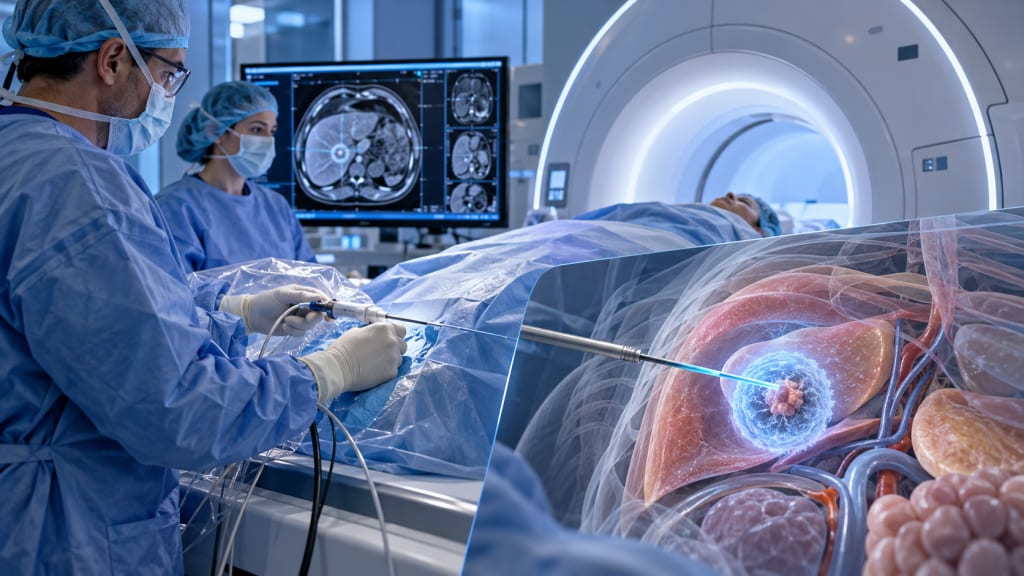
The technique, known as MRI-guided cryoablation, uses thin probes inserted through the skin to create an intensely cold zone around a tumour. Doctors can see that frozen area on MRI images as it develops, helping them target diseased tissue while protecting nearby nerves, organs and other critical structures.
Liverpool Hospital's team says it is the only group in Australia currently offering MRI-guided cancer intervention of this kind, although cryoablation itself is not a new treatment.
What Is MRI-Guided Cryoablation?
Cryoablation is a minimally invasive procedure that destroys abnormal tissue using extreme cold.
Rather than making a large surgical incision and physically removing a tumour, an interventional radiologist guides one or more narrow cryoprobes through a small puncture in the skin.
The probe is positioned directly within or next to the tumour using medical imaging.
Once correctly placed, highly compressed gas—commonly argon—is used to rapidly cool the probe. The surrounding tissue freezes and an "ice ball" forms around the treatment area.
That freezing process damages tumour cells and ultimately causes the targeted tissue to die.
Liverpool Hospital's MRI-guided system adds another important element: clinicians can continuously visualize the developing treatment zone during the procedure.
 Imrul
Imrul
Why MRI Guidance Matters
Freezing a tumour is only useful if doctors can destroy the intended tissue without harming important structures nearby.
That is where real-time MRI becomes especially valuable.
MRI provides detailed soft-tissue imaging without using ionizing radiation. During cryoablation, clinicians can observe the boundary of the frozen tissue and adjust their treatment accordingly.
Liverpool Hospital's new interventional radiology facility was specifically designed to support advanced image-guided treatment. The hospital's IR-MACS suite combines MRI, CT, angiography and ultrasound within one integrated environment, allowing complex procedures to be performed without repeatedly moving patients between different imaging rooms.
Liverpool Hospital's Head of Interventional Radiology, Dr Glen Schlaphoff, has described the facility as enabling real-time MRI-guided tumour ablation and other procedures requiring particularly precise imaging.
How Does Cryoablation Destroy a Tumour?
The treatment relies on extreme cold rather than cutting or burning tissue.
When cells freeze rapidly, several damaging processes can occur.
Ice Crystals Damage the Cells
As temperatures fall, ice crystals form inside and around tumour cells.
These crystals can disrupt cellular structures and membranes, contributing to irreversible injury.
Blood Supply Is Disrupted
Freezing can also damage the small blood vessels supplying the targeted tissue.
Without adequate blood flow, tumour cells are deprived of oxygen and nutrients.
The Frozen Tissue Eventually Dies
After treatment, the destroyed tissue is generally left in place rather than surgically removed.
The body gradually responds to and processes the damaged area over time.
The visible ice ball also provides clinicians with an immediate indication of how much surrounding tissue has been treated.
Which Tumours Can MRI-Guided Cryoablation Treat?
MRI-guided cryoablation is not suitable for every cancer or every patient.
At Liverpool Hospital, specialists are using the technology for carefully selected lesions, including some involving:
- The spine and bones
- Kidneys
- Liver
- Soft tissues
- Nerves and pain-related conditions
- Certain vascular abnormalities
The Liverpool-based interventional radiology team reports extensive previous experience with conventional cryoablation, including kidney and liver tumours, while MRI guidance extends the technique to cases where highly detailed visualization may be particularly valuable.
A Patient With a Painful Spinal Tumour Saw Rapid Relief
One of the cases highlighted in reporting about the technology involved 64-year-old Josephine Cordina, who had a small tumour measuring approximately nine millimetres near her spine.
The lesion was causing significant pain.
Traditional surgery in such a sensitive area can sometimes involve substantial intervention, including spinal stabilization and a longer recovery period.
Instead, doctors treated the lesion using MRI-guided cryoablation.
According to accounts of her treatment, Cordina reported that her pain had disappeared by the following day and that she was able to return to normal activities much more quickly than would typically be expected after major spinal surgery.
Her result is encouraging, but it is important to remember that one patient's experience does not predict the outcome for every patient.
Tumour type, size, location, overall health and proximity to vital structures all influence whether cryoablation is appropriate.
Does Cryoablation Replace Surgery?
Not generally.
MRI-guided cryoablation should be viewed as an additional treatment option, rather than a universal replacement for surgery.
Some cancers are still best managed through surgical removal, chemotherapy, radiotherapy, immunotherapy or combinations of treatments.
Cryoablation may be particularly attractive when:
- Surgery would be technically difficult
- A tumour sits close to sensitive structures
- A patient is considered high-risk for major surgery
- Preserving surrounding tissue is especially important
- Rapid pain relief is an important treatment goal
- A minimally invasive approach may provide adequate tumour control
Treatment decisions require assessment by oncology, surgery, radiology and other relevant specialists.
Liverpool Hospital's cryoablation service requires patients to be referred by a GP or specialist, after which imaging and medical history are reviewed to determine suitability.
Faster Recovery Is One of the Biggest Advantages
Traditional open surgery may require substantial incisions, general anaesthesia, postoperative monitoring and rehabilitation.
Percutaneous cryoablation is performed through small skin punctures.
For appropriate patients, that can mean:
Less tissue trauma: The treatment does not require a large surgical opening.
Shorter hospital stays: Some patients may leave hospital the same day or following morning.
Faster recovery: Patients can sometimes resume normal activities considerably sooner than after major surgery.
Reduced disruption to surrounding anatomy: Imaging allows clinicians to concentrate treatment on a carefully defined region.
These advantages are among the reasons minimally invasive interventional oncology has become an increasingly important part of modern cancer care.
Cryoablation Is Not New — the MRI Integration Is
Headlines describing the technology can sometimes make it sound as though Australia has only just discovered tumour freezing.
That would be misleading.
Cryoablation has been used internationally for years, including for certain kidney, liver, lung, prostate, bone and soft-tissue lesions.
What is notable at Liverpool Hospital is the use of in-bore MRI guidance for cryoablation, combined with a purpose-built interventional imaging environment.
Dr Schlaphoff's professional profile states that he performed Australia's first MRI-guided in-bore cryoablation in 2025.
The distinction matters because it is the imaging capability—not the basic idea of freezing tissue—that represents the major local development.
Inside Liverpool Hospital’s Advanced Imaging Suite
The technology forms part of the wider redevelopment of Liverpool Hospital in south-western Sydney.
In September 2025, NSW Health announced the opening of the hospital's IR-MACS multimodality interventional radiology suite.
The facility brings together:
- MRI
- CT scanning
- Angiography
- Ultrasound
- Interventional treatment facilities
within a centralized clinical environment.
According to NSW Health, the system allows some complex procedures to be performed using several imaging technologies without transferring a patient from one location to another.
That integration can help clinicians move from imaging and diagnosis to treatment more efficiently while maintaining precise anatomical guidance.
Why This Could Matter for Cancer Treatment
The significance of MRI-guided cryoablation goes beyond one machine.
Cancer treatment is increasingly moving toward precise, image-guided and organ-preserving interventions.
Instead of approaching every tumour through major surgery, specialists can increasingly select treatments based on the location and biological characteristics of an individual lesion.
For suitable patients, image-guided ablation can potentially reduce the physical burden of treatment.
It may also provide new possibilities for lesions located in areas where conventional surgery would be unusually difficult or damaging.
Liverpool Hospital's program illustrates how interventional radiology is becoming more closely integrated with oncology rather than functioning solely as a diagnostic specialty.
What Are the Limitations and Risks?
Cryoablation is minimally invasive, but that does not mean it is risk-free.
Possible complications can vary depending on the tumour location and may include:
- Bleeding
- Infection
- Damage to surrounding organs
- Nerve injury
- Incomplete destruction of the tumour
- Recurrence requiring further treatment
- Anaesthesia-related complications
The Liverpool interventional radiology service notes that serious bleeding or damage to adjacent structures is uncommon in experienced hands, but every procedure still requires individual risk assessment.
There are also cancers for which cryoablation would not provide adequate treatment.
For that reason, patients should not interpret the technique as a general substitute for established cancer therapies.
FAQ About MRI-Guided Cryoablation
What is MRI-guided cryoablation?
MRI-guided cryoablation is a minimally invasive treatment that destroys selected tumours by freezing them while MRI imaging helps doctors monitor the treatment area in real time.
Does cryoablation kill cancer cells?
Yes. Extremely low temperatures damage the targeted cells and their blood supply, leading to tissue death. The technique is used for selected tumours and abnormal tissues.
Is cryoablation better than surgery?
Not necessarily. Cryoablation may be preferable for certain patients or tumour locations, while surgery remains more appropriate for others. Treatment depends on tumour type, size, location and the patient's overall condition.
Is Liverpool Hospital the first in Australia to use MRI-guided cryoablation?
Liverpool Hospital's interventional radiology team states that it is currently Australia's only service offering this form of MRI-guided cancer intervention, and Dr Glen Schlaphoff is reported to have performed Australia's first MRI-guided in-bore cryoablation there in 2025.
MRI-Guided Cryoablation Adds Another Tool to Cancer Care
The most important part of Liverpool Hospital's program is not simply that doctors can freeze tumours.
They have been able to do that for years.
The advance lies in combining cryoablation with detailed real-time MRI guidance inside an integrated interventional suite, giving specialists another way to treat difficult lesions while minimizing disruption to surrounding healthy tissue.
For some carefully selected patients, that may mean avoiding major surgery, spending less time in hospital and returning to normal life sooner.
It will not replace conventional cancer treatment, but it demonstrates where interventional oncology is heading: smaller incisions, more precise imaging and increasingly targeted treatment.
For patients considering cryoablation, the next step should be a discussion with their oncologist, surgeon or interventional radiologist to determine whether the procedure is appropriate for their specific diagnosis.