Nadia Farès on Screen: The Filmography of an Actress Who Made Glamour Feel Dangerous
The easiest way to remember Nadia Farès is to start with the obvious facts. She was beautiful. She was strikingly photogenic. She had the kind of face the camera understands immediately. But that is not why her filmography deserves a long look. Plenty of performers are beautiful on screen. Farès mattered because she gave beauty weight. She rarely felt ornamental. She brought alertness, tension, and a slightly steely gravity to her roles, whether she was in a French thriller, a crime drama, a horror film, or a later television series built around power and moral damage. Her death in Paris on April 17, 2026, at age 57, has naturally pushed viewers back toward her best-known work, but it has also created a better opportunity: to look at her career as a whole and see the pattern more clearly than headlines usually allow.
That pattern is richer than a single breakout credit. Yes, The Crimson Rivers remains the title most strongly attached to her public memory. Yes, she worked across French and international projects in ways that made her career look both glamorous and mobile. But what gives her filmography real texture is the consistency of her screen personality across changing genres. Nadia Farès could play allure, intelligence, force, suspicion, pain, and command without overexplaining any of them. She belonged to that class of actors who make a movie feel more adult simply by entering the frame. That quality made her unusually useful to filmmakers—and, in retrospect, makes her whole body of work worth revisiting.
A serious look at her filmography also reveals something else: she was not a performer who coasted on one period of visibility. Her career came in phases. Early French film and television work built her craft. Mid-career thrillers and genre films gave her range and wider recognition. A later pause and return reshaped her screen identity again, especially in television, where she began playing women of authority, calculation, and emotional hardness. If you trace those phases carefully, Farès stops looking like a familiar supporting star from a few remembered titles and begins looking more like what she was: a durable actress with a distinctive mode, a pan-European screen presence, and a filmography stronger than casual memory often admits.
Before the breakout: learning the screen in the early 1990s
Nadia Farès did not arrive as a fully formed star in one famous film. Her career began the slower way, through early television and smaller cinema appearances that gradually taught directors how to use her. AlloCiné’s biographical summary notes that she first appeared on screen in the television production L’Exil in 1991, then made her cinema debut in Les amies de ma femme in 1992. Those titles are easy to skip over now, but they matter because they show how early her career began and how quickly she was moving between formats. She was not only a film actress who occasionally did television. From the beginning, she was a screen actress in the broader European sense, willing to move where the work was.
In the French industry of the 1990s, that flexibility mattered. An actor could build public recognition through television while developing range in cinema, and Farès seems to have understood that instinctively. She was young, visually memorable, and already usable in parts that required a little more danger or edge than a purely ingénue image would allow. The early roles do not yet show the full version of her later screen authority, but they do show the traits that would become central: control, poise, and a refusal to play scenes as if emotional intensity required obvious effort. Even at the start, she looked composed in ways that read as mature rather than passive.
The first genuinely important shift in her filmography came with Elles n’oublient jamais in 1994. AlloCiné’s biography emphasizes that it was this film, directed by Christopher Frank, that first made the wider public notice her. She played Angela, and the phrasing used in the French write-up is telling: she is described there as “vénéneuse,” effectively poisonous or venomous, a word that captures a lot about how Farès began to register in the French imagination. She was not simply attractive. She could be dangerous, withholding, morally slippery, or psychologically charged. That is a much more durable star lane than beauty alone.
In hindsight, this period is where her career’s underlying grammar takes shape. She works in drama, thriller, and crime-adjacent material and slowly becomes the kind of actress filmmakers can cast when they need something stronger than soft glamour. Her 1995 appearance in Policier and her work in Dis-moi oui… continue that process. She is still in the apprenticeship phase, but you can already see the components of the later Nadia Farès screen effect: elegance with weight, emotional distance that never empties into coldness, and the ability to imply private interior life without stopping the narrative to advertise it.
The mid-1990s: a tougher image begins to form
By the middle of the decade, Farès was becoming more legible as a particular kind of actress. She could move between tonal registers, but her strongest work increasingly drew on her capacity to bring hardness to beauty. AlloCiné notes that she appeared in Claude Lelouch’s ensemble film Hommes, femmes : mode d’emploi, then in Les Démons de Jésus by Bernie Bonvoisin, where she “impose son image de dure à cuire”—effectively, where she imposes or cements her image as a tough woman. That phrase is important because it describes not just one role, but an industry realization. Farès was becoming castable as a woman who could stand up to roughness, crime, pressure, or social threat without seeming miscast.
That is a subtle but meaningful distinction in filmography analysis. Some actresses build early careers by playing vulnerability and gradually push outward. Farès seems to have had a more unusual path. She could certainly play emotion, but the market quickly recognized that she carried force well. In Les Démons de Jésus, in particular, the image that begins to harden is not the image of a decorative supporting actress but of a woman who can bring rough energy, moral complexity, and bodily presence to the screen. She is not there merely to soften the frame. She can sharpen it.
That sharpened image helps explain why she remains memorable in films people may only vaguely recall. Even when the title fades, her energy inside it does not. She belongs to that category of actor whose filmography gains strength through accumulation. You may not need every single movie to be canonical to understand her value. What matters is that, again and again, the roles are variations on an identifiable screen instrument. Farès could carry menace, glamour, and self-command simultaneously. That made her adaptable to crime cinema, adult melodrama, and later international genre work. It also made her stand out in an era when French and European cinema still gave actresses room to look sophisticated without making them weightless.
The turn of the millennium and the film that fixed her legacy
For many viewers, Nadia Farès begins in Les Rivières pourpres—known internationally as The Crimson Rivers—even though that is obviously not where her career began. The reason the film matters so much is not only its popularity. It is that the role matched her screen gifts perfectly. Posthumous coverage from RTL, People, and other outlets still leads with the film when identifying her, which shows how completely it fused with her public legacy. In the years since release, it has remained the title most likely to bring her face back to viewers instantly.
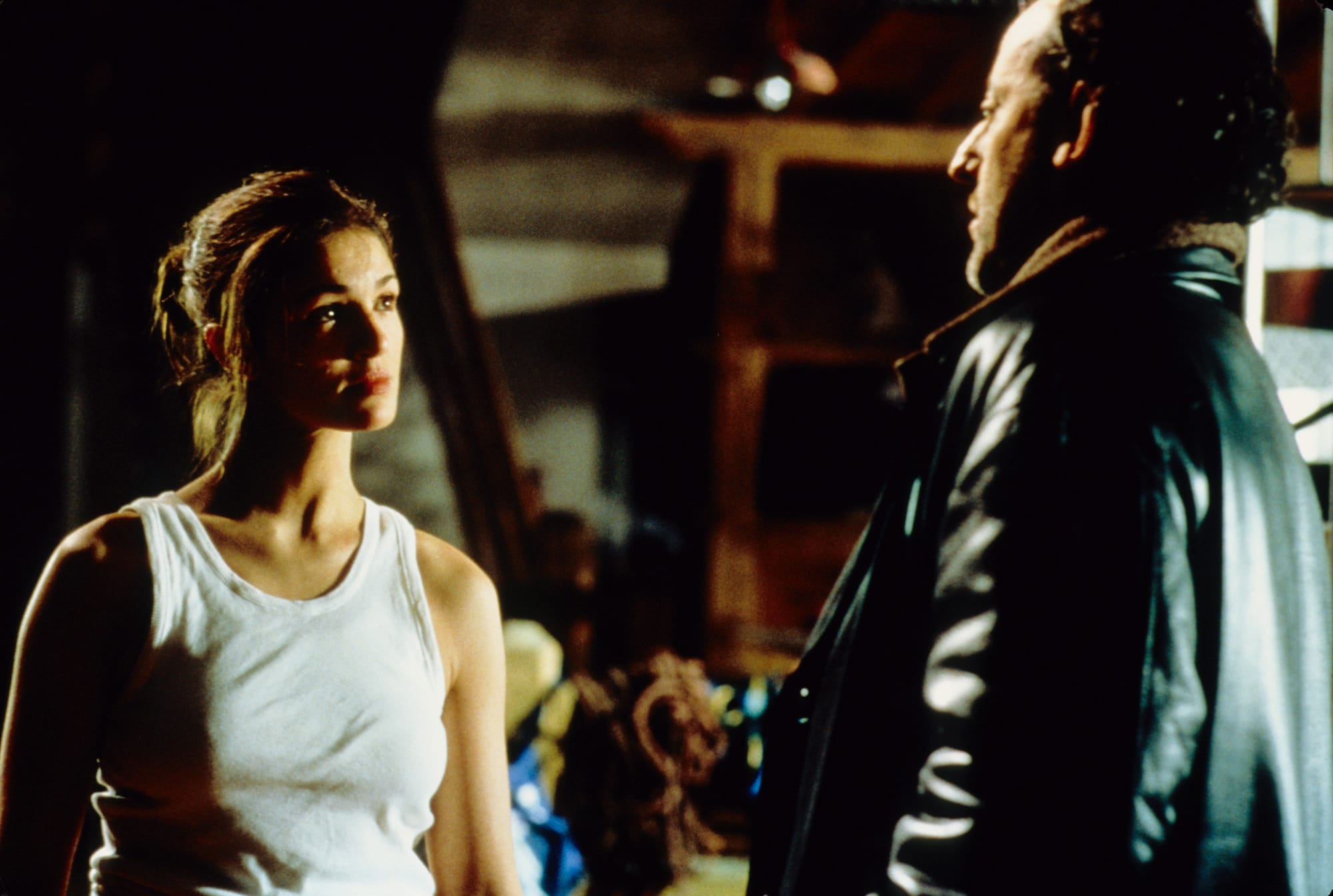
There is a reason for that persistence. Farès works especially well in material where atmosphere, danger, and adult emotional stakes matter. The Crimson Rivers is exactly that kind of film: dark, procedural, tense, and filled with buried corruption. She does not need to dominate every scene to leave an impression there. What she brings is concentration. She seems to understand thriller space instinctively. She knows how to look like she belongs inside violence, institutional secrecy, and dread without overplaying toughness. Some actors look strong because the script tells you they are. Farès often looked strong because she inhabited pressure naturally.
This is also where her beauty becomes inseparable from her dramatic usefulness. In lesser hands, a glamorous actress in a crime thriller can feel inserted for contrast. Farès never felt inserted. She felt integrated. Her visual power intensified the film’s mood instead of pulling against it. That is one reason her work in The Crimson Rivers has lasted better than some broader summaries of her career. It captured her essential screen contradiction in the best possible way: she could look polished and still make the room feel dangerous.
A filmography is often clarified by one role that teaches the audience how to read all the others. The Crimson Rivers did that for Nadia Farès. After it, earlier work looked like preparation and later work looked like variation. It did not trap her in one mode, but it did cement what that mode could do at full strength.
Genre fluency: action, horror, and international movement
Once you move past the French breakthrough years, one of the most interesting things about Nadia Farès’s filmography is how fluently she moved into international genre work without losing the core of her screen identity. That is harder than it looks. Many actors crossing from one national cinema into English-language or genre-oriented projects end up flattened by the translation. The roles get simpler. The image gets narrower. The actor becomes a type. Farès did not entirely escape that risk, but she fared better than many because the qualities that made her compelling in French thrillers—poise, hardness, visual authority—were also highly exportable.
Her 2002 role in Nid de guêpes is an important bridge in that regard. It comes after the wider recognition of The Crimson Rivers and before her later English-language genre appearances, and it confirms just how effective she could be in action-oriented material. This is not accidental casting. Farès belonged naturally in films where threat, pursuit, or pressure were central. She understood how to inhabit danger without straining for it. That is a quality action cinema desperately needs and rarely gets in performers whose appeal is initially read as glamorous rather than physical.
Then come the titles that many international viewers may know even if they do not immediately place her name: War and Storm Warning, both from 2007. AlloCiné lists her in Rogue l’ultime affrontement—the French title for War—as Jade Agent Kinler, while IMDbPro’s production page for Storm Warning lists her as Pia, one of the film’s central characters. These roles matter because they show Farès working in two distinct genre lanes: sleek action-thriller machinery on the one hand, rawer survival-horror tension on the other. The connective tissue is her screen credibility under stress.
In War, she functions inside a stylized, hard-edged action framework, one built around criminal networks, betrayal, and violent spectacle. In Storm Warning, the register is more visceral. The horror setting lets her draw on a different aspect of her presence—less controlled glamour, more embodied threat and endurance. That range is easy to underestimate because both films sit outside the French-cinema reputation that defined her for some critics. But from a filmography standpoint, they are revealing. They show a performer capable of traveling across markets without becoming unrecognizable. She did not suddenly become a different actress in English-language genre work. She remained Nadia Farès: forceful, watchable, alert, hard to trivialize.
The television years and the mature phase of power
Another thing that makes Nadia Farès’s career interesting is that her later period is not a simple decline from earlier film visibility. It is more like a reconfiguration. AlloCiné notes a pause from 2009 to 2015, followed by a return in the series Marseille, where she played Vanessa d’Abrantès, described as a woman of power willing to do anything to rise. That is a revealing description because it sounds almost like a summary of the mature Nadia Farès persona. She had aged into authority. She was no longer only an actress directors could use for tension or glamour inside a thriller. She could now anchor power itself.
Television suited this later phase beautifully. In long-form storytelling, Farès could let menace, ambition, history, and composure unfold over time rather than through the compressed shorthand of film. Marseille in particular benefited from casting that could sell not just public conflict but the emotional and political wear underneath it. Farès’s presence fits that kind of material naturally. She could play women who had lived, calculated, compromised, survived. Her beauty remained, but it had accumulated history. That made it more interesting, not less.
The same later-career pattern continues in titles such as Les Ombres Rouges, La Promesse, and Luther in its French version. AlloCiné’s listings show her repeatedly cast in roles of adult seriousness—Aurore Garnier Paoletti, Inès Castaing, Rose—rather than in nostalgic reprises of earlier glamour. This tells you a lot about how the French screen industry saw her as she aged. She was not being parked in decorative late-career parts. She was being trusted with women who had edge, agenda, or emotional history. That is a better kind of longevity than many more famous careers ever achieve.
Her television period also helps correct a common misunderstanding about actresses whose most publicly famous work belongs to an earlier moment. A performer can remain artistically active and useful long after mainstream international awareness narrows around one or two recognizable titles. That appears to be exactly what happened with Farès. Her later screen life may not have carried the same crossover profile as The Crimson Rivers, but it shows discipline and adaptation rather than fading. She found the roles age had prepared her for and played them with the same seriousness she had always brought to thrillers and genre work.
The overlooked films and why they matter
A strong filmography is not only the sum of the obvious titles. It is also the pattern hidden in the lesser-discussed ones. In Farès’s case, films like L’Ex femme de ma vie, Pour le plaisir, L’Enfant de la Nuit, Les Grandes bouches, Sous les pieds des femmes, and Chacun sa vie may not dominate the public conversation around her, but they help illustrate something critics and audiences should recognize more often: she did not need prestige branding to be interesting. Her value as a performer carried across comedies, dramas, thrillers, shorts, and later ensemble work.
That versatility should not be mistaken for shapelessness. It is almost the opposite. The reason these smaller or less internationally famous titles matter is that they show how stable her core instrument was. She could step into quite different filmic environments and still deliver the same essential promise: maturity, tension, elegance, and the sense of a private intelligence working behind the face. That is a rare enough gift that even medium-sized projects can become worth revisiting simply because she is in them.
There is also something instructive about the kinds of parts she did not seem drawn toward. Even when she appeared in lighter material, she rarely read as frothy or flimsy. The comedy could be there, the ensemble looseness could be there, but the center of gravity remained strong. Farès always seemed to carry an adultness the camera could not ignore. In an industry still too inclined to infantilize or flatten women once they have been coded as glamorous, that adultness becomes an artistic signature in itself.
Beauty, toughness, and the kind of screen identity that ages well
The longer you look at Nadia Farès’s filmography, the clearer it becomes that her true medium may have been not any single genre, but a specific interplay of glamour and force. Some actors age badly on screen because their image was built too narrowly around youth or seduction. Farès’s image aged well because it was always anchored in something sturdier. Even the early write-ups from AlloCiné suggest this: she is noticed as “venomous,” “tough,” emotionally vivid, and able to move with ease between dramatic and lighter roles. Those are good foundations for longevity. They leave room for transformation.
That is also why her later work in political and family dramas feels coherent rather than like a genre switch forced by age. She had already been carrying the seeds of those parts all along. The glamour was still there, but now it came with visible history. The composure now implied experience rather than mystery alone. The toughness no longer needed to be announced because it was embedded in the face and body. Viewed in that light, Farès’s career is not really a sequence of disconnected credits. It is a sustained study in how one screen presence can be translated across time.
The unfinished second act
One of the saddest details in the reporting around her death is that Farès was apparently preparing a first feature as a writer-director. People and Entertainment Weekly both note that she had been working toward a directing debut, reportedly an action comedy with Studio TF1, based on a screenplay she wrote. That detail matters for any discussion of her filmography because it suggests the body of work we have is incomplete in a deeper sense than death always makes things incomplete. Farès was not only leaving behind roles. She was on the edge of authoring work herself.
That possibility casts her existing filmography in a slightly different light. You start to wonder what she had learned over three decades of acting across French cinema, television, thrillers, genre projects, and international productions. You wonder what kind of female strength, tonal ambiguity, or physical intensity she might have built into a film of her own. It is always tempting to mythologize the unwritten chapter, and one should resist doing so too much. Still, the fact remains: Nadia Farès appears to have been moving toward a more authored creative future when her life ended. That makes the career retrospective feel less like closure and more like interruption.
Nadia Farès: Remembering a Fearless Screen Presence Whose Beauty, Strength, and Range Left a Lasting Mark
How to read her filmography now
So how should viewers approach Nadia Farès’s work now, especially if they only know the name from death notices or from The Crimson Rivers?
The best way is not to chase completeness first. Start instead with the pattern. Watch Elles n’oublient jamais for the early emergence of her public image. Watch The Crimson Rivers for the role that fixed her legacy. Watch Nid de guêpes, War, or Storm Warning to see how she travels across action and genre. Then move into Marseille, Les Ombres Rouges, or La Promesse to understand what happened when time strengthened rather than erased her screen authority. AlloCiné’s listings make that arc visible even before you press play. The credits themselves tell a story of adaptation, pause, return, and deepening.
Read this way, her filmography becomes more than a list of jobs. It becomes a portrait of an actress who found a durable mode and kept refining it. She was not endlessly protean in the chameleon sense, nor was she trapped in one register. She had a stable center and used it intelligently. That is a more interesting career shape than flashy reinvention for its own sake. It is the career shape of a performer who knew what the camera saw in her and learned how to keep making that perception richer.
Final word
Nadia Farès’s filmography deserves to be discussed not because death has briefly made her visible again, but because the work supports the attention. Born in Marrakesh in 1968, active on screen from the early 1990s through the mid-2020s, and remembered now above all for The Crimson Rivers, she built a career across film and television that was stronger, tougher, and more coherent than a casual glance might suggest. She moved from early French thrillers and dramas into crime cinema, international genre work, and later television roles defined by authority and emotional wear. Along the way, she developed one of the most quietly durable screen identities of her generation: glamorous without being hollow, forceful without being rigid, and watchable in a way that made even imperfect projects feel more grounded.
The best tribute to that kind of career is not sentiment alone. It is rewatching. It is looking at the full spread of the work, not only the famous title. It is recognizing that Nadia Farès was not simply a beautiful actress people happened to remember. She was a serious screen presence who made style feel dangerous, adulthood feel cinematic, and toughness feel elegant. That is not a minor achievement. It is a legacy.