
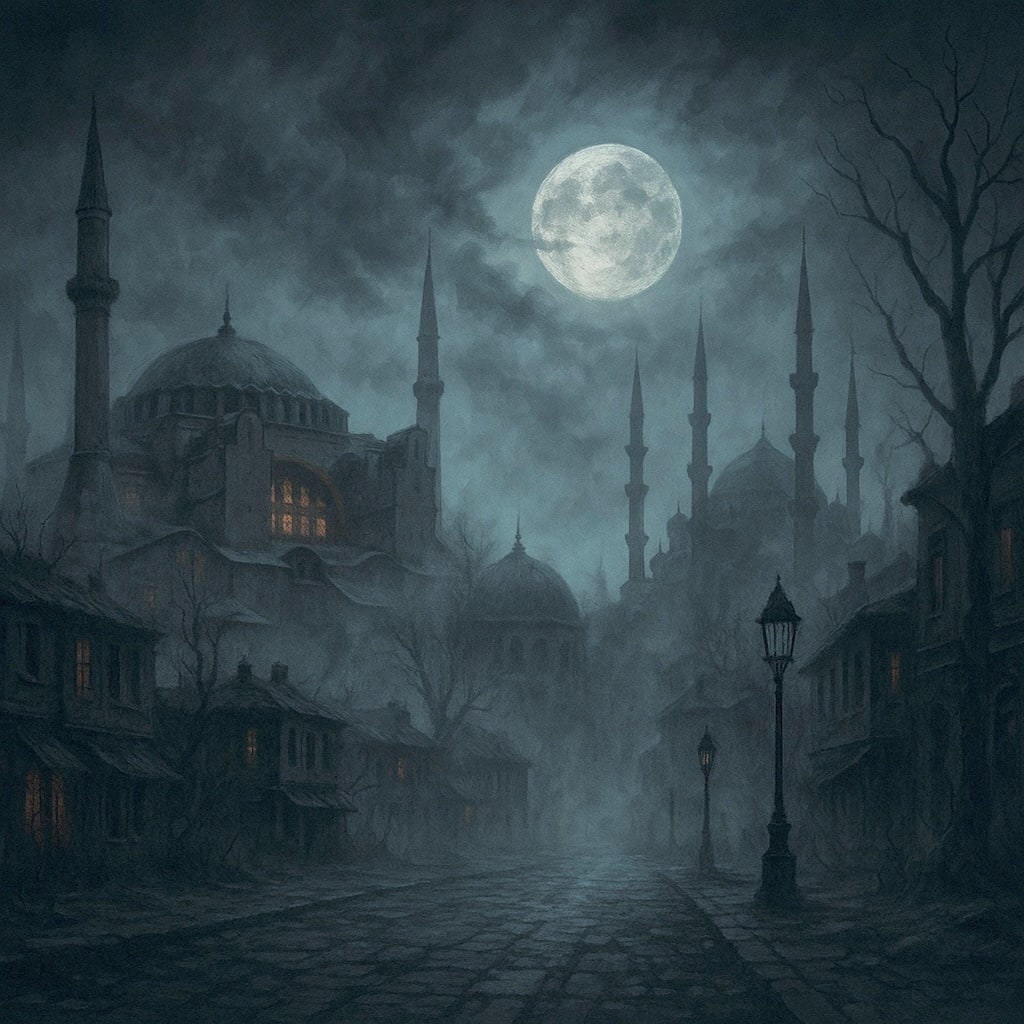
The Ottomans vs Vampires: The Origin and Truth of the Middle East's Secret History
Imagine a village somewhere in the Ottoman Empire, centuries before Bram Stoker introduced the world to Count Dracula.
It is late at night.
The streets are empty.
The village has recently buried one of its inhabitants.
But the dead, according to terrified witnesses, have not remained in their graves.
Strange noises echo through houses. Families report apparitions outside their doors. People become ill, and rumors spread that something buried beneath the earth has returned to torment the living.
The villagers seek help.
Not from a fictional vampire hunter armed with silver bullets and holy water, but from local authorities.
Soon the matter reaches a judge.
Religious scholars are consulted.
A grave may be opened.
And, in some recorded cases, the corpse is pierced, decapitated, or burned.
It sounds like the opening chapter of a Gothic horror novel.
But cases resembling this scenario genuinely appear in Ottoman historical records.
Long before the modern vampire became a familiar figure in films and television, inhabitants of Ottoman territories feared supernatural beings they believed could rise from the dead, harm their neighbors, spread misfortune, and sometimes drink human blood.
These creatures went by different names.
Cadı.
Obur.
Hortlak.
Upir.
Their characteristics varied across regions, languages, and religious communities.
Yet the most astonishing part of this history is not simply that people believed such creatures existed.
It is that some of the Ottoman Empire's most respected legal authorities seriously considered how communities should respond to them.
Sixteenth-century religious rulings addressed accusations involving restless corpses.
Seventeenth-century accounts described terrifying supernatural battles.
Eighteenth-century officials documented frightened communities and disturbed graves.
And in 1833, the Ottoman government's official newspaper published a report about two supposedly undead former Janissaries.
The historical evidence is substantial enough that researchers have written academic studies examining what they call the Ottoman response to vampirism.
There is, however, a crucial distinction.
The records demonstrate that vampire beliefs, accusations, and anti-vampire rituals existed. They do not demonstrate that supernatural vampires were real.
The true history is arguably more disturbing.
It reveals how fear of death, religious traditions, political tensions, cultural exchanges, and incomplete knowledge about the human body could combine to convince entire communities that the dead were attacking the living.
And it challenges the familiar assumption that vampire history belongs exclusively to European castles and Transylvanian legends.
Before Dracula, There Were Ottoman Vampires

Most people associate vampires with Count Dracula.
The black cape.
The pointed teeth.
The aristocratic castle.
The mysterious figure who emerges after sunset to drink blood.
But that image is relatively modern.
Bram Stoker's Dracula was published in 1897, drawing upon a much older collection of European supernatural traditions.
By then, stories of corpses returning from their graves had circulated for centuries across Eastern and Southeastern Europe.
Many of those territories had spent long periods under Ottoman rule.
The empire's European provinces, collectively known as Rumelia, included regions inhabited by Greek, Bulgarian, Serbian, Albanian, Bosnian, and other communities.
Their religious traditions and folklore were diverse.
Some believed the dead could become dangerous because of improper burial, curses, grave disturbances, or unresolved wrongdoing.
Others feared that certain corpses could leave their resting places and attack relatives.
Sometimes the suspected revenant was believed to spread disease.
Sometimes it was accused of strangling sleepers.
Sometimes it was said to drink blood.
These beliefs did not fit into a single universally agreed description of a vampire.
Instead, they formed a broad family of related traditions.
The Forgotten Ottoman Connection
The Ottoman Empire became an important environment in which these traditions circulated and interacted.
Its territories connected the Balkans, Anatolia, the Black Sea region, and parts of the Middle East.
People traveled between regions through trade, military service, migration, and religious networks.
Beliefs moved with them.
A 2017 study by historian Salim Fikret Kırgı argues that vampire-like supernatural beliefs were not confined to Balkan Orthodox Christian communities.
They also appeared across religious and cultural boundaries in regions connected by Ottoman rule.
Kırgı's research examines how Ottoman legal scholars and administrators responded to these fears, particularly when they threatened public order.
That is why describing the subject simply as the Middle East's forgotten vampire history can be misleading.
Much of the strongest evidence comes from the Ottoman Balkans and Black Sea world, rather than the Arab Middle East.
The Ottoman connection is real.
But the geography is much wider than the modern meaning of the Middle East.
 Imrul

What Did the Ottomans Call Vampires?
The creatures described in Ottoman-era sources were not necessarily identical to modern fictional vampires.
Different communities used different names and attached different characteristics to the supernatural beings they feared.
Name | Historical or folkloric context | Common association |
|---|---|---|
Cadı / Câdû | Ottoman Turkish and related regional usages | Witchcraft, dangerous revenants, reanimated corpses |
Obur | Turkic and Black Sea folklore | Blood-drinking or malevolent supernatural beings |
Upir / Upír | Slavic traditions | A returning dead person, often regarded as an ancestor of the modern vampire concept |
Hortlak | Turkish folklore | A corpse or spirit believed to return from the grave |
Vrykolakas | Greek folklore | A dangerous revenant associated with death and improper burial |
Karakoncolos | Balkan and Anatolian folklore | A frightening supernatural creature, especially associated with winter traditions |
These categories overlap, and their meanings differ by period and locality. None is a perfect translation of the modern fictional vampire. etd.ceu.edu+2
The term cadı is particularly important.
In modern Turkish, it is commonly translated as witch.
But in certain historical Ottoman contexts, it could describe a corpse believed to have returned from death.
That creates confusion when modern readers encounter documents about Ottoman witchcraft.
A historical cadı accusation may refer to a living person suspected of magical practices—or to a dead person believed to be haunting the living.
Understanding the context is essential.
The Ottoman Religious Rulings That Addressed Vampires
Perhaps the strongest evidence that Ottoman officials dealt with revenant fears comes from the sixteenth century.
During the reign of Sultan Suleiman the Magnificent, one of the empire's most influential religious scholars was Ebussuud Efendi.
He served as the Ottoman şeyhülislam, the empire's leading religious-legal authority.
His opinions helped shape important aspects of Ottoman legal practice.
Among his surviving legal rulings are responses to questions about corpses allegedly returning to life.
These documents are extraordinary.
Not because they prove the existence of vampires, but because they show how allegations of supernatural activity could become serious legal and administrative problems.
The Question That Reached the Sheikh al-Islam
One ruling concerned reports of corpses changing after burial.
Their bodies allegedly became reddish, appeared to contain blood, or showed other unusual characteristics.
Ebussuud discussed possible supernatural explanations within the intellectual and theological framework of his time.
However, he did not issue a uniform instruction that every suspicious corpse should be destroyed.
In one ruling involving a Muslim corpse, he rejected exhumation and burning.
Other rulings addressing a Christian revenant allegedly threatening villagers allowed very different responses.
That difference matters.
It reveals that Ottoman legal responses were neither straightforward nor entirely consistent.
They reflected religious distinctions, local customs, and uncertainty about how to respond to reports that could not easily be explained.
When a Grave Became a Legal Emergency
One especially unsettling series of rulings concerned a village near Salonica, present-day Thessaloniki.
According to the reported allegations, a deceased Christian appeared at people's doors after burial.
He supposedly invited others to accompany him.
Those people then died and were themselves believed to return.
Fear spread through the community.
The legal questions included whether Muslim inhabitants could flee and how the disturbances should be stopped.
The scholar directed the community toward established authority rather than allowing uncontrolled flight.
In a subsequent response, he described measures drawn from local practice, including staking a corpse, separating the head from the body, and, if other measures failed, burning the remains.
This sounds remarkably similar to the vampire-killing methods familiar from European Gothic fiction.
Yet the ruling predates Dracula by more than three centuries.
Did the Ottoman State Officially Declare Vampires Real?
Not in the simple sense suggested by some sensational headlines.
A religious-legal opinion addressing an alleged supernatural problem is not the same as a scientific verification of that problem.
Furthermore, historians emphasize that the rulings were not consistent.
Some authorities treated the accusations as dangerous supernatural possibilities.
Others referred to customary practices or sought to calm frightened populations.
And some Ottoman officials explicitly described the fears as unfounded.
The historical significance lies in the state's willingness, in certain situations, to intervene in communities terrified by revenant rumors.
The documents reveal an empire negotiating between inherited beliefs, religious authority, and practical governance.
They do not establish an empire-wide vampire-hunting program.
The Night of the Flying Vampires: Evliya Çelebi's Terrifying Account

One of the strangest vampire-related stories in Ottoman literature comes from the famous traveler Evliya Çelebi.
Born in 1611, Çelebi spent decades traveling through Ottoman territories and neighboring regions.
His monumental ten-volume Seyahatname, or Book of Travels, contains descriptions of cities, customs, architecture, religious practices, historical events, legends, and extraordinary encounters.
Some passages resemble careful observations.
Others blend storytelling, folklore, exaggeration, and the fantastic.
Among the most extraordinary is his account of supernatural beings in the Caucasus.
April 25, 1666: A Battle in the Night Sky
Çelebi describes a terrifying confrontation involving beings associated with Circassian and Abkhazian communities.
According to the account, supernatural entities fought in the sky during the night.
The scene involved flashes of light, darkness, violent combat, and creatures believed to possess extraordinary powers.
Some were described as drinking the blood of their enemies.
Others were said to fall to the ground during the battle.
The story presents the confrontation as an extraordinary event witnessed during the traveler's journey.
A scholarly study of Çelebi's account identifies the date given in his narrative as April 25, 1666.
It is the kind of episode that could easily inspire a modern supernatural horror film.
Imagine a dark Caucasian village.
Villagers gathering beneath a storm-filled sky.
Lightning illuminating creatures locked in combat.
And a traveler recording the episode for readers hundreds of years later.
But how should historians interpret it?
Was Evliya Çelebi Describing Something He Actually Saw?
The safest historical interpretation is that Çelebi recorded a supernatural account embedded in local storytelling and cultural traditions.
His travelogue is an invaluable historical source.
But it is not a modern scientific field report.
The presence of an event in Seyahatname does not establish that the extraordinary phenomena physically occurred.
Historians study such passages because they reveal what people believed, how communities described the supernatural, and how travelers understood unfamiliar cultures.
In this case, the account provides evidence that blood-drinking supernatural creatures formed part of the traditions circulating around the Black Sea and Caucasus.
It also demonstrates the remarkable geographical reach of Ottoman supernatural storytelling.
These were not simply legends associated with Romanian castles.
They appeared in the cultural worlds of Circassians, Abkhazians, Ottoman travelers, and other communities connected through regional exchange.
The Edirne Cases: When Ottoman Officials Investigated Disturbed Graves

By the beginning of the eighteenth century, accounts of dangerous revenants were still reaching Ottoman authorities.
A case from approximately 1701 concerned alleged signs of supernatural activity around a grave near Edirne.
A local judge reported that villagers were frightened by what they believed were indications of an evil spirit.
The report referred to earlier religious rulings about suspicious corpses and the customs used to deal with them.
Another case concerned a deceased Muslim woman named Cennet, buried in Edirne.
According to the historical account, people feared that supernatural activity was occurring around her grave.
The grave was opened, and witnesses reported that the body had not decomposed as expected and that the face retained a reddish appearance.
For people who associated such observations with returning corpses, these details seemed frightening.
The Authorities Were Not Always Convinced
One of the most important details in these cases is that officials did not necessarily share the villagers' supernatural interpretation.
Some records explicitly characterize the residents' fears as illusions or unfounded anxieties.
The authorities nonetheless considered interventions intended to reassure the community.
This suggests that responses to alleged vampires could sometimes function as a form of crisis management.
The authorities were dealing with frightened people.
Fear could cause families to abandon homes, disrupt village life, or provoke conflict.
Whether or not officials believed a revenant was genuinely responsible, they had to address the consequences of the accusation.
The records reveal an uncomfortable possibility: disturbing human remains could be treated as a practical method of calming a community, even when officials doubted the underlying supernatural explanation.
The 1833 Tırnova Vampire Case: Two Dead Janissaries Accused of Terrorizing a Town

Perhaps the most famous Ottoman vampire incident occurred in the nineteenth century.
Its location was Tırnova, now known as Veliko Tarnovo.
Its alleged perpetrators were two men who had already died.
And its details were published in an official Ottoman newspaper.
The Case That Entered the Government Gazette
On October 6, 1833, issue 68 of Takvim-i Vekayi, the Ottoman Empire's official gazette, published a report about alleged supernatural disturbances in Tırnova.
The report originated from local official Ahmed Şükrî Efendi.
Residents claimed that invisible beings were disturbing homes, moving objects, and frightening people.
Some accounts described attacks that felt like attempted strangulation.
The town eventually sought the assistance of a specialist believed to possess the knowledge needed to identify and destroy such entities.
His name was Nikola.
The suspected revenants were identified as Ali Alemdar and Abdi Alemdar, two deceased men associated with the Janissaries.
The Vampire Hunter Named Nikola
According to the report, Nikola used customary divination practices to identify the graves allegedly responsible for the disturbances.
The bodies were exhumed.
They were described as showing signs that believers considered suspicious.
The remains were then subjected to destructive measures intended to prevent the alleged hauntings.
The story eventually culminated in the burning of the corpses.
For a modern reader, the episode may sound like a sensational horror tale.
But its publication in a government newspaper gives the event a different historical significance.
It demonstrates that the accusation was considered important enough to enter an official communication channel.
It does not mean the government had established that supernatural creatures existed.
Why Were the Accused Vampires Former Janissaries?
This is where the story becomes politically fascinating.
The Janissaries had once been one of the Ottoman Empire's most powerful military institutions.
But their influence increasingly came into conflict with reforming rulers.
In 1826, Sultan Mahmud II violently abolished the Janissary Corps during the event known as the Auspicious Incident.
Thousands were killed or subjected to repression during the upheaval.
The Tırnova report appeared seven years later.
Both accused revenants were associated with the now-abolished military institution.
That detail has encouraged historians to consider whether the story also reflected post-Janissary political hostility.
Research into the incident notes that the report used hostile language toward former Janissaries and emerged in a period when their reputation remained politically charged.
Were the Janissaries Being Demonized Even After Death?
It is a compelling possibility.
When a political or military institution is destroyed, hostility toward it does not necessarily disappear.
Stories that portray its former members as dangerous, corrupt, or malevolent may continue circulating.
Accusing deceased Janissaries of returning as supernatural threats could reinforce negative portrayals of the old order.
But historians must be cautious.
The surviving evidence does not prove that the entire Tırnova episode was fabricated as a centrally planned political operation.
It does support examining the case within the propaganda, social fears, and institutional conflicts of the period.
In that sense, the story may be about more than vampires.
It may also reveal how political struggles can continue in the public imagination long after the people involved have died.
Did the Ottoman Empire Really Employ Vampire Hunters?
One of the most surprising features of the historical record is the existence of people described as specialists in dealing with supernatural disturbances.
Terms such as cadıcı and cadı ustası referred to individuals believed to possess expertise in identifying or neutralizing dangerous supernatural beings.
In certain nineteenth-century records, expenses associated with such specialists were paid through official channels.
Historian Zeynep Aycibin discusses these arrangements in her study of Ottoman witch and vampire beliefs.
But the term vampire hunter can create the wrong impression.
There is no reliable evidence of a permanent empire-wide corps comparable to fictional monster hunters.
Instead, the documents describe local specialists operating within regional traditions, sometimes receiving payments for particular cases.
Their expertise was understood through the supernatural beliefs of the communities that employed them.
The historical reality is unusual enough without exaggeration.
Some Ottoman communities paid people to deal with alleged revenants, and officials occasionally authorized or accommodated these practices.
That is a significant piece of social history.
It is not proof that those specialists ever encountered genuine undead beings.
The Real Horror: Why Did People Think Corpses Were Coming Back to Life?

The historical records raise an obvious question.
If vampires were not actually rising from graves, what caused people to believe that they were?
The answer is not a single phenomenon.
Vampire beliefs developed from overlapping fears involving death, illness, decomposition, religious traditions, and unusual events that people could not easily explain.
Several mechanisms are particularly relevant.
1. The Human Body Behaves Strangely After Death
One of the most disturbing discoveries a person could make after opening a grave is that a corpse does not always look the way they expect.
Decomposition varies considerably depending on temperature, burial conditions, moisture, oxygen, and other factors.
The body may swell as gases accumulate.
Fluids can emerge from the mouth or nose.
The skin may change color.
Soft tissues may recede, making hair or nails appear longer even though they have not actually continued growing.
To people unfamiliar with these processes, such observations could seem like evidence that a corpse had remained unnaturally active.
A reddish face or dark fluid around the mouth might be interpreted as proof that the deceased had been drinking blood.
In reality, such changes can occur during ordinary decomposition.
2. Disease Could Make the Dead Appear Responsible for New Deaths
Imagine a household in which several people become ill over a period of weeks.
One person dies.
Soon afterward, another develops symptoms.
Then a third.
Without an understanding of infectious disease transmission, the sequence may appear to have a supernatural cause.
If the first person to die is believed to be returning at night, subsequent deaths can reinforce the accusation.
The resulting story becomes self-sustaining.
The more people die, the more dangerous the alleged revenant appears.
In some European settings, vampire panics became associated with outbreaks of diseases such as tuberculosis.
However, disease explanations should not be applied automatically to every Ottoman incident.
Each historical report requires examination of its own circumstances.
3. Sleep Experiences Can Feel Like Supernatural Attacks
Some reports of nocturnal attacks describe an invisible presence, overwhelming fear, or the sensation of being strangled.
These details resemble experiences that can occur during sleep paralysis.
During sleep paralysis, a person may become aware of their surroundings while temporarily unable to move.
Some experience frightening hallucinations involving shadowy figures or pressure on the chest.
The experience can feel intensely real.
But it has a neurological explanation involving the transition between sleep and wakefulness.
Sleep paralysis may help explain certain categories of supernatural encounter reports, although there is no way to diagnose historical witnesses from written descriptions alone.
4. Fear Can Spread Through an Entire Community
Once a community accepts the possibility of a returning corpse, ordinary events may acquire frightening meanings.
A noise outside becomes evidence of an apparition.
An illness becomes proof of a curse.
An unusually preserved corpse becomes confirmation of supernatural activity.
Each new rumor strengthens the others.
The resulting fear can influence behavior, memory, and the interpretation of ambiguous events.
This does not mean the people involved were simply foolish.
They were attempting to explain disturbing experiences using the knowledge and cultural frameworks available to them.
Understanding that context is essential to studying supernatural history seriously.
Did Vampires Originate in the Ottoman Empire?
This question has generated scholarly debate.
Vampire-like traditions existed across numerous cultures before the rise of modern European vampire fiction.
Stories of harmful returning dead, blood-drinking beings, and dangerous spirits appear in different historical settings.
It would therefore be inaccurate to claim that the Ottoman Empire invented vampires.
However, the empire played an important role in the cultural environment through which many Balkan and Black Sea revenant traditions circulated.
Historian Salim Fikret Kırgı argues that these beliefs should be understood as part of a shared regional phenomenon rather than assigned exclusively to one religious or ethnic community.
A 2024 paper in Humanities and Social Sciences Communications goes further, challenging Western-centered accounts of vampire literary history and emphasizing Ottoman and Turkic influences.
Did the Word “Vampire” Come From Turkish?
Some researchers have explored possible connections between Turkic terms such as obur and words used in Slavic and neighboring languages for supernatural beings.
But the etymology remains debated.
It would be too strong to state that the modern English word vampire definitively originated in Ottoman Turkish.
Language histories are complicated, especially in regions where Turkic, Slavic, Greek, Albanian, and other communities interacted over centuries.
What is clearer is that vampire beliefs crossed linguistic and religious boundaries.
They were not the exclusive possession of any single culture.
From Ottoman Folklore to Dracula

The modern vampire is a product of centuries of storytelling and literary transformation.
By the eighteenth century, reports of alleged vampires in Southeastern Europe had attracted widespread attention.
These accounts helped establish the revenant as a subject of European fascination.
During the nineteenth century, Gothic writers developed the figure into something increasingly recognizable.
John Polidori's The Vampyre introduced an influential aristocratic vampire.
Sheridan Le Fanu's Carmilla contributed another major literary interpretation.
Then, in 1897, Bram Stoker published Dracula.
The novel combined older vampire folklore with Gothic horror, sexuality, anxiety about foreignness, and late-Victorian concerns.
Its success helped create the modern fictional vampire.
The Ottoman Connection to Dracula's Historical Background
The name Dracula also has a connection to the political and military history of the Ottoman frontier.
Vlad III of Wallachia, commonly known as Vlad the Impaler, fought against Ottoman forces during the fifteenth century.
His reputation for extreme violence later became associated with the Dracula name.
However, the relationship between the historical ruler and Stoker's fictional vampire is often exaggerated.
The novel's vampire is not a straightforward historical portrayal of Vlad III.
Nor is there evidence that Ottoman vampire investigations directly produced Stoker's character.
The more defensible conclusion is that Ottoman-era Balkan history formed part of the larger cultural landscape in which vampire traditions evolved.
The path from local revenant fears to Gothic fiction was complex, involving folklore, travel writing, political history, and literary imagination.
The Darkest Part of Ottoman Vampire History Was Entirely Human
The historical material is disturbing because the recorded consequences were sometimes real even when the supernatural explanations were not.
Graves were opened.
Human remains were damaged.
Families and communities experienced intense fear.
Specialists were called upon to destroy alleged monsters.
And religious or administrative authorities sometimes became involved in practices driven by supernatural accusations.
The people believed to be dangerous were already dead.
They could not defend themselves against accusations.
Their bodies became the focus of anxieties that the living struggled to resolve.
This reveals something important about the history of fear.
When an entire community becomes convinced that a hidden threat exists, actions that would otherwise appear unacceptable may begin to seem necessary.
A grave becomes evidence.
A corpse becomes an enemy.
And an extraordinary act of violence can be framed as the restoration of public safety.
That is the real horror beneath the supernatural legend.
A Brief Timeline of Ottoman Vampire History
- Mid-sixteenth century — The rulings of Ebussuud EfendiOttoman legal opinions address reports of corpses returning and consider different responses based on the circumstances.
- 1666 — Evliya Çelebi's supernatural accountThe Ottoman traveler records a story involving blood-drinking beings and a terrifying confrontation in the Caucasus.
- Around 1701 — The Edirne casesOfficials receive reports of suspected revenants and consider responses to widespread local fear.
- Eighteenth century — Vampire lore continuesOttoman literary and travel accounts describe revenants in Balkan and Black Sea communities.
- October 6, 1833 — The Tırnova reportThe official newspaper Takvim-i Vekayi publishes an account involving two dead former Janissaries accused of supernatural disturbances.
- Nineteenth century — Paid specialists appear in recordsLocal authorities in some regions document expenses for people described as experts in dealing with alleged supernatural threats.
- 1897 — Dracula is publishedBram Stoker's novel helps transform the older revenant traditions into the internationally recognizable fictional vampire.
What Is Actually True About Ottoman Vampires?
Claim | Historical assessment |
|---|---|
Ottoman communities believed in vampire-like creatures | Documented |
Some religious scholars issued rulings concerning suspected revenants | Documented |
Corpses were sometimes exhumed or destroyed | Documented in historical reports |
Evliya Çelebi described blood-drinking supernatural beings | Documented as a literary/travel account |
An official newspaper reported an 1833 vampire-like incident | Documented |
Some specialists received official payment to address such fears | Supported by historical research |
The Ottoman Empire maintained a secret national vampire-hunting army | Unsupported |
Historical documents prove that undead vampires existed | No scientific or historical proof |
All vampire legends originated in the Ottoman Empire | Unsupported; the origins are diverse and contested |
Frequently Asked Questions
Did the Ottoman Empire really believe in vampires?
Some communities within Ottoman territories believed in vampire-like revenants, and legal or administrative authorities sometimes responded to those fears. Beliefs varied across regions and periods, and officials were not uniformly convinced that supernatural explanations were true.
Did Ottoman religious scholars issue fatwas about vampires?
Yes. Sixteenth-century rulings associated with Ebussuud Efendi addressed reports involving allegedly reanimated corpses. Some discussed staking, decapitation, or burning, while others rejected disturbing the dead.
What was the 1833 Tırnova vampire incident?
An official Ottoman newspaper published allegations that two deceased former Janissaries were causing supernatural disturbances in Tırnova, now Veliko Tarnovo in Bulgaria. The report described efforts to identify and destroy the supposed revenants.
Did the Ottoman government hire vampire hunters?
Some local records mention payments to specialists known as cadıcı or cadı ustası. This does not establish the existence of a permanent national vampire-hunting organization.
Was Evliya Çelebi's vampire battle real?
Çelebi recorded a story involving supernatural beings in the Caucasus. Historians treat it as evidence of folklore and storytelling, not as verification that flying vampires physically existed.
Were Ottoman vampires the same as Dracula?
No. Ottoman and Balkan revenant traditions were diverse. The aristocratic, sophisticated vampire popularized by Dracula emerged through later literary developments.
Did vampire beliefs originate in Islam?
No. Vampire-like stories circulated across multiple religious and cultural communities. Ottoman records are valuable because they show how different traditions interacted under imperial rule.
The Truth Was Stranger Than the Legend
For more than a century, popular culture has taught audiences to imagine vampires through the Gothic landscapes of Europe.
A castle in Transylvania.
A coffin hidden beneath the earth.
A mysterious aristocrat who emerges after sunset.
And a hunter determined to destroy him before dawn.
But the historical world behind these stories was far larger and more complicated.
It included villages along the Black Sea.
Communities in the Ottoman Balkans.
Religious scholars attempting to answer disturbing questions.
Judges dealing with terrified inhabitants.
Travelers recording extraordinary tales.
And government officials responding to reports that the dead had returned.
Some people genuinely believed they were being attacked by supernatural beings.
Others were skeptical.
And some authorities responded not because they had verified a vampire, but because the fear itself had become a problem that required intervention.
The surviving documents reveal more than unusual folklore.
They reveal how societies attempt to explain death when the boundaries of knowledge are uncertain.
They reveal how different cultures influence one another.
They reveal how religious authority and local custom can become intertwined.
And they reveal how fear may transform the bodies of the dead into objects of suspicion.
The Ottoman Empire did not secretly wage a proven war against supernatural vampires.
But it did govern communities in which vampire-like beliefs were sufficiently powerful to influence legal opinions, local investigations, burial practices, and official records.
That history is real.
And perhaps it is more unsettling than the supernatural story.
Because no actual vampire is needed to explain how the events unfolded.
Only human beings.
Human beings frightened of death.
Human beings searching for answers.
Human beings interpreting the unfamiliar through the beliefs of their time.
And human beings willing to disturb the dead in order to feel safe among the living.
Long before Dracula terrified readers, the Ottoman world was already recording stories of the dead who would not stay buried.
The vampires may have belonged to folklore.
But the fear—and the things people did because of it—belonged to history.
Sources and Further Reading
- Central European University — The Belief in Vampire-like Supernatural Creatures in the Ottoman Empire. Salim Fikret Kırgı's scholarly research into Ottoman revenant beliefs and official responses.
- Ankara University — Osmanlı Devleti'nde Cadılar Üzerine Bir Değerlendirme. Zeynep Aycibin's study of Ottoman vampire accusations, ritual responses, and community tensions.
- Oxford Academic — Ottomans and the Supernatural: Breaking the Order of Things. Detailed analysis of Ebussuud Efendi's rulings and the Edirne and Balkan cases.
- KÜRE Encyclopedia — Tırnova Witch Case. Historical context of the official 1833 report involving former Janissaries.
- Humanities and Social Sciences Communications — Geo-political Vampirism. A scholarly interpretation of Ottoman and Balkan influences on later vampire literature.
- Acta Orientalia — Evliya Çelebi in the Circassian Lands. Research on the traveler's supernatural accounts and Caucasian folklore.
- PBS NewsHour — How Vampire Lore Emerged From Medical Mysteries. Scientific explanations of decomposition, disease, and vampire-related fears.


