
Modern-Day Trance Mediumship Debate: Is Psychic Channeling Disappearing?
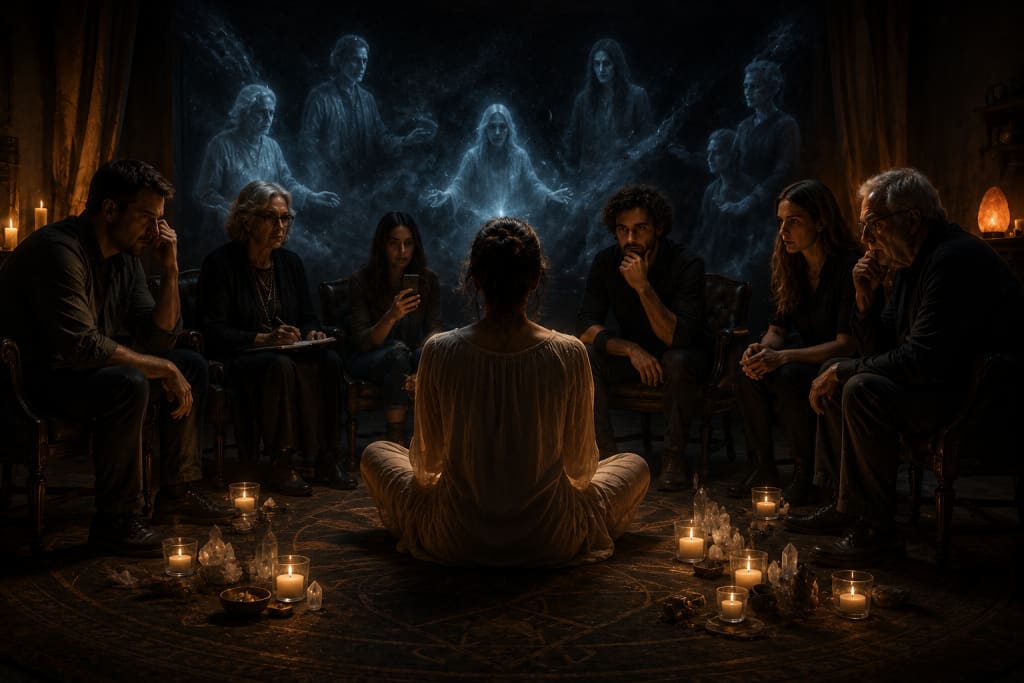
For more than a century, trance mediumship has occupied one of the most mysterious corners of modern spirituality. In dimly lit rooms, séance circles, Spiritualist churches, private development groups, and New Age gatherings, mediums have claimed to enter altered states of consciousness and allow spirit communicators, guides, teachers, or nonphysical intelligences to speak through them. To believers, trance mediumship is sacred communication. To skeptics, it is performance, suggestion, psychology, or fraud. To cultural historians, it is part religion, part theater, part grief ritual, part social movement, and part mirror of each era’s deepest anxieties.
Today, however, a new question has emerged inside spiritual communities and among observers of modern mysticism: is trance mediumship disappearing?
Some practitioners say yes. They argue that old-style trance work is far less common than it once was. Deep trance demonstrations, long-form spirit lectures, physical séance circles, and carefully trained development groups seem rarer in public life. Many modern psychics now focus on fast evidential readings, tarot, astrology, intuitive coaching, manifestation work, energy healing, or online content. In a digital culture built for short videos and instant answers, the slow, disciplined, often private practice of trance mediumship can feel like a relic from another world.
Others disagree. They say trance mediumship is not dying; it is changing shape. It has moved from Victorian parlors and Spiritualist halls into Zoom circles, online workshops, retreat centers, podcasts, livestreams, and personal spiritual coaching. The language has shifted too. Many people no longer call it “trance mediumship.” They call it channeling, conscious channeling, spirit communication, light language, higher-self transmission, guide work, or intuitive download.
So what is really happening? Is psychic channeling fading from modern spirituality, or is it simply adapting to a new cultural environment?
The answer is complicated. Trance mediumship as a traditional public religious practice may be less visible than it once was. But channeling as a broader spiritual idea is far from gone. It has been remixed for the internet age, absorbed into wellness culture, and reshaped by new ideas about consciousness, trauma, creativity, and personal empowerment.
The old séance room may be quieter. But the channel, in one form or another, is still open.
What Is Trance Mediumship?
Trance mediumship is usually described as a form of mediumship in which the medium enters an altered or semi-conscious state and allows communication from spirits, guides, or nonphysical intelligences to come through. In some traditions, the medium remains partially aware. In others, the medium claims to have little or no memory of what was said.
General definitions of mediumship describe it as the claimed practice of mediating communication between spirits of the dead and living people, with forms that include séance work, trance, and channeling.
A trance state itself is commonly understood as a state of semi-consciousness, abstraction, or deep absorption. Merriam-Webster defines trance as a sleeplike altered state, often associated with diminished sensory or motor activity, or a state of profound abstraction.
In spiritual settings, trance mediumship is not always the same as ordinary psychic reading. A psychic reader may claim to use intuition, clairvoyance, cards, or energy impressions while remaining fully conscious. A trance medium, by contrast, claims to step aside in some way so that another consciousness can communicate.
This distinction matters because the debate over whether trance mediumship is disappearing often focuses on depth. Older Spiritualist traditions often valued deep trance, where the medium’s voice, posture, vocabulary, and mannerisms might appear to change. Modern channeling often happens in a lighter, more conscious state. The practitioner may remain aware, speak fluidly, and frame the communication as a collaborative process rather than full spirit control.
That shift has created tension. Traditionalists may argue that modern channeling is too casual, too self-branded, and too mixed with personal opinion. Modern practitioners may argue that older trance models were too rigid, theatrical, or dependent on outdated séance culture.
Both sides are responding to the same change: the meaning of “mediumship” has expanded.
A Short History of Trance Mediumship
Modern trance mediumship is closely tied to Spiritualism, a religious and cultural movement that grew rapidly in the nineteenth century. Spiritualism became especially influential in the United States and Britain, offering people the hope that the dead could communicate with the living. Séances, table-rapping, spirit messages, automatic writing, and trance lectures became part of the movement’s public identity.
Britannica describes a séance as a meeting centered on a medium who seeks communication with spirits of the dead, often held in darkness or subdued light, traditionally with participants sitting in a circle.
In the nineteenth and early twentieth centuries, trance mediumship had a strong public role. Some mediums delivered speeches while in trance. Others claimed to transmit teachings from spirit guides. Some became famous for physical phenomena, direct voice communication, or materialization séances. Spiritualist churches developed formal structures, services, healing practices, and training systems.
The Spiritualists’ National Union, founded in the United Kingdom in 1901, remains one of the largest Spiritualist organizations and continues to promote Spiritualism, mediumship, healing, training, and accreditation.
But Spiritualism also faced repeated crises of credibility. Fraud scandals damaged public trust. Stage magicians exposed séance tricks. Scientific investigators challenged claims. Some mediums were caught using hidden devices, costumes, assistants, or psychological techniques. As the movement became associated with both genuine grief work and sensational spectacle, its public reputation became unstable.
A 2024 literary-historical essay on Spiritualism notes that historians often trace part of Spiritualism’s decline to the late nineteenth-century demand for dramatic “materialization” séances, where fraud became widespread enough that even some Spiritualists lamented the movement’s degeneration into spectacle.
This history still affects trance mediumship today. The practice carries a double inheritance: profound spiritual meaning for believers, and deep suspicion for skeptics.
Why People Think Trance Mediumship Is Disappearing
The idea that trance mediumship is disappearing comes from several visible changes.
First, traditional public trance demonstrations are less central to mainstream spiritual culture than they once were. A century ago, Spiritualist meetings, séances, and trance lectures could draw large audiences. Today, public interest in spirituality remains strong, but it is spread across many practices: astrology, tarot, crystals, energy healing, meditation, breathwork, past-life regression, manifestation, near-death-experience research, angel work, and self-development.
Second, many Spiritualist churches have smaller public visibility than they once did. Some remain active, especially in the UK, Australia, and parts of the United States, but they compete with online spiritual entrepreneurs, wellness influencers, and secular mental-health language. The Spiritualists’ National Union still offers training pathways and maintains accreditation systems for mediums and healers, showing that formal Spiritualist practice continues, but it now exists within a much broader and more crowded spiritual marketplace.
Third, trance mediumship requires discipline and time. Traditional development often involves sitting in circle, learning control, building trust, practicing altered states safely, and understanding spiritual philosophy. This slow apprenticeship model does not easily fit a culture of instant courses, personal branding, and short-form content.
Fourth, modern audiences often want direct personal evidence rather than long philosophical spirit lectures. A person grieving a loved one may want names, memories, personality traits, and emotional reassurance. That favors evidential mediumship over trance discourse. Trance communication can feel less immediately verifiable because the spirit communicator may speak in broad teachings rather than specific personal details.
Fifth, the word “trance” itself may feel uncomfortable to modern audiences. It can suggest loss of control, hypnosis, manipulation, or theatrical possession. Many practitioners prefer softer language such as “blending,” “overshadowing,” “inspired speaking,” or “conscious channeling.”
In other words, trance mediumship may not be disappearing because people stopped believing in spirit communication. It may be disappearing as a label, a public format, and a traditional training culture.
The Rise of Channeling
While traditional trance mediumship may feel less visible, channeling has become a major part of modern alternative spirituality. Channeling is often presented as receiving messages from spirit guides, angels, ascended masters, extraterrestrial intelligences, collective consciousness, the higher self, or universal wisdom.
The difference between mediumship and channeling is often blurry. In many definitions, channeling is treated as a form of mediumship or a related New Age practice. General mediumship references identify channeling as a similar practice connected to spirit communication.
The language changed for cultural reasons. “Mediumship” is strongly tied to Spiritualism and communication with the dead. “Channeling” sounds broader, more cosmic, more self-development oriented, and less bound to church structure. A medium may contact a deceased relative. A channeler may transmit a message from a guide, star being, ascended teacher, goddess archetype, or one’s own higher consciousness.
This broader vocabulary helped channeling move into wellness culture. It could be sold as personal growth, spiritual guidance, creativity, emotional healing, or intuitive empowerment. That made it easier to package into workshops, books, online courses, memberships, and coaching programs.
Critics argue that this shift has diluted older mediumistic discipline. Supporters argue that it has democratized spiritual communication, making it less dependent on formal institutions and more accessible to ordinary seekers.
Either way, channeling has not disappeared. It has become more individualized, branded, and hybrid.
The Internet Changed Everything
The biggest transformation in trance mediumship and channeling is the internet.
In the past, mediumship was tied to physical spaces: churches, séances, circles, homes, halls, and retreat centers. The medium and sitters were in the same room. The atmosphere mattered. Darkness, silence, group energy, and ritual structure all shaped the experience.
Now, spiritual communication can happen through livestreams, video calls, social media posts, private voice notes, online courses, and subscription communities. This has changed both access and expectations.
Online culture rewards visibility, personality, speed, and emotional immediacy. A trance medium sitting quietly for long periods before delivering slow philosophical speech may not fit the attention economy. A channeler delivering short, emotionally charged messages on TikTok or Instagram may spread much faster.
The online shift also changes authority. In older Spiritualist communities, mediums might be trained, tested, and evaluated by teachers or churches. Today, anyone can call themselves a channeler, psychic, or intuitive guide and begin building an audience. This openness creates opportunity, but also risk. It allows sincere practitioners to reach people, but it also makes exaggeration, manipulation, and spiritual performance easier.
The result is not the death of mediumship. It is the platformization of mediumship.
Psychic channeling has become content.
Also Read: Declassified: CIA Releases Psychic Experiment Documents Shedding Light on Unconventional Research
Why Traditionalists Are Worried
Traditional trance mediumship communities often worry that something valuable is being lost.
Their concern is not only nostalgia. Trance work, in older traditions, was often treated as sacred discipline. It required grounding, ethics, training, humility, and a clear distinction between personal imagination and spirit influence. Development circles could take years. Teachers emphasized patience. Public demonstration was not supposed to be rushed.
Modern channeling culture sometimes appears to bypass that discipline. A person may attend a weekend workshop, declare themselves a channel, and begin offering paid transmissions. Messages may be vague, flattering, or emotionally manipulative. The language may borrow from many traditions without deep understanding. Claims may become grandiose: galactic councils, ancient masters, divine missions, or exclusive revelations.
Traditionalists fear that trance mediumship is being replaced by performance spirituality. They worry that the slow art of altered-state mediumship is becoming indistinguishable from inspirational speaking.
There is also concern about ego. In classic Spiritualist ideals, the medium is often expected to be a servant of spirit, not the star of the show. In influencer culture, the personality of the channeler can become central. Branding, aesthetics, charisma, and monetization may overshadow the message.
This does not mean modern channeling is always shallow. Many contemporary practitioners are sincere, disciplined, and ethically careful. But the concern is understandable. When an esoteric practice enters the attention economy, it changes.
Why Modern Practitioners Disagree
Modern channelers often reject the idea that trance mediumship is disappearing. They argue that it is evolving because consciousness itself is evolving, or because spiritual communication no longer needs old Victorian forms.
They may say that deep trance is not superior to conscious channeling. A medium does not need to lose awareness for meaningful communication to occur. Instead of being “taken over,” the practitioner may blend with a guide or receive impressions while remaining present. This model feels safer and more empowering to many people.
Modern practitioners also point out that spiritual language must adapt. Younger audiences may not feel drawn to Spiritualist church structures, hymns, formal demonstrations, or older séance vocabulary. They may connect more easily with meditation, energy work, somatic healing, trauma awareness, and intuitive development.
From this perspective, channeling is not declining. It is being translated.
The old model asked the medium to become passive enough for spirit to speak. The new model often asks the practitioner to become conscious enough to collaborate with guidance. That is a major philosophical shift.
It also reflects wider cultural changes. Modern spirituality often emphasizes personal agency, healing, empowerment, and direct experience. People are less willing to accept hierarchical spiritual authority. They want tools, not institutions. They want language that fits therapy, creativity, nervous-system regulation, and self-discovery.
In that environment, trance mediumship survives by becoming less formal and more personal.
The Skeptical View: Was It Ever Really Spirit Communication?
Any serious article on trance mediumship must also acknowledge the skeptical position.
Skeptics argue that trance mediumship and channeling can be explained by psychology, suggestion, performance, dissociation, unconscious creativity, cold reading, social cues, memory, expectation, and cultural conditioning. From this view, a medium in trance is not communicating with spirits but entering an altered state in which the mind produces material that feels external.
This does not necessarily mean the medium is deliberately fraudulent. A person may sincerely believe they are channeling while actually accessing subconscious material. Human consciousness is capable of surprising forms of dissociation, role-taking, absorption, improvisation, and symbolic expression.
The skeptical view also points to the long history of exposed fraud in mediumship. From fake materializations to theatrical séance tricks, fraudulent practices have damaged the credibility of the field for generations. Historical accounts of Spiritualism repeatedly note how demands for dramatic phenomena contributed to deception and public disillusionment.
For skeptics, the decline of traditional trance mediumship may simply reflect a more educated public, stronger scientific culture, and less tolerance for unverifiable claims.
But this explanation alone does not fully account for the continued popularity of channeling. Even in highly technological societies, people still seek spiritual contact, nonordinary experience, and meaning beyond material life. Skepticism has not ended the desire for communication with the unseen.
It has only changed how such claims are received.
The Believer’s View: The Spirit World Is Adapting
Believers often interpret the changes differently. They may argue that spirit communication adapts to each era. In the nineteenth century, table-rapping and séance phenomena matched the culture of parlors, letters, and public lectures. In the twentieth century, trance lectures, healing circles, and Spiritualist churches gave structure to the movement. In the twenty-first century, online channeling, energy work, and intuitive development reflect a global, digital, psychologically aware age.
From this view, psychic channeling is not disappearing. It is becoming more accessible.
A believer might say that the spirit world no longer needs dramatic deep trance because human consciousness is more open. Communication can be lighter, faster, and more integrated. Instead of one medium speaking from a platform, many people are learning to access guidance directly.
This view fits the broader democratization of spirituality. People no longer rely only on priests, ministers, gurus, or professional mediums. They seek direct experience through meditation, dreams, synchronicities, automatic writing, intuitive prompts, and personal ritual.
Traditional trance mediumship may look smaller because the function it once served has spread into many different practices.
The channel has multiplied.
The Role of Grief
Mediumship has always been closely connected to grief. People seek mediums because they want to know whether loved ones survive death. They want reassurance, forgiveness, closure, and continuing connection.
Research into assisted after-death communication and mediumship has explored how people use such experiences within grief and continuing-bonds frameworks. One cited academic article by Julie Beischel and colleagues discusses possible effects of readings with psychic mediums on bereavement from a continuing-bonds perspective.
Whether one believes the communication is objectively real or psychologically meaningful, the emotional function is clear. Mediumship gives people a way to maintain relationship with the dead.
This may help explain why evidential mediumship remains more visible than trance mediumship. A grieving person often wants direct, personal details. They may not want a long trance lecture from a spirit teacher. They want to hear: your mother is okay, your son remembers this, your husband is still with you, your friend forgives you.
Modern spiritual markets respond to demand. Personal readings are easier to sell, easier to understand, and easier to evaluate emotionally. Trance mediumship, especially philosophical or guide-based communication, may feel less urgent to grief-centered audiences.
So one reason trance mediumship appears to be fading is that modern mediumship has become more client-focused and therapeutic.
The Shift From Public Séance to Private Healing
Old-style trance mediumship often happened in public or semi-public settings. A medium might speak before a group, conduct a circle, or demonstrate phenomena in a séance. Modern spiritual work is often more private and healing-oriented.
This reflects a broader cultural shift. People now use spiritual services alongside therapy, coaching, wellness retreats, mindfulness practices, and self-help. The goal is often personal healing rather than proof of survival after death.
Trance channeling has adapted by becoming part of healing sessions. A practitioner may channel guidance for life direction, trauma release, soul purpose, ancestral healing, or emotional transformation. The old question “Can the dead speak?” becomes “What guidance does my soul need?”
That change makes trance mediumship harder to recognize. It may not look like a séance anymore. It may look like a coaching session.
This is one of the main reasons the disappearance debate is tricky. If one defines trance mediumship narrowly—deep altered-state spirit control in a Spiritualist context—then yes, it appears less publicly dominant. If one defines it broadly as altered-state spiritual communication, then it remains alive in many forms.
Professionalization and Accreditation
Another important factor is professionalization.
Organizations such as the Spiritualists’ National Union continue to offer training, accreditation, and development pathways for mediums, speakers, and healers. The SNU states that its accreditation system is designed to show that a medium, speaker, or healer has undergone training and assessment.
This kind of structure appeals to people who want standards and accountability. It also preserves older Spiritualist traditions.
But online spirituality often operates outside such structures. A channeler may have no formal training, no accountability body, and no peer assessment. Some audiences see this as freedom. Others see it as dangerous.
Professionalization can protect quality, but it can also feel restrictive. Informal channeling can feel accessible, but it can also become unregulated. The tension between these models is central to the modern debate.
Traditional trance mediumship is not only competing with skepticism. It is competing with spiritual entrepreneurship.
Is Deep Trance Harder to Find?
Many experienced Spiritualists and mediumship students say deep trance is harder to find today than lighter forms of inspired speaking or conscious channeling.
There are several possible reasons.
Deep trance requires trust. The medium must feel safe enough to surrender ordinary control. That is difficult in a culture where everything can be recorded, judged, clipped, mocked, or taken out of context.
Deep trance also requires stable development groups. Many people now move quickly between teachers, online courses, and spiritual trends. Long-term circles may be less common.
Deep trance is harder to market. A short intuitive message can become a social media clip. A deep trance sitting may be slow, subtle, and dependent on atmosphere.
Deep trance also raises ethical concerns. If a practitioner claims to be unconscious while another entity speaks, responsibility becomes complicated. Who is accountable for harmful advice? How can sitters evaluate consent, safety, and accuracy? Modern spiritual ethics often favor conscious participation.
For these reasons, deep trance may indeed be less visible than before. But reduced visibility does not equal extinction. It may continue mainly in private circles, specialist workshops, and traditional Spiritualist environments.
The Impact of Science and Mental Health Awareness
Modern mental health awareness has also changed how trance and channeling are viewed.
In earlier eras, altered states were often interpreted through religion or spirit communication. Today, people are more likely to consider dissociation, trauma responses, voice-hearing experiences, suggestibility, hypnosis, or neurodivergent forms of absorption. This does not automatically invalidate spiritual interpretations, but it complicates them.
Responsible spiritual teachers increasingly emphasize grounding, consent, psychological stability, and discernment. They may warn students not to use channeling as a substitute for medical or mental-health care. They may also discourage grandiose claims or dependency on guides.
This is a positive development. Trance mediumship can be emotionally intense. People who are vulnerable, grieving, isolated, or suggestible may be harmed by careless practitioners. Ethical boundaries matter.
The modern debate is therefore not just “Is channeling real?” It is also “How can people explore altered states safely?”
A practice can be meaningful and still require caution.
Why Some Audiences Prefer Channeling Over Religion
Another reason channeling persists is that many people are spiritually curious but institutionally skeptical. They may not identify with organized religion, yet they still believe in consciousness, spirit, energy, or life after death.
Channeling offers direct access without requiring formal membership in a church. It feels personal, flexible, and experiential. It can be blended with meditation, yoga, astrology, psychology, creativity, and self-help.
This flexibility is one of its strengths. It is also one of its weaknesses. Without a stable tradition, channeling can become vague, inconsistent, or overly commercial. But for many seekers, that openness is exactly the appeal.
Traditional trance mediumship belonged to a more structured spiritual world. Modern channeling belongs to a more individualized spiritual marketplace.
That difference explains much of the generational divide.
The Commercial Problem
The commercialization of channeling is one of the biggest reasons some people believe the practice is losing depth.
Spiritual services are now marketed through websites, memberships, online academies, certification programs, exclusive transmissions, premium readings, and subscription platforms. Some of this is fair. Practitioners need to earn a living, and spiritual labor takes time. But commercialization can also create pressure to produce constant messages, dramatic claims, and emotionally addictive content.
A medium who once sat quietly in development for years may now feel pressure to post daily “channeled guidance” to stay relevant. A channeler may exaggerate spiritual authority to stand out in a crowded market. Audiences may become dependent on external messages instead of developing discernment.
This is where old Spiritualist caution remains valuable. A spiritual message should not be judged only by how dramatic it sounds. It should be judged by ethics, clarity, humility, usefulness, and emotional effect.
A channel that constantly creates fear, dependency, superiority, or urgency should be questioned.
The Fraud Question Has Not Gone Away
Fraud remains a serious issue in mediumship and channeling. The tools have changed, but the risks remain.
In the past, fraudulent mediums used dark rooms, hidden devices, staged phenomena, or planted information. Today, unethical practitioners can use social media research, vague statements, emotional manipulation, paid spiritual dependency, or high-pressure coaching funnels.
This does not mean all mediums are fraudulent. It means the field requires discernment.
People seeking readings or channeling sessions should be cautious of practitioners who guarantee contact with specific deceased people, claim exclusive cosmic authority, pressure clients into repeated expensive sessions, create fear about curses or attachments, discourage medical or psychological care, or isolate clients from family and friends.
Healthy spiritual work should leave people feeling clearer, stronger, and more grounded—not more afraid or dependent.
This ethical issue affects the disappearance debate because fraud damages trust. When people lose trust, traditional practices decline. For trance mediumship to survive meaningfully, ethics matter as much as mystery.
So, Is Psychic Channeling Disappearing?
The honest answer is: traditional deep trance mediumship may be declining in public visibility, but psychic channeling is not disappearing. It is transforming.
The older model of trance mediumship—formal, Spiritualist, circle-based, often public, and sometimes deeply altered-state—is less culturally dominant than it once was. It survives in Spiritualist churches, specialist training groups, private circles, and dedicated communities, but it no longer defines the mainstream image of psychic spirituality.
At the same time, channeling has spread into broader culture. It appears in online spiritual communities, New Age teaching, intuitive coaching, energy healing, writing practices, meditation groups, and personal development spaces. Its language has become more flexible and less tied to communication with the dead.
So the practice is not vanishing. It is fragmenting.
What may be disappearing is not channeling itself, but a certain old-world seriousness around trance development: the patience, discipline, ethics, and communal testing that once surrounded it in more formal traditions.
The future of trance mediumship depends on whether modern practitioners can preserve depth while adapting to new forms.
The Future of Trance Mediumship
Trance mediumship is unlikely to return to its nineteenth-century public prominence. The cultural conditions that created that world are gone. People no longer gather around séance tables in the same way. Scientific skepticism is stronger. Entertainment options are endless. Religion itself has changed.
But trance mediumship may survive as a smaller, more specialized practice.
Its future may depend on five things: ethical training, psychological awareness, transparency, community standards, and meaningful spiritual depth. Practitioners who can explain what they do without making exaggerated claims may earn more trust. Teachers who integrate spiritual tradition with modern mental-health awareness may help the practice mature. Communities that value patience over performance may keep deeper trance work alive.
Channeling, meanwhile, will likely continue to grow in hybrid forms. It may become less about “spirits taking over” and more about altered consciousness, intuitive intelligence, symbolic communication, and transpersonal experience.
In that sense, trance mediumship may not be dying. It may be entering a quieter phase, leaving the stage and returning to smaller circles.
Final Verdict
The debate over modern-day trance mediumship reveals a larger transformation in spiritual culture. Traditional trance mediumship, especially deep trance connected to Spiritualist churches and séance circles, appears less publicly visible than it once was. It requires time, discipline, trust, and training—qualities that can struggle in a fast digital culture built around instant content and personal branding.
But psychic channeling itself is not disappearing. It has changed names, platforms, styles, and audiences. It has moved into online workshops, intuitive coaching, conscious channeling, meditation communities, and New Age spirituality. The old séance table has not vanished so much as dissolved into many smaller digital rooms.
For believers, this is evolution. For skeptics, it is reinvention. For traditionalists, it may feel like dilution. For cultural observers, it is a fascinating example of how mystical practices adapt to modern life.
The real question is not simply whether trance mediumship is disappearing. The deeper question is whether modern channeling can keep its soul while changing its form.
If it becomes only content, branding, and vague inspiration, then something important may indeed be lost. But if practitioners preserve discipline, humility, ethics, and reverence for altered states, trance mediumship may continue—less loudly perhaps, but not less meaningfully.
The channel is not closed. It is changing frequency.


