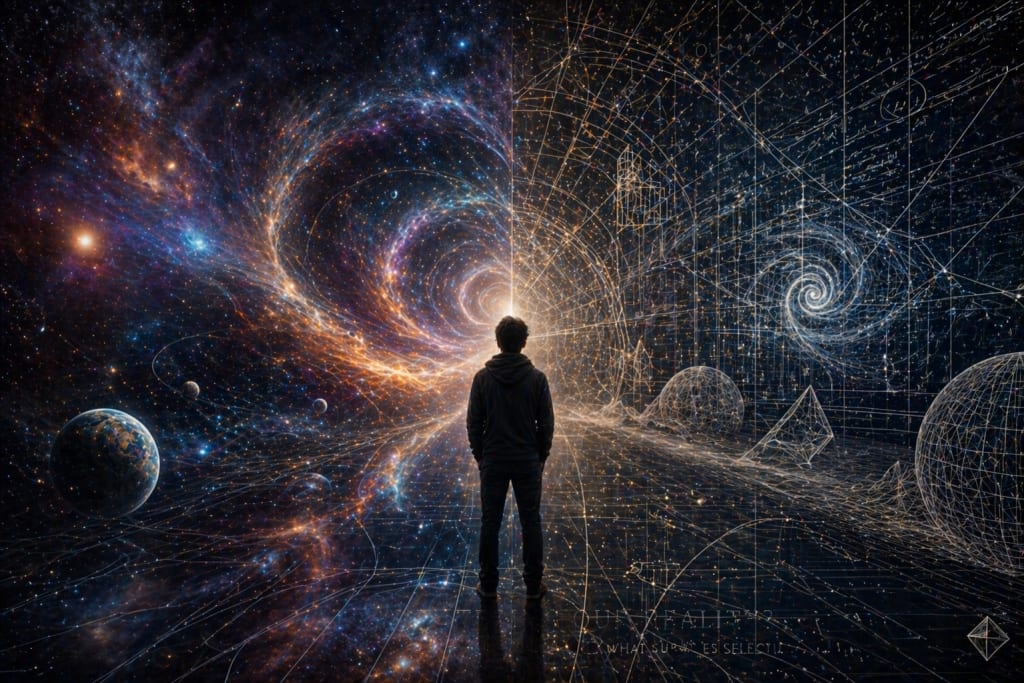
Is Mathematics the Universe or Its Map?
Few questions are as deceptively simple and as intellectually explosive as this one: Is mathematics a map of the universe, or is it reality itself?
At first glance, the answer seems obvious. Mathematics looks like a tool. We use it to measure distance, predict planetary motion, design bridges, train AI models, and calculate energy, probability, and risk. That makes it feel like a language of description, a kind of master blueprint humans developed to decode the world. In that sense, mathematics appears to be a map: powerful, abstract, and incredibly accurate, but still separate from the terrain it describes.
And yet, the deeper you go, the less stable that answer becomes.
Why should mathematics work so well at all? Why does a symbolic system invented or discovered in the human mind align with galaxies, gravity, atoms, light, and black holes? Why do abstract objects like complex numbers, tensors, group symmetries, and non-Euclidean geometries later turn out to describe physical reality with astonishing precision? Why does nature seem not merely compatible with mathematics, but in some uncanny sense structured by it?
This is where the debate becomes profound. Some thinkers argue that mathematics is simply our best model of reality, an elegant compression tool built by intelligent beings trying to navigate the universe. Others believe mathematics is more than description. They suspect that reality at its deepest level is mathematical, and that what we call matter, time, space, and law are expressions of a more fundamental mathematical order.
This is not just a philosophical game. It touches the foundations of physics, metaphysics, epistemology, logic, and even theology. It influences how we understand truth, objectivity, consciousness, and existence itself. If mathematics is only a map, then human beings are interpreters standing outside the pattern. If mathematics is reality itself, then we may be living inside a structure more abstract and more precise than ordinary intuition can grasp.
The question is not just what math does.
The question is what math is.
And once that question is opened, it changes everything.
Why This Question Matters More Than It Seems
To many people, the question sounds academic. Interesting, maybe, but remote from everyday life. In truth, it sits underneath almost every major scientific achievement of the modern world.
Physics depends on mathematical formulation.
Engineering depends on mathematical predictability.
Economics, cryptography, AI, statistics, medicine, telecommunications, logistics, and digital infrastructure all assume that reality is stable enough to be captured mathematically.
That assumption is stunning if you stop and look at it closely.
The universe is not obligated to be legible. Reality did not need to be expressible in equations. Yet over and over again, it is. Not perfectly, not completely, but far more deeply than common sense would predict.
This leads to two broad possibilities:
Mathematics as a Human Construct
In this view, mathematics is an invention. Humans create symbolic systems, definitions, rules, and structures to organize experience. Math works because we refine it to fit observed patterns.
Mathematics as a Discovered Structure
In this view, mathematics is not invented in any ultimate sense. It is discovered. Human beings uncover truths that already exist independently of us. Equations are not arbitrary tools but glimpses into the architecture of being.
The tension between these views has shaped centuries of thought.
The “Map” View: Mathematics as Description, Not Substance
Let us begin with the more intuitive idea: mathematics is a map.
A map is not the territory. It is a representation. A railway map does not contain trains. A weather model is not the sky. A coordinate system is not a mountain. In the same way, mathematics may be a highly compressed symbolic framework that helps finite minds model patterns in the world.
This view has several strengths.
It Matches Everyday Experience
Most people encounter math as a tool. We use numbers to count objects, algebra to solve practical problems, and geometry to measure space. Math feels like a human interface laid over the world.
It Explains Why Different Mathematical Systems Exist
There is not just one mathematics in practice. Humans have developed Euclidean and non-Euclidean geometries, classical and intuitionist logics, discrete and continuous models, different axiomatic systems, and multiple frameworks for probability and computation. That flexibility suggests mathematics may be a family of modeling instruments rather than one metaphysical substance.
It Avoids Overreach
The map view is philosophically cautious. It avoids the leap from “math describes reality well” to “reality is math.” Those are not automatically the same claim.
This caution matters. A perfect blueprint of a building is still not the building itself. The fact that mathematics predicts the motion of a planet does not necessarily prove that the planet is a mathematical object in the strongest ontological sense.
The Limits of the Map Analogy
Still, the map view starts to strain under pressure when we look at the history of science.
Again and again, mathematics developed in a seemingly abstract or “pure” way later turns out to be physically indispensable.
Consider a few famous examples:
- Non-Euclidean geometry looked like an abstract intellectual exercise before becoming essential to general relativity.
- Complex numbers seemed artificial before becoming central to electrical engineering and quantum mechanics.
- Group theory seemed highly abstract before becoming foundational in particle physics and symmetry analysis.
- Tensor calculus became indispensable in describing spacetime curvature.
- Hilbert spaces turned into the natural language of quantum states.
This creates a real puzzle. If mathematics is merely a human-made map, why do such abstract regions of the map later correspond to real terrain we had not yet explored?
That is one reason many thinkers have felt the map metaphor is incomplete.
The “Reality Itself” View: Mathematics as the Deep Structure of Existence
The opposing position is far more radical and far more seductive: mathematics is not just a description of reality. It is what reality is made of at the deepest level.
This idea comes in many forms, but the core intuition is simple. The universe behaves in regular, structured, law-like ways because it is fundamentally mathematical. Physical reality is not merely expressible in mathematics. It is an instantiation, manifestation, or embodiment of mathematical relations.
In this view:
- A particle is not fundamentally a tiny billiard ball
- Space is not merely a visual backdrop
- Time is not just a flowing river
- Matter is not the final layer of existence
Instead, what is fundamental may be structure, relation, symmetry, quantity, transformation, and information. These are mathematical in character.
Why This View Attracts Serious Thinkers
The strongest appeal of this idea is explanatory elegance. It makes sense of why mathematics fits the world so powerfully. If reality is mathematical at its core, then the success of mathematics is no miracle. It is exactly what we should expect.
This view also aligns with the trajectory of modern physics. As science progresses, the world often becomes less concrete to intuition and more structural in formulation.
At everyday scale, you see apples, stones, and rivers.
At deeper levels, physics gives you:
- fields
- tensors
- amplitudes
- operators
- symmetries
- manifolds
- probability distributions
- information structures
Reality begins to look less like a collection of “things” and more like a web of mathematically describable relations.
That shift is philosophically important.
Plato, Pythagoras, and the Ancient Origins of the Debate
This debate is not new. In many ways, it is ancient.
Pythagorean Thought
The Pythagoreans believed that number is the essence of all things. This was not just about arithmetic. It was a vision in which order, ratio, harmony, and mathematical form were woven into the fabric of existence.
Music offered one of their strongest examples. Harmonic intervals could be expressed through simple numerical ratios. That suggested that beauty, structure, and reality itself might rest on mathematical foundations.
Plato and the Realm of Forms
Plato pushed the discussion further. He distinguished between the changing sensory world and the eternal world of Forms. Mathematical objects, in many later interpretations of Plato, belong closer to that higher level of reality than ordinary physical things do.
A drawn circle is never perfect. A mathematical circle is exact.
A physical triangle is flawed. A geometric triangle is ideal.
This gave rise to mathematical Platonism, the view that mathematical truths exist independently of human minds. Under this approach, when mathematicians prove theorems, they are not inventing truths. They are discovering timeless structures.
That idea remains enormously influential.
Mathematical Platonism: Discovery, Not Invention
Mathematical Platonism is perhaps the strongest philosophical form of the “reality itself” view, though it does not always claim the physical universe is nothing but mathematics.
Its core claim is that mathematical objects and truths are real in a non-physical but objective sense.
For example:
- 2 + 2 = 4 was true before humans existed
- prime numbers do not depend on language
- the Pythagorean theorem is not a cultural preference
- logical consistency is not a social convention
This gives mathematics a strange status. It is not physical like a rock, but it is not subjective like a preference. It seems mind-independent, necessary, and discovered rather than invented.
The Power of This View
Platonism explains why mathematics feels universal. Different civilizations can discover the same theorem. Different minds can converge on the same proof. Mathematical truth appears stable across time and culture in a way that few other human domains do.
The Challenge
But Platonism has a famous problem: Where do these mathematical objects exist? Not in space. Not in time. Not in matter. So what kind of existence do they have?
That question has troubled philosophers for centuries.
Formalism, Logicism, and Structuralism
To understand the modern debate, we need to look at a few major philosophical alternatives.
Formalism
Formalism treats mathematics as manipulation of symbols according to rules. On this view, mathematics does not require independently existing abstract objects. It is a structured game of inference inside axiomatic systems.
This approach avoids metaphysical heaviness, but many critics feel it fails to explain why mathematics applies so well to the physical world.
Logicism
Logicism, associated with thinkers like Frege and Russell, aimed to ground mathematics in logic. The hope was that mathematics could be reduced to purely logical truths.
This was a grand project, though later developments complicated it significantly.
Structuralism
Structuralism offers a powerful middle ground. It suggests mathematics is fundamentally about structures and relations, not about individual abstract objects floating in some metaphysical heaven.
Under structuralism, what matters is the pattern, not the substance. The number 3 is what occupies a certain place in a structure. A group is defined by relational properties. A geometric system is identified by formal relations among elements.
This is attractive because modern physics also seems deeply structural. It may be that what is real is not “stuff” but the relations and patterns that organize stuff.
The Famous Puzzle: Why Is Mathematics So Unreasonably Effective?
One of the most important formulations of this mystery came from physicist Eugene Wigner, who spoke of the unreasonable effectiveness of mathematics in the natural sciences.
That phrase became iconic because it captured the shock many scientists feel.
Why should mathematics created in abstraction later describe empirical reality so precisely?
There are several possible answers.
1. Selection Bias
We notice the successes and ignore the failures. Humans build mathematical tools for useful domains, so of course those tools work where we apply them.
This explanation has some merit, but it feels incomplete. It does not fully explain why deeply abstract mathematics later maps reality unexpectedly well.
2. Human Cognition Is Shaped by the Universe
Because our minds evolved inside this universe, our conceptual systems may naturally mirror some of its regularities. Mathematics may fit reality because both shaped the conditions of our thought.
Interesting, but still partial.
3. Reality Is Deeply Mathematical
This is the bold answer. Mathematics works because it is not external to the world. It is the world’s inner grammar.
This answer is elegant, but it raises profound metaphysical commitments.
Physics and the Drift Toward Mathematical Ontology
Modern physics has repeatedly pushed reality away from naive common sense.
Classically, we imagine the world as made of objects with fixed properties moving in space and time. But advanced physics tells a more abstract story.
In Relativity
Gravity is not a force in the old Newtonian sense. It is the curvature of spacetime, describable through geometric structure.
In Quantum Mechanics
Particles are not always well-described as tiny objects with definite paths. They are bound up with wavefunctions, operators, probabilities, and abstract state spaces.
In Field Theory
What seems like matter may be better understood as excitations of underlying fields.
In Symmetry Physics
Fundamental interactions are often encoded through group symmetries and invariant mathematical relations.
This does not prove the universe is literally mathematics. But it does show that the more fundamental our theories become, the more structural and mathematical their ontology appears.
That matters.
Is Math Invented or Discovered?
This is one of the clearest entry points into the debate.
The Case for Invention
Humans choose notation, axioms, definitions, and systems. We build branches of mathematics with creative freedom. We decide what to formalize and what to emphasize.
In that sense, mathematics clearly contains invention.
The Case for Discovery
Once a system is defined, many consequences are not optional. They are discovered. You do not invent that there are infinitely many primes after setting up ordinary arithmetic. You prove it.
This suggests mathematics may involve both invention and discovery:
- We invent the formal doors
- We discover what lies behind them
That hybrid view is appealing because it preserves human creativity without reducing mathematics to arbitrary convention.
A Helpful Distinction: Mathematics as Language vs Mathematics as Ontology
A lot of confusion disappears if we separate two different claims.
Claim One: Mathematics Is the Best Language for Reality
This is relatively modest. It says mathematics is our most precise descriptive framework for expressing patterns in nature.
Claim Two: Reality Is Fundamentally Mathematical
This is much stronger. It says mathematical structure is not merely language but ontology, the actual being of the universe.
Someone can accept the first without accepting the second.
That distinction is critical.
You can believe math is the sharpest map ever created while still rejecting the idea that the map is the territory.
Case Study: A Circle in Thought and a Planet in Motion
Take a circle.
A mathematical circle is perfect. It has exact symmetry, zero thickness, and flawless relation between radius and circumference.
No physical circle is perfect. Every drawn circle is rough. Every orbit is perturbed. Every material object is approximate.
This seems to support the “map” view. Math gives us idealization; reality gives us imperfect physical embodiment.
But now consider planetary motion. The fact that celestial mechanics can be captured mathematically with such extraordinary power suggests that physical systems are not random messes. They lean toward mathematical intelligibility.
So which is it?
The strongest answer may be this: physical reality may not be identical to mathematical ideality, but it may be governed by or instantiated through mathematical structure. That is subtler than saying “the universe is literally an equation,” but stronger than saying math is just convenient notation.
The Case Against “Reality Is Math”
To be fair, the strongest objections matter.
Equations Need Interpretation
An equation on a page does nothing until it is connected to physical meaning. Symbols alone do not tell you what mass, charge, time, or energy are in lived reality.
Experience Is Not Obviously Mathematical
Pain, color, beauty, grief, desire, and consciousness do not seem reducible in any obvious way to equations. Even if their conditions are mathematically modelable, subjective experience resists easy formal capture.
Models Can Be Multiple
Different mathematical models can sometimes describe the same physical phenomena. That suggests mathematics may underdetermine ontology.
Abstract Existence Is Mysterious
If mathematics is reality itself, what exactly does that mean? Does a theorem “exist” in the same sense a star exists? Most people find that claim intuitively difficult.
These are serious objections. They prevent the debate from collapsing into easy certainty.
The Strongest Middle Position
A thoughtful middle position is increasingly attractive: mathematics is neither merely a human fiction nor the whole of reality in a simplistic sense.
Instead, mathematics may be:
- the deepest language of structure
- the framework through which relational reality becomes intelligible
- a discovery of mind-independent patterns
- a partial but profound access point to the architecture of the universe
This view avoids two extremes.
It avoids saying math is just a convenient game with symbols.
And it avoids saying everything meaningful about existence is exhausted by formal structure.
Under this approach, mathematics is more than a map but may not be the whole territory. It is the grammar of the territory, the logic of its form, the architecture through which the real becomes stable, describable, and predictive.
What This Means for 2026 and Beyond
As science advances into AI, quantum computing, cosmology, complexity science, and emergent systems, the question becomes even more urgent.
Future breakthroughs may depend on whether we think reality is fundamentally:
- particle-based
- field-based
- information-based
- relation-based
- mathematically structural
Already, frontier physics increasingly favors structural description over naive material pictures. At the same time, AI and computation are pushing us to think more deeply about abstraction, symbolic representation, and the relation between formal systems and lived reality.
The coming years may not settle the ancient question, but they will sharpen it.
And perhaps that is the real value of the debate. It forces us to face a stunning possibility: the world may be more abstract than our senses suggest and more intelligible than pure accident would allow.
Final Verdict
So, is mathematics a map of the universe or reality itself?
The most intellectually honest answer is this: mathematics is at least the deepest map we have ever found, and it may also be the structural backbone of reality itself.
It is probably too shallow to call mathematics merely a human invention. Its truths feel discovered, not fabricated. Its reach into physics is too deep, too strange, and too predictive to dismiss as convenient coincidence.
But it is also too quick to declare that equations alone exhaust reality. Lived experience, interpretation, embodiment, and existence itself may include dimensions not fully captured by formalism.
The best conclusion, then, is not that math is “just a map” or that “everything is nothing but math.” It is that mathematics appears to be the most direct window into the universe’s inner order. Whether that order is the whole of reality or the deepest visible layer of it remains one of the greatest open questions in human thought.
And that may be the real wonder.
We do not merely use mathematics to describe the cosmos.
We may be using it to glimpse what the cosmos is.
FAQ: People Also Ask
1. Is mathematics invented or discovered?
The strongest answer is: both. Humans invent symbols, notation, and formal systems, but once those systems are established, many truths within them are discovered rather than chosen.
2. Why does mathematics describe the universe so well?
This is one of the deepest puzzles in science and philosophy. Possible answers include human cognitive adaptation, selection bias, and the idea that reality itself is deeply mathematical in structure.
3. What does it mean to say reality is mathematical?
It means that the most fundamental layer of existence may consist not of material “stuff” in the ordinary sense, but of relations, symmetries, structures, and formal patterns that mathematics captures.
4. What is mathematical Platonism?
Mathematical Platonism is the view that mathematical truths and objects exist independently of human minds. Under this perspective, mathematicians discover eternal truths rather than invent them.
5. Is mathematics just a language?
It is certainly a language, but many argue it is more than that. It does not merely describe patterns; it may reveal objective structure built into reality itself.
6. Can reality exist without mathematics?
Reality may exist without humans doing mathematics, but the deeper question is whether reality could exist without mathematical structure. Many philosophers and physicists think the answer is no.
7. Does physics prove the universe is mathematics?
No. Physics strongly shows that mathematics is extraordinarily effective in describing reality, but it does not decisively prove that reality is identical to mathematics.
8. Are numbers real?
That depends on your philosophy. Platonists say yes, numbers are real in an abstract, mind-independent sense. Nominalists say no, numbers are useful fictions or linguistic tools.
9. How is this relevant to science in 2026?
It shapes how researchers think about quantum theory, spacetime, AI, information, emergence, and the possibility that structure or information is more fundamental than matter.
10. What is the simplest way to understand this debate?
Think of it this way: a map describes a landscape, but sometimes a map is so precise and so deeply aligned with the land that you begin to wonder whether the land itself is built from the same logic as the map.