The Cornfield Bomber: The Jet That Landed Itself
Some aviation stories sound exaggerated because they are. Others sound impossible because reality occasionally develops a sense of humor.
The story of the Cornfield Bomber belongs to the second group.
In 1970, a U.S. Air Force Convair F-106A Delta Dart entered a dangerous flat spin during a training mission over Montana. Its pilot, 1st Lt. Gary Foust, tried to recover. The aircraft would not respond. With altitude running out and the jet apparently doomed, Foust did what pilots are trained to do when an aircraft becomes unrecoverable.
He ejected.
That should have been the end of the airplane.
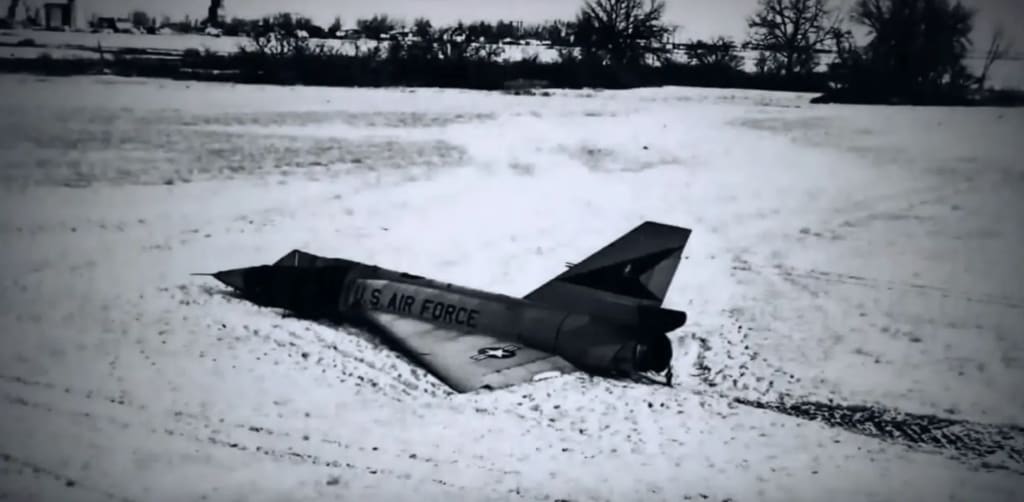
Instead, the F-106 did something extraordinary. Freed of its pilot and changed by the force and weight shift of the ejection, the jet recovered from the spin, stabilized itself, descended in a controlled glide, and made a gentle belly landing in a snowy farmer’s field near Big Sandy, Montana. It came to rest largely intact. Even more unbelievably, its engine was still running.
The locals called it the Cornfield Bomber, though it was not a bomber and the field was snow-covered. The nickname stuck because the image was too perfect: a pilotless Cold War interceptor sitting in rural Montana as if it had simply decided to land there.
And the story did not end in that field. After minor repairs, the aircraft returned to service and eventually became a museum exhibit, preserved as one of the strangest survivors in U.S. Air Force history.
What Was the Cornfield Bomber?
The Cornfield Bomber was a Convair F-106A Delta Dart, serial number 58-0787. The F-106 was an all-weather interceptor developed from the earlier F-102 Delta Dagger. It was designed to defend North American airspace during the Cold War, when the United States feared Soviet bomber attacks. The National Museum of the United States Air Force notes that the F-106 had a more powerful engine than the F-102 and used the Hughes MA-1 electronic guidance and fire-control system.
This was not a slow or forgiving training aircraft. It was a supersonic interceptor built for speed, altitude, and rapid response. Its technical notes list a maximum speed of 1,525 mph, a ceiling of 53,000 feet, and armament that could include one AIR-2A Genie nuclear air-to-air missile plus four AIM-4 Falcon missiles.
In other words, this was a serious Cold War machine.
That makes the Cornfield Bomber story even stranger. A high-performance jet interceptor, built for nuclear-age air defense, ended up landing itself like a tired farm animal settling into the snow.
The Training Mission That Went Wrong
On February 2, 1970, Foust was flying from Malmstrom Air Force Base in Montana during a training mission. The aircraft suddenly entered what the Air Force museum describes as an uncontrollable flat spin, forcing the pilot to eject.
A flat spin is one of the most dangerous situations a fighter pilot can face. In a normal spin, an aircraft rotates while descending, but the nose may remain low enough for recovery techniques to work. In a flat spin, the aircraft can rotate almost like a falling disk, with airflow over the control surfaces disrupted so badly that normal inputs become ineffective.
For the pilot, the situation becomes a race against altitude.
Foust followed recovery procedures, but the aircraft did not recover. Business Insider, summarizing Foust’s later museum interview, quotes him explaining that the jet remained in the spin while he went through emergency procedures, and it “did not recover.”
At that point, staying with the aircraft would not have been bravery. It would have been suicide.
So Foust ejected.
The Impossible Recovery
The mystery begins after the pilot leaves.
According to the National Museum of the U.S. Air Force, once the F-106 was unpiloted, it recovered on its own, apparently because of the balance and configuration changes caused by the ejection. It then made a gentle belly landing in a snow-covered field near Big Sandy.
That explanation is not magic. It is aerodynamics.
When Foust ejected, several things changed almost instantly:
- The aircraft lost the pilot’s weight.
- The center of gravity shifted.
- The ejection sequence disturbed the aircraft’s attitude.
- The nose was pushed down enough to help break the flat-spin condition.
- The jet had been trimmed in a configuration that helped it settle into a stable glide.
HistoryNet’s aviation account adds that the aircraft had been trimmed toward a wings-level, reduced-power glide state, and after ejection it recovered to straight-and-level flight. One of the other pilots reportedly radioed the now-parachuting Foust with the unforgettable line: “Gary, you’d better get back in it.”
That sentence captures the absurdity of the moment. The pilot had just escaped what seemed to be a doomed fighter. Then the fighter appeared to be flying better without him.
Key Takeaway: The F-106 did not “think” or intentionally land itself. Its recovery was a rare combination of aircraft design, trim setting, weight shift, ejection forces, reduced power, altitude, and luck.
The Landing Near Big Sandy
After recovering from the spin, the F-106 descended toward rural Montana.
Instead of crashing nose-first or exploding into wreckage, it approached the snowy ground in a surprisingly stable attitude. Business Insider notes that Foust later described about six inches of snow on the ground and said the aircraft skidded a couple hundred yards or more before stopping.
The landing was a belly landing, meaning the aircraft came down without landing gear extended. Normally, that would still cause severe damage. But snow helped reduce friction and absorb some of the impact. The aircraft slid across the field rather than breaking apart.
The jet suffered relatively little damage—mainly underside skin damage—astonishing everyone who expected a crash site.
Then came the next strange detail: the engine was still running.
Local authorities arrived and contacted the air base. According to HistoryNet, the sheriff was instructed on how to shut the aircraft down, but the jet began sliding again after its hot engine melted snow underneath it. The sheriff wisely backed away and waited for the aircraft to run out of fuel. It eventually moved hundreds of feet on its belly before the engine finally stopped.
It is hard to imagine a more surreal scene: a pilotless supersonic interceptor, sitting in a farmer’s field, still alive enough to move.
Why the Damage Was So Minor
The Cornfield Bomber survived because several unlikely factors worked together.
First, the F-106 recovered from the spin into a relatively stable descent. If it had remained in a flat spin, it likely would have struck the ground violently.
Second, the aircraft was at reduced power. That mattered because it was not diving into the ground under full thrust.
Third, the snow-covered field acted like a natural cushion and slide surface. A hard runway or rocky terrain might have produced much worse damage.
Fourth, the aircraft’s belly landing spread the impact over a larger surface area, instead of concentrating it through landing gear collapse or nose-first impact.
Finally, luck played a role. Aviation people are usually careful with the word “miracle,” but this was one of those moments when engineering and luck became difficult to separate.
Pro Tip for Readers: The Cornfield Bomber is often described as “mysterious,” but the real wonder is not that physics stopped working. It is that physics worked in the aircraft’s favor at exactly the right moment.
The Jet’s Second Life
After the landing, recovery crews removed the aircraft from the field. HistoryNet reports that the wings were removed and the jet was transported by rail. The aircraft later received repairs and upgrades before returning to service with the 49th Fighter-Interceptor Squadron, the final Air Force unit to operate the F-106.
The National Museum of the U.S. Air Force gives the clean official summary: after minor repairs, the aircraft was returned to service. It last served with the 49th Fighter Interceptor Squadron before being brought to the museum in August 1986.
This is where the popular version sometimes gets slightly confused. The aircraft did not sit for sixteen years and then return to service. It returned to service after repair. The sixteen-year mark matters because the accident happened in 1970 and the jet arrived at the museum in 1986.
Still, the broader point remains incredible. A fighter that should have been destroyed not only survived, but flew again.
Why the Cornfield Bomber Still Fascinates Aviators
The Cornfield Bomber fascinates people because it sits at the boundary between explanation and astonishment.
Aviation experts can explain the likely mechanics: spin recovery after weight shift, trim setting, altered center of gravity, stable descent, low power, snow-covered field, and lucky terrain. But even after the explanation, the story still feels improbable.
That is because aircraft accidents usually punish small mistakes. A few degrees, a few seconds, a few feet of altitude can decide survival or disaster. In this case, a chain of dangerous events produced the opposite outcome. The pilot survived. The airplane survived. The field survived. Even the legend survived.
The story also challenges a basic assumption: aircraft need pilots to land. Usually, of course, they do. But under rare conditions, a properly trimmed aircraft can continue flying after the pilot leaves. The F-106 did not perform a planned landing. It simply settled into a stable enough flight path to meet the ground gently.
That distinction matters.
The Cornfield Bomber was not autonomous in the modern sense. It was not guided by artificial intelligence. It did not choose a landing zone. It was not “smart.”
It was accidentally stable.
And sometimes, accidentally stable is enough.
The Role of the F-106’s Design
The F-106 was not an ordinary aircraft. The National Museum of the U.S. Air Force notes that after takeoff, the Hughes MA-1 electronic guidance and fire-control system could be given control of the aircraft to fly it to altitude and attack position, fire missiles, break off the attack run, and return the aircraft near base, after which the pilot would land manually.
That does not mean the MA-1 system “landed” the Cornfield Bomber. The museum’s explanation for the 1970 event specifically points to balance and configuration changes after ejection, not an automatic landing system.
But the aircraft’s overall design does help explain why it could settle into stable flight. Interceptors like the F-106 were engineered for high-speed performance, guided intercept profiles, and controlled flight regimes. When the spin broke and the aircraft found a trimmed attitude, it had enough aerodynamic stability to continue descending rather than tumbling.
The strangest part is not that an aircraft can glide. Many aircraft can. The strangest part is that this particular aircraft recovered from a dangerous spin after the pilot gave up on it.
Myth Versus Mechanics
The Cornfield Bomber story is often told like a ghost story: the jet “decided” to land itself.
That version is fun, but the better version is more impressive. The real story shows how complex machines can behave in ways even trained operators do not expect.
The aircraft was not alive. But it was full of design features, aerodynamic tendencies, trim settings, fuel weight, engine thrust, and structural balance. When the pilot ejected, those variables changed. The old unstable condition disappeared, and a new stable condition emerged.
That is the heart of the story.
The F-106 did not defy physics.
It obeyed physics so perfectly that it looked like a miracle.
Key Takeaway: The Cornfield Bomber is not a story about a haunted jet. It is a story about how aircraft behavior can change dramatically when weight, trim, airflow, and attitude shift at the same time.
What This Story Teaches About Aviation
The Cornfield Bomber teaches several lessons.
First, it shows why pilots train for emergencies even when the outcome seems hopeless. Foust followed procedures, tried to recover, and ejected only when necessary. His survival was not luck alone; it was training.
Second, it shows that aircraft accidents are systems events. A single cause rarely explains everything. The spin, recovery attempts, trim state, ejection, weight shift, snowfield, engine setting, and terrain all shaped the outcome.
Third, it reminds us that “unrecoverable” sometimes means unrecoverable under the conditions available to the pilot—not necessarily impossible under every changed condition.
Fourth, it proves that history loves irony. The pilot left the airplane because it would not recover. Then, once he left, it recovered.
That irony is why the story still circulates more than fifty years later.
Conclusion
The Cornfield Bomber remains one of the most unbelievable true stories in aviation history.
On February 2, 1970, an F-106A Delta Dart entered a flat spin over Montana. Its pilot, 1st Lt. Gary Foust, fought to recover the jet but eventually had to eject. By every normal expectation, the aircraft should have crashed.
Instead, it recovered by itself.
Changed by the ejection, trimmed into a stable attitude, and helped by a snowy Montana field, the pilotless interceptor descended, belly-landed, skidded across the snow, and came to rest largely intact. Its engine was still running. Its pilot survived. And after repairs, the jet returned to service before eventually taking its place in the National Museum of the United States Air Force.
The story feels impossible because it reverses the usual logic of aviation emergencies. The pilot escapes; the aircraft dies. But in this case, the pilot escaped—and the aircraft kept going.
The Cornfield Bomber did not truly “choose” to land.
But for one strange afternoon in Montana, it seemed as if a Cold War fighter decided it was not ready to become wreckage.
Frequently Asked Questions
What was the Cornfield Bomber?
The Cornfield Bomber was a Convair F-106A Delta Dart, serial number 58-0787, that landed itself in a snowy Montana field after its pilot ejected during a training mission in 1970.
When did the Cornfield Bomber incident happen?
The incident happened on February 2, 1970, during a training mission from Malmstrom Air Force Base in Montana.
Who was the pilot of the Cornfield Bomber?
The pilot was 1st Lt. Gary Foust. He ejected after the aircraft entered a flat spin and failed to recover during emergency procedures.
Why did the pilot eject?
Foust ejected because the F-106 entered an uncontrollable flat spin. After attempting recovery procedures without success, he left the aircraft to save his life.
How did the F-106 land itself?
After the ejection, the aircraft’s balance and configuration changed. The shift helped it recover from the flat spin, stabilize, and descend into a gentle belly landing in a snow-covered field.
Did the engine keep running after landing?
Yes. Reports describe the jet’s engine still running after it landed. Local authorities were advised to wait until the aircraft ran out of fuel rather than risk approaching the moving aircraft.
Where did the Cornfield Bomber land?
It landed in a snow-covered farmer’s field near Big Sandy, Montana.
Was the Cornfield Bomber badly damaged?
No. The aircraft suffered surprisingly minor damage, mostly to its underside from the belly landing. It was repaired and returned to service.
Did it really return to service sixteen years later?
Not exactly. It returned to service after repairs. Sixteen years after the 1970 incident, in August 1986, it was brought to the National Museum of the United States Air Force.
Where is the Cornfield Bomber now?
The Cornfield Bomber is on display at the National Museum of the United States Air Force in Dayton, Ohio.