Blue Sea Dragon: The Tiny Sea Slug That Steals the Portuguese Man o’ War’s Sting
It looks like something imagined for a fantasy movie.
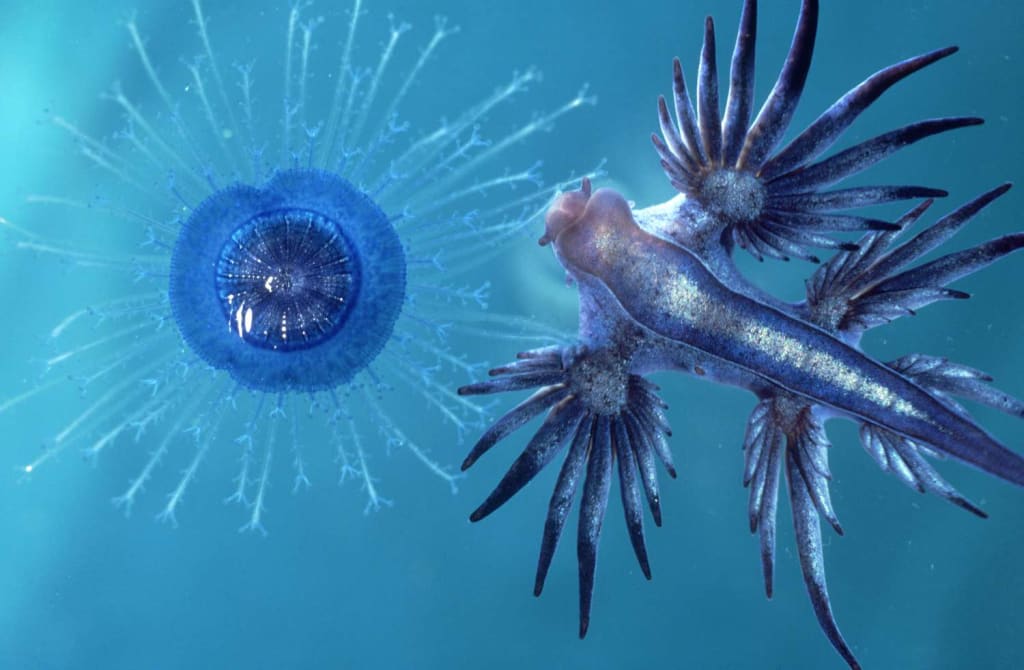
A tiny creature barely a few centimeters long drifts across the ocean surface with six wing-like clusters spreading from its metallic-blue body. From above, it resembles a miniature dragon suspended in water.
Its delicate appearance suggests something harmless.
That assumption would be a mistake.
The blue sea dragon, scientifically known as Glaucus atlanticus, is a small shell-less sea slug with one of the strangest defensive strategies in the animal kingdom.
It hunts venomous floating animals—including the notorious Portuguese man o’ war—eats their tissues, preserves some of their unfired stinging capsules, transports those microscopic weapons through its own body, and stores them in the tips of its finger-like appendages.
Later, when threatened, the slug can use those stolen stinging cells for its own defense.
In other words, the blue dragon does not merely survive eating an animal capable of delivering a painful sting.
It steals its prey’s weapons.
The Australian Museum confirms that nematocysts—the microscopic stinging capsules from prey such as Physalia—can pass through the blue sea slug intact and later be used defensively.
Its blue-and-silver coloration is equally remarkable. Because the animal normally floats upside down, the bright blue side of its body faces the sky and helps disguise it against the ocean when viewed from above. Its silvery side faces downward and blends with the bright surface light when predators look upward from beneath the water.
And yes, there is some scientific basis behind the widely repeated claim that a blue dragon's defensive sting can be exceptionally potent.
Because it can concentrate stolen nematocysts in specialized structures at the ends of its appendages, credible scientific and government sources note that its sting may be more powerful than that of the individual prey from which the stinging cells originated.
That does not mean every blue dragon sting is automatically worse than every Portuguese man o’ war encounter.
But it certainly means one thing:
Do not pick one up.
What Is a Blue Sea Dragon?
The blue sea dragon is a species of marine gastropod.
That means it belongs to the enormous mollusk group containing:
- Snails
- Slugs
- Limpets
- Conchs
- Whelks
- Sea hares
- Nudibranchs
More specifically, Glaucus atlanticus is a nudibranch, a group of soft-bodied marine gastropods that lose their shells during development.
It belongs to the family Glaucidae.
The U.S. Bureau of Ocean Energy Management identifies the blue dragon as a gastropod living at the surface of the open ocean and distributed through tropical and temperate waters of the Atlantic, Pacific, and Indian oceans.
It is known by many common names, including:
- Blue dragon
- Blue sea dragon
- Blue glaucus
- Blue angel
- Sea swallow
- Blue sea slug
- Dragon slug
Its scientific name, Glaucus atlanticus, was formally associated with the species in the eighteenth century.
Despite its dramatic appearance, it is usually only around 2.5 to 3 centimeters long—roughly an inch.
That means photographs often make it look much larger than it really is.
A blue dragon sitting in someone's palm can appear enormous in a close-up image.
In reality, the creature may be shorter than the final joint of a person's thumb.
 Imrul
Imrul
It Does Not Swim Like an Ordinary Sea Slug
Most people imagine sea slugs crawling across rocks, coral reefs, or the seafloor.
The blue dragon lives a completely different lifestyle.
It is pelagic, meaning it spends its life in open water rather than crawling around on the bottom.
More specifically, it belongs to a surface-drifting community of organisms sometimes called the neuston.
The blue dragon swallows air and maintains a gas bubble in its stomach, which provides buoyancy.
This allows it to remain against the ocean surface.
Wind, waves, and currents then carry it across the sea.
It therefore has relatively little control over where it ultimately travels.
The ocean itself becomes its transportation system.
The Blue Dragon Lives Upside Down
One of the strangest facts about Glaucus atlanticus is its orientation.
It normally floats belly-up.
What looks like the animal's back in many photographs is actually the side facing downward beneath the ocean surface.
Its blue underside faces upward toward the sky.
This inversion is essential to understanding its coloration.
The animal's appearance is designed around the fact that it spends its life upside down.
 Imrul
Imrul
Why Is the Blue Sea Dragon Blue?
Its spectacular coloration serves as camouflage.
This is an example of countershading, but with an unusual twist.
Because the animal floats upside down:
Viewed From Above
The blue portion faces upward.
Against the blue ocean surface, the slug becomes harder for birds or other predators above the water to distinguish.
Viewed From Below
The silvery-gray side points downward.
From beneath, that pale coloration blends with sunlight reflecting through the ocean surface.
Both BOEM and Oceana describe this two-direction camouflage system.
The animal therefore uses the same basic optical principle employed by many marine creatures:
look darker from above,
look lighter from below.
But the blue dragon achieves the effect while floating inverted.
Is the Blue Color a Warning?
Possibly in part, but its primary role is commonly described as camouflage.
Bright blue in nature can sometimes signal toxicity or danger, a strategy known as aposematism.
Yet for a surface-floating animal, blue is also an exceptionally effective background color.
The blue dragon's appearance therefore combines something almost paradoxical:
It is visually spectacular when humans hold it against sand or skin.
In its natural environment, those same colors help it disappear.
This is an important reminder that animal coloration must be interpreted from the perspective of the animal's actual habitat.
A creature that looks impossibly bright in your hand may be remarkably difficult to detect in the ocean.
Those “Wings” Are Not Wings
The dragon-like structures projecting from its body are called cerata.
They occur in groups along the body and give Glaucus atlanticus its unmistakable shape.
They are not used for flight.
And they are not simply decorative.
The digestive system extends into these appendages, and specialized structures at their tips can store stolen stinging capsules obtained from prey.
Smithsonian describes nudibranchs such as blue dragons moving intact nematocysts through branches of their digestive system toward specialized sacs in their cerata.
This means the most visually beautiful part of the animal is also where some of its most dangerous defensive equipment is concentrated.
What Does a Blue Sea Dragon Eat?
The blue dragon is a predator.
Its diet includes floating cnidarians and related surface organisms.
Most famously, it eats the Portuguese man o’ war.
Other potential prey includes surface-drifting organisms such as:
- Blue buttons
- By-the-wind sailors
- Other hydrozoans
- Related pelagic organisms
Australian Museum material notes its strong association with Physalia species and its habit of feeding on bluebottle tentacles.
The relationship between the tiny slug and the much larger man o’ war is extraordinary.
A Portuguese man o’ war may trail tentacles for many meters through the water.
The blue dragon may be only a few centimeters long.
Yet the slug actively consumes it.
The Portuguese Man o’ War Is Not Actually a Jellyfish
This is worth correcting because the two terms are often used interchangeably.
A Portuguese man o’ war looks like a jellyfish.
But biologically, it is a siphonophore.
Rather than being one individual animal in the ordinary sense, it is a colony composed of specialized units called zooids that function together.
Some are involved in floating.
Others handle feeding.
Others capture prey.
Others reproduce.
Its long tentacles carry enormous numbers of microscopic stinging structures capable of immobilizing fish and causing painful injuries in humans.
And somehow, the blue dragon eats them.
How Does It Eat Something So Dangerous?
The blue dragon has evolved remarkable resistance to the defensive equipment of its prey.
It can attack and consume Portuguese man o’ war tissue while avoiding or tolerating many of the stings that would incapacitate other predators.
But the truly remarkable part happens after ingestion.
The blue dragon does not simply digest every stinging capsule.
Some remain unfired and intact.
Those capsules are selectively transported through the digestive system and into specialized storage structures.
This biological theft has a name:
kleptocnidy.
The prefix “klepto” means stealing.
The animal is literally stealing cnidarian stinging machinery.
What Exactly Is a Nematocyst?
A nematocyst is a microscopic biological weapon.
Cnidarians such as jellyfish, sea anemones, corals, and Portuguese man o’ war possess specialized cells called cnidocytes.
Inside those cells are capsules containing tightly coiled, harpoon-like threads.
When triggered by mechanical or chemical signals, the thread can discharge extraordinarily quickly.
It penetrates or entangles the target while delivering venom.
Smithsonian describes nematocyst firing as an extremely rapid process in which the venom-bearing structure shoots from the cell to attack prey or defend the animal.
The Portuguese man o’ war possesses huge numbers of these structures along its tentacles.
The blue dragon eats them.
Somehow, instead of destroying all of them, it keeps selected unfired capsules usable.
The Blue Dragon Turns Its Prey’s Weapon Against the World
After surviving ingestion, nematocysts travel into the slug's cerata.
At the tips are specialized sacs known as cnidosacs.
There the stolen capsules can remain available for later defensive use.
When a predator threatens the slug, the nematocysts can be deployed.
This is remarkable because the weapon was not genetically manufactured by the blue dragon itself.
The slug constructs the storage system.
Its prey supplies the ammunition.
This phenomenon occurs in various nudibranchs, but the blue dragon is one of its most visually spectacular examples.
Can Its Sting Really Be Stronger Than a Portuguese Man o’ War?
This widely repeated claim requires a little nuance.
Smithsonian has reported that because blue dragons can concentrate nematocysts in their cerata, their sting can be more powerful than that of the much larger animals from which the cells were taken.
BOEM similarly states that the stolen stinging cells are stored in a more concentrated arrangement, increasing the potency of the slug's defense.
So the claim is not simply an internet invention.
However, “stronger” should not be interpreted as a universal medical rule.
The severity of any sting depends on many factors:
- How many nematocysts fire
- What prey species supplied them
- Where the person is stung
- How long contact lasts
- Individual sensitivity
- The size of the slug
- The quantity and type of stored capsules
A direct encounter with long Portuguese man o’ war tentacles can expose someone to an enormous number of stinging cells.
A blue dragon carries a much smaller total quantity.
Its defensive structures may be concentrated, but overall exposure still depends on the circumstances.
So the most accurate statement is:
Blue dragons can concentrate stolen nematocysts and may deliver an exceptionally painful or potent localized sting, potentially stronger per contact area than expected from such a tiny animal.
Can a Blue Dragon Sting a Human?
Yes.
Humans should not handle them.
The sting can be painful, and authorities warn beachgoers to leave the animals alone.
BOEM specifically cautions that even stranded blue dragons can sting and recommends avoiding contact.
This is particularly important because their beautiful appearance creates exactly the wrong instinct.
People see a tiny, delicate blue creature washed onto sand and want to pick it up for photographs.
That is precisely what not to do.
Can a Dead Blue Dragon Still Sting?
Potentially, yes.
The danger comes from functional nematocysts rather than a conscious decision by the slug to attack.
Cnidarian stinging cells can remain capable of firing after the animal carrying them has died.
Portuguese man o’ war tentacles are well known for retaining their ability to sting after stranding.
Because blue dragons store intact nematocysts, a stranded or apparently dead specimen should also be treated cautiously.
BOEM explicitly warns that contact with a dead blue dragon may still result in a sting.
Does the Blue Dragon Produce Its Own Venom?
Not in the way most people imagine.
Its famous defensive sting depends largely on stolen nematocysts obtained from its prey.
The slug has evolved the biological machinery to:
- Eat stinging prey.
- Avoid destroying selected nematocysts.
- Transport them.
- Store them.
- Redeploy them.
So saying the blue dragon is “venomous” can be useful conversationally, but the more fascinating explanation is that it practices biological weapons recycling.
It steals an already manufactured delivery system.
How Does It Avoid Stinging Itself?
This is one of the most intriguing aspects of kleptocnidy.
A nematocyst must remain unfired during ingestion, transport, and storage.
Nudibranchs possess adaptations that reduce activation and allow selected capsules to survive movement through the digestive tract.
The exact mechanisms differ among species and remain the subject of biological research.
Mucus, digestive conditions, selective transport, and cellular processes are thought to contribute.
What is clear is that the animal has evolved a way to handle defensive structures designed to fire explosively when disturbed.
It is the biological equivalent of swallowing loaded microscopic harpoons and safely moving them into an ammunition compartment.
How Big Is a Blue Dragon?
Usually very small.
Oceana describes Glaucus atlanticus as roughly 2.5 centimeters, or about one inch, long.
BOEM gives an approximate size of 3 centimeters, or 1.2 inches.
Individual size varies.
Its tiny dimensions are important because online macro photography creates a misleading impression.
Magnified against a hand or beach, the elaborate appendages make it look like a substantial animal.
Put it beside a coin and its scale becomes obvious.
This predator of Portuguese man o’ war can be smaller than the coin itself.
Where Do Blue Sea Dragons Live?
They are associated with tropical, subtropical, and some temperate oceans.
Oceana records them across the:
- Atlantic Ocean
- Pacific Ocean
- Indian Ocean
They have been documented around regions including:
- Australia
- South Africa
- Mozambique
- Parts of the Americas
- Gulf coastal waters
- Various oceanic islands and warm-current zones
They do not maintain a territory in the way a reef fish might.
Their distribution is heavily influenced by:
- Ocean currents
- Wind
- Surface-water conditions
- Availability of prey
Where Portuguese man o’ war and other surface drifters move, blue dragons may follow.
Why Do Blue Dragons Suddenly Appear on Beaches?
They normally live offshore at the ocean surface.
But they are weak swimmers compared with the forces moving them.
Strong winds and currents can push entire communities of surface-drifting animals toward shore.
This may include:
- Blue dragons
- Portuguese man o’ war
- Blue buttons
- By-the-wind sailors
- Purple sea snails
When conditions concentrate large numbers together, blue dragons may wash onto beaches in groups sometimes described informally as blue fleets.
BOEM notes that groups of blue dragons can be transported ashore by wind and tide.
This is why beach sightings can suddenly appear in clusters rather than as isolated animals.
Blue Dragons Have Appeared on Texas Beaches
The Gulf Coast has produced notable blue dragon strandings.
Recent sightings have led marine experts to remind beachgoers not to touch them.
Such appearances are particularly striking because people may encounter several blue-colored surface species at once when winds push the floating community ashore.
The presence of blue dragons can also indicate that Portuguese man o’ war or other stinging organisms are nearby.
So finding one beautiful blue slug can be a clue that the surrounding beach deserves extra caution.
Are Blue Dragons Becoming More Common?
This is difficult to answer confidently.
A rise in reports does not necessarily mean a rise in population.
More sightings can result from:
- Social media
- Better public awareness
- Smartphone photography
- More beach monitoring
- Unusual currents
- Seasonal wind patterns
- Changes in prey abundance
- Ocean warming
BOEM notes changes in reported distribution and discusses warmer waters and changing currents as possible influences.
However, attributing individual beach appearances directly to climate change requires caution.
Marine distributions naturally vary, and long-term datasets are needed to distinguish persistent range shifts from temporary events.
Is Glaucus atlanticus Found Everywhere?
It has a remarkably broad oceanic range, but genetic research suggests that populations separated by major geographic barriers may not mix freely.
Oceana cites research showing genetic structure between populations across Afro-Eurasian and American regions.
That makes this tiny ocean drifter scientifically interesting beyond its appearance.
It spends its life carried by global currents, yet continents and oceanographic boundaries can still influence how populations connect genetically.
Is Every “Blue Dragon” the Same Species?
No.
This is another common source of confusion.
Several closely related blue floating nudibranchs can look similar.
The genus Glaucus includes species that may be difficult for non-specialists to distinguish.
For example, Glaucus marginatus can also be called a blue dragon and resembles Glaucus atlanticus.
So not every tiny blue slug photographed on a beach should automatically be identified as G. atlanticus based on color alone.
Accurate identification may require examining:
- Body proportions
- Cerata arrangement
- Size
- Anatomy
- Geographic context
This matters when interpreting social-media reports.
“Blue dragon” is a common name, not a guarantee of exact species identification.
What Are Cerata?
The blue dragon's most recognizable structures are its cerata.
They look like:
- Fingers
- Feathers
- Wings
- Spikes
They are arranged in branching groups along the body.
Their functions include aspects of:
- Digestion
- Defense
- Surface-area management
Most famously, the ends of the cerata can contain cnidosacs holding stolen nematocysts.
That means the dragon-like silhouette is not just visually dramatic.
Its shape reflects the animal's internal biology.
Does the Blue Dragon Have a Shell?
No visible adult shell.
Like other nudibranchs, it is a shell-less marine gastropod.
Its ancestors belong to the same broad evolutionary lineage as snails.
But the protective hard shell associated with many gastropods has been lost.
That raises an evolutionary problem:
How does a soft-bodied animal defend itself?
Nudibranchs evolved many solutions.
Some use:
- Toxic chemicals
- Warning colors
- Camouflage
- Mimicry
- Stolen cnidarian stinging cells
The blue dragon's solution is among the most spectacular.
Instead of carrying armor, it carries stolen ammunition.
What Does the Blue Dragon’s Mouth Look Like?
Despite its elegant appearance, it is a carnivore equipped to feed on other animals.
Its feeding apparatus includes a radula, a ribbon-like structure lined with tiny teeth common to many mollusks.
The teeth help scrape, tear, or process prey.
BOEM describes the animal feeding on venomous prey using sharp, serrated teeth.
So beneath the miniature dragon appearance is the feeding machinery of an efficient predator.
Can a Tiny Blue Dragon Kill a Portuguese Man o’ War?
The interaction is not always a dramatic one-on-one battle.
Blue dragons may feed on tentacles and tissues, sometimes consuming portions rather than instantly destroying an entire colony.
Their small size means they can exploit parts of much larger prey.
This makes the ecological relationship even more interesting.
The dragon does not need to overpower its prey through brute force.
It has evolved the ability to approach something most predators avoid and turn its defenses into food.
Do Blue Dragons Eat Each Other?
Cannibalistic behavior has been reported among blue dragons and related pelagic nudibranchs, particularly when food conditions bring animals into close proximity.
This should not be surprising.
They are carnivorous sea slugs living in an environment where suitable food can be unpredictable.
Still, the species is much more strongly associated with feeding on surface-drifting cnidarians such as Portuguese man o’ war.
The charming appearance therefore hides a very capable predator.
How Do Blue Dragons Reproduce?
Blue dragons are simultaneous hermaphrodites.
Each individual possesses both male and female reproductive organs.
However, that does not mean they simply reproduce alone.
They normally mate with another individual.
BOEM notes that two blue dragons must interact to achieve fertilization and that both can subsequently lay eggs.
Having both reproductive systems can be advantageous for animals drifting unpredictably through the open ocean.
When encounters with another member of the species are rare, almost any mature individual encountered may potentially be a reproductive partner.
Mating Is Particularly Complicated When Both Partners Are Armed
Imagine the problem.
Two tiny animals approach one another.
Both are covered in cerata containing stolen stinging capsules.
They must position their bodies closely enough to reproduce without triggering harmful contact.
Evolution has produced anatomical and behavioral adaptations that make this possible.
The process is another reminder that the nematocysts are not theoretical weapons.
The animals themselves have to live around them.
Where Do They Lay Their Eggs?
Blue dragons live at the ocean surface, so they do not simply crawl onto a reef to attach eggs.
Egg strings may be associated with floating material.
BOEM reports that eggs can be deposited on floating debris or even material associated with prey remains.
This keeps developing offspring within the same drifting surface ecosystem occupied by adults.
What Is the “Blue Fleet”?
When multiple blue dragons accumulate together at the surface, the group is sometimes called a blue fleet.
The term is wonderfully appropriate.
A collection of tiny blue predators floats across the sea under the influence of currents and wind.
But the same physical forces that create such gatherings can push them onto beaches.
For beachgoers, a blue fleet should be admired visually rather than handled.
What Else Lives in Their Floating World?
Blue dragons are part of a fascinating surface-ocean community.
Among their neighbors may be:
- Portuguese man o’ war
- Blue buttons
- By-the-wind sailors
- Violet sea snails
- Other pelagic nudibranchs
Many share blue, violet, or silver coloration.
That is not coincidence.
They occupy the same optical environment at the boundary between air and ocean.
Collectively, these animals create one of the strangest ecosystems on Earth: a community living on what is essentially the ocean's skin.
The Ocean Surface Is an Ecosystem of Its Own
To humans, the water surface looks like a boundary.
To the blue dragon, it is a habitat.
Surface tension forms a physical interface with properties different from the water below.
Light behaves differently there.
Wind directly moves organisms.
Floating prey accumulates.
Predators can attack from both the sky and beneath the water.
The blue dragon is exquisitely adapted to this thin ecological zone.
Its buoyancy,
color,
feeding behavior,
and defensive strategy
all make sense once we stop imagining it as a normal seafloor slug.
Why Doesn’t It Simply Swim Away From Danger?
The blue dragon can move its body, but it is fundamentally a drifter.
Ocean currents and wind exert forces far beyond what such a small animal can overcome.
This makes passive defense extremely important.
If you cannot outrun every predator, you need to be:
- Hard to see
- Unpleasant to eat
- Dangerous to touch
The blue dragon has all three.
Camouflage Above, Weapons Below
Its survival strategy is beautifully layered.
First:
Avoid detection.
Countershading makes the animal difficult to distinguish against the surface.
Second:
Eat dangerous prey.
This gives it access to a food source that many animals avoid.
Third:
Steal the prey's defenses.
Nematocysts become reusable weapons.
This is evolutionary efficiency at its finest.
One adaptation feeds into another.
Why Doesn’t the Blue Dragon Get Stung by Every Nematocyst It Eats?
Not every biological detail is completely understood, but resistance to prey defenses is fundamental to its ecological niche.
It would be impossible to specialize on Portuguese man o’ war without mechanisms for reducing the consequences of the prey's sting.
The slug's digestive and mucus systems appear capable of protecting it sufficiently during feeding while preserving selected nematocysts.
The result is an extraordinary evolutionary arms race:
The man o’ war evolves a powerful sting.
The blue dragon evolves resistance.
Then it turns the same defense back into a weapon of its own.
Is the Blue Dragon Poisonous or Venomous?
Technically, these terms describe different exposure routes.
A venomous organism actively delivers toxins through structures such as fangs, spines, or stinging cells.
A poisonous organism typically causes harm when eaten or touched because toxins are present in its tissues.
The blue dragon's main human hazard comes from stinging nematocysts.
So “venomous” is closer to the mechanism people are concerned about.
But there is another wrinkle:
the actual nematocysts originated from its prey.
That makes the blue dragon an unusual example where simple labels do not capture the full biological story.
What Should You Do If You Find One on a Beach?
The safest response is extremely simple:
Do not touch it.
Do not:
- Pick it up for a photograph
- Put it in your palm
- Let children handle it
- Let pets investigate it
- Assume it is safe because it looks dead
Observe from a distance.
Take photographs without contact.
If large numbers have stranded, local beach authorities or marine wildlife organizations may appreciate reports.
What If a Blue Dragon Stings You?
Because blue dragon stings are relatively uncommon and involve nematocysts derived from cnidarian prey, medical advice should follow current local guidance for marine stings.
Seek urgent medical help if symptoms include:
- Difficulty breathing
- Severe or spreading pain
- Significant swelling
- Chest symptoms
- Fainting
- Widespread skin reactions
- Persistent vomiting
- Signs of an allergic reaction
The precise first-aid approach to cnidarian stings can vary by species and location, so outdated internet remedies should be avoided.
In particular, never assume that one home treatment works for every marine sting.
Why “Don’t Touch the Blue Dragon” Is Good Advice Even for Experts
Wildlife should generally not be handled unnecessarily.
With blue dragons, there is an additional reason.
Their nematocyst load depends partly on what they have recently eaten.
Two animals that look almost identical may therefore not carry exactly the same defensive arsenal.
That unpredictability makes casual handling especially unwise.
Their small size does not make them safe.
Does It Deliberately Sting People?
No.
Humans are not prey.
A blue dragon does not hunt swimmers or chase beachgoers.
Its stinging cells are primarily defensive.
People are usually exposed because they touch or step on stranded animals.
Describing the blue dragon as “aggressive toward humans” would therefore be misleading.
It is dangerous to handle, not a creature searching for people to attack.
Are Blue Dragons Endangered?
Their conservation status remains poorly understood.
Oceana notes that because of the animal's small size and enormous geographic range, relatively little is known about overall population status.
Open-ocean surface species can be difficult to survey consistently.
Their populations may fluctuate substantially with:
- Currents
- Climate patterns
- Prey availability
- Water temperature
- Wind
This makes conventional population counts challenging.
What Threats Could Affect Them?
Potential pressures include broad changes affecting surface-ocean ecosystems:
- Plastic pollution
- Ocean warming
- Changes in circulation
- Chemical pollution
- Altered prey distributions
However, specific population-level impacts on Glaucus atlanticus are not as well quantified as they are for many larger marine species.
It is therefore better to acknowledge uncertainty than to claim the species is clearly declining or increasing worldwide.
The Blue Dragon and Plastic Pollution
Its habitat brings it into close contact with floating debris.
The ocean surface accumulates natural floating materials as well as human-made plastics.
That creates potential ecological interactions we do not yet fully understand.
A tiny surface predator sharing habitat with plastic fragments may encounter altered food webs, artificial surfaces, and pollutants.
But direct claims about population effects require more research.
The broader lesson is simple:
surface ecosystems are not empty water.
They contain specialized animals adapted to a habitat that human pollution increasingly occupies too.
Why Scientists Study Animals Like the Blue Dragon
The blue dragon is more than an internet curiosity.
Its biology raises fascinating research questions.
Scientists can study it to better understand:
Kleptocnidy
How does one animal preserve and reuse another animal's cellular weapons?
Cellular Recognition
How are useful nematocysts selected rather than digested?
Evolution
How did predators evolve resistance to dangerous cnidarian prey?
Biogeography
How do drifting species remain genetically structured across oceans?
Surface Ecology
How do animals survive at the thin boundary between atmosphere and sea?
Biomaterials
How can biological structures remain functional after passing through another animal's digestive system?
Sometimes the most unusual organisms expose biological processes that would be difficult to understand from more familiar species.
It Is a Sea Slug, but It Looks Like Science Fiction
The blue dragon's viral popularity is understandable.
Its appearance contains almost everything humans associate with fantasy creatures.
It has:
- Metallic color
- Bilateral symmetry
- Wing-like projections
- A narrow tail
- A dragon-like silhouette
- A dangerous defense
Yet every part of that appearance has a biological explanation.
The “wings” are cerata.
The metallic blue is camouflage.
The upside-down posture is a floating adaptation.
The sting is stolen.
Reality turns out to be stranger than the fantasy.
The Most Extraordinary Detail Is That the Weapon Is Still Alive Enough to Work
Consider what must happen for kleptocnidy to succeed.
A nematocyst originates in one animal.
It must remain unfired.
Then:
- The prey is eaten.
- The capsule survives digestion.
- It is recognized or selectively retained.
- It moves through another animal's tissues.
- It reaches a storage sac.
- It remains functional.
- It can later discharge against an entirely different predator.
That is extraordinary cellular recycling.
The blue dragon is effectively carrying functioning microscopic structures built by another species.
Is This Unique to the Blue Dragon?
No.
Several nudibranchs are capable of stealing nematocysts from cnidarian prey.
The phenomenon is one of the most remarkable defensive adaptations among sea slugs.
What makes Glaucus atlanticus particularly famous is the combination of:
- Extreme coloration
- Surface-drifting lifestyle
- Portuguese man o’ war diet
- Tiny size
- Dragon-like shape
It is the perfect animal for making an already bizarre biological process visually unforgettable.
What Makes the Portuguese Man o’ War Relationship So Extraordinary?
Predators usually overcome prey defenses in one of two ways:
avoid them,
or resist them.
The blue dragon adds a third:
appropriate them.
The prey invests biological energy in creating powerful stinging structures.
The predator avoids paying that cost itself.
Instead, it collects those structures after eating the prey.
From an evolutionary perspective, this is extraordinarily efficient.
It is almost like defeating an armed opponent, collecting its weapons, and carrying them into the next encounter.
Tiny Does Not Mean Defenseless
Humans often associate size with danger.
Large shark: dangerous.
Large snake: dangerous.
Large predator: dangerous.
But the blue dragon demonstrates how misleading that intuition can be.
An animal just a few centimeters long can carry microscopic defensive structures capable of causing significant pain.
Its survival does not depend on physical strength.
It depends on chemistry, cellular biology, camouflage, and evolutionary specialization.
Nature does not measure power only in kilograms.
The Beauty Is Part of the Survival Strategy
Perhaps the most remarkable thing about the blue sea dragon is that every feature people admire has a practical purpose.
Its blue color helps hide it.
Its silver side helps hide it.
Its unusual orientation helps maintain camouflage.
Its stomach bubble keeps it afloat.
Its cerata store defensive weapons.
Its ability to eat dangerous prey gives it both food and protection.
What appears to us as artistic design is actually an integrated survival system.
The Bottom Line
The blue sea dragon, Glaucus atlanticus, is one of the most extraordinary small predators in the ocean.
It is a shell-less nudibranch usually measuring only around 2.5 to 3 centimeters long. It lives at the surface of tropical, subtropical, and some temperate oceans, where it floats upside down using a swallowed gas bubble for buoyancy and is transported largely by wind and currents.
Its extraordinary blue-and-silver coloration acts as countershading.
The bright blue underside faces upward and helps disguise the animal against the sea when seen from above. Its silvery-gray surface faces downward, helping it blend with reflected light when seen from below.
But its most extraordinary adaptation comes from what it eats.
The blue dragon preys on stinging surface animals, most famously the Portuguese man o’ war.
It can retain unfired nematocysts from that prey, transport them through its digestive system, and store them in specialized sacs within its cerata.
Those stolen weapons can then be used against predators.
Credible sources report that because the nematocysts can be concentrated in the slug's appendages, its defensive sting may in some circumstances be surprisingly potent—even potentially more powerful than expected from the prey supplying the stinging cells.
That makes the famous advice absolutely sensible:
Look, photograph, admire—but do not touch.
The blue dragon may be tiny.
It may be beautiful.
It may look like a creature designed for fantasy.
But beneath that delicate blue body is one of the ocean's most ingenious survival systems:
a predator that steals the sting of its prey and carries it as its own weapon.
Frequently Asked Questions
What is a blue sea dragon?
The blue sea dragon, Glaucus atlanticus, is a small shell-less marine gastropod, or nudibranch, that lives at the ocean surface.
Is the blue dragon a real animal?
Yes. Despite its fantasy-like appearance, it is a real species of sea slug.
How big is a blue dragon?
Adults are commonly around 2.5–3 centimeters long, roughly one inch.
Where do blue dragons live?
They occur in tropical, subtropical, and some temperate waters of the Atlantic, Pacific, and Indian oceans.
Why is the blue dragon blue?
Its coloration provides camouflage at the ocean surface.
Does the blue dragon float upside down?
Yes. It normally floats belly-up at the ocean surface.
How does it stay afloat?
It swallows air and maintains a gas bubble in its stomach that provides buoyancy.
Can the blue dragon swim?
It can move its body, but it is largely a surface drifter transported by wind and ocean currents.
What does a blue dragon eat?
Its prey includes floating cnidarians and siphonophores, particularly Portuguese man o’ war.
Is a Portuguese man o’ war a jellyfish?
No. It is a siphonophore—a colony of specialized zooids functioning together.
How can the blue dragon eat a Portuguese man o’ war?
It has adaptations allowing it to feed on stinging prey without being incapacitated by most of the nematocysts.
Does the blue dragon steal venom?
More precisely, it steals intact nematocysts, the microscopic stinging capsules used by its prey.
What is kleptocnidy?
Kleptocnidy is the ability of an animal to steal functional cnidarian stinging structures and reuse them for its own defense.
Where does the blue dragon store the stolen stingers?
They are stored in specialized structures called cnidosacs located toward the tips of its cerata.
What are cerata?
Cerata are the finger-like projections extending from the blue dragon's body.
Can a blue dragon sting humans?
Yes. Contact can produce a painful sting, which is why marine authorities advise against handling them.
Can a blue dragon sting be stronger than a Portuguese man o’ war sting?
Sources including Smithsonian and BOEM report that blue dragons can concentrate stolen nematocysts, potentially producing a very potent localized sting. The actual severity of an encounter depends on numerous factors.
Does every blue dragon have the same strength of sting?
Probably not. Its defensive arsenal may depend partly on what it has recently eaten and how many functional nematocysts it has stored.
Can a dead blue dragon still sting?
Yes, potentially. Functional nematocysts may remain capable of firing, and BOEM warns against touching even stranded specimens.
Should I pick up a blue dragon?
No. Observe and photograph it without touching it.
Is the blue dragon poisonous?
Its main defensive hazard comes from stored stinging nematocysts rather than from simply being a poisonous animal in the ordinary sense.
Does the blue dragon manufacture Portuguese man o’ war venom?
No. It obtains functional stinging structures by consuming its prey.
Why doesn't it sting itself?
It possesses adaptations allowing selected unfired nematocysts to survive ingestion and be transported safely into storage structures.
Does the blue dragon have wings?
No. The structures that resemble wings are groups of cerata.
Does it have a shell?
Adult blue dragons do not have the external shell associated with ordinary snails.
Is it actually a snail?
It belongs to Gastropoda, the same broad mollusk class as snails and slugs.
Are blue dragons dangerous to swimmers?
They do not hunt humans, but touching one can cause a painful sting.
Do blue dragons attack people?
No. Humans are not prey. Stings are defensive and usually result from accidental contact or handling.
Why do blue dragons wash onto beaches?
Wind and ocean currents can push surface-drifting organisms toward shore.
What is a blue fleet?
A group of blue dragons floating or washing ashore together is sometimes informally called a blue fleet.
Are blue dragons found in Texas?
Yes. They have been documented along the Texas Gulf Coast, particularly during conditions that push floating ocean organisms toward shore.
Are there different species of blue dragon?
Yes. Several closely related Glaucus species can have similar blue coloration and body shapes.
Is every blue slug on a beach Glaucus atlanticus?
No. Accurate identification sometimes requires closer examination.
Are blue dragons hermaphrodites?
Yes. Individuals possess both male and female reproductive organs.
Can one blue dragon reproduce by itself?
They generally mate with another individual rather than relying on self-fertilization.
Where do they lay eggs?
Eggs may be attached to floating material or prey remains at the ocean surface.
Do blue dragons eat each other?
Cannibalistic behavior has been reported, although their better-known prey consists of floating cnidarians and siphonophores.
What is countershading?
Countershading is camouflage in which different body surfaces match the backgrounds seen from above and below.
Why is the blue dragon silver underneath?
Because the animal floats upside down, its silvery surface faces downward and helps it blend with bright surface light when viewed from below.
What predators eat blue dragons?
Their predators are not as well documented as those of many larger marine animals, but camouflage and stolen nematocysts provide protection from potential fish and bird predators.
Is the blue dragon endangered?
Its global conservation status is not well characterized. Its broad range and difficult-to-survey open-ocean habitat make population assessment challenging.
Why are blue dragons important scientifically?
They offer researchers an extraordinary system for studying predator adaptation, kleptocnidy, cellular transport, marine camouflage, and life at the air-sea interface.
What is the most amazing thing about the blue sea dragon?
It does something few animals can: it eats a dangerous stinging predator, saves that animal's unfired microscopic weapons, and later uses them for its own defense.