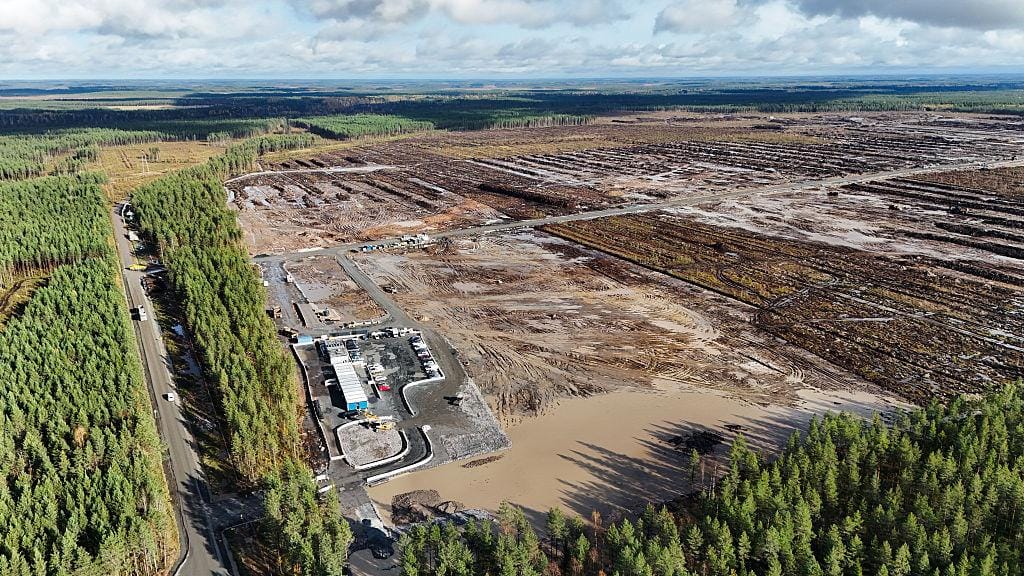
Google Cleared 1,300 Acres of Finnish Forest for AI Data Centers. Now Wolves Are Reportedly Entering Villages.
For years, Finland's forests have represented something that technological progress cannot easily manufacture.
Silence.
Biodiversity.
Clean air.
And vast stretches of woodland where wildlife exists far from the noise of industrial development.
But in northern Finland, an ambitious expansion of artificial intelligence infrastructure has transformed hundreds of hectares of forest into cleared construction sites.
Approximately 530 hectares—roughly 1,300 acres—of forest have been cleared across two locations associated with Google's planned data centers.
That is an area equivalent to more than 700 standard international football pitches.
The trees were removed as part of preparations for a multibillion-euro investment intended to expand Google's cloud-computing and AI infrastructure.
But the work proceeded before the required environmental impact assessment procedures had been completed.
Finnish authorities intervened in October 2026, ordering Google's affiliated developer to suspend environmentally disruptive preparatory work at both locations.
Meanwhile, nearby residents began reporting changes they could see and hear.
Construction machinery replaced the quiet of the forest.
Muddy runoff reportedly affected nearby waterways.
Wildlife habitats were disturbed.
And in the village of Otanmäki, one resident described an especially unsettling development.
Wolves had started appearing near the village.
The animals, she believed, had been driven from their familiar habitat as the surrounding forest disappeared.
Google has acknowledged that the project fell short of its standards and apologized, while saying it intends to comply with Finnish authorities.
The controversy now raises an important question about the artificial intelligence boom:
What happens when the world's growing demand for digital infrastructure begins competing directly with the forests, wildlife, and communities surrounding it?
Where Did Google Clear the Forest?
The controversy involves two proposed data center locations in northern Finland.
The sites lie in different municipalities, but both are part of Google's wider Finnish infrastructure expansion.
Location | Reported area cleared | Approximate acres |
|---|---|---|
Muhos | 330 hectares | 815 acres |
Otanmäki, Kajaani | Just under 200 hectares | About 494 acres |
Combined | Approximately 530 hectares | About 1,300 acres |
The reported figures do not necessarily mean every square meter was previously untouched old-growth forest.
Commercial forest management has long shaped parts of Finland's landscape.
Nevertheless, the conversion of hundreds of hectares of wooded land into industrial infrastructure can permanently change habitat structure, drainage, and land use.
And that is precisely why environmental assessments matter.
 Imrul

Why Finland Ordered Google to Stop Work
On October 6, 2026, Finland's Licensing and Supervision Authority, known as LVV, directed Google's subsidiary Tuike Finland Oy to suspend preparatory activities that could significantly alter the environment.
The order covered operations such as tree removal, topsoil stripping, excavation, crushing, changes to drainage, and construction of roads or storage areas.
The authority's concern was not simply that trees had been cut down.
It was that extensive land-altering work had taken place before the environmental impact assessment process was completed.
According to Finland's national broadcaster Yle, the authority concluded that the activities could substantially change the environment in ways that should have been evaluated beforehand.
Why an Environmental Impact Assessment Matters
An environmental impact assessment, or EIA, examines the potential consequences of a proposed project before major decisions and irreversible work proceed.
For a large industrial development, that may include evaluating effects on habitats, waterways, groundwater, noise, transportation, neighboring communities, and alternative site configurations.
The point is to identify risks while changes are still possible.
If extensive forest clearing occurs before the assessment is completed, some of the conditions that should have been studied may already have disappeared.
This creates a fundamental problem.
An assessment intended to guide decisions becomes less useful if major environmental changes have already occurred.
Legal experts interviewed by technology publication TechTarget emphasized this issue, warning that restoration promises cannot substitute for assessments carried out at the appropriate stage.
Does the Order Cancel Google's Data Centers?
No.
The suspension concerns environmentally significant preparatory work while the necessary procedures are completed.
Some lower-impact activities, including planning, measurements, and limited surveys, may continue under the regulator's conditions.
The projects have not automatically been canceled.
But the dispute has created regulatory uncertainty and could delay development.
Wolves Are Reportedly Entering Nearby Villages

Among the most striking claims emerging from the affected communities are reports of wolves appearing near residential areas.
In Otanmäki, local resident Anni Ranta told The Guardian that wolves had begun entering the village after the surrounding forest was cleared.
Her account describes a community witnessing rapid environmental change while trying to understand its consequences.
The testimony is significant because large-scale land disturbance can affect animal behavior and movement.
But there is an important scientific distinction.
The resident's observation is evidence of a reported local experience, not conclusive proof that the data center project caused every wolf sighting.
Establishing the cause would require ecological monitoring, information about wolf territories, prey populations, and other possible influences.
Why Habitat Disruption Could Affect Wildlife
Wild animals depend on interconnected habitats for movement, feeding, shelter, and reproduction.
Removing large areas of vegetation can alter those connections.
It can also disturb prey species and change the routes used by larger predators.
Wolves are capable of traveling across extensive territories.
Their movements depend on multiple factors, including food availability, human activity, territory boundaries, and seasonal conditions.
Forest clearing could plausibly influence some of those movements.
But wolf sightings in or near settlements can occur for other reasons as well.
The careful conclusion is that residents are reporting an ecological disturbance that deserves investigation—not that scientists have already established a direct causal chain from tree removal to wolves entering villages.
The Environmental Damage Goes Beyond the Trees
The disappearance of trees is the most visible consequence of large-scale forest clearing.
But the effects can extend much further.
Trees are part of a complex system involving soil, water, insects, fungi, birds, mammals, and countless microscopic organisms.
When a forest is removed, the changes are not restricted to the landscape above ground.
1. Soil Disturbance and Erosion
Roots help hold soil in place.
Vegetation can reduce the force of rainfall reaching the ground and influence how water moves across the landscape.
When trees and topsoil are removed, exposed ground may become more vulnerable to erosion.
Heavy machinery can also compact soil, reducing its ability to absorb water.
At the Finnish sites, authorities identified topsoil removal, changes to ditches, and road construction among the activities requiring scrutiny.
These changes may have consequences for local drainage long after the initial clearing.
2. Muddy Water Entering Streams

Residents and environmental campaigners have raised concerns about brown or muddy water appearing in local waterways.
Such discoloration can be consistent with sediment entering streams after soil disturbance.
Sediment can affect aquatic habitats by changing water clarity, covering streambeds, and influencing conditions for some organisms.
However, determining the extent and cause of pollution at a particular location requires water-quality measurements and appropriate environmental investigations.
The available reporting documents local concerns; it does not establish the precise volume of sediment entering each affected waterway.
3. Noise and Habitat Disruption
Clearing forest for industrial construction can introduce heavy machinery, vehicle traffic, excavation, and potentially blasting.
These activities may disrupt nearby residents and wildlife.
Animals respond differently to noise and human activity.
Some avoid disturbed areas.
Others change feeding times, movement patterns, or habitat use.
The long-term impact depends on the species involved, the quality of remaining habitat, and whether ecological connections are maintained.
4. Loss of Carbon Storage
Forests store carbon in trunks, branches, roots, and soil.
Removing trees reduces the amount of standing biomass that can continue storing carbon.
Disturbing soils can also affect stored carbon, depending on site conditions and management practices.
The precise climate effect of Google's Finnish land clearing has not been established in the reporting examined.
It would require information about the forest types, timber processing, soil carbon, future land use, and the emissions associated with construction.
Nevertheless, forest conversion is a legitimate factor in assessing the environmental footprint of infrastructure.
 Imrul

Why Google Is Investing €13 Billion in Finland
The controversy is taking place against the backdrop of a much larger technological transformation.
Google announced plans for approximately €13 billion in Finnish investment, including expansion of data center infrastructure.
Finland offers several characteristics attractive to large technology companies.
Its northern climate can support efficient cooling strategies.
The country has substantial electricity infrastructure.
It also offers political stability and access to the European market.
Data centers are essential to cloud computing, search services, storage, and increasingly artificial intelligence.
AI workloads can be especially computationally demanding.
Training large models and running AI services for millions of users require significant processing capacity.
That demand has encouraged technology companies to expand their physical infrastructure.
But the digital services appear much less physical to users than they actually are.
A search result may arrive in seconds.
An AI-generated response may appear almost instantly.
Behind those interactions are servers, power systems, cooling equipment, electrical connections, and buildings occupying real land.
The Hidden Physical Infrastructure Behind AI

The environmental impact of a data center is not determined solely by the electricity it consumes.
Its overall footprint can also include construction materials, land conversion, transmission infrastructure, cooling systems, water use, and eventual equipment replacement.
Those impacts differ considerably between locations and designs.
A data center supplied by low-carbon electricity may have a smaller operational carbon footprint than an equivalent facility relying on fossil fuels.
But low-carbon electricity does not erase the ecological consequences of removing forests or altering waterways.
These are separate environmental considerations that need to be evaluated together.
Google's Response: An Apology and Plans to Plant Trees
Google has acknowledged shortcomings in its handling of the Finnish project.
The company said it believed it was acting in good faith under its understanding of applicable forestry legislation.
It also maintained that it had conducted nature surveys and taken measures intended to protect environmentally valuable areas.
Nevertheless, the company accepted that it had not met its own standards.
Google confirmed it would comply with the regulator's instructions, and its Finland country manager, Antti Järvinen, publicly apologized in October.
The company also outlined plans for tree planting across approximately 130 hectares in Muhos.
Can Planting New Trees Replace the Lost Forest?
Replanting can contribute to restoration, but it is not an instant replacement for established woodland.
A newly planted tree does not immediately provide the same ecological functions as a mature tree.
A young plantation may also differ from an older forest in structure, species composition, biodiversity, and soil conditions.
The proposed 130 hectares of planting is considerably smaller than the approximately 330 hectares reported cleared at Muhos.
And it represents an even smaller fraction of the combined area affected across both sites.
However, comparing hectares alone does not fully measure restoration quality.
The choice of species, planting location, long-term management, habitat connectivity, and survival of the planted trees would all affect the ecological outcome.
Conservationists have challenged whether the proposed measures are sufficient to compensate for the damage already done.
What Local Communities Stand to Gain—and Lose
Not everyone living near the projects opposes the data centers.
Large infrastructure investments can offer potential economic benefits.
They may create temporary construction employment, permanent technical and operational roles, business opportunities, and local tax revenue.
Additional investment may also improve electricity or other infrastructure.
For some municipalities, attracting a major international technology company may provide opportunities that would otherwise be difficult to secure.
But residents also have legitimate reasons to question the balance of benefits and costs.
A relatively small local workforce may operate a large data center after construction.
Some financial benefits may flow to companies and suppliers outside the affected region.
Meanwhile, nearby communities may experience permanent land-use changes, traffic, noise, and environmental disruption.
The scale and distribution of these impacts require careful project-specific analysis.
Economic Development Is Not the Same as Community Consent
A municipality may welcome investment because it expects jobs and revenue.
But residents living closest to a construction site may experience the consequences differently.
That tension is not unique to Finland.
It appears in discussions involving mines, factories, power plants, transport projects, and other major developments around the world.
The central question is not simply whether infrastructure generates economic value.
It is whether its development follows the law, considers environmental consequences, and gives affected communities meaningful opportunities to understand and respond to those consequences.
The Bigger Question: Can AI Expansion Be Environmentally Responsible?
The Finnish controversy illustrates an uncomfortable reality of the AI boom.
Artificial intelligence can help researchers study ecosystems, improve energy forecasting, analyze satellite imagery, and identify environmental changes.
But the infrastructure required to provide these services also consumes resources.
There is no automatic contradiction in using technology for environmental research while acknowledging that its development can create environmental costs.
The challenge is ensuring those costs are properly measured and managed.
What Responsible Data Center Development Should Include
An environmentally responsible approach requires more than ambitious sustainability announcements.
It depends on decisions made before construction begins.
Environmental concern | Responsible planning approach |
|---|---|
Habitat loss | Evaluate alternative sites and minimize ecological disturbance |
Forest conversion | Assess biodiversity, carbon stocks, and restoration feasibility |
Electricity demand | Evaluate grid effects and additional low-carbon energy supply |
Water use | Measure local water availability and cooling requirements |
Construction runoff | Establish erosion and sediment-control measures |
Community impact | Engage residents and monitor noise, traffic, and other disturbances |
Regulatory compliance | Complete required assessments before irreversible work |
A project can deliver valuable technological services while still being poorly managed environmentally.
Equally, a project should not be assumed harmful in every respect simply because it is a data center.
Its impacts depend on where it is built, how it operates, and whether safeguards are effective.
Why Finland's Response Matters Beyond Google
The Finnish regulator's intervention is significant because it demonstrates that a large investment commitment does not automatically override environmental requirements.
Google's plans involve billions of euros and substantial infrastructure development.
But those economic stakes do not remove the need to complete required procedures.
The issue also highlights a broader lesson for cloud and AI infrastructure developers.
Obtaining access to land and electricity does not necessarily mean a site is ready for major construction.
Environmental permitting, land-use planning, and ecological assessment must be integrated into project timelines.
Treating them as administrative obstacles to be resolved after site preparation creates serious risks.
Those risks can include construction delays, legal investigations, reputational damage, restoration obligations, and the loss of public trust.
For companies promoting environmental sustainability, the credibility of their commitments depends partly on whether their construction practices are consistent with those claims.
Frequently Asked Questions
Did Google really clear 1,300 acres of forest in Finland?
Reports indicate that approximately 330 hectares were cleared or prepared at Muhos and just under 200 hectares at the Otanmäki/Kajaani site. Combined, that represents roughly 1,300 acres. The figure covers two locations, not one continuous forest.
Why did Finland stop Google's data center work?
Finland's Licensing and Supervision Authority ordered a suspension of environmentally significant preparatory work because required environmental impact assessment procedures had not been completed before extensive site alterations occurred.
Are wolves entering villages because of the forest clearing?
Residents in Otanmäki have reported wolves appearing near the village and believe habitat disturbance contributed to their movements. However, the available reporting does not establish a scientifically verified causal relationship between the clearing and individual wolf sightings.
Has Google apologized?
Yes. Google acknowledged shortcomings in its handling of the project, and its Finland country manager publicly apologized. The company said it would comply with the regulator's instructions.
Will Google plant trees to replace the forest?
Google has announced plans for planting across approximately 130 hectares at Muhos. However, newly planted trees cannot immediately replace the ecological functions of established forests, and conservationists have questioned the adequacy of the measures.
Are the Finnish data center projects canceled?
No. The regulatory intervention suspends environmentally significant preparatory activities pending the required assessments. It does not automatically cancel the projects.
The Forest Behind the Future of Artificial Intelligence
Artificial intelligence is often discussed as something almost weightless.
A technology made of mathematics, software, and information.
Something that exists somewhere in the cloud.
But clouds, in this context, have addresses.
They require buildings.
They consume electricity.
They depend on physical networks.
And sometimes, they require substantial changes to real landscapes.
In northern Finland, the expansion of AI infrastructure has become a visible reminder of that physical reality.
Hundreds of hectares of forest have been cleared.
Residents have reported environmental disruption.
Conservationists have challenged the handling of the sites.
Finnish authorities have intervened.
And Google has acknowledged that its actions fell below its standards.
The controversy does not establish that every AI data center is environmentally irresponsible.
Nor does it mean that technological development should stop.
But it demonstrates why major infrastructure projects cannot be evaluated solely through investment figures, computing capacity, or anticipated economic benefits.
The trees removed from a landscape are part of an ecological system.
The waterways affected by construction support other forms of life.
And the people living nearby have a stake in decisions that may permanently change their surroundings.
Perhaps the most important question is not whether artificial intelligence can become more powerful.
It almost certainly will.
The more difficult question is whether its expansion can be managed with sufficient care for the environment and communities that make that expansion possible.
A smarter digital future should not require treating the natural world as an afterthought.
And if artificial intelligence is supposed to help humanity solve complex problems, its infrastructure should be developed with the same seriousness about consequences, evidence, and long-term responsibility.
Sources and Further Reading
- The Guardian — Anger in Finland Over Google's Forest Clearing (October 22, 2026). Detailed reporting on the cleared sites, local residents, ecological concerns, and company response.
- Yle News — Google Halts Work as Finnish Police Investigate Suspected Illegal Logging (October 8, 2026). Finnish national broadcaster's reporting on the regulatory order and investigation.
- Tom's Hardware — Wolves Reported Near Villages After Forest Clearing (October 2026). Technology-industry reporting on the land-clearing figures and wildlife concerns.
- TechTarget — Finland Orders Pause on Google's €13 Billion Data Center Expansion (October 7, 2026). Analysis of environmental permitting and site preparation.
- Euronews — Finland Orders Pause Over Environmental Concerns (October 7, 2026). AFP-based reporting on conservation concerns and Google's statement.
- The Next Web — Google Acknowledges Suspension and Apology (October 26, 2026). Follow-up reporting on the company's response and replanting plans.