Freemasonry Debates: Cult, Occult, or Ponzi Scheme? When the Paranormal Meets Crime
Few organizations have inspired as much fascination, suspicion, fear, and conspiracy as Freemasonry.
To its members, Freemasonry is a fraternal organization built around fellowship, moral improvement, charity, ritual tradition, and symbolic lessons. To critics, it is secretive, hierarchical, elitist, and too closely connected to power. To conspiracy theorists, it becomes something far darker: an occult network, hidden government, satanic cult, shadow judiciary, global cabal, or even a sophisticated social-control system operating behind respectable doors.
Some accusations are exaggerated. Some are historically rooted. Some are religious objections. Some come from genuine concerns about secrecy and conflicts of interest. Some are pure fantasy. Some belong more to paranormal folklore than to evidence. And some, especially debates about influence in policing, courts, business, and politics, belong to a more serious public-transparency conversation.
That is what makes Freemasonry such a compelling subject for a “paranormal meets crime” discussion. It sits at the crossroads of ritual, secrecy, elite networking, moral panic, conspiracy culture, religious anxiety, and suspicion of hidden power.
So what is Freemasonry really? A cult? An occult order? A Ponzi scheme? A harmless fraternity? A private social club? A charitable network? Or a misunderstood institution whose secrecy has made it the perfect screen for every fear people have about power?
The honest answer is more complex than any slogan.
Freemasonry is not a Ponzi scheme in the legal or financial sense. It is not a single world government. It is not proven to be a criminal organization. It is not, by mainstream definition, a cult in the way destructive high-control groups are usually understood. But it is also not unreasonable that people question a private oath-bound fraternity with rituals, symbolic secrecy, internal loyalty, and historic links to influential men.
The real story is not that Freemasonry is secretly controlling everything. The real story is that secrecy, power, ritual, and reputation create the perfect conditions for suspicion.
What Is Freemasonry?
Freemasonry is one of the world’s oldest fraternal organizations. The United Grand Lodge of England describes it as one of the world’s oldest social and charitable organizations, with roots in the traditions of medieval stonemasons who built cathedrals and castles. It presents modern Freemasonry as a members’ organization focused on ceremony, tolerance, respect, civic responsibility, charity, and friendship.
Britannica defines Freemasonry as the teachings and practices of the fraternal order of Free and Accepted Masons, describing it as an oath-bound society often devoted to fellowship, moral discipline, and mutual assistance, while concealing at least some rituals or customs from the public.
That definition explains the core tension. Freemasonry is public and private at the same time. Its lodges, charities, buildings, history, and membership are often publicly visible. But its rituals, ceremonies, passwords, signs, and internal culture have historically included secrecy. This makes it different from an ordinary social club.
Freemasonry is organized through lodges. Members pass through degrees, the best known being Entered Apprentice, Fellow Craft, and Master Mason. These degrees use symbolic drama, moral teaching, architectural imagery, tools of stonemasonry, biblical references, and ritual language to teach lessons about character, mortality, brotherhood, truth, and conduct.
Most mainstream Masonic bodies require members to believe in a Supreme Being, though they generally say Freemasonry is not a religion and does not replace a member’s faith. That requirement has contributed to religious debate. Some churches see Freemasonry as spiritually problematic because of oaths, ritual symbolism, or interfaith religious language. Masonic organizations usually respond that Freemasonry is not a church and does not teach salvation theology.
This tension between “not a religion” and “requires belief in a higher power” is one reason Freemasonry has remained controversial.
Why Freemasonry Attracts Suspicion
Freemasonry attracts suspicion for four main reasons: secrecy, ritual, symbolism, and social influence.
Secrecy is the obvious one. Even when an organization says it has nothing criminal to hide, secrecy creates questions. What is said inside the lodge? What obligations do members make? Do they favor one another in business, policing, courts, politics, or employment? Are there private loyalties stronger than public duties?
Ritual adds another layer. Masonic ceremonies use symbolic language, formal oaths, aprons, tools, tracing boards, allegorical death-and-rebirth themes, and dramatic initiation. To members, these are moral and symbolic traditions. To outsiders, they can look occult, theatrical, or even sinister.
Symbolism intensifies the mystery. The square and compasses, the all-seeing eye, pillars, checkered floors, stars, sun and moon imagery, skulls in some Masonic-adjacent traditions, and references to temple-building all lend themselves to interpretation. Symbols are flexible. A member may see morality and geometry. A conspiracy theorist may see hidden control.
Social influence is the most serious concern. Freemasonry historically attracted men in public life, business, law, policing, the military, and local government. Even if most members are ordinary people, the perception of private networks among influential men has fueled fears of favoritism, corruption, and quiet protection.
That last concern is not paranormal. It is civic. A private fraternity becomes controversial when membership may overlap with public authority.
Is Freemasonry a Cult?
The word cult is emotionally powerful but often imprecise.
In everyday speech, people use “cult” to mean any secretive or strange group. But in serious analysis, destructive cults or high-control groups usually involve strong behavioral control, isolation from family, authoritarian leadership, financial exploitation, suppression of dissent, coercive recruitment, extreme dependency, and punishment for leaving.
By that standard, mainstream Freemasonry does not neatly fit the destructive-cult model. Members generally live ordinary lives, keep their religions, families, jobs, and political identities, and can leave. Freemasonry is not usually built around one living guru or prophet. It does not typically demand communal living, total obedience, or separation from society.
However, critics use the word “cult” because Freemasonry includes initiation, ritual secrecy, oaths, degrees, hierarchy, and symbolic teaching. Those features can feel cult-like to outsiders, especially in cultures suspicious of closed male fraternities.
The better question is not “Is Freemasonry a cult?” but “Does Freemasonry’s structure create unhealthy secrecy or divided loyalty?”
For most local members, the answer may be no. A lodge may function as a social and charitable brotherhood. But in positions of public trust, even the perception of hidden loyalty can be a problem. If a police officer, judge, contractor, politician, or senior official belongs to a private fraternity whose members call one another brothers, the public may reasonably ask whether conflicts of interest are being disclosed.
That is not anti-Masonic hysteria. That is governance.
Is Freemasonry Occult?
The answer depends on how one defines occult.
The word “occult” simply means hidden or concealed. In that basic sense, Freemasonry has occult features because it uses hidden ritual knowledge, initiation, symbolism, and degrees. But “occult” in popular culture often means magic, spirit contact, demon worship, paranormal powers, or secret esoteric doctrine.
Mainstream Freemasonry generally denies being magical, satanic, or a system of occult worship. Its official descriptions present it as moral, charitable, and fraternal rather than supernatural.
Still, Freemasonry has undeniably influenced and overlapped with Western esoteric culture. Some occult and ceremonial-magic organizations borrowed Masonic-style degrees, lodge structures, passwords, initiations, and symbolism. Some individual Freemasons were interested in mysticism, alchemy, Rosicrucianism, Kabbalah, Hermeticism, Theosophy, or ritual magic. That does not mean all Freemasonry is occult magic. It means Masonic forms became part of a wider esoteric vocabulary.
This is where confusion begins.
Freemasonry uses symbols. Occult orders also use symbols. Freemasonry has degrees. Occult orders also have degrees. Freemasonry uses secrecy. Magical orders also use secrecy. To an outsider, these worlds can blur.
The paranormal reputation of Freemasonry comes from this symbolic atmosphere. Temples, oaths, veiled meanings, initiation chambers, secret signs, and references to hidden wisdom all feel mysterious. Even if the official teachings are moral rather than magical, the aesthetic invites occult interpretation.
So the fair answer is: Freemasonry is not normally an occult religion or magical order in its mainstream form, but it has esoteric symbolism and has historically overlapped with occult culture enough to fuel debate.
Is Freemasonry a Ponzi Scheme?
Calling Freemasonry a Ponzi scheme is usually inaccurate.
A Ponzi scheme is a fraudulent investment operation where returns to earlier investors are paid from money contributed by newer investors rather than legitimate profit. Freemasonry, in its mainstream form, is not an investment scheme promising financial returns. Members typically pay dues, may donate to charity, attend meetings, and participate in lodge activities.
There is no credible basis for describing regular Freemasonry as a Ponzi scheme in the legal sense.
However, some people use “Ponzi scheme” loosely to mean a system where members pay money, move through levels, and receive status, networking, or social benefit. That is not the same thing. Many clubs, professional associations, churches, alumni networks, fraternities, and private societies collect dues and offer community or status. That does not make them Ponzi schemes.
A more reasonable criticism might be that any closed network can create informal privilege: business referrals, social introductions, mentoring, patronage, and access. Those benefits are not inherently criminal, but they can become ethically questionable if they influence public duties or create unfair advantage.
So the real question is not whether Freemasonry is a Ponzi scheme. It is whether private fraternity networks ever create favoritism, conflicts of interest, or hidden influence.
That is a serious question, but it should not be confused with financial fraud.
Freemasonry and Crime: What Is the Serious Concern?
The serious crime-related concern around Freemasonry is not that lodges are secretly conducting paranormal rituals or global criminal operations. The more grounded concern is corruption through private loyalty.
The issue is simple: if members of a private fraternity are also police officers, judges, lawyers, politicians, contractors, or civil servants, could they protect one another? Could they share information? Could they influence promotions, contracts, investigations, or disciplinary processes? Could they create a perception that justice is not fully transparent?
These concerns have appeared especially in the United Kingdom. Recent debate around Metropolitan Police disclosure rules shows that the issue remains alive. In 2025, The Guardian reported that the Met considered and later faced legal challenge over a policy requiring officers and staff to declare Freemasonry membership as a “declarable association,” citing concerns about potential conflicts of interest and public trust. The United Grand Lodge of England challenged the move, arguing it was unlawful and discriminatory.
The same reporting linked the debate to long-running concerns about police corruption and public mistrust, including issues raised after the investigation into the 1987 murder of private investigator Daniel Morgan. The articles also note that no criminal proof has been established merely from Masonic association, which is an important distinction.
This is the careful position: Freemasonry membership does not prove corruption. But undisclosed membership in a private fraternal network can create perceived or actual conflicts of interest in public institutions.
Transparency rules are not the same as persecution. But they must be fair, evidence-based, and consistent across comparable organizations.
Why Anti-Masonic Conspiracy Theories Became So Powerful
Anti-Masonic conspiracy theories have a long history. They often portray Freemasons as hidden rulers, enemies of religion, manipulators of politics, or controllers of banks, courts, revolutions, and secret societies.
These theories became especially powerful because Freemasonry combined three things that conspiracy culture loves: secrecy, elite membership, and symbols.
Historically, Masonic conspiracy theories have also overlapped with antisemitic and extremist narratives. Some “Judeo-Masonic” conspiracy theories falsely merged Freemasons with Jewish communities into a single imagined plot. Such ideas became part of dangerous extremist propaganda in Europe and beyond. Search results from academic sources on extremist ideology note the importance of Judeo-Masonic conspiracy theory in some extremist traditions.
This is one reason the topic must be handled responsibly. Criticizing secrecy or conflicts of interest is legitimate. Repeating old claims about secret global control, satanic worship, or hidden ethnic-religious cabals can slide into dangerous conspiracy thinking.
Anti-Masonic conspiracy theories often work by treating symbols as evidence. The all-seeing eye appears on a building; therefore Masons control it. A politician was a Mason; therefore policy was Masonic. A court official belonged to a lodge; therefore justice was rigged. This style of reasoning is emotionally satisfying but often weak.
The presence of a symbol is not proof of a plot. The membership of an individual is not proof of institutional control. Secrecy is not proof of criminality.
But secrecy does create the atmosphere in which such theories thrive.
Why the Rituals Look “Paranormal”
Freemasonry is full of ritual language, and ritual always looks strange from the outside.
Initiation ceremonies are designed to create emotional impact. They use darkness, light, symbolic tools, formal speech, moral allegory, and dramatic progression. For members, this may feel solemn, educational, and bonding. For outsiders, especially those seeing leaked fragments without context, it can look occult or threatening.
This is how ritual gets misunderstood. A symbolic death may be interpreted as literal death worship. A blindfold may be seen as mind control. An oath may be seen as criminal loyalty. An altar-like arrangement may be seen as religious replacement. A temple may be seen as pagan worship. A symbolic penalty in old ritual language may be interpreted as actual violence.
Some criticism is fair: private oaths can be unsettling, especially if members also hold public office. Some ritual language may feel archaic or disturbing. But ritual symbolism is not automatically evidence of crime or paranormal activity.
Human beings use ritual everywhere: courts, universities, churches, militaries, parliaments, graduations, weddings, funerals, and fraternal orders. Robes, oaths, symbols, ranks, processions, and formal language are not unique to Freemasonry.
What makes Masonic ritual controversial is that much of it is private.
Private ritual invites public imagination.
Freemasonry and Religion: Why Some Faith Groups Object
Some religious groups object to Freemasonry because it requires belief in a Supreme Being but does not define that being according to one specific religion. Masonic lodge prayers and symbols may bring together men from different faiths under a shared moral framework. To supporters, this promotes tolerance. To critics, it creates religious ambiguity.
Some Christian critics argue that Masonic ritual competes with church teaching, uses oaths forbidden by scripture, or treats all religions as equally valid in a way they consider theologically unacceptable. Some Muslim, Catholic, evangelical, and other religious voices have raised concerns in different contexts, though attitudes vary widely by country and community.
Freemasonry’s official bodies generally insist that it is not a religion and has no political or religious affiliation. UGLE’s official materials say the organization has no political or religious affiliations and includes members of different backgrounds.
The debate persists because Freemasonry occupies a strange middle ground. It is not a church, but it uses religious language. It is not a theology, but it requires belief in a higher power. It is not a cult, but it uses initiation. It is not an occult magical order, but it uses esoteric-looking symbols.
That ambiguity is why religious suspicion has lasted for centuries.
The Paranormal Image: Temples, Symbols, and Secret Knowledge
Freemasonry’s paranormal reputation is largely aesthetic.
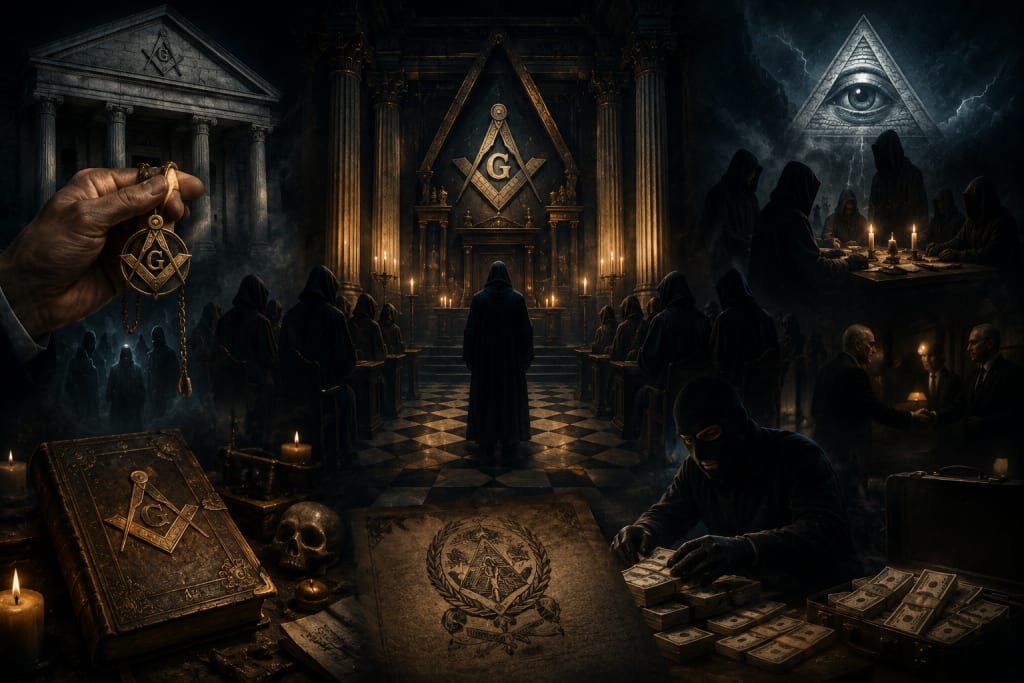
Masonic halls are often called temples. Ceremonies happen in formal lodge rooms. Members wear aprons and regalia. Symbols appear on walls, documents, rings, gravestones, and buildings. Degrees imply hidden knowledge revealed step by step. The language of light, darkness, building, death, rebirth, and the Great Architect of the Universe feels mystical.
For horror writers, conspiracy theorists, and paranormal storytellers, this is irresistible.
Freemasonry becomes the perfect fictional organization because it is real enough to be recognizable and secret enough to be imagined. A novelist can place a hidden chamber under a Masonic lodge. A film can use symbols for mystery. A YouTube conspiracy video can freeze-frame a square and compasses and suggest hidden control. A ghost story can connect old lodge buildings with rituals gone wrong.
The actual local lodge may be a group of older men raising money for charity and eating dinner after ceremony. But the imagery allows the imagination to build something darker.
This is the difference between Freemasonry as lived reality and Freemasonry as myth.
The myth is often more powerful than the facts.
Why Freemasonry Is Not the Illuminati
Many conspiracy theories blur Freemasonry with the Illuminati. Historically, they are not the same thing.
The Bavarian Illuminati was a short-lived eighteenth-century secret society founded in 1776 and suppressed within a decade. Freemasonry is older, broader, and still exists globally in many forms. Some historical Illuminati members were also Freemasons or used Masonic networks, which helped later conspiracy theories merge the two. But modern Freemasonry is not simply “the Illuminati.”
The merger of Masons, Illuminati, global banking, satanic cults, aliens, and secret world government is mostly a product of modern conspiracy culture. It takes real fragments—secret societies existed, some elite men were Masons, symbols overlap, political networks matter—and turns them into a totalizing myth.
This kind of myth is attractive because it simplifies complexity. Instead of messy politics, class power, capitalism, bureaucracy, corruption, and institutional failure, there is one hidden group behind everything.
That is psychologically satisfying but historically weak.
Real power usually does not require a single secret lodge. It often operates through money, law, lobbying, class networks, institutions, media, ideology, and ordinary self-interest. These are less cinematic than secret rituals, but often more important.
The “Secret Society” Label
Britannica describes Freemasonry as the largest worldwide secret society, while also clarifying that secret societies do not necessarily conceal their existence or membership but may conceal rituals or customs.
This distinction matters.
Freemasonry is not secret in the sense that nobody knows it exists. Masonic buildings are visible. Grand lodges have websites. Many members publicly identify themselves. Some lodge events are open. Charitable work is advertised. Historical records are available.
But Freemasonry is secretive in the sense that internal rituals, signs, and ceremonial details have traditionally been private. That privacy is central to its identity. Members may see it as sacred tradition, bonding, or symbolic progression. Critics see it as unnecessary secrecy that creates distrust.
The phrase “society with secrets” is often used by Masons to soften the “secret society” label. But for critics, the difference may feel semantic.
The public question remains: when is privacy acceptable, and when does secrecy become socially harmful?
For an ordinary hobby group, privacy may be harmless. For a network overlapping with public power, secrecy becomes more controversial.
Freemasonry, Charity, and Public Service
Any fair discussion must acknowledge that Freemasonry has a long charitable dimension. Masonic organizations operate charitable foundations, support hospitals, education, disaster relief, local community causes, and member welfare. UGLE and other Masonic bodies emphasize civic responsibility and charitable work in their public descriptions.
This charitable work is real and should not be dismissed simply because the organization is controversial. Many members join for friendship, moral teaching, family tradition, charity, and community.
Most Freemasons are not powerful elites. Many are ordinary men participating in a fraternal culture. In some jurisdictions, there are also women’s Masonic organizations and mixed orders, though mainstream recognition varies.
The conspiracy image of Freemasonry as an all-powerful global machine often ignores the ordinary reality of local lodges: meetings, ceremonies, meals, charity drives, aging membership, building maintenance, local events, and community relationships.
That ordinary reality does not erase legitimate transparency concerns. But it does complicate the cartoon villain version.
Where the Crime Angle Gets Real
The crime angle becomes real in three areas: conflict of interest, corruption perception, and misuse of fraternal loyalty.
First, conflict of interest. If two people involved in a legal, policing, business, or disciplinary matter are members of the same lodge, should that be disclosed? In many public roles, comparable associations may need declaration.
Second, corruption perception. Even without proof of wrongdoing, undisclosed private networks can damage public trust. If the public believes officials may protect fellow members, confidence suffers.
Third, misuse of loyalty. Any brotherhood, alumni network, religious group, political club, or professional association can be misused when members prioritize insiders over fairness. Freemasonry is not unique in this. But because it is oath-bound and historically secretive, suspicion is sharper.
The Metropolitan Police disclosure debate shows how these concerns remain active in real institutions. The reported policy was not a ban on membership but a proposed disclosure requirement intended to address transparency and trust, which UGLE challenged as discriminatory and unlawful.
That is the kind of debate worth having: not fantasy about demons, but practical questions about public duty.
Why People Call It a “Network”
One reason Freemasonry is controversial is that it is undeniably a network.
Members meet regularly. They build trust. They share rituals and identity. They may socialize across professions. They may refer business or support one another. That is true of many fraternities, alumni societies, clubs, churches, professional associations, and private schools.
Networks are not inherently criminal. Human society runs on networks. The ethical question is whether the network is transparent, fair, and subordinate to public law.
A Masonic brother helping another brother find work is not automatically corruption. A public official favoring a Masonic brother in a contract, investigation, hiring process, or court matter would be a serious ethical problem.
The difference is context, duty, and evidence.
Conspiracy thinking often skips that distinction. It treats all networking as corruption. But public accountability requires precision. Who did what? What decision was affected? Was membership concealed? Was there a duty to disclose? Was there evidence of favoritism?
Without those questions, criticism becomes rumor.
Why the Ponzi Label Persists Anyway
Even though Freemasonry is not a Ponzi scheme, the label persists because some outsiders see degree systems and dues as suspicious.
A member pays dues. There are ranks or degrees. There is prestige in advancement. There may be additional bodies beyond basic Craft Masonry. Some members buy regalia or attend paid events. To suspicious observers, this can look like a hierarchy that extracts money.
But a Ponzi scheme requires fraudulent investment returns. Freemasonry does not normally promise financial returns from recruiting members. It is a dues-based membership organization. Advancement is ritual and symbolic, not a guaranteed profit model.
A more accurate critique might be that some fraternal systems can create status incentives or social pressure to spend money on events, regalia, donations, or affiliated bodies. That can happen in many organizations. It does not make the whole structure a Ponzi scheme.
Precision matters because false labels weaken legitimate criticism.
If the concern is financial transparency, ask for financial transparency. If the concern is favoritism, ask about conflicts of interest. If the concern is religious incompatibility, discuss theology. If the concern is secrecy, discuss secrecy.
Calling everything a Ponzi scheme turns analysis into noise.
The Horror-Folklore Version of Freemasonry
In paranormal and horror culture, Freemasonry often appears as a shadow organization with secret chambers, forbidden rituals, occult symbols, blood oaths, ancestral curses, and hidden crimes. This fictional version is not the same as real Freemasonry, but it is culturally important.
Why does it work so well?
Because Masonic imagery already has atmosphere. The lodge room. The blindfold. The oath. The apron. The candlelight. The temple language. The old building on a quiet street. The symbols carved into stone. The cemetery markers with square and compasses. The idea of knowledge revealed only after initiation.
For horror, that is gold.
The same imagery that members may see as solemn and moral can be reinterpreted as sinister by outsiders. This is how ritual communities become folklore objects. The secrecy creates a blank space, and horror fills it.
That does not mean horror writers should avoid Freemasonry. It means audiences should distinguish fiction from accusation. A Masonic-coded villain in a novel is not evidence against real Masons.
The Responsible Way to Discuss Freemasonry
A responsible debate about Freemasonry should hold several truths at once.
Freemasonry is a real fraternal tradition with centuries of history, charity, ritual, and social life.
It has secrecy and symbolism that understandably attract suspicion.
It is not proven to be a global criminal cult.
It is not a Ponzi scheme.
It has had members in influential positions, which makes transparency concerns legitimate.
It has been targeted by exaggerated, religiously hostile, and sometimes extremist conspiracy theories.
Its occult reputation comes partly from symbolism, secrecy, and overlap with esoteric culture, not from proof that mainstream lodges practice magic or satanic worship.
Public officials may reasonably be asked to disclose memberships that could create perceived conflicts of interest, but such policies should be fair, lawful, and consistent.
That balanced approach is harder than shouting “cult” or “conspiracy,” but it is more useful.
Final Verdict
Freemasonry sits in a strange cultural position: public enough to be visible, private enough to be mysterious, old enough to feel powerful, symbolic enough to look occult, and socially connected enough to raise legitimate questions about influence.
Is it a cult? Not in the usual destructive high-control sense, though its rituals, oaths, secrecy, and hierarchy can feel cult-like to critics.
Is it occult? Not as a mainstream magical or satanic order, but it contains esoteric symbolism and has historically overlapped with Western occult culture enough to fuel suspicion.
Is it a Ponzi scheme? No. That label is inaccurate. Freemasonry is not a fraudulent investment model promising returns from recruitment.
Is it above criticism? Absolutely not. Any private oath-bound fraternity with members in public institutions should be open to questions about transparency, conflicts of interest, and accountability.
The real mystery of Freemasonry is not that it secretly controls the world. The deeper issue is why secretive institutions make people feel that the world is being controlled from behind closed doors. Freemasonry became a magnet for paranormal fear and crime suspicion because it combines ritual, privacy, brotherhood, symbols, and influence—the exact ingredients from which conspiracy folklore is made.
In the end, the most convincing answer is neither blind defense nor wild accusation.
Freemasonry is a private fraternal order with moral, charitable, symbolic, and social functions. It also carries enough secrecy and historical influence to deserve scrutiny when it intersects with public power.
The ghost in the lodge is not necessarily a demon, cult, or criminal empire.
It is secrecy itself.