Psychological Thriller vs Domestic Suspense: The Key Differences, Why “Domestic Noir” Still Matters in 2026, and How to Tell Them Apart
If you have ever finished a twisty novel, loved it, and then felt oddly unsure what to call it, you are not alone. Was it a psychological thriller? Domestic suspense? Domestic noir? A family thriller? A marriage thriller? The modern suspense shelf has become so crowded with overlapping labels that even publishers and booksellers often blur them together. In 2026, that overlap is still real, but the categories do not mean the same thing. The cleanest way to understand them is this: psychological thriller describes the method of tension, while domestic suspense describes the arena where that tension plays out. And domestic noir is the darker, more intimate label still used for a particular strain of relationship-centered suspense, especially in literary and bookseller conversations.
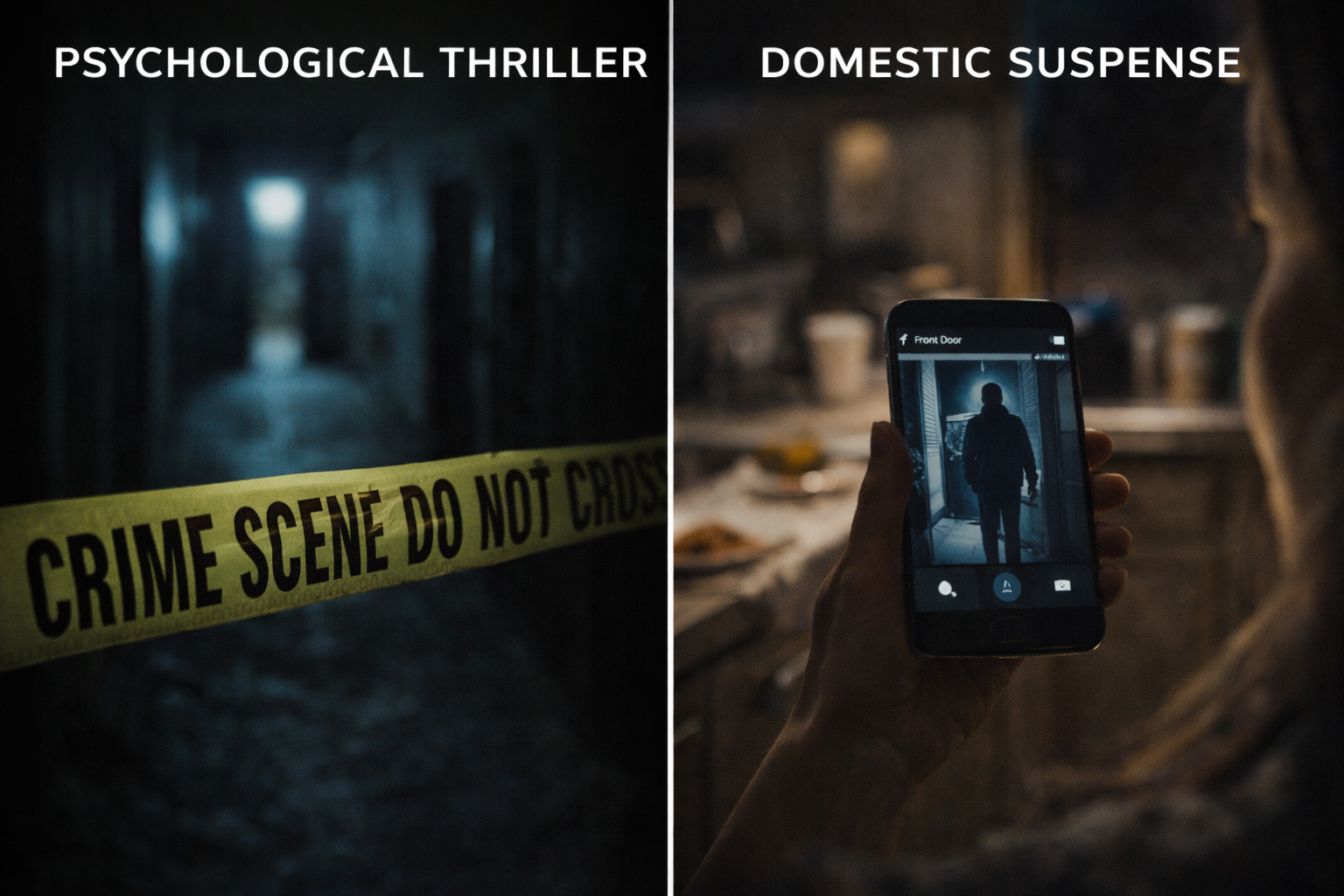
That difference sounds small until you start testing it against real books. A psychological thriller usually wants to get inside the mind: obsession, paranoia, coercion, unreliable memory, manipulation, delusion, or emotional warfare. Domestic suspense usually wants to turn the ordinary structures of private life into danger: marriage, motherhood, suburbia, childcare, friendship, inheritance, family loyalty, and the polished surfaces of “normal” homes. One asks, What is happening inside this person’s head? The other asks, What is happening behind this family’s front door? The strongest books often do both, which is exactly why readers keep mixing them up.
So the short answer to psychological thriller vs domestic suspense is not that one is “deeper” and the other is “more commercial.” It is that they prioritize different engines of suspense. A psychological thriller destabilizes perception. Domestic suspense weaponizes intimacy. When the two merge well, you get the kind of novel people devour in one weekend and then spend another week arguing about.
What a psychological thriller really is
A psychological thriller is usually built on mental pressure rather than external spectacle. The fear does not come mainly from explosions, chase scenes, or body counts. It comes from uncertainty inside the self or inside a relationship: can I trust my partner, my memory, my narration, my motives, or even my version of events? Writers Digest described psychological thrillers as stories in which emotional violence can matter as much as literal death, and Pan Macmillan’s current thriller pages still market the category through obsession, deception, psychological duress, gaslighting, and domestic unraveling rather than through police procedure or action plotting.
That is why the genre so often leans on narrators who are compromised in one way or another. They may be grieving, dissociating, repressing, addicted, emotionally dependent, jealous, ashamed, manipulated, or simply wrong. The tension comes from instability: not only what happened, but whether the viewpoint through which we are learning it can be trusted. A current example of that emphasis is Good Intentions, which Macmillan describes as a psychological suspense debut about a luxury party planner who becomes obsessed with a woman she meets in a hospital waiting room, and then frames in terms of grief, guilt, obsession, voyeurism, and moral gray zones. That is psychological-thriller territory in its pure form: the threat grows out of fixation and inner distortion.
The genre also loves identity fractures. Pan Macmillan’s current psychological-thriller guide highlights a novel in which a woman returns home only to find another woman in her house while her husband insists the stranger is his wife. That setup is not fundamentally about a crime-scene puzzle. It is about gaslighting, identity, destabilization, and the terror of losing control over reality. Even when the plot later expands, the core promise remains psychological: the reader comes for the mind game.
That is one reason psychological thrillers can unfold almost anywhere. They do not need a domestic setting, though they often use one. They can happen in elite schools, hospitals, wilderness retreats, small towns, offices, trains, social media ecosystems, or beauty pageants. The thing that makes them psychological is not the wallpaper. It is the pressure placed on perception and selfhood. Macmillan’s 2026 description of Pretty Dead Things, for example, sells it as a “rich and addictive” novel with a jaw-dropping twist from a psychological suspense author, even though its visible setup includes Texas pageantry, an old disappearance, and a deadly storm. The label holds because the suspense is still rooted in trauma, secrets, buried resentment, and the subjective instability of the characters inside that pressure cooker.
What domestic suspense actually means
Domestic suspense is narrower in setting and wider in emotional familiarity. It usually takes the structures readers know best — marriage, children, neighbors, friendship, suburbia, family routines, school-gate politics, money stress, inheritance tension, care work, private resentments — and turns those structures dangerous. Penguin Random House’s current “Books to Read if You Love Domestic Thrillers” page is useful here because the examples repeatedly center homes, husbands, wives, children, assistants, socialites, suburban developments, and family disappearances. The entire pitch is that these are dark, suspenseful stories built from secrets within marriages and families.
That “within” matters. Domestic suspense thrives on the idea that the threat is already intimate. It is in the marriage bed, the kitchen, the group chat, the cul-de-sac, the nursery, the wine night, the custody arrangement, the family trust, the guest room, or the mother-in-law dynamic. The danger is close enough to know your routines, use your tenderness against you, and make your own home feel unstable. Pan Macmillan’s current thriller guidance describes books like The Guest as being set in a “heart-pounding home full of secrets,” and other recommendations on the same site are tagged with phrases like “domestic suspense,” “family secrets,” and “hidden identities.” Those are not accidental blurbs. They identify the domestic-suspense promise very clearly: the danger is personal, proximate, and socially recognizable.
That is why domestic suspense often feels especially readable. The terrain is familiar. You do not need to learn the rules of espionage, courtroom procedure, or serial-killer profiling. You already understand the emotional architecture. A spouse can lie. A child can become leverage. A neighborhood can become surveillance. A family holiday can become a tribunal. A perfect house can become a trap. In PRH’s current domestic-thriller list, The Hunting Wives begins with a woman moving with her husband and son into what looks like an idyllic small-town life, while While We Were Burning opens with a picture-perfect suburban life collapsing after a friend’s mysterious death. Those are almost textbook domestic-suspense setups: private life as pressure chamber.
So where does “domestic noir” fit in 2026?
This is where things get interesting, because domestic noir is both an older term and still a living one. The National Centre for Writing’s Noirwich material says “domestic noir, or domestic suspense” is a subgenre integral to its programming and identifies Julia Crouch as the originator of the term. Writers Digest likewise notes that “domestic noir” was coined by Crouch and describes books in that lane as ones where inner trauma mounts faster than the body count and much of the cruelty occurs between people who know each other well. In other words, the phrase is not dead; it is still part of the critical and bookseller vocabulary.
At the same time, the market-facing language in 2026 more often leans toward domestic suspense, domestic thriller, or simply psychological thriller. Pan Macmillan’s 2026 thriller pages repeatedly use “domestic suspense” and “psychological thriller,” while bookseller and review language still happily uses “domestic noir” for darker, more intimate books. Waterstones, for example, describes My Husband as “pitch-black domestic noir,” while Pan Macmillan describes some of the same kind of reading experience in terms of domestic deception, gaslighting, family betrayal, and psychological suspense. So the simplest current answer to domestic noir meaning 2026 is this: the phrase still exists, but it now functions less like a rigid shelf label and more like a tonal signal for the darker, more corrosive, often more feminist end of domestic suspense.
That tonal signal matters. Domestic noir usually feels a little blacker, meaner, and more claustrophobic than generic domestic suspense. It is less interested in “what if your family had a secret?” and more interested in how marriage, motherhood, money, coercion, and social performance can become forms of entrapment. Writers Digest’s formulation is still the cleanest: inner trauma rises faster than the body count, and the cruelty often comes from those already inside the intimate circle. That is why “domestic noir” still feels useful in 2026 even if publishers do not always stamp it on the spine.
The biggest difference: the engine of suspense
If you only remember one difference, make it this one.
In a psychological thriller, the main engine is usually perception. The book wants to destabilize what the protagonist or reader believes is true. The dread comes from uncertainty, obsession, false memory, gaslighting, emotional manipulation, voyeurism, compulsion, or a mind pushed beyond safety. The plot may involve marriage or family, but the pulse of the novel is: Can I trust what I think I know?
In domestic suspense, the main engine is usually intimacy. The book wants to weaponize familiar bonds. The suspense comes from betrayal inside the unit that is supposed to protect you: spouse, ex-spouse, child, parent, neighbor, nanny, best friend, assistant, or lover. The pulse of the novel is: What is happening inside the home, family, or relationship that should feel safe but does not? PRH’s domestic-thriller recommendations make this pattern obvious: wives, suburban developments, children, close female friendships, employers, assistants, and partners dominate the setups.
That is why a single book can be both. If a novel about a marriage also relies on gaslighting, unreliable perception, and emotional breakdown, it can sit comfortably in both categories. Behind Closed Doors is a good example of market overlap: Macmillan presents it as a bestselling psychological thriller, while praise on the site calls B. A. Paris a master of “high-wire domestic suspense.” That is not contradiction. It is a reminder that one term names the mode of fear and the other names the site of fear.
The second big difference: where the danger lives
Psychological thrillers can roam. Domestic suspense usually stays close to home, whether literally or symbolically.
The classic psychological thriller is happy to put danger in the mind, the institution, the office, the road trip, the wilderness, or a niche social environment. A character may be trapped by a manipulator, by their own memory, by an obsession, or by a reality that no longer makes sense. Domestic suspense, by contrast, usually asks what happens when private life curdles. The violence may remain mostly emotional, but the setting stays bound to home life, couplehood, family maintenance, or the social rituals that orbit them. That is why terms like “suburban noir,” “family secrets,” “perfect marriage,” and “heart-pounding home full of secrets” keep recurring in publisher copy.
This is also why domestic suspense often feels more immediately relatable to a broader audience. Its danger is not exotic. It is ordinary life under strain. A neighbor rips out your child’s banner. A husband insists the wrong woman is his wife. A mother fixates on her son’s girlfriend. A party planner becomes consumed by a stranger whose grief mirrors her own. The threat is not “out there.” It is already inside the emotional routines readers recognize.
The third difference: what the reader is promised
When readers pick up a psychological thriller, they usually expect mental chess. They want secrets, reversals, unreliable narration, emotional coercion, shocking motives, and the sense that reality itself may be unstable. They are paying for the sensation of being outmaneuvered. Pan Macmillan’s current psychological-thriller language is full of “domestic deception,” “psychological suspense,” “twists,” “obsession,” and “dark, clever” setups. That is the promise: disorientation with design.
When readers pick up domestic suspense, they usually expect close-range betrayal. They want marriages under pressure, family lies, social facades, class resentment, motherhood anxiety, coercive control, and the revelation that the people who know us best may also know exactly how to hurt us. PRH’s domestic-thriller page frames these books through marriages, families, suburbia, women’s friendships, and respectable-looking communities under strain. That is a different promise. It says: this story will make ordinary life feel dangerous.
This difference in promise matters because it shapes everything from chapter construction to twist design. A psychological thriller twist often reorders reality: who is lying, who is missing, who remembers correctly, who is manipulating whom, whether the narrator has misread the whole book. A domestic-suspense twist often reorders relationship truth: the husband was not the husband you thought, the friendship was built on rivalry, the neighbor war was hiding a deeper grievance, the “perfect life” was financed by rot, the family mythology was false. The two kinds of twists can overlap, but they arrive from different emotional directions.
Pacing feels different too
This is where many readers notice the split even if they cannot name it.
Psychological thrillers often pace themselves through escalating instability. The chapters may be tight, sharp, and propulsive, but the real feeling is inward spiral. One contradiction appears, then another. A memory proves unreliable. An explanation collapses. A fixation deepens. A voice becomes less trustworthy. A pattern of coercion tightens. The pace feels like mounting mental compression.
Domestic suspense, by contrast, often paces itself through layered exposure. The structure is less “the mind is breaking” and more “the family façade is cracking.” The early tension may be quieter: a marital chill, a missing friend, a suspicious assistant, a difficult mother-in-law, a resentful child, a neighborhood feud. Then the book keeps peeling wallpaper, exposing betrayal after betrayal until private life becomes unlivable. PRH’s current domestic-thriller list is full of exactly this architecture: the stress is social first, then criminal.
That is why readers who love “one more chapter” books can enjoy both genres for different reasons. Psychological thrillers keep you reading because you want to know what is real. Domestic suspense keeps you reading because you want to know what these people are hiding from each other — and how long the social performance can last before it detonates.
Character design is another giveaway
A psychological thriller protagonist is often built around interiority under pressure. Their thought patterns matter as much as the plot. They may be observant but compromised, intelligent but deluded, sympathetic but obsessive, or victimized yet unreliable. You read partly to be inside their unease. That is why blurbs for books like Good Intentions emphasize obsession, grief, guilt, and morally gray interior motives, not just incident.
A domestic-suspense protagonist, on the other hand, is often built around roles under pressure. Wife. Mother. husband. girlfriend. son. daughter. assistant. neighbor. hostess. Ex-wife. Friend. The role matters because the book wants to show how social expectation and private danger interact. The Hunting Wives, While We Were Burning, and Perfectly Nice Neighbors all fit this pattern: the characters are not only individuals with secrets, but social beings inside marriages, family units, and communities whose hierarchies generate suspense.
That is not a small distinction. In psychological thrillers, character is often the site of destabilization. In domestic suspense, character is often the site of social collision. One bends inward. The other bends relationally outward. The best books, again, can do both. But if you want to tell them apart, ask whether the novel’s deepest unease comes from the mind or from the household.
Why the overlap is so strong right now
The overlap is not confusion. It is evolution.
By 2026, the suspense market is fully comfortable blending terms because readers themselves have learned to like hybrids. Pan Macmillan’s recent thriller guidance regularly pairs psychological-thriller language with domestic-suspense tags, and PRH’s domestic-thriller lists recommend books that are also sold through unreliable narration, dark twists, and emotionally destabilizing reveals. The market is basically saying: readers do not want rigid silos. They want emotionally intelligent page-turners with both intimacy and mind games.
That is also why the phrase best psychological thrillers guide often ends up including domestic titles, and why lists of domestic thrillers frequently slide into psychological suspense. The categories are not enemies. They are nested. Domestic suspense is often one of the most fertile settings for psychological-thriller techniques, because home is where gaslighting, coercive control, resentment, shame, dependency, and rivalry become most credible. If the danger lives in the marriage, of course the mind becomes the battleground.
So which books fit where?
If a book’s main hook is obsession, manipulation, unreliability, perception, or psychological entrapment, you are probably in psychological-thriller territory, even if the setting is a house or marriage. Good Intentions fits this cleanly because its core is obsession and grief-driven fixation. The same is true of many “woman in trouble” or “something is wrong with my reality” novels.
If a book’s main hook is secrets within marriages, families, neighborhoods, or private social arrangements, you are probably in domestic-suspense territory, even if it has sharp twists and emotional manipulation. The Hunting Wives, While We Were Burning, Perfectly Nice Neighbors, and the praise framing around B. A. Paris all fit here because they center home life, family performance, and intimate betrayal.
If a book does both — and many of the best ones do — the marketing often depends on which side the publisher wants to emphasize. A book can be psychologically constructed and domestically set. That is why the labels so often overlap on retailer pages and in blurbs. The question is not whether overlap exists. It absolutely does. The question is which part of the reading experience the label wants to foreground.
For readers, here is the easiest test
If you are standing in a bookstore or scrolling online and want to know what kind of thriller you are about to buy, ignore the buzzwords for a moment and ask three practical questions.
First: Where does the danger live? If it lives inside marriage, family, motherhood, suburbia, childcare, neighborhood politics, or close friendship, it is probably domestic suspense. If it lives more strongly inside memory, obsession, perception, identity, or manipulation, it is probably psychological thriller.
Second: What will likely break first — the mind or the household? If the novel is mostly about a façade of domestic life collapsing, domestic suspense is probably the better label. If the novel is mostly about a reality system collapsing inside the protagonist’s head, psychological thriller is probably the better label.
Third: What kind of unease is being sold? Claustrophobic home life, family betrayal, coercive domestic roles, and hidden spousal secrets point one way. Gaslighting, obsession, unreliable memory, identity fracture, and paranoid uncertainty point the other. If both show up, you are likely looking at a crossover — which, in 2026, is often exactly the point.
For writers, the distinction matters even more
If you are writing in this space, the categories are not just marketing labels. They help you understand what your book is promising.
A domestic-suspense novel should make the reader fear intimacy. The tension should come from secrets that are believable within households and relationships. The setting should feel socially recognizable. The stakes should be emotional before they become criminal. Readers should feel that the walls of normal life are hiding rot.
A psychological thriller should make the reader distrust certainty. The tension should come from destabilized perception, obsession, coercion, emotional manipulation, or a mind under siege. The protagonist’s inner experience should not merely carry the plot; it should be a major part of the suspense architecture.
And if you are writing domestic noir, you should probably lean even harder into the corrosive end of the spectrum: intimate cruelty, social performance, gendered pressure, private entrapment, and the quiet violence that accumulates behind respectability. That is the flavor the term still signals, even now.
Final verdict: the difference in one sentence
A psychological thriller is about what fear does to the mind.
A domestic suspense novel is about what fear does to the home.
And domestic noir is the dark, intimate zone where private life becomes the site of dread, betrayal, and emotional violence.
That is why the categories overlap so often and still remain worth separating. They are not interchangeable, even when they live on the same shelf. One is built around destabilized perception. One is built around weaponized intimacy. The best modern suspense novels often fuse both, which is why the boundary can feel porous. But the boundary is still there, and once you see it, a lot of modern thriller marketing suddenly makes more sense.