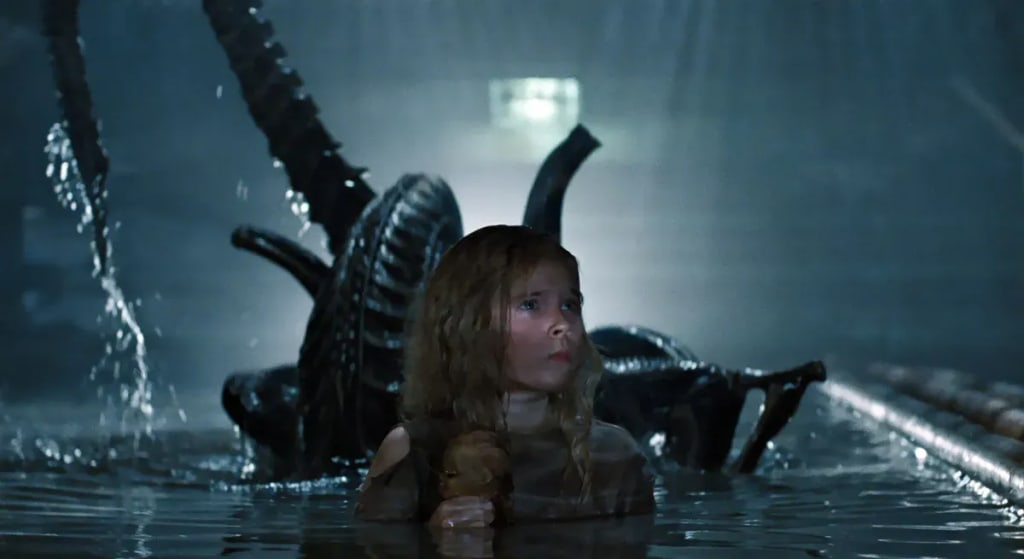
Aliens at 40: Celebrating James Cameron’s Nearly Perfect Science-Fiction Sequel
On July 18, 1986, audiences returned to the terrifying universe introduced by Ridley Scott’s Alien—but the experience waiting for them was larger, faster, louder, and more emotionally ambitious.
Written and directed by James Cameron, Aliens continued the story of Ellen Ripley while transforming the restrained haunted-house horror of the 1979 original into an explosive science-fiction war film.
It was a bold creative decision.
Rather than attempting to imitate Ridley Scott’s masterpiece, Cameron expanded its world, multiplied its creatures, introduced a memorable unit of Colonial Marines, deepened Ripley’s emotional journey, and created one of cinema’s most celebrated sequels.
Forty years after its theatrical release, Aliens remains a defining achievement in action, horror, science fiction, and blockbuster filmmaking. Its influence can be seen across movies, television, video games, comic books, military science fiction, and almost every story involving a heavily armed team entering an environment it does not fully understand.
Yet its lasting power does not come from gunfire, explosions, or Xenomorphs alone.
At the heart of Aliens is a story about grief, survival, motherhood, corporate greed, and the creation of a new family after unimaginable loss.
Aliens Was Released on July 18, 1986
Aliens opened theatrically on July 18, 1986, seven years after the release of Ridley Scott’s Alien. The official 20th Century Studios listing identifies the film’s runtime as 137 minutes and describes Ripley awakening after 57 years in hypersleep before returning to the colony world where her original nightmare began.
The sequel starred:
- Sigourney Weaver as Ellen Ripley
- Carrie Henn as Rebecca “Newt” Jorden
- Michael Biehn as Corporal Dwayne Hicks
- Bill Paxton as Private William Hudson
- Lance Henriksen as Bishop
- Paul Reiser as Carter Burke
- Jenette Goldstein as Private Vasquez
- William Hope as Lieutenant Gorman
- Al Matthews as Sergeant Apone
Although Cameron retained the Xenomorph and Ripley from the original, almost everything surrounding them was expanded.
The isolated commercial towing vessel Nostromo was replaced by a military expedition.
One alien became an entire colony.
A single nightmare hidden within dark corridors became a war against a seemingly unstoppable species.
Despite this increased scale, the sequel preserved the claustrophobia, dread, and body horror that had made the original so effective.
 Imrul
Imrul
 Imrul
Imrul
A Sequel That Refused to Repeat the Original
One of the greatest strengths of Aliens is that it does not simply recreate Alien with different characters.
Ridley Scott’s film is essentially a haunted-house story set aboard a spacecraft. Its horror comes from isolation, uncertainty, silence, darkness, and the inability to understand the creature hunting the crew.
Cameron recognized that repeating the same structure would likely produce a weaker imitation.
Instead, he asked what would happen if the Xenomorph threat were confronted by trained soldiers carrying advanced weapons.
At first, the Colonial Marines appear overwhelmingly prepared.
They are confident, heavily armed, technologically equipped, and accustomed to combat. Their attitude suggests that Ripley’s warnings are exaggerated and that the mission will be routine.
That confidence collapses almost immediately.
The Marines discover that their weapons, training, and bravado cannot protect them from an enemy that attacks from walls, ceilings, ventilation shafts, and darkness.
This structure allows Cameron to create something different without abandoning the core terror of the franchise.
Alien asks what happens when ordinary workers encounter one perfect predator.
Aliens asks what happens when military power confronts an entire species of them—and discovers it is not enough.
Horror Was Not Removed—It Was Reconfigured
Aliens is often described as the film that replaced horror with action.
That description is only partly correct.
Cameron undeniably introduced more combat, military technology, explosions, pursuit sequences, and large-scale spectacle. However, the creature horror remains present throughout the film.
The abandoned colony of Hadley’s Hope is deeply unsettling before a single Xenomorph appears.
The corridors are empty.
Furniture has been overturned.
Barricades have failed.
Personal belongings remain where frightened colonists abandoned them.
The colony’s silence creates the sense that something terrible happened there, but the details remain hidden.
When the Marines finally enter the atmospheric-processing station, the walls themselves appear to have changed. The alien hive blends biological material with industrial machinery, making it difficult to distinguish the environment from the creatures hiding within it.
The first major attack is not presented as a conventional action scene.
It is chaotic, dark, confusing, and terrifying.
The Marines cannot clearly see their attackers. Their ammunition creates additional danger. Communication breaks down, leadership fails, and experienced soldiers are killed before they fully understand what is happening.
The film’s action does not eliminate horror.
It demonstrates how quickly confidence and firepower can be destroyed by fear.
Ellen Ripley Returns—But Everything She Knew Is Gone
When Aliens begins, Ripley is rescued after drifting through space for 57 years.
For her, the events aboard the Nostromo feel recent. For everyone else, more than half a century has passed.
The world has moved on.
Her crewmates are dead.
Her warnings are dismissed.
Her professional reputation is damaged.
The company treats her testimony as inconvenient rather than heroic.
Most painfully, Ripley learns that her daughter, Amanda, lived an entire life and died while her mother remained lost in space.
This detail is more fully explored in the Special Edition, but its emotional importance shapes the entire film.
Ripley did not merely survive the first encounter.
She returned to a future in which she had lost everything she expected to go home to.
This is why her relationship with Newt becomes so central.
Ripley sees in the child both someone she must protect and a second opportunity to provide the maternal care that time stole from her.
Ripley’s Trauma Drives the Story
At the beginning of Aliens, Ripley suffers recurring nightmares.
She is physically safe, but emotionally she remains trapped aboard the Nostromo.
The company hearing provides no validation. Officials question her judgment and suspend her flight status. The corporation seems more concerned about the cost of the destroyed ship than the lives of its crew.
Ripley initially refuses to return to LV-426.
Her refusal is completely understandable. She has no reason to trust Weyland-Yutani, and she knows what the creatures can do.
However, she eventually realizes that avoiding the planet will not end her trauma.
Returning becomes an attempt to confront the nightmare directly.
Importantly, Ripley does not begin the mission as a soldier.
She joins as an adviser.
Her authority comes not from rank but experience. She is the only person who understands the enemy, yet the Marines repeatedly underestimate her until events prove her correct.
Her transformation into an action hero therefore feels earned.
She does not suddenly become fearless.
She acts despite fear because others depend on her.
Sigourney Weaver Redefined the Action Hero
Sigourney Weaver’s performance is the emotional foundation of Aliens.
She portrays Ripley as intelligent, frightened, compassionate, angry, practical, and extraordinarily resilient.
The character’s strength does not depend on removing her femininity or emotional vulnerability. Her maternal bond with Newt is not presented as a weakness. It becomes the source of her greatest courage.
Weaver received an Academy Award nomination for Best Actress, an unusual achievement for a performance in a science-fiction action film at that time. The nomination remains one of the clearest indications of how powerfully her work was received.
Ripley was not the first strong woman in cinema, but Aliens helped redefine what a female blockbuster hero could be.
She was not written as an imitation of a male action star.
She was not invulnerable.
She was not emotionally detached.
She survived through experience, judgment, empathy, determination, and an ability to remain functional while those around her collapsed.
Her most famous moments are powerful because the film carefully builds toward them.
By the time she steps forward in the Power Loader to confront the Alien Queen, the audience understands exactly what she is defending.
Ripley and Newt Give the Film Its Emotional Heart
The relationship between Ripley and Newt remains one of the most beautifully constructed elements of Aliens.
Newt is the sole known survivor of the Hadley’s Hope colony.
Like Ripley, she has survived an encounter that others cannot fully comprehend.
She has lost her parents, her brother, her home, and every familiar source of safety.
When the Marines discover her, she is living inside ventilation systems and hidden spaces, relying on instinct and knowledge of the colony’s structure.
Adults initially treat her as a frightened child who must be controlled.
Ripley listens to her.
This distinction is crucial.
Ripley understands that Newt survived because she is observant, intelligent, and capable. She does not dismiss the child’s fear because she has experienced the same disbelief herself.
Their bond develops gradually through trust.
Ripley cleans Newt’s face.
She offers her food.
She repairs her doll.
She promises to protect her.
Newt, in turn, becomes the emotional connection that allows Ripley to begin rebuilding her life.
Both characters have lost their original families.
Together, they form the beginning of a new one.
Two Mothers at War
The relationship between Ripley and Newt is mirrored by the connection between the Alien Queen and her eggs.
This parallel transforms the film’s climax into more than a physical confrontation.
Ripley enters the hive to rescue Newt and discovers the Queen protecting an enormous chamber filled with offspring.
For a brief moment, Ripley and the Queen appear to understand one another.
Ripley threatens the eggs with her flamethrower.
The Queen restrains the nearby drones.
A silent negotiation takes place between two mothers.
The agreement collapses, and Ripley destroys the eggs before fleeing with Newt.
The final confrontation aboard the Sulaco therefore becomes a battle between two maternal figures, each fighting to protect or avenge her offspring.
This thematic structure gives the climax emotional meaning beyond spectacle.
Ripley is not simply defeating a monster.
She is defending the daughter she has chosen.
Carrie Henn’s Performance as Newt
Carrie Henn had no previous professional acting experience when she played Newt.
Her performance is remarkable because the character could easily have become irritating, overly sentimental, or defined only by helplessness.
Instead, Newt is observant, resourceful, suspicious, and emotionally believable.
She knows more about surviving the colony than the trained soldiers.
Her warning—“They mostly come at night. Mostly.”—is memorable because it communicates both childhood vulnerability and terrifying experience.
Henn creates a character who has been forced to grow up quickly without losing the qualities of a frightened child.
Her chemistry with Weaver gives the film much of its humanity.
Although Henn did not continue pursuing acting as a career, Newt remains one of the most recognizable child characters in science-fiction cinema.
The Colonial Marines Are Unforgettable
James Cameron created a military unit whose members feel as though they existed before the movie began.
The Marines tease one another, argue, boast, complain, and communicate through the kind of shorthand associated with people who have worked together for a long time.
Even characters with relatively little screen time possess recognizable personalities.
Sergeant Apone is calm, authoritative, and respected.
Vasquez is fearless and aggressive.
Drake is physically imposing and closely connected to Vasquez.
Frost provides humor.
Gorman appears inexperienced and uncomfortable with command.
Hicks remains quiet, observant, and dependable.
Hudson is loud, boastful, funny, and psychologically unprepared for the scale of the threat.
The unit’s personality makes the first attack far more effective.
The audience does not see anonymous soldiers disappear.
It watches a close-knit group collapse.
Bill Paxton Made Hudson Iconic
The late Bill Paxton delivered one of the film’s most memorable performances as Private Hudson.
At the beginning, Hudson presents himself as an unstoppable soldier.
He boasts about the Marines’ weapons, technology, and combat capabilities.
After the first disastrous encounter, that confidence disappears.
His panicked reaction reflects the terror that other characters try to suppress.
Hudson’s famous cry of despair became one of the most quoted lines in science-fiction history.
Yet the character is more than comic relief.
Despite his fear, Hudson continues fighting.
He repairs equipment, helps defend the survivors, and ultimately dies while attacking the creatures rather than running from them.
Paxton understood that Hudson’s fear did not make him useless.
It made him human.
The character works because he expresses what many ordinary people would feel in the same situation.
Michael Biehn’s Hicks Is a Different Kind of Hero
Michael Biehn plays Corporal Dwayne Hicks with restraint.
Hicks is not the loudest Marine or the most physically intimidating.
He earns Ripley’s trust because he listens.
When command fails, Hicks accepts responsibility without becoming authoritarian.
He respects Ripley’s experience, teaches her how to use a pulse rifle, and supports her decisions when others hesitate.
His developing connection with Ripley is subtle.
The film does not interrupt its central story with an unnecessary romance. Instead, it creates mutual respect and the possibility of something deeper after survival.
Hicks also contributes to the film’s emerging family structure.
Ripley becomes the maternal protector.
Hicks becomes a steady paternal presence.
Newt becomes their shared responsibility.
Bishop occupies another important place within this improvised group.
Together, they form a fragile alternative to everything Ripley lost.
Jenette Goldstein Created an Action Icon in Vasquez
Jenette Goldstein’s portrayal of Private Vasquez became one of the film’s most influential supporting performances.
Vasquez is physically strong, aggressive, courageous, and completely comfortable within the military unit.
She is not treated as a novelty by the Marines. She belongs among them.
Her toughness is established almost immediately, but Goldstein also gives the character loyalty and emotional depth.
Vasquez’s final scenes with Gorman transform both characters.
Gorman, who earlier failed under pressure, returns to help her when she is injured.
Together, they make a final sacrifice rather than allow the aliens to capture them.
The moment gives Gorman redemption and allows Vasquez to die as she lived—defiant and unwilling to surrender.
Lance Henriksen’s Bishop Challenges Ripley’s Fear
Ripley’s distrust of Bishop comes directly from her experience with Ash, the android aboard the Nostromo who betrayed the crew.
When she learns Bishop is synthetic, she immediately assumes he may become another corporate threat.
Bishop spends the film challenging that assumption.
He is calm, helpful, self-sacrificing, and deeply committed to protecting human life.
His dangerous journey through the colony’s narrow tunnel system demonstrates courage without bravado.
His eventual return with the dropship appears to confirm his reliability—until the Alien Queen tears him apart.
Even after being severely damaged, Bishop continues trying to protect Newt.
Lance Henriksen gives the character a quiet humanity that contrasts with the behavior of several human characters, particularly Burke.
The film uses Bishop to ask an important question: what truly makes someone human?
The android behaves ethically.
The corporate representative does not.
Paul Reiser Made Burke Disturbingly Believable
Carter Burke is one of the most effective human villains in science-fiction cinema because he initially appears friendly and harmless.
Paul Reiser avoids playing him as obviously sinister.
Burke speaks softly, smiles, reassures Ripley, and presents himself as a reasonable company representative.
His betrayal is frightening because it reflects ordinary corporate calculation rather than grand villainy.
He is willing to sacrifice Ripley, Newt, and the Marines if it allows him to return with alien specimens.
His plan is not driven by madness.
It is driven by profit and career advancement.
Burke embodies one of the franchise’s central ideas: the Xenomorph may be biologically monstrous, but human greed repeatedly creates the conditions that allow it to kill.
The aliens behave according to their nature.
Burke chooses betrayal.
Gorman’s Failure and Redemption
Lieutenant Gorman begins the mission with authority but little practical combat experience.
He has completed only a small number of real operations, and his hesitation contributes to the disaster beneath the atmospheric processor.
His failure is frustrating because Ripley understands the situation more clearly than he does.
However, the film does not leave him as a coward.
Later, when Vasquez is injured and trapped, Gorman returns for her.
He knows they cannot escape.
Their final shared moment gives both characters dignity.
Gorman’s arc is brief but meaningful.
He begins as someone with rank but no tested courage.
He dies after finally finding it.
The Alien Queen Expanded the Mythology
One of Cameron’s greatest additions to the franchise was the Alien Queen.
The original film presented the Xenomorph’s reproductive cycle through the egg, Facehugger, Chestburster, and adult creature.
Aliens expanded that biology by introducing a central reproductive figure responsible for producing the eggs.
The Queen is physically larger and more intelligent than the other creatures.
She communicates through movement, controls the drones, understands threats, and demonstrates maternal aggression.
The design remains one of the greatest achievements in practical creature effects.
Rather than relying on modern digital imagery, the production used a massive physical creation operated by multiple performers and technicians.
The Queen’s size and weight give her an intimidating presence that still feels convincing decades later.
Her confrontation with Ripley became one of the most iconic battles in action cinema.
The Power Loader Scene Still Works
The Power Loader is introduced earlier in the film as an industrial machine used for moving heavy cargo.
This setup is essential.
When Ripley later uses it against the Alien Queen, the moment does not feel like a convenient last-minute invention.
It is a tool the audience has already seen her operate.
The sequence also reflects Ripley’s identity.
She defeats the Queen not because she suddenly becomes physically stronger, but because she understands machinery and knows how to use the tools available to her.
The scene combines character, spectacle, theme, and preparation.
It also produces one of cinema’s most famous confrontations.
The line Ripley delivers before attacking the Queen has become inseparable from the character and was playfully revisited by Weaver during the 2026 Academy Awards.
James Cameron’s Direction
Before Aliens, Cameron had directed The Terminator, but he was not yet established as one of Hollywood’s leading blockbuster filmmakers.
Aliens demonstrated many of the qualities that would define his career:
- Strong female protagonists
- Detailed fictional technology
- Clear action geography
- Class and corporate criticism
- Large-scale spectacle grounded in character
- Practical effects
- Relentless pacing
- Emotional storytelling within genre cinema
Cameron’s action scenes remain effective because the audience understands where the characters are, what they need to accomplish, and what will happen if they fail.
The film rarely creates spectacle without purpose.
Every major action sequence changes the situation.
The hive attack destroys the Marines’ confidence.
The operations-room siege removes their security.
The dropship crash eliminates their escape.
The reactor countdown creates a deadline.
Newt’s abduction gives Ripley a personal mission.
The Queen’s arrival aboard the Sulaco creates one final threat after apparent safety.
The film continually tightens its structure until Ripley must confront the enemy directly.
Cameron Expanded the World Without Overexplaining It
Aliens adds substantial information to the universe while preserving mystery.
Viewers learn about:
- Colonial settlements
- Military expeditions
- Weyland-Yutani’s corporate influence
- Terraforming technology
- Dropships
- Pulse rifles
- Synthetic humans
- Alien hive behavior
- The Alien Queen
- The broader existence of human space travel
However, Cameron does not pause the story for excessive exposition.
Most world-building appears through dialogue, production design, military procedures, and character behavior.
The technology feels functional because characters use it naturally rather than explaining every detail.
This approach inspired generations of science-fiction creators.
The Colonial Marines in particular became a template for military units in movies and games.
Practical Effects Give the Film Physical Weight
The effects in Aliens remain impressive because the creatures, sets, vehicles, weapons, and machinery appear to occupy real physical space.
The production relied heavily on:
- Creature suits
- Miniatures
- Rear projection
- Mechanical effects
- Puppetry
- Full-scale sets
- Optical compositing
- Physical explosions
- Forced perspective
The restrictions of the production often encouraged creative solutions.
Only a limited number of complete alien suits were available, but rapid editing, darkness, smoke, sound, and carefully chosen angles created the impression of an overwhelming swarm.
The result proves that effectiveness does not depend solely on showing more.
A few physical creatures, presented intelligently, can feel like an entire army.
James Horner’s Score
James Horner composed a powerful orchestral score that contributes significantly to the film’s momentum and emotion.
The music combines military rhythms, suspenseful strings, metallic sounds, and heroic themes.
Its creation occurred under difficult production circumstances, with Horner reportedly having limited time to complete and record the score.
Despite those challenges, the music became highly influential.
The urgent percussion accompanying the film’s final escape has been reused and imitated across trailers and action productions.
Horner’s quieter passages also support the emotional connection between Ripley and Newt.
The score is not merely loud or militaristic.
It understands when the film requires fear, sadness, wonder, or triumph.
The Film’s Sound Design
Sound is central to the terror of Aliens.
The creatures’ screams are distinct and immediately recognizable.
The pulse rifles sound heavy and dangerous.
Motion trackers create tension through increasingly rapid electronic pulses.
Doors, machinery, alarms, ventilation systems, and distant movement make the colony feel alive even when nothing is visible.
The motion tracker is especially effective because it gives characters information without giving them understanding.
They know something is approaching.
They do not know exactly where it is or how it will attack.
The famous sequence in which the creatures appear to be inside the room demonstrates how sound and incomplete information can create more fear than a clear image.
The Motion Tracker Became a Genre Symbol
Few fictional technologies have influenced science fiction and video games as strongly as the motion tracker.
Its display is simple.
Moving objects appear as points.
Distance decreases.
The warning sound becomes faster.
That basic design creates immediate tension because the audience can understand it instantly.
Countless games have borrowed the concept, especially survival-horror and military-science-fiction titles.
The device also captures one of the film’s central fears: knowing danger is close but being unable to see it.
Hadley’s Hope Feels Like a Real Place
Production design gives the colony a lived-in quality.
Hadley’s Hope is not a futuristic palace.
It is an industrial settlement built by workers and families in an unforgiving environment.
Its corridors, medical facilities, living quarters, vehicles, cafeterias, and maintenance spaces suggest a functioning community before the disaster.
The Special Edition strengthens this effect by showing colonists before the outbreak.
Viewers see Newt’s family and witness the discovery that begins the catastrophe.
Some prefer the theatrical version’s mystery, while others value the extended edition’s additional context and emotional depth.
Both versions demonstrate how effectively Cameron constructed the colony as more than an action setting.
It was Newt’s home.
Its destruction therefore carries human weight.
The Special Edition Adds Important Character Material
The Special Edition restores several notable sequences, including:
- Life at Hadley’s Hope before the outbreak
- The discovery of the derelict spacecraft
- Ripley learning about Amanda’s death
- Additional material involving the Marines
- Automated sentry-gun sequences
- More development between Ripley and Hicks
The revelation about Amanda is especially important because it clarifies why Ripley becomes so emotionally attached to Newt.
The sentry-gun scenes also create tension by showing ammunition gradually disappearing as unseen creatures repeatedly attack.
However, the theatrical cut has tighter pacing and preserves the mystery surrounding the colony’s fate.
Both versions offer distinct strengths.
The theatrical version is leaner.
The Special Edition is richer in character and world-building.
The Film’s Criticism of Corporate Greed
Weyland-Yutani remains one of the franchise’s most persistent threats.
The company repeatedly views the Xenomorph as a commercial or military opportunity rather than a danger that must be destroyed.
In Aliens, this attitude is represented through Burke.
The corporation’s willingness to risk human lives for profit gives the film a political dimension.
The Marines believe they are conducting a rescue mission.
Ripley believes they are eliminating a threat.
Burke sees a potential product.
This conflict remains relevant because the film understands that institutions can become dangerous when financial value is separated from moral responsibility.
The company does not need to hate the victims.
It simply considers them less valuable than the potential discovery.
Vietnam War Influences
Aliens contains clear echoes of the Vietnam War and other conflicts in which technologically superior military forces underestimated unfamiliar enemies.
The Colonial Marines arrive with overwhelming firepower and complete confidence.
They expect a quick operation against an inferior opponent.
Instead, they encounter enemies adapted perfectly to the local environment.
Their technology becomes unreliable.
Their chain of command collapses.
Their assumptions prove fatal.
Cameron uses military science fiction not only to celebrate soldiers but also to question institutional arrogance.
The individual Marines are brave.
The system that sent them into the colony without understanding the danger is irresponsible.
Masculinity, Bravado, and Real Courage
The film repeatedly contrasts performative toughness with genuine courage.
Hudson talks constantly about weapons and dominance before the attack.
Gorman has authority but initially cannot act decisively.
Burke appears calm but becomes cowardly and treacherous.
Ripley begins frightened but repeatedly moves toward danger to protect others.
Hicks rarely boasts, yet remains dependable.
Bishop appears physically less human than the others, yet risks himself without hesitation.
The film’s message is clear: courage is not the absence of fear or the performance of aggression.
Courage is choosing to act responsibly when fear is justified.
Why Aliens Is Often Considered Equal—or Superior—to Alien
Comparisons between Alien and Aliens have continued for decades.
The two films are difficult to rank because they pursue different goals.
Alien is slower, colder, more mysterious, and more purely horrific.
Aliens is faster, more emotional, more expansive, and more action-oriented.
The original may be the more formally perfect horror film.
The sequel may be the more satisfying character journey.
What makes Cameron’s achievement remarkable is that Aliens can reasonably be considered equal to its predecessor without copying it.
Many sequels become larger but less meaningful.
Aliens becomes larger while deepening its protagonist.
It expands the mythology while preserving the threat.
It increases the number of creatures without making them harmless.
It adds humor without undermining terror.
It provides emotional resolution while leaving the universe dangerous.
Current 40th-anniversary retrospectives continue to describe it as one of the greatest action-horror sequels ever made and emphasize its genre shift, maternal themes, action construction, practical effects, and lasting influence.
A Rare Sequel That Justifies Its Existence
Many sequels exist because a successful film created a recognizable brand.
Aliens feels necessary because it asks what happened to Ripley after she survived.
The original ends with physical escape.
The sequel examines emotional survival.
Ripley has escaped the creature but not the trauma.
She must return to the source of her fear, confront the institutions that ignored her, and choose whether she can risk caring for someone again.
The climax resolves more than an external threat.
When Ripley rescues Newt and defeats the Queen, she proves to herself that she is no longer powerless.
The film ends with Newt calling her “Mommy.”
That moment completes Ripley’s emotional journey.
She lost a daughter during her absence.
She found another through courage and compassion.
The Supporting Cast Elevates Every Scene
The film’s ensemble remains one of its greatest strengths.
Sigourney Weaver provides its emotional center.
Carrie Henn gives the story innocence and vulnerability.
Michael Biehn offers calm strength.
Bill Paxton provides humor, panic, and humanity.
Lance Henriksen gives Bishop grace and moral clarity.
Paul Reiser makes corporate betrayal disturbingly ordinary.
Jenette Goldstein creates one of cinema’s most recognizable soldiers.
William Hope portrays failure, fear, and redemption.
Al Matthews gives Apone natural command and authority.
Even characters with limited screen time remain memorable because the performances and dialogue suggest fully formed personalities.
The audience feels the unit’s losses because the Marines are not interchangeable.
The Legacy of Bill Paxton
Bill Paxton died in 2017, but his performance as Hudson remains inseparable from the film’s identity.
He brought nervous energy and improvisational humor to the role without weakening the story’s tension.
Hudson is often remembered for panic, but his final stand reveals genuine bravery.
Paxton later appeared in numerous major films and television productions, including Near Dark, Predator 2, True Lies, Apollo 13, Twister, Titanic, and Big Love.
His work with Cameron extended across several films.
In Aliens, he created a character whose fear, humor, and courage remain vivid four decades later.
The Film Expanded Alien Into a Franchise
The original film introduced a terrifying universe.
Aliens turned that universe into a larger franchise.
It added terminology, technology, military culture, creature biology, and world-building that influenced later films, novels, comics, toys, and games.
The Colonial Marines became especially important to the franchise’s identity.
Many later adaptations drew more heavily from Cameron’s military-action framework than from the original’s quiet horror.
The film’s success helped establish Alien as a property capable of supporting different genres and interpretations rather than one repeated formula.
Influence on Video Games
The influence of Aliens on video games is enormous.
Its impact can be seen in:
- Motion trackers
- Squad-based military dialogue
- Pulse-rifle-style weapons
- Industrial science-fiction environments
- Space marines
- Alien swarms
- Dropships
- Defensive last stands
- Mission structures involving abandoned colonies
- Corporate conspiracies
- Power-armored confrontations
Games such as Contra, Metroid, Doom, Halo, StarCraft, Gears of War, and numerous licensed Alien titles reflect aspects of its imagery or structure.
The phrase “space marine” existed before the film, but Cameron’s interpretation became one of popular culture’s defining versions.
Influence on Later Action Cinema
Aliens demonstrated how action could remain suspenseful even when protagonists possessed powerful weapons.
The key was to ensure that the enemy, environment, and circumstances remained more dangerous than the heroes’ equipment.
Later filmmakers borrowed its pattern:
- Introduce a confident team.
- Establish distinctive personalities.
- Send them into an unfamiliar environment.
- Destroy their assumptions.
- Reduce their resources.
- Force survivors to improvise.
- Build toward a desperate escape.
This structure appears across action, horror, war, and science-fiction films.
Few successors have matched the original combination of clarity, character, terror, and momentum.
Why the Film Has Aged So Well
Many science-fiction films from the 1980s remain entertaining but visibly tied to their period.
Aliens has aged unusually well because its design emphasizes functional realism.
The technology is worn, industrial, and physical.
The characters use keyboards, screens, tools, vehicles, and machinery that appear designed for work rather than visual novelty.
The film avoids excessive dependence on predictions about consumer technology.
Its themes have also remained relevant:
- Corporate disregard for human life
- Military overconfidence
- Trauma
- Institutional disbelief
- Artificial intelligence
- Reproductive fear
- Family created through choice
- Survival under impossible conditions
The emotional truth of Ripley and Newt’s relationship remains unaffected by changes in special-effects technology.
The Film’s Academy Recognition
Aliens received several Academy Award nominations and won for Best Visual Effects and Best Sound Effects Editing.
Sigourney Weaver’s Best Actress nomination was particularly important because major awards bodies historically overlooked performances in science-fiction, fantasy, horror, and action films.
Her nomination demonstrated that genre cinema could contain acting as complex and deserving of recognition as conventional prestige dramas.
It also helped establish Ripley as more than a popular action character.
She became one of cinema’s most respected dramatic protagonists.
James Cameron Became a Blockbuster Filmmaker
The critical and commercial success of Aliens helped establish Cameron as a director capable of managing ambitious studio productions.
He later directed:
- The Abyss
- Terminator 2: Judgment Day
- True Lies
- Titanic
- Avatar
- Avatar: The Way of Water
Many qualities associated with those films are already present in Aliens.
Technical ambition serves emotional storytelling.
Action grows from character decisions.
Powerful women occupy central roles.
Institutions underestimate dangers they believe they can control.
Spectacle builds toward intimate human choices.
Aliens was not merely an early success.
It provided the blueprint for much of Cameron’s later career.
Why Its Humor Works
The film contains a surprising amount of humor, particularly through Hudson and the interactions among the Marines.
This humor does not weaken the horror because it occurs naturally within the group.
Soldiers joke to relieve tension.
They tease one another because of familiarity.
Their confidence becomes ironic after the first attack.
The humor also makes the characters likable before they are placed in danger.
Without those lighter moments, the Marines might feel like functional pieces in an action sequence.
Because audiences laugh with them, their deaths feel more significant.
The Final Act Is a Masterclass in Escalation
The final section of Aliens remains one of the best sustained action sequences ever constructed.
The reactor is approaching destruction.
Newt has been taken.
The surviving characters must escape.
Ripley chooses to descend alone into the hive.
She rescues Newt.
They confront the Queen.
Bishop arrives with the dropship.
The colony explodes.
The survivors reach the Sulaco.
The film appears finished.
Then the Queen emerges.
Each stage increases danger without becoming confusing.
The geography remains clear.
The objectives remain understandable.
The emotional stakes remain personal.
Cameron’s control over pacing prevents the sequence from feeling repetitive despite its length.
The Controversial Fate of Newt, Hicks, and Bishop
The emotional investment created by Aliens made the opening of Alien 3 especially controversial.
That sequel revealed that Newt and Hicks had died before its main story began, while Bishop was damaged beyond recovery.
Many fans felt the decision erased the family that Aliens had spent its entire story constructing.
Cameron has remained highly critical of that choice, arguing that it discarded the audience’s emotional investment in the characters.
The controversy itself demonstrates the effectiveness of Aliens.
Viewers cared deeply about Ripley, Newt, Hicks, and Bishop because Cameron had made their connection feel meaningful.
Their survival was not merely a plot outcome.
It was the emotional reward of the film.
Is Aliens Better Than Alien?
There is no objective answer.
Alien is a masterpiece of atmospheric science-fiction horror.
Aliens is a masterpiece of action-horror and emotional storytelling.
The original is more mysterious.
The sequel is more expansive.
The original makes the Xenomorph unknowable.
The sequel develops its biology and social structure.
The original focuses on survival.
The sequel focuses on confronting trauma and protecting others.
Some viewers prefer the purity and restraint of Ridley Scott’s film.
Others find Cameron’s sequel more emotionally satisfying and endlessly rewatchable.
The remarkable achievement is that both films can stand as genre landmarks despite being dramatically different.
Forty Years Later, Aliens Still Feels Alive
On its 40th anniversary, Aliens remains thrilling because its spectacle is inseparable from its humanity.
Audiences remember the pulse rifles, motion trackers, Xenomorph hive, Power Loader, Alien Queen, dropship, and Colonial Marines.
But they also remember:
- Ripley promising Newt she will return
- Hicks giving Ripley the tracking device
- Bishop crawling toward Newt after being torn apart
- Hudson fighting despite his terror
- Vasquez and Gorman making their final stand
- Newt reaching for Ripley
- Ripley confronting the Queen as a mother
These moments endure because the film understands that action becomes meaningful when viewers care about the people involved.
Final Thoughts
James Cameron faced an almost impossible challenge when he agreed to follow Ridley Scott’s Alien.
The original was already considered a landmark of science-fiction horror.
Repeating it would have invited comparison.
Changing it risked alienating audiences.
Cameron succeeded because he respected the original without becoming trapped by it.
He retained the terror of the Xenomorph while building a different genre around it.
He expanded the world without overexplaining it.
He created memorable Marines whose humor and camaraderie made their losses matter.
He introduced the Alien Queen and added a powerful maternal dimension to the creature mythology.
Most importantly, he continued Ellen Ripley’s story in a way that gave her trauma, strength, grief, and survival emotional meaning.
Sigourney Weaver delivered a performance that helped redefine the action hero.
Carrie Henn gave the film its vulnerable heart.
Michael Biehn, Bill Paxton, Lance Henriksen, Paul Reiser, Jenette Goldstein, William Hope, Al Matthews, and the rest of the ensemble created characters who remain recognizable decades later.
Forty years after its release, Aliens is not simply remembered as a great sequel.
It remains one of the greatest science-fiction action films ever made.
It is intense, frightening, funny, emotional, technically accomplished, and nearly flawless in its construction.
Whether it is superior to its predecessor will always remain a matter of personal preference.
What is beyond dispute is that James Cameron created a sequel brave enough to become its own masterpiece.
Happy 40th anniversary to Aliens.
Frequently Asked Questions
When was Aliens released?
Aliens was released theatrically on July 18, 1986.
Who directed Aliens?
The film was written and directed by James Cameron.
Is Aliens a horror film or an action film?
It combines science-fiction, action, horror, military drama, and survival thriller elements. Although more action-oriented than Alien, it retains substantial creature horror and suspense.
How long after Alien is Aliens set?
Ripley is discovered after spending approximately 57 years in hypersleep.
Who plays Ellen Ripley?
Sigourney Weaver portrays Ellen Ripley.
Was Sigourney Weaver nominated for an Oscar?
Yes. Weaver received an Academy Award nomination for Best Actress for her performance in Aliens.
Who plays Newt?
Newt is played by Carrie Henn.
What is Newt’s real name?
Her full name is Rebecca Jorden, although nearly everyone calls her Newt.
Who plays Corporal Hicks?
Michael Biehn portrays Corporal Dwayne Hicks.
Who plays Hudson?
The late Bill Paxton plays Private William Hudson.
Who plays Bishop?
Lance Henriksen portrays Bishop, the synthetic crew member aboard the Sulaco.
Who plays Burke?
Paul Reiser plays Weyland-Yutani representative Carter Burke.
Who plays Vasquez?
Jenette Goldstein portrays Colonial Marine Private Vasquez.
Why does Ripley distrust Bishop?
Ripley previously encountered Ash, a synthetic officer who betrayed the crew of the Nostromo. She initially fears that Bishop may behave similarly.
What are the Colonial Marines?
They are a futuristic military unit sent to investigate the loss of communication with the Hadley’s Hope colony on LV-426.
What is Hadley’s Hope?
Hadley’s Hope is a human terraforming colony established on LV-426.
What is the Alien Queen?
The Queen is the enormous reproductive leader of the Xenomorph hive and produces the eggs from which Facehuggers emerge.
Did Aliens introduce the Alien Queen?
Yes. The Queen was one of the most important additions Cameron made to the creature’s mythology.
What is the Power Loader?
It is an industrial exoskeleton used for moving heavy cargo. Ripley later uses it to fight the Alien Queen.
What is the difference between the theatrical and Special Edition versions?
The Special Edition restores scenes involving Ripley’s daughter, life at Hadley’s Hope, sentry guns, and additional character development. The theatrical version has faster pacing.
Did Aliens win any Academy Awards?
Yes. It won Academy Awards for Best Visual Effects and Best Sound Effects Editing and received several other nominations.
Why is Aliens considered one of the greatest sequels?
It expands the original’s universe, changes genres without discarding the horror, deepens Ripley’s character, introduces memorable new characters, and tells a story that stands independently.
Is Aliens better than Alien?
That depends on personal preference. Alien is generally regarded as the more restrained horror film, while Aliens is celebrated as a larger action-horror epic with greater emotional scope.
How old is Aliens in 2026?
The film celebrates its 40th anniversary on July 18, 2026.