Jodie Foster’s A Private Life Is Coming to Netflix: Why This French Mystery Belongs on Your Watchlist
Jodie Foster is bringing one of her most intriguing recent performances to Netflix US. A Private Life, originally titled Vie privée, is scheduled to arrive on the platform on July 29, 2026, giving subscribers access to a stylish French-language mystery built around an apparent suicide, a suspicious psychiatrist, and an investigation that becomes increasingly personal.
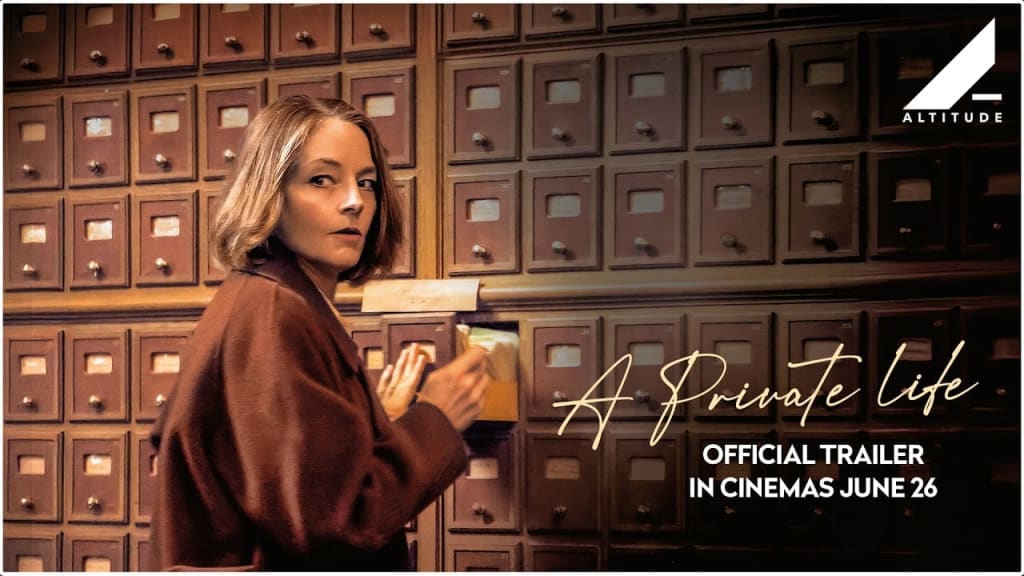
Foster plays Lilian Steiner, a respected Parisian psychoanalyst who becomes convinced that one of her patients was murdered. Rather than accept the official explanation, she begins investigating the death herself, uncovering secrets while confronting uncomfortable questions about her work, family, memories, and private identity.
Directed by Rebecca Zlotowski, the approximately 105-minute film combines psychological drama, detective fiction, dark comedy, family tension, and moments of surrealism. It is not a conventional crime thriller that races from clue to clue. Instead, it follows an intelligent but increasingly destabilized woman as professional certainty gives way to obsession.
For viewers who enjoy mysteries driven by character, atmosphere, and ambiguity rather than constant action, A Private Life could become one of Netflix’s most interesting additions of July 2026.
A Private Life is scheduled to become available on Netflix US on July 29, 2026.
The date applies specifically to the United States catalog. Netflix availability frequently differs between countries because distribution and licensing agreements are negotiated by territory.
Viewers outside the United States should therefore check their regional Netflix listings rather than assume the film will arrive worldwide on the same day.
The Netflix release is also better described as the film’s Netflix subscription debut rather than its first digital release. A Private Life previously became available through transactional video-on-demand services, where viewers could rent or purchase it. Sony Pictures Classics currently lists the film as available to watch through home-entertainment platforms.
Netflix catalog reporting identifies July 29, 2026, as the planned US arrival date. Streaming schedules can occasionally change, so subscribers may want to verify the listing closer to release day.
The Cannes Film Festival’s official listing identifies the film as a French production with a 105-minute runtime. Rotten Tomatoes also lists it at one hour and 45 minutes.
Lilian Steiner is a highly regarded psychoanalyst living and working in Paris.
She is accustomed to occupying the position of authority in a conversation. Patients enter her office, describe their fears and desires, and expect her to recognize patterns they cannot see themselves.
That confidence is disrupted when Lilian learns that one of her patients, Paula Cohen-Solal, has died.
The death is treated as a suicide, but Lilian becomes convinced that something is wrong. Whether motivated by professional guilt, intuition, wounded pride, genuine evidence, or an unstable combination of all four, she refuses to let the matter rest.
Lilian begins investigating Paula’s life and family. Her questions lead her toward Paula’s husband, Simon, and daughter, Valérie, while also pulling Lilian’s former husband, Gabriel, into her amateur detective work.
The deeper Lilian searches, the less reliable her understanding of the case becomes.
Is she uncovering a murder?
Is she projecting her own emotions onto the patient’s death?
Did she miss something important during therapy?
Is her investigation about justice, guilt, control, or a desire to escape the disorder in her own life?
The film does not immediately separate these possibilities. That uncertainty becomes its central source of suspense.
Sony Pictures Classics summarizes the story as Lilian mounting a private investigation into the death of a patient she believes was murdered. The Cannes synopsis similarly emphasizes that her conviction drives her beyond the expected boundaries of her profession.
The strongest reason to approach A Private Life without detailed spoilers is that the film is designed around uncertainty rather than a simple chain of evidence.
Lilian is not a trained police detective. She is a psychiatrist attempting to apply her understanding of human behavior to a possible crime.
That gives her certain advantages.
She knows how people conceal information. She listens for contradictions, emotional displacement, avoidance, and changes in language. She understands that what a person refuses to discuss may be as important as what they say openly.
However, those same skills can become liabilities.
A psychoanalyst is trained to interpret. An investigator must also know when not to interpret too much.
Lilian’s professional habits encourage her to search for hidden meaning everywhere. Every hesitation becomes suspicious. Every family conflict appears potentially connected to the death. Every private memory seems capable of changing the case.
The film keeps viewers questioning whether Lilian is becoming a brilliant investigator or an unreliable one.
Jodie Foster gives A Private Life its center of gravity.
Lilian Steiner is intelligent, accomplished, observant, impatient, emotionally guarded, and not always easy to like. She is accustomed to diagnosing other people while maintaining careful control over how much of herself she reveals.
The patient’s death disrupts that arrangement.
As the investigation develops, Lilian is forced out of the protected environment of her consulting room. She must interact with grieving relatives, revisit professional decisions, ask for help, and tolerate the possibility that her judgment may be wrong.
Foster avoids turning Lilian into a traditional heroic detective.
She can be perceptive in one scene and socially clumsy in the next. She is capable of genuine empathy, but she can also become self-absorbed. Her confidence is impressive until it begins resembling denial.
This complexity allows the film to create suspense without depending entirely on the identity of a possible murderer.
The mystery is also about Lilian.
Viewers are not only asking what happened to Paula. They are asking what the investigation will expose about the woman pursuing the truth.
Many amateur detectives are written as naturally charming outsiders. Lilian is different.
She does not investigate because solving crimes has always fascinated her. She investigates because one specific death threatens her understanding of herself.
Paula was not simply a stranger. She was someone who trusted Lilian with private thoughts and emotional pain.
If Paula was murdered, Lilian may have access to information that others missed.
If Paula died by suicide, Lilian may have to confront the possibility that she failed to recognize the danger.
Either interpretation places pressure on her professional identity.
The case becomes impossible for her to treat objectively because it is inseparable from guilt.
One of the film’s biggest points of interest is Jodie Foster’s French-language performance.
Foster has spoken French fluently for many years. She attended the Lycée Français de Los Angeles and has maintained a close connection with French language and cinema throughout her career.
She has previously appeared in French productions and worked with European filmmakers, but A Private Life represents her first leading role performed primarily in French.
At the 2025 Cannes Film Festival, Foster discussed how acting in French affected her performance and sense of identity. She described the experience as different from performing in English because language changes rhythm, emotional expression, and personality.
That difference benefits the character.
Lilian is an American who has built her adult life in Paris. She is fluent and professionally established, yet her identity exists between cultures.
Foster’s French does not feel like a promotional trick attached to an English-language star. It becomes part of Lilian’s psychology.
The slight difference in cadence, emotional timing, and verbal confidence helps create a woman who belongs in Paris while still retaining the perspective of someone who came from elsewhere.
People often assume that fluency means language becomes emotionally neutral.
In reality, speaking a second language can affect how someone presents anger, affection, humor, vulnerability, and authority.
A person may sound more direct in one language and more cautious in another. Certain memories may feel connected to the language in which they were originally experienced.
For Lilian, French is the language of her professional authority and present-day life.
English represents another layer of identity, history, and emotional memory.
The film’s use of language therefore supports its interest in private and public selves. Lilian may be fluent in what she says to others while remaining less fluent in what she tells herself.
Rebecca Zlotowski directed and co-wrote A Private Life with Anne Berest and Gaëlle Macé.
Zlotowski is known for films that place psychologically complicated women inside stories involving desire, family, memory, power, and social identity.
Her earlier work includes:
Other People’s Children, starring Virginie Efira, received particular attention for its emotionally nuanced portrayal of a woman forming a bond with her partner’s child while reconsidering her own desires and future.
With A Private Life, Zlotowski moves into mystery territory without abandoning her interest in intimate relationships.
The possible crime gives the story momentum, but the film remains concerned with marriage, therapy, family history, aging, identity, grief, and the stories people invent to understand their lives.
Zlotowski has said that working with Foster represented a long-held ambition. The project was developed around the possibility of giving Foster a French-language character complex enough to justify their collaboration.
Viewers expecting a dark and relentlessly serious murder investigation may be surprised by the film’s tone.
A Private Life contains suspense, but it also includes comedy, romantic history, family irritation, awkward behavior, surreal imagery, and psychological absurdity.
TIFF described it as a slyly comic psychological thriller. Rotten Tomatoes characterizes it as a mixture of Hitchcockian suspense, polished visuals, and playful camp.
That combination makes the film more unusual than its basic synopsis suggests.
At different moments, it can resemble:
The shifts will appeal to viewers who enjoy movies that resist clear categorization.
They may frustrate anyone seeking a tightly engineered police procedural with realistic investigative methods and a neatly explained conclusion.
The film can reasonably be described as a slow-burn mystery, but that label needs qualification.
Its suspense develops through character behavior, contradictions, emotional discomfort, and Lilian’s changing state of mind. It does not rely on violent set pieces or frequent physical danger.
However, A Private Life is not solemn from beginning to end.
Its comic energy makes it lighter and stranger than many psychological thrillers. Lilian’s investigation sometimes has the awkwardness of an intelligent person entering a profession she does not understand.
She may know the human mind, but that does not make her good at surveillance, interrogation, or maintaining social boundaries.
The pleasure comes partly from watching a controlled professional become increasingly uncontrolled.
The film’s tension comes from several questions:
These questions accumulate gradually.
The film is more interested in destabilizing certainty than creating constant danger.
Daniel Auteuil plays Gabriel Haddad, Lilian’s former husband.
Gabriel becomes an important partner in her investigation, but his presence does more than give Lilian someone with whom to discuss clues.
Their history adds another kind of mystery.
The audience must determine what remains between them after the end of their marriage. Affection, irritation, familiarity, attraction, resentment, and mutual dependence can exist simultaneously.
Auteuil brings warmth and comic timing to the role.
His chemistry with Foster helps prevent the film from becoming trapped inside Lilian’s anxiety. Gabriel can challenge her assumptions while also enabling some of her more questionable decisions.
Their detective partnership has the energy of two people who know exactly how to annoy each other but remain unable to detach completely.
Several critics have highlighted Foster and Auteuil’s chemistry as one of the film’s strongest qualities.
A Private Life brings together a notable group of French and European performers.
Virginie Efira plays Paula, the patient whose death begins the investigation.
Although Paula’s absence drives the plot, the character remains present through memories, therapy, testimony, family relationships, and the different versions of her life constructed by others.
Efira previously starred in Zlotowski’s acclaimed Other People’s Children.
Mathieu Amalric plays Paula’s husband, Simon.
Amalric is known internationally for films including The Diving Bell and the Butterfly, Quantum of Solace, Munich, and The French Dispatch.
Simon becomes one of the people Lilian examines as she attempts to determine whether Paula’s death was truly a suicide.
Luàna Bajrami plays Paula and Simon’s daughter, Valérie.
Her grief and anger complicate Lilian’s investigation. From the family’s perspective, the psychiatrist asking intrusive questions may be less a heroic truth-seeker than an unwelcome professional attempting to avoid responsibility.
Vincent Lacoste plays Julien, the son of Lilian and Gabriel.
His presence brings the investigation into Lilian’s family life and reinforces the film’s interest in the distance between professional insight and personal understanding.
Lilian may be skilled at analyzing patients, but that does not necessarily mean she understands her own child, former husband, or family dynamics.
The official Cannes cast listing confirms Foster, Auteuil, Efira, Amalric, Lacoste, and Bajrami in these central roles.
The ensemble gives the film credibility even when its plot becomes deliberately eccentric.
Each actor brings an established screen identity.
Foster provides intensity and analytical intelligence.
Auteuil introduces warmth, romance, and humor.
Efira gives emotional weight to a woman who must remain vivid despite her absence.
Amalric can make an apparently ordinary conversation feel unpredictable.
Lacoste brings understated comedy and generational tension.
Bajrami gives the victim’s family a necessary perspective that challenges Lilian’s self-image.
This matters because A Private Life depends less on elaborate action than on the meanings hidden inside conversations.
A look, pause, defensive response, or strangely timed joke can alter how the audience understands a character.
A Private Life began attracting attention well before its arrival on Netflix.
The film premiered Out of Competition at the 2025 Cannes Film Festival.
Its Cannes selection gave the project a high-profile international launch and drew attention to Foster’s first major French-language leading role.
The official Cannes listing identifies Rebecca Zlotowski as director and presents the film’s central premise: a renowned psychiatrist becomes convinced that a patient’s death was murder and decides to investigate.
The film later screened at the Toronto International Film Festival.
TIFF promoted it as a slyly comic psychological thriller and emphasized the collaboration between Foster and Zlotowski.
Vie privée was selected as the closing film of the 51st Deauville American Film Festival in September 2025.
The choice was especially appropriate because the film represents an unusually direct meeting between French and American cinema: an American star performing in French for a French director within a Paris-set story.
The film also appeared at other major events, including the New York Film Festival, the BFI London Film Festival, and the American French Film Festival.
Critical response has been generally positive, although not universally enthusiastic.
As of July 5, 2026, Rotten Tomatoes lists A Private Life with an 82 percent Tomatometer score based on 142 reviews. Because aggregate ratings can change as additional reviews are added, the percentage should be treated as a current snapshot rather than a permanent figure.
The critical consensus praises:
The most common criticisms involve:
This divided response is useful for setting expectations.
The film is not being praised as a perfectly constructed whodunit. It is being praised primarily as an eccentric, stylish character study held together by Foster.
Foster has built much of her career around intelligent characters placed under psychological pressure.
Her most celebrated roles frequently involve women who must maintain control while confronting danger, institutional failure, trauma, or moral uncertainty.
Lilian fits within that tradition but adds a more comic and self-critical dimension.
She is not Clarice Starling pursuing a serial killer with extraordinary discipline.
She is not the fiercely protective mother from Panic Room.
She is not the isolated detective from True Detective: Night Country.
Lilian is capable, but she is also messy.
Her investigation exposes vanity, insecurity, loneliness, and emotional blind spots. Foster allows those weaknesses to become funny without reducing the character to a joke.
Even critics who found the mystery unconvincing frequently singled out Foster as the reason the film remained engaging. Rotten Tomatoes’ review excerpts repeatedly emphasize her choices, screen presence, fluency, and ability to hold together the film’s conflicting tones.
On the surface, Lilian is trying to determine how Paula died.
At a deeper level, she is attempting to regain authority.
A patient’s unexpected death represents a rupture in the psychiatrist’s carefully ordered world. Lilian is supposed to interpret distress before it becomes irreversible.
Paula’s death suggests that something escaped her understanding.
By transforming the death into a murder mystery, Lilian may be giving herself a problem she believes she can solve.
Murder offers an external culprit.
Suicide leaves her with more painful questions about treatment, responsibility, listening, and failure.
The investigation can therefore be interpreted in several ways:
The film does not force viewers to select only one explanation.
Lilian’s motives can be sincere and self-serving at the same time.
A Private Life is fascinated by psychoanalysis, but it does not treat therapy as magical access to truth.
Lilian has spent years listening to people describe dreams, memories, fears, family conflicts, and desires. Her profession depends on the belief that hidden patterns can be interpreted.
The investigation tests that belief.
Real evidence does not always behave like a dream.
A contradiction may indicate deception, but it may also reflect grief.
Hostility may reveal guilt, but it may also be a reasonable response to an intrusive stranger.
A patient’s account may contain symbolic truth without providing literal information about a crime.
Lilian’s greatest professional strength is her willingness to search beneath the surface. Her greatest weakness is the assumption that every surface must conceal something.
The title operates on several levels.
Every patient has a private life that even a therapist may never fully understand.
Paula’s private life becomes the subject of Lilian’s investigation.
Lilian also has a private self concealed beneath her professional authority.
Gabriel, Julien, Simon, Valérie, and the other characters each possess motives, memories, and emotional histories that cannot be completely accessed from the outside.
The title also reflects Jodie Foster’s own cultural identity.
Foster has lived much of her life under public scrutiny while protecting her personal relationships and family. Casting her in a film about the boundary between public, professional, and hidden identities gives the material additional resonance.
The mystery asks whether anyone can truly know another person’s private life.
The psychological drama asks whether people even understand their own.
The Paris setting gives A Private Life elegance, but it also supports the film’s psychological structure.
Lilian moves between controlled interiors and unpredictable public spaces.
Her consulting room represents professional order. People sit in expected positions, follow established rules, and reveal information according to a familiar ritual.
Outside that room, Lilian loses control.
Apartments, streets, family homes, medical spaces, and social encounters create new roles she cannot manage as easily.
Paris also contributes to the film’s relationship with classic European thrillers.
The architecture, apartments, cafés, clothing, and restrained visual style create an atmosphere that can appear sophisticated even while the characters behave irrationally.
That contrast strengthens the film’s dark comedy.
The surface remains polished while the people beneath it become increasingly disordered.
The film has frequently been described as Hitchcockian.
That comparison does not mean it copies one specific Alfred Hitchcock film. It refers to several broader characteristics:
Rebecca Zlotowski does not attempt to imitate Hitchcock’s style completely.
She combines those influences with contemporary French comedy, family drama, psychoanalytic satire, and surreal imagery.
The result is less controlled than a classic Hitchcock thriller but also more unpredictable.
Only partly.
A patient’s death and the possibility of murder give the story serious stakes. Themes of suicide, professional responsibility, grief, trauma, and family conflict are treated with genuine weight.
However, the film is not relentlessly dark.
It frequently finds humor in Lilian’s behavior, particularly when her confidence exceeds her investigative competence.
The relationship between Lilian and Gabriel also introduces elements of screwball comedy. Their shared history creates rapid shifts between cooperation, frustration, attraction, and disagreement.
Viewers should expect tonal variety rather than a single mood.
A Private Life is not a horror movie.
It does not depend on monsters, graphic violence, or sudden jump scares.
Its discomfort is psychological.
The film explores the fear that professional competence may be an illusion, that another person may remain unknowable, and that searching for hidden truth can expose parts of oneself that were safer when ignored.
There are unsettling and surreal moments, but viewers seeking traditional horror may find the film too restrained.
Those who enjoy psychological unease and ambiguous reality are more likely to appreciate its approach.
The film is likely to appeal to viewers who enjoy:
Fans of productions such as Anatomy of a Fall, Only Murders in the Building, Elle, Swimming Pool, Personal Shopper, or character-focused Hitchcock mysteries may find something familiar in its combination of wit, suspicion, and psychological instability.
The comparisons are tonal rather than exact. A Private Life has its own playful and occasionally surreal identity.
The film may not satisfy viewers who prefer:
Its mystery is important, but the film is not interested only in solving the case.
Lilian’s emotional and psychological unraveling receives at least as much attention as the evidence.
A few expectations can help viewers appreciate the film on its own terms.
English-speaking viewers should expect subtitles unless they understand French.
The French-language performance is one of the film’s main attractions, not an obstacle the production attempts to hide.
The death of a patient sounds like the beginning of an extremely dark thriller.
The finished film mixes that darkness with eccentric comedy, romance, and surreal psychological detours.
The mystery may divide viewers, but Foster’s performance is the film’s most consistently praised element.
The film was produced and released independently of Netflix, with Sony Pictures Classics handling its US theatrical distribution.
Netflix is adding the film to its US licensed catalog rather than releasing it as an original production.
Some promotional descriptions have listed the movie at 104 minutes, while Cannes and Rotten Tomatoes identify a runtime of approximately 105 minutes. The difference may reflect rounding or regional versions.
Festival films and limited theatrical releases often struggle to reach a large general audience.
A Private Life opened in a limited number of US theaters in January 2026 and earned approximately $1.4 million domestically according to Rotten Tomatoes’ current listing.
That limited release means many Jodie Foster fans may not have had a practical opportunity to see it in cinemas.
Netflix can substantially expand the audience for a film like this.
The recognizable lead actor may attract viewers who would not normally search for a French psychological mystery. Once discovered, the film can introduce those viewers to Rebecca Zlotowski, Daniel Auteuil, Virginie Efira, Mathieu Amalric, Luàna Bajrami, and contemporary French cinema more broadly.
Its manageable runtime also makes it easier to select than a limited series or multi-hour crime saga.
Certain movies are better positioned for streaming discovery than theatrical success.
A Private Life has several qualities that could help it gain attention on Netflix:
Netflix viewers frequently discover international films through recognizable actors or familiar genre categories.
A Jodie Foster mystery can function as an accessible entry point into a film that is more European, eccentric, and psychologically playful than its thumbnail may initially suggest.
A Private Life appears worth watching for viewers interested in Jodie Foster, French cinema, unconventional mysteries, and psychologically complicated protagonists.
Its greatest strengths are clear:
Its limitations are equally important:
The best reason to watch is not the promise of a perfect whodunit.
It is the chance to watch Jodie Foster play a brilliant woman whose confidence becomes both her investigative tool and her greatest obstacle.
A Private Life arrives on Netflix US with a compelling combination of prestige and accessibility.
It has a two-time Academy Award winner in the lead, a respected French director, a celebrated supporting cast, an 82 percent current Tomatometer score, and appearances at Cannes, Toronto, Deauville, New York, and London.
More importantly, it offers something different from the average streaming thriller.
Lilian Steiner is not a police officer chasing an obvious killer. She is a psychiatrist trying to interpret a death while losing control of the emotional boundaries that once protected her.
The investigation becomes a mirror.
Every secret she uncovers raises another question about guilt, memory, marriage, family, language, and the limits of understanding another person.
Viewers seeking a fast, brutal crime story may find the film too playful.
Those who enjoy mysteries that leave room for comedy, ambiguity, and psychological contradiction may find it far more rewarding.
A Private Life is scheduled to stream on Netflix US beginning July 29, 2026.
Clear the evening, turn on the subtitles, and prepare to question not only who may be lying—but whether the person asking the questions can trust her own interpretation of the truth.
A Private Life is scheduled to arrive on Netflix US on July 29, 2026. The date applies to the US catalog and may differ in other countries.
No. A Private Life is a French production distributed theatrically in the United States by Sony Pictures Classics. Netflix is licensing the film for its US streaming catalog.
The film follows Lilian Steiner, a respected psychiatrist who becomes convinced that one of her patients was murdered. She begins a private investigation that forces her to examine the patient’s family, her professional decisions, and unresolved parts of her own life.
Jodie Foster plays Lilian Steiner, the psychiatrist at the center of the mystery.
Yes. The film is primarily French-language, with Jodie Foster performing her first leading role predominantly in French.
Yes. Foster attended the Lycée Français de Los Angeles and has spoken French for many years. She has previously worked in French cinema, although A Private Life is her first major French-language lead performance.
The original title is Vie privée, which translates directly as “Private Life.”
Rebecca Zlotowski directed the film and co-wrote it with Anne Berest and Gaëlle Macé.
The cast includes Daniel Auteuil, Virginie Efira, Mathieu Amalric, Vincent Lacoste, Luàna Bajrami, Noam Morgensztern, and Sophie Guillemin.
The film runs for approximately 105 minutes, or one hour and 45 minutes.
Yes, but it is not a conventional police procedural. It combines an amateur murder investigation with psychological drama, dark comedy, romance, family conflict, and surreal elements.
Yes. Its tension develops gradually through conversations, suspicion, emotional instability, and uncertainty about Lilian’s interpretation of events.
The film is psychologically unsettling but is not a traditional horror movie. It does not rely on monsters or frequent jump scares.
Yes. Although the story begins with a patient’s death, the film includes dark comedy and playful scenes, particularly involving Lilian and her former husband Gabriel.
Daniel Auteuil plays Gabriel Haddad, Lilian’s former husband and reluctant investigative partner.
Virginie Efira plays Paula Cohen-Solal, the patient whose death begins Lilian’s investigation.
Yes. It premiered Out of Competition at the 2025 Cannes Film Festival.
Yes. The film screened at the Toronto International Film Festival, where it was presented as a slyly comic psychological thriller.
Yes. Vie privée was selected as the closing film of the 51st Deauville American Film Festival in September 2025.
As of July 5, 2026, the film holds an 82 percent Tomatometer score based on 142 critic reviews. The score may change as new reviews are added.
Positive reviews frequently praised Jodie Foster’s performance, her French-language delivery, her chemistry with Daniel Auteuil, the Parisian visuals, and the film’s playful mixture of suspense and comedy.
Some critics found the mystery convoluted, the genre shifts distracting, and the surreal elements insufficiently connected to the main investigation.
No major source identifies it as an adaptation of a novel. It was written for the screen by Rebecca Zlotowski, Anne Berest, and Gaëlle Macé.
The film is rated R in the United States for language, graphic nudity, brief violence, and some sexual content. It is intended for mature audiences.
The confirmed reported date concerns Netflix US. Availability in the United Kingdom, Canada, Australia, Bangladesh, and other territories may differ because streaming rights vary by country.
Yes. The movie previously received theatrical and transactional digital releases. Its July 29 arrival marks its addition to Netflix US rather than its first-ever home release.
Yes. Foster’s performance is the most consistently praised part of the film, and her work in French gives the role a distinct rhythm compared with many of her English-language characters.
Subtitles are the best option for viewers who want to experience Foster’s original French-language performance and the vocal work of the French cast.
The film resolves important parts of its story, but its psychological and tonal ambiguity may leave viewers debating certain choices and meanings afterward.
Its combination of French-language performance, psychoanalysis, dark comedy, former-spouse chemistry, surreal memory, and amateur investigation distinguishes it from more conventional crime thrillers.