Why As Above, So Below Is an Underrated Horror Gem
Some horror movies need darkness, monsters and elaborate sets to make you feel trapped.
As Above, So Below had the Paris Catacombs.
Released in 2014 and directed by John Erick Dowdle, the found-footage horror film follows archaeologist Scarlett Marlowe into the tunnels beneath Paris in search of the legendary Philosopher's Stone. What begins as an archaeological adventure gradually turns into something far stranger: a descent through guilt, alchemy, religious symbolism and what appears to be Hell itself.
Critics were largely unimpressed when the film arrived. Rotten Tomatoes currently records only a 30% critics' score, while Metacritic lists a score of 39.
Yet the movie never really disappeared.
Instead, As Above, So Below slowly found the audience that seemed to understand what it was trying to do.
Today it is frequently mentioned among the most underrated horror films of the 2010s.
And there is a good reason.
Beneath the shaky cameras and jump scares is one of the most ambitious found-footage concepts of its era: Indiana Jones descends through Dante's Inferno while carrying a camera.
What Is As Above, So Below About?
Scarlett Marlowe, played by Perdita Weeks, is an archaeologist obsessed with completing the work of her deceased father.
Her objective is almost impossibly ambitious.
She wants to find the Philosopher's Stone.
In alchemical legend, the Philosopher's Stone is a substance capable of transforming base metals into gold and, in some traditions, producing an elixir capable of granting extraordinary longevity.
Scarlett believes clues left by the legendary alchemist Nicolas Flamel point toward the stone's location beneath Paris.
She recruits George, played by Ben Feldman, to help translate the clues.
A cameraman named Benji accompanies them.
Once in Paris, they connect with a group of urban explorers who know the illegal sections of the Catacombs.
The plan sounds straightforward.
Enter.
Find the hidden chamber.
Retrieve the stone.
Leave.
Naturally, they do almost none of those things successfully.
The group enters increasingly unfamiliar tunnels.
Passages collapse.
Impossible rooms appear.
People begin seeing things connected to their past.
And eventually the characters realize that the place beneath Paris may not simply be underground.
They may have crossed into something much worse.

The Paris Catacombs Were Not Just a Movie Set
This is where As Above, So Below immediately gains an advantage over most horror films.
Much of it was filmed inside the actual Paris Catacombs.
The production became the first movie granted permission by French authorities to shoot extensively inside both publicly accessible and restricted areas of the Catacombs.
That authenticity matters.
You can build narrow stone corridors on a soundstage.
You can scatter bones across the walls.
You can create artificial darkness.
But real underground spaces behave differently.
They feel irregular.
Dirty.
Wet.
Unpredictable.
The Catacombs contain all of those qualities naturally.
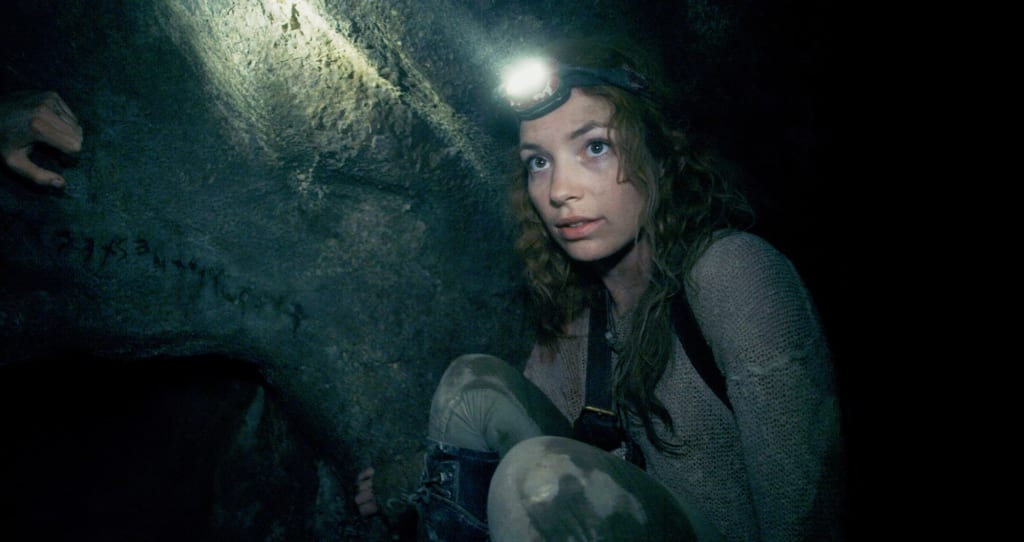
Production itself was extremely difficult. There was no ordinary electrical infrastructure in many of the locations, and wireless equipment could be unreliable underground. Actors wore cameras and used their own headlamps while navigating narrow passages.
The filmmakers deliberately leaned into those limitations.
Instead of fighting the environment, they allowed it to define the movie.
The result is one of the few found-footage films where the setting feels genuinely capable of killing the characters even before anything supernatural happens.
What Are the Paris Catacombs?
Beneath Paris lies an enormous network of former limestone quarry tunnels.
Beginning in the late 18th century, authorities transferred human remains from overcrowded Parisian cemeteries into sections of these underground quarries.
Today, the official ossuary contains the bones of millions of people.
Only a relatively small portion of the network is legally accessible to tourists.
Beyond those public corridors lies a much larger subterranean maze.
Unofficial explorers known as cataphiles have spent decades entering restricted portions of the tunnels.
That real-world mythology gives As Above, So Below an enormous head start.
The movie does not need to convince us that the location is disturbing.
A labyrinth beneath one of the world's most famous cities, lined with human skulls and largely inaccessible to ordinary visitors, already sounds like horror fiction.
Except it exists.
The Movie Understands Why the Catacombs Are Frightening
The obvious way to make a Catacombs horror movie would be to fill the tunnels with ghosts.
As Above, So Below does something more interesting.
Its first major source of fear is simply space.
The characters squeeze through gaps barely wider than their bodies.
They crawl through tunnels.
They descend deeper without knowing whether another exit exists.
There are moments when the ceiling seems only inches from the camera.
For viewers uncomfortable with enclosed spaces, the movie can become physically unpleasant before anything explicitly supernatural appears.
This claustrophobia is strengthened by the found-footage format.
A traditional wide shot could reassure us by showing where everyone is standing.
Here, visibility is restricted.
Someone may be two meters away and still disappear into darkness.
The camera itself becomes trapped.
That is exactly where found footage works best.
Why Found Footage Actually Makes Sense Here
By 2014, found footage had become one of horror's most overused techniques.
After The Blair Witch Project, Paranormal Activity, REC, Cloverfield and countless imitators, audiences had become familiar with the formula.
Someone carries a camera.
Something horrible happens.
For reasons increasingly difficult to justify, they keep filming.
As Above, So Below occasionally suffers from those same conventions.
But its choice of format is unusually defensible.
Scarlett's expedition is being documented.
Some cameras are attached directly to the explorers.
Light sources and recording equipment overlap.
The environment itself makes handheld footage feel natural.
Director John Erick Dowdle and his brother Drew said the film was conceived partly as an adventure story presented in a highly personal style, with Indiana Jones-like influences incorporated into the horror structure.
That combination is one reason the movie feels different from many of its found-footage contemporaries.
It is not merely:
People enter haunted place.
It is:
Scholars solve historical clues, hunt for an alchemical artifact, enter an underground labyrinth and gradually realize they may be recreating an ancient journey into Hell.
That is a much bigger idea.
The Film Is Secretly an Adventure Movie
The first half of As Above, So Below could almost belong to another genre.
Scarlett travels internationally.
She deciphers inscriptions.
She searches tombs.
She investigates Nicolas Flamel.
She solves puzzles involving symbols and ancient languages.
The characters crawl through forbidden tunnels searching for hidden chambers.
There are echoes of:
Indiana Jones.
The Da Vinci Code.
Tomb Raider.
Only instead of eventually finding a conventional archaeological treasure, the explorers keep moving downward into something increasingly metaphysical.
Ben Feldman described the movie at the time as combining horror with the kind of treasure-hunting qualities associated with Dan Brown and Indiana Jones.
That hybrid structure is one of the film's greatest strengths.
It gives the characters a reason to keep moving forward.
They are not simply idiots refusing to leave a haunted house.
For much of the film, Scarlett genuinely believes the next discovery will justify the danger.
Her obsession becomes the engine pulling everyone deeper.
Scarlett Marlowe Is an Unusual Horror Protagonist
Scarlett is not passive.
She is not dragged unwillingly into the supernatural.
She is the person dragging everyone else.
That makes her considerably more interesting than the typical found-footage protagonist.
She speaks multiple languages.
She understands archaeology.
She has expertise in alchemy.
She can decipher clues under extreme pressure.
She is brave to the point of recklessness.
And that last characteristic matters.
Scarlett's intelligence does not necessarily make her wise.
Her obsession with completing her father's work repeatedly causes her to underestimate the danger facing everyone around her.
In a different film she might be the adventurous academic hero.
Here, those same qualities become frightening.
Her determination begins looking less like courage and more like compulsion.
She has to keep going.
She has to prove that her father was right.
And that need becomes one of the psychological keys to the entire movie.
The Title Is Much More Than a Cool Horror Phrase
"As above, so below" is associated with the Emerald Tablet, a short Hermetic text central to later alchemical traditions.
The familiar English phrase is a modern condensation of a line commonly interpreted as expressing a correspondence between different levels of reality—the world above and the world below, macrocosm and microcosm. The earliest known form of the Emerald Tablet survives through medieval Arabic textual traditions before later Latin translations.
Inside the film, the phrase works on several levels.
Paris exists above.
The Catacombs exist below.
But the underground world also increasingly mirrors what exists inside each character.
External architecture becomes internal psychology.
Their buried guilt becomes physically visible.
That is the film's central trick.
They are not simply descending beneath Paris.
They are descending into themselves.
The Catacombs Become a Psychological Mirror
This is where the movie becomes much more interesting than its initial reputation suggests.
The characters begin encountering manifestations connected to their guilt, trauma or unresolved past.
George carries guilt involving his younger brother.
Scarlett carries unresolved trauma involving her father's death.
Other characters encounter figures and memories that appear deeply personal.
The deeper they go, the less the Catacombs behave like physical geography.
Space stops making sense.
Routes repeat.
Objects appear where they should not exist.
Past events intrude into the present.
The location becomes almost responsive.
John Erick Dowdle explicitly described the idea as being influenced by Dante's Inferno, with characters receiving forms of punishment connected to their own wrongdoing.
That detail fundamentally changes how the movie should be read.
The strange events are not random haunted-house attractions.
They are judgments.
As Above, So Below Is Basically a Descent Into Hell
The Dante connection becomes increasingly obvious as the group travels deeper.
Dante's Inferno presents Hell as a descending structure.
The further Dante and Virgil travel, the deeper they move into moral and spiritual corruption.
Punishments reflect sins through a principle often described as contrapasso—a relationship between the nature of a sin and the nature of its punishment.
As Above, So Below borrows that logic.
Characters confront horrors shaped by what they have done or what they cannot forgive themselves for doing.
The tunnels therefore operate less like a monster's lair and more like a moral machine.
This also explains one of the movie's strangest ideas:
The only way out is further down.
Under ordinary survival logic, that sounds insane.
If you are trapped underground, continuing downward seems suicidal.
Under the film's symbolic logic, however, it makes perfect sense.
You cannot escape Hell by refusing to confront what brought you there.
You have to go through it.
"Abandon All Hope" Is Not Subtle—and That Is Fine
The movie directly evokes imagery associated with Dante.
At a certain point, subtlety is no longer the goal.
The group is passing through a spiritual boundary.
Once that happens, As Above, So Below stops pretending its geography must remain realistic.
The deeper world becomes inverted.
Entrances become exits.
The dead appear.
Architecture repeats.
The characters reach spaces that cannot logically exist underneath Paris.
This is where some critics lost patience with the film.
If you expect the movie to remain a grounded Catacombs thriller, its later supernatural escalation can feel excessive.
But if you recognize the structure as an infernal descent, the escalation becomes the entire point.
The first half finds Hell geographically.
The second half discovers that Hell is personal.
The Philosopher's Stone Is Also Psychological
Scarlett enters the Catacombs searching for a literal alchemical object.
She believes she finds it.
At first, the stone appears capable of extraordinary things.
But later the movie complicates its meaning.
The true transformation seems to involve Scarlett herself.
Alchemy historically was not always understood purely as an attempt to manufacture gold.
Within various later spiritual and esoteric interpretations, physical transformation could also symbolize purification and transformation of the practitioner.
That makes the Philosopher's Stone ideal for this story.
Scarlett begins by believing salvation is external.
There is an artifact.
She must find it.
Possess it.
Use it.
By the end, salvation depends on something internal.
She must recognize truth.
Accept guilt.
Confess.
The treasure hunt becomes a psychological transformation.

Spoilers: Why Scarlett Has to Return the Stone
Scarlett initially treats the Philosopher's Stone as the solution to everything.
It represents proof that her father's life's work was not meaningless.
It represents intellectual victory.
It may even represent control over death.
Then its power stops working.
Scarlett realizes she misunderstood the alchemical clues.
The stone she carried was not ultimately the answer.
She returns it.
That act matters because Scarlett's greatest problem has always been obsession.
She entered the Catacombs because she could not release her father's pursuit.
Giving the stone back is therefore more than correcting an archaeological mistake.
It is surrendering the idea that an object can resolve everything she carries inside her.
The film's true "stone" becomes transformation through acknowledgment.
It is not necessarily sophisticated philosophy.
But within a 93-minute found-footage horror movie, it is surprisingly ambitious.
Why Confession Matters in the Ending
The survivors eventually realize that escaping requires confronting what they have refused to acknowledge.
George must face his guilt.
Scarlett must confront what happened with her father.
The supernatural environment seems to respond when they finally accept these truths.
That is the logic behind the movie's version of Hell.
Guilt traps them.
Recognition opens the route outward.
Dowdle described the descent as almost comparable to psychotherapy: going deeper into the mind and reaching the lowest level before being able to emerge again.
That idea also explains why the physical route home becomes so strange.
The characters are no longer solving a navigation problem.
They are completing a psychological journey.
The Final Exit Is One of the Movie's Best Images
Near the end, the surviving characters climb through what appears to be another underground opening.
Instead of emerging horizontally from some tunnel entrance, they pull themselves upward through a manhole.
Paris is suddenly around them.
The ordinary city.
Cars.
Buildings.
Night.
Everything appears almost shockingly normal.
After spending so much time underground, simply seeing open urban space becomes a relief.
But the orientation of their exit also completes the title.
What was below becomes above.
What appeared inverted becomes restored.
They have passed through the other side.
It is one of the film's simplest and most effective visual ideas.
The Movie's Most Disturbing Scares Are Often Not Its Loudest
As Above, So Below contains plenty of conventional horror imagery.
Ghostly figures.
Violence.
Sudden attacks.
Dark silhouettes.
But its strongest moments often involve something being subtly wrong.
A telephone rings where no telephone should exist.
A piano appears underground.
A familiar object from childhood sits inside an impossible chamber.
Someone encounters a person who should not be there.
A tunnel leads somewhere physically impossible.
These moments work because they violate reality before they explicitly threaten anyone.
The underground environment is already hostile.
Once reality itself becomes unreliable, there is nowhere safe left to stand.
The Burning Car Is a Perfect Example
One of the movie's most memorable images involves a burning vehicle deep underground.
Logically, it is absurd.
That is exactly why it works.
A car belongs on a road.
Not inside ancient Catacombs.
The image tells us without explanation that geographical realism has ended.
The filmmakers physically brought unusual objects, including a car and piano, into the real underground space rather than creating every strange environment digitally.
That gives the surreal imagery a tactile quality.
It looks impossible.
But it also looks physically present.
The Real Catacombs Make the Supernatural Elements Stronger
There is an interesting contrast operating throughout the film.
The setting is real.
The mythology is fantastical.
That combination increases the unease.
If everything had been built on a soundstage, the movie could feel like an ordinary supernatural adventure.
But viewers know—or quickly discover afterward—that much of the underground environment actually exists.
Those walls are real.
Those tunnels are real.
The history of human remains beneath Paris is real.
The fictional Hell is inserted into a place already associated with death.
That makes the transition from archaeology to supernatural horror feel surprisingly natural.
Why Critics Disliked As Above, So Below
The movie's reputation as underrated exists partly because its initial critical reception was genuinely poor.
Rotten Tomatoes currently records a 30% Tomatometer score from 79 critics. Its current audience score is also much higher than the critical score, though neither suggests universal approval.
RogerEbert.com's Simon Abrams praised the premise and energy but criticized the execution and the exhausting camera movement.
The Los Angeles Times was far harsher, attacking both its found-footage style and reliance on familiar horror devices.
Those criticisms are not baseless.
The movie has problems.
The Shaky Camera Can Be Exhausting
Anyone who dislikes found footage is unlikely to be converted by this movie.
During chaotic sequences, the image becomes extremely unstable.
Characters scream.
Lights bounce.
The camera crashes into walls.
Orientation disappears.
For some viewers, this produces immersion.
For others, motion sickness.
The physical chaos is intentional, but intentional discomfort is still discomfort.
The format also creates the familiar found-footage question:
Why exactly is anyone still recording?
The filmmakers have more justification than many movies in the genre, but there are still moments where cinematic necessity wins over realistic human behavior.
Some Characters Are Underdeveloped
The movie's psychological concept depends on individual guilt.
But not every character receives enough development for that guilt to carry equal emotional weight.
Scarlett and George are relatively well-defined.
Some members of the Catacombs group function more as companions destined to encounter horrors.
The movie gives clues about their histories, but its fast pace means some deaths register more as effective scares than meaningful tragedy.
This may be the film's biggest missed opportunity.
If every character's personal Hell had been developed with the same care as Scarlett and George's, the Dante structure could have been much more powerful.
The Lore Moves Very Fast
Alchemy.
Nicolas Flamel.
The Philosopher's Stone.
Latin inscriptions.
Hermetic ideas.
French history.
Dante.
Personal guilt.
Literal Hell.
The movie tries to fit a remarkable amount into 93 minutes.
That speed is part of its charm.
It never sits still long enough to become boring.
But it also means certain revelations are explained quickly and immediately replaced by something else.
A longer or slower movie might have explored the ideas more deeply.
Then again, a slower version might have lost the manic momentum that makes this one memorable.
Why the Movie Has Aged Better Than Its Reviews
One reason may be that the found-footage boom is no longer as overwhelming as it was in 2014.
At the time, critics were reviewing As Above, So Below after years of similar camera techniques.
What now feels like an interesting stylistic choice could then feel like yet another tired trend.
Distance changes perception.
Today, viewers can more easily judge it as an individual movie rather than another entry arriving during found footage's saturation point.
And once separated from that context, its unusual strengths become easier to appreciate.
There simply are not many horror movies combining:
archaeology,
urban exploration,
alchemy,
real Parisian tunnels,
Dante,
religious symbolism,
psychological guilt,
and found footage.
That combination gives the film an identity.
The Box Office Suggests Audiences Were Curious
For a movie with poor reviews, As Above, So Below performed respectably.
Box Office Mojo records approximately $41.9 million worldwide, including $21.3 million in the United States and Canada.
Reported production-budget estimates are generally in the $5–10 million range.
For a relatively inexpensive horror production, that is a successful commercial result.
But its longer-term reputation may matter more.
Over time, streaming, online horror communities and recommendation lists helped introduce the film to viewers who had missed it theatrically.
That is exactly the environment in which underrated horror tends to survive.
A movie does not need universal approval.
It needs passionate viewers willing to keep recommending it.
It Feels Like a Horror Video Game Before the Era of Horror Video Games Everywhere
There is another reason modern audiences respond to it.
As Above, So Below has an almost game-like structure.
Decode clue.
Enter restricted area.
Find artifact.
Solve puzzle.
Descend to next level.
Encounter manifestation.
Lose party member.
Discover new rule.
Go deeper.
Unlock exit.
That structure resembles survival-horror and exploration games more than conventional haunted-house cinema.
The first-person cameras strengthen the feeling.
You are not watching the characters from a safe distance.
You seem to be moving through the tunnels with them.
For audiences raised on first-person horror games, the movie's visual language arguably feels even more natural now than it did in 2014.
Scarlett Is Basically Lara Croft Trapped in Hell
The comparison sounds playful, but it explains the movie remarkably well.
Scarlett possesses many qualities associated with adventure-game protagonists.
She is academically brilliant.
Athletic.
Fearless.
Multilingual.
Obsessed with ancient history.
Comfortable entering obviously dangerous ruins.
Able to solve riddles while everyone else is panicking.
Put her into a traditional adventure movie and she might comfortably occupy the same cinematic space as Indiana Jones or Lara Croft.
As Above, So Below takes that type of hero and asks:
What happens when the ancient puzzle cannot simply be conquered?
What happens when the tomb investigates you back?
That reversal is one of the movie's cleverest ideas.
Why Horror Fans Keep Recommending It
The movie is imperfect.
That may actually help explain its cult appeal.
Perfectly polished films are easy to respect.
Messy movies with strong ideas are often easier to love.
As Above, So Below takes huge swings.
Not all of them work.
But the ambition is obvious.
It wants to be:
a treasure hunt,
a found-footage film,
a claustrophobic survival thriller,
an occult mystery,
a ghost story,
a psychological allegory,
and a journey through Hell.
Very few studio horror films would even attempt that combination.
The result is strange enough to stick in memory.
Is As Above, So Below Actually Scary?
That depends heavily on what frightens you.
If you are terrified by:
- enclosed spaces
- getting lost underground
- darkness
- human remains
- tunnels
- crawling through narrow gaps
- being unable to turn around
- distorted geography
- supernatural manifestations of guilt
then the movie has an extremely effective toolbox.
If your idea of frightening horror depends primarily on graphic violence or traditional monsters, it may feel less intense.
Its most reliable fear is claustrophobia.
Even viewers who find the supernatural material uneven can still feel deeply uncomfortable watching people squeeze through ancient tunnels with no clear route back.
The Real Horror Is That They Keep Going Deeper
There is a recurring nightmare logic in the movie.
Every new problem suggests that the solution is further underground.
That violates almost every survival instinct.
Lost?
Go deeper.
Tunnel blocked?
Go deeper.
Something impossible happened?
Go deeper.
People are dying?
Go deeper.
The structure becomes psychologically oppressive because the characters' route toward safety looks indistinguishable from their route toward destruction.
And that is precisely how the movie wants Hell to function.
Escape does not mean turning around.
There is no going back.
The Film's Most Important Rule Is Hidden in Its Title
At first, "As Above, So Below" appears to describe geography.
Paris above.
Catacombs below.
Then it describes alchemy.
Macrocosm and microcosm.
Then psychology.
Inner guilt becomes external reality.
Then the narrative structure itself.
To escape the world below, the characters must reverse what they did above.
Scarlett's archaeological search becomes an internal search.
The title therefore keeps changing meaning as the film progresses.
That is stronger thematic construction than the movie often receives credit for.
Is As Above, So Below a Masterpiece?
Probably not.
Its flaws are too visible.
Some supporting characters lack depth.
The shaky camera can become exhausting.
Several scares are conventional.
The mythology occasionally moves faster than the storytelling can support.
But "masterpiece" is not the only category worth discussing.
There is another kind of movie:
the ambitious genre film that becomes more interesting the more you think about it.
As Above, So Below belongs there.
Its surface is an entertaining underground nightmare.
Underneath that is a story about obsession, guilt and transformation.
Underneath that is Dante.
Underneath Dante is Hermeticism.
And underneath everything are actual tunnels filled with the bones of millions of dead Parisians.
There are layers beneath layers.
Which, considering the movie's title, feels appropriate.
Why As Above, So Below Deserves Its Cult Reputation
The phrase "underrated horror gem" is used so often that it can become meaningless.
But As Above, So Below genuinely fits.
It received weak critical reviews.
It never became one of the defining mainstream horror hits of its decade.
Yet people keep discovering it.
Keep discussing the ending.
Keep analyzing its Dante references.
Keep debating whether the Catacombs represent Hell, purgatory or psychological judgment.
Keep recommending it to anyone asking for claustrophobic horror.
And perhaps most importantly, it does something many forgettable horror movies never accomplish:
It creates a world you remember.
Years later, you may forget individual character names.
You probably will not forget the idea.
A group enters the Catacombs beneath Paris looking for the Philosopher's Stone.
The tunnels begin reflecting their sins.
They realize they have entered Hell.
And the only possible escape is to keep going deeper.
That is a great horror premise.
And despite its flaws, As Above, So Below understands exactly how terrifying it is.
Frequently Asked Questions
What is As Above, So Below about?
The 2014 horror film follows archaeologist Scarlett Marlowe and a group of explorers entering the Paris Catacombs in search of the Philosopher's Stone. Their archaeological expedition gradually becomes a supernatural journey in which the tunnels appear to confront them with guilt and trauma.
Is As Above, So Below based on a true story?
No. The story and characters are fictional. However, much of the film was shot inside the real Paris Catacombs, and it incorporates genuine historical ideas surrounding alchemy, Nicolas Flamel, the Emerald Tablet and the Catacombs themselves.
Was As Above, So Below actually filmed in the Paris Catacombs?
Yes. It became the first film production granted permission by French authorities to shoot extensively within the actual Paris Catacombs, including areas normally closed to the public.
Who directed As Above, So Below?
John Erick Dowdle directed the film and co-wrote it with his brother Drew Dowdle.
Who plays Scarlett in As Above, So Below?
British actress Perdita Weeks plays archaeologist Scarlett Marlowe.
Is As Above, So Below found footage?
Yes. The movie uses found-footage and first-person camera techniques, including cameras carried or worn by characters during their exploration of the Catacombs.
What does "as above, so below" mean?
The phrase is commonly associated with the Emerald Tablet and Hermetic traditions. Broadly, it expresses correspondence between different levels of existence—what occurs above is reflected below, and the macrocosm corresponds with the microcosm.
Is the Philosopher's Stone real?
The Philosopher's Stone belongs to historical alchemical tradition and legend. Alchemists associated it with transmutation, particularly the conversion of base metals into gold, and sometimes with an elixir of life. There is no evidence that a substance with the legendary powers depicted in such stories exists.
Is Nicolas Flamel a real historical person?
Yes. Nicolas Flamel was a real medieval Parisian scribe and manuscript seller. His later reputation as a powerful alchemist developed largely after his lifetime.
Is As Above, So Below based on Dante's Inferno?
The film is strongly influenced by Dante's Inferno. Director John Erick Dowdle specifically described drawing from the concept of punishments corresponding to wrongdoing and the idea of characters confronting their own personal Hell.
Are the Catacombs literally Hell in the movie?
The film leaves some ambiguity, but the deeper sections clearly stop behaving like ordinary physical tunnels. The Dante references, supernatural punishments and impossible geography strongly suggest the characters enter either Hell itself or a supernatural space functioning according to similar rules.
Why do the characters have to go deeper to escape?
Symbolically, the film treats descent as confrontation. The characters cannot escape by avoiding their guilt; they must pass through the deepest level and acknowledge what they have done before they can return to the surface.
What does the ending of As Above, So Below mean?
The survivors escape after confronting their guilt and accepting truths they had previously avoided. Their emergence through a Paris manhole reverses the descent and completes the movie's "as above, so below" theme—the world beneath mirrors and transforms what exists above.
Why does Scarlett return the Philosopher's Stone?
Scarlett realizes that her understanding of the stone and its power was incomplete. Returning it also works symbolically: she has to release the obsession inherited from her father rather than continuing to believe that possessing an external object will resolve her internal guilt.
Why did critics dislike As Above, So Below?
Critics frequently objected to the shaky found-footage camerawork, conventional horror scares and uneven storytelling. Rotten Tomatoes currently records a 30% critics' score.
Was As Above, So Below financially successful?
Yes. Box Office Mojo reports a worldwide gross of approximately $41.9 million. Reported production-budget estimates are substantially lower, generally around $5–10 million.
Why is As Above, So Below considered underrated?
Its initial critical reception was poor, but later audiences have increasingly praised its real Catacombs setting, claustrophobic atmosphere, adventure-horror structure, occult mythology and use of Dantean themes. Its distinctive combination has helped it develop a strong cult reputation.
Is As Above, So Below worth watching?
For viewers who enjoy found footage, claustrophobic horror, occult mysteries, archaeology and supernatural symbolism, it remains one of the more unusual horror films of the 2010s. Its execution is imperfect, but its setting and central concept are difficult to forget.