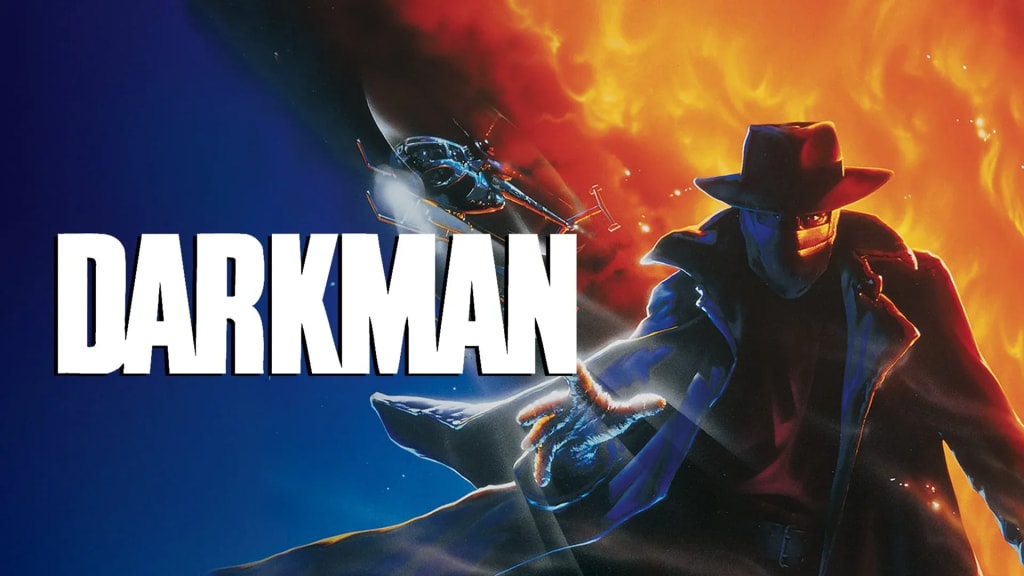
Darkman (1990): Sam Raimi’s Twisted Superhero Classic
Before Sam Raimi gave Spider-Man his webs, he created a superhero who barely had a face.
His name was Darkman.
Released in 1990, Darkman arrived at a fascinating moment for comic-book cinema. Tim Burton's Batman had become a phenomenon the previous year, but superheroes were still nowhere near the dominant Hollywood genre they would eventually become.
Raimi's solution was wonderfully strange.
Instead of adapting an existing comic-book hero, he invented one.
Scientist Peyton Westlake is brutally attacked and left for dead after criminals destroy his laboratory. Horrifically burned and unable to return normally to his old life, Peyton rebuilds his research on synthetic skin and discovers that he can temporarily manufacture realistic human faces.
The disguises give him the perfect weapon for revenge.
There is only one problem.
In daylight, the synthetic skin lasts 99 minutes.
After that, it begins to dissolve.
What follows is part superhero origin story, part revenge thriller, part Universal monster movie and part hyperactive Sam Raimi horror comedy.
Liam Neeson brings genuine tragedy to Peyton Westlake.
Frances McDormand gives the story an emotional center.
Larry Drake creates a villain memorable enough to feel like he escaped from an actual comic book.
And Raimi shoots the entire thing with the restless visual imagination that would eventually make his Spider-Man films so distinctive.
More than three decades later, Darkman still feels unlike almost any superhero movie Hollywood has made since.
That may be because Raimi created it before anyone had agreed what a modern superhero movie was supposed to look like.
Darkman Was a Superhero Without a Comic Book
One of the strangest things about Darkman is that it feels completely like a comic-book adaptation.
Except there was no comic book.
Peyton Westlake was created specifically for the movie.
Sam Raimi had wanted to work with established pulp and superhero properties. Accounts of the film's development say he was particularly interested in The Shadow and had also pursued Batman, but obtaining the rights proved impossible.
So Raimi eventually reached a beautifully simple conclusion:
If Hollywood would not let him adapt somebody else's superhero, he would create his own. (denofgeek.com)
Raimi later explained that the idea began as a short story about a man deprived of his own face who therefore had to wear the faces of other people.
That concept gradually developed into Peyton Westlake and the world of Darkman. (denofgeek.com)
The influences are visible everywhere.
The Shadow.
Batman.
The Phantom of the Opera.
The Invisible Man.
The Hunchback of Notre Dame.
Universal's classic monsters.
Pulp crime stories.
Mad-scientist movies.
Yet because Raimi was not required to obey decades of existing mythology, he could combine all of those influences however he wanted.
The result was something that felt familiar and completely new at the same time.
Who Is Peyton Westlake?
Before becoming Darkman, Peyton Westlake is a scientist.
Played by Liam Neeson, Peyton is researching the creation of synthetic skin.
His technology is remarkably advanced.
Using photographic and computer data, he can reconstruct realistic human tissue and reproduce a person's face.
The breakthrough has one major limitation.
The artificial skin remains stable for only 99 minutes when exposed to light.
After that, it rapidly deteriorates.
Peyton cannot understand why.
In darkness, however, the material remains stable for much longer.
That scientific problem appears to be the central challenge of Peyton's life.
Then criminals enter his laboratory.
Suddenly the 99-minute limitation becomes the foundation of an entirely new identity.
Julie Hastings Accidentally Brings the Criminal World to Peyton's Door
Peyton's girlfriend, attorney Julie Hastings, is played by Frances McDormand.
Julie discovers evidence connecting wealthy developer Louis Strack Jr. to corrupt business dealings.
The incriminating memorandum eventually ends up in Peyton's laboratory.
That brings Robert G. Durant and his gang to Peyton.
Durant does not politely ask for the document.
He and his men torture Peyton, destroy the laboratory and leave the scientist inside as the building explodes.
Peyton is presumed dead.
But he survives.
Barely.
The attack does more than destroy his face.
It removes his previous life.
The scientist who wakes afterward can no longer simply return home and continue where he left off.
Peyton Westlake has effectively been murdered even though his body remains alive.
That is where Darkman becomes a tragedy rather than merely a revenge movie.
The Hospital Saves Peyton—but Changes Him Again
Peyton is recovered as an unidentified burn victim.
Doctors perform an experimental procedure intended to make his unbearable injuries survivable.
The treatment interrupts his ability to feel physical pain.
In comic-book logic, that has consequences.
Without ordinary pain feedback, his body can exert itself beyond normal limits.
The procedure also contributes to extreme emotional instability and bursts of adrenaline-fueled strength.
A contemporary Washington Post review described the transformed Peyton as possessing increased strength alongside uncontrolled rage after the medical treatment. (washingtonpost.com)
This is important.
Peyton's "superpowers" are not clean gifts.
Everything comes with damage attached.
He cannot feel pain.
That sounds useful until you realize pain exists partly to tell the body when it is being destroyed.
He becomes stronger.
But his emotional control deteriorates.
He survives.
But survival does not restore the person he was.
The superhero transformation is simultaneously a medical catastrophe.
Liam Neeson Plays Darkman as a Tragic Monster
Modern audiences know Liam Neeson largely as the commanding presence of films such as Taken, Schindler's List, The Grey and countless action thrillers.
In Darkman, he is considerably stranger.
Peyton oscillates between tenderness, fury, desperation and manic theatricality.
At times he feels like a tragic stage character.
At other moments, Raimi lets Neeson become almost cartoonishly explosive.
That combination should not work.
Somehow it does.
The performance reflects Peyton's fractured psychology.
He desperately wants to believe that the old Peyton Westlake still exists.
But every attempt to return to his former life reminds him that he has changed.
His face is gone.
His nervous system has been altered.
His emotions have become unstable.
His relationship with Julie can survive only while he hides behind an artificial version of himself.
Darkman therefore is not simply Peyton wearing bandages.
Darkman is what exists after Peyton realizes he cannot truly become Peyton again.
The Synthetic Skin Is One of the Best Superhero Devices Ever Invented
The genius of Peyton's technology is that it performs several functions simultaneously.
It gives him disguises.
It allows him to infiltrate Durant's criminal organization.
It lets him impersonate enemies.
It gives the movie elaborate identity games.
But most importantly, it gives every disguise a time limit.
Ninety-nine minutes.
That single rule creates instant suspense.
Peyton can recreate his original face and see Julie again.
But only temporarily.
He can become one of Durant's henchmen.
But only temporarily.
Every plan contains a clock.
Eventually the face melts.
This transforms what could have been an unlimited superpower into something dramatically useful.
The disguise is powerful enough to solve problems but unstable enough to create new ones.
Peyton Can Wear Anyone's Face Except His Own Permanently
There is also something psychologically cruel about the technology.
Peyton can recreate almost anyone.
Durant.
A gangster.
A stranger.
Even Peyton Westlake.
But he cannot permanently be himself.
The very invention Peyton spent his scientific career developing becomes the mechanism through which he confronts his lost identity.
For 99 minutes, Julie can look at him and see the man she loved.
Peyton can almost pretend nothing happened.
Then the skin breaks down.
Reality returns.
That turns the synthetic-face technology into more than a plot device.
It becomes the movie's central metaphor.
How long can someone perform the identity they used to possess after trauma has fundamentally changed them?
For Peyton, the answer is exactly 99 minutes.
Darkman Is Really a Beauty and the Beast Story
Raimi himself emphasized that he did not primarily think of Darkman as conventional horror.
He described it more as a tragedy, particularly the story of a man attempting to regain a lost relationship. (slashfilm.com)
That is why Julie matters so much.
Without her, Darkman would be a stylish revenge story.
With her, Peyton has something he cannot simply kill his way toward recovering.
He wants Julie to love him.
But does he want her to love the person he has become?
Or the face he manufactures for her?
That uncertainty is much more painful than anything Durant does to him.
Peyton fears rejection.
He also fears that accepting Julie's love may require revealing something about himself he can barely accept.
Like the Phantom of the Opera or the Beast, his external transformation becomes inseparable from questions of love, shame and identity.
The Carnival Scene Shows Everything Darkman Has Lost
One of the most memorable scenes takes place at a carnival.
Peyton has recreated his original face and spends time with Julie.
For a brief period, life seems almost normal.
Then something ridiculously small happens.
Peyton wants a prize.
A carnival worker denies it to him.
The situation escalates.
Peyton's emotional instability erupts.
Suddenly the apparently normal man standing beside Julie becomes terrifyingly aggressive.
The scene is funny in the exaggerated Raimi style.
It is also painful.
Peyton realizes that the problem is no longer just his appearance.
Even if his face could somehow be restored permanently, he is not psychologically the same person.
His rage has become unpredictable.
The man Julie remembers may truly be gone.
That revelation is more devastating than the melted mask.
Raimi Shoots Emotion Like a Comic Book Explosion
Nobody would mistake Darkman for restrained filmmaking.
Raimi zooms.
Tilts.
Cuts rapidly.
Distorts images.
Throws the audience through montages.
Uses exaggerated close-ups.
Moves the camera in ways that seem physically impossible.
At moments of psychological stress, the film practically explodes visually.
That style had already become one of Raimi's signatures through The Evil Dead and Evil Dead II.
With Darkman, he was suddenly applying those techniques to a larger studio production.
Raimi explained at the time that comic books influenced the visual design heavily. He wanted frames that communicated information in bold, dramatic images much like individual comic panels. (washingtonpost.com)
You can see the philosophy in almost every action sequence.
The film does not photograph comic-book events realistically.
It attempts to photograph the feeling of reading a comic book.
Darkman Looks Like a Comic That Never Existed
That distinction is important.
Many comic-book movies try to make superheroes appear plausible.
Darkman frequently goes in the opposite direction.
It wants silhouettes.
Smoke.
Industrial skylines.
Huge shadows.
Bandages blowing dramatically.
Villains framed like grotesque illustrations.
Faces filling the screen.
Violence exaggerated until it becomes black comedy.
A 1990 Washington Post review observed that Raimi had effectively approached the superhero trend backward: rather than adapting comics into live action, he invented a hero and made the movie feel like a living comic strip. (washingtonpost.com)
That may explain why the movie has aged so well visually.
It was never chasing realism.
Stylization does not become obsolete in quite the same way.
Robert G. Durant Is a Perfect Raimi Villain
Larry Drake's Robert G. Durant is unforgettable from his first appearance.
He is controlled.
Polite.
Methodical.
And completely monstrous.
Durant collects fingers from his victims using a cigar cutter.
That detail tells you almost everything.
He does not simply kill people.
He has ritual.
Style.
A hobby.
Drake plays Durant with the exaggerated precision of an old pulp villain while never losing the sense that he is genuinely dangerous.
The performance works particularly well against Neeson's emotional Darkman.
Peyton is unstable because too much has happened to him.
Durant is calm because cruelty does not disturb him at all.
One is becoming a monster against his will.
The other already was one.
Louis Strack Jr. Represents a Different Kind of Villainy
Colin Friels plays developer Louis Strack Jr., whose corruption sits behind the attack that destroys Peyton.
Where Durant is openly frightening, Strack is respectable.
Powerful.
Wealthy.
Presentable.
He represents institutional villainy rather than street-level brutality.
This distinction gives Darkman two different antagonistic forces.
Durant commits violence.
Strack benefits from systems capable of hiding it.
And Julie's relationship with Strack's business dealings gives the final conflict a more personal connection.
The villains are not trying to conquer the planet.
They are greedy men protecting corrupt development plans.
That relatively grounded objective makes the operatic tone around them even stranger—and more enjoyable.
Darkman Is Not Actually a Traditional Hero
Peyton wants revenge.
That matters.
He is not primarily patrolling the streets looking for innocent people who need protection.
He does not adopt a moral code equivalent to Batman's.
He does not decide that great power creates responsibility.
His mission is personal.
The people he targets destroyed his life.
He wants them to pay.
That places Darkman closer to the tradition of pulp avengers and tragic antiheroes than conventional superheroes.
A retrospective from Den of Geek makes the same observation: Peyton's motivations center on revenge and recovering Julie rather than generalized crime fighting. (denofgeek.com)
This ambiguity makes him interesting.
Darkman is heroic compared with the criminals he fights.
That does not mean Peyton is becoming morally healthier.
Revenge Gradually Consumes the Man Seeking It
This gives the movie another layer.
Peyton's enemies made him Darkman physically.
But revenge helps complete the psychological transformation.
Every disguise makes deception easier.
Every act of violence gives rage another outlet.
Every encounter with Durant's gang pulls Peyton further from the ordinary scientist he remembers.
The revenge works.
His enemies fall.
Yet victory cannot restore his face.
It cannot restore his nervous system.
It cannot erase what happened.
And it cannot return him to the emotional state he occupied before the explosion.
That is why the ending matters.
The story does not end with Peyton defeating the villain and walking happily into Julie's arms.
The superhero origin comes at the cost of the man's previous identity.
The Ending Refuses to Give Peyton His Old Life Back
After the climactic confrontation, Julie still wants Peyton.
That should be the happy ending.
Peyton refuses it.
He recognizes what he has become and disappears into the crowd.
Using his synthetic faces, he can become anyone.
Which means he can no longer comfortably be one person.
The final voice-over captures the tragedy of the character.
He has moved beyond Peyton Westlake without finding another stable identity.
Darkman is anonymous.
Everywhere and nowhere.
The person with no true face.
And then Raimi adds one final joke.
Bruce Campbell's Cameo Is the Perfect Final Raimi Touch
In the closing moments, Peyton assumes another face while disappearing into the crowd.
That face belongs to Bruce Campbell, Raimi's longtime collaborator and star of the Evil Dead films.
Campbell's appearance lasts only briefly, but for Raimi fans it is unmistakable.
The cameo transforms an otherwise melancholy ending into something characteristically playful.
Peyton has accepted that his identity will constantly change.
For one moment, apparently, he looks like Ash Williams.
Only Sam Raimi would finish a tragic superhero origin story that way.
Danny Elfman's Score Makes Darkman Feel Enormous
The music is another reason the movie feels much larger than its premise.
Danny Elfman composed the score shortly after his landmark music for Tim Burton's Batman.
You can hear some shared DNA.
Huge brass.
Percussion.
Gothic grandeur.
Dark romanticism.
But Darkman allows Elfman to become even more grotesque and manic.
Raimi was enormously enthusiastic about Elfman's contribution, telling The Washington Post that music was essentially the soul of the picture and praising the decision to use a sweeping classical approach rather than simply hammering every action beat with effects. (washingtonpost.com)
Elfman himself later described Darkman as an opportunity to write unusually long musical passages without holding back. (denofgeek.com)
That freedom is audible.
The score does not accompany Darkman quietly.
It announces him.
The Practical Effects Give Peyton Real Physical Presence
Another major strength is the makeup and physical effects.
Peyton's injuries are grotesque.
The synthetic masks feel tactile.
Faces deform.
Skin bubbles and disintegrates.
Bodies collide with machinery.
Explosions have physical weight.
Raimi's background in practical horror filmmaking matters enormously.
Darkman arrived before digital visual effects became the default answer to every impossible superhero image.
That forced the production to solve many sequences physically.
The result sometimes looks exaggerated.
But exaggerated is exactly what the movie wants.
Darkman's face should not merely look medically realistic.
It should look like the face of a tragic pulp monster.
This Is the Missing Link Between Evil Dead and Spider-Man
Watching Darkman after Raimi's later career makes it even more interesting.
You can see his filmmaking evolving in real time.
From Evil Dead comes:
the aggressive camera movement,
grotesque makeup,
physical comedy,
horror imagery,
sudden tonal shifts,
and willingness to make suffering absurdly funny.
From the future Spider-Man movies, you can already see:
the tragic superhero,
the romantic relationship endangered by secret identity,
scientific experiments producing extraordinary consequences,
villains with heightened personalities,
comic-book visual grammar,
and action scenes driven by emotion rather than spectacle alone.
Years before Peter Parker swung through Manhattan, Raimi was already practicing superhero storytelling.
Darkman was the laboratory.
Peyton Westlake and Peter Parker Have More in Common Than They First Appear
The characters look completely different.
Peter Parker is an optimistic young hero.
Peyton Westlake is a mutilated avenger.
Yet Raimi is interested in similar questions.
What happens when an ordinary person gains extraordinary abilities?
How does power affect love?
Can someone preserve ordinary relationships while living behind another identity?
What happens when emotion overwhelms control?
Can scientific brilliance create catastrophe as easily as progress?
In Raimi's superhero stories, powers rarely make life simpler.
They intensify whatever emotional problem already exists.
For Peter Parker, responsibility becomes overwhelming.
For Peyton Westlake, trauma becomes vengeance.
The costumes are different.
The psychological mechanism is surprisingly similar.
Darkman Arrived Just One Year After Batman
The timing also matters.
Tim Burton's Batman had transformed Hollywood expectations for comic-book movies in 1989.
Darkman arrived in August 1990.
Superhero cinema was still experimenting with darkness, stylization and adult audiences.
There was no Marvel Cinematic Universe.
No standardized origin-story structure.
No expectation of a dozen interconnected sequels.
A superhero film could still look like a horror movie because nobody had fully established that it should not.
That freedom benefits Darkman enormously.
It can be romantic tragedy for five minutes, grotesque comedy for three, action thriller for ten and comic-book madness immediately afterward.
Modern franchise filmmaking often prizes tonal consistency.
Raimi prizes momentum.
Darkman Was a Genuine Box-Office Success
The experiment worked commercially.
Darkman opened in the United States on August 24, 1990 and took the No. 1 position for its opening weekend with approximately $8.05 million from 1,786 theaters. (boxofficemojo.com)
Box Office Mojo lists approximately $33.9 million domestically and about $48.9 million worldwide across its reported releases. (boxofficemojo.com)
That was a meaningful result for an original character with no established comic-book audience.
Unlike Batman or Superman, nobody entered the theater already knowing who Darkman was.
Raimi had to sell the superhero and the film simultaneously.
He succeeded.
Critics Were More Positive Than Darkman's Cult Status Might Suggest
Darkman sometimes gets discussed as if it were a misunderstood failure later rescued by cult audiences.
That is not entirely accurate.
The film received a meaningful amount of positive critical attention from the beginning.
Rotten Tomatoes currently records an 80% Tomatometer score, describing the film's appeal as a combination of gothic tragedy and explosive comic-strip style. (rottentomatoes.com)
Contemporary Washington Post reviews particularly admired Raimi's visual imagination, gothic atmosphere and ability to translate comic-book sensibility into live-action filmmaking. (washingtonpost.com)
The movie was strange.
But people recognized that the strangeness was deliberate.
The Production Itself Was Apparently Chaotic
The movie's manic energy may partly reflect what happened behind the scenes.
Later accounts describe significant conflict between Raimi's preferred cut and Universal's concerns about the film's length and tone.
According to producer Robert Tapert, Universal became unhappy with early versions and brought in veteran editor Bud S. Smith, at one point producing a much shorter cut.
Raimi's team ultimately reworked the film again shortly before its release. (denofgeek.com)
That history makes the finished film's coherence almost surprising.
There are abrupt tonal transitions.
Sequences race forward.
Moments that would occupy several scenes in another movie explode across the screen in montage.
Yet rather than feeling unfinished, the movie feels feverish.
For Darkman, feverish works.
The Studio Wanted Mainstream Raimi—and Got Raimi Anyway
Darkman represented one of Raimi's first major opportunities to work at a significantly larger Hollywood scale after the cult success of the Evil Dead films.
The production budget was far beyond anything he had previously controlled.
But increased resources did not make Raimi conventional.
They simply gave him bigger toys.
Helicopters.
Explosions.
Elaborate sets.
More sophisticated makeup.
A major orchestral score.
Instead of smoothing out his filmmaking personality, the resources amplified it.
A contemporary profile described Darkman as Raimi's first major mainstream production while emphasizing that his hyperactive visual instincts had survived the transition. (washingtonpost.com)
That is probably why the movie still feels personal.
It is a studio superhero film made by someone who had not yet learned to behave like a studio superhero director.
Darkman Eventually Became an Actual Comic-Book Character
There is an amusing reversal in the character's history.
Darkman began as an original movie designed to feel like a comic book.
Then the success of the movie led to actual comics.
The character expanded into novels, comics, merchandise and additional films.
So Raimi effectively reverse-engineered a superhero franchise.
Movie first.
Comic mythology afterward.
That says something about how convincing the original construction was.
Darkman felt like he had decades of pulp history behind him even though audiences had met him only minutes earlier.
The Sequels Couldn't Completely Recreate the Original
The success of Darkman eventually produced two direct-to-video sequels:
Darkman II: The Return of Durant
and
Darkman III: Die Darkman Die.
Liam Neeson did not return.
Arnold Vosloo took over the role of Peyton Westlake, while Larry Drake returned as Durant for the second film. The franchise records list both sequels alongside Raimi's theatrical original. (the-numbers.com)
The sequels have their defenders, but the first movie remains fundamentally different.
That is partly because Darkman is not merely about a masked avenger.
It is about becoming that avenger.
Once Peyton's transformation is complete, much of the original tragedy cannot simply be repeated.
Why Darkman Never Became a Massive Superhero Franchise
On paper, he seems perfect for one.
He has:
a distinctive visual identity,
a tragic origin,
a scientific superpower,
a clear limitation,
an open-ended disguise mechanism,
a memorable name,
and an urban crime-fighting setting.
Yet the character never became Batman-level mythology.
One explanation is that Darkman may be too specifically tied to Raimi's sensibility.
Remove the feverish camera.
Remove the grotesque humor.
Remove Neeson's operatic desperation.
Remove Elfman's music.
What remains?
A good concept, certainly.
But the 1990 film's identity comes from the way all those elements collide.
Darkman is not merely intellectual property.
He is a tone.
That is considerably harder to franchise.
His Power Is Also Stranger Than Most Superhero Abilities
Darkman does not fly.
He cannot naturally transform.
He does not shoot energy.
His central ability is essentially advanced prosthetic impersonation.
That makes his stories potentially fascinating.
Darkman can infiltrate almost any criminal organization.
He can make enemies distrust one another.
He can become his own target.
He can manipulate evidence.
He can weaponize identity itself.
But every transformation has a clock attached.
In a modern superhero landscape filled with increasingly enormous cosmic powers, Darkman's modest ability still feels unusually creative.
He does not need to destroy a city.
He can destroy a criminal organization by making two villains believe they are talking to different people.
The 99-Minute Rule Is Better Than Unlimited Power
Modern superhero storytelling sometimes struggles because characters become too powerful.
The stronger the hero becomes, the more enormous the next threat must become.
Darkman avoids that problem immediately.
His technology has a fixed limitation.
Ninety-nine minutes.
No argument.
No convenient extension because the plot needs one.
The mask will fail.
That gives every identity-based sequence suspense even when Peyton has the upper hand.
You know the disguise works.
You also know it is dying.
The question becomes whether Peyton can finish what he needs to do before his face literally melts away.
It is such an effective dramatic rule that it feels surprising more superhero films do not build limitations this clearly into their powers.
Darkman Is Ultimately About Identity
Revenge drives the plot.
Identity gives it meaning.
Peyton loses his face.
Then he gains access to infinitely many faces.
That should represent freedom.
Instead, it destroys certainty.
If you can look like anyone, who are you?
If the person you love recognizes only the artificial reconstruction of your former appearance, which version is real?
If trauma changes your behavior enough, does restoring your appearance restore the person?
Peyton begins the film with one identity and one face.
He ends with countless faces and almost no identity at all.
That is the cruel paradox at the center of the movie.
The technology that lets him recreate himself ultimately teaches him that recreation is impossible.
The Bandages Make Him More Human, Not Less
Darkman's iconic appearance is wonderfully simple.
Bandaged face.
Long coat.
Hat.
Dark clothing.
He resembles someone halfway between a pulp detective and a Universal monster.
But the bandages are not a superhero costume in the ordinary sense.
They hide injury.
That distinction changes how we read the character.
Batman deliberately constructs a frightening identity.
Spider-Man deliberately creates his mask.
Peyton covers himself because exposure is unbearable.
Darkman's visual identity therefore grows directly from vulnerability.
The thing that makes him look intimidating exists because he is wounded.
That contradiction gives the design enormous emotional power.
The Movie's Real Horror Is Not Peyton's Face
The makeup is grotesque.
But the deeper horror is that Peyton cannot return to himself.
His greatest fear is not:
I look frightening.
It is:
I don't know whether I am still the person I was.
That is why Darkman has more emotional weight than its pulpy surface initially suggests.
Physical transformation stories have always been powerful because they externalize internal fears.
The Invisible Man becomes invisible and loses moral restraint.
The Fly becomes something increasingly nonhuman.
The Phantom hides disfigurement behind performance.
Peyton Westlake joins that tradition.
His face is destroyed.
But the true question is what happened underneath it.
Darkman Predicted the Superhero Antihero Boom
Years later, mainstream audiences would embrace morally ambiguous comic-book figures with enormous enthusiasm.
Blade.
Spawn.
The Punisher.
Hellboy.
Deadpool.
Venom.
Characters who exist somewhere between monster, hero and antihero became commercially normal.
In 1990, Darkman already occupied that territory.
A RogerEbert.com retrospective of superhero cinema groups Darkman among the darker lineage of post-Batman comic-book films that eventually included titles such as The Crow, Spawn and Blade. (rogerebert.com)
Yet Darkman remains unusual even among those characters because he was created directly for cinema.
Film is not adapting his mythology.
Film is his mythology.
It Also Feels Refreshingly Free From Franchise Homework
Watching Darkman today can be unexpectedly liberating.
You do not need to watch six previous movies.
There is no post-credit scene advertising another hero.
No larger universe needs establishing.
Nobody explains which timeline this belongs to.
Peyton Westlake begins the film as a scientist.
By the end he is Darkman.
Complete story.
That simplicity lets the movie concentrate on transformation rather than world-building.
The universe exists because this story requires it.
Not because twelve other releases need somewhere to happen.
Sam Raimi Would Eventually Get the Superhero He Wanted
The historical irony is wonderful.
Raimi created Darkman because established superhero properties were largely inaccessible to him.
A little more than a decade later, Sony handed him Spider-Man.
His 2002 Spider-Man became one of the defining superhero movies of its era.
Then Spider-Man 2 became one of the genre's most acclaimed sequels.
Looking backward, Darkman suddenly resembles an audition nobody realized Raimi was giving.
All the ingredients were already present:
a scientist transformed by extraordinary circumstances,
a divided identity,
romantic tragedy,
big emotions,
stylized villains,
wild camera movement,
sincere melodrama,
and the willingness to let superhero storytelling become unapologetically operatic.
Raimi did not suddenly learn how to direct comic-book heroes in 2002.
He had created his own twelve years earlier.
Why Darkman Still Works
Darkman is not polished in the modern franchise sense.
That is precisely why it remains exciting.
It is too violent to be clean family entertainment.
Too funny to remain grim.
Too tragic to be simple camp.
Too grotesque to become conventional romance.
Too superheroic to remain horror.
Too horrific to become straightforward superhero fantasy.
It keeps slipping between categories.
That instability mirrors Peyton himself.
He does not belong anywhere either.
Not completely scientist.
Not conventional superhero.
Not monster.
Not villain.
Not Peyton anymore.
Not entirely Darkman yet.
The movie exists in the same unstable space as its protagonist.
A Superhero Movie Could Probably Never Be Made Quite Like This Today
A studio could certainly reboot Darkman.
The visual effects would be more sophisticated.
The synthetic faces could transform seamlessly.
Action sequences could become enormous.
But something might disappear.
The original has a handmade insanity.
Raimi's camera behaves like it is enjoying itself too much.
The makeup looks physical.
The villains are shamelessly theatrical.
Danny Elfman's score roars.
Neeson commits to emotions that a more ironic movie would probably undercut with jokes.
The film is willing to be ridiculous and sincere simultaneously.
That is difficult to manufacture through corporate planning.
It usually happens when a filmmaker has a strange idea and somebody temporarily gives him enough money to make it.
Darkman Deserves to Be Remembered as More Than “Raimi Before Spider-Man”
It is tempting to treat the movie primarily as a historical curiosity.
The superhero film Sam Raimi made before Spider-Man.
The early Liam Neeson action role.
The movie with the Bruce Campbell cameo.
But Darkman deserves more than footnote status.
It created a genuinely distinctive superhero from scratch.
It gave that hero a clear visual identity.
A brilliant central power.
A memorable limitation.
A tragic emotional conflict.
Excellent villains.
And an ending brave enough to deny him ordinary happiness.
Rotten Tomatoes still records an 80% critics' score more than three decades after release, while the film's continuing cult reputation has kept Darkman recognizable despite the absence of a modern franchise. (rottentomatoes.com)
That endurance is not accidental.
Peyton Westlake Didn't Get His Life Back—and That Is Why the Origin Works
Most superhero origins contain a moment when the protagonist accepts the new identity.
Peter Parker becomes Spider-Man.
Bruce Wayne becomes Batman.
Clark Kent becomes Superman.
Peyton Westlake's transformation is darker.
He becomes Darkman because returning to Peyton Westlake is no longer possible.
His superhero identity is not a dream fulfilled.
It is what remains.
That gives the final transformation unusual sadness.
He defeats the men responsible.
He survives.
Julie still cares for him.
And yet there is no restoration.
No miraculous cure.
No final face.
Peyton disappears into the city using somebody else's appearance.
Tomorrow he can wear another.
Then another.
He can become anyone.
Except, permanently, himself.
That is the tragedy Sam Raimi built beneath all the explosions, severed fingers, melting faces and comic-book camera tricks.
Darkman is a superhero movie about a man who wins his revenge and loses his identity.
And more than 35 years later, there still isn't another superhero quite like him.
Frequently Asked Questions
What is Darkman about?
Darkman follows scientist Peyton Westlake, whose work on synthetic skin is interrupted when criminals attack him and destroy his laboratory. Horrifically disfigured but alive, Peyton uses his face-making technology to impersonate his enemies and seek revenge while struggling to preserve his relationship with Julie Hastings.
Who directed Darkman?
Darkman was directed by Sam Raimi, who had previously made The Evil Dead and Evil Dead II and later directed the original Spider-Man trilogy starring Tobey Maguire. (rottentomatoes.com)
Who plays Darkman?
Liam Neeson plays scientist Peyton Westlake and his alter ego Darkman. (rottentomatoes.com)
Who plays Julie in Darkman?
Frances McDormand plays Julie Hastings, Peyton Westlake's girlfriend and an attorney whose discovery of incriminating business information helps set the central plot in motion. (rottentomatoes.com)
Who is the main villain in Darkman?
The film has two major antagonists. Larry Drake plays sadistic gangster Robert G. Durant, while Colin Friels plays corrupt developer Louis Strack Jr. (rottentomatoes.com)
Was Darkman based on a comic book?
No. Sam Raimi created Darkman as an original character for the film after being unable to secure the rights to established properties he was interested in adapting, particularly The Shadow. (denofgeek.com)
Was Darkman inspired by Batman?
Batman was among several influences surrounding Raimi's concept, but Darkman also draws heavily from pulp characters and classic monsters such as the Shadow, the Phantom of the Opera and the Invisible Man. Raimi ultimately created an original hero rather than directly adapting any one of them. (denofgeek.com)
What is Darkman's superpower?
Darkman's central advantage comes from Peyton's synthetic-skin technology, which allows him to create highly realistic facial disguises and impersonate other people. His medical treatment after the attack also leaves him unable to feel normal pain and capable of bursts of abnormal strength and rage.
Why does Darkman's synthetic skin last only 99 minutes?
Peyton's synthetic skin becomes unstable after approximately 99 minutes of exposure to light. Solving that instability was the scientific problem he was working on before his attack. The limitation later creates a strict time limit for his disguises. (denofgeek.com)
Can Darkman feel pain?
Peyton undergoes an experimental medical treatment after his burns that disrupts normal pain sensation. The film uses the procedure to explain both his ability to withstand physical punishment and some of his heightened emotional instability.
Why does Darkman wear bandages?
Peyton's face and body are severely burned during the attack on his laboratory. The bandages cover his injuries while also becoming the defining visual appearance of Darkman.
Is Darkman a hero or an antihero?
Darkman is best described as an antihero. Peyton targets genuinely dangerous criminals, but his primary motivation is personal revenge rather than a broader commitment to crime fighting, and his increasingly violent methods make him morally more ambiguous than a traditional superhero.
Did Danny Elfman compose the Darkman music?
Yes. Danny Elfman composed the film's orchestral score shortly after his celebrated work on Tim Burton's Batman. Raimi considered the music exceptionally important to the film's gothic and melodramatic tone. (washingtonpost.com)
Does Bruce Campbell appear in Darkman?
Yes. Bruce Campbell makes a brief cameo near the end of the film as one of the faces Peyton uses while disappearing into a crowd.
When was Darkman released?
Darkman opened theatrically in the United States on August 24, 1990. (boxofficemojo.com)
Was Darkman successful at the box office?
Yes. The film opened at No. 1 with approximately $8.05 million in its first weekend. Box Office Mojo lists about $33.9 million domestically and roughly $48.9 million worldwide across reported releases. (boxofficemojo.com)
How were Darkman's reviews?
The film received significant critical support and has maintained a strong reputation. Rotten Tomatoes currently lists an 80% critics' score, praising its mixture of gothic tragedy and energetic comic-book style. (rottentomatoes.com)
Were there Darkman sequels?
Yes. Two direct-to-video sequels followed: Darkman II: The Return of Durant and Darkman III: Die Darkman Die. Liam Neeson did not return, with Arnold Vosloo taking over the role of Peyton Westlake. (the-numbers.com)
Is Darkman connected to Spider-Man?
The characters do not share a cinematic universe. The connection is director Sam Raimi, who made Darkman in 1990 and later directed Spider-Man (2002), Spider-Man 2 (2004) and Spider-Man 3 (2007). Darkman contains many stylistic and thematic elements Raimi would later bring to his Spider-Man films.
Why is Darkman considered a cult classic?
Its combination of superhero mythology, horror imagery, pulp storytelling, practical effects, black comedy, Liam Neeson's intense performance and Sam Raimi's distinctive filmmaking style has allowed the movie to remain recognizable decades after release despite never becoming a major modern franchise.
Is Darkman worth watching today?
Yes, particularly for viewers interested in unconventional superhero films, Sam Raimi's visual style, practical effects or darker comic-book stories. It feels very different from contemporary cinematic-universe superhero movies because it functions as a complete, strange and highly personal origin story.