Legend of the Werewolf 1975: Peter Cushing and the Tragic Gothic Beast of British Horror
On the night of the full moon, legend becomes reality.
Few monster myths are as emotionally powerful as the werewolf. Unlike vampires, ghosts, or demons, the werewolf is frightening because the monster is not fully separate from the human being. The beast is hidden inside the man. The curse lives under the skin. The horror is not only that someone transforms into a creature, but that the person may still be trapped somewhere inside it.
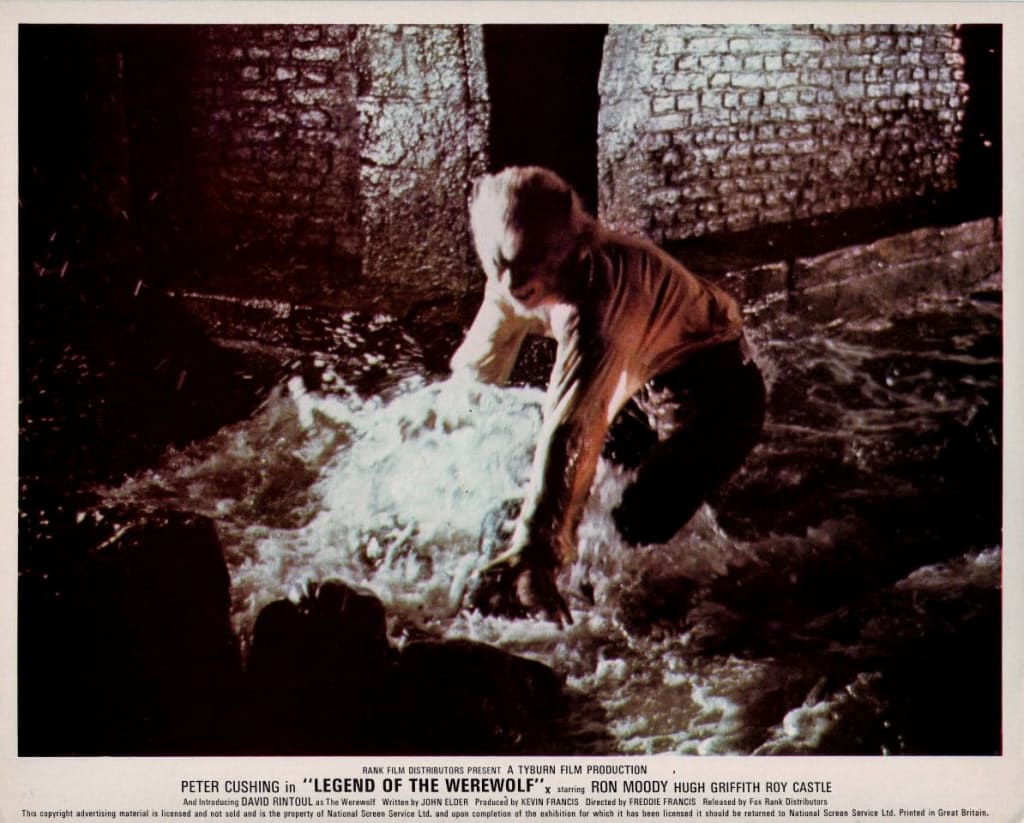
That is the tragic power at the heart of Legend of the Werewolf, the 1975 British Gothic horror film directed by Freddie Francis and starring Peter Cushing, David Rintoul, Ron Moody, Hugh Griffith, and Roy Castle.
Released during a strange transitional moment for British horror, Legend of the Werewolf arrived after the golden age of Hammer Films had begun to fade. The lush Gothic style that once dominated British horror was no longer fashionable in the same way. The genre was changing. Audiences were moving toward harsher, bloodier, more modern horror. Yet this film looked backward with affection, returning to foggy streets, old-world tragedy, cursed blood, doomed romance, and the melancholy of a monster who never truly asked to become one.
That is part of what makes the film interesting.
Legend of the Werewolf is not the loudest or most famous werewolf film of the 1970s. It is often overshadowed by bigger horror landmarks and better-known monster classics. But for fans of British Gothic horror, it holds a special charm. It has atmosphere, period flavor, Peter Cushing’s elegance, a tragic central figure, and a sincere belief in the emotional weight of folklore.
It is not simply a film about a wolfman killing under the full moon.
It is a film about a man who is seen as a monster before he has ever had the chance to understand himself.
The Story of Etoile
The film begins with a dark fairy-tale premise.
An infant is abandoned after tragedy and raised by wolves. Instead of entering the world through comfort, family, and human care, he grows up in the wilderness, closer to animals than people. When he is eventually discovered by a traveling showman, he becomes a spectacle: the “Wolf Boy,” a strange attraction for crowds who want to stare at what they do not understand.
This is where the tragedy begins.
Etoile, played as an adult by David Rintoul, is not introduced as a villain. He is introduced as someone displaced. He is caught between worlds: too human to remain an animal, too animalized by others to be accepted fully as human. Civilization claims to rescue him, but it also exploits him. People do not first see his soul. They see his difference.
That makes the werewolf curse feel more emotional than mechanical.
When the full moon rises and the beast emerges, the horror comes from more than bloodshed. It comes from the feeling that Etoile’s humanity is constantly being denied, suppressed, misunderstood, and finally overwhelmed.
He is not merely a monster in the streets.
He is a wounded person shaped by abandonment, performance, loneliness, instinct, and desire.
That is why Legend of the Werewolf remains compelling for cult horror fans. It understands that the best werewolf stories are not only about transformation. They are about identity.
Peter Cushing as Professor Paul Cataflanque
Peter Cushing brings dignity, warmth, and intelligence to the film as Professor Paul Cataflanque.
By 1975, Cushing was already a legend of British horror. His presence alone gave a film a certain grace. Whether playing Van Helsing, Baron Frankenstein, Sherlock Holmes, or a grieving scholar, Cushing had a rare ability to make Gothic material feel emotionally grounded.
In Legend of the Werewolf, he plays the scientist not as a cold rationalist, but as a compassionate investigator. Professor Cataflanque does not simply want to destroy the creature. He wants to understand what is happening. He looks at the horror with curiosity, sadness, and moral seriousness.
That choice matters.
Many monster films divide characters into hunters and hunted. The hunter sees the beast, raises the weapon, and restores order. Cataflanque is different. He is interested in truth. He recognizes that behind the killings may be a deeper tragedy. His role gives the film an emotional conscience.
Cushing’s performance is one of the film’s strongest assets. He brings gentleness to scenes that could have been purely procedural. He suggests that intelligence and compassion can coexist. He makes the professor feel like a man who understands that the monster is not only an enemy, but also a suffering being.
In a werewolf story, that makes all the difference.
David Rintoul’s Tragic Werewolf
David Rintoul’s Etoile is central to the film’s emotional identity.
He is not a suave aristocratic monster or a purely savage creature. He is vulnerable, confused, intense, and often painfully out of place. His physicality matters because the character is someone whose body has been shaped by wilderness, performance, and repression.
Etoile wants to belong.
That is one of the saddest parts of the film.
He enters civilization, but civilization does not fully know what to do with him. He becomes useful as entertainment, then frightening as he grows into manhood, then dangerous when the curse reveals itself. His humanity is always conditional.
The film’s romantic thread adds to that tragedy. Etoile is drawn toward love and tenderness, but desire and violence become dangerously tangled under the shadow of the full moon. The werewolf myth often uses transformation as a metaphor for impulses that cannot be controlled. In this film, that metaphor is tied to loneliness and longing.
Etoile is frightening because of what he becomes.
But he is heartbreaking because of what he wants to be.
Also Read: The Werewolf of Bedburg: The Dark Legend of Peter Stumpp
Ron Moody and the Traveling Showman
Ron Moody plays the traveling showman who discovers and exploits the wild child.
His presence gives the film a theatrical quality. The circus and sideshow elements fit beautifully into Gothic horror because they create a world where spectacle, cruelty, wonder, and commerce overlap. The “Wolf Boy” is treated as an attraction before he is treated as a person.
This is one of the film’s most interesting ideas.
Monsters are not always born in isolation. Sometimes society helps create them by turning difference into entertainment. Etoile is displayed, named, shaped, and used. His wildness becomes profitable until it becomes inconvenient.
The traveling showman element also connects the film to older horror traditions, where carnivals, circuses, laboratories, theaters, and traveling exhibitions often serve as places where society’s hidden fears are put on display.
In Legend of the Werewolf, the circus is not only a setting.
It is a symbol of how people turn the unknown into a spectacle.
Gothic Paris and the Shadow of Old Europe
The film eventually moves into Paris, where the werewolf legend takes on a more classic Gothic shape.
The Paris of Legend of the Werewolf is not realistic in a modern historical-drama sense. It is theatrical, foggy, artificial, and stylized. Streets, sewers, brothels, zoos, laboratories, and shadowed interiors become part of a dreamlike horror landscape.
That artificiality is part of its British Gothic charm.
Hammer and Hammer-adjacent films often created European settings through studio craft rather than realism. The result could sometimes look stagey, but it also created a special atmosphere: a Europe of nightmares, lanterns, cobblestones, velvet curtains, old sins, and moonlit danger.
Legend of the Werewolf belongs to that tradition.
Its Paris is less a city than a Gothic imagination of a city. It is a place where science, desire, death, class, folklore, and animal instinct meet in dark alleys and hidden rooms.
For viewers who love British Gothic horror, this is one of the film’s pleasures.
It may not have the budget or cultural force of earlier classics, but it understands the mood.
Tyburn Film Productions and the End of an Era
One of the reasons Legend of the Werewolf matters historically is its connection to Tyburn Film Productions.
Tyburn was a short-lived British production company associated with Kevin Francis, son of director Freddie Francis. The company attempted to continue the Gothic horror tradition at a time when Hammer’s dominance was fading and British horror was struggling to find a new identity.
That context gives Legend of the Werewolf a bittersweet quality.
It feels like a film made slightly out of time. By 1975, horror was changing rapidly. The genre had been shaken by more modern, visceral, and psychologically raw films. Gothic castles, foggy streets, tragic monsters, and period costumes were beginning to feel old-fashioned to many audiences.
But old-fashioned does not always mean worthless.
Sometimes it means loyal to a mood that cinema was leaving behind.
Legend of the Werewolf feels like one of the final echoes of a particular British Gothic tradition: elegant, theatrical, tragic, and literary in spirit. It belongs to a world of cursed bloodlines, moral investigation, doomed creatures, and the belief that monsters should be pitied as much as feared.
For that reason, the film has a special place among cult horror fans.
It is not simply a werewolf movie.
It is a late Gothic artifact.
Freddie Francis Behind the Camera
Freddie Francis was one of British cinema’s great visual craftsmen.
He was an acclaimed cinematographer as well as a director, and his horror work often carried a strong sense of atmosphere. Even when working with modest resources, Francis understood shadow, composition, and the emotional language of Gothic images.
In Legend of the Werewolf, his direction leans into the old-fashioned pleasures of the genre. The film is not built like a modern horror machine. It is slower, moodier, and more theatrical. It cares about setting, performance, and tragic atmosphere.
This may not satisfy viewers looking for relentless shocks, but it gives the film its identity.
Francis treats the werewolf story with sincerity. The monster is not a joke. The full moon is not merely a special effect trigger. The curse has emotional weight. The film wants the audience to feel sadness under the horror.
That sincerity is one of the reasons it continues to attract affection.
A Different Kind of Werewolf Movie
Many werewolf films focus on fear of the body.
The body changes. Hair grows. Bones shift. Teeth sharpen. Human speech gives way to growls. The civilized self is destroyed by animal instinct. The horror is physical, painful, and grotesque.
Legend of the Werewolf includes that tradition, but its real interest is more emotional.
The film asks what happens when a man raised outside human society tries to live within it. It asks whether civilization can truly save someone if it first treats him as a curiosity. It asks whether science can understand folklore without dismissing the suffering inside it.
The werewolf here is not only a beast.
He is an outsider.
That is what makes the film closer to Gothic tragedy than simple monster entertainment. Like many classic monsters, Etoile is dangerous, but he is also lonely. He is feared, but he is also failed. His transformation reveals a curse, but his human life reveals a wound.
This is why the film’s fans often remember its sadness as much as its horror.
Folklore and the Full Moon
The full moon is central to the werewolf myth.
In older folklore, werewolf transformation had many possible causes: curses, magic belts, wolf skins, witchcraft, demonic pacts, inherited conditions, or punishment for sin. Modern cinema simplified and popularized the full moon transformation, turning lunar cycles into one of horror’s most recognizable images.
Legend of the Werewolf uses this tradition effectively.
The full moon becomes a signal that the civilized self cannot hold forever. It is the moment when repression fails and the beast emerges. In Gothic horror, nature often represents the forces that society tries to control but never fully defeats. The moon is beautiful, distant, and indifferent. It shines on lovers and killers alike.
For Etoile, the full moon is not freedom.
It is doom.
That gives the film its tragic rhythm. Every rise of the moon carries inevitability. The audience knows the curse will return. The character may fight, hide, or hope, but the old legend keeps moving toward blood.
Why Fans Still Like It
Legend of the Werewolf has earned a loyal cult following because it offers something many modern horror films do not: a sincere Gothic mood.
Fans appreciate the period atmosphere, Peter Cushing’s heartfelt performance, the tragic humanity of Etoile, and the film’s connection to classic British horror. It is not a perfect film, and not everyone loves its pacing or production limitations. But for the right viewer, those limitations become part of the charm.
This is a film for people who enjoy candlelit horror, foggy streets, old-fashioned performances, doomed monsters, and the emotional melancholy of Gothic storytelling.
It is also appealing because it stands slightly apart from more famous werewolf films. It is not as widely celebrated as The Wolf Man, The Curse of the Werewolf, An American Werewolf in London, or The Howling. That underdog quality gives it cult value.
Finding Legend of the Werewolf can feel like discovering a forgotten chapter of British horror.
And forgotten chapters often have a special magic.
Peter Cushing’s Compassionate Horror Legacy
Peter Cushing’s horror legacy is often associated with authority: vampire hunter, scientist, doctor, detective, aristocrat, investigator. But his greatest strength was not simply authority. It was sensitivity.
He could make even genre dialogue feel meaningful because he listened on screen. He reacted with thought. He carried grief, intelligence, and moral seriousness in his face. In a film like Legend of the Werewolf, that quality is essential.
Professor Cataflanque could have been a stock figure: the scientist who explains the monster. Instead, Cushing turns him into a humane presence. He gives the film warmth, and that warmth deepens the tragedy.
This is one reason Cushing remains beloved by horror fans.
He never acted as if horror was beneath him.
He respected the material.
And because he respected it, audiences did too.
A Cult Classic in the Shadow of Hammer
It is impossible to discuss Legend of the Werewolf without mentioning Hammer’s shadow.
Hammer Films had already defined British Gothic horror for decades with Dracula, Frankenstein, mummy, vampire, witchcraft, and psychological horror films. Peter Cushing himself was one of Hammer’s central icons. Anthony Hinds, writing here under his John Elder pseudonym, was deeply associated with the Hammer tradition.
So Legend of the Werewolf feels almost haunted by Hammer.
It has the look and flavor of a film trying to keep that tradition alive after its strongest years had passed. The result can feel derivative to some viewers, but affectionate to others. It is not reinventing the werewolf myth radically. It is preserving a style of Gothic storytelling that was disappearing.
That preservation matters.
Not every cult film becomes loved because it changed cinema. Some become loved because they capture the last glow of a fading era.
Legend of the Werewolf is one of those films.
Final Thoughts
Legend of the Werewolf is a beautifully old-fashioned piece of British Gothic horror.
It may not be the most famous werewolf film ever made, but it has a haunting identity of its own. It combines tragic romance, folklore, period atmosphere, and monster-movie melancholy into a story about a cursed outsider who wants humanity but cannot escape the beast within.
David Rintoul’s Etoile gives the film its sadness.
Ron Moody’s showman gives it theatrical color.
Freddie Francis gives it Gothic shape.
Tyburn Film Productions gives it historical importance as part of British horror’s late Gothic afterglow.
And Peter Cushing gives it heart.
That is why the film still matters to cult horror fans.
Under the full moon, Legend of the Werewolf is not only about murder, fear, and transformation. It is about the old Gothic idea that monsters are most frightening when they are also tragic.
The beast may stalk the streets of Paris.
But the real horror is that somewhere inside him, a lonely man is still trying to be understood.
FAQs About Legend of the Werewolf
What is Legend of the Werewolf?
Legend of the Werewolf is a 1975 British Gothic horror film about Etoile, a man raised by wolves who becomes cursed to transform into a werewolf under the full moon.
Who stars in Legend of the Werewolf?
The film stars Peter Cushing, David Rintoul, Ron Moody, Hugh Griffith, and Roy Castle.
Who plays the werewolf in Legend of the Werewolf?
David Rintoul plays Etoile, the tragic young man who becomes the werewolf.
What role does Peter Cushing play?
Peter Cushing plays Professor Paul Cataflanque, a compassionate scientist and investigator who tries to understand the werewolf mystery.
Who directed Legend of the Werewolf?
The film was directed by Freddie Francis, a major figure in British horror and an acclaimed cinematographer.
Which studio produced Legend of the Werewolf?
The film was produced by Tyburn Film Productions, a short-lived British company that tried to continue the Gothic horror tradition after Hammer’s decline.
Is Legend of the Werewolf connected to Hammer Films?
It is not a Hammer film, but it strongly resembles Hammer-style Gothic horror. Several people involved had close connections to the Hammer tradition.
Why do horror fans like Legend of the Werewolf?
Fans appreciate its Gothic atmosphere, period setting, Peter Cushing’s performance, tragic werewolf story, and cult status as a lesser-known British horror film.
Is Legend of the Werewolf scary?
It is more Gothic and tragic than aggressively frightening. Its appeal comes from mood, folklore, and old-fashioned monster tragedy rather than modern jump scares.
Is Legend of the Werewolf a cult classic?
Yes. Although it is often overshadowed by better-known werewolf films, it has developed a loyal cult following among fans of British Gothic horror.