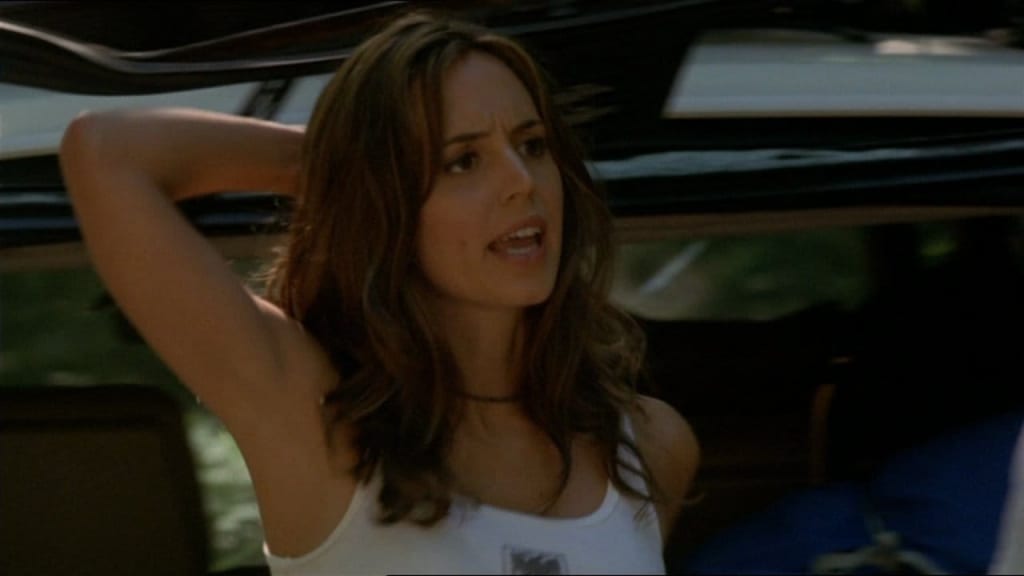
Eliza Dushku as Jessie Burlingame in Wrong Turn: A Defining Survivor of 2000s Horror
Few horror situations are more immediately unsettling than becoming stranded on an unfamiliar road, miles from help, with the growing realization that someone deliberately engineered the accident.
That nightmare forms the foundation of Wrong Turn, the 2003 survival-horror film in which Eliza Dushku plays Jessie Burlingame, a young traveler forced to transform from an ordinary woman on a camping trip into a determined survivor.
Jessie does not begin the film as a trained fighter, police officer or experienced wilderness specialist. She is simply traveling through West Virginia with friends when their disabled vehicle leaves them isolated in the forest. Once the group discovers that violent hunters are stalking them, Jessie must rely on instinct, courage and emotional resilience.
Dushku gives the character an appealing mixture of vulnerability and strength. Jessie is frightened by what she encounters, but fear never completely controls her. She observes, adapts and continues moving even as the people around her are killed.
That balance helped make Jessie one of the most recognizable heroines of early-2000s horror and gave Wrong Turn an emotional center beneath its chases, gruesome deaths and relentless wilderness atmosphere.
Who Is Jessie Burlingame?
Jessie Burlingame is one of the principal characters in the original Wrong Turn.
She is traveling with Carly, Scott, Evan and Francine on what is supposed to be a camping trip. Their plans collapse after their vehicle’s tires are punctured by barbed wire deliberately placed across a remote mountain road.
Medical student Chris Flynn, played by Desmond Harrington, then crashes into their disabled vehicle after taking the same isolated route. With no reliable communication and little idea where they are, members of the group leave the road to search for assistance.
Instead, they discover an isolated cabin occupied by three murderous mountain men known as Three Finger, Saw Tooth and One Eye.
The discovery turns the group’s attempt to find help into a desperate battle for survival. The film follows Jessie and Chris as they try to escape the forest while their companions are hunted individually. Rotten Tomatoes’ synopsis similarly identifies Jessie and her friends as travelers stranded in West Virginia before discovering that hostile cannibals are pursuing them.
Eliza Dushku Was Perfectly Cast as Jessie
Eliza Dushku brought an established screen presence to Wrong Turn.
Her casting gave Jessie immediate credibility as a character who could be emotionally expressive without appearing helpless. Dushku’s performance suggests strength early in the story, but she does not make Jessie seem unrealistically fearless.
Instead, Jessie’s courage develops through necessity.
Dushku communicates fear through her eyes, breathing and physical reactions. When Jessie encounters human remains inside the cabin or realizes that the attackers are returning, her terror feels immediate. Yet she remains alert enough to understand what must happen next.
That combination is central to the character’s effectiveness.
Jessie is not memorable because she never becomes afraid. She is memorable because she continues acting while afraid.
The film officially credits Dushku as Jessie Burlingame, alongside Desmond Harrington as Chris Flynn, Jeremy Sisto as Scott, Emmanuelle Chriqui as Carly and Kevin Zegers as Evan.
Jessie’s Transformation Into a Survivor
Jessie’s character arc is built around adaptation.
At the beginning, she is part of a group. Decisions are shared, and the dangers of the forest are not yet understood. Once the attackers begin eliminating her friends, the social security of the group rapidly disappears.
Jessie must learn several painful lessons:
- The accident was deliberately caused.
- The isolated cabin is not a source of safety.
- The attackers know the terrain far better than their victims.
- Remaining still can be as important as running.
- Rescue cannot be assumed.
- Survival may require confronting rather than merely escaping the threat.
The transformation does not happen through a single dramatic speech. It unfolds physically through hiding, climbing, running, observing and making decisions under pressure.
By the final portion of the film, Jessie is no longer waiting for someone else to explain the danger. She understands that survival depends on staying mentally present even when the situation appears hopeless.
Strength Without Invulnerability
A weaker version of the character might have turned Jessie into an invincible action heroine.
Wrong Turn avoids that.
Jessie is physically overwhelmed, captured and placed in situations from which she cannot escape alone. She experiences grief and terror as the group becomes smaller. Her survival depends partly on cooperation with Chris, just as his survival repeatedly depends on the choices and sacrifices of others.
This vulnerability makes her courage more meaningful.
The film does not suggest that Jessie survives because she possesses superhuman abilities. She survives because she refuses to surrender psychologically.
Her emotional reactions also preserve the story’s horror. An entirely unshaken protagonist could make the attackers seem less threatening. Jessie’s visible fear tells the audience that the danger is real, while her continued resistance prevents the film from becoming purely hopeless.
Is Jessie Burlingame a “Final Girl”?
Jessie is frequently described by fans and retrospective coverage as the final girl of Wrong Turn. Entertainment Weekly’s 20th-anniversary history of the franchise directly referred to Dushku’s Jessie in those terms.
However, her status comes with an important qualification.
The traditional final girl is often the last surviving central character who confronts the killer alone. Jessie is not the film’s only survivor. Chris also escapes the forest, and the climax depends heavily on his return to the attackers’ cabin to rescue her.
Jessie can therefore be understood as the film’s principal female survivor and emotional final girl, even though the narrative ultimately gives audiences a surviving pair rather than a solitary heroine.
This does not make her less important to the tradition. Horror has never followed a single rigid formula, and many memorable survivor characters share the climax with another person.
What matters is that Jessie undergoes the recognizable final-girl journey:
- She gradually understands the true danger.
- She witnesses the destruction of her social group.
- She becomes increasingly resourceful.
- She endures direct pursuit and captivity.
- She survives the final confrontation.
- She leaves the location permanently changed by the experience.
Jessie and Chris Work as Complementary Survivors
The relationship between Jessie and Chris is one of the film’s most effective choices.
They are not introduced through a conventional romance. Chris enters the story by crashing into the group’s disabled car. Their connection grows from shared danger rather than immediate emotional intimacy.
Chris contributes medical knowledge, physical determination and a willingness to return after being injured. Jessie contributes alertness, emotional strength and persistence. Neither character could easily have survived every stage alone.
Their partnership gives the film a cooperative survival structure.
Jessie is not reduced to someone who simply waits for Chris to save her. She participates actively throughout the journey and repeatedly endures dangers that would have broken a less determined character.
At the same time, the story allows her to need assistance without presenting that need as weakness. Horror survival often depends on timing, luck and cooperation as much as individual bravery.
The Cabin Sequence Reveals Jessie’s Control
The isolated cabin sequence is one of the most important parts of the film.
Jessie and the others enter expecting to find help. Instead, they discover human remains and evidence that the building belongs to the people hunting them.
When the attackers return, the survivors are forced to hide inside the cabin while witnessing the treatment of one of their murdered friends.
For Jessie, this scene marks the moment when uncertainty disappears.
Before entering the cabin, the group knows that something is wrong. After seeing what happens inside, they understand that they are facing deliberate, organized and repeated violence.
Dushku’s performance during this section depends heavily on controlled reactions. Jessie cannot scream, run or openly express horror without exposing everyone. Her survival requires her to suppress the body’s natural response to terror.
The scene demonstrates that her greatest strength is not physical power but the ability to remain focused under unbearable psychological pressure.
The Watchtower Sequence Tests Her Courage
Jessie, Carly and Chris eventually reach an old observation tower and attempt to contact help.
For a brief moment, the elevated structure appears to offer safety. That illusion collapses when the attackers surround the tower and set it on fire, forcing the survivors to escape through the trees.
The sequence combines several of Jessie’s greatest fears:
- Height
- Fire
- Pursuit
- Physical exhaustion
- The possibility of watching another friend die
The production constructed the tower and artificial forest elements for the sequence. During filming, Emmanuelle Chriqui suffered a dislocated shoulder while performing part of Carly’s fall, illustrating the physical complexity involved in creating the scene.
For Jessie, the sequence removes another potential sanctuary.
The road was unsafe.
The cabin was unsafe.
The tower is also unsafe.
Every location that might ordinarily represent rescue becomes part of the trap. Her survival therefore depends less on reaching a safe place than on continuing to adapt as each refuge disappears.
Captivity Does Not End Jessie’s Resistance
Near the climax, Jessie is captured and taken back to the cabin.
This is the point at which the attackers appear to have won. She is restrained, isolated and surrounded by evidence of what will happen if she cannot escape.
The scene temporarily removes her physical agency, but it does not erase her presence as a survivor.
Jessie remains observant. She looks for opportunities, reacts to changes around her and continues resisting whenever possible.
Her captivity also gives the climax emotional urgency. Chris could escape after surviving his fall, but he chooses to return for her. His decision transforms the final confrontation from simple flight into a rescue operation.
Once freed, Jessie immediately participates in the escape rather than remaining psychologically defeated.
Dushku Makes Fear Feel Active
One reason Dushku’s performance remains engaging is that she turns fear into an active dramatic force.
Jessie’s terror influences how she moves, hides and evaluates danger. It is not merely an expression placed on top of the action.
Her physical performance changes as the film progresses.
Early in the story, Jessie moves as part of a group. Later, her posture becomes more defensive, her reactions faster and her attention more intensely focused on the environment.
Dushku also understands when restraint is more effective than obvious emotion.
In several scenes, Jessie cannot openly cry or scream because silence is necessary for survival. The performance therefore relies on facial tension and controlled breathing, allowing the audience to understand what the character feels without requiring dialogue.
Jessie Never Becomes Cruel
Another important aspect of the character is that survival does not strip away her humanity.
Jessie becomes tougher, but she does not become indifferent to the deaths around her. She remains visibly affected by the loss of her friends and by the brutality she witnesses.
This distinguishes resilience from emotional numbness.
Some horror protagonists survive by becoming as violent as their attackers. Jessie is willing to fight when necessary, but the film does not suggest that she enjoys violence or experiences empowerment through killing.
Her objective remains escape.
That focus keeps the audience emotionally connected to her. She is fighting to preserve her life, not to prove that she is the strongest person in the forest.
The Wilderness Becomes a Character
Jessie’s ordeal is shaped by the setting as much as by the attackers.
The forest is dense, unfamiliar and difficult to navigate. Limited visibility allows danger to emerge from almost anywhere. Trees provide hiding places but also conceal the hunters. Cliffs, waterfalls and abandoned structures create temporary opportunities that can quickly become traps.
Although the story is set in West Virginia, filming took place primarily in Canada, including wooded locations north of Toronto. Director Rob Schmidt described working in a large park that could create the illusion of isolated wilderness despite nearby urban surroundings.
The environment makes Jessie’s lack of experience especially important.
The attackers know where to place traps, how to approach without being seen and which paths their victims are likely to follow. Jessie must survive inside territory that effectively belongs to them.
How Jessie Differs From Earlier Horror Heroines
Jessie belongs to a tradition that includes characters such as Sally Hardesty from The Texas Chain Saw Massacre, Laurie Strode from Halloween and Sidney Prescott from Scream.
Like those characters, she begins in an apparently ordinary situation and is forced to discover abilities she did not know she possessed.
However, Jessie reflects the faster, more physical style of early-2000s horror.
Her story emphasizes:
- Extended forest pursuit
- Graphic practical effects
- Physical climbing and jumping
- Rapid movement between locations
- Cooperative survival
- A comparatively action-driven climax
She is less defined by a prolonged psychological confrontation with a single masked killer and more by a continuous struggle against several attackers in hostile terrain.
That distinction helps her fit the survival-horror tradition as much as the conventional slasher model.
Why Jessie Remains Memorable
Jessie is memorable because the film gives audiences several reasons to invest in her survival.
She is sympathetic without being passive.
She is strong without being invulnerable.
She experiences fear without becoming incapable.
She accepts help without losing her independence.
Most importantly, her strength feels earned through the events of the film.
By the time she escapes, the audience has watched her lose friends, hide among human remains, flee a burning tower, endure pursuit and survive captivity.
Her final survival does not feel guaranteed simply because she is played by the film’s most recognizable actress. The story repeatedly places her in situations where escape appears unlikely.
Wrong Turn Became Larger Than Its Original Release
Directed by Rob Schmidt and written by Alan B. McElroy, Wrong Turn was released in the United States on May 30, 2003. It earned approximately $28.7 million worldwide against a reported production budget of about $12.6 million.
Its theatrical performance was respectable rather than enormous, and contemporary critical reception was mixed. Yet the film developed a substantial afterlife through home entertainment and horror fandom.
The original eventually inspired multiple sequels and a 2021 reboot with a different mythology. Entertainment Weekly described the franchise as unexpectedly resilient, noting how the 2003 movie grew from a modest theatrical release into a long-running horror property.
Jessie’s presence contributed to that endurance.
Later installments increasingly emphasized graphic violence and the attackers themselves, but the original remains distinctive because viewers have recognizable survivors to follow and support.
Stan Winston’s Creature Effects Strengthened Her Performance
Legendary effects artist Stan Winston was involved as a producer, while his team helped create the appearance of the film’s three attackers.
The practical makeup gave the performers something tangible to react to. Rather than imagining computer-generated threats that would be added later, Dushku and the other actors could see the attackers’ physical designs during filming.
Cast member Emmanuelle Chriqui recalled being genuinely disturbed when she first encountered the actors in their full makeup in the woods.
That physical presence supports Jessie’s reactions.
The attackers occupy the same environment as the survivors, allowing confrontations to feel immediate and tactile. Their practical appearance gives weight to every chase and close encounter.
The Character Deserved a Return
Jessie survives the first movie but does not become the continuing protagonist of the sequels.
The franchise instead introduces new groups of victims and survivors, with later stories expanding the mythology of the cannibal family.
That absence has contributed to Jessie’s lasting appeal. Her future remains open to audience imagination.
Viewers are left to wonder:
- How did she recover from the experience?
- Did she speak publicly about what happened?
- Was she believed?
- Did authorities investigate the forest?
- Did she remain in contact with Chris?
- Could she ever feel safe while traveling again?
A follow-up centered on Jessie’s trauma and recovery could have taken the series in a more character-driven direction.
Instead, she remains preserved within the original movie as the young woman who entered the wilderness unprepared and emerged as a survivor.
Jessie Burlingame’s Legacy in 2000s Horror
The early 2000s produced a wave of horror films built around remakes, graphic violence, isolated locations and hostile groups.
Within that era, Jessie stands out because Dushku gives her a recognizably human emotional journey.
She is not simply present to run, scream or become another elaborate death scene. She functions as one of the film’s central perspectives and gives the audience someone whose survival matters.
The term “final girl” is often associated with perfection, purity or adherence to genre rules. Jessie is more interesting when understood simply as a survivor.
She does not survive because she represents an idealized moral standard. She survives through courage, partnership, observation and refusal to give up.
Final Thoughts
Eliza Dushku’s portrayal of Jessie Burlingame gives Wrong Turn much of its emotional intensity.
The film surrounds her with monstrous attackers, practical gore and an environment designed to eliminate every possibility of safety. Yet Jessie never disappears beneath the spectacle.
Dushku makes her frightened, grieving and physically vulnerable while preserving the determination that drives her forward.
Jessie’s evolution is believable because she does not instantly become fearless. She becomes more capable with every terrible discovery, learning that survival requires movement, patience, trust and the willingness to resist even when escape seems impossible.
Although Chris survives alongside her, Jessie remains the original film’s defining female survivor and one of its most enduring characters.
More than two decades later, Wrong Turn is remembered not only for Three Finger and his fellow hunters but also for the woman who refused to become their next victim.
Jessie Burlingame entered the mountains as an adventurous traveler.
She left them as one of the most memorable survivors of early-2000s horror.
Frequently Asked Questions
Who played Jessie Burlingame in Wrong Turn?
Eliza Dushku played Jessie Burlingame in the original 2003 film.
Who is Jessie Burlingame?
Jessie is a young woman traveling with friends on a camping trip when their vehicle becomes stranded on an isolated road in West Virginia. She becomes one of the principal survivors after the group is hunted through the forest.
Is Jessie the main character in Wrong Turn?
Jessie and Chris Flynn function as the film’s central survivors. Chris drives part of the narrative, while Jessie serves as its principal female protagonist and emotional final girl.
Does Jessie survive Wrong Turn?
Yes. Jessie escapes the forest with Chris after the climactic confrontation at the attackers’ cabin.
Is Jessie Burlingame a final girl?
She is commonly described as one, although she is not the only survivor. Chris also survives, making Jessie a variation on the traditional solitary final-girl archetype.
Why is Jessie considered courageous?
She continues thinking and resisting despite witnessing the deaths of her friends, being pursued through unfamiliar wilderness and eventually being captured by the attackers.
Does Jessie return in the sequels?
No. Although she survives the original film, Jessie does not become a recurring protagonist in the subsequent installments.
Who directed Wrong Turn?
Rob Schmidt directed the film from a screenplay by Alan B. McElroy.
When was Wrong Turn released?
The film was released theatrically in the United States on May 30, 2003.
Where is Wrong Turn set?
The story takes place in the remote forests of West Virginia, although much of the production was filmed in Canada.
Who survives with Jessie?
Chris Flynn, played by Desmond Harrington, survives the events alongside her.
Why did Wrong Turn become a cult favorite?
Its isolated wilderness setting, practical creature effects, memorable villains, fast pacing and sympathetic survivors helped it develop a lasting audience after its original theatrical release and inspired a long-running franchise.
What makes Eliza Dushku’s performance effective?
Dushku combines visible fear with determination, allowing Jessie to remain emotionally believable while gradually becoming more resourceful and resilient.