I, Monster (1971): Christopher Lee’s Forgotten Gothic Masterpiece
The monster lives within us all.
Few ideas have haunted Gothic literature more persistently than the possibility that civilization does not eliminate our darker impulses—it merely teaches us how to hide them.
Robert Louis Stevenson gave that fear one of its greatest literary forms in Strange Case of Dr Jekyll and Mr Hyde. More than eight decades later, British horror cinema returned to the story with an unusual and surprisingly psychological interpretation.
The result was I, Monster, released in Britain in 1971.
Starring Christopher Lee as both the respectable Dr. Charles Marlowe and his increasingly depraved alter ego Edward Blake, with Peter Cushing as Frederick Utterson, the film resembles a lost Hammer production at first glance.
But I, Monster was actually made by Amicus Productions, Hammer's great British horror rival of the period. Powerhouse Films describes it as an Amicus adaptation of Stevenson's novella and notes that director Stephen Weeks made the film as his first feature at only 22 years old.
The movie changes Jekyll and Hyde's names, introduces overt Freudian psychology and experiments with an unusual 3D process, but otherwise remains surprisingly close to Stevenson's original structure.
Most importantly, it gives Christopher Lee one of his most subtle horror performances.
There is no towering Dracula.
No elaborate supernatural creature.
The monster gradually emerges from inside an ordinary man.
And that may be what makes I, Monster so disturbing.
What Is I, Monster About?
The story takes place in Victorian London.
Dr. Charles Marlowe is a psychologist experimenting with a chemical compound intended to release the hidden impulses of the human mind.
Marlowe believes that civilized behavior suppresses powerful desires beneath the surface of consciousness.
What would happen, he wonders, if those inhibitions could simply be removed?
At first, he experiments on patients.
Eventually, like so many doomed scientists in Gothic fiction, he turns the experiment upon himself.
The drug works.
But not as safely as he imagined.
Marlowe gradually becomes another personality: Edward Blake.
Blake possesses none of Marlowe's restraint.
He is aggressive, impulsive, cruel and increasingly violent.
At first, Marlowe appears able to move between the two identities.
But each transformation seems to make Blake stronger.
The experiment that was supposed to reveal the hidden mind begins destroying the man who created it.
Meanwhile, Marlowe's friend and lawyer Frederick Utterson, played by Peter Cushing, becomes increasingly suspicious of the mysterious Blake and his connection to Marlowe.
He initially assumes that Blake may be blackmailing his friend.
The truth is far worse.
ACMI describes I, Monster as largely faithful to Stevenson's original story despite changing the central character names, with Christopher Lee portraying Marlowe as a man whose inhibition-releasing drug transforms him into the violent Edward Blake.
It Is Really Dr. Jekyll and Mr. Hyde
There is little mystery about the film's literary origins.
Charles Marlowe is Henry Jekyll.
Edward Blake is Edward Hyde.
Frederick Utterson remains Frederick Utterson.
The structure, central transformation and moral conflict all come directly from Stevenson's 1886 novella.
The intriguing question is therefore not whether I, Monster is a Jekyll and Hyde adaptation.
It clearly is.
The stranger question is why producer and screenwriter Milton Subotsky changed the two most famous names in the story.
No definitive explanation has become universally accepted.
Whatever the reason, the decision gives the film a slightly unusual quality.
Audiences already know the secret.
Yet the characters behave as though they are solving it for the first time.
That shifts attention away from the mystery of Marlowe and Blake's relationship and toward something more psychological:
What is happening inside Marlowe?
A More Psychological Jekyll and Hyde
One of the film's most interesting choices is its emphasis on psychology.
Marlowe is not simply a chemist seeking to divide good from evil.
He is interested in repression.
He discusses human behavior using ideas influenced by Sigmund Freud, particularly the possibility that socially unacceptable desires remain buried beneath conscious behavior.
ACMI specifically notes that Marlowe is portrayed as a believer in Freudian ideas about divided or repressed aspects of the personality.
That makes I, Monster feel surprisingly modern.
Marlowe's experiment effectively asks:
What would remain if social inhibition disappeared?
Would humans reveal some naturally innocent inner self?
Or would civilization's restraints prove to be the only things preventing violence, cruelty and selfish desire?
The film's answer is deeply pessimistic.
Once Blake appears, he does not behave like an independent demon who has possessed Marlowe.
He feels like something that was always present.
The drug simply opens the door.
Christopher Lee as Dr. Charles Marlowe
Christopher Lee's reputation was already enormous by 1971.
He had become internationally associated with Count Dracula through Hammer's series of Gothic horror films.
He had played Frankenstein's Creature.
He had appeared in The Mummy.
His extraordinary height, commanding voice and aristocratic appearance made him a natural screen monster.
Yet I, Monster asks him to begin from almost the opposite position.
Charles Marlowe is restrained.
Quiet.
Intellectual.
Controlled.
Lee deliberately suppresses much of his usual authority.
Marlowe appears almost withdrawn.
This makes the eventual emergence of Edward Blake more effective.
The monster does not arrive through a spectacular transformation sequence.
He seeps through the performance.
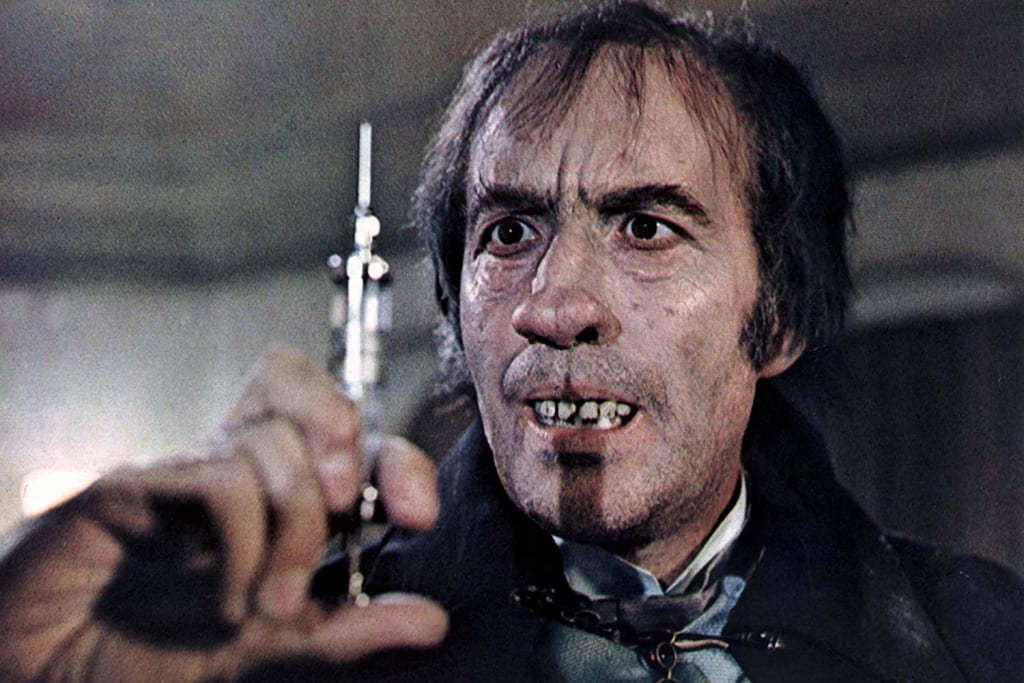
Christopher Lee's Transformation Into Edward Blake
Many Jekyll and Hyde adaptations make the transformation itself the central special-effects attraction.
Faces distort.
Hair grows.
Bodies contort.
The difference between Jekyll and Hyde is made physically obvious.
I, Monster takes a slower approach.
ACMI notes that the transformation is presented gradually through changes in Lee's voice, face and physical posture, giving the film an understated and almost surreal quality.
Lee changes how he moves.
His smile becomes disturbing.
His posture loosens.
His eyes appear more predatory.
The makeup becomes progressively stronger as Blake gains greater control.
This is much more unsettling than instantly transforming Marlowe into an obviously different creature.
Early Blake still looks recognizably like Marlowe.
That forces the viewer to confront the underlying idea directly:
There may not be a clear boundary between the respectable man and the monster.
Blake Becomes Uglier as Marlowe Becomes More Corrupted
The physical transformation develops alongside the psychological one.
Blake's appearance grows rougher and more animalistic with repeated exposure to the drug.
This creates an important ambiguity.
Is the serum physically transforming Marlowe?
Or is the exterior simply becoming a visual representation of the internal corruption that was previously hidden?
The movie never needs to resolve the question completely.
Gothic horror often works best when psychology and supernatural imagery overlap.
Blake's face becomes the visible map of desires Marlowe refuses to acknowledge as his own.
One of Christopher Lee's Most Underrated Performances
Lee appeared in an extraordinary number of films during his career.
Naturally, some performances became overshadowed by Dracula, Saruman, Count Dooku and his other iconic roles.
I, Monster deserves greater recognition because it demonstrates an aspect of Lee that popular memory sometimes forgets.
He was not simply imposing.
He could be remarkably subtle.
As Marlowe, Lee gives us repression.
As Blake, he gradually removes it.
The brilliance lies in the transition.
The viewer can still detect one man underneath both performances.
That makes the story tragic rather than merely monstrous.
The question becomes not:
“Who is Edward Blake?”
but:
“How much of Edward Blake was already Charles Marlowe?”
Peter Cushing as Frederick Utterson
Peter Cushing plays Frederick Utterson, Marlowe's close friend and lawyer.
This is worth clarifying because Utterson is sometimes incorrectly described in summaries as another physician.
Stevenson's Utterson is a lawyer, and the film broadly retains that role.
Cushing's character functions as the moral and investigative center of the story.
He notices Marlowe's increasingly strange behavior.
He encounters Blake.
He begins trying to understand why such an unpleasant man seems to possess unusual influence over his respectable friend.
Utterson initially imagines a conventional explanation.
Perhaps Blake knows something damaging about Marlowe.
Perhaps he is blackmailing him.
The possibility that Marlowe and Blake are literally the same person is almost too irrational to consider.
That allows Cushing to approach the story as a detective mystery even though audiences already understand the central secret.
Lee and Cushing Together Again
Christopher Lee and Peter Cushing are among the most famous partnerships in horror cinema.
Their names are inseparable from Hammer.
Together, they appeared in films including variations on:
- Dracula
- Frankenstein
- Sherlock Holmes
- The Mummy
- other Gothic and supernatural stories
Their screen dynamic worked because the two actors complemented each other.
Lee often represented overwhelming physical or supernatural presence.
Cushing frequently represented intelligence, discipline and moral determination.
In I, Monster, those familiar qualities are still present.
But the film was not a Hammer production.
It was made by Amicus.
That makes it particularly interesting to British horror fans because it brings two performers so closely associated with Hammer into the orbit of Hammer's major competitor.
Amicus Productions: Hammer's Great Rival
British horror of the 1960s and early 1970s is often discussed almost entirely through Hammer Film Productions.
Hammer certainly dominated the period.
But Amicus created its own important body of horror.
The company was particularly famous for anthology films—movies containing several shorter horror stories linked by a framing narrative.
Amicus productions included titles such as:
- Dr. Terror's House of Horrors
- Tales from the Crypt
- The House That Dripped Blood
- Asylum
- Vault of Horror
Unlike many of those films, I, Monster tells a single continuous story.
Powerhouse Films explicitly identifies it as an Amicus take on Stevenson's classic novella.
The atmosphere, period setting and casting can make it feel Hammer-like, but its production history belongs to a different British horror tradition.
Stephen Weeks Was Only 22
One of the most surprising facts about I, Monster concerns its director.
Stephen Weeks was just 22 years old when he made the film as his first feature.
Powerhouse Films confirms that I, Monster was Weeks's feature debut at age 22.
That makes the movie's visual confidence impressive.
Weeks approaches the material with heavy shadows, strange camera movement and oppressive Victorian interiors.
He does not direct it as a fast monster movie.
Instead, the atmosphere is slow and claustrophobic.
Rooms feel crowded with furniture.
Corridors feel narrow.
London appears damp, dark and enclosed.
Clocks, lamps, curtains, laboratories and drawing rooms create a world governed by respectable surfaces.
Blake represents everything those surfaces are attempting to contain.
The Victorian London Atmosphere
The setting is essential.
Stevenson's original story depends heavily upon the contradiction between Victorian respectability and secret vice.
Public reputation matters enormously.
A gentleman is expected to behave according to rigid social expectations.
But the city contains another world:
alleys,
night streets,
bars,
violence,
prostitution,
drunkenness,
crime.
Jekyll and Hyde therefore operate not simply as two personalities but as two versions of Victorian society.
Respectable daylight and forbidden night.
Marlowe and Blake function similarly.
The film's Gothic production design emphasizes that division.
Warm interior rooms contrast with threatening streets.
Marlowe's controlled intellectual environment becomes increasingly contaminated by Blake.
The monster is not invading civilization from outside.
He is emerging from one of its respectable drawing rooms.
The Film's Famous 3D Experiment
One of the strangest elements of I, Monster is its attempted use of three-dimensional imagery.
The film is sometimes described simply as having been “shot in 3D.”
That is not quite accurate in the modern stereoscopic sense.
The production attempted to exploit something called the Pulfrich effect.
The technique uses differences in brightness between the viewer's two eyes.
When an image moves laterally across the screen and one eye views it through a darker lens, the brain processes that image fractionally later than the other eye.
That timing difference can create an illusion of depth.
This means the filmmakers did not need two synchronized camera images in the traditional stereoscopic manner.
Instead, movement had to be carefully designed.
Objects would cross the frame.
Camera movement could create layers of foreground and background motion.
The visual choreography attempted to produce depth when viewed with the appropriate glasses.
The technique was ultimately abandoned as a commercial presentation strategy, although traces of the intended effect remain visible in the film's unusual lateral movements. Sources on the film's production describe the Pulfrich experiment as intended for 3D presentation but abandoned for its normal release.
Why the 3D Experiment Failed
The Pulfrich method had significant limitations.
It depended on continuous movement.
A static shot produced little or no stereoscopic effect.
Filmmakers therefore had to compose scenes in ways that served the 3D illusion rather than purely dramatic needs.
That becomes restrictive very quickly.
The technology also depended on precise projection and viewing conditions.
For an atmospheric Gothic drama driven largely by conversation and performance, this was hardly ideal.
The result is fascinating as a historical experiment but probably contributed to production difficulties.
Rather than becoming the film's selling point, the technique largely disappeared from its theatrical identity.
Today, the failed experiment has become one of the most interesting pieces of I, Monster trivia.
The Film's Two Cuts
Modern viewers may encounter more than one version of I, Monster.
Powerhouse Films' restored Blu-ray included:
- the original 75-minute theatrical cut
- an 81-minute extended version
The restoration was created from original film materials and released as the movie's world Blu-ray premiere in 2020.
The additional material does not radically rewrite the story.
Instead, the longer version provides more room for dialogue and psychological development.
For viewers interested primarily in Christopher Lee's interpretation of Marlowe and the film's themes of repression and duality, the extended cut is particularly worthwhile.
Why Change Jekyll and Hyde to Marlowe and Blake?
The name changes remain one of the movie's oddest choices.
Henry Jekyll becomes Charles Marlowe.
Edward Hyde becomes Edward Blake.
There has been considerable speculation about why.
The movie does not disguise its source particularly well.
Utterson retains his name.
The plot follows Stevenson.
Anyone familiar with Jekyll and Hyde would recognize the story almost immediately.
Changing the names therefore does not create genuine mystery.
What it does accomplish is psychological distance.
Because audiences do not hear “Dr. Jekyll” every few minutes, they can temporarily approach the story as a slightly different interpretation instead of constantly comparing it with earlier adaptations.
Whether this was the filmmakers' intention is uncertain.
But creatively, it helps I, Monster establish its own identity.
Freud Replaces Victorian Moral Science
Stevenson's original story is often interpreted through Victorian anxieties about morality, evolution, degeneration, addiction, sexuality and divided identity.
I, Monster shifts part of that discussion toward twentieth-century psychoanalysis.
Marlowe effectively treats human morality as repression.
Civilization, in his view, does not necessarily make people good.
It suppresses certain impulses.
The serum strips away that inhibition.
This resembles a simplified popular interpretation of Freud's distinction between instinctual drives and the psychological forces that regulate them.
The film is not a sophisticated textbook treatment of Freudian theory.
But using psychology gives the old story a different emphasis.
Blake is no longer merely “evil Jekyll.”
He is presented as the consequence of a scientist believing that hidden desires can be released without destroying the structure that normally controls them.
Is Edward Blake the Real Marlowe?
This becomes the film's most disturbing question.
Marlowe would probably argue that Blake is separate from himself.
Blake represents the impulses he normally suppresses.
But if those desires originate within Marlowe, can he really deny responsibility?
The serum does not appear to implant evil thoughts.
It removes barriers.
That makes Blake less like an invading personality and more like an extreme expression of aspects already present within Marlowe.
This interpretation makes I, Monster morally complicated.
A person cannot simply create an alter ego, place every unacceptable desire inside it and declare the respectable personality innocent.
Marlowe created Blake.
Marlowe continues taking the drug.
And increasingly, Marlowe loses the ability to determine where one identity ends and the other begins.
The Monster Within
The greatest Jekyll and Hyde adaptations understand that Hyde is frightening precisely because he is not truly an outsider.
Frankenstein creates another being.
Dracula invades from elsewhere.
The Wolf Man is cursed.
But Jekyll's monster comes from himself.
That distinction gives the story extraordinary psychological power.
Everyone understands the experience of suppressing impulses.
Anger.
Jealousy.
Cruelty.
Greed.
Violence.
Desire.
Revenge.
We build identities partly by choosing which impulses to act upon and which to reject.
Jekyll's mistake is assuming that he can separate those choices from himself.
Marlowe makes the same mistake.
The monster is not created by the serum.
The serum gives the monster permission.
Christopher Lee's Physical Performance
Lee's physical transformation deserves particular attention.
He does not merely change his face.
He changes the way Blake occupies space.
Marlowe's movements are controlled and socially conscious.
Blake seems liberated from awareness of how he appears to others.
His body becomes looser.
His expressions become exaggerated.
His pleasure becomes visible.
This gradually turns Lee's imposing physical presence into something animalistic.
The effect is particularly powerful because we know Lee's face so well from other horror roles.
Dracula often possesses aristocratic control.
Blake does not.
He feels increasingly uncivilized.
Lee essentially dismantles his own famous screen dignity.
Makeup Used as Psychological Progression
The makeup complements the performance rather than replacing it.
Instead of one enormous transformation, Blake becomes progressively more grotesque.
His hair changes.
His skin becomes rougher.
His features grow more distorted.
But the progression is gradual enough that Marlowe remains visible underneath.
ACMI's description of the film emphasizes exactly this understated transformation through facial, vocal and physical change rather than spectacular effects.
That restraint is one reason the movie has aged better than many transformation-heavy horror films of the same era.
The performance does most of the work.
Carl Davis and the Film's Uneasy Mood
The film's music was composed by Carl Davis, who later became widely respected for both film and television composition and for creating scores for restored silent films.
Powerhouse's restored release included a dedicated feature in which Davis discussed his score for I, Monster.
The music contributes to the movie's atmosphere without turning it into an operatic monster spectacle.
Like Weeks's direction and Lee's performance, it tends to support unease rather than announce horror.
That tonal restraint suits the psychological nature of the story.
The Supporting Cast
Although Lee and Cushing understandably dominate discussions of I, Monster, the film contains a notable supporting cast.
It includes:
- Mike Raven as Enfield
- Richard Hurndall as Dr. Lanyon
- George Merritt as Poole
- Kenneth J. Warren
- Susan Jameson
- Marjie Lawrence
ACMI's archive lists these performers alongside Lee and Cushing and categorizes the film as a 1971 British adaptation produced by Amicus and British Lion.
Richard Hurndall would later become familiar to Doctor Who fans when he portrayed the First Doctor in The Five Doctors after William Hartnell's death.
Mike Raven was himself associated with British horror during the period.
The ensemble helps give the movie the unmistakable texture of early-1970s British genre cinema.
Is I, Monster a Hammer Film?
No.
This is one of the most common misconceptions surrounding it.
The presence of Christopher Lee and Peter Cushing makes the confusion understandable.
The Victorian setting also resembles Hammer's visual territory.
But I, Monster was made by Amicus Productions, with British Lion involved in the production and distribution history. ACMI lists Amicus Productions and British Lion Films as its production companies.
The distinction matters to horror historians.
Hammer and Amicus shared actors and audiences but developed different identities.
Hammer was particularly famous for Gothic feature films.
Amicus became especially associated with modern-set anthology horror.
I, Monster is interesting partly because Amicus temporarily steps directly into Hammer territory.
Why I, Monster Was Overlooked
Several factors probably contributed.
The Story Was Already Familiar
By 1971, audiences had seen numerous Jekyll and Hyde adaptations.
A new version needed a strong commercial hook.
The 3D Experiment Never Became the Hook
The unusual Pulfrich process could have distinguished the film, but the plan was abandoned.
It Was Neither Fully Hammer Nor Typical Amicus
That gave the movie less obvious brand identity.
The Film Is Deliberately Restrained
Audiences expecting bloodier early-1970s horror may have found it slow.
Lee Had More Famous Characters
Dracula naturally dominated discussion of Christopher Lee's horror career.
Cushing Has a Supporting Role
Fans expecting a major Lee-versus-Cushing confrontation may find the film quieter than anticipated.
All of this allowed I, Monster to slip into an awkward historical space.
It was respected by some viewers but rarely treated as an essential British horror title.
Contemporary Reaction Was Mixed
The film has never enjoyed universal critical acclaim.
Its measured pacing, repetitive dialogue and restrained storytelling have drawn criticism.
Rotten Tomatoes currently lists only a very small number of professional reviews, while its audience reputation remains mixed.
Later appreciation has tended to focus particularly on Christopher Lee.
That makes sense.
Even viewers who find the movie imperfect often single out his performance as its strongest element.
And for fans of British Gothic horror, atmosphere alone can make the movie worthwhile.
Why It Deserves Reassessment
Films do not need to be flawless to deserve rediscovery.
Sometimes an overlooked movie becomes interesting precisely because of where it sits historically.
I, Monster brings together:
- Robert Louis Stevenson
- Freudian psychology
- Amicus Productions
- Christopher Lee
- Peter Cushing
- Victorian Gothic horror
- experimental 3D filmmaking
- a remarkably young director
- early-1970s British genre cinema
That combination alone makes it significant.
More importantly, the movie approaches Jekyll and Hyde with genuine seriousness.
It does not reduce the story to a monster transformation.
It remains interested in the tragedy of Marlowe.
That emotional dimension gives Christopher Lee far more to play than a conventional villain.
Is I, Monster Really a “Forgotten Masterpiece”?
“Masterpiece” is naturally subjective.
The film has flaws.
Its pacing can be slow.
Some supporting performances are uneven.
Its experimental visual technique occasionally influences the staging in distracting ways.
The ending arrives quickly.
And it lacks the production scale of the greatest Hammer classics.
But the description becomes much easier to defend when focusing on Lee's performance and the film's psychological interpretation.
Rather than a forgotten perfect film, I, Monster may be better understood as a forgotten Gothic gem—an ambitious and atmospheric adaptation containing one of Christopher Lee's most interesting performances.
That distinction actually makes rediscovering it more rewarding.
It does not need exaggerated praise.
It simply deserves to be remembered.
I, Monster Compared With Other Jekyll and Hyde Films
The story has been adapted repeatedly.
Different versions emphasize different aspects.
The 1931 Dr. Jekyll and Mr. Hyde, starring Fredric March, remains one of the most celebrated cinematic interpretations.
Hammer itself produced The Two Faces of Dr. Jekyll in 1960.
Christopher Lee appeared in that film too—but not as Jekyll. IMDb notes that Lee played Paul Allen in the earlier adaptation before eventually taking the central divided role in I, Monster.
This creates a fascinating connection in Lee's career.
He participated in two very different screen interpretations of the same literary story roughly a decade apart.
By 1971, he had the maturity and screen authority to make the divided protagonist entirely his own.
A Film About Addiction as Much as Evil
There is another possible reading of Marlowe's descent.
The serum behaves like an addictive substance.
Initially, Marlowe believes he controls it.
He decides when to take it.
He studies the consequences.
He treats himself as both scientist and experimental subject.
Eventually, control reverses.
The experience becomes something he cannot safely manage.
The transformations begin governing his existence.
Viewed this way, Blake represents not only repressed aggression but the frightening experience of becoming dependent upon the thing that first seemed liberating.
That gives I, Monster another layer of psychological relevance.
The pursuit of freedom produces a new form of imprisonment.
Respectability and Violence
Marlowe and Blake also expose an enduring social hypocrisy.
Societies often imagine violence as belonging to an identifiable class of “bad people.”
The respectable person is presumed good.
The criminal is presumed fundamentally different.
Stevenson's story destroys that comforting division.
The doctor and the monster are the same man.
I, Monster preserves that insight effectively.
Marlowe's education, profession and social status do not prevent the existence of destructive impulses.
Respectability can conceal darkness just as easily as it can reflect virtue.
That idea remains disturbing because it denies us the safety of believing monsters always look monstrous.
Why Victorian Gothic Still Works
The Victorian period remains perfect territory for stories about divided identity.
Public behavior was governed by strict conventions.
Appearance mattered.
Class mattered.
Reputation mattered.
Sexual behavior, addiction, mental illness and social scandal were often hidden behind respectable façades.
The narrow streets and shadowed interiors of Gothic London therefore become extensions of the divided mind.
There is always another room.
Another door.
Another identity.
Another street after dark.
Marlowe himself becomes a Gothic city:
respectable on the surface,
dangerous underneath.
The Monster Does Not Need Supernatural Powers
Edward Blake possesses no magical ability.
He is frightening because he has lost restraint.
That makes I, Monster closer to psychological horror than supernatural horror.
Many of the most frightening humans in real life are not monsters because they possess extraordinary powers.
They become frightening when ordinary moral limits disappear.
Empathy.
Shame.
Responsibility.
Fear of consequences.
Recognition of another person's humanity.
Remove those barriers and an ordinary individual can become terrifying.
That is the philosophical heart of the Jekyll and Hyde story.
And I, Monster understands it.
The Meaning Behind the Title
The title itself becomes more powerful once the story is understood.
I, Monster.
Not:
“The Monster.”
Not:
“Monster Within.”
Not even:
“Dr. Jekyll and Mr. Hyde.”
The title can almost be read as a confession.
I am the monster.
Marlowe cannot ultimately separate himself from Blake.
The attempt to divide the self fails because both personalities belong to the same human being.
That is perhaps the darkest conclusion the story can offer.
The monster is not another creature waiting outside.
The monster speaks in the first person.
Why Modern Horror Fans Should Watch It
Fans discovering British horror through streaming and restored Blu-rays have an opportunity earlier audiences did not.
Films once trapped in poor television prints can now be reassessed through restored editions.
Powerhouse Films' Indicator release gave I, Monster a 2K restoration and preserved both the 75-minute theatrical version and the 81-minute extended cut.
For modern viewers, the movie is especially worth exploring if you enjoy:
- Christopher Lee
- Peter Cushing
- Hammer horror
- Amicus Productions
- Gothic cinema
- Victorian mysteries
- psychological horror
- Dr. Jekyll and Mr. Hyde
- practical makeup
- slow-burn horror
- British genre films of the 1960s and 1970s
It may not deliver the relentless violence expected from modern horror.
That is precisely the point.
Its horror develops through personality.
The Real Horror Is Recognition
We are comfortable with monsters when they are clearly different from us.
Fangs.
Claws.
Decaying skin.
Supernatural powers.
Such creatures can be defeated because they belong to another category.
Jekyll and Hyde removes that comfort.
There is no clean separation.
The civilized man and the violent creature share one body.
This is why the story survived far beyond the Victorian period.
Everyone possesses impulses they do not express.
Most people do not become Edward Blake because morality, empathy, conscience and social restraint matter.
But Stevenson asks what would happen if someone deliberately removed those restraints.
I, Monster asks the same question.
And Christopher Lee's performance makes the answer disturbingly intimate.
The Bottom Line
I, Monster is a 1971 British Gothic horror film directed by Stephen Weeks and produced by Amicus, adapting Robert Louis Stevenson's Strange Case of Dr Jekyll and Mr Hyde under altered character names.
Christopher Lee plays psychologist Dr. Charles Marlowe, whose experimental drug releases his inhibited impulses and gradually transforms him into Edward Blake.
Peter Cushing plays Frederick Utterson, Marlowe's friend and lawyer, who begins investigating the mysterious relationship between the two identities.
Despite occasional claims to the contrary, director Stephen Weeks was only 22 years old when making his feature debut, not 24.
The movie also was not a conventional stereoscopic 3D production. It experimented with the Pulfrich effect, using choreographed lateral movement and differential viewing brightness to create the perception of depth. The 3D concept was ultimately abandoned for general theatrical presentation.
What remains is a moody, psychologically focused interpretation of one of Gothic literature's greatest ideas.
Its greatest asset is Christopher Lee.
His transformation works not because the makeup is spectacular but because the boundary between Marlowe and Blake slowly disappears.
At first, the viewer watches one man becoming another.
Eventually, we begin wondering whether there were ever truly two men at all.
That is why I, Monster deserves rediscovery.
Beneath the fog, the Victorian laboratories and the Gothic atmosphere lies an uncomfortable idea that has lost none of its power:
The monster is frightening because he was never truly separate from the man.
Frequently Asked Questions
What is I, Monster?
I, Monster is a 1971 British Gothic horror film based on Robert Louis Stevenson's Strange Case of Dr Jekyll and Mr Hyde. It stars Christopher Lee and Peter Cushing.
Is I, Monster actually a Jekyll and Hyde movie?
Yes. It follows Stevenson's story closely but renames Dr. Henry Jekyll as Charles Marlowe and Edward Hyde as Edward Blake. ACMI describes it as mostly faithful to the original plot despite these changes.
Who plays Dr. Marlowe in I, Monster?
Christopher Lee plays Dr. Charles Marlowe.
Who plays Edward Blake?
Christopher Lee also plays Edward Blake, Marlowe's violent alter ego.
Who does Peter Cushing play?
Peter Cushing plays Frederick Utterson, Marlowe's friend and lawyer.
Is Utterson a doctor in I, Monster?
No. Some summaries mistakenly describe him as a physician, but Utterson retains the lawyer role associated with Stevenson's story.
Who directed I, Monster?
Stephen Weeks directed the film.
How old was Stephen Weeks when he directed I, Monster?
He was only 22 years old, and I, Monster was his first feature film.
Was I, Monster made by Hammer?
No. It was made by Amicus Productions, although Christopher Lee, Peter Cushing and its Victorian Gothic style make it easy to mistake for a Hammer film.
What was Amicus Productions?
Amicus was a British production company particularly famous for horror films and anthology movies during the 1960s and 1970s.
Was I, Monster filmed in 3D?
It was designed to experiment with a 3D effect based on the Pulfrich effect, rather than conventional stereoscopic photography. The plan was abandoned for its normal theatrical release.
What is the Pulfrich effect?
It is an optical effect in which one eye receives a darker image and therefore processes moving imagery slightly later than the other eye, allowing lateral motion to create an illusion of depth.
Why does the camera move sideways so much in I, Monster?
Many movements were designed to help create the intended Pulfrich 3D illusion.
Why were Jekyll and Hyde renamed?
No universally accepted definitive explanation has emerged. The characters were changed to Charles Marlowe and Edward Blake even though much of Stevenson's story was retained.
Is the film faithful to Strange Case of Dr Jekyll and Mr Hyde?
Broadly, yes. ACMI describes it as mostly faithful despite the name changes and psychological modernization.
What is different about this adaptation?
The film places greater emphasis on Freudian psychology and presents Marlowe's serum as releasing suppressed inhibitions.
Does Christopher Lee wear heavy monster makeup?
The makeup becomes stronger over time, but the transformation is relatively subtle. Lee changes his voice, expression, movement and posture alongside gradual makeup changes.
Is I, Monster one of Christopher Lee's best performances?
That is subjective, but the film is frequently praised for allowing Lee to display unusually subtle physical and psychological transformation rather than relying only on his commanding horror persona.
Did Christopher Lee appear in another Jekyll and Hyde movie?
Yes. He appeared in Hammer's The Two Faces of Dr. Jekyll in 1960, playing Paul Allen rather than Jekyll.
How long is I, Monster?
The original theatrical cut runs approximately 75 minutes, while the restored extended version runs approximately 81 minutes.
Is there an extended cut?
Yes. Powerhouse Films released both the theatrical and extended versions in its restored Blu-ray edition.
When was the restored Blu-ray released?
Powerhouse Films released its Indicator limited edition on September 28, 2020. It was the film's world Blu-ray premiere.
Who composed the music?
Carl Davis composed the film's score.
Where was I, Monster made?
The film was produced in the United Kingdom, with studio work associated with Shepperton Studios.
What genre is I, Monster?
It combines Gothic horror, psychological horror, period drama and elements of mystery.
Is I, Monster very violent?
Compared with many modern horror films—and even some British horror films of its own era—it is relatively restrained. Much of its horror comes from atmosphere and psychological deterioration.
What is the main theme?
The central theme is the duality of human nature and the danger of believing our darker impulses can be separated from our moral identity.
Is Edward Blake supernatural?
Not in the conventional sense. He emerges through Marlowe's experimental drug and represents the release of previously suppressed impulses.
Why does Marlowe continue taking the serum?
His scientific curiosity, fascination with the transformation and gradually weakening control all contribute to his continued experimentation.
Is the movie about good versus evil?
Yes, but it complicates the traditional idea by suggesting that good and evil may coexist within the same person rather than existing as completely separate forces.
Is I, Monster scary?
It is more unsettling than frightening by modern standards. Its power comes from Gothic atmosphere, Christopher Lee's performance and the idea of personality gradually losing its restraints.
Why is the movie overlooked?
Its familiar source story, failed 3D experiment, modest scale, mixed initial reception and the existence of more famous Lee and Cushing films all contributed to its relative obscurity.
Is I, Monster worth watching today?
For fans of Christopher Lee, Peter Cushing, Jekyll and Hyde adaptations, Amicus, Hammer-style Gothic cinema or psychological horror, absolutely.
What makes Christopher Lee's performance special?
Rather than instantly becoming an elaborate monster, Lee gradually changes Marlowe's voice, posture, expression and behavior until Edward Blake seems to emerge organically from within him.
What does the title I, Monster mean?
It can be interpreted almost as a confession: the monster is not an external creature but part of the self.
What is the lasting message of I, Monster?
Its most powerful idea is that civilization may restrain our darkest impulses without necessarily eliminating them.
The monster does not always wait outside the door.
Sometimes, the door opens inward.