Michael Review: A Powerful, Polished Tribute
There are biopics that explain a life, and there are biopics that try to recreate a feeling. Michael — Antoine Fuqua’s 2026 film about Michael Jackson — clearly belongs to the second category. It is less interested in dissecting every contradiction of its subject than in putting audiences back inside the glow, velocity, and spectacle of Jackson’s rise. Released in theaters on April 24, 2026 in the U.S., the film stars Jaafar Jackson, Michael Jackson’s nephew, and was co-produced with the Jackson estate.
That choice shapes everything.
If you walk into Michael expecting a cold, prosecutorial cradle-to-grave study, this is not that movie. The film reportedly ends in 1988, before the allegations that later reshaped public debate around Michael Jackson’s legacy, and multiple reports say that production changes and legal restrictions forced the movie away from that later terrain. Critics have called the result selective or sanitized, while audiences have embraced it as an emotional, music-first celebration.
And that tension is exactly where the review has to start.
Because judged as a comprehensive reckoning, Michael is incomplete. Judged as a performance-driven big-screen tribute to the making of a superstar, it is often electrifying.
Jaafar Jackson Is the Movie’s Miracle
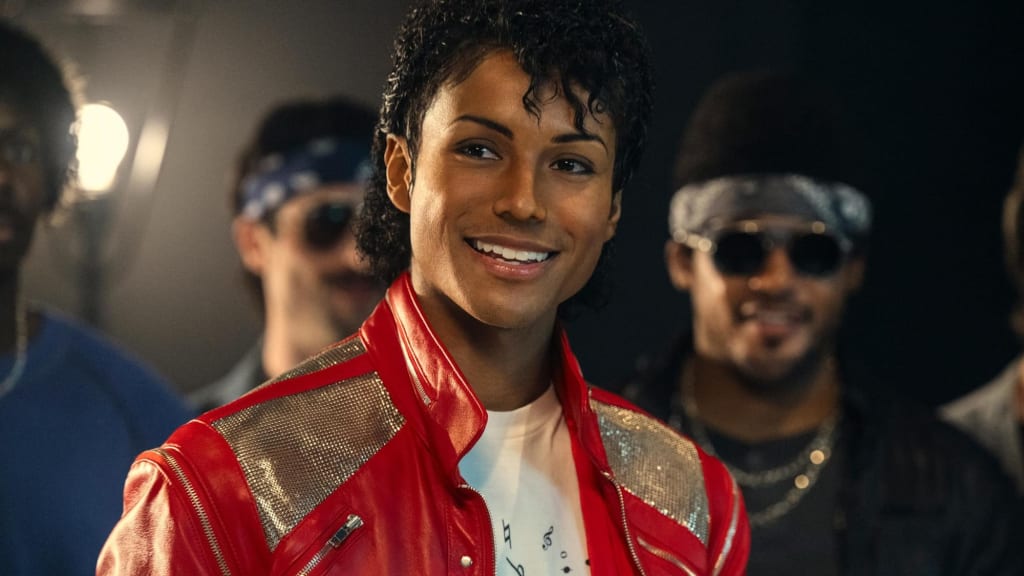
The strongest fact about Michael is also the simplest one: Jaafar Jackson had to do the impossible, and by most accounts he comes astonishingly close.
Even critics who were tough on the film itself repeatedly singled him out. Rotten Tomatoes’ early review roundup said the movie is strongest when Jaafar is performing as his uncle, and Variety’s review summary praised the way he captures the look, voice, movement, and emotional delicacy that made Michael Jackson such a singular figure. AP likewise notes that Jackson’s nephew was cast to star, and audience reaction has strongly backed that choice.
That matters because this role could have gone horribly wrong.
Michael Jackson is not just famous. He is one of those artists whose gestures, vocal textures, body angles, and stage instincts are already burned into public memory. The margin for error was tiny. Too much imitation, and the performance would feel like mimicry. Too little, and the illusion would collapse.
From everything that has been reported — and from the film’s audience momentum — Jaafar seems to have found the right center. He does not merely cosplay his uncle’s mannerisms. He appears to understand that Michael Jackson’s magnetism lived in a strange balance of softness and force, vulnerability and control, fragility and absolute stage command. That is much harder to capture than a moonwalk or a whisper.
This is why so many viewers are responding in emotional rather than technical language. They are not just saying the performance is “good.” They are saying it feels like Michael is alive again on screen.
That is the highest compliment this movie can receive, and it seems to be the one it is getting most often.
The Film Understands the Power of Performance
One reason Michael works as well as it does is that it apparently knows exactly where its dramatic advantage lies: in the music, the movement, and the construction of Michael Jackson as a once-in-a-generation performer.
Rotten Tomatoes’ early summary says the film succeeds as a celebration of Jackson’s music and star power even when critics found the larger storytelling thin or too cautious. That feels like the right way to frame its biggest strength. Michael is at its most persuasive when it stops trying to reassure you that this is an Important Biopic and simply lets the performance sequences, rehearsals, pressure, ambition, and charisma do the talking.
That instinct is smart.
Because whatever else one thinks about Michael Jackson’s public life, there is no serious argument against the scale of his artistry. He changed the visual language of pop stardom. He altered how performance, dance, video, and celebrity ambition worked in modern music. A film called Michael would fail completely if it could not make you feel that force. By most accounts, it can.
And that is why the film seems to be landing much more strongly with general audiences than with many critics. Audiences do not always go to a biopic asking for total historical architecture. Often, they want to feel the person’s cultural energy again. AP reported that despite a 38% Rotten Tomatoes critics score, audiences responded far more warmly, giving the film an A- CinemaScore, while the opening weekend shattered the record for a music biopic with $97 million domestically and $217.4 million worldwide.
That is not a small gap. It is a major split between critical hesitation and audience enthusiasm.
A Celebration, Not a Full Reckoning
This is where the review has to stay honest.
The biggest artistic and ethical criticism surrounding Michael is not hard to identify. The film does not fully confront the later allegations and controversies that transformed Jackson’s legacy. AP reported that the movie was reworked to conclude in 1988 after a major production problem involving a third act focused on the Jordan Chandler accusations, and critics have argued that the final version glosses over major parts of the story. The Guardian called the result “bowdlerised,” while Rotten Tomatoes’ first-reviews roundup described it as “safe” and “a little hollow” beyond the performance highs.
This criticism is fair.
If a biopic asks to stand as the definitive portrait of a figure as culturally vast and contested as Michael Jackson, then omission becomes part of the meaning. You cannot fully separate the artist’s triumph from the questions that later surrounded him and expect everyone to accept the result as complete.
But completeness may not actually be what this film is trying to offer.
That does not excuse the omission. It simply clarifies the mode. Michael appears to function less as a definitive judgment than as a curated emotional experience — one that wants to return viewers to the awe, speed, pressure, and brilliance of Jackson’s ascent. That makes it more limited, but it also makes it easier to understand.
This is not the final word on Michael Jackson.
It is a polished, highly controlled act of remembrance.
The Direction Knows When to Go Big
Antoine Fuqua is not a delicate filmmaker in the abstract. He understands momentum, confrontation, spectacle, and star framing. That makes him an intriguing fit for this material. The challenge of a Michael Jackson film is not only emotional. It is architectural. The movie has to move like celebrity itself: quickly, seductively, rhythmically, and with a sense of scale.
Reports from the first wave of reviews suggest that Michael is often at its most compelling when it leans into that scale instead of trying to force conventional biopic depth into every corner. Critics who were mixed on the script still acknowledged the flash, nostalgia, and performance charge.
That makes sense. Michael Jackson was never a small subject. A film about him should have some operatic energy, some sheen, some velocity. It should occasionally overwhelm. A dry, academically balanced treatment might have satisfied a different audience, but it could also have failed to evoke the visceral experience of Jackson as a performer.
The question is whether the movie’s bigness becomes illumination or evasion.
By the look of the reception, the answer is: both.
Why Audiences Are Loving It Anyway
The audience response is the most revealing part of the whole story.
Whatever critics may think of the film’s omissions, the public has responded with intensity. AP and other reports say Michael posted the biggest opening weekend ever for a music biopic and a very strong audience grade. That tells you something important: viewers are not merely evaluating the movie as journalism. They are evaluating it as an event.
And as an event, it clearly works.
That is not surprising. The film gives audiences three things that are very hard to resist when they are well executed:
1. Recognition
People already know the music, the iconography, the silhouette, the moves, the emotional history.
2. Resurrection
The biopic offers the thrill of seeing a mythic performer “return” in embodied form through Jaafar Jackson.
3. Celebration
For viewers who primarily associate Michael Jackson with artistry, childhood memory, dance, and pop-cultural wonder, the movie functions as a large-scale act of homage.
That combination is powerful. It may not satisfy every critic, but it absolutely explains why the audience is showing up in such force.
The Movie’s Weakness Is Also Its Strategy
The same thing that makes Michael accessible is also what limits it.
By choosing celebration over confrontation, the film creates a smoother emotional experience — but also a narrower one. It can thrill more easily because it asks fewer destabilizing questions. It can move like a tribute because it resists becoming a reckoning.
That will divide viewers sharply.
Some will see that as artistic cowardice.
Others will see it as tonal coherence.
Many will probably accept both at once.
And that may be the most honest way to review the film. Michael is not empty. It is not a cheap imitation. It is not a failure as entertainment. But it is also not brave enough, or perhaps not structured to be brave enough, to become the full dramatic study its subject ultimately deserves.
Still, movies are not only measured by what they refuse to do.
They are also measured by what they accomplish.
And Michael accomplishes quite a lot.
This Is the Kind of Biopic That Creates Fans
One of the more interesting reactions the film is generating is from younger or less committed viewers who seem to be leaving as stronger Michael Jackson fans than they entered. That is a sign of real cinematic success.
A biopic that only flatters preexisting fans is doing one thing.
A biopic that creates new admiration is doing something more.
That is probably where Michael will have its longest afterlife. It may not win every argument about historical responsibility, but it is likely to deepen emotional attachment to Jackson’s artistry and bring new viewers into his catalog. If a movie sends people back to the performances, the songs, the videos, the inventiveness, and the stagecraft with fresh wonder, then it has done meaningful cultural work.
That seems to be happening here.
Michael is not the definitive Michael Jackson film. It is too selective, too careful in what it leaves out, and too committed to celebration to qualify as the final word on its subject. Reports from critics and industry coverage make that limitation impossible to ignore. The film ends in 1988, avoids later allegations, and has drawn repeated criticism for feeling sanitized.
But that is only half the truth.
The other half is that Michael seems to achieve something rare and undeniably cinematic: it gives audiences the sensation of Michael Jackson’s star power again, and it does so through a performance from Jaafar Jackson that has been widely praised even by critics who were cool on the film overall. Add in the movie’s record-breaking opening and strong audience reaction, and the picture becomes clear: this is a flawed but potent biopic, one that succeeds most when it stops trying to be history and simply becomes spectacle, rhythm, pressure, and pop legend.
So no — Michael is not beyond criticism.
But it is also not something to dismiss with a lazy shrug.
It is a solid, emotionally charged, crowd-pleasing biopic anchored by an outstanding central performance. And for many viewers, that will be more than enough to make them leave the theater thrilled.
FAQ
Is Michael (2026) out now?
Yes. The official movie site says Michael opened in theaters on April 24, 2026 in the U.S.
Who plays Michael Jackson in Michael?
Michael Jackson is played by his nephew, Jaafar Jackson. AP reported that Jaafar was cast to star, and many reviews have highlighted his performance as the film’s biggest strength.
Who directed the film?
The film was directed by Antoine Fuqua.
Is Michael getting good reviews?
Critics are mixed to negative overall, while audiences are much more positive. AP reported a 38% critics score on Rotten Tomatoes and an A- CinemaScore from audiences.
Does the movie cover the allegations against Michael Jackson?
Not fully. AP reported that the film was reworked to end in 1988, before the later allegations surfaced, after a costly production rethink and reshoots.
Why are audiences liking it more than critics?
Because the movie appears to work strongly as a celebration of Michael Jackson’s performance energy, music, and image, especially through Jaafar Jackson’s portrayal, even if many critics find the storytelling too safe.
Was the film a box office success?
Yes. AP reported that Michael opened to $97 million in the U.S. and Canada and $217.4 million worldwide, setting a new opening record for a music biopic.
What is the best reason to see it?
If you want to feel the spectacle, rhythm, and star power of Michael Jackson recreated on the big screen, this film appears to deliver that better than almost anything else.