
Rachel Weisz as Evelyn Carnahan: The Brilliant Heart of The Mummy and The Mummy Returns
Rachel Weisz’s portrayal of Evelyn Carnahan in The Mummy and The Mummy Returns created one of the most charming and enduring heroines in modern adventure cinema.
When audiences first meet Evelyn, she does not look like a conventional action hero. She is a librarian and aspiring Egyptologist whose enthusiasm occasionally moves faster than her coordination. She knocks over shelves, struggles to earn professional recognition, and enters the lost city of Hamunaptra armed with scholarly knowledge rather than military experience.
Yet the qualities that initially make her seem unsuited for a dangerous expedition become exactly what the heroes need.
Evelyn can read ancient languages, identify forgotten rituals, understand archaeological discoveries, and connect clues that everyone else overlooks. Her curiosity accidentally helps unleash an ancient evil, but her intelligence also makes defeating it possible.
By The Mummy Returns, she has developed into a confident field researcher, experienced adventurer, devoted mother, capable fighter, and equal partner to Rick O’Connell. Her knowledge remains central, but it is now joined by greater physical confidence and an increasingly personal connection to ancient Egypt.
Rachel Weisz makes that transformation believable because she never treats the earlier Evelyn as someone who needed to become a completely different person.
The courage was already there.
The sequel simply gives it more room to emerge.
Written and directed by Stephen Sommers, The Mummy opened in May 1999 as a large-scale reimagining of Universal’s classic monster property. It combined supernatural horror, romantic comedy, archaeological fantasy, and old-fashioned adventure, with Brendan Fraser as Rick O’Connell, Rachel Weisz as Evelyn, John Hannah as her brother Jonathan, and Arnold Vosloo as the resurrected Imhotep. The Mummy Returns reunited the principal cast in May 2001 and expanded the story into a larger family adventure.
Although the movies contain undead armies, magical books, desert battles, curses, reincarnation, and world-threatening villains, Evelyn provides their emotional and intellectual center.
Rick may carry the weapons.
Evelyn understands what they are fighting.
Spoiler Warning
The following article discusses major events from The Mummy and The Mummy Returns, including Evelyn’s role in Imhotep’s resurrection, her connection to Princess Nefertiri, her relationships, and the ending of both films.
Who Is Evelyn Carnahan?
Evelyn Carnahan is introduced in The Mummy as a British librarian working at the Cairo Museum of Antiquities.
She is deeply knowledgeable about ancient Egypt and desperate to prove that she belongs in serious archaeological circles. Her professional ambitions are complicated by limited field experience and by people who underestimate her abilities.
Evelyn’s first major scene immediately establishes the character’s essential combination of intelligence, enthusiasm, and physical comedy. While working in the library, she accidentally creates a spectacular domino effect that brings down an entire arrangement of shelves.
The sequence could have reduced her to a simple comic figure.
Instead, it reveals how Rachel Weisz approaches the character.
Evelyn is embarrassed, but she is not ashamed of who she is. Her awkwardness does not make her unintelligent, and her mistakes do not destroy her confidence. She remains fascinated by books, languages, artifacts, and the possibility of discovering something the academic establishment has overlooked.
That distinction is important.
Evelyn is not a foolish person written to provide convenient information. She is an intelligent person whose excitement sometimes overpowers her caution.
The film identifies her as both a librarian and Egyptologist, while later commentary on the character has emphasized that her ability to translate ancient texts and understand the film’s invented mythology makes her indispensable to the expedition.
Evelyn’s Proud Identity as a Librarian
One of Evelyn’s defining moments comes when she declares, with complete sincerity:
“I am a librarian.”
The moment is humorous, but Evelyn does not present her profession as a joke.
She may not yet be an experienced explorer, gunfighter, or treasure hunter, but she is proud of her knowledge. She understands that scholarship has value even in a world dominated by adventurers and men carrying large collections of weapons.
Rachel Weisz plays the scene with conviction rather than embarrassment.
That choice transforms Evelyn’s profession into a heroic identity.
Her books are not merely background decoration. Her ability to read, research, translate, and remember becomes as important as Rick’s ability to survive a gunfight.
The character’s enduring appeal comes partly from this refusal to separate intelligence from adventure. Evelyn does not need to abandon scholarship to become brave. She demonstrates that intellectual curiosity can itself be adventurous.
SYFY’s retrospective on the character similarly highlights the importance of this self-assurance: Evelyn begins the story physically clumsy, but she already knows who she is and values the skills that later become essential to stopping Imhotep.
Intelligence as a Form of Heroism
Many adventure films use the scholar as a person who explains the legend before the physical hero takes over.
Evelyn is different.
Her knowledge continually changes the direction of the plot.
She understands the value of the map connected to Hamunaptra. She interprets inscriptions, recognizes artifacts, reads ancient Egyptian, investigates the nature of Imhotep’s curse, and identifies the ritual necessary to make him mortal.
Rick can fight the physical manifestations of evil, but he cannot translate the books that control them.
That creates an effective balance between the two characters.
Evelyn is not included simply to admire Rick’s heroism. Rick repeatedly depends on her expertise. Their survival requires both physical action and intellectual understanding.
This structure gives Evelyn genuine narrative power.
She does not merely accompany the adventure.
She helps define its objective, initiates its most important discoveries, and provides the knowledge required to resolve the crisis.
Curiosity Is Evelyn’s Greatest Strength and Most Dangerous Flaw
Evelyn’s curiosity drives nearly everything that happens in the first film.
She wants to find Hamunaptra because it represents a discovery that could transform her career and establish her as a serious Egyptologist. Once she reaches the city, she cannot resist investigating its texts and hidden chambers.
That curiosity has disastrous consequences.
When Evelyn reads from the Book of the Dead, she accidentally resurrects Imhotep. The decision unleashes the curse that threatens the expedition and eventually the wider world.
The movie does not excuse her mistake.
It also does not suggest that curiosity itself is the problem.
Evelyn’s error comes from combining knowledge with insufficient caution. She can translate the words, but she does not yet fully understand the danger of speaking them.
This becomes an important part of her development.
She does not respond by abandoning scholarship or allowing shame to paralyze her. She accepts responsibility and uses the same intellectual determination to search for a solution.
Her knowledge awakens Imhotep.
Her knowledge also helps defeat him.
The story therefore presents curiosity as powerful rather than automatically virtuous. It can open doors that should have remained closed, but it can also reveal the path out of the danger that follows.
Retrospectives on the character have frequently noted this dual role: Evelyn’s reading resurrects the villain, but she then refuses to flee from the consequences and becomes essential to reversing what she has done.
Evelyn’s Bravery in The Mummy
Evelyn begins the expedition without Rick’s combat experience, but she is never lacking in courage.
She travels into dangerous territory, enters ancient ruins, continues investigating after the expedition begins suffering horrifying losses, and confronts a supernatural enemy whose existence would overwhelm most people.
Her bravery is especially meaningful because she is often frightened.
Evelyn screams, panics, and reacts visibly when confronted by mummies, scarabs, corpses, or magical threats. The film does not ask her to become emotionally expressionless in order to qualify as strong.
She feels fear and keeps participating.
That makes her courage more relatable.
A fearless person faces no internal resistance. Evelyn must overcome fear repeatedly, often while having less practical experience than the people around her.
She also volunteers to go with Imhotep when doing so can protect Rick and the others. Although the situation places her in the familiar position of a captured heroine, she does not become passive. She watches for weaknesses, challenges Imhotep, attempts to delay his plans, and continues searching for an opportunity to escape.
Rick’s rescue efforts matter, but physical rescue alone cannot defeat the villain.
The final victory still requires Evelyn’s ability to interpret the Book of Amun-Ra and use its power to make Imhotep vulnerable.
Is Evelyn Carnahan a Damsel in Distress?
Evelyn occasionally occupies situations associated with the traditional damsel-in-distress role.
She is kidnapped by Imhotep. She becomes the intended human sacrifice in his attempt to restore Anck-Su-Namun. Rick races to reach her before the ritual is completed.
However, the character does not remain confined to that structure.
Evelyn’s choices help create the expedition. Her decisions move the plot forward. Her expertise repeatedly saves the group, and the climax cannot be resolved without her participation.
She also refuses to wait helplessly for Rick whenever danger appears.
Even while captured, she communicates, observes, resists, and looks for openings. She understands the ritual taking place around her and contributes directly to stopping it.
The film allows Rick to be a traditional swashbuckling hero without requiring Evelyn to become intellectually or emotionally secondary.
She can need help in one situation and still remain a hero.
This is one reason the character has aged more successfully than many adventure-film love interests. Her vulnerability does not erase her agency, while her intelligence does not make her unrealistically capable of handling every physical threat alone.
Rachel Weisz’s Gift for Physical Comedy
Evelyn’s comic moments are essential to the tone of The Mummy.
The movie moves between horror, romance, action, and absurdity. A performance that leaned too heavily toward seriousness could have made its supernatural mythology feel ridiculous. A performance that treated everything as a joke could have removed the danger.
Weisz finds the balance.
Her physical comedy is expressive without turning Evelyn into a caricature. The library disaster, her reactions to Rick’s appearance, her discomfort around danger, and her occasional attempts to preserve dignity all feel rooted in personality.
Evelyn is funny because she is sincere.
She believes completely in the importance of what she is doing, even when the situation around her becomes chaotic.
Weisz rarely appears to be asking the audience to laugh at Evelyn’s intelligence. The humor comes from her confidence colliding with circumstances she cannot control.
That difference protects the character.
Evelyn may create disorder, but she is not the joke of the film.
The Transformation After the Riverboat Escape
The riverboat sequence marks an early turning point in Evelyn’s adventure.
The expedition is attacked, the boat burns, and the characters are forced to escape with little more than their lives. Evelyn loses many of the objects and tools that represented her carefully planned scholarly expedition.
From that point onward, the experience becomes less controlled.
She can no longer approach Hamunaptra as a museum professional examining safely contained objects. She must adapt to a living conflict involving rival explorers, armed attackers, ancient guardians, and supernatural danger.
Rick later gives her a set of archaeological tools, a small gesture that helps develop their romance while also showing that he respects what matters to her.
He does not ask Evelyn to stop being a scholar.
He gives her the tools to continue.
Their attraction grows because each begins to recognize the value of the other’s abilities.
Evelyn and Rick O’Connell
The chemistry between Rachel Weisz and Brendan Fraser is one of the principal reasons The Mummy remains so warmly remembered.
Rick and Evelyn are opposites without feeling artificially incompatible.
Rick is practical, physically experienced, skeptical, and prepared to solve problems with weapons. Evelyn is academically driven, curious, idealistic, and determined to understand what lies beneath the surface.
He knows how to reach Hamunaptra and survive its dangers.
She knows why Hamunaptra matters and what its discoveries mean.
Their relationship develops through attraction, irritation, admiration, and increasing trust. Rick initially sees Evelyn as inexperienced and dangerously curious. Evelyn initially sees him as uncivilized and reckless.
Both assessments are partly correct.
Neither assessment is complete.
Rick gradually realizes that Evelyn’s knowledge is not decorative. She repeatedly understands things he cannot and continues acting courageously after the expedition becomes terrifying.
Evelyn discovers that Rick’s rough manner hides loyalty, resourcefulness, and a genuine willingness to risk himself for other people.
Their romance works because neither character completely absorbs the other.
Rick does not become a scholar.
Evelyn does not abandon books for weapons.
They become a partnership in which their different strengths create something more capable than either could achieve alone.
Contemporary retrospectives frequently identify the chemistry between Fraser and Weisz as one of the film’s defining qualities, particularly because their quieter romantic and comedic scenes are as memorable as its large action sequences.
Evelyn and Jonathan Carnahan
Evelyn’s relationship with her brother Jonathan adds another dimension to her character.
Jonathan is charming, opportunistic, frequently dishonest, and highly interested in treasure. He often appears less academically serious than Evelyn, but he remains loyal when the situation becomes dangerous.
Their sibling dynamic is affectionate without becoming sentimental.
Evelyn is regularly frustrated by Jonathan’s irresponsibility, while Jonathan mocks her intensity and occasionally benefits from her discoveries. Nevertheless, each understands the other deeply.
Jonathan also helps keep Evelyn connected to her ordinary identity during increasingly extraordinary events.
Before Rick becomes her romantic partner, Jonathan is the person who already knows her habits, ambitions, insecurities, and determination.
The relationship gives Evelyn a family connection that exists independently of romance.
It also strengthens the ensemble. Rick, Evelyn, and Jonathan function not as interchangeable heroes but as three distinct personalities whose abilities and weaknesses repeatedly overlap.
Evelyn’s Professional Insecurity
Behind Evelyn’s enthusiasm is a desire to be taken seriously.
She has knowledge, talent, and ambition, but she lacks the institutional recognition she wants. Her interest in Hamunaptra is therefore not merely personal curiosity. The discovery offers a chance to prove that she deserves a place among respected scholars.
This helps explain some of her recklessness.
Evelyn is not chasing treasure in the same way as Jonathan or the competing American expedition. She is chasing professional legitimacy.
She wants evidence that her life among books has prepared her for meaningful discovery.
The irony is that she eventually proves herself through events no academic institution would be prepared to evaluate. She does not simply uncover a lost city. She survives a supernatural catastrophe and helps prevent an ancient being from spreading death across the world.
By the conclusion, Evelyn has gained something more important than external approval.
She has direct knowledge of her own capabilities.
Evelyn’s Evolution in The Mummy Returns
The Mummy Returns introduces a more experienced Evelyn.
She is now married to Rick and known as Evelyn O’Connell, although cast listings also continue to identify her as Evelyn Carnahan. They have a young son, Alex, whose intelligence, curiosity, and tendency to become involved with dangerous artifacts clearly reflect both parents.
The sequel does not leave Evelyn behind while Rick continues adventuring.
She remains an active Egyptologist and field explorer. She enters ancient sites, examines artifacts, interprets visions, investigates the Scorpion King’s legend, and participates directly in the family’s dangerous expedition.
Her physical confidence has also increased.
The hesitant librarian who once entered Hamunaptra with limited practical experience now moves through ruins with familiarity. She handles weapons, fights opponents, and responds to supernatural danger without the same initial disbelief.
This development feels earned because the first film already established her determination.
Evelyn did not suddenly become brave between movies.
She gained experience that allowed her existing courage to become more controlled.
Marriage Does Not End Evelyn’s Adventure
Adventure stories sometimes treat marriage as the conclusion of a heroine’s independence.
Once the romantic relationship has been secured, the woman may be removed from danger, reduced to domestic support, or left behind while the male hero begins another mission.
The Mummy Returns largely avoids that pattern.
Evelyn and Rick are introduced as a functioning married team. Their relationship has matured, but their playful attraction remains. They explore together, raise Alex together, disagree without becoming enemies, and respond as partners when their family is threatened.
The movie’s repeated treatment of them as a unit does not erase Evelyn’s individuality.
She still has her own expertise, visions, historical connection, and character arc.
Rick protects her because he loves her, but Evelyn is not defined only by being Rick’s wife. She continues making discoveries and decisions that neither Rick nor Jonathan could make in her place.
Their marriage strengthens the story because it gives the adventure emotional stakes beyond the beginning of a romance.
They are no longer discovering whether they love each other.
They are defending the life they have built.
Evelyn as a Mother
Motherhood adds another layer to Evelyn without replacing her previous identity.
She is protective of Alex, but she also recognizes his intelligence and curiosity. She understands why he is drawn to ancient objects because the same impulse has shaped her life.
That similarity creates both affection and danger.
Alex inherits Evelyn’s fascination with discovery and Rick’s confidence around risk. His curiosity places him in the middle of the supernatural conflict surrounding the Bracelet of Anubis, leading to his abduction and forcing the family into another race against time.
Evelyn’s response combines maternal fear with professional competence.
She does not remain behind while Rick searches for their son. She participates in the pursuit because she has knowledge essential to finding him.
The sequel therefore allows Evelyn to be a mother, scholar, romantic partner, and adventurer simultaneously.
None of those identities is presented as inherently incompatible with the others.
The Revelation of Princess Nefertiri
One of the sequel’s largest additions to Evelyn’s story is her connection to Princess Nefertiri.
Evelyn begins experiencing visions of ancient Egypt that reveal events involving Nefertiri, Anck-Su-Namun, Imhotep, and Pharaoh Seti I. The story eventually identifies Evelyn as the reincarnation of Nefertiri, giving her a personal connection to the conflict that extends far beyond academic interest.
Rachel Weisz is credited with playing both Evelyn and Nefertiri in The Mummy Returns.
The reincarnation storyline changes Evelyn’s relationship with history.
In the first film, ancient Egypt is something she studies.
In the sequel, it becomes something she remembers.
Her expertise is no longer only the result of education and intellectual passion. It is connected to a previous existence and an unfinished struggle with Anck-Su-Namun.
This gives Evelyn a more active position within the mythology, although it also introduces a complicated question: does making her historically significant strengthen the character, or suggest that her ordinary intelligence was not enough?
The most satisfying interpretation is that Nefertiri does not create Evelyn’s courage.
It explains certain memories and abilities while revealing that her present-day character has always contained the determination necessary to confront the past.
Evelyn and Anck-Su-Namun
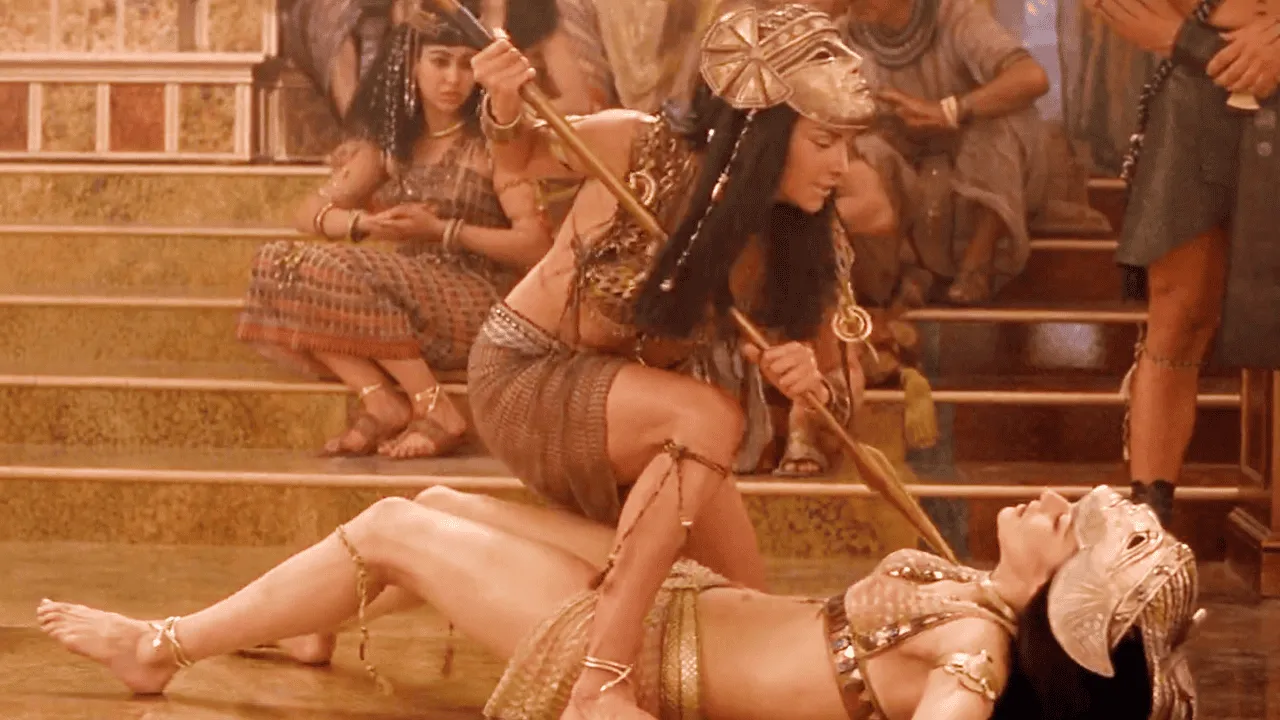
The physical confrontation between Evelyn and Anck-Su-Namun is one of the clearest demonstrations of how far Evelyn has developed.
Through Nefertiri’s memories, Evelyn recalls an ancient rivalry and combat training that allow her to engage Anck-Su-Namun directly.
The fight gives Evelyn an action sequence that belongs specifically to her.
Rick is not fighting her opponent on her behalf. Evelyn faces a threat connected to her own history and uses abilities that are part of her character arc.
The scene is deliberately larger and more stylized than Evelyn’s action in the first film. The Mummy Returns expands almost every element of its predecessor, including its mythology, scale, and physical spectacle.
Still, the fight works because it reflects an emotional conflict.
Anck-Su-Namun represents betrayal, selfish survival, and obsessive love that destroys everyone around it.
Evelyn represents loyalty, partnership, and the willingness to risk herself for her family.
Their physical confrontation becomes a clash between two very different ideas of love and courage.
Evelyn’s Death and Return
During the struggle, Evelyn is fatally wounded by Anck-Su-Namun.
Her death is one of the sequel’s most emotional moments because it temporarily breaks the O’Connell family’s sense of security. Rick, who is usually able to respond to danger through immediate action, is left devastated beside her.
Alex later uses the Book of the Dead to restore his mother.
The resurrection mirrors the supernatural mechanics that began the first film but changes their emotional meaning.
In The Mummy, Evelyn reads from the book without understanding the consequences and brings back a cursed figure driven by destructive obsession.
In The Mummy Returns, Alex uses ancient knowledge with a specific loving purpose: restoring someone whose life was taken.
The parallel also reinforces Evelyn’s connection to the books at the center of the series. Written knowledge creates danger, but knowledge itself is not evil. Its consequences depend on understanding, intention, and context.
Why Evelyn Returns to Save Rick
Near the climax of The Mummy Returns, both Rick and Imhotep are left hanging above the underworld.
Evelyn immediately risks herself to pull Rick to safety.
Anck-Su-Namun, by contrast, abandons Imhotep rather than placing herself in danger.
The contrast devastates Imhotep because his entire existence has been driven by the belief that their love justified murder, resurrection, and destruction.
Evelyn and Rick demonstrate the kind of love Imhotep believed he possessed.
Their love is not defined only by desire.
It is demonstrated through action, loyalty, trust, sacrifice, and the refusal to abandon one another when survival becomes difficult.
Evelyn’s decision is therefore more than a romantic gesture.
It completes the film’s comparison between its two central couples.
Rick and Evelyn repeatedly choose each other.
Imhotep and Anck-Su-Namun choose obsession until one of them must make a genuine sacrifice.
Evelyn’s Strength Does Not Eliminate Her Femininity
Evelyn’s development is notable because the films do not suggest she must reject femininity to become capable.
She can wear elegant period clothing, fall in love, become a mother, express fear, and remain physically affectionate while also functioning as a serious scholar and adventurer.
The sequel gives her more action, but it does not transform her into a copy of Rick.
She still approaches problems through interpretation and historical knowledge. Her increased fighting ability expands her character rather than replacing her original strengths.
This balance helps explain why Evelyn has remained influential.
She does not fit a narrow choice between the intellectual woman and the action heroine.
She is both.
She can be humorous without becoming incompetent, romantic without becoming dependent, and vulnerable without becoming powerless.
Knowledge and Action Work Together
The two films repeatedly show that intelligence and physical courage are not competing forms of heroism.
Rick and Evelyn survive because each respects abilities the other does not possess.
Rick understands weapons, combat, terrain, and immediate danger. Evelyn understands languages, mythology, ritual, history, and the significance of artifacts.
When one skill set becomes insufficient, the other becomes essential.
This also prevents Rick’s strength from diminishing Evelyn.
He is physically more capable in many situations, but that does not make him the complete hero. Without Evelyn, he may survive individual attacks while remaining unable to stop the larger supernatural threat.
Likewise, Evelyn’s knowledge does not guarantee survival without people who can protect the time and space she needs to use it.
Their relationship represents cooperation rather than competition.
Rachel Weisz’s Performance
Rachel Weisz succeeds because she understands the exact tone the movies require.
Evelyn must be believable as a brilliant academic, an inexperienced explorer, a romantic lead, a source of comedy, a frightened victim, and eventually a confident action heroine.
Playing any one element too strongly could have damaged the balance.
If Evelyn appeared too foolish, the audience would not believe that her knowledge could save everyone.
If she appeared too self-serious, the comedy would disappear.
If she became instantly fearless, her development would feel unearned.
If she remained permanently helpless, the romance and adventure would become frustrating.
Weisz moves between these modes without making Evelyn feel inconsistent.
The character is funny because she is enthusiastic.
She is frightened because the danger is real.
She is brave because she continues despite that fear.
She is romantic because she trusts Rick, not because she has surrendered her independence.
She becomes more physically confident because experience has changed her.
Retrospectives on the film have credited Weisz with giving elegance and individuality to a role that might otherwise have become a familiar “beautiful and brainy” love-interest stereotype.
The Importance of Weisz’s Voice and Delivery
Evelyn’s dialogue often contains exposition that explains mythology, artifacts, rituals, and historical relationships.
Exposition can easily feel artificial.
Weisz makes it engaging by allowing Evelyn’s passion to shape the delivery. She does not speak as though she is providing information for the audience. She speaks as someone genuinely thrilled to understand what others have missed.
Her voice changes with her circumstances.
She can sound precise and professional while discussing archaeology, breathlessly excited during discovery, indignant when underestimated, playfully irritated with Rick, and terrified when knowledge reveals how serious the curse has become.
These variations give the information emotional purpose.
Evelyn is not only telling the audience what something means.
She is showing why it matters to her.
Confidence Without Perfection
Evelyn’s confidence is especially appealing because it exists alongside obvious imperfection.
She makes consequential mistakes.
She can be impulsive, academically competitive, overly curious, physically awkward, and convinced that understanding a text gives her sufficient control over it.
The movies do not require her to become perfect before treating her as heroic.
Instead, her heroism includes the way she responds to mistakes.
She does not conceal what she has done or allow other people to solve the problem while she retreats. She remains involved, takes responsibility, and applies her abilities to repairing the damage.
This makes Evelyn more inspiring than a character who simply knows everything from the beginning.
Competence is not presented as never being wrong.
It is presented as possessing the courage and discipline to continue learning after being wrong.
The Films’ Fictionalized Egypt
Although Evelyn is presented as an Egyptologist, The Mummy films are fantasy adventures rather than historically accurate accounts of ancient Egypt.
Hamunaptra is fictional, and the movies freely combine invented languages, magical books, curses, deities, reincarnation, and altered versions of historical names and practices.
The mythology exists to create a supernatural adventure, not to serve as a reliable guide to Egyptian history. Retrospectives on the film have similarly described its lore as largely invented and identified Hamunaptra as a fictional lost city.
This distinction does not diminish Evelyn’s importance as a character.
Within the films’ fictional universe, she is a highly capable expert whose knowledge follows the rules established by the story.
However, viewers interested in actual Egyptian history should separate the movies’ entertaining mythology from historical scholarship.
Evelyn as an Adventure Heroine
Evelyn belongs to a tradition of adventure heroines who enter dangerous historical spaces alongside physically experienced male leads.
What distinguishes her is the degree to which her academic identity remains valuable throughout the story.
She is not introduced as a scholar only to discover that books are useless in the real world.
The opposite happens.
The further the expedition moves into supernatural danger, the more important her education becomes.
Evelyn’s development does not teach her to stop being a librarian.
It teaches everyone else why a librarian belongs on the adventure.
This makes her particularly meaningful to viewers who identify more with curiosity and learning than with conventional action-hero qualities.
She suggests that the person who reads the inscription, remembers the legend, or recognizes the overlooked detail may be just as heroic as the person who defeats an enemy in combat.
The Commercial Success of the Two Films
The two films were major theatrical successes.
The Mummy opened in the United States on May 7, 1999, and earned approximately $418.4 million worldwide against a reported production budget of $80 million.
The Mummy Returns opened on May 4, 2001, and earned approximately $435.9 million worldwide against a reported $98 million budget.
That success helped establish the 1999 film as a major adventure franchise and gave Weisz one of the roles most closely associated with her early international breakthrough.
Her subsequent career would include acclaimed dramatic work and an Academy Award for The Constant Gardener, but Evelyn remained a defining part of her popular screen image. Entertainment Weekly has described The Mummy as the project that brought her to a much broader mainstream audience after earlier stage and independent-film work.
Why Evelyn Remains a Fan Favorite
Evelyn is memorable because she feels aspirational without feeling unreachable.
She is brilliant, but she makes mistakes.
She is beautiful, but her personality is not built around being admired.
She is courageous, but she becomes frightened.
She falls in love, but romance does not eliminate her ambitions.
She becomes a mother, but motherhood does not end her adventures.
She develops combat ability, but intelligence remains her greatest strength.
Most importantly, Evelyn enjoys being herself.
She does not spend the first film wishing she were Rick. She is proud of scholarship, language, books, and history even when the people around her consider those interests impractical.
The narrative ultimately proves her right.
The adventurous gunfighter needs the librarian.
The world needs the person who knows how to read the book.
The Chemistry of the Ensemble
Although Evelyn is central, her performance becomes even stronger through her relationships with the ensemble.
Brendan Fraser gives Rick a mixture of competence, humor, physical vulnerability, and romantic sincerity that works naturally with Weisz’s intellectual enthusiasm.
John Hannah’s Jonathan provides a sibling connection and comic unpredictability.
Arnold Vosloo’s Imhotep gives Evelyn an antagonist who values her partly as a means to resurrect someone else, making his treatment of her fundamentally different from Rick’s recognition of her individuality.
Oded Fehr’s Ardeth Bay adds a serious guardian figure who gradually accepts that the outsiders may be essential to containing the threat they have unleashed.
The actors operate within the same heightened tone. They can treat supernatural stakes sincerely while recognizing that the films are designed to be joyful, romantic adventures rather than oppressive horror stories.
That shared understanding allows Evelyn’s humor, intelligence, and emotional sincerity to coexist naturally.
Why The Mummy Still Feels Distinctive
The 1999 film continues to stand out because it combines genres without allowing one to erase the others.
It contains horror imagery, but it remains fun.
It contains romance, but the adventure does not stop.
It contains comedy, but the characters still care about the danger.
It contains mythology, but the exposition is carried by personalities the audience enjoys following.
Universal marked the film’s 25th anniversary with a theatrical rerelease in 2024, describing it as an important adventure blockbuster whose appeal had endured across generations. Retrospectives surrounding the anniversary similarly emphasized its continued reputation as a highly rewatchable combination of swashbuckling adventure, horror, comedy, and romance.
Evelyn is crucial to that balance.
She can move from a library accident to a tender romantic scene, from translating a curse to escaping the undead, without appearing to belong to a different movie.
Did Evelyn Need to Become an Action Hero?
Some viewers prefer the more academically focused Evelyn of the first film, while others appreciate the sequel’s expansion of her physical abilities.
Both interpretations have merit.
The first film’s Evelyn is distinctive because she demonstrates that scholarship alone can be heroic. She does not need exceptional combat skills to justify her place in the story.
The sequel risks weakening that message by connecting her abilities to reincarnation and making her a more conventional fighter.
However, her development can also be understood as the natural result of experience.
After surviving Hamunaptra, marrying an adventurer, continuing fieldwork, and raising a child in a family surrounded by dangerous discoveries, it would be surprising if Evelyn had not become more physically prepared.
The most important point is that the sequel does not replace her intelligence with action.
Her scholarship, memory, translations, and historical understanding remain essential.
Did Rachel Weisz Appear in the Third Mummy Film?
Rachel Weisz did not return for The Mummy: Tomb of the Dragon Emperor, released in 2008.
Maria Bello played Evelyn in the third film, while Brendan Fraser and John Hannah returned as Rick and Jonathan.
The recasting contributed to the third film feeling disconnected from the emotional chemistry of the first two installments for many viewers.
Evelyn continued to exist as a character, but Weisz’s particular mixture of humor, intelligence, elegance, and adventurous energy had become so closely associated with the role that replacing her significantly altered the family dynamic.
For that reason, many fans primarily associate Evelyn Carnahan with the 1999 and 2001 films.
What Evelyn Carnahan Teaches About Heroism
Intelligence Is Practical
Evelyn’s knowledge is not presented as abstract decoration. It saves lives, reveals dangers, and provides solutions.
Mistakes Do Not Cancel Competence
Her greatest error creates the central crisis, but she remains capable of helping solve it.
Courage Can Include Fear
Evelyn does not need to stop being frightened before acting bravely.
Curiosity Requires Responsibility
Discovery is powerful, but knowledge must be approached with respect for its consequences.
Partnership Does Not Require Sameness
Rick and Evelyn work because they contribute different abilities rather than competing to become the same kind of hero.
Love Is Demonstrated Through Choice
The contrast between Rick and Evelyn and the villains shows that devotion is not proved by obsession. It is proved through loyalty, sacrifice, and action.
Growth Does Not Require Rejecting Your Original Self
Evelyn becomes a stronger adventurer without abandoning the librarian and scholar she was at the beginning.
Frequently Asked Questions
Who plays Evelyn Carnahan in The Mummy?
Rachel Weisz plays Evelyn Carnahan in The Mummy and The Mummy Returns. Maria Bello took over the role in the third film.
Is Evelyn Carnahan a librarian or an Egyptologist?
She is both. Evelyn works as a librarian at the Cairo Museum of Antiquities and possesses extensive knowledge of Egyptology, ancient languages, religious rituals, and archaeological material.
Does Evelyn marry Rick O’Connell?
Yes. By The Mummy Returns, Evelyn and Rick are married and have a son named Alex.
What is Evelyn’s married name?
Her married name is Evelyn O’Connell, although she is still frequently identified by her original surname, Carnahan, in cast listings and discussions of the character.
Is Evelyn the reincarnation of Nefertiri?
The Mummy Returns reveals that Evelyn is the reincarnation of Princess Nefertiri, the daughter of Pharaoh Seti I and an ancient rival of Anck-Su-Namun.
Does Rachel Weisz play Nefertiri?
Yes. She portrays both Evelyn and Nefertiri in The Mummy Returns.
Does Evelyn cause Imhotep to return?
Yes. In the first film, she reads from the Book of the Dead and accidentally resurrects Imhotep.
How does Evelyn help defeat Imhotep?
She translates and reads from the Book of Amun-Ra, allowing Imhotep’s immortality to be removed so that Rick can defeat him.
Does Evelyn die in The Mummy Returns?
She is fatally wounded by Anck-Su-Namun but is later resurrected by Alex using the Book of the Dead.
Is Hamunaptra a real ancient Egyptian city?
No. Hamunaptra, called the City of the Dead in the films, is fictional.
Why is Evelyn considered a strong heroine?
Her strength comes from intelligence, curiosity, courage, loyalty, adaptability, and her willingness to take responsibility for her decisions. She contributes directly to solving the supernatural conflicts rather than functioning only as a romantic interest.
Is Evelyn stronger in The Mummy Returns?
She is more experienced and physically capable in the sequel. However, her fundamental courage and intelligence are already present in the first film.
Did Rachel Weisz perform Evelyn’s fight scenes?
Weisz performed Evelyn’s acting and physical role, while complex action productions generally involve stunt performers and coordinators as needed. The final scenes combine acting, choreography, stunt work, practical effects, and visual effects.
Why did Rachel Weisz not appear in the third film?
Weisz did not return, and the role was recast with Maria Bello. Public reports over the years have offered different explanations, so claims about one definitive reason should be treated cautiously.
Are The Mummy films historically accurate?
No. They use historical names and Egyptian-inspired imagery within a fictional supernatural mythology. They should be viewed as fantasy adventures rather than historical accounts.
What genre is The Mummy?
The film combines action-adventure, supernatural horror, fantasy, comedy, and romance. Its ability to balance those genres is a major part of its lasting appeal.
Final Thoughts
Rachel Weisz’s Evelyn Carnahan remains beloved because she represents a kind of heroism that adventure films do not always celebrate.
She is not introduced as the strongest fighter, the most experienced explorer, or the person most comfortable with danger.
She is introduced surrounded by books.
Her power comes from wanting to understand the world.
That curiosity creates danger, but it also gives her the courage to enter places other people have forgotten, read words no one else can interpret, and search for answers when physical strength is not enough.
Evelyn’s journey across The Mummy and The Mummy Returns is not the story of an incompetent woman becoming worthy of adventure.
She was always worthy.
The first film gradually reveals that her knowledge and determination are heroic qualities. The second shows what happens when those qualities are strengthened by experience, love, responsibility, and greater confidence.
Rachel Weisz makes every stage convincing.
She gives Evelyn comic awkwardness without humiliating her, intelligence without coldness, vulnerability without passivity, and courage without removing fear. Her chemistry with Brendan Fraser gives the films their romantic warmth, while her relationships with Jonathan and Alex turn the adventure into a family story.
Rick O’Connell may look like the obvious hero.
He has the weapons, the battlefield experience, and the instinct to run toward immediate danger.
But Rick cannot understand the curse alone.
He cannot read the ancient books, reconstruct the rituals, recognize every artifact, or discover how to make an immortal enemy vulnerable.
For that, the adventure needs Evelyn.
It needs the scholar who opens the wrong book and then refuses to run from what emerges.
It needs the woman who begins among fallen library shelves and eventually stands against undead armies, ancient rivals, and supernatural forces.
Most of all, it needs someone who can face the end of the world and remain proud of what she has always been:
A librarian.