
England’s Haunted Islands: Monsters, Giants and Ghost Ships
England is a country of old roads, ruined abbeys, drowned villages, battlefield ghosts, black dogs, sea caves, standing stones, and coastal places where history seems to breathe through the mist. But some of its strangest stories belong not to castles or manor houses, but to islands.
Islands have always been powerful places in folklore. They sit between worlds: land and sea, safety and danger, settlement and wilderness, the living and the dead. An island can be reached, but not always easily. Some are cut off by tides. Some are surrounded by dangerous currents. Some were used by monks, smugglers, soldiers, prisoners, lighthouse keepers, fishermen, and reclusive communities. Others carry stories so old that history and legend have become impossible to separate.
England’s haunted islands are not simply scenic locations with ghost stories attached. They are atmospheric landscapes where isolation intensifies everything. A cry across the water travels differently. A ruined chapel looks stranger at dusk. A tidal causeway feels like a warning. A fogbank can turn a familiar coastline into another century.
Across these islands, legends speak of red-eyed monsters, giant human skeletons, phantom Viking longships, ghostly monks, cursed causeways, unexplained lights, spectral animals, and strange figures glimpsed on beaches and marshes. Some tales belong to ancient folklore. Some are linked to archaeology, invasion, shipwreck, and local memory. Some are almost certainly exaggerations. Others endure because they express something deeply human: fear of the sea, fear of isolation, fear of what survives beneath England’s polite surface.
From Lindisfarne in the north to Lundy in the Bristol Channel, from tidal islands in Essex to Cornish legends around St Michael’s Mount, England’s island folklore feels like a map of haunted imagination.
Why Islands Attract Ghost Stories
There is a reason islands are perfect settings for haunting legends. They are naturally dramatic. The sea creates a boundary. The tide controls movement. Weather changes quickly. People can be trapped, delayed, or separated from the mainland. Even a small island can feel psychologically larger when the water rises around it.
In England, many islands are tidal. That means they are not always islands in the same way. At low tide, a causeway may appear, allowing people to walk or drive across. At high tide, the route vanishes beneath the water. This rhythm creates a sense of mystery. The island appears accessible, then forbidden. It is part of the mainland, then apart from it.
This makes tidal islands especially rich in folklore. They are threshold places. You must know the time. You must respect the crossing. You must leave before the sea returns. A mistake can become fatal.
Haunted island stories often grow from real danger. Shipwrecks, drownings, invasions, raids, storms, smuggling, disease, isolation, and war all leave psychological marks on a landscape. A ghost story may preserve a memory that official history has forgotten. A monster legend may exaggerate a real fear. A phantom ship may carry centuries of maritime grief.
England’s islands also sit within deep cultural layers. Roman roads, Anglo-Saxon monasteries, Viking raids, medieval pilgrimage, Tudor fortifications, Civil War conflict, Victorian tourism, wartime defenses, and modern conservation all overlap in these places. Every generation adds its own shadow.
That is why the haunted island is such a powerful idea. It is not only a location. It is a container for memory.
Lindisfarne: Holy Island and the Shadow of Viking Longships

Few English islands feel as historically charged as Lindisfarne, also known as Holy Island. Located off the coast of Northumberland, Lindisfarne is reached by a tidal causeway and is famous for its monastery, saints, ruins, and dramatic coastal setting. It is one of England’s most sacred landscapes, but also one of its most haunted by memory.
The island is central to early English Christianity. Lindisfarne Priory was founded in the seventh century and became associated with St Aidan and St Cuthbert. It was also the place connected to the creation of the Lindisfarne Gospels, one of the great treasures of medieval manuscript culture. English Heritage describes Lindisfarne as one of the most important centres of early Christianity in Anglo-Saxon England.
But Lindisfarne is also remembered for violence. In 793, Viking raiders attacked the monastery, an event often described as one of the symbolic beginnings of the Viking Age in Britain. The attack shocked the Christian world because Lindisfarne was not merely a settlement; it was holy ground. To later writers, the raid seemed like an assault from beyond civilization, a terrifying arrival from the sea.
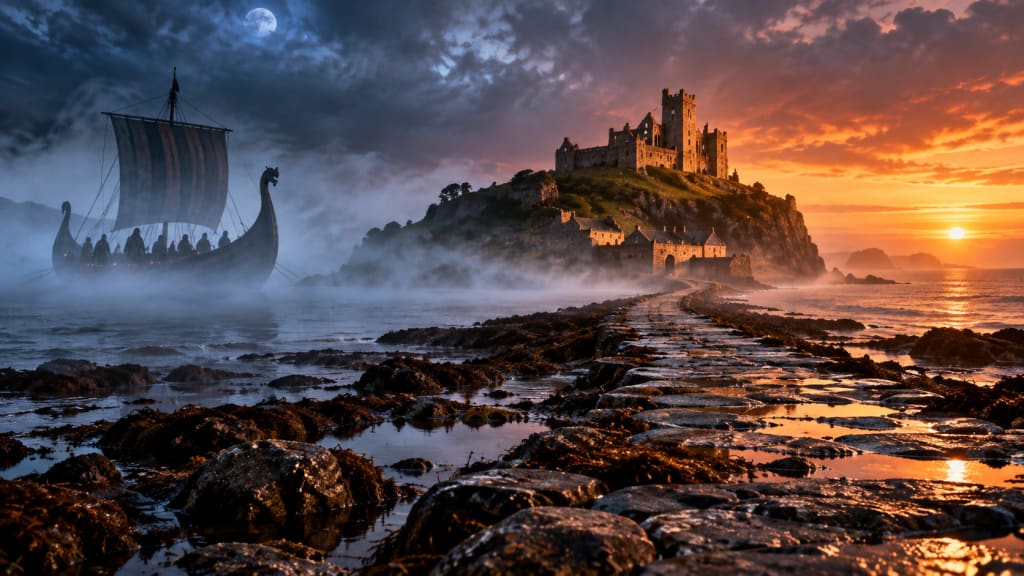
This is where the image of the eerie Viking longship becomes so powerful. Whether told as folklore, ghostly memory, or atmospheric legend, the idea of a phantom longship approaching Lindisfarne fits the island perfectly. Imagine the low shape of a ship cutting through sea mist. Imagine oars moving soundlessly. Imagine the monks hearing the first cries from the shore. Even without a literal ghost, the historical memory of the raid can make the island feel haunted.
The legend does not need a single fixed apparition to work. Lindisfarne’s haunting is larger than one ghost. It is a haunting by invasion, by sacred violation, by the collision of worlds. Christian prayer met Norse violence. Manuscripts met axes. Sanctuary met the sea.
Even today, the tidal causeway adds to the atmosphere. Visitors must check safe crossing times because the road is covered by water at high tide. That practical warning feels almost symbolic. Lindisfarne is reachable, but only on its own terms. Stay too long, and the sea cuts you off.
In ghost lore, Lindisfarne is often associated with spectral monks, ancient footsteps, and the lingering presence of its religious past. But the darker vision is the longship: the shape on the horizon that returns again and again in the imagination, reminding England that some hauntings are not only supernatural. Some are historical wounds.
Lundy Island: Giants, Skeletons, and the Edge of the Bristol Channel

If Lindisfarne belongs to saints and Viking terror, Lundy Island belongs to isolation, shipwreck, pirates, wildlife, and giant legends. Located in the Bristol Channel, Lundy is a rugged island with cliffs, seabirds, old ruins, and a powerful sense of distance from the mainland. Its name is often linked to Norse origins, commonly interpreted as “puffin island,” reflecting the Scandinavian presence around the British coasts.
Lundy has long attracted strange stories. Its remote position made it a place of danger and opportunity. Pirates, privateers, smugglers, shipwrecks, religious communities, and unusual inhabitants all contributed to its mythic reputation. But among its most curious legends are tales of giant human skeletons.
One widely repeated claim says that in the nineteenth century, unusually tall skeletons were found on the island. Accounts often describe two skeletons discovered in stone-lined graves, said to measure more than eight feet tall. These claims appear in folklore and alternative history discussions of British giants, though such stories should be treated carefully because they are difficult to verify through modern archaeological standards.
Still, the legend has power. Lundy feels like the sort of place where giant stories would survive. Its cliffs are dramatic. Its rocks seem ancient and severe. Its isolation makes ordinary events feel magnified. A strange burial on Lundy could easily become a tale of giants.
England has many giant traditions. English Heritage notes that mythical giants appear throughout England’s landscape, often as builders, landscape-makers, or figures attached to ancient places rather than merely as monsters. In that wider tradition, Lundy’s giant skeleton stories fit into a long habit of explaining unusual graves, large stones, cliffs, and ancient ruins through the presence of beings larger than ordinary humans.
The giant skeleton legend also touches a deeper fascination: the fear that the past was physically different from the present. What if earlier inhabitants were stronger, stranger, taller, or closer to myth? What if an island preserved evidence of a forgotten race? These questions are not scientific conclusions, but they are the emotional engine of giant folklore.
Lundy’s haunted feeling is not only about skeletons. Islands like Lundy also carry the loneliness of shipwreck. The Bristol Channel can be harsh and unpredictable. Seafarers once faced fog, rocks, storms, and poor navigation. In such places, ghost stories naturally gather around cliffs and coves. The dead at sea rarely receive the neat closure of the dead on land. Their stories return as lights, cries, figures, and warnings.
Lundy is therefore an island of scale: high cliffs, deep water, huge birds, giant legends, and a feeling that the human world becomes small at its edges.
St Michael’s Mount: Giants, Pilgrims, and the Cornish Sea

Although often associated with Cornwall’s broader Celtic and maritime folklore, St Michael’s Mount belongs firmly to England’s haunted island imagination. Rising from Mount’s Bay near Marazion, it is one of the most visually striking tidal islands in the country. At low tide, visitors can walk across a stone causeway. At high tide, the sea surrounds it.
The island is famous for its castle, chapel, gardens, and medieval religious history. It has also long been tied to the legend of giants. One of the most famous stories tells of Cormoran, a giant said to have lived on the Mount and terrorized the surrounding area. In later versions linked to the tale of Jack the Giant Killer, Jack defeats the giant, often by tricking him into falling into a pit.
This legend gives St Michael’s Mount a mythic personality. The island does not merely hold a castle; it becomes the giant’s home. Its dramatic rise from the sea makes the story feel physically plausible in a fairy-tale sense. A giant needs a giant’s seat, and the Mount looks like one.
St Michael’s Mount also has ghostly associations. Ancient religious sites often accumulate stories of apparitions, monks, bells, and unexplained presences. The combination of pilgrimage, isolation, sea fog, and castle architecture creates a perfect atmosphere for haunting. A person walking the causeway at dusk can easily understand why legends cling to the place.
The island’s giant story differs from Lundy’s skeleton legends. Lundy hints at burial and mystery. St Michael’s Mount gives the giant a name, a personality, and a role in local storytelling. Cormoran is not a vague ancient being; he is a folklore character woven into the landscape.
This is one of the oldest functions of island legend: it makes geography memorable. A hill becomes a giant’s home. A path becomes a causeway of danger. A rock becomes a weapon. A cave becomes a lair. The landscape becomes readable through story.
Osea Island: Tides, Isolation, and Modern Ghostliness

Osea Island, located in the Blackwater Estuary in Essex, has the kind of geography that invites ghost stories. It is a tidal island, connected to the mainland by a causeway that disappears beneath the water at high tide. That alone gives it an eerie quality. A road that exists only part of the day feels like a passage between worlds.
Osea has a varied modern history, including periods as a retreat, private island, and unusual community space. Like many tidal islands, it carries an atmosphere of separation. The mainland is close, but the tide decides whether it is reachable. This creates the emotional condition that ghost stories love: near safety, but temporary isolation.
Essex’s coastal islands are often overlooked in favor of more famous haunted locations, but they have a distinct mood. The estuary landscape is flat, muddy, wide, and atmospheric. Mist can sit low over the water. Bird calls echo across marshes. Boats appear and disappear. At night, the boundary between land, mudflat, and water can become uncertain.
Haunted stories in such places often involve figures seen at a distance, unexplained lights, strange sounds, and the feeling of being watched across open ground. The landscape itself does much of the work. Unlike a castle haunting, where fear is enclosed by walls, an estuary haunting is exposed. You can see far, but that does not always make you feel safe.
Osea’s haunting power comes from rhythm. The island is governed by the tide. The crossing must be timed. The sea covers the road. That physical fact becomes symbolic: some places let you in, but they do not promise to let you leave whenever you choose.
Mersea Island: Sea Monsters, Marshes, and Red-Eyed Things

Mersea Island, also in Essex, sits between the Blackwater and Colne estuaries. It is the kind of place where coastal history, fishing culture, Roman traces, oyster beds, and local folklore mix naturally. Like many English islands, Mersea is not remote in a dramatic oceanic sense, but it still carries island psychology. It has a causeway. It has tides. It has marshy edges. It has stories.
Legends of red-eyed monsters belong naturally to England’s eastern and coastal folklore. The most famous related tradition is the black dog legend, especially the terrifying figure known as Black Shuck in East Anglia. Black Shuck is commonly described as a huge black dog with burning or fiery eyes, haunting lanes, marshes, churches, and lonely places. The National Parks site notes that Black Shuck is said to prowl parts of Norfolk and Suffolk, including tales around the Broads and Burgh Castle.
Although Black Shuck is not limited to islands, its imagery fits estuary landscapes perfectly. A red-eyed creature on a lonely coastal road, a shape moving near a marsh, or a black form glimpsed near a causeway belongs to the same emotional world as Mersea folklore. Eastern England’s flatlands, reeds, churches, fog, and tidal waterways create perfect territory for spectral animals.
Red eyes are important in folklore because they suggest intelligence without humanity. A creature with red eyes is not just an animal. It is watching. It knows something. It may be an omen, a guardian, a demon, or a warning. In marshland and island folklore, such creatures often represent danger at the boundary: between land and water, life and death, road and mud, home and wilderness.
Mersea’s setting makes these stories feel plausible after dark. The open skies and quiet roads can become strangely exposed. The sea is not always dramatic here; sometimes it is flat, silver, and silent. That stillness can be more unsettling than waves.
In folklore, the red-eyed monster often appears when a place feels too quiet.
Canvey Island: Marshland, Industry, and Modern Unease
Canvey Island in Essex has a very different atmosphere from Lindisfarne or St Michael’s Mount. It is not usually imagined as medieval or romantic. It is low-lying, modern, industrial in parts, and closely tied to the Thames Estuary. But that does not make it less strange. In some ways, it makes it more unsettling.
Canvey’s folklore and reputation draw from marshland, flood memory, estuary isolation, and the uncanny quality of industrial edges. Places where oil tanks, sea walls, creeks, mudflats, and suburban streets meet can feel deeply atmospheric. They are neither fully natural nor fully urban. They are human-made landscapes holding back water.
The Thames Estuary has long been a place of strange stories. Mud preserves things. Tides reveal and hide objects. Boats wreck, bodies wash ashore, and lights appear across the water. Industrial coastlines often produce modern ghost stories because they feel abandoned even when they are active.
Canvey also carries the memory of disaster. The North Sea flood of 1953 devastated parts of England’s east coast, including Canvey Island, where dozens of people died. Such events leave a lasting emotional imprint. Even without a specific apparition, a landscape marked by flood can feel haunted by water itself.
In island folklore, low-lying places are especially vulnerable. The fear is not only of ghosts, but of the sea returning. A tidal island with high cliffs suggests ancient mystery. A low estuary island suggests fragility. The haunting is horizontal: water, mist, mud, road, sea wall, and sky.
That makes Canvey one of England’s more modern haunted-feeling islands. Its ghosts are not only medieval monks or Viking raiders. They are flood memories, industrial shadows, and the anxiety of living on land that must constantly negotiate with the sea.
Northey Island: The Battle Memory of the Blackwater
Northey Island, near Maldon in Essex, is a small tidal island with a history that reaches deep into England’s past. It is often associated with the Battle of Maldon in 991, when Anglo-Saxon forces fought Viking raiders. The battle became famous through the Old English poem The Battle of Maldon, one of the great surviving works of Anglo-Saxon heroic literature.
Whether one approaches Northey as history, poetry, or legend, it has a powerful atmosphere. A tidal causeway. A battlefield memory. Viking raiders. Defenders facing overwhelming force. A landscape shaped by mud, water, and timing.
Battlefields often become haunted in folklore because they concentrate sudden death and unresolved emotion. On an island or tidal shore, that feeling intensifies. The dead are not imagined lying in neat graves; they are imagined in mud, water, reeds, and tide channels. The battlefield changes shape with the water.
The Viking longship image returns here in a different form from Lindisfarne. At Lindisfarne, the longship is sacrilegious terror approaching a holy island. At Northey, it is military threat: raiders arriving through estuary waters, forcing local defenders into a deadly confrontation.
A ghostly longship in such a setting is more than a ship. It is the return of invasion memory. It is the shape of fear approaching from the horizon. It is the reminder that England’s coast was once porous, vulnerable, and repeatedly tested by those who came from the sea.
Northey’s haunting is quiet but potent. It is not necessarily the place of theatrical apparitions. It is a place where landscape and literature combine. The mudflats seem to hold the poem’s mood: courage, pride, loss, and the fatal decisions that turn history into legend.
The Farne Islands: Saints, Storms, and Sea-Borne Spirits
The Farne Islands, off the Northumberland coast, are famous for wildlife, seabirds, seals, monastic history, and maritime danger. They are strongly associated with St Cuthbert, who lived as a hermit on Inner Farne before becoming one of the most important saints of northern England.
Like Lindisfarne, the Farnes combine holiness and harshness. They are beautiful, but exposed. They are places of prayer and survival, not comfort. A hermit’s island is already close to the supernatural imagination because solitude can become sacred or terrifying depending on the story.
The Farnes are also tied to shipwreck and rescue. Their waters can be dangerous, and the islands are associated with lighthouse history and the famous courage of Grace Darling, who helped rescue survivors from the wreck of the Forfarshire in 1838. Maritime tragedy gives the islands a haunted charge even when legends are not specific.
Storm islands produce ghost stories because they are places where human control fails. A lighthouse beam, a bell, a cry in the wind, a figure on rocks, a boat that should not be there—these images belong naturally to the Farnes.
The soundscape matters too. Seabirds, seals, waves, and wind can create uncanny impressions. A seal’s cry can sound disturbingly human. Wind passing through ruins can resemble voices. In darkness or fog, a rock can become a figure. Folklore often begins with the senses under stress.
The Farnes remind us that not all hauntings are about evil. Some are about endurance. Saints, hermits, sailors, lighthouse keepers, and rescuers all leave behind a moral atmosphere. The islands feel haunted by hardship, devotion, and the thin line between survival and death.
Burgh Island: Glamour, Crime, and Tidal Mystery
Burgh Island in Devon is famous for its Art Deco hotel, tidal sea tractor, and association with Agatha Christie. It has a very different personality from the northern holy islands or the Essex marsh islands. Burgh is glamorous, literary, and cinematic. Yet it also belongs to England’s haunted island tradition because it is tidal, isolated, and dramatically shaped by the sea.
A tidal island with a hotel already feels like the perfect setting for mystery. Guests arrive, the tide rises, the route back disappears, and the island becomes its own stage. This is why islands are so useful in crime fiction and ghost stories: they create a closed world. Everyone present matters. Escape is delayed. Secrets have nowhere to go.
Burgh Island’s connection to Agatha Christie strengthens its atmosphere. Christie used island settings to explore suspicion, isolation, and murder. Even when the island is not being presented as supernatural, the psychological conditions are similar to haunting: separation, tension, hidden motives, and the pressure of the sea.
Burgh’s ghostliness is therefore more elegant than monstrous. It is less about red-eyed creatures and more about footsteps in corridors, figures at windows, old parties, secrets behind polished doors, and the strange silence after the tide cuts the island off.
The island shows that haunted atmosphere does not require medieval ruins. Sometimes a grand hotel, a stormy night, and a disappearing causeway are enough.
Drake’s Island: Military Shadows in Plymouth Sound
Drake’s Island, located in Plymouth Sound, carries a military and maritime atmosphere. It has been used defensively for centuries because of its strategic position. Fortifications, barracks, and military structures give it a different kind of haunting from monastic or folklore islands.
Military islands often feel haunted by discipline and abandonment. A fort is built to watch, defend, and resist. When its military purpose fades, the remaining structures can feel like shells of authority. Empty rooms, tunnels, gun emplacements, and sea-facing walls create a strong sense of presence.
Drake’s Island is associated with stories of tunnels, soldiers, and unexplained phenomena. Whether one treats these as legend, local rumor, or atmospheric storytelling, the island’s physical character supports them. Fortified islands are designed around fear: fear of invasion, fear of attack, fear of enemy ships entering the harbor.
That means the haunting is already built into the architecture. A defensive island is a place where people waited for danger. Even when danger never arrived, the waiting remains.
Drake’s Island also reflects an important part of England’s island folklore: not all ghosts are ancient. Some belong to military history, wartime anxiety, and modern abandonment. A place does not need a medieval abbey to feel haunted. Concrete, brick, iron, tunnels, and searchlight positions can be just as eerie.
Hilbre Islands: Tides, Birds, and the Edge of the Dee
The Hilbre Islands lie in the Dee Estuary, near the Wirral. They are tidal islands reached by walking across sands at low tide. Like all tidal islands, they demand respect. Safe crossing requires timing and local knowledge. The sea can return faster than expected, and the landscape can confuse those unfamiliar with it.
The Hilbre Islands have an atmosphere of openness and exposure. Wide sands, birds, seals, wind, and distant water create a feeling that the world has been stripped down to elemental things. This kind of place often produces subtle hauntings rather than dramatic ones.
Tidal sands are naturally uncanny. They appear solid, then change. Footprints vanish. Water channels shift. Distance becomes deceptive. A person walking alone may feel watched by birds, seals, or simply by the emptiness itself.
Folklore around such places often centers on lost travelers, ghostly monks, drowned figures, and lights seen across the water. Even when specific stories vary, the emotional pattern is consistent: the shore is not stable. It remembers and erases at the same time.
The Hilbre Islands belong to the haunting of threshold landscapes. They are not frightening because they are dark and enclosed. They are frightening because they are too open, too exposed, and too dependent on the sea’s clock.
Red-Eyed Monsters and England’s Black Dog Tradition
The idea of red-eyed monsters on English islands connects to one of the country’s most enduring folklore traditions: the spectral black dog.
Across England, ghostly black dogs appear under many names. They haunt lanes, churchyards, bridges, marshes, coast roads, and lonely paths. Some are omens of death. Some are guardians. Some attack. Others guide travelers. Their descriptions vary, but many are huge, black, shaggy, silent, and marked by burning eyes.
Black Shuck, especially associated with East Anglia, is the most famous version. Tales of Shuck often include fiery or red eyes and appearances in lonely rural or coastal places. The National Parks folklore account describes Black Shuck as a huge black dog said to prowl Norfolk and Suffolk, with legends around places such as Reedham, Coltishall, Potter Heigham, and Burgh Castle.
Why do these legends fit islands and coasts so well? Because coasts are liminal. They are edges. A black dog at a crossroads is frightening, but a black dog near a causeway or marsh is even more symbolic. It stands between safe land and dangerous water. It may be warning, guarding, or hunting.
Red eyes make the creature unforgettable. In darkness, eyes are often the first thing seen. Animal eyes reflecting light can become supernatural in memory. A dog, fox, seal, or other creature glimpsed at night may become something larger in retelling. But folklore is not only misidentification. It is meaning. The red-eyed monster represents a warning that the landscape is not fully human.
In island stories, such creatures often appear when people cross boundaries they should respect: walking too late, ignoring the tide, entering ruins, disturbing graves, or traveling alone in weather that changes too quickly.
Giant Skeletons and the Island Imagination
Giant skeleton legends appear in many parts of Britain, but islands give them a special force. A giant buried on the mainland may become part of a hill or ancient monument. A giant buried on an island feels like the remnant of a lost world.
Why do people tell stories of giant bones? Sometimes large fossil remains were misinterpreted. Sometimes unusually tall human remains were exaggerated. Sometimes old graves, stone-lined burials, and ancient monuments inspired stories. Sometimes local pride made communities attach themselves to legendary beings.
English Heritage’s discussion of giants in English landscapes highlights that giants are widespread in myth and are often tied to landscape formation, ancient sites, and local storytelling. That helps explain why island giant stories endure. They give scale and drama to places that already feel larger than ordinary life.
The claim of giant skeletons on Lundy is a classic example. It may not satisfy modern archaeological standards, but as folklore, it reveals how people imagine islands as vaults of strange history. The island becomes a place where the past is not fully domesticated. Something enormous may be buried there. Something older than normal history may remain.
Giant stories also reverse the usual island feeling. Humans often feel small on islands because the sea surrounds them. A giant legend answers that smallness by imagining beings large enough to dominate the landscape.
Phantom Longships and the Memory of Invasion
The ghostly Viking longship is one of the most powerful images in English coastal folklore. Whether attached to Lindisfarne, Northey, or other northern and eastern shores, the longship carries historical dread.
The Viking Age left a deep mark on England. Raids, settlements, battles, place names, trade, violence, and cultural exchange all shaped the country. But in ghost stories, the longship often represents the terrifying first sight of invasion: a dark shape offshore, men at the oars, weapons ready, the sea delivering danger.
A phantom longship does not need to be seen by many witnesses to matter as folklore. It is a memory-image. It condenses centuries of coastal vulnerability into one vision. The ship comes from mist because the past itself comes from mist. It is visible, then gone. It may be silent because history is silent until imagination gives it sound.
At Lindisfarne, the longship violates sacred space. At Northey, it brings battle. In other coastal legends, it may appear as a warning before storm or death. The Viking ship is both historical object and supernatural symbol.
This is why haunted island folklore often feels deeper than a simple ghost tale. It preserves emotional history. The longship is not merely a boat. It is fear arriving by water.
Why England’s Haunted Islands Still Fascinate Us
England’s haunted islands continue to fascinate because they combine beauty and unease. They are travel destinations, wildlife habitats, heritage sites, pilgrimage routes, and scenic escapes. But beneath the postcard surface, they carry stories of violence, isolation, drowning, invasion, vanished communities, strange burials, and supernatural watchers.
They also remind us that folklore is not only about whether something literally happened. Folklore is about how people make sense of place.
A red-eyed monster may express fear of lonely roads, marshes, and night travel. A giant skeleton may express awe toward ancient graves and dramatic landscapes. A Viking longship may preserve the trauma of coastal raids. A ghostly monk may hold the memory of religious devotion and destruction. A drowned figure may warn people to respect the tide.
These stories survive because they are useful. They teach caution. They create identity. They turn geography into narrative. They make a place unforgettable.
Modern visitors may arrive with smartphones, GPS maps, weather apps, and online tide tables, but the old atmosphere remains. Stand on a tidal causeway as the light fades and it is easy to understand why earlier generations imagined ghosts there. Watch mist gather over mudflats and the mind begins to populate the distance. Hear seabirds crying around ruined stone and the past feels close.
England’s haunted islands are not cut off from the modern world. They are reminders that the modern world still sits on older layers of fear and wonder.
Final Verdict
England’s haunted islands are among the country’s most atmospheric folklore landscapes. They are places where geography itself feels supernatural: roads vanish beneath tides, ruins stand against the sea, cliffs hold old burials, and mist turns history into apparition.
From Lindisfarne’s Viking-haunted shores to Lundy’s giant skeleton legends, from the red-eyed creatures of eastern folklore to the tidal mysteries of Osea, Mersea, Burgh, Hilbre, and St Michael’s Mount, these islands reveal a darker and more imaginative side of England’s coast.
Their legends should not always be read as literal history. Some are folklore, some are local memory, some are exaggeration, and some are atmospheric storytelling shaped by dangerous landscapes. But that does not make them meaningless. In many ways, it makes them more powerful.
A haunted island is a place where the past cannot fully leave. The sea cuts it off, protects it, distorts it, and returns its stories again and again. Red eyes shine near the marsh. Giants sleep under stone. Longships appear in the mist. Bells, footsteps, cries, and warnings travel across the water.
England’s islands are beautiful by daylight. But at dusk, when the tide rises and the mainland slips farther away, they become something older: thresholds between history and legend, where the dead, the monstrous, and the forgotten still seem close enough to hear.


