Farewell, Salah! ❤️ A Tribute to Liverpool’s Unforgettable Egyptian King
Some players join a football club.
Others become part of its history, its identity, and the memories supporters carry for the rest of their lives.
Mohamed Salah became all three.
After nine extraordinary years at Liverpool, the Egyptian King has walked away from Anfield with 442 appearances, 257 goals, eight major trophies, countless records, and a permanent place among the greatest players ever to wear the red shirt. Only Ian Rush and Roger Hunt scored more goals for Liverpool, placing Salah third on the club’s all-time list.
Those numbers tell us how productive he was.
They cannot fully explain how he made Liverpool supporters feel.
They cannot recreate the anticipation whenever he received the ball near the right touchline, the sudden change in atmosphere when he cut onto his left foot, or the fraction of silence before another curling shot found the far corner.
They cannot measure the joy of Madrid, the relief of ending a 30-year wait for the league title, the disbelief of watching him destroy Manchester United at Old Trafford, or the affection in the song that followed him around every stadium.
Salah arrived as an exciting signing.
He departed as a Liverpool immortal.
This is not simply goodbye to a goalscorer.
It is farewell to an era.
The Final Goodbye at Anfield
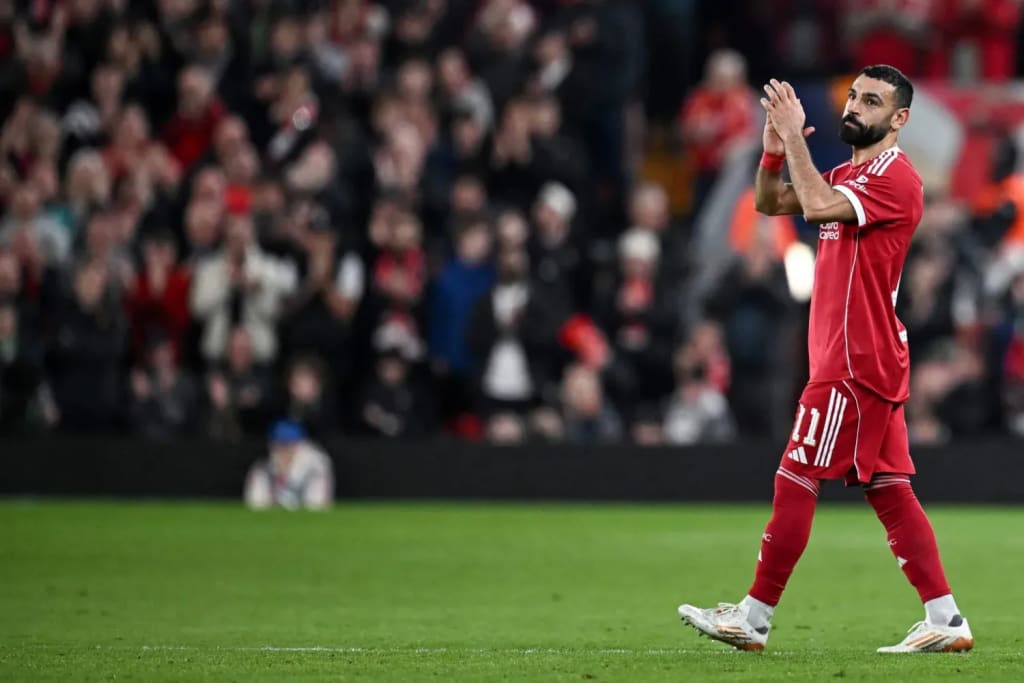
Mohamed Salah made his 442nd and final Liverpool appearance in a 1-1 draw against Brentford at Anfield on May 24, 2026.
Even in his final match, he left one more contribution behind, providing the assist that took him beyond Steven Gerrard for the most Premier League assists recorded by a Liverpool player.
After the match, Salah and Andy Robertson were given guards of honour by teammates and staff. They returned to the pitch to receive mementos and one last enormous ovation from the supporters who had travelled through nine unforgettable seasons with them.
Salah had so often appeared emotionally unshakable.
He had played through pressure, criticism, exhaustion, title races, European finals, injuries, contract uncertainty, and the expectations of millions.
On his final afternoon at Anfield, the emotion could no longer be contained.
“I cried a lot – I think more than I did in my whole life,” Salah admitted afterward.
It was not merely the end of a professional contract.
Liverpool had become his home.
His daughters had grown up around the club. His family had developed its own relationship with the city and supporters. Salah said Liverpool meant everything to him and explained that his children intended to continue supporting the club even after his departure.
The farewell belonged not only to Mohamed Salah the footballer.
It belonged to the man, the father, and the family who had given a significant part of their lives to Liverpool.
He Arrived With Something to Prove
When Liverpool signed Salah from Roma in the summer of 2017, excitement was mixed with uncertainty.
English football remembered his brief and unsuccessful period at Chelsea. Some observers questioned whether he could adapt to the Premier League. Others saw a quick winger who might improve Jürgen Klopp’s attack without necessarily becoming its defining figure.
Salah answered almost immediately.
He scored 44 goals in all competitions during his debut campaign, the second-highest total ever achieved by a Liverpool player in a single season. He also surpassed Fernando Torres’ previous club record of 33 goals in a first Liverpool season.
This was not a gradual adjustment.
It was an explosion.
Defenders understood that Salah wanted to move in from the right onto his left foot. They knew the preferred angle, the acceleration, and the destination of the shot.
Knowing did not help.
He attacked space before it appeared.
He used his balance to survive physical challenges that should have stopped him.
He could sprint beyond a high defensive line, combine through crowded areas, or create a shooting angle where none seemed available.
His first campaign delivered 32 Premier League goals, then a record for a 38-match season, and the first of his four Golden Boots.
Within months, Salah was no longer answering questions about whether he belonged in England.
The rest of the league was trying to discover how to stop him.
The Front Three That Changed Liverpool
Salah became one part of an attacking trio that defined Klopp’s Liverpool.
Sadio Mané brought directness, aggression, movement, and relentless intensity from the left.
Roberto Firmino dropped into deeper spaces, connected midfield with attack, pressed defenders, and created room for others.
Salah attacked the spaces Firmino opened and turned Liverpool’s pressure into goals.
Together, they became one of the most feared attacking units of their generation.
Their qualities were different, but their understanding appeared instinctive. One movement created another. A pressing action became a counterattack. A loose pass became a sprint toward goal.
Salah was nominally a winger, but Klopp described the position he developed as something closer to a “winger-striker”—a player expected to defend the flank and then occupy the areas where he could decide matches.
That description captured Salah’s transformation.
He did not remain near the touchline waiting to cross.
He became an elite goalscorer beginning from a wide position.
The role changed how many teams thought about attacking football and helped Liverpool return to the highest level of the European game.
Kiev Broke His Heart
The 2017-18 season carried Liverpool to the Champions League final against Real Madrid in Kyiv.
For Salah, the match ended painfully early.
A shoulder injury forced him off during the first half, taking Liverpool’s most dangerous attacker out of the game and leaving him in tears.
Liverpool lost the final.
For a player who had produced one of the greatest debut seasons in the club’s history, it was a cruel conclusion.
Yet Salah’s Liverpool story was never defined by avoiding disappointment.
It was defined by returning from it.
A year later, Liverpool reached another Champions League final.
This time, Salah remained on the pitch.
Madrid Brought Redemption
Liverpool faced Tottenham Hotspur in the 2019 Champions League final.
After only 108 seconds, Salah converted a penalty to give Liverpool the lead. It was the second-fastest opening goal in the history of the European Cup or Champions League final. Divock Origi later completed a 2-0 victory.
The contrast with Kyiv could not have been sharper.
A year earlier, Salah had left the final injured and devastated.
In Madrid, he scored, celebrated, and lifted the European Cup.
The image of him holding the trophy represented more than redemption for one player. It confirmed Liverpool’s return to Europe’s summit.
Salah had joined a club determined to rebuild its relationship with the greatest prize in European football.
He helped bring it home.
He Helped End the 30-Year Wait
Liverpool followed European glory with the achievement generations of supporters had been waiting to experience.
The club had not won England’s top division since 1990.
Liverpool came agonisingly close in 2018-19, earning 97 points but finishing behind Manchester City. Instead of allowing that disappointment to weaken them, Salah and his teammates responded by producing 99 points in 2019-20.
The 30-year wait was over.
Salah contributed 29 Premier League goals and assists during that championship season and scored one of its most emotionally significant goals against Manchester United at Anfield.
When Alisson Becker launched the ball downfield and Salah escaped toward goal, an entire stadium rose with him.
He finished past David de Gea, removed his shirt, and celebrated in front of the Kop.
The crowd began singing that Liverpool were going to win the league.
For the first time, it did not feel premature.
Salah had helped turn hope into certainty.
A Champion Without the Celebration He Deserved
The 2019-20 title was historic, but the COVID-19 pandemic prevented Liverpool from celebrating it in the traditional way.
The trophy was lifted inside a largely empty Anfield.
Supporters watched from homes around the world rather than filling the streets and stands around the stadium.
Salah had ended the club’s 30-year wait, but he had not yet experienced lifting the Premier League trophy before a full Anfield crowd.
That unfinished emotional business was resolved five years later.
The Second League Title
Salah’s 2024-25 campaign was among the finest individual seasons produced in Premier League history.
He recorded 29 goals and 18 assists in the league, giving him 47 direct goal involvements—the highest total ever recorded in a 38-match Premier League season.
Across all competitions, he finished with 34 goals and 23 assists in 52 appearances as Liverpool won the league under Arne Slot.
That season earned Salah:
- A fourth Premier League Golden Boot
- The Golden Playmaker award
- Premier League Player of the Season
- A third PFA Players’ Player of the Year award
- A third FWA Footballer of the Year award
He became the first player to win the PFA award three times and the first to complete the Premier League Player of the Season, Golden Boot, and Playmaker combination in the same campaign.
Most importantly, Salah lifted the Premier League trophy in front of supporters.
The first title had ended the wait.
The second allowed Liverpool and Salah to celebrate together.
More Than a Goalscorer
Salah’s scoring statistics will naturally dominate discussions of his legacy.
Yet focusing only on goals risks overlooking how complete he became.
During his early Liverpool years, he was most feared for speed, movement behind defenders, and ruthless finishing.
As time passed, his game evolved.
He became more creative.
He learned to dictate attacks rather than merely finish them. His passing from the right became increasingly precise, his awareness of runners improved, and he developed the ability to control matches even when opponents denied him direct routes to goal.
Between 2021 and 2025, Salah supplied 67 assists in all competitions. In his final Liverpool appearance, he registered his 93rd Premier League assist for the club, setting a new Liverpool record.
He left the Premier League with 191 Liverpool goals and 93 Liverpool assists.
That total of 284 direct goal involvements for one club is the highest in the competition’s history.
The young Salah who arrived in 2017 was a devastating attacker.
The player who departed in 2026 was a complete forward.
The Goals We Will Never Forget
Selecting one defining Salah goal is almost impossible.
There was the breathtaking strike against Chelsea at Anfield, hit with power and precision from distance before he stood with arms extended in a moment of calm celebration.
There was the solo goal against Manchester City, when he escaped challenges in a crowded area before finishing from an apparently impossible angle.
There was the similarly brilliant run against Watford one week later.
There was the looping finish against Roma in the Champions League semifinal, delivered against his former club.
There was the penalty in Madrid.
There was the title-charged goal against Manchester United in January 2020.
There were late winners, European goals, derby goals, opening-day goals, and finishes from positions defenders believed they had already protected.
Salah made one particular action his signature.
He would receive the ball on the right, shift inward, create half a metre with his first few steps, and bend the ball toward the far corner.
Everyone knew what was coming.
For nine years, it kept coming anyway.
The Night He Conquered Old Trafford
Salah’s relationship with Manchester United produced some of the most treasured moments of his Liverpool career.
In October 2021, Liverpool travelled to Old Trafford and won 5-0.
Salah scored a hat-trick, becoming the first visiting player to achieve a Premier League treble at the stadium and the first Liverpool player to score three times away against United since 1936.
The performance felt like an exhibition of complete attacking superiority.
His finishing was sharp.
His movement was effortless.
Liverpool played with the confidence of a team that knew precisely how dangerous it had become.
Salah ultimately finished his Liverpool career with 16 goals against Manchester United, more than any other player in the club’s history.
For supporters, that statistic alone guarantees a special kind of immortality.
The Records Became Almost Routine
Salah broke so many records that new milestones sometimes began to feel normal.
They were not normal.
He reached 50 Liverpool goals in only 65 appearances, faster than any player in club history.
He became Liverpool’s fastest player to reach 100 top-flight goals.
He scored the quickest hat-trick in Champions League history, completing it in six minutes and 12 seconds against Rangers.
He finished with 53 European goals for Liverpool, more than any other player representing the club.
He became Liverpool’s record Premier League scorer with 191 goals.
He produced eight consecutive seasons with at least 20 goals in all competitions, the longest such run in club history.
He won four Premier League Golden Boots, matching Thierry Henry’s competition record.
He became the highest-scoring African player in Premier League history and also recorded more assists than any other African player in the competition.
Salah did not merely appear in Liverpool’s record book.
He forced significant parts of it to be rewritten.
The Numbers of a Liverpool Immortal
Salah’s final Liverpool record reads:
- 442 appearances
- 257 goals
- Third-highest scorer in club history
- 191 Premier League goals for Liverpool
- 93 Premier League assists for Liverpool
- 284 Premier League goal involvements for the club
- 53 European goals for Liverpool
- Four Premier League Golden Boots
- Three PFA Players’ Player of the Year awards
- Three FWA Footballer of the Year awards
- Eight major trophies
His trophy collection includes:
- Premier League: 2019-20 and 2024-25
- UEFA Champions League: 2018-19
- FIFA Club World Cup: 2019
- UEFA Super Cup: 2019
- FA Cup: 2021-22
- League Cup: 2021-22 and 2023-24
Statistics do not settle every debate about greatness.
In Salah’s case, they make avoidance of that debate impossible.
The Egyptian King
The nickname was affectionate, but it also reflected something larger.
Salah carried the hopes of Liverpool supporters while remaining a source of pride for millions in Egypt, across Africa, throughout the Arab world, and among communities that rarely saw someone from their background occupy such a central place in English football.
He did not hide who he was.
He celebrated goals by bowing in prayer.
He represented Egypt with unmistakable pride.
He became one of the most visible Muslim athletes in world sport while being adored by supporters from every possible background.
At Anfield, identity became connection.
The Kop sang his name.
Children copied his celebration.
Supporters travelled wearing shirts marked with the number 11.
His popularity crossed borders, languages, cultures, and generations.
For many young fans, Salah demonstrated that they did not need to become less like themselves to belong at the highest level.
They could arrive as they were and become kings.
His Availability Was Part of His Greatness
Salah’s talent was obvious.
His consistency required something more.
He treated his body and profession with extraordinary discipline. Season after season, he remained available, productive, and physically prepared.
Liverpool could build attacking systems around him because he was usually there.
Opponents could plan specifically for him, double-mark him, crowd his space, and target him physically.
He returned every week.
He carried expectations that would have exhausted many players. A short run without scoring could be treated as a crisis because his own standards had become so extreme.
Twenty goals was no longer regarded as an excellent Salah season.
It was treated almost as a minimum.
That is what sustained greatness does.
It changes the definition of ordinary.
He Gave Liverpool His Prime
Players often become associated with several clubs across long careers.
Salah’s Liverpool chapter was different.
He gave the club the central years of his footballing life.
He arrived at 25, developed into one of the best players in the world, won every major club trophy available to him, and stayed for nine seasons.
He did not offer Liverpool one exceptional year followed by gradual decline.
He kept producing.
His goal totals across consecutive seasons were remarkably stable. Even as the squad changed, the front three separated, Klopp departed, and a new managerial era began, Salah remained the attacking constant.
The players around him changed.
His responsibility increased.
The goals continued.
From Doubt to Undeniable Greatness
Salah’s career carried an important lesson about how early failure can mislead us.
His Chelsea period once shaped how English football viewed him.
Some saw a player who had been tested by the Premier League and found insufficient.
Salah refused to accept that judgment as final.
He rebuilt in Italy.
He improved at Fiorentina and Roma.
He returned to England stronger, more intelligent, more physically prepared, and emotionally determined to succeed.
Liverpool did not receive the same player who had struggled at Chelsea.
They received someone who had used disappointment as preparation.
His story reminds us that development does not happen according to the schedule outsiders expect.
A difficult beginning is not always a verdict.
Sometimes it is only the first chapter.
The Bond With Jürgen Klopp
Salah and Jürgen Klopp created something historically significant together.
Klopp provided the structure, trust, and tactical freedom that allowed Salah to become a devastating hybrid forward.
Salah provided the goals required to transform exciting football into trophies.
Their relationship was not always free of visible tension. Elite competitors do not necessarily agree in every moment.
What mattered was the body of work.
Together, they reached three Champions League finals, won the European Cup, ended Liverpool’s league-title drought, collected domestic trophies, and restored the club’s expectation of competing at the highest level.
The Salah who arrived was already talented.
The Salah who developed under Klopp became a Liverpool legend.
The Standard He Leaves Behind
Salah’s legacy is not only contained in highlights and trophies.
It survives in the standards future Liverpool attackers will be expected to meet.
Supporters now know what relentless elite production looks like.
They know the value of availability.
They know that a wide forward can score like a centre-forward while creating for teammates.
They know that a player can maintain individual ambition without becoming separated from the team’s purpose.
The next wearer of Liverpool’s right-sided attacking role will not be judged fairly at first.
Every movement, goal total, and missed chance will inevitably be compared with Salah.
That is the burden left by greatness.
Not Every Ending Needs Anger
Football farewells can become bitter.
Contracts expire.
Negotiations fail.
Form declines.
Supporters search for someone to blame.
Salah’s departure still carries sadness and unanswered questions, but his final message was rooted in love.
He told supporters that leaving was difficult and that he would remain one of them. He said he would always love and support Liverpool.
That is an appropriate ending.
There is no need to reduce nine years of history to the circumstances of departure.
The trophies remain.
The goals remain.
The songs remain.
The relationship remains.
A player can leave a club without leaving its story.
What Salah Gave the Supporters
He gave them anticipation.
He gave them reliability.
He gave them the belief that a match was never finished while he remained on the pitch.
He gave them goals against rivals and goals in finals.
He gave them European nights.
He gave them league titles.
He gave younger supporters their first experience of Liverpool becoming champions of England.
He gave older supporters the end of a 30-year wait.
He gave families reasons to celebrate together.
He gave strangers in different countries a shared name to sing.
He gave the number 11 a new place in Liverpool history.
Most importantly, he gave everything during one of the most successful periods the club has experienced in the modern era.
What Liverpool Gave Salah
The relationship changed both sides.
Liverpool gave Salah the stage on which his full talent could be expressed.
Klopp gave him a role designed around his most dangerous qualities.
Teammates created spaces and opportunities.
Supporters gave him unconditional affection.
Anfield gave him a home.
Salah arrived wanting to prove himself.
Liverpool gave him the environment in which proof became unnecessary.
By the end, he was no longer trying to demonstrate that he belonged among the elite.
He was being discussed alongside Kenny Dalglish, Ian Rush, Steven Gerrard, Roger Hunt, and the greatest figures in the club’s history.
Liverpool helped Salah become the Egyptian King.
Salah helped Liverpool become champions again.
Farewell to the Player, Never the Memories
There will be another opening day without Salah on Liverpool’s right wing.
There will be another Champions League night when supporters look toward that side of the pitch and briefly expect to see number 11 preparing to run behind the defence.
There will be matches when Liverpool need a goal and the mind automatically returns to all the times Salah provided one.
Football continues.
New heroes arrive.
Teams evolve.
But genuine eras do not disappear when they end.
They become memory.
Salah’s Liverpool years will live in the stories supporters tell:
The debut season.
The Roma goal.
The tears in Kyiv.
The penalty in Madrid.
The sprint against Manchester United.
The league title after 30 years.
The Old Trafford hat-trick.
The 2024-25 masterpiece.
The second championship.
The final assist.
The tears at Anfield.
Final Tribute: Thank You, Mohamed Salah
Farewell, Mo.
Thank you for every sprint down the right.
Thank you for every impossible finish.
Thank you for the goals that changed matches and the moments that changed seasons.
Thank you for returning after heartbreak.
Thank you for Madrid.
Thank you for helping end the 30-year wait.
Thank you for giving supporters a second league title they could celebrate with you inside Anfield.
Thank you for representing Liverpool with pride, discipline, courage, and consistency.
Thank you for showing that greatness does not need to arrive loudly.
Sometimes it arrives smiling, works every day, and keeps scoring until the record books run out of space.
You came to Liverpool with something to prove.
You leave with nothing left to prove.
442 appearances.
257 goals.
Eight major trophies.
Nine unforgettable years.
But your legacy will never be reduced to numbers.
It lives in the sound of the Kop singing your name.
It lives in the children who grew up copying your celebration.
It lives in the supporters who watched you transform from an exciting signing into one of the greatest footballers Liverpool has ever known.
You said you wanted to be remembered at this club.
You will be.
Not simply as a great scorer.
Not simply as a champion.
Not simply as the Egyptian King.
You will be remembered as Mohamed Salah—the man who helped put Liverpool back where it belonged.
Farewell, Salah. Thank you for everything. You’ll Never Walk Alone. ❤️
Frequently Asked Questions About Mohamed Salah’s Liverpool Farewell
Has Mohamed Salah left Liverpool?
Yes. Salah concluded his nine-year Liverpool career following the 2025-26 season. His final appearance came against Brentford at Anfield on May 24, 2026.
How many games did Salah play for Liverpool?
He made 442 appearances in all competitions.
How many goals did Salah score for Liverpool?
He scored 257 goals, making him the third-highest scorer in Liverpool history behind Ian Rush and Roger Hunt.
How many Premier League goals did Salah score for Liverpool?
He scored 191 Premier League goals for Liverpool. His total Premier League career record, including his earlier Chelsea appearances, stands at 193.
How many assists did Salah provide for Liverpool in the Premier League?
He registered 93 Premier League assists for Liverpool, passing Steven Gerrard’s previous club record with an assist in his final appearance.
How many trophies did Salah win with Liverpool?
He won eight major trophies: two Premier League titles, one Champions League, one FIFA Club World Cup, one UEFA Super Cup, one FA Cup, and two League Cups.
How many Golden Boots did Salah win?
He won four Premier League Golden Boots, matching Thierry Henry’s competition record.
What was Salah’s best individual Liverpool season?
His debut campaign produced 44 goals in all competitions, but his 2024-25 season may have been his most complete. He recorded 34 goals and 23 assists across all competitions while helping Liverpool win the Premier League.
What record did Salah set in the 2024-25 Premier League season?
He produced 47 goal involvements through 29 goals and 18 assists, setting a record for a 38-match Premier League campaign.
What was Salah’s final contribution for Liverpool?
He provided an assist during Liverpool’s 1-1 draw with Brentford, taking him to a club-record 93 Premier League assists for the Reds.
Did Salah win the Champions League with Liverpool?
Yes. Liverpool defeated Tottenham Hotspur 2-0 in the 2019 final, with Salah scoring an early penalty.
Did Salah help Liverpool end its league-title drought?
Yes. He was a central member of the 2019-20 team that won Liverpool’s first top-flight championship in 30 years.
How many league titles did Salah win at Liverpool?
He won two, in 2019-20 and 2024-25.
What was Salah’s most famous performance against Manchester United?
His hat-trick in Liverpool’s 5-0 victory at Old Trafford in October 2021 remains one of his defining performances. He became the first visiting player to score a Premier League hat-trick at the stadium.
Why is Salah called the Egyptian King?
The affectionate nickname reflects his Egyptian identity, extraordinary performances, goals, trophies, and connection with Liverpool supporters.
Is Salah Liverpool’s greatest Premier League goalscorer?
Yes. His 191 Premier League goals for the club are a Liverpool record.
Where does Salah rank among Liverpool’s all-time scorers?
He ranks third with 257 goals, behind Ian Rush and Roger Hunt.
What did Salah say about leaving Liverpool?
He described the farewell as extremely emotional, said Liverpool and its people meant everything to him, and promised that he would always love and support the club.
Will Salah be remembered as a Liverpool legend?
His records, trophies, longevity, iconic performances, and connection with supporters firmly place him among the greatest players in the club’s history.