Norway Donates 4.5 Million Kroner From Israel Match to Gaza Medical Aid
Norway’s emphatic 5–0 victory over Israel in a 2026 FIFA World Cup qualifier produced one of the national team’s most memorable sporting nights in years.
Erling Haaland scored a hat-trick, passed 50 international goals and moved Norway significantly closer to its first World Cup appearance since 1998.
Yet the most consequential result of the match may have occurred away from the pitch.
The Norwegian Football Federation, known as the NFF, donated a total of 4.5 million Norwegian kroner to Médecins Sans Frontières, or Doctors Without Borders, to support emergency humanitarian and medical work in Gaza.
The donation grew out of a commitment made before the October 11, 2025 match at Oslo’s Ullevaal Stadion. The federation had announced that the financial surplus generated by the fixture would be directed to humanitarian relief rather than retained as ordinary match profit.
After the accounts were completed, the NFF added a further contribution of 1.5 million kroner, bringing the total donation to 4.5 million kroner.
The decision attracted international attention because it placed a football governing body directly inside one of the most politically and morally difficult debates in world sport.
Norway fulfilled its obligation to play a FIFA-sanctioned qualifier against Israel while simultaneously declaring that it could not remain indifferent to the suffering of civilians in Gaza.
Is the Viral Story True?
The central story is true, but one important detail is frequently simplified.
Norway’s football federation did donate 4.5 million kroner to Doctors Without Borders for humanitarian work connected with Gaza.
Norway also defeated Israel 5–0, with Haaland scoring three goals.
However, it is more accurate to say that the NFF donated the surplus or profit from the match and then added an extra contribution, rather than claiming that every krone of gross ticket revenue was transferred directly to the charity.
The federation’s official announcement before the match said that the surplus would go to Doctors Without Borders. Its later statement explained that the final contribution had been increased to 4.5 million kroner.
That distinction matters because ticket revenue and match profit are not the same thing.
 Mille Team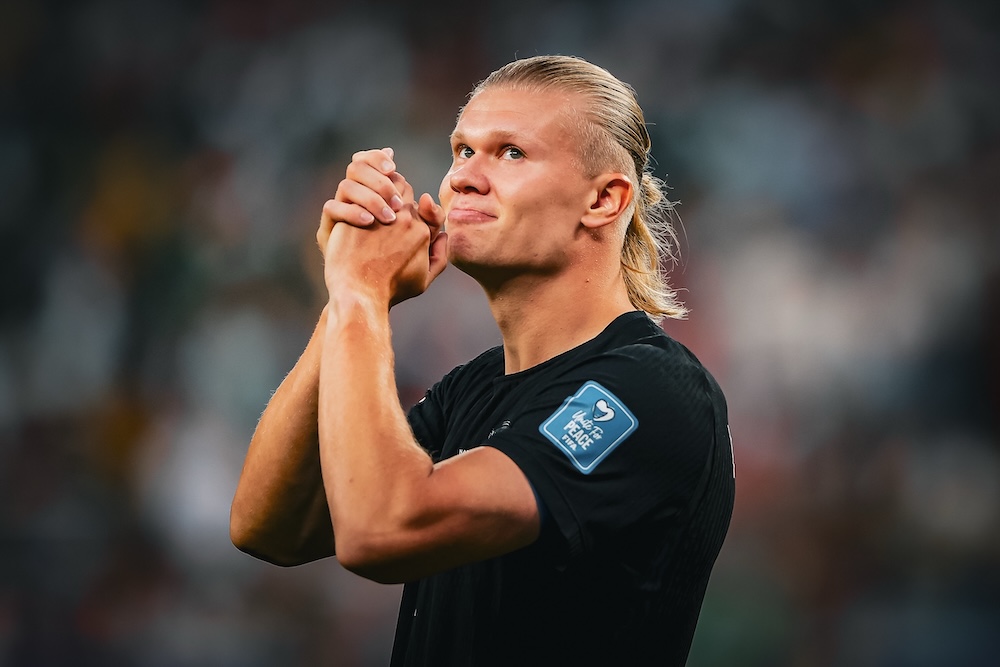
Hosting an international fixture involves expenses such as:
- Stadium operations
- Security
- Police coordination
- Staffing
- Ticketing
- Broadcasting arrangements
- Team logistics
- Medical services
- Temporary infrastructure
The Norway–Israel match required unusually extensive security measures, including a reduction in stadium capacity. The NFF nevertheless ensured that the humanitarian contribution reached 4.5 million kroner by supplementing the match surplus with its own additional funding.
Why the NFF Made the Donation
The Norwegian federation had been publicly troubled by the humanitarian context surrounding its World Cup qualifying matches against Israel.
When the fixture was announced, the NFF said that neither it nor other organizations could remain indifferent to the severe civilian suffering in Gaza. It described the match as difficult for reasons extending far beyond football.
Norway was still required to participate.
Both Norway and Israel were members of FIFA and UEFA, and Israel remained eligible for World Cup qualifying competition. The NFF could not simply cancel the fixture without risking serious sporting and disciplinary consequences.
Its response was therefore to separate two issues.
On the field, Norway would fulfil its competitive responsibility.
Off the field, the federation would use the match’s financial outcome to assist civilians affected by the conflict.
The NFF selected Doctors Without Borders because the organization was delivering emergency care in Gaza and other surrounding areas affected by war. The federation said it wanted the money to support an organization saving lives and providing active relief on the ground.
Where the Money Went
The 4.5 million kroner was donated to Médecins Sans Frontières, internationally known by its French initials, MSF.
The organization provides emergency medical assistance in conflict zones, disaster areas and communities facing severe healthcare shortages.
For Gaza-related operations, such work has included care involving:
- Trauma injuries
- Emergency surgery
- Maternal health
- Childhood illness
- Burns
- Infections
- Malnutrition
- Displacement
- Mental-health distress
- Shortages of medicine and medical equipment
The NFF specified that the contribution was intended for emergency relief in Gaza and surrounding areas affected by the war.
The donation did not go to a government, political party, football federation or armed organization.
It went to an internationally recognized medical humanitarian group.
That choice allowed the Norwegian federation to frame its action around civilian care rather than partisan political support.
The Match: Norway 5–0 Israel
The qualifier was played at Ullevaal Stadion in Oslo on October 11, 2025.
Norway entered the match leading its qualifying group and pursuing a return to the World Cup after an absence stretching back to 1998.
The home side won 5–0.
Haaland scored three times, while Israel also conceded two own goals. The result gave Norway six victories from its first six group matches and an extraordinary positive goal difference of 26.
The scoreline reflected Norway’s attacking superiority, but the match began unusually for Haaland.
He had an early penalty saved, only for officials to order a retake because goalkeeper Daniel Peretz had left his line too soon.
Haaland then missed the retaken penalty as well.
For many strikers, two missed penalties in quick succession could have disrupted the entire evening.
Haaland responded by scoring a hat-trick.
His goals reinforced his status as one of international football’s most prolific forwards and took his Norway tally beyond 50 goals in remarkably few appearances.
Haaland’s Hat-Trick
Haaland’s first goal came before halftime, helping Norway establish control after the early penalty drama.
He added two more in the second half as Israel’s resistance collapsed.
By the final whistle, his missed penalties had become a minor detail in an otherwise dominant performance.
The hat-trick carried significance beyond one match.
It brought Haaland to 51 goals in 46 international appearances, an extraordinary scoring rate that placed him firmly at the center of Norway’s qualification campaign.
His performance helped turn a politically tense fixture into another major step toward a long-awaited World Cup return.
What Haaland Said About the Political Debate
Haaland did not place himself at the center of the political discussion surrounding the game.
When asked to address issues beyond football, he indicated that he did not believe it was his role as a player to lead that conversation.
His public focus remained on Norway’s qualification campaign and its next match.
Reuters reported after the victory that both Haaland and coach Ståle Solbakken emphasized the sporting objective still ahead rather than treating qualification as complete.
This position should not be confused with the federation’s institutional stance.
The NFF chose to speak publicly about civilian suffering and make the donation.
Haaland chose to concentrate his remarks on playing and qualification.
A national federation and an individual footballer do not necessarily carry the same public responsibilities or feel equally equipped to discuss a geopolitical conflict.
A Match Played Under Exceptional Security
The fixture took place amid significant political tension.
Norwegian authorities implemented some of the strictest security measures associated with a sporting event in the country in decades.
Stadium capacity was reduced by roughly 2,500 seats because parts of the venue were needed for security arrangements. The federation had consulted with police and UEFA before deciding how the event would be staged.
Outside the stadium, pro-Palestinian demonstrators marched through Oslo carrying Palestinian flags and calling for Israel to be suspended from international football.
Norwegian police used tear gas after a smaller group breached barriers near the stadium, and several arrests were reported. Most of the larger demonstration was described as peaceful.
Inside Ullevaal, spectators displayed Palestinian flags and banners. Chants supporting Palestine could be heard during the evening, while the Israeli national anthem was met with loud boos from sections of the crowd.
The match therefore unfolded simultaneously as:
- A World Cup qualifier
- A major security operation
- A public protest
- A humanitarian fundraising event
- A debate about the relationship between sport and politics
Why Israel Was Still Allowed to Play
The NFF had expressed concern over Israel’s continuing participation in FIFA and UEFA competitions.
Norwegian football president Lise Klaveness had called for football authorities to examine whether Israel was complying with the governing bodies’ rules, particularly in connection with football activities in occupied Palestinian territories and the wider effects of the war.
However, FIFA and UEFA had not suspended Israel.
As a member federation, Norway remained bound by the competition schedule.
Refusing to play unilaterally could have led to:
- A forfeited match
- Sporting sanctions
- Fines
- Possible removal from qualification
- Disciplinary proceedings
The NFF therefore played the game while using its own platform and financial control to express its humanitarian position.
This was neither a full boycott nor political neutrality.
It was an attempt to operate within sporting regulations while publicly acknowledging the conflict surrounding the fixture.
The Israeli Federation’s Response
The decision was not welcomed by everyone.
The Israel Football Association criticized the Norwegian federation’s actions before the match, arguing that football should be used to unite people rather than become a vehicle for one-sided political messaging.
Israeli representatives also objected to the NFF’s public description of the conflict and the decision to direct match proceeds specifically toward Gaza-related work.
From the Norwegian perspective, however, refusing to acknowledge the humanitarian situation would itself have represented a political and moral choice.
The federation argued that the scale of civilian suffering made silence impossible.
This disagreement reflects a larger unresolved question in international sport:
Can a governing body remain neutral when one of its competitions takes place against the background of war, alleged violations of international law and mass civilian suffering?
Can Football Ever Be Separate From Politics?
Football organizations frequently insist that sport should remain separate from politics.
In practice, international football has always been connected with:
- National identity
- Diplomacy
- State funding
- Human rights
- War
- Migration
- Racism
- Economic power
- Public protest
National teams compete under flags and national anthems.
Governments host tournaments.
Political leaders attend matches.
FIFA and UEFA decide whether countries may participate after invasions, sanctions or institutional disputes.
The question is therefore rarely whether politics will enter football.
It is which political issues football authorities choose to recognize and how consistently they respond.
The Norway–Israel fixture made that tension impossible to hide.
Comparisons With Russia
Protesters and critics repeatedly compared Israel’s continued participation with the suspension of Russian teams following Russia’s full-scale invasion of Ukraine in 2022.
Russian clubs and national teams were excluded from FIFA and UEFA competition.
Israel was not subjected to the same measure.
Those calling for suspension argued that the different treatment represented a double standard.
Others maintained that the conflicts, legal circumstances and governing-body decisions were not identical and could not be treated through a simple comparison.
Norway’s federation did not boycott Israel, but its leadership had questioned whether international football authorities were applying their own principles consistently.
The donation allowed the NFF to make a meaningful humanitarian intervention even while FIFA and UEFA continued allowing the match to proceed.
The Symbolism of Donating Match Profit
The contribution had practical value.
Four and a half million kroner can finance medicine, staff, equipment and emergency treatment.
It also had symbolic value.
Football matches generate revenue from public attention.
Supporters buy tickets because they care about the team and the competition.
By redirecting the match surplus, the federation transformed part of that attention into humanitarian assistance.
The decision communicated that the fixture could not be treated as an ordinary commercial event.
Norway still wanted to win.
The federation still sold tickets.
The match still counted toward World Cup qualification.
But it refused to treat the surrounding suffering as irrelevant.
Was the Donation Political?
Yes, in the broad sense that it responded to a politically charged conflict.
It was also humanitarian.
Those two descriptions are not mutually exclusive.
Choosing to provide medical support to civilians affected by war carries political meaning because it publicly acknowledges their suffering.
But the donation did not finance a political campaign or military actor.
It supported Doctors Without Borders.
The NFF framed its position around emergency care, civilian protection and the responsibility not to ignore human suffering.
A humanitarian action can take place inside a political context without becoming an endorsement of every political claim associated with that context.
Why the Additional 1.5 Million Kroner Matters
The final donation was larger than the match surplus alone.
According to the NFF’s December 2025 announcement, the federation added 1.5 million kroner, taking the total received by Doctors Without Borders to 4.5 million kroner.
This detail strengthens the significance of the action.
It shows that the federation was not merely passing on whatever amount happened to remain after expenses.
It made a separate institutional decision to increase the contribution.
The final amount therefore represented both:
- Revenue generated by the match
- Additional money deliberately committed by the NFF
That is more precise than the viral description of “all ticket money,” and in some ways more meaningful.
How Much Is 4.5 Million Kroner?
Exchange rates fluctuate, but 4.5 million Norwegian kroner was worth several hundred thousand US dollars at the time.
For a major football industry, this is not an enormous commercial sum.
For humanitarian medical operations, it can still be highly valuable.
Such funding can contribute toward:
- Surgical materials
- Antibiotics
- Pain medication
- Wound treatment
- Mobile clinics
- Medical staff
- Maternal care
- Water and sanitation support
- Emergency transport
The impact depends on conditions on the ground, access restrictions and the organization’s operational priorities.
Norway’s Wider Position on Gaza
The donation was consistent with Norway’s broader diplomatic and humanitarian engagement in the region.
Norway has historically played a role in Israeli-Palestinian diplomacy and has provided significant humanitarian and development assistance to Palestinians.
In 2024, Norway formally recognized the State of Palestine alongside Ireland and Spain.
The Norwegian football federation is institutionally separate from the government, but its language around civilian suffering broadly reflected concerns repeatedly expressed within Norwegian public life.
The NFF had already stated in 2024 that it stood alongside the Norwegian government in calling for an end to disproportionate attacks on innocent civilians in Gaza.
Football Federations as Moral Institutions
A national football federation is not a government or humanitarian agency.
Its primary responsibilities include:
- Organizing competitions
- Developing players
- Supporting clubs
- Managing national teams
- Protecting sporting integrity
- Representing the country within FIFA and UEFA
Yet football federations also possess enormous cultural influence.
Their decisions affect millions of supporters.
When a federation addresses human rights or humanitarian suffering, critics may accuse it of exceeding its mandate.
When it remains silent, others may argue that it is protecting commercial interests at the expense of moral responsibility.
There is no politically neutral option when the competition itself has become controversial.
The NFF chose a limited but concrete response: fulfil the match, donate the surplus and speak openly about why the game could not be considered normal.
The Difference Between the Federation and the Players
Some observers expected Norwegian players, particularly Haaland, to make stronger political statements.
That expectation raises difficult questions.
Elite footballers possess enormous platforms, but they are not necessarily specialists in international law, humanitarian policy or conflict history.
Players may also face:
- Pressure from national federations
- Club responsibilities
- Sponsor relationships
- Misquotation
- Online abuse
- Expectations to represent an entire country’s politics
Haaland chose to focus on football.
The NFF, through its elected leadership and institutional process, took the public position and made the donation.
Supporters may judge those choices differently, but they should not be treated as identical decisions.
Haaland’s Sporting Focus
After the 5–0 win, Haaland resisted celebrating qualification prematurely.
Norway had placed itself in a commanding position, but the campaign was not mathematically complete.
He and Solbakken emphasized that the next fixture still needed to be won.
That focus reflected the memory of a country that had repeatedly failed to reach major tournaments despite producing elite players.
The team’s task was to turn promise into qualification.
The victory over Israel brought Norway close to doing so.
Norway’s Long World Cup Absence
Before qualifying for the 2026 tournament, Norway’s previous World Cup appearance had come in France in 1998.
The country had not reached the European Championship since 2000.
Several talented generations had fallen short.
The emergence of Haaland, Martin Ødegaard, Alexander Sørloth and a stronger supporting squad changed expectations.
The Israel result became one of the clearest signs that Norway was no longer merely a promising team.
It was becoming a decisive and efficient one.
The 5–0 victory eventually formed part of a campaign that returned Norway to the global stage.
More Than One Story Can Be True
The match demonstrates that sport does not always produce a single clean narrative.
It was possible for the night to be:
- A brilliant football performance by Norway
- A devastating defeat for Israel
- A milestone in Haaland’s career
- A decisive moment in World Cup qualification
- A scene of public protest
- A heavily secured international event
- A source of medical funding for Gaza
- A reflection of unresolved double standards in global sport
Reducing the event to only the score would ignore its political and humanitarian context.
Reducing it only to politics would ignore the sporting achievement and the players’ professional responsibilities.
The complete story includes both.
Why the Story Went Viral Months Later
The donation received renewed online attention in 2026 as Norway and Haaland became major subjects during the World Cup.
Posts began circulating that contrasted Haaland’s hat-trick with the federation’s humanitarian contribution.
Some of those posts accurately captured the essential story.
Others simplified the financial details or implied that the donation had been made immediately after the final whistle.
In reality, the commitment had been announced before the October 2025 match, while the final 4.5 million kroner total was confirmed later after the NFF added extra funds.
The corrected chronology is:
- The NFF announced before the match that the surplus would support humanitarian relief.
- Norway beat Israel 5–0 on October 11, 2025.
- Haaland scored a hat-trick.
- The federation calculated the financial result.
- The NFF added 1.5 million kroner.
- Doctors Without Borders received a total of 4.5 million kroner.
What Other Sports Organizations Can Learn
The NFF’s action offers several lessons for sporting institutions.
Humanitarian Responses Should Be Concrete
Statements carry more weight when accompanied by measurable assistance.
Beneficiaries Should Be Credible
Using an established independent medical organization helped distinguish humanitarian relief from partisan funding.
Financial Claims Should Be Transparent
The distinction between gross revenue, surplus and added contributions should be clearly explained.
Players Should Not Carry the Entire Burden
Institutions should take responsibility for policies rather than forcing individual athletes to answer every political question.
Sporting Obligations and Moral Action Can Coexist
A federation may be required to compete while still using its platform to address suffering.
Consistency Matters
Football authorities lose credibility when human-rights standards appear to change according to political alliances.
Criticism and Limitations
The donation did not satisfy everyone.
Some activists argued that Norway should have refused to play or demanded Israel’s suspension more forcefully.
From that perspective, donating match proceeds did not address the legitimacy gained through continued participation in FIFA competition.
Others believed the NFF politicized sport and unfairly directed criticism toward Israel.
A third position welcomed the medical contribution but cautioned against presenting charity as a substitute for political action capable of ending civilian suffering.
All three reactions reveal the limits of symbolic action.
A football federation cannot stop a war through one donation.
But limited influence does not make all action meaningless.
Medical Aid Cannot Replace Political Solutions
Doctors Without Borders can treat wounds, support hospitals and provide emergency care.
Humanitarian organizations cannot independently create a durable ceasefire, rebuild political institutions or resolve the Israeli-Palestinian conflict.
Medical relief addresses immediate suffering.
Political solutions must address why the suffering continues.
The NFF’s contribution should therefore be understood as humanitarian assistance, not a resolution of the larger crisis.
Why the Donation Still Matters
Humanitarian work often depends on thousands of contributions that are individually too small to change an entire conflict.
Their importance lies in what they make possible for specific people.
A donation may help provide:
- One operation
- One course of treatment
- One functioning clinic
- One safe delivery
- One child’s medical care
- One trauma team’s supplies
The inability to solve everything does not remove the responsibility to help where possible.
That appears to have been the principle behind the NFF’s decision.
Final Thoughts
The story of Norway’s donation is true, with one important correction.
The Norwegian Football Federation did not simply transfer every krone of gross ticket sales from the Israel match.
It committed the match’s financial surplus to Doctors Without Borders and later added 1.5 million kroner, producing a total donation of 4.5 million Norwegian kroner for humanitarian relief in Gaza.
The sporting facts are equally clear.
Norway defeated Israel 5–0 at Ullevaal Stadion on October 11, 2025.
Erling Haaland recovered from two early penalty misses to score a hat-trick, pass 50 international goals and move his country close to its first World Cup qualification in 27 years.
Haaland did not attempt to lead the political debate.
He maintained that his role was to focus on football and helping Norway complete its qualification campaign.
The federation took the institutional position instead.
It said it could not remain indifferent to the suffering of civilians in Gaza, selected Doctors Without Borders as its humanitarian partner and converted a controversial fixture into meaningful medical support.
The donation did not remove the political controversy surrounding the match.
It did not answer whether Israel should have remained eligible to compete.
It did not resolve accusations of inconsistency within FIFA and UEFA.
It did, however, demonstrate that a football organization can acknowledge the world beyond the stadium.
On the field, Norway produced five goals and a decisive victory.
Off it, the match helped generate 4.5 million kroner for people needing emergency care.
The two outcomes belonged to the same evening—and both are part of its legacy.
Frequently Asked Questions
Did Norway donate money from its match against Israel?
Yes. The Norwegian Football Federation donated money connected with the match to Doctors Without Borders for humanitarian work in Gaza.
How much did the federation donate?
The final donation was 4.5 million Norwegian kroner.
Was it all the ticket revenue?
Not exactly. The NFF originally committed the match surplus or profit, then added 1.5 million kroner to bring the total to 4.5 million.
Why is “all ticket revenue” inaccurate?
Gross ticket revenue does not account for security, stadium operations, staffing and other costs. The official wording referred to the surplus.
Which organization received the money?
Médecins Sans Frontières, also known as Doctors Without Borders.
What was the money intended for?
It was earmarked for emergency humanitarian and medical work in Gaza and nearby areas affected by the war.
When was the Norway–Israel match played?
It was played on October 11, 2025.
Where was the match held?
At Ullevaal Stadion in Oslo.
What was the score?
Norway won 5–0.
Who scored for Norway?
Erling Haaland scored a hat-trick. Israel also conceded two own goals.
Did Haaland miss a penalty?
Yes. He had an early penalty saved, and after a retake was ordered, the second attempt was also saved.
How did he respond?
He went on to score three goals.
How many international goals did Haaland have after the match?
He reached 51 goals in 46 senior appearances for Norway.
Why was the match politically controversial?
It took place during the Gaza conflict amid international criticism of Israel’s military actions and debate over whether Israeli teams should remain in FIFA and UEFA competitions.
Did Norway refuse to play Israel?
No. Norway fulfilled the scheduled World Cup qualifier.
Why could the NFF not simply cancel the game?
A unilateral refusal could have caused a forfeiture, disciplinary action and serious consequences for Norway’s World Cup campaign.
Did the Norwegian federation support suspending Israel?
Its leadership had called for football authorities to examine Israel’s compliance with FIFA and UEFA rules, but Norway did not independently boycott the match.
Were there protests?
Yes. Pro-Palestinian demonstrations took place in Oslo before the match.
Did police use tear gas?
Yes. Police used tear gas after some demonstrators breached security barriers near the stadium.
Were Palestinian flags displayed inside the stadium?
Yes. Flags and pro-Palestinian banners were visible, and supportive chants were heard.
Was stadium capacity reduced?
Yes. Security measures reduced the available capacity by approximately 2,500 seats.
Did Haaland comment on Gaza?
He avoided taking a leading political position and indicated that he preferred to focus on football.
Did Haaland support the donation?
The donation was an institutional decision made by the NFF. Public reporting focused on Haaland’s sporting comments rather than a detailed personal statement about the contribution.
Did Norway qualify for the World Cup that night?
Not mathematically, but the victory placed it very close to qualification.
When had Norway last played in a World Cup before 2026?
Norway’s previous appearance was in 1998.
Why did the NFF choose Doctors Without Borders?
It wanted the money to support an organization providing active emergency medical relief on the ground.
Is Doctors Without Borders a political organization?
It is an independent international medical humanitarian organization, although its work often occurs within politically contested conflicts.
Did the donation go to Hamas?
No evidence supports that claim. The money was donated to Doctors Without Borders for medical humanitarian work.
Did the money go to the Palestinian government?
No. It went to Doctors Without Borders.
When was the final donation announced?
The NFF announced the final 4.5 million kroner total in December 2025.
Why did the federation add more money?
It chose to add 1.5 million kroner beyond the match surplus, raising the total contribution.
How much was 4.5 million kroner in US dollars?
The exact value depends on the exchange rate, but it represented several hundred thousand US dollars.
Was the donation made after Norway won?
The commitment was announced before the match. The final amount was confirmed after the financial result was calculated.
Why is the story circulating again in 2026?
It regained attention as Haaland and Norway attracted greater global interest around the 2026 World Cup.
Is the viral post generally accurate?
Its central claim is accurate, but “all ticket revenue” should be corrected to the match surplus plus an additional NFF contribution.
Was the match only about politics?
No. It was also an important World Cup qualifier and a major sporting performance by Norway.
Was the donation merely symbolic?
It carried symbolic meaning, but 4.5 million kroner also represented concrete funding for humanitarian medical work.
Did the donation end the controversy?
No. Critics continued debating whether the match should have been played and whether Israel should remain in international competition.
What is the most accurate summary?
Norway beat Israel 5–0 in a 2025 World Cup qualifier, Haaland scored a hat-trick, and the Norwegian Football Federation donated the match surplus plus additional funding—4.5 million kroner in total—to Doctors Without Borders for Gaza relief.