India's Fake Toll Plaza Scam: How Villagers Collected Money From Drivers for Years Before Authorities Shut It Down
Imagine driving along a busy Indian national highway.
Ahead, you see a legitimate toll plaza.
But before you reach it, someone approaches with an attractive offer.
Why pay the full toll when you can take a short alternative route and pay a fraction of the amount?
The detour looks convenient.
Other vehicles are using it.
There is someone collecting money, and the route eventually reconnects with the highway.
So you pay.
You drive away believing you have saved money.
What you may not realize is that the people collecting the fee have no legal authority to operate a toll station.
And the money you handed over is going directly into an unauthorized collection operation.
This was the basic arrangement uncovered in Gujarat's Morbi district in December 2023.
Near the town of Wankaner, groups operating from private land and village access roads allegedly diverted motorists away from the official National Highways Authority of India (NHAI) toll plaza.
Instead of paying the legitimate highway toll, drivers paid much smaller amounts at unauthorized checkpoints.
The arrangement continued for years.
And when authorities finally intervened, the case became one of India's most unusual highway-related fraud stories.
But there is an important correction to the widely circulated version of the story.
The incident was exposed in 2023, not 2013.
Some of the illegal collection activity had reportedly continued for approximately 12 years, potentially dating back to around 2011. A second unauthorized collection point began operating around December 2022.
That distinction matters because early reporting described the operation as a scam that had lasted about 18 months, while a later investigation by The Indian Express uncovered a much longer history involving the original village bypass.
The true story is less about a sophisticated imitation of government infrastructure than an exploitation of something surprisingly simple:
Motorists were willing to pay a smaller unofficial charge to avoid a larger official one.
And that arrangement became profitable enough to continue until complaints and a government investigation finally brought it to an end.
Where Did the Fake Toll Plaza Operate?

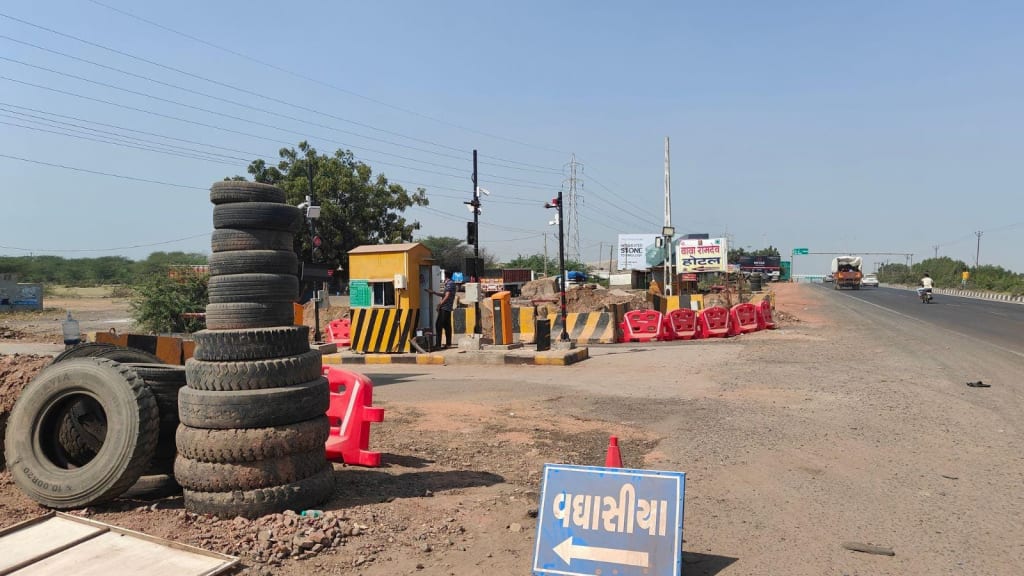
The operation took place near Vaghasia village in Morbi district, Gujarat, along National Highway 27, formerly known as NH-8A.
The highway connects Wankaner and Morbi and serves traffic traveling toward important commercial areas and ports in Gujarat.
The official toll plaza was operated under the national-highway system.
But nearby village tracks and private property gave motorists an alternative.
The roads allowed vehicles to leave the main route, bypass the authorized toll station, and return to the highway.
According to a detailed December 19, 2023 investigation by The Indian Express, the unauthorized collection points were located roughly 600 meters from the official toll plaza.
They operated on both sides of the highway, using different access routes depending on the direction of travel.
How the Scam Worked: The Attraction of Paying Less
The operation relied on a simple psychological incentive.
Drivers dislike paying expensive highway tolls.
Truck operators, in particular, may cross the same stretches of road frequently, making toll expenses a recurring business cost.
If someone offers a shorter route at a lower price, the savings can seem worthwhile.
The people running the unauthorized collection points exploited that calculation.
They directed vehicles away from the genuine toll plaza and charged an alternative fee.
Some collectors reportedly described the money as a contribution toward local temple construction.
Others simply collected payment in exchange for allowing vehicles to use the bypass.
The Price Difference Was Enormous
According to The Indian Express, the unauthorized booths charged approximately ₹10 for cars and ₹50 for trucks in arrangements described during its investigation.
The authorized toll rates cited in the same report were much higher, including ₹110 for cars and ₹380 or ₹720 for trucks, depending on the axle category.
Ahmedabad News - The Indian Express
Vehicle category | Reported unauthorized charge | Official toll cited |
|---|---|---|
Car | ₹10 | ₹110 |
Truck | ₹50 | ₹380–₹720 |
Amounts reflect the specific arrangements reported in December 2023; separate early reports quoted different unofficial rates.
For a car driver, the cheaper route could appear to save ₹100.
For a truck driver, the apparent saving could be several hundred rupees.
Those differences help explain why some motorists voluntarily used the unofficial detour.
But the arrangement also created financial harm to the legitimate toll system, and allegations of intimidation meant not all payments could be assumed voluntary.
The Closed Factory That Became Part of the Operation
One of the most unusual details involves a defunct ceramics factory.
A site belonging to White House Tiles Private Limited was used as part of the bypass network.
The property helped vehicles avoid the authorized toll station before returning to the highway.
The accused allegedly operated a collection point on or around the factory premises.
This made the arrangement harder to classify as a conventional fake toll plaza.
The scammers did not need to reproduce an entire government highway checkpoint.
They had access to land and routes that provided an alternative to it.
The existing geography did much of the work.
A legitimate road system stood nearby.
The official toll booth existed.
But the unauthorized operators controlled access to a cheaper passage around it.
That combination allowed the scheme to continue without building a complete imitation of the NHAI's infrastructure.
How Did an Illegal Toll Operation Continue for So Long?
The most astonishing detail is that the arrangement did not require sophisticated technology or elaborate forged government documents.
According to the investigation, the original route began as a dirt track used by villagers traveling to agricultural land across the highway.
Over time, motorists discovered that the track could also be used to avoid the official toll plaza.
Local operators began collecting money from drivers using the shortcut.
For years, this apparently became an accepted arrangement among some road users.
The operators had access to the road.
Drivers received a cheaper passage.
And the legitimate toll plaza lost potential revenue.
The Temple Contribution Explanation
One unusual detail was the claim that the collected money would support temple construction in Vaghasia village.
Such explanations could make a payment seem less like an unauthorized toll and more like a community contribution.
That does not establish where the collected money ultimately went.
But it demonstrates how the operators allegedly justified charging motorists for using the bypass.
As the operation expanded, the involvement of additional collection points and allegations of intimidation drew greater attention.
The case eventually prompted formal complaints from the legitimate toll operator.
December 4, 2023: The Scam Is Finally Exposed
The situation changed when the National Highways Authority of India received complaints about vehicles being diverted around the official toll plaza.
Morbi district authorities organized an investigation involving police and local administrative officials.
On December 4, 2023, authorities intervened and stopped the unauthorized collection.
A police complaint named several individuals connected with the operation.
Among those accused were Dharmendrasinh Zala, then sarpanch of Vaghasia village, his brother Yuvrajsinh Zala, and others associated with the collection points and factory property.
The suspects were accused of involvement in unauthorized collections and alleged extortion.
The investigation revealed how the bypass roads and privately controlled premises had enabled motorists to avoid the legitimate checkpoint.
The Financial Consequences Were Immediately Visible
The most revealing evidence of the operation's impact came after it was stopped.
The Indian Express reported in December 2023 that the legitimate toll plaza's daily revenue had increased from approximately ₹15 lakh to ₹20 lakh.
That suggested a substantial amount of traffic had previously avoided the authorized collection point.
A later November 2024 report quoted a local official describing a rise from approximately ₹17 lakh to ₹22 lakh per day, equivalent to a 25% increase.
These are reported comparisons from different periods, not necessarily conflicting audited measurements.
REPORTED OFFICIAL TOLL REVENUE AFTER THE CRACKDOWN
₹15 lakh
Daily revenue before
₹20 lakh
Daily revenue afterDecember 2023 figures reported by The Indian Express. The change cannot by itself establish the total money illegally collected. Ahmedabad News - The Indian Express
The figures provide a glimpse of the potential economic impact.
But they should not be interpreted as a precise measurement of the perpetrators' earnings.
Some traffic may have used the bypass for other reasons, and official toll revenue can change for multiple factors.
Did the Scam Really Collect ₹75 Crore?
Some online headlines and reports have attached a figure of ₹75 crore to the Gujarat fake toll-plaza story.
It is a dramatic claim.
But the verified reporting does not establish an audited ₹75-crore total collected by the accused.
The difference between an estimate of government revenue lost, an extrapolation from toll traffic, and cash actually collected by unauthorized operators is enormous.
Without detailed transaction records, reliable traffic counts, or an official accounting, it would be misleading to present that figure as proven.
The same caution applies to claims that the entire operation continued unchanged for precisely 12 years.
The available evidence indicates that the older village-road arrangement existed for many years, while the factory-side operation was considerably newer.
The incident evolved over time rather than operating as one identical setup throughout.
What Happened to the Accused?
The December 2023 intervention was not the end of the legal story.
In January 2024, The Indian Express reported the arrest of two accused individuals who had initially avoided police.
The case continued through the criminal justice system.
By November 2024, The Indian Express reported that the police investigation had been completed and the matter was before a court.
At least four accused had been arrested and were out on bail at that time.
The report also described efforts by the legitimate toll operator to prevent further unauthorized bypass collections.
A Remarkable Twist: Official Toll Booths Were Later Added
In November 2024, the authorized toll operator, Bamanbore Tollway Private Limited, installed new collection booths at the entrance and exit of Vaghasia village.
The purpose was to prevent revenue leakage through the same bypass area.
Unlike the earlier unauthorized collection points, these were described by NHAI-linked officials as lawful arrangements under the toll operator's contract.
In other words, the area where an illegal toll operation had existed was later equipped with authorized toll infrastructure.
That development makes the case even more unusual.
The shortcut that enabled the scam did not simply disappear.
The legitimate operator adapted its collection system to address it.
Why This Was Not an Ordinary Fake Government Office Scam
The Gujarat case differs from many fraud operations involving impersonation.
In a conventional fake-office scam, criminals might create a government signboard, forge documents, or pretend to be officials.
The Morbi operation worked through a more subtle mechanism.
The unauthorized collectors exploited an existing alternative route.
Drivers understood that they were avoiding the official toll.
The attraction was not necessarily that the illegal booth looked convincingly governmental.
The attraction was that it was cheaper.
That distinction raises uncomfortable questions about the relationship between fraud, convenience, and voluntary participation.
Some motorists may have believed they were paying a legitimate local access fee.
Others may have knowingly used the bypass to avoid the authorized toll.
And police allegations indicate that intimidation was also part of the operation.
Not every driver's experience was necessarily the same.
What the Scam Revealed About Infrastructure Oversight
The case highlights a problem that can arise when major infrastructure projects intersect with local roads and private land.
An authorized toll station may have clear boundaries and legally established collection points.
But nearby paths can create opportunities for traffic to bypass those points.
If these routes become heavily used, unauthorized operators may begin charging for access.
The resulting arrangement can continue when responsibilities among road authorities, local government, police, and private property owners are unclear or when complaints are not resolved promptly.
This does not establish that particular officials knowingly permitted the operation.
It does illustrate the importance of monitoring traffic patterns, responding to complaints, and ensuring that collection activities are legally authorized.
The longer an unofficial arrangement becomes established, the more difficult it may be to remove without conflict.
Timeline of the Gujarat Fake Toll Plaza Scam
- Around 2011 — The older bypass collection developsLater reporting indicates that villagers began charging vehicles using a dirt-track route around the official toll plaza roughly 12 years before the crackdown.
- December 2022 — Another collection point emergesAn unauthorized route and booth are established around the closed White House Tiles factory premises.
- December 4, 2023 — Authorities intervenePolice and local administrators stop the unauthorized collection and initiate criminal proceedings.
- December 8–19, 2023 — The story gains national attentionNews outlets report the fake toll operation. A detailed Indian Express investigation reveals its longer history.
- January 2024 — Further arrests reportedPolice arrest accused individuals who had been evading capture.
- November 2024 — Authorized collection points installedThe legitimate toll operator installs new booths on the village-access route. Police confirm that the investigation is complete and the case is in court.
Frequently Asked Questions
Was there a fake toll plaza in India in 2013?
The widely reported Gujarat fake toll-plaza case was uncovered in December 2023, not 2013. However, the original unauthorized collection arrangement reportedly began roughly 12 years earlier, around 2011. A separate fake toll-pass racket was reported in Mumbai in 2012 and carried by some outlets in January 2013.
Where was the Gujarat fake toll plaza located?
It operated near Vaghasia village in Wankaner, Morbi district, Gujarat, close to the official toll plaza on NH-27, formerly NH-8A.
How long did the scam operate?
Early news reports described approximately 18 months of activity. A more detailed investigation found that an older village-road collection arrangement had existed for roughly 12 years, while a second booth emerged in 2022.
How much money did the accused collect?
The exact amount has not been reliably established in the reporting reviewed. Viral claims of ₹75 crore should not be presented as a verified collection total.
Did police shut down the operation?
Yes. Authorities intervened on December 4, 2023, and criminal proceedings followed.
What happened afterward?
By November 2024, police had completed the investigation, the matter was before a court, and the legitimate toll operator had installed authorized collection booths on the village route.
The Most Astonishing Part Wasn't the Fake Toll Plaza. It Was How Ordinary the Scam Became.
The story of Gujarat's unauthorized toll operation is unusual because it did not rely entirely on deception in the conventional sense.
There was no need to construct an enormous replica of a national-highway toll complex.
No elaborate technological system was necessary.
The operators had something simpler.
A shortcut.
A lower price.
And a steady flow of drivers willing to use it.
The arrangement reportedly continued for years before authorities finally stopped it.
By then, the unauthorized collection points had become part of the way some motorists traveled through the area.
That is perhaps the most revealing lesson of the case.
Fraud does not always succeed because people believe an elaborate lie.
Sometimes it succeeds because an unofficial arrangement offers something people want—and continues long enough to become familiar.
For the legitimate toll operator, it represented lost revenue and a serious enforcement problem.
For the accused, it became the subject of criminal allegations.
And for the public, it offered a remarkable example of how a simple infrastructure loophole could develop into a long-running unauthorized collection operation.
India's fake toll-plaza scandal was not just about people collecting money on a road. It was about how a shortcut, a financial incentive, and years of insufficient oversight allowed an illegal arrangement to become an everyday business.
Sources and Further Reading
- The Indian Express — How Five Men Built Fake Toll Booths in Gujarat (December 19, 2023). Detailed local investigation into the routes, prices, accused individuals, and reported 12-year history.
- NDTV — Fake Toll Plaza Set Up on Gujarat Highway (December 8, 2023). Initial reporting on the official investigation.
- The Indian Express — Gujarat's Fake Toll Booths Revisited (November 11, 2024). Follow-up on the police case, bail, and installation of legitimate collection points.
- Mint — Gujarat Fake Toll Plaza Operated for 1.5 Years (December 9, 2023). Contemporary summary of the initial allegations.
- Business Standard / PTI — Fake Toll Passes Racket Busted, Two Held. A separate earlier Mumbai toll-pass forgery case, useful for distinguishing the stories.