Why I Spent $50 on a Dress That Doesn’t Exist: The Strange New Psychology of Digital Fashion
In an era where our identities stretch across screens, timelines, avatars, and meticulously curated profiles, the very idea of fashion is undergoing a transformation so radical that it’s beginning to detach entirely from the physical world. Digital fashion—garments that you can’t touch, fold, wash, or hang—has become one of the fastest-growing cultural markets. From AR-enhanced dresses edited onto your photos to high-end couture skins in video games, people are paying real money for outfits that will never exist offline. And surprisingly, for many, it feels completely natural.
This shift isn’t happening in the fringes of tech culture; it’s showing up everywhere. Instagram influencers buying digital gowns instead of renting physical ones. Gamers dropping hundreds on exclusive character skins. Teenagers editing unique digital jackets into their photos. And major brands—Balenciaga, Gucci, Nike—selling virtual fashion with the same seriousness as traditional collections. What once sounded absurd is becoming the new normal: flexing an outfit you can never actually touch is now part of the modern wardrobe.
But why? Why would anyone pay $50—or $500, or $5,000—for a dress that doesn’t physically exist? The answer lies not in the garment itself, but in the shifting nature of identity, status, self-expression, and the economy of attention in a world increasingly lived online.
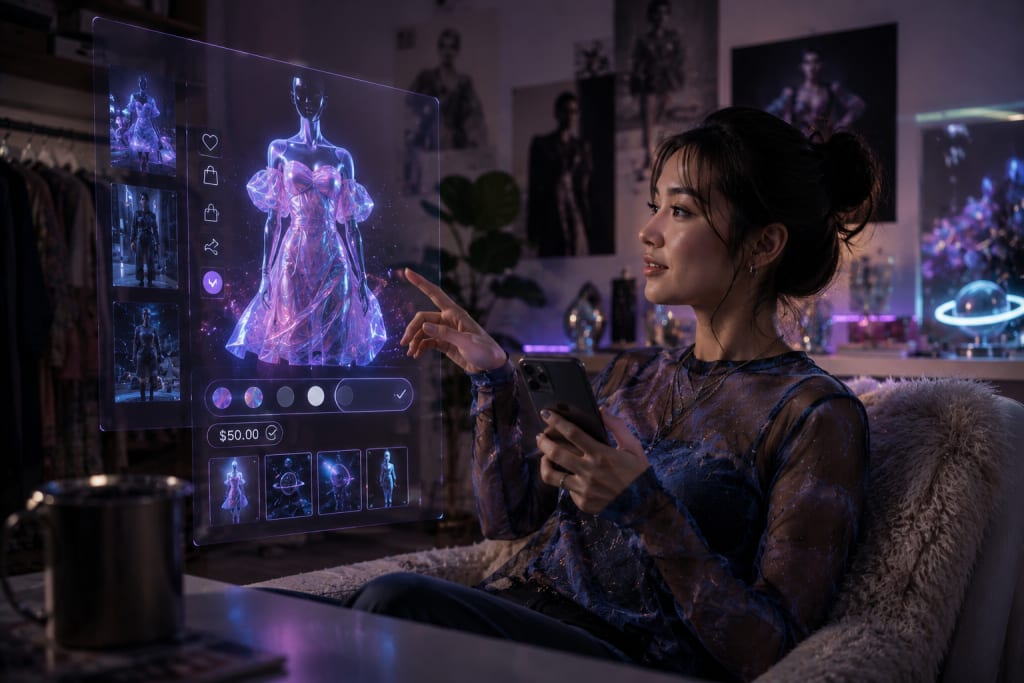
Digital fashion first appeals to the contemporary desire for limitless customization. In the real world, our wardrobes are restricted by budgets, closet space, and physics. But in the digital world, you can wear a dress made of fractal fire, a suit stitched from galaxies, or sneakers that change color every second. You’re no longer bound by fabric or gravity. A digital outfit is pure imagination—design unfiltered by practicality. People aren’t buying textiles; they’re buying impossible beauty, visual fantasy, and creative freedom.
Yet the deeper psychological pull is tied directly to the infrastructure of social media. For decades, fashion has been inseparable from its role in signaling identity: who you are, what tribe you belong to, what you believe in, what you can afford. But today, most people don’t display their fashion to crowds on the street—they display it to feeds, followers, and digital communities. The audience that matters is online, so the wardrobe that matters increasingly is too.
And online, digital fashion performs better than real clothing. It photographs perfectly. It stands out in a sea of similar content. It requires no dry-cleaning, no ironing, no storage, no shipping. You can “try on” ten looks in a day, post them all, and never touch a hanger. A digital outfit is less about wearing and more about performing—the perfect fit for a social ecosystem driven by images, impressions, and microbursts of attention.
There’s also a status element, but not in the old materialistic sense. In the world of digital fashion, exclusivity doesn’t come from scarcity of fabric but scarcity of code. Limited-edition skins, one-of-one AR dresses, or creator-designed outfits function like digital collectibles. Owning them feels like joining a small, elite community of people who understand the language of the new era. And unlike physical designer pieces, these digital clothes can look like absolutely anything—your body becomes a canvas for art, not apparel.
Environmental consciousness plays a surprising role as well. Younger generations, especially Gen Z, are acutely aware of the waste, pollution, and labor exploitation tied to fast fashion. Digital garments offer a guilt-free alternative: a way to express, experiment, and gain aesthetic novelty without contributing to landfills or carbon emissions. For some, buying a virtual dress is not indulgence—it’s ethics.
Then there’s gaming culture, which arguably normalized this entire economy long before the mainstream caught on. For over a decade, millions of players have spent billions on cosmetic upgrades: Fortnite skins, League of Legends outfits, Roblox accessories, and countless others. To gamers, a character skin is not a frivolous purchase; it’s an extension of identity in a space where they socialize, compete, and exist for hours a day. The leap from game skins to digital fashion on social media is smaller than it looks. The psychological framework is the same: if your life has a digital dimension, your appearance in that dimension matters.
But at the heart of digital fashion’s appeal is something far more emotional: the desire to reinvent ourselves. In physical life, reinvention is slow, expensive, and often impossible. Online, reinvention is instant. A new digital outfit can reflect a mood, a fantasy, or a version of yourself that you’re not ready—or able—to express in real life. The screen becomes a buffer, a safe zone, a creative engine. For some, digital fashion isn’t just aesthetic—it’s liberation.
Will digital fashion replace physical clothing? Unlikely. But it will increasingly coexist with it, especially as AR tools and virtual wardrobes become integrated into our everyday digital routines. Tomorrow’s closet may live partly on your phone, partly in your gaming profile, and partly in your social personas. What we wear publicly in the real world might become less important than what we wear publicly online.
So yes, spending $50 on a dress that doesn’t exist sounds strange—until you realize that value is no longer determined by material weight. It’s determined by visibility, expression, identity, and the evolving rules of a society that now lives half of its life inside a screen. Digital fashion isn’t replacing reality; it’s expanding it. And in this expanded reality, a dress made of light and pixels can hold just as much emotional power as one made of silk.
If anything, digital fashion reflects the truest shift of our era: what matters is not what we wear, but how we present ourselves in a world where the boundaries between the physical and the virtual have dissolved.