
The Katyn Massacre: How Stalin’s Secret Police Murdered Poland’s Elite—and Blamed Nazi Germany for Nearly 50 Years
In the spring of 1940, thousands of Polish prisoners were taken from Soviet camps in carefully organized transports.
Their families stopped receiving letters.
The prisoners vanished.
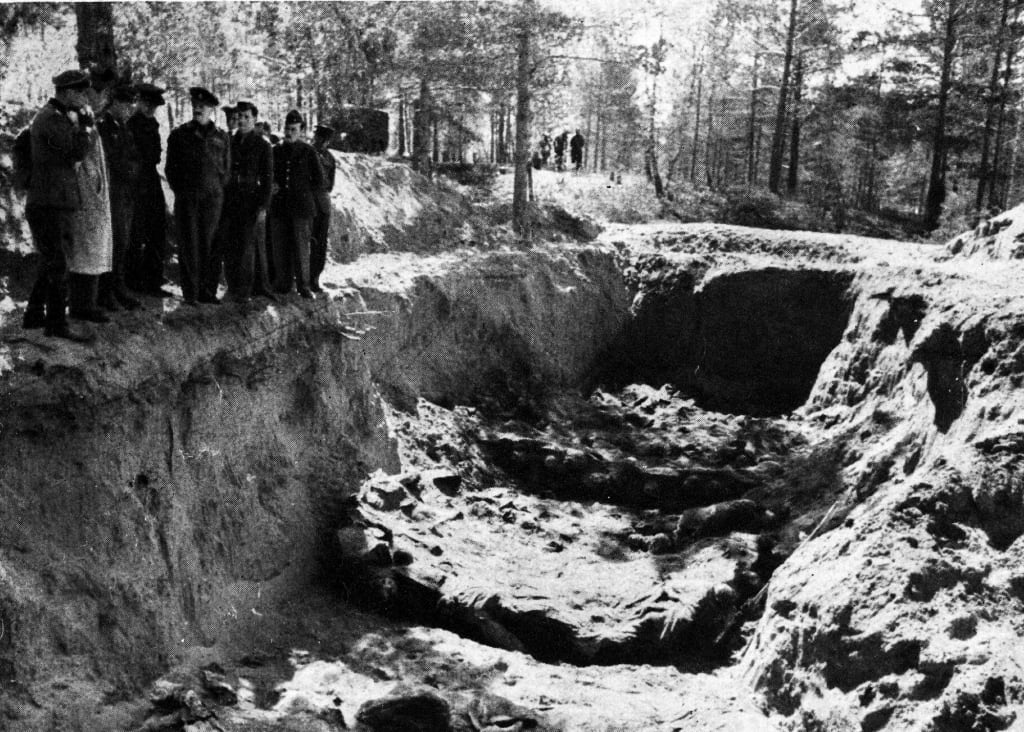
Three years later, mass graves filled with Polish officers were uncovered in the Katyn Forest near Smolensk. Nazi Germany accused Joseph Stalin’s Soviet Union of committing the massacre. Moscow immediately responded that the Nazis themselves had murdered the prisoners after invading Soviet territory in 1941.
For once, Nazi propaganda was telling the truth about who had committed a particular atrocity.
That inconvenient fact helped create one of the most extraordinary disinformation campaigns of World War II.
The Soviet secret police—the NKVD—had executed nearly 22,000 Polish military officers, police officers, government officials, intellectuals and other prisoners in April and May 1940 following a decision approved by Stalin and the Soviet Politburo. Yet the USSR officially blamed Nazi Germany until April 1990.
Strictly speaking, the Soviet falsehood lasted about 47 years after the graves became an international issue in 1943, rather than a literal 50. More importantly, the truth was not completely unknown during those decades. Polish investigators, Western intelligence officials, witnesses and a U.S. congressional committee accumulated substantial evidence of Soviet responsibility long before Moscow confessed.
What lasted nearly half a century was the official Soviet lie—and the political machinery required to sustain it.
Katyn therefore became more than the name of a massacre.
It became a case study in state murder, wartime propaganda, diplomatic expediency and the frightening ability of a powerful government to manufacture an alternative history.
The Story Begins With the Destruction of Poland
The Katyn massacre cannot be understood without September 1939.
Nazi Germany invaded Poland from the west on September 1, beginning the European phase of World War II.
Sixteen days later, on September 17, the Soviet Union invaded Poland from the east.
The two dictatorships had already secretly divided much of Eastern Europe into spheres of influence under the Molotov-Ribbentrop Pact signed in August 1939. Germany and the Soviet Union subsequently occupied different portions of defeated Poland.
The occupations were ideologically different, but both regimes immediately targeted people capable of resisting foreign domination.
The Germans murdered Polish elites through operations including the Intelligenzaktion and later the AB-Aktion.
The Soviets conducted arrests, deportations and political repression across the territories they had seized.
The Red Army and NKVD took hundreds of thousands of Polish military personnel and civilians into custody. Officers, police personnel and other selected prisoners were separated and concentrated in camps under NKVD control.
Three camps became especially important:
- Kozelsk
- Starobelsk
- Ostashkov
The men confined there represented far more than Poland’s professional military establishment.
Why the Prisoners Were So Valuable to Poland
Interwar Poland relied heavily on reserve officers.
A physician could also be an Army lieutenant.
A lawyer might hold an officer’s commission.
So could a teacher, professor, engineer, journalist or civil servant.
At Kozelsk alone, prisoners included hundreds of doctors, lawyers, engineers and teachers, as well as university lecturers, writers and journalists. Starobelsk contained scholars, teachers, physicians, lawyers and engineers alongside career officers. Ostashkov held large numbers of police, military police, border guards, intelligence personnel and prison officials.
This mattered enormously.
Killing these prisoners would not simply reduce Poland’s military manpower.
It would remove a substantial section of the professional and administrative class capable of rebuilding an independent Polish state.
The Katyn victims therefore represented a dangerous category from Stalin’s perspective:
People with education, organizational experience, patriotism and institutional authority.
People who might resist Sovietization.
The NKVD Interrogated the Prisoners Before Deciding Their Fate
The prisoners did not immediately know what would happen to them.
NKVD personnel interrogated them, collected information about their backgrounds and assessed whether they might be willing to cooperate with Soviet authorities.
Most were considered politically hostile.
By early 1940, Soviet officials faced a question:
What should be done with thousands of Polish officers and prisoners whom the regime regarded as committed enemies?
Lavrentiy Beria, head of the NKVD, provided an answer.
Kill them.
March 5, 1940: The Decision Behind Katyn
The central documentary evidence in the Katyn case is devastatingly direct.
On March 5, 1940, Beria submitted a proposal concerning Polish prisoners to the Soviet leadership.
The Politburo approved the decision that same day.
The measure authorized cases against thousands of Polish prisoners and detainees to be handled without ordinary proceedings and with the death penalty applied. Stalin and other senior Soviet leaders approved the decision.
The eventual killings covered prisoners from the three major camps as well as thousands of Polish citizens held in prisons in Soviet-occupied territories.
A later secret KGB memorandum from 1959 recorded the number executed under the March 1940 decision as 21,857.
That is why modern references usually describe Katyn as the murder of approximately 22,000 people.
And there is another important misconception.
Most of them were not actually murdered in the Katyn Forest.
“Katyn” Was Really a Network of Killing Sites
The name “Katyn massacre” is convenient, but geographically misleading.
Katyn became the symbol of the entire crime because the graves there were the first to become internationally famous.
The execution program operated across several locations.
Kozelsk prisoners were sent toward Katyn
Beginning in April 1940, prisoners were transported from Kozelsk toward Smolensk.
Thousands were eventually murdered and buried in the Katyn Forest.
The Polish Institute of National Remembrance records 4,421 victims from this group.
Starobelsk prisoners were killed in Kharkiv
Prisoners from Starobelsk were transported to the NKVD headquarters in Kharkiv.
Executions took place there, and the bodies were buried near Piatykhatky.
The documented total from this group was 3,820.
Ostashkov prisoners were killed in Kalinin
Prisoners from Ostashkov were transported to Kalinin, now Tver.
They were executed in NKVD facilities and buried at Mednoye.
The documented total was 6,311.
Thousands of prisoners elsewhere were also executed
Another approximately 7,300 prisoners held in western Ukraine and western Belarus were included in the execution decision.
Known and suspected burial locations extend beyond the three famous sites.
Collectively, these killings became known simply as Katyn.
The Murder Process Was Industrial in Its Organization
The prisoners were not killed during a chaotic battlefield retreat.
These were controlled executions organized by state institutions.
Lists arrived.
Prisoners were selected.
Transports departed.
Groups were delivered into NKVD custody.
Executions were conducted repeatedly.
Bodies were taken to prepared burial areas.
At Katyn, victims were typically shot in the back of the head. Similar execution methods were used at the other sites.
The bureaucracy is part of what makes Katyn so chilling.
Mass murder did not require emotional frenzy.
It required paperwork.
Transportation.
Personnel.
Lists.
Vehicles.
Ammunition.
Graves.
Secrecy.
The state converted human beings into entries in an execution schedule.
Then Thousands of Men Simply Disappeared
Families noticed something strange almost immediately.
Letters from the prisoners stopped arriving.
Mail sent to them began returning.
When Germany invaded the Soviet Union in June 1941 and Moscow later restored relations with the Polish government-in-exile, the mystery became politically urgent.
Polish authorities began forming an army on Soviet territory under General Władysław Anders.
Thousands of previously imprisoned Poles emerged from Soviet prisons and labor camps to join it.
But many of Poland’s officers were missing.
Approximately 15,000 prisoners could not be located.
Polish officials repeatedly asked Stalin’s government where they were.
The explanations became increasingly implausible.
During one famous conversation, Stalin suggested that the missing officers might have escaped to Manchuria.
Thousands of prisoners had apparently disappeared without records, transportation evidence or contact with their families.
The truth was much simpler.
They were already dead.
Germany Invaded the Soviet Union—and Eventually Reached Katyn
Operation Barbarossa transformed the geography of the crime.
Germany invaded the Soviet Union in June 1941 and captured the Smolensk region.
The Katyn graves were now located inside German-occupied territory.
Information about bodies in the area circulated before the discovery became a major propaganda event, but in early 1943 German authorities began systematic exhumation work.
On April 13, 1943, German radio publicly announced the discovery of mass graves containing Polish officers.
Berlin immediately recognized the propaganda value.
Here was an atrocity committed by one of the Allies.
Better still, the victims were Polish—allowing Nazi propagandists to try to shatter the already fragile relationship between Stalin and the Polish government-in-exile.
There was an enormous credibility problem.
The source exposing the crime was Nazi Germany.
What Happens When a Liar Tells the Truth?
By 1943, the Nazis had invaded countries across Europe, carried out mass shootings and constructed a system of industrialized genocide.
Joseph Goebbels’ propaganda apparatus lied continuously.
So when Nazi Germany announced that the Soviets had massacred thousands of Polish prisoners, skepticism was understandable.
The accusation was politically useful to Berlin.
The Germans absolutely intended to exploit Katyn.
But a statement does not become false merely because a propagandist benefits from it.
German motives and Soviet guilt could coexist.
That created one of the central paradoxes of Katyn:
Nazi Germany was lying constantly about countless things while telling the essential truth about this specific massacre.
The Evidence at Katyn Pointed Toward 1940
German authorities organized an international group of forensic specialists and invited observers to examine the graves.
The Polish Red Cross also sent a technical team.
Documents and personal effects found on the victims were particularly significant.
Letters, diaries, newspapers and other dated materials ended around the spring of 1940.
The physical condition of the remains and evidence surrounding the graves also supported a 1940 execution date.
That mattered because Germany did not occupy the Smolensk region until 1941.
If the prisoners had died in spring 1940, the Germans could not have killed them there.
By early June 1943, more than 4,100 bodies had reportedly been exhumed from the Katyn site, with thousands identified.
The evidence was becoming difficult to dismiss.
The Polish Government Asked for an Independent Investigation
The Polish government-in-exile faced an impossible situation.
Its citizens had apparently been murdered by an allied power.
Yet Poland desperately depended upon Britain, the United States and the Soviet Union to defeat Nazi Germany.
The Polish government requested an investigation by the International Committee of the Red Cross.
Moscow reacted furiously.
Stalin accused the Polish government of cooperating with Hitler’s propaganda campaign.
The Soviet Union then severed diplomatic relations with the Polish government-in-exile in April 1943.
Katyn had achieved exactly what Berlin hoped it would achieve:
It deepened the rupture between Poland and the Soviet Union.
But Germany’s exploitation of the massacre did not change who committed it.
Moscow Invented an Alternative Timeline
The Soviet explanation was straightforward.
Yes, the Polish officers were dead.
But the NKVD had not killed them.
According to Moscow, the prisoners had remained alive until German forces captured the region in 1941.
The Germans then supposedly murdered them.
This changed the crucial date from spring 1940 to late 1941.
When the Red Army recaptured Smolensk in 1943, Soviet authorities gained control of the crime scene.
They then organized their own investigation.
The Burdenko Commission Created the Official Soviet Version
The Soviet government established a special commission associated with prominent surgeon Nikolai Burdenko to investigate Katyn.
Its conclusion was predictable.
The Germans had committed the massacre.
Soviet newspapers prominently published the findings in January 1944, asserting that German forces had killed the prisoners in 1941 and had subsequently falsified evidence to blame the USSR. Contemporary U.S. diplomatic records document the Soviet campaign in detail.
The Soviet narrative therefore became an official state position.
From that point onward, admitting Soviet guilt would require admitting something much larger:
That the government had not merely committed the massacre.
It had fabricated an investigation about it.
The Western Allies Had a Serious Problem
Britain and the United States had powerful reasons not to challenge Stalin publicly in 1943.
The Red Army was fighting enormous German forces on the Eastern Front.
Soviet participation was essential to defeating Hitler.
Opening a major public confrontation with Moscow over thousands of murdered Polish officers threatened Allied unity at an extraordinarily dangerous stage of the war.
President Franklin D. Roosevelt’s wartime correspondence reflects this priority. The U.S. National Archives summarizes the American position as one of non-involvement and notes Roosevelt’s emphasis on maintaining unity to win the war.
This did not necessarily mean Western leaders believed the Soviet explanation.
It meant strategic necessity shaped what they were willing to say publicly.
Churchill Had His Own Suspicions
British officials also received evidence that pointed toward Soviet responsibility.
But Winston Churchill’s government faced the same brutal strategic calculation.
Britain was at war with Hitler.
Stalin was helping destroy Hitler’s armies.
The Polish government-in-exile was an ally, but the Soviet Union had become militarily indispensable.
Churchill therefore opposed an International Red Cross investigation taking place under German-controlled conditions, warning that any such inquiry under Nazi occupation could be manipulated.
That skepticism toward a German-controlled investigation was understandable.
But the forensic evidence did not disappear simply because Nazi Germany had publicized it.
American POWs Saw the Graves
Among the observers brought to Katyn were Allied prisoners of war.
One of the most important was U.S. Army Lt. Col. John H. Van Vliet Jr.
Van Vliet examined the situation and became convinced that the Soviets, rather than the Germans, had committed the killings.
Evidence relating to Van Vliet later became part of a much larger controversy over what American officials knew and what information was lost, suppressed or inadequately pursued. The U.S. National Archives now maintains extensive collections relating to the Van Vliet material and the subsequent investigation.
The larger point is crucial:
By the end of World War II, Soviet responsibility was not some impossible theory lacking evidence.
People within Allied institutions had serious reasons to believe it.
America’s Wartime Silence Was Later Investigated
In 1951, the U.S. House of Representatives created a select committee chaired by Representative Ray Madden to investigate Katyn.
The committee examined thousands of pages of documentation and heard extensive testimony.
Its conclusion was unequivocal.
The NKVD was responsible.
The committee also investigated whether American officials had deliberately covered up evidence. Its final assessment was more nuanced on that question, criticizing failures to properly evaluate warning signs and noting that relevant information had not been made public when it could have influenced perceptions of the Soviet Union.
By 1952, then, an official U.S. congressional investigation had publicly rejected Moscow’s story.
Yet inside the Soviet bloc, the lie continued.
The Soviets Even Tried to Put Katyn Into the Nuremberg Case Against Germany
One of the most audacious episodes occurred at the Nuremberg trials.
The Soviet prosecution included Katyn among crimes attributed to Nazi Germany.
Soviet prosecutors introduced the findings of their own commission and attempted to establish that German forces had murdered the Polish prisoners in 1941.
The defense contested the accusation.
The surviving Nuremberg transcripts show the dispute playing out openly, including German defense arguments that the Soviet allegation had not been proved.
The International Military Tribunal ultimately did not attribute Katyn to Germany in its final judgment.
Katyn effectively disappeared from the verdict.
That silence was enormously significant.
The Soviet Union had attempted to convert its own crime into an official Nazi atrocity inside history’s most famous war-crimes trial.
It failed.
But it would continue making the allegation elsewhere for decades.
The Katyn Lie Became State-Enforced History
After the war, Poland fell under communist rule within the Soviet sphere.
The new authorities faced an obvious legitimacy problem.
Polish society remembered the missing officers.
Families knew when letters had stopped.
Survivors knew which camps their comrades had occupied.
The Polish government-in-exile had accused Moscow.
The evidence had not vanished.
So Katyn became politically dangerous.
Public discussion of Soviet responsibility could be censored or punished.
Official historical narratives followed Moscow’s version.
References to Katyn frequently attributed the crime to the Germans or avoided meaningful discussion altogether.
For many Polish families, truth survived privately.
At home.
Among relatives.
Within émigré communities.
Through underground publications.
Katyn became one of the clearest dividing lines between official history and remembered history.
A Secret Soviet Memo Proved the Leadership Never Believed Its Own Story
Perhaps the most extraordinary evidence of the deception remained inside Soviet archives.
In March 1959, KGB chairman Alexander Shelepin wrote a secret memorandum to Soviet leader Nikita Khrushchev.
The memo discussed records concerning the Polish prisoners executed in 1940.
It gave the total number of victims under the March 5 decision as 21,857.
Shelepin recommended destroying many of the individual prisoner files because preserving them served no operational purpose and created the danger that the truth could someday emerge.
Think about what that means.
In public, the Soviet state maintained that Germany had committed the crime.
In secret, the head of the KGB was discussing exactly how many people Soviet authorities had executed and whether the evidence should be destroyed.
The lie was not a mistaken historical interpretation.
Senior Soviet institutions knew it was false.
Katyn Became a Perfect Example of How State Disinformation Works
The Katyn deception was effective because it used several techniques that remain familiar.
Deny immediately
The USSR rejected the accusation as soon as the German announcement appeared.
Attack the source
Because Nazi Germany exposed the graves, Moscow could argue that the entire story was fascist propaganda.
Create a counter-investigation
Instead of merely denying the allegation, Soviet authorities produced their own commission and evidence.
Change the timeline
The murders were shifted from 1940 to 1941, placing responsibility inside the period of German occupation.
Attack anyone demanding an investigation
The Polish government’s request for international scrutiny was portrayed as cooperation with Hitler.
Repeat the story institutionally
Newspapers, government publications, diplomatic statements and official historical accounts repeated the German-guilt narrative.
Suppress contradictory evidence
Inside Soviet-controlled systems, challenging the official version carried political consequences.
This is how a lie survives for decades.
Not because no evidence exists.
Because access to legitimacy, archives and public speech is controlled.
The Truth Began Breaking Through During Glasnost
By the late 1980s, the Soviet Union was changing.
Mikhail Gorbachev’s policies of glasnost and perestroika opened limited space for discussion of crimes that had previously been censored.
Pressure from Poland grew.
Researchers examined archival inconsistencies.
The official explanation became increasingly impossible to sustain.
Finally, on April 13, 1990, the Soviet Union publicly acknowledged for the first time that the NKVD had committed the Katyn massacre.
The Soviet statement identified Beria and other NKVD officials and described Katyn as one of the grave crimes of Stalinism. Gorbachev also provided Polish authorities with important documents and ordered further investigation.
After almost half a century, the central Soviet lie collapsed.
But the most important documents had not yet been released.
Boris Yeltsin Released the “Smoking Gun” Documents
The Soviet Union dissolved in 1991.
The following year, Russian President Boris Yeltsin authorized the transfer of copies of highly sensitive Katyn documents to Poland.
In October 1992, archival material from the so-called special file was provided to Polish President Lech Wałęsa.
Among the documents was the March 5, 1940 decision connected to Beria’s proposal and approved by Stalin and other Soviet leaders.
The 1959 Shelepin memorandum was also included.
These documents eliminated any serious evidentiary basis for the old Soviet version.
The order had existed.
The leadership knew.
The numbers were recorded.
The cover story had been fabricated afterward.
Russia Later Formally Acknowledged Stalin’s Responsibility
The historical acknowledgment did not end in 1990.
In November 2010, Russia’s State Duma adopted a declaration stating that archival materials showed the Katyn crime had been carried out on the direct orders of Stalin and other Soviet leaders.
This was significant because it moved beyond simply acknowledging NKVD responsibility.
It explicitly connected the crime to Stalin’s leadership.
By then, the fundamental historical question—who ordered and carried out the massacre—was supported not merely by Polish and Western investigations but by Soviet and Russian archival documentation and official Russian acknowledgment.
Why Did Stalin Want These Men Dead?
There was probably no single personal motive applicable to every victim.
The broader political logic is clearer.
Stalin’s regime viewed large sections of Poland’s officer corps, police, state administration and educated professional class as hostile to Soviet power.
These were precisely the people most capable of organizing resistance to Soviet control.
Killing them weakened the Polish state even if Poland were later restored territorially.
Among the victims were:
- Career military officers
- Reserve officers
- Police
- Border guards
- Physicians
- Lawyers
- Engineers
- Teachers
- Academics
- Journalists
- Government personnel
The Polish Institute of National Remembrance characterizes the massacre as part of a broader Soviet effort against social groups that had built and could potentially rebuild independent Polish statehood.
Katyn was therefore not simply revenge against captured soldiers.
It was also political decapitation.
Was Katyn a War Crime, a Crime Against Humanity or Genocide?
The legal terminology remains more complicated than the historical responsibility.
The mass killing of prisoners in Soviet custody is widely treated as a grave international crime and war crime.
Polish institutions have also debated and advanced broader classifications, including the argument that the massacre bears characteristics of genocide because it deliberately targeted important elements of the Polish national elite.
Russian authorities have historically resisted the genocide classification.
The European Court of Human Rights later dealt with cases brought by relatives of Katyn victims, but jurisdictional limitations prevented the Court from ruling on Russia’s responsibility for killings that occurred decades before Russia became bound by the European Convention on Human Rights. The Court also encountered disputes concerning Russia’s later investigation and classified records.
The terminology remains legally contested in some respects.
The identity of the perpetrators does not.
Why the Nazi Discovery Complicated the Truth So Much
Katyn presents an uncomfortable lesson about evidence.
The Nazis were among history’s most prolific perpetrators of mass murder.
Their propaganda machine manufactured lies constantly.
Yet they discovered genuine evidence of a massacre committed by another dictatorship.
That forced Allied governments and ordinary observers into an unusual intellectual trap.
Rejecting Nazi propaganda was generally sensible.
But automatically assuming that every factual claim made by Nazi Germany had to be false could also produce error.
The correct historical method is not:
“Who benefits from this claim?”
It is:
“What does the evidence establish?”
At Katyn, the physical evidence pointed toward 1940.
The missing prisoners’ correspondence stopped in 1940.
Soviet archival documents eventually confirmed the 1940 execution order.
And secret Soviet internal records showed that officials knew exactly what had happened.
Did the United States and Britain “Cover Up” Katyn?
The answer requires careful wording.
Western leaders certainly subordinated the Katyn issue to wartime strategy.
They were unwilling to publicly confront Stalin in a way that might fracture the coalition fighting Hitler.
U.S. archival material also shows that officials possessed or received evidence pointing toward Soviet responsibility, and later congressional investigators criticized how some of that information had been handled.
But saying “the West knew everything and participated in the Soviet conspiracy” oversimplifies a messier historical record.
Different officials possessed different information at different times.
Some evidence was considered unreliable because it originated under German control.
Some reports were suppressed, lost or insufficiently pursued.
And strategic policy clearly discouraged aggressive public confrontation.
The most defensible conclusion is that wartime political priorities encouraged silence and avoidance even while substantial evidence increasingly pointed toward Soviet guilt.
That silence helped the Soviet lie survive internationally.
The Katyn Lie Survived Longer Than Stalin
Stalin died in 1953.
The lie continued.
Nikita Khrushchev denounced portions of Stalin’s terror.
Katyn remained officially misrepresented.
Later Soviet leaders changed.
Katyn remained.
Generations passed through schools under communist governments while the official version continued to deny Soviet responsibility.
This demonstrates one of the most dangerous characteristics of institutional dishonesty.
Once a government makes a lie foundational, later leaders inherit a problem.
Telling the truth means admitting not only the original crime but decades of subsequent deception.
Every year of denial makes confession politically more expensive.
So the easiest choice is often another year of denial.
Then another.
And another.
Why Katyn Still Matters
Katyn is not merely an Eastern European historical dispute.
It illustrates how authoritarian information systems function.
First comes the crime.
Then denial.
Then counteraccusation.
Then fabricated evidence.
Then institutional repetition.
Then punishment or marginalization of dissent.
Eventually, generations grow up knowing two histories:
The official one.
And the one whispered inside families.
Katyn also exposes a painful reality about international politics.
Governments do not always defend historical truth when truth conflicts with immediate strategic interests.
Britain and the United States needed Stalin to defeat Hitler.
Poland needed the Allies to survive.
The Soviet Union understood its leverage.
The dead could not negotiate.
The Families Were Forced to Live Inside the Lie
Political analysis can make Katyn sound abstract.
For the victims’ families, it was not.
Thousands of wives lost husbands.
Children lost fathers.
Parents lost sons.
For years, many did not even know where those relatives had died.
The letters simply stopped.
Then came contradictory explanations.
After 1943, families learned that bodies had been found.
After the war, many lived under governments that denied who had killed them.
Commemorating the victims truthfully could itself become politically sensitive.
The crime therefore continued long after the shootings ended.
There was the physical murder.
Then there was the attempted murder of memory.
The 2010 Smolensk Air Disaster Added Another Layer to Katyn’s Memory
Katyn returned dramatically to global attention in April 2010.
A Polish government delegation was traveling to commemorate the 70th anniversary of the massacre when its aircraft crashed near Smolensk.
Polish President Lech Kaczyński, his wife Maria and many senior Polish officials, military commanders and public figures were killed.
The disaster occurred only a short distance from the historical landscape associated with Katyn.
The timing created an almost unbearable historical symmetry.
Polish leaders traveling to memorialize national elites murdered in 1940 had themselves died near Smolensk 70 years later.
The crash became a separate and highly contentious political issue.
It should not be conflated with the historical evidence surrounding the Katyn massacre.
But it ensured that Katyn once again occupied a central place in Polish national memory.
Katyn Was Not Successfully Hidden—It Was Successfully Made Politically Inconvenient
One of the biggest misconceptions about the case is that nobody knew the truth until 1990.
That is wrong.
Evidence existed in 1943.
Polish investigators believed the Soviets were responsible.
Western military and intelligence personnel developed similar conclusions.
The U.S. Madden Committee publicly attributed the killings to the NKVD in 1952.
Exiles wrote about Katyn.
Researchers investigated it.
Families remembered.
What the Soviet Union controlled was not the existence of evidence.
It controlled what could officially be acknowledged within its political sphere.
That is an important distinction.
A state does not have to convince everyone of a lie.
Sometimes it only has to make telling the truth costly enough.
The Most Damning Evidence Came From the Perpetrators Themselves
In the end, the strongest evidence did not come from Nazi Germany.
It did not come from British intelligence.
It did not come from Polish anti-communists.
It came from Soviet files.
Beria’s proposal.
The Politburo decision.
Stalin’s approval.
NKVD records.
Shelepin’s 1959 memorandum.
The Soviet government’s 1990 admission.
The Russian archival releases of 1992.
The Russian State Duma’s 2010 acknowledgment of Stalin’s direct responsibility.
That is what makes modern Katyn denialism historically untenable.
The documentary trail leads back into the institutions that committed the massacre.
The Real Scandal Was Not Just the Murder
Katyn contained two crimes against truth.
The first was physical.
Nearly 22,000 Polish prisoners and detainees were deliberately killed by the Soviet state.
The second was historical.
Their killers attempted to transfer responsibility to another regime and preserve that falsehood across generations.
The fact that Nazi Germany had itself committed crimes on a vastly larger scale made the deception easier to sustain.
Blaming Hitler for another massacre sounded plausible because Hitler was responsible for so many massacres.
But history cannot function by probability.
Each crime has its perpetrators.
Katyn belonged to Stalin’s Soviet Union.
What Katyn Teaches About Propaganda
The most useful lesson of Katyn may be that propaganda rarely consists only of completely invented stories.
Effective propaganda often combines:
- Genuine facts
- Selective facts
- Existing prejudices
- Missing context
- Correct accusations attached to false conclusions
- Real crimes used to conceal other crimes
The Soviet argument exploited a true fact:
The Nazis were mass murderers.
It then attached a false conclusion:
Therefore the Nazis killed the Polish officers at Katyn.
Germany performed the reverse maneuver.
It exposed a genuine Soviet atrocity not because Berlin cared about Polish victims but because Goebbels hoped to damage Allied unity.
Both regimes attempted to use dead Poles for political purposes.
That does not make the evidence morally symmetrical.
It makes historical verification essential.
The Final Irony of Katyn
In 1940, the Soviet authorities believed they could erase a portion of Poland’s elite.
They murdered the prisoners in secret.
They buried them in forests.
They hid the records.
When the graves were exposed, they blamed their enemy.
When they regained the territory, they produced a counter-investigation.
They carried the accusation into Nuremberg.
They censored discussion.
They kept incriminating documents inside classified archives.
Yet the very bureaucracy that made the massacre possible also preserved the evidence.
The dictatorship documented itself.
Lists survived.
Memos survived.
Decisions survived.
Internal correspondence survived.
Eventually, the archive betrayed the lie.
That may be the enduring historical lesson of Katyn.
Power can suppress truth for decades.
It can imprison people for repeating it.
It can rewrite textbooks.
It can manufacture commissions.
It can accuse the innocent.
It can convince millions.
But maintaining a lie forever is much harder than maintaining it for one generation.
The officers murdered in 1940 were supposed to disappear into Soviet earth.
Instead, their graves became evidence.
Their names became memorials.
And the lie designed to erase them became one of the most famous examples of political deception in modern history.
Frequently Asked Questions About the Katyn Massacre
What was the Katyn massacre?
The Katyn massacre was a series of mass executions carried out by the Soviet NKVD in April and May 1940.
Nearly 22,000 Polish military officers, police officers, border guards, government personnel, intellectuals and other prisoners were killed following a decision approved by Stalin and the Soviet leadership.
Who ordered the Katyn massacre?
The execution policy was approved by the Soviet Politburo on March 5, 1940, following a proposal from NKVD chief Lavrentiy Beria.
Joseph Stalin and other senior Soviet leaders approved the decision. Later Russian archival releases confirmed the documentary record.
How many people were killed in the Katyn massacre?
Approximately 22,000 Polish prisoners and detainees were killed.
A secret 1959 memorandum by KGB chairman Alexander Shelepin recorded 21,857 executions connected to the March 1940 decision.
Were all Katyn victims killed in Katyn Forest?
No.
About 4,421 prisoners from Kozelsk were killed and buried in the Katyn area.
Other major groups were executed in Kharkiv and Kalinin, now Tver, while thousands of additional Polish prisoners were killed elsewhere in Soviet Ukraine and Belarus.
Who discovered the Katyn graves?
The mass graves became internationally known after German forces occupying the Smolensk region announced their discovery in April 1943.
German authorities organized exhumations and used the massacre extensively for propaganda against the Soviet Union and the Western Allies.
Did Nazi Germany commit the Katyn massacre?
No.
Nazi Germany falsely committed countless other atrocities during World War II, but the Katyn executions were carried out by the Soviet NKVD in 1940 before Germany occupied the Smolensk area.
The Soviet Union itself acknowledged NKVD responsibility in 1990.
Why did the Soviet Union blame Germany for Katyn?
Once Germany publicized the graves in 1943, admitting responsibility would have exposed a Soviet war crime committed against citizens of an allied country.
Moscow instead claimed German forces had killed the prisoners after occupying the region in 1941 and later created an official commission supporting that version.
What was the Burdenko Commission?
The Burdenko Commission was the Soviet investigation organized after the Red Army recaptured the Smolensk region.
It attributed the killings to German forces and dated the murders to 1941. The claim became the official Soviet explanation for decades.
Did the Soviets try to blame Katyn on Germany at the Nuremberg trials?
Yes.
Soviet prosecutors introduced Katyn as a German crime and presented evidence based on the Soviet investigation.
The accusation was challenged during the proceedings, and the final International Military Tribunal judgment did not attribute the massacre to Germany.
Did Britain and the United States know the Soviets were responsible?
Officials in both countries received substantial evidence pointing toward Soviet responsibility during and after the war.
However, maintaining the alliance with the Soviet Union against Nazi Germany was considered strategically essential. The United States adopted a public policy of avoiding confrontation over Katyn during the war.
Did the United States cover up Katyn?
A 1952 U.S. congressional investigation concluded that the NKVD was responsible and examined whether American officials had suppressed information.
The Madden Committee criticized the handling of evidence and concluded that important warning signs had not been adequately acted upon, although the question of a coordinated American cover-up was more complicated than the determination of Soviet guilt.
Who was John Van Vliet?
Lt. Col. John H. Van Vliet Jr. was an American prisoner of war whom the Germans brought to observe the Katyn graves.
He became convinced that the killings had occurred while the Soviets controlled the region. His reports later became important in debates about what U.S. officials knew and how Katyn evidence was handled.
Why did Stalin kill Polish officers?
Soviet authorities considered the prisoners politically hostile and potentially dangerous to Soviet control of Poland.
The victims included large numbers of military leaders, police personnel and educated professionals capable of supporting or rebuilding an independent Polish state.
When did the Soviet Union admit responsibility for Katyn?
The Soviet Union officially acknowledged NKVD responsibility on April 13, 1990 under Mikhail Gorbachev.
The admission ended nearly 47 years of official denial following the international exposure of the graves in 1943.
What documents did Boris Yeltsin release about Katyn?
In October 1992, Russian authorities provided Poland with copies of documents from a highly secret archival file.
They included the March 5, 1940 decision connected to Beria’s proposal and the 1959 Shelepin memorandum describing the executions.
Did Stalin personally know about Katyn?
Yes.
Archival documents establish that the execution decision was approved at the highest level of Soviet government, including Stalin.
In 2010, the Russian State Duma formally stated that archival material showed the Katyn crime was committed on the direct orders of Stalin and other Soviet leaders.
What was the Shelepin memo?
The Shelepin memorandum was a secret 1959 communication from KGB chairman Alexander Shelepin to Nikita Khrushchev.
It recorded that 21,857 Polish prisoners had been executed under the 1940 decision and proposed destroying many individual records connected with the victims.
Why is it called the Katyn massacre if killings happened elsewhere?
Katyn Forest became the symbolic name because the graves there were the first major burial site publicly exposed in 1943.
The broader Katyn crime includes executions carried out at Kharkiv, Kalinin and other locations across the Soviet Union.
Was the Katyn massacre genocide?
The classification remains legally and politically debated.
Polish authorities and scholars have argued that the deliberate destruction of important sections of Poland’s national elite bears characteristics of genocide, while Russian authorities have historically rejected that legal classification.
There is no comparable dispute in the established historical record over NKVD responsibility for the executions.
What did the European Court of Human Rights decide about Katyn?
The European Court of Human Rights considered cases brought by relatives of Katyn victims concerning Russia’s later handling of the investigation.
Because the massacre occurred decades before Russia became bound by the European Convention, the Court faced temporal jurisdiction limits and did not adjudicate Soviet responsibility for the original 1940 killings.
Is Soviet responsibility for Katyn still disputed by historians?
The mainstream historical record is overwhelming.
Soviet archival documents, the March 1940 decision, NKVD records, the 1959 Shelepin memorandum, the Soviet Union’s 1990 admission and Russia’s subsequent disclosures all establish Soviet responsibility.
The Russian State Duma also formally acknowledged Stalin’s direct responsibility in 2010.
Why is Katyn historically important?
Katyn matters both as a mass killing and as one of the twentieth century’s most consequential examples of state disinformation.
The Soviet government committed the executions, denied responsibility, accused Nazi Germany, constructed an official counter-investigation, attempted to advance that accusation at Nuremberg and maintained the false account for decades.
The truth survived because witnesses remembered, families persisted, investigators preserved evidence and—most decisively—the Soviet state had documented its own crime.
How long did the Katyn lie last?
The massacre occurred in 1940.
After Germany publicly revealed the graves in April 1943, Moscow blamed the killings on Nazi Germany.
The Soviet Union officially admitted NKVD responsibility on April 13, 1990.
The public Soviet denial therefore lasted almost exactly 47 years—close enough to explain why Katyn is often described as a lie maintained for “half a century.”
What is the most important lesson of the Katyn massacre?
Katyn demonstrates that historical truth can be suppressed without being completely erased.
The Soviet state possessed enormous power over archives, media, education and public speech, yet it could not permanently destroy the documentary trail connecting the massacre to its own leadership.
For decades, Moscow insisted that another regime had committed the crime.
Eventually, its own files proved otherwise.
That is what makes Katyn more than a story about 1940.
It is a warning about what happens after governments discover that controlling the story can become almost as important as controlling the battlefield.


