
Why Men Betray Their Captain: The Psychology Behind the Mutiny on the Bounty
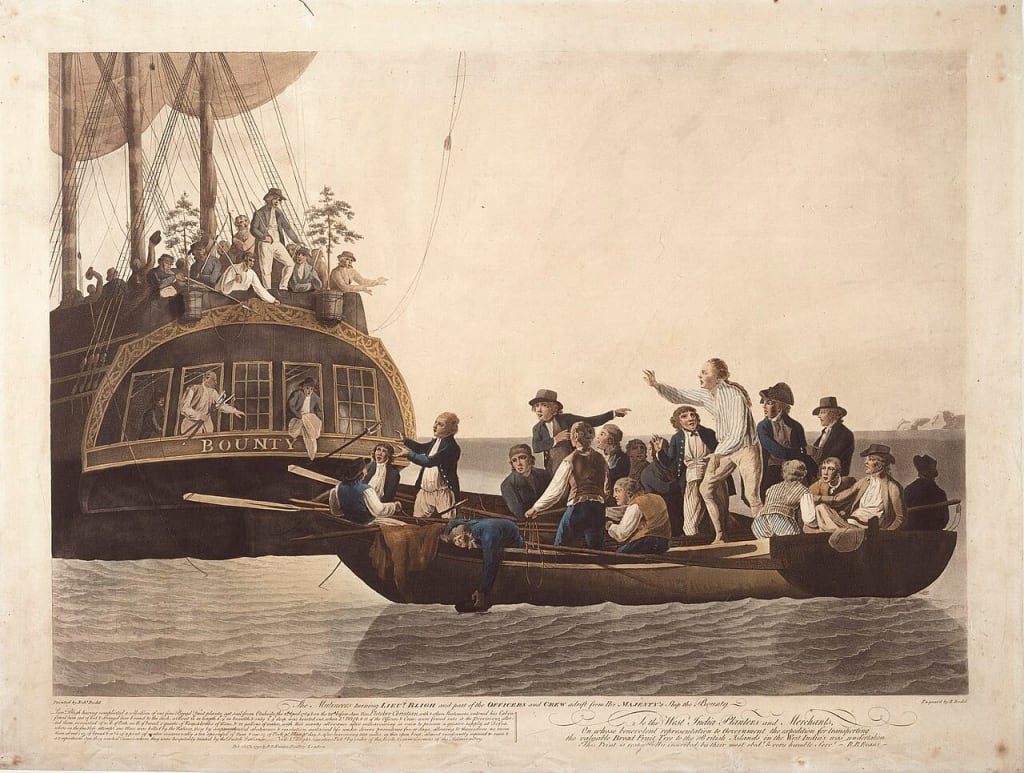
At dawn on April 28, 1789, Fletcher Christian and a small group of armed sailors entered the cabin of Lieutenant William Bligh aboard the Bounty. Within hours, one of the most famous acts of naval rebellion in history was complete.
Bligh and 18 men were forced into an overcrowded launch and abandoned in the Pacific. Christian took control of the ship, knowing that mutiny against the Royal Navy could lead to death if he were captured.
The basic facts are dramatic enough. The deeper question is harder: why would trained sailors violate one of the strongest rules in military life—obedience to lawful command—and risk everything by turning against their own commander?
There was no single cause. The Mutiny on the Bounty emerged from a volatile combination of damaged authority, humiliation, group loyalty, weakened discipline, social comparison, isolation, personal conflict, and an abrupt transition from the relative freedom of Tahiti back to the rigid hierarchy of an 18th-century naval vessel.
Modern psychology cannot diagnose men who died more than two centuries ago. It can, however, give us useful frameworks for understanding how loyalty collapses, how groups redefine who deserves obedience, and how an act once unthinkable can suddenly become possible.
What Was the Mutiny on the Bounty?
The Bounty was a British naval vessel commanded by William Bligh, then a lieutenant in the Royal Navy.
Its mission was not combat. The ship was sent to Tahiti to collect breadfruit plants and transport them to the British West Indies, where colonial planners hoped breadfruit could become an inexpensive food source for enslaved plantation laborers.
Bligh's own published account states that the Bounty carried 46 people and departed England in December 1787. It reached Tahiti on October 26, 1788.
The crew then remained in Tahiti for approximately five months while the breadfruit plants matured enough for transportation.
That unusually long stay would become central to almost every later explanation of the mutiny.
The Bounty departed Tahiti on April 4, 1789.
Only 24 days later, Christian seized the ship.
The Mutiny Happened Fast
Mutinies can sound like events built through months of organized conspiracy.
The Bounty uprising appears to have been far more immediate.
According to Bligh's narrative, Christian was responsible for the morning watch. Shortly before sunrise on April 28, Christian and several armed men entered Bligh's cabin while he was asleep, tied his hands, threatened him, and brought him onto the deck.
Officers considered loyal to Bligh were confined or controlled.
The ship's launch was lowered.
Bligh and 18 others were eventually forced into it.
Royal Museums Greenwich summarizes the division aboard the ship as more complicated than a simple 50-50 split: 18 men actively joined the mutiny, two were described as passive, and several men loyal to Bligh could not accompany him because there was insufficient room in the boat.
That detail matters psychologically.
A mutiny rarely produces perfectly clean categories of "loyal" and "disloyal."
Some people lead.
Some join enthusiastically.
Some comply because armed men are already in control.
Some hesitate.
Some sympathize without acting.
Others remain physically trapped on the wrong side of the conflict.
Military betrayal can therefore be both a personal decision and a rapidly spreading group event.
William Bligh Was Not Quite the Monster Popular Culture Created
The familiar movie version of Mutiny on the Bounty often presents Bligh as a sadistic tyrant whose cruelty made rebellion almost inevitable.
The historical evidence is much more complicated.
Bligh clearly had serious interpersonal weaknesses.
Royal Museums Greenwich describes him as having a volatile temper and notes repeated clashes with officers and crewmen.
Other historical assessments emphasize his capacity for insulting, humiliating, and verbally attacking subordinates.
But physical brutality does not appear to have been exceptional by the harsh standards of the 18th-century Royal Navy.
Some historical research has even argued that Bligh relied on flogging less heavily than many contemporary naval commanders. The image of a captain constantly having men whipped for minor mistakes is therefore misleading.
This distinction is crucial.
Bligh's leadership problem may have been less about extreme corporal punishment and more about something psychologically corrosive: humiliation.
Humiliation Can Damage Authority More Deeply Than Punishment
Military hierarchy depends on authority.
But authority is not sustained by rank alone.
People also judge whether leaders are competent, fair, predictable, and worthy of respect.
A commander may possess formal power while gradually losing psychological legitimacy.
Bligh appears to have repeatedly criticized his officers in highly personal terms. Fletcher Christian, who had previously sailed with Bligh and initially enjoyed his confidence, increasingly became one of the targets.
In modern organizational psychology, public humiliation is especially dangerous because it does more than communicate that a subordinate made a mistake.
It attacks social status.
For an officer or senior subordinate, being verbally degraded in front of lower-ranking personnel can threaten identity, reputation, and authority simultaneously.
The psychological message becomes:
"You are not merely wrong. You are contemptible."
That can produce anger far beyond what an ordinary disciplinary correction would create.
Why Status Mattered So Much Aboard an 18th-Century Ship
A naval vessel was not simply a workplace.
It was a closed hierarchy.
Rank determined:
- who gave orders;
- who obeyed;
- who ate with whom;
- sleeping arrangements;
- access to resources;
- social standing;
- professional future;
- and personal honor.
Christian was not simply another sailor.
He was master's mate and effectively one of Bligh's most important subordinates.
Bligh had trusted him sufficiently to place him in significant responsibility.
That history makes their breakdown especially important.
When conflict occurs between strangers, hostility may remain impersonal.
When conflict occurs between people who previously trusted each other, the emotion can become betrayal.
Bligh could believe Christian had betrayed years of friendship and professional support.
Christian could believe Bligh had transformed from mentor into humiliator.
Both men could therefore experience themselves as the betrayed party.
That is one reason the Bounty story remains so psychologically compelling.
Fletcher Christian and the Psychology of a Broken Leader-Follower Relationship
Modern leadership research suggests that people are more likely to trust leaders whom they perceive as representing the values and identity of the group.
Social identity research describes effective leadership partly as the ability to create and maintain a sense of "us." Leaders gain influence when followers see them as standing for the group rather than merely exercising power over it.
Apply that idea carefully to the Bounty.
At the beginning of the voyage, Bligh was the unquestioned formal representative of the ship.
But if sailors increasingly interpreted him as insulting officers, criticizing the crew, and making their return to naval discipline personally miserable, another identity could emerge.
Instead of:
"We are the Bounty, commanded by Bligh."
the psychological division can become:
"We are the crew, and Bligh is the problem."
Once that shift occurs, obedience becomes fragile.
Mutiny Begins When the Definition of Loyalty Changes
From the Navy's perspective, loyalty was simple.
A sailor owed obedience to the lawful chain of command.
Christian therefore betrayed Bligh, the ship, the Crown, and the Royal Navy.
But people inside rebellious groups often reconstruct loyalty differently.
They may begin to believe that obedience to the leader would actually betray the group.
This psychological reversal appears in many revolts.
The rebellious group develops a new moral narrative:
- the leader has failed us;
- the leader no longer deserves authority;
- we must protect each other;
- ordinary procedures cannot solve the problem;
- resistance has become justified.
The act remains mutiny legally.
Psychologically, however, participants may reinterpret it as self-defense, liberation, justice, or loyalty to comrades.
This does not prove that their interpretation is correct.
It explains how people cross a moral line they previously considered unacceptable.
Tahiti Changed the Crew's Psychological Reference Point
One of the most important factors in the Bounty story was the five-month stay in Tahiti.
Life there differed radically from shipboard existence.
Crew members spent considerable time ashore, formed relationships with Tahitians, acquired tattoos, and experienced a social environment far removed from the rigid routines of the Royal Navy.
Many developed intimate relationships.
Food was available.
The climate was warm.
Movement was less restricted.
The men had enjoyed months in an environment that, from their perspective, offered far more personal freedom.
Then they had to leave.
The psychological significance of that transition is easy to underestimate.
Relative Deprivation: Why Conditions Can Feel Worse After Freedom
Humans do not evaluate circumstances in isolation.
We compare them with alternatives.
A sailor who spends a year under strict naval discipline may gradually adapt to that environment.
But give him five months of comparative freedom and then return him to cramped quarters, watches, commands, inspections, and punishment.
The same shipboard conditions may now feel dramatically worse.
This is related to the concept of relative deprivation.
People become dissatisfied not simply because conditions are objectively difficult, but because they compare those conditions with something perceived as better.
Tahiti gave the crew an alternative life to compare against naval service.
That changed the emotional meaning of returning to the Bounty.
Before Tahiti, the ship was normal.
After Tahiti, the ship could feel like confinement.
The Contrast Between Tahiti and the Bounty Was Extreme
Consider the transition psychologically.
In Tahiti, a sailor might experience:
- social relationships ashore;
- sexual and romantic attachments;
- access to fresh food;
- relative autonomy;
- tropical surroundings;
- physical space.
Back aboard ship, he faced:
- cramped conditions;
- constant hierarchy;
- watches;
- inspections;
- restricted movement;
- dangerous labor;
- months or years before returning home.
Royal Museums Greenwich explicitly identifies the crew's difficulty readjusting to shipboard discipline after their prolonged stay in Tahiti as part of the mutiny's context.
This does not mean "Tahiti caused the mutiny."
It means the crew's psychological baseline had changed.
The Bounty Was Also Structurally Vulnerable to Rebellion
The ship itself presented an unusual command problem.
Bligh was the only commissioned naval officer aboard.
There were no marines to provide an independent armed force supporting the captain's authority.
This mattered enormously.
On a larger warship, mutineers might face:
- several commissioned officers;
- marines;
- stronger internal security;
- more divided work groups;
- more obstacles to gaining control of weapons;
- and a larger number of loyal personnel.
The Bounty was small.
Once a few armed men controlled key spaces, the entire balance of power could change within minutes.
Psychologically, opportunity matters.
People may harbor resentment for months without rebelling if rebellion looks impossible.
When opportunity suddenly appears, private anger can become collective action.
Why People Join a Mutiny Once It Starts
The first person to rebel faces enormous risk.
The tenth person often faces a different calculation.
Imagine being a sailor who wakes to discover that Christian and several armed men already control the deck.
You now have several options:
- Fight the mutineers.
- Support Bligh verbally.
- Join Christian.
- Remain passive.
- Wait to see who wins.
Those choices are made under pressure.
Information is incomplete.
Weapons are visible.
The legal consequences of choosing incorrectly may be fatal.
This creates what social scientists sometimes describe as a coordination problem.
Many people may dislike the commander privately.
But none wants to become the first rebel.
Once several men act simultaneously, however, everyone learns something important:
"I am not alone."
That information can rapidly lower the psychological barrier to joining.
Social Proof Can Accelerate Rebellion
Humans use other people's behavior to interpret uncertain situations.
If one sailor complains about Bligh, another might dismiss him as resentful.
If ten sailors openly support Christian while armed, dissatisfaction suddenly looks collective.
Each new participant changes the perceived odds.
The question shifts from:
"Should I betray my captain?"
to:
"Which side now controls the ship?"
This is one reason revolts can develop with extraordinary speed.
Private resentment accumulates slowly.
Collective action can erupt suddenly.
Group Cohesion Can Support Discipline—or Rebellion
Military organizations depend heavily on cohesion.
Research has repeatedly linked unit cohesion with performance, readiness, satisfaction, and lower levels of indiscipline.
But cohesion itself is morally neutral.
A cohesive group can become highly effective at obeying legitimate authority.
It can also become highly effective at resisting authority.
If sailors identify more strongly with one another than with their commander, group cohesion can reinforce mutiny rather than prevent it.
The key question becomes:
Where does the strongest loyalty reside?
With the institution?
With the commander?
With a subgroup?
With close companions?
With a charismatic alternative leader?
On the Bounty, those loyalties fractured.
Fletcher Christian Became an Alternative Center of Authority
Christian did not need to become an officially legitimate captain before the mutiny.
He needed enough men to accept his leadership at the decisive moment.
Because he was already a senior shipboard figure, Christian possessed several advantages.
He knew the vessel.
He understood routines.
He had relationships throughout the crew.
He had access to spaces and responsibilities unavailable to ordinary sailors.
He also had grievances that some crew members could recognize.
Once Christian moved against Bligh, his rank beneath Bligh helped make him a plausible alternative leader.
Mutinies frequently require such a figure.
Discontent alone is rarely enough.
Someone must transform frustration into coordinated action.
The Coconut Incident and the Power of a Triggering Event
Shortly before the mutiny, a dispute arose over missing coconuts.
Bligh reportedly suspected that Christian had taken some and verbally attacked him.
Historians have often treated this confrontation as one of the final triggers rather than the entire cause of the rebellion.
That distinction is important.
Major acts are often triggered by minor incidents.
The incident does not have to be objectively enormous.
It only needs to activate tensions already near breaking point.
A missing coconut seems trivial compared with seizing a Royal Navy vessel.
Psychologically, however, the argument may have represented something much larger:
- another humiliation;
- another accusation;
- another attack on Christian's honor;
- confirmation that the relationship with Bligh was beyond repair.
The coconut was not necessarily the cause.
It may have been the spark.
Why Humiliation Can Produce Extreme Reactions
Anger is often associated with physical harm.
Humiliation is different.
Humiliation involves perceived loss of status before others.
A person feels reduced, dishonored, or treated as inferior.
In highly status-conscious cultures, that can be psychologically explosive.
Christian's professional identity mattered.
His authority over sailors mattered.
His reputation mattered.
If he believed Bligh repeatedly destroyed that reputation in front of the crew, every insult could weaken both his self-respect and his ability to function as a leader.
This creates a dangerous paradox.
A captain may insult a subordinate to reinforce hierarchy.
But repeated humiliation can eventually make the subordinate feel he has nothing left to lose by destroying the hierarchy itself.
Was Fletcher Christian Having a Psychological Breakdown?
Bligh's account portrays Christian as emotionally distressed during the mutiny.
The historical record has encouraged generations of writers to speculate about Christian's state of mind.
But modern readers should be cautious.
It is not scientifically responsible to diagnose a historical person with depression, trauma, personality disorder, or another psychiatric condition based on dramatic descriptions recorded more than 200 years ago.
What can reasonably be said is that Christian appears to have been under severe emotional strain.
Bligh himself described Christian as visibly disturbed during their final confrontation.
That supports an interpretation of acute distress.
It does not establish a medical diagnosis.
The Psychology of "No Way Back"
Mutiny creates an unusually powerful psychological commitment.
Once Christian seized Bligh, the situation changed permanently.
He could not simply apologize later.
The Royal Navy treated mutiny as one of the gravest military crimes.
Returning voluntarily could mean trial and execution.
This creates what behavioral scientists might describe as escalating commitment.
After crossing a line with severe consequences, reversing course becomes psychologically and practically difficult.
Each additional act makes return harder.
First:
Seize the captain.
Then:
Control the weapons.
Then:
Force loyalists into the launch.
Then:
Sail away.
Then:
Avoid British authorities.
Then:
Find somewhere beyond the Navy's reach.
The rebellion generates its own momentum.
Mutiny Turns Fear of Punishment Into Continued Rebellion
Before the mutiny, fear of punishment discouraged rebellion.
After the mutiny, fear of punishment encouraged continued flight.
That reversal is one of the most important psychological transformations in any serious act of insubordination.
The same institution that once motivated obedience now motivates escape.
Christian and his closest followers could reasonably expect that capture would place their lives at risk.
The result was not simply a change of command aboard the Bounty.
It was the beginning of permanent exile.
Bligh's Leadership After the Mutiny Complicates the Tyrant Narrative
One of the great ironies of the Bounty story is what happened next.
Bligh's performance after being expelled from his own ship demonstrated extraordinary technical leadership.
He and 18 companions were crowded into a small launch with limited provisions.
After an unsuccessful attempt to obtain supplies at Tofua, they began an astonishing open-boat journey toward Timor.
Royal Museums Greenwich records a journey of 3,618 nautical miles over 47 days.
Bligh's navigation, rationing, discipline, and ability to keep the group functioning remain remarkable achievements.
The U.S. Naval History and Heritage Command likewise describes Bligh as a highly skilled navigator whose survival voyage became a major feat of seamanship.
That raises an interesting leadership question.
How could the same man lose control of one group and successfully lead another through near-impossible conditions?
Competence and Leadership Are Not the Same Skill
Bligh appears to have possessed exceptional technical competence.
Navigation required:
- mathematical skill;
- astronomical knowledge;
- observation;
- discipline;
- record keeping;
- risk calculation.
But technical competence does not automatically produce interpersonal effectiveness.
A person can be brilliant at solving operational problems while damaging relationships.
The distinction remains relevant in modern organizations.
A technically excellent commander may still struggle with:
- emotional regulation;
- communication;
- conflict resolution;
- delegation;
- respect;
- psychological safety;
- managing status.
Bligh's survival voyage suggests that calling him simply incompetent is unsustainable.
The more interesting possibility is that he was operationally exceptional but interpersonally volatile.
Crisis Leadership Can Strengthen Authority
There is another important difference.
Before the mutiny, sailors could blame Bligh for discomfort.
After the mutiny, the loyalists in the launch faced the Pacific Ocean.
Their greatest threat was no longer the commander.
It was starvation, exposure, storms, navigation failure, and death.
Under those conditions, Bligh's expertise became obviously valuable.
His authority and the group's survival interests aligned.
Every correct navigational judgment reinforced his legitimacy.
This is a powerful psychological lesson.
Leadership effectiveness is partly situational.
The traits that damage relationships during routine life can coexist with traits that become invaluable during extreme crisis.
Why the Loyalists Did Not Mutiny Against Bligh in the Launch
If Bligh were merely an unbearable tyrant, one might ask why the overcrowded survivors did not rebel against him during their desperate voyage.
The answer is probably not a single factor.
Several conditions had changed:
- the remaining men had already chosen or demonstrated loyalty;
- Bligh's navigation was essential;
- everyone faced a common external threat;
- internal conflict could kill them;
- the group's goal was clear;
- resources were extremely limited;
- survival required disciplined cooperation.
Shared danger can increase cohesion dramatically.
The launch had what the Bounty increasingly lacked: a single obvious objective.
Survive.
Betrayal Works in Both Directions
The word "betrayal" is central to the Bounty story because almost every faction could use it.
Bligh viewed Christian's rebellion as betrayal.
Christian may have viewed Bligh's treatment of him as a betrayal of trust and friendship.
Loyal sailors could view mutineers as traitors.
Mutineers could view loyalists as defenders of an intolerable commander.
Men who remained aboard despite wanting to leave could later fear being branded as mutineers.
This is psychologically important.
Betrayal is not merely an action.
It is also an interpretation of a violated relationship.
Modern research on military personnel shows that perceived betrayal by leaders or institutions can have profound psychological consequences because military organizations demand unusually high levels of trust, sacrifice, and dependency.
The modern concept should not be retroactively imposed as a diagnosis of Bounty crew members.
But it helps explain why conflicts with trusted leaders can become so emotionally intense.
Institutional Betrayal and Military Identity
Military service requires individuals to accept vulnerabilities that civilians often do not.
Service members surrender substantial control over:
- location;
- working conditions;
- daily schedules;
- physical safety;
- discipline;
- and personal autonomy.
In exchange, they expect the institution and chain of command to operate according to rules.
Modern research defines institutional betrayal broadly as wrongdoing or failure by an institution toward people who depend on it. Military personnel may be particularly sensitive to such experiences because military identity emphasizes loyalty, sacrifice, trust, and hierarchy.
Again, this does not prove that Bligh institutionally betrayed Christian.
It provides a useful model for understanding why perceived unfairness from military authority can strike at identity itself.
Moral Injury Is Related—but Should Be Used Carefully
Modern military psychology also discusses moral injury.
The concept refers to psychological distress associated with experiences that violate deeply held moral expectations, including one's own actions, failure to act, witnessing wrongdoing, or perceived betrayal by trusted leaders.
Some modern studies specifically identify leadership betrayal as a potentially morally injurious experience.
However, it would be inappropriate to declare that Fletcher Christian "had moral injury."
There is no clinical assessment.
There is no modern psychological record.
The concept is better used as an analytical comparison.
Military betrayal is emotionally powerful precisely because obedience rests partly on moral expectations of reciprocal duty.
The subordinate owes loyalty upward.
The leader owes responsibility downward.
When either side believes that exchange has collapsed, the psychological foundation of authority weakens.
Mutiny Is Rare Because Military Systems Build Multiple Barriers Against It
If resentment alone caused mutiny, military organizations would experience constant rebellion.
They do not.
Successful discipline creates several overlapping barriers:
- lawful authority;
- institutional identity;
- punishment;
- shared mission;
- professional norms;
- peer pressure;
- rituals;
- promotion incentives;
- fear of dishonor;
- group cohesion.
Mutiny becomes more likely only when several of those barriers weaken simultaneously.
The Bounty presents a remarkable convergence.
There was a small crew.
No marines were aboard.
Bligh was the only commissioned officer.
The crew had spent months away from normal shipboard discipline.
Some had formed strong attachments in Tahiti.
Conflict between Bligh and Christian intensified.
The crew's social identity fragmented.
Weapons became accessible to the rebels.
And Christian reached a psychological breaking point.
No single factor explains the outcome.
Together, they created a system vulnerable to sudden collapse.
Why Mutiny Can Spread Like a Cascade
Imagine ten sailors who privately dislike their commander.
Each believes he is alone.
None rebels.
Now one sailor openly challenges the commander.
A second supports him.
A third realizes that rebellion may actually succeed.
The fourth joins because neutrality is becoming dangerous.
The fifth joins because his closest friend has joined.
Soon the decision is no longer individual.
It becomes a cascade.
Social scientists observe similar dynamics in protests, coups, workplace revolts, political uprisings, and military insurrections.
People often conceal preferences until they discover that others share them.
The first visible acts reveal information.
That information changes behavior.
The Bounty mutiny's extraordinary speed is therefore not necessarily evidence that every participant had planned rebellion for months.
It may demonstrate how quickly hidden grievances can become collective once someone breaks the obedience barrier.
Why Some Men Stayed Loyal
Psychology also helps explain the opposite decision.
Why risk dying in an open boat rather than remain aboard a captured ship?
Loyal sailors may have been influenced by:
- professional identity;
- personal respect for Bligh;
- fear of execution for mutiny;
- belief in naval law;
- uncertainty about Christian;
- expectation that the rebellion would eventually fail;
- moral opposition to seizing a King's vessel.
Military loyalty is often deeply internalized.
For someone who sees himself primarily as a Royal Navy sailor, mutiny may not merely be illegal.
It may be incompatible with identity.
This is why group identity can point in opposite directions.
Some sailors may think:
"I am loyal to my shipmates."
Others:
"I am loyal to the Navy."
Both are forms of group loyalty.
The conflict is over which group has priority.
The Men Left Behind Faced a Terrible Legal Problem
One of the most revealing aspects of the Bounty aftermath involved men who remained aboard but claimed they had not voluntarily joined the mutiny.
Bligh himself recorded that several men wanted to accompany him but were prevented from entering the already overcrowded launch.
For those men, remaining on the ship was dangerous legally.
How could they later prove they had not participated willingly?
British authorities eventually captured surviving crew members in Tahiti.
Ten men reached England for court-martial after four captives died when HMS Pandora was wrecked. Four of the ten were acquitted; six were convicted and sentenced to death, although three of the six ultimately received pardons.
The remaining three—Thomas Burkett, John Millward, and Thomas Ellison—were executed in 1792.
The trials illustrate a fundamental difficulty in group rebellion:
Physical presence does not necessarily reveal psychological allegiance.
The Mutineers Could Not Simply Return to Tahiti Forever
After seizing the Bounty, Christian's group eventually returned toward Tahiti.
But Tahiti was not safe.
British ships could arrive.
Local leaders had established relationships with European visitors.
The Royal Navy could send a vessel specifically to capture them.
Christian and eight other mutineers eventually left Tahiti again with Polynesian men and women and searched for somewhere remote enough to disappear.
They settled on Pitcairn Island.
The Bounty was burned.
The ship that had given the mutineers freedom was destroyed partly to prevent discovery and escape.
Psychologically, this was the final closing of the door.
Pitcairn Shows Why Removing Authority Does Not Remove Conflict
Popular retellings sometimes imply that Christian's followers rejected tyranny and escaped into a South Pacific paradise.
What followed on Pitcairn was much darker.
Nine British mutineers arrived with six Polynesian men and twelve Polynesian women according to historical accounts.
Relationships quickly became unequal and violent.
Land ownership, relationships with women, status, forced labor, alcohol, resentment, and racial hierarchy contributed to escalating conflict.
Christian was eventually killed.
Most of the original adult men died violently or through other causes.
The destruction of Bligh's authority had not produced a harmonious society.
It merely replaced one contested hierarchy with another.
The Pitcairn Aftermath Changes the Moral Story
If the mutiny were simply a struggle between an evil captain and freedom-loving sailors, Pitcairn should have become evidence that the rebels' social model worked.
Instead, it became evidence of how difficult authority, power, resources, and inequality remain even after formal hierarchy disappears.
The mutineers had complained about domination.
Some later dominated others.
They had rejected an authoritarian structure.
They created new status inequalities.
They had escaped naval discipline.
Violence still emerged.
This does not absolve Bligh of leadership failures.
It shows that rebellion and moral virtue are not the same thing.
Hollywood Turned a Complex Mutiny Into a Simple Morality Play
The Bounty story became ideal material for novels and films because it contains a powerful dramatic structure:
tyrannical captain versus noble rebel.
That structure is emotionally satisfying.
History is less tidy.
Bligh could be verbally abusive and still be an exceptional navigator.
Christian could have legitimate grievances and still lead an illegal seizure of a naval vessel.
Some mutineers could act voluntarily while others were coerced or trapped.
Tahiti could represent freedom to British sailors while simultaneously existing within a wider colonial encounter that brought exploitation and disease to Polynesian communities.
The breadfruit mission itself was tied to the economics of Caribbean slavery.
The real story therefore resists heroes and villains.
The Psychology of Military Betrayal Is Usually Reciprocal
One of the most enduring lessons from the Bounty is that military betrayal often develops through reciprocal perception.
The commander thinks:
"My men no longer respect their duty."
The men think:
"Our commander no longer respects us."
The commander responds with tighter discipline.
The men interpret tighter discipline as further evidence of abuse.
The commander sees resentment and becomes more suspicious.
The group becomes more alienated.
Each side interprets the other's behavior as proof of its existing belief.
This creates a feedback loop.
In organizational psychology, deteriorating trust can become self-reinforcing.
Once every action is interpreted through suspicion, repairing the relationship becomes extremely difficult.
Bligh and Christian May Have Become Trapped in an Escalation Cycle
Their relationship appears to have moved from familiarity to conflict, then hostility.
Bligh criticized Christian.
Christian became distressed or resentful.
Bligh may have interpreted that response as further weakness or insubordination.
Christian may have interpreted additional criticism as deliberate persecution.
By the final days, ordinary disagreements carried the weight of accumulated resentment.
This is why conflict management matters before a crisis.
By the time a relationship reaches open contempt, the immediate argument is rarely the real problem.
The fight is about everything that came before it.
What Modern Military Leaders Can Learn From the Bounty
The Bounty is not a modern military leadership case study in the formal sense.
Its social world, legal system, naval culture, technology, and disciplinary practices were radically different.
Yet several principles remain recognizable.
Respect reinforces authority
Subordinates can tolerate demanding leaders when they perceive rules as fair and treatment as respectful.
Humiliation may produce compliance in the short term while destroying trust over time.
Competence does not excuse poor communication
Bligh's navigation demonstrated extraordinary ability.
Technical excellence did not prevent catastrophic interpersonal failure.
Leaders need accurate information about group morale
A commander who cannot distinguish obedience from genuine commitment may overestimate loyalty.
Silence is not always agreement.
Cohesion must connect the unit to the mission
Strong peer loyalty can strengthen a military organization.
If peer identity becomes opposed to command identity, the same cohesion can support resistance.
Discipline works best when viewed as legitimate
Fear can force obedience.
Legitimacy makes obedience more durable.
Small grievances can trigger large crises
The final dispute may seem trivial because it represents months of accumulated tension.
Leaders should pay attention to patterns, not just incidents.
The Bounty Also Warns Against Simplifying Rebellion
There is another lesson.
Understanding why people rebel is not the same as justifying what they do afterward.
Christian may have felt deeply humiliated.
The crew may have found the return from Tahiti unbearable.
Bligh may have damaged his own authority.
None of those facts automatically makes every act committed by the mutineers morally defensible.
Psychological explanation and moral judgment are different tasks.
We can understand how betrayal becomes possible without romanticizing betrayal.
Was Bligh Responsible for the Mutiny?
He was certainly part of the causal environment.
His temper and treatment of subordinates appear to have contributed to deteriorating relationships.
But saying that Bligh contributed to the conditions is different from saying he "caused" every participant to mutiny.
The crew retained agency.
Christian made decisions.
Other sailors made decisions.
Structural conditions mattered.
Tahiti mattered.
Naval organization mattered.
Personal relationships mattered.
Opportunity mattered.
A useful way to understand complex historical events is to avoid searching for one cause when several interacting causes are required.
The Bounty mutiny was a system failure expressed through individual choices.
Was Fletcher Christian a Hero or a Traitor?
Legally, he was a mutineer.
From the perspective of the Royal Navy, he committed one of the gravest possible breaches of duty.
Romantic literature later transformed him into a freedom-seeking rebel resisting tyranny.
Neither label captures the entire psychological story.
Christian appears to have been a competent seaman under extreme emotional strain who reached a point where he chose rebellion over continued submission to Bligh.
That decision required courage in one sense and violated military duty in another.
It liberated some men from Bligh's command while placing others in mortal danger.
It also led Christian into permanent exile and ultimately into another violent social order.
Historical people rarely fit comfortably into moral categories designed for fiction.
Why the Mutiny on the Bounty Still Fascinates Us
The event happened more than two centuries ago, yet it remains culturally powerful because its central conflict is timeless.
When does authority stop feeling legitimate?
How much humiliation can loyalty survive?
Why does one person rebel while another obeys?
What happens when a group decides its leader no longer deserves command?
Can betrayal ever feel like loyalty?
Those questions extend far beyond wooden ships and the Royal Navy.
They appear in armies, governments, companies, political movements, families, and institutions.
The Bounty gives them unusually dramatic form because the entire social system was trapped aboard a small ship in the Pacific.
There was no human resources department.
No transfer request.
No easy resignation.
No outside mediator.
No telephone.
Authority, resentment, friendship, fear, honor, survival, and violence all existed inside the same wooden hull.
The Real Psychology Behind the Mutiny
The Mutiny on the Bounty was not simply a story of cruel leadership.
Nor was it simply a story of weak discipline.
Its psychology lies in the interaction between several forces:
- a commander whose technical ability exceeded his interpersonal skill;
- a senior subordinate who increasingly experienced command as intolerable;
- a crew exposed to months of relative freedom;
- weakening shipboard discipline;
- a small vessel with limited security;
- strong peer relationships;
- public humiliation and status conflict;
- a sudden opportunity for coordinated rebellion;
- and the knowledge that once mutiny began, there could be no easy return.
Taken individually, none of those factors guarantees mutiny.
Together, they created a situation in which obedience collapsed almost overnight.
The Final Irony of the Bounty
William Bligh lost his ship but survived one of history's most extraordinary open-boat voyages.
Fletcher Christian gained the ship but lost almost everything else.
Bligh returned to Britain, was acquitted over the loss of the Bounty, continued his naval career, and eventually became an admiral.
Christian became a fugitive beyond the effective reach of the British state and ultimately died on remote Pitcairn.
The mutiny that appeared to free him also made ordinary life impossible.
That may be the deepest psychological contradiction in the entire story.
Rebellion solved Christian's immediate problem—Bligh's authority.
It created a far larger one.
Once loyalty was broken, there was nowhere left to go home.
Frequently Asked Questions
What caused the Mutiny on the Bounty?
There was no single cause. Historians generally point to growing conflict between William Bligh and Fletcher Christian, weakening discipline, the crew's long stay in Tahiti, difficult readjustment to naval life, Bligh's humiliating leadership style, and the opportunity created by the Bounty's unusual command structure.
When did the Mutiny on the Bounty happen?
The mutiny occurred on April 28, 1789, shortly after the Bounty had departed the Tongan islands during its return journey from Tahiti.
Who led the Mutiny on the Bounty?
Fletcher Christian, the ship's master's mate and one of William Bligh's senior subordinates, led the mutiny.
Was William Bligh really a cruel captain?
Bligh had a volatile temper and was known for harsh verbal criticism, but the popular image of him as an exceptionally violent flogging captain is disputed. Historical evidence suggests his use of corporal punishment was not unusually severe by contemporary Royal Navy standards.
Why did Fletcher Christian hate Captain Bligh?
Their relationship deteriorated after initially being relatively close. Repeated criticism, disputes over performance, threats, and public humiliation appear to have contributed significantly to Christian's resentment. A confrontation over missing coconuts shortly before the mutiny is often viewed as a final trigger rather than the sole cause.
Did the crew mutiny because they wanted to return to Tahiti?
Tahiti was an important factor but not the entire explanation. Crew members had experienced months of relative freedom and formed relationships there, making the return to restrictive naval life psychologically difficult. However, leadership conflict and weakened discipline also played major roles.
How many men joined Fletcher Christian's mutiny?
Royal Museums Greenwich identifies 18 men as actively joining Christian's mutiny. Other crew members remained aboard under more ambiguous circumstances, including men whom Bligh said wanted to accompany him but could not fit into the launch.
How many men were put in the boat with William Bligh?
Bligh and 18 other men were forced into the Bounty's launch, meaning 19 people were crowded into the small open boat.
How far did Captain Bligh sail after the mutiny?
Bligh navigated the launch approximately 3,618 nautical miles to Timor after stopping briefly at Tofua. The major part of the journey lasted 47 days and remains one of history's most famous feats of open-boat navigation.
Did William Bligh survive the Mutiny on the Bounty?
Yes. Bligh survived the open-boat journey, returned to Britain, was acquitted over the loss of the ship, resumed his career, and eventually reached flag rank.
What happened to Fletcher Christian?
Christian and eight fellow mutineers eventually settled on Pitcairn Island with Polynesian men and women. Christian was later killed during violent conflict within the settlement.
What happened to the Bounty after the mutiny?
After unsuccessful attempts to establish themselves elsewhere, Christian and eight mutineers sailed to remote Pitcairn Island. The Bounty was burned to reduce the risk of discovery and prevent its use for escape.
Were any Bounty mutineers executed?
Yes. Ten captured crew members eventually faced court-martial in England. Four were acquitted, six received death sentences, three of those six were pardoned or otherwise spared, and Thomas Burkett, John Millward, and Thomas Ellison were executed in 1792.
Was the Bounty mutiny planned for months?
The evidence does not support a simple picture of a long, carefully organized conspiracy involving the whole group. The revolt appears to have crystallized rapidly around Christian and a relatively small group after tensions had been building for a considerable period.
Why are military mutinies psychologically different from ordinary workplace rebellion?
Military personnel operate under stronger legal, moral, and identity-based obligations of obedience. Their safety also depends heavily on group discipline and command. Breaking with authority therefore involves not only disagreement but potential loss of identity, comradeship, career, freedom, and sometimes life.
What role does group psychology play in mutiny?
Group psychology can transform isolated resentment into collective action. Once individuals discover that others share their grievances, the perceived risk of rebellion can fall, alternative leaders can gain influence, and loyalty may shift from formal authority toward the rebellious subgroup.
Can strong military cohesion actually contribute to mutiny?
Yes, under unusual circumstances. Cohesion normally supports readiness, performance, and discipline. But if a tightly bonded group begins identifying itself against its leadership, peer loyalty can reinforce resistance rather than obedience. Military cohesion research shows that cohesion is strongly related to group functioning, but the direction of group identity remains crucial.
Does the concept of moral injury explain Fletcher Christian's behavior?
It should not be used as a retrospective diagnosis. Modern moral injury research does show that perceived betrayal by leaders can be psychologically significant for military personnel, but there is insufficient evidence to diagnose Christian or any other Bounty sailor with a modern clinical condition.
What is the biggest leadership lesson from the Mutiny on the Bounty?
Formal authority is strongest when it is supported by legitimacy, respect, competence, and shared identity. A leader can possess rank and technical brilliance while still losing the psychological loyalty that makes people willingly follow.
Was the Mutiny on the Bounty really about freedom?
Only partly. Some mutineers clearly preferred life in the Pacific to returning to rigid naval service, but the aftermath shows that escaping one hierarchy did not eliminate power, inequality, conflict, or violence. The mutiny was as much about broken leadership and group loyalty as it was about freedom.
Why is the Mutiny on the Bounty still important today?
Because it demonstrates how authority can collapse when trust, identity, fairness, and leadership legitimacy break down together. The technology and culture of 1789 are distant, but the psychology of loyalty, humiliation, group conflict, and betrayal remains recognizably human.


