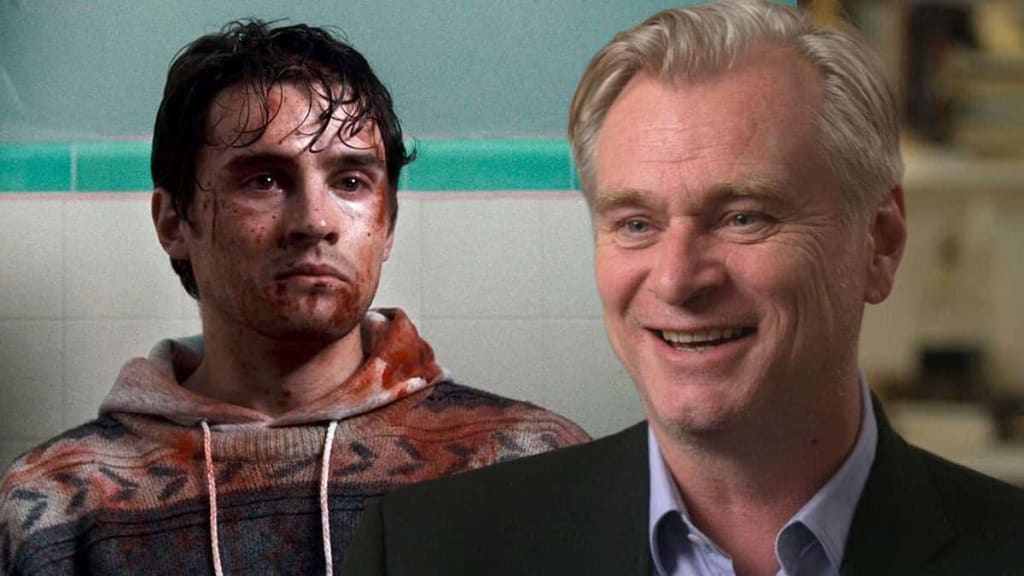
Christopher Nolan Praises Obsession and Says The Odyssey Has Fuelled His Horror Ambitions
Christopher Nolan has once again expressed his desire to direct a full horror movie—and this time, he has identified Curry Barker’s breakout hit Obsession as an example of exactly what the genre needs.
While discussing the creative experience of making The Odyssey, Nolan said the mythological epic had strengthened his appetite for horror. However, the filmmaker stressed that his decision would not depend on technology, visual effects, IMAX experimentation, or finding another enormous production challenge.
For Nolan, everything begins with a powerful concept.
He praised Obsession for possessing the kind of immediately compelling premise he believes a successful horror film requires, declaring that the movie “works like a motherfucker.” Nolan added that his interest is fundamentally about story rather than satisfying a technical ambition.
The enthusiastic endorsement is significant not only because it comes from one of the world’s most influential filmmakers, but also because Obsession was created by a young director who emerged through online comedy and independent filmmaking rather than the traditional studio system.
It also renews a fascinating question:
What would a Christopher Nolan horror movie actually look like?
What Christopher Nolan Said About Obsession
Nolan explained that horror must be approached carefully from a conceptual perspective. A filmmaker cannot depend entirely on disturbing imagery, loud sound effects, expensive production design, or technical spectacle.
The underlying idea must be exceptional.
He described Curry Barker’s Obsession as an example of a horror movie built around an “amazing idea” and praised the film’s effectiveness in unusually forceful language. Nolan said his motivation to direct horror would ultimately come from discovering the right story—not from finding a new camera system or filmmaking technique to explore.
That distinction is important because Nolan is so frequently associated with technical ambition.
His films have involved rotating corridors, large-format film cameras, practical aerial battles, reversed physical action, recreated nuclear explosions, enormous historical settings, and increasingly sophisticated IMAX production methods.
Yet Nolan’s comments suggest that he would not begin a horror project by asking how to make the genre larger.
He would begin by asking what idea could sustain the fear.
Nolan Has Not Officially Announced a Horror Movie
The comments should not be interpreted as confirmation that Nolan’s next film will be a horror project.
As of July 2026, no title, script, cast, production schedule, or studio arrangement for a Nolan-directed horror movie has been officially announced.
His statement is best understood as an expression of serious creative interest.
Nolan is actively looking for an idea capable of justifying a complete journey into the genre. He appears more interested than ever after making The Odyssey, but he has not claimed to have found the concept he would personally direct.
This is not merely promotional speculation created around the release of his latest film. Nolan has been discussing his interest in horror for several years.
At a British Film Institute event in February 2024, he said that he would love to make a horror film but believed the genre required an exceptional central idea. He also described horror as particularly cinematic because it creates a visceral response through image, sound, rhythm, atmosphere, and audience anticipation.
His latest comments therefore represent a continuation—and perhaps an intensification—of an existing ambition.
How The Odyssey Increased Nolan’s Interest in Horror
At first glance, Homer’s The Odyssey may seem far removed from modern horror.
It is an ancient epic about Odysseus attempting to return home after the Trojan War, encountering storms, monsters, supernatural forces, temptation, death, and psychological suffering along the way.
But its most famous episodes contain many of horror’s fundamental ingredients:
- Isolation in hostile environments
- Human beings trapped by monstrous forces
- Transformation and loss of identity
- Cannibalistic creatures
- Seduction masking mortal danger
- Unseen supernatural powers
- Deadly temptation
- Fear of never returning home
- The psychological consequences of war
Nolan’s adaptation gave him an opportunity to work with creatures and threatening mythological encounters more directly than in his previous films. The experience appears to have made him increasingly curious about sustaining that unease across an entire horror production.
The Odyssey was released on July 17, 2026, following a physically demanding international production mounted on an enormous scale. It was Nolan’s first feature filmed entirely with IMAX film cameras and became the largest global opening of his directing career.
Yet when discussing horror, Nolan did not focus on the size or technology of that production.
Instead, he returned to the importance of a simple, effective story.
That is where Obsession enters the conversation.
What Is Curry Barker’s Obsession About?
Written and directed by Curry Barker, Obsession follows a hopeless romantic who uses a mysterious object known as the One Wish Willow to make his crush fall in love with him.
His wish works—but not in the way he imagined.
The forced affection develops into something increasingly sinister, destructive, and terrifying. What begins as a fantasy of romantic fulfilment becomes a nightmare about desire, control, entitlement, and the consequences of treating another person’s emotions as something that can be possessed.
Focus Features released Obsession theatrically on May 15, 2026. The film stars Michael Johnston, Inde Navarrette, Cooper Tomlinson, Megan Lawless, and Andy Richter.
The central concept is immediately understandable:
What if you could force the person you love to love you back—and what if that wish became impossible to control?
That clarity is likely part of what appealed to Nolan.
The idea can be communicated in one sentence, but it creates room for psychological horror, body horror, dark comedy, romance, tragedy, and moral discomfort.
Why Nolan May Have Responded to the Concept
Nolan has consistently built films around strong conceptual engines.
Memento asks how a man who cannot form new memories can investigate his wife’s death.
The Prestige examines the destructive rivalry between two magicians.
Inception imagines professional thieves entering dreams to steal or implant ideas.
Interstellar connects a family separation with humanity’s search for another habitable world.
Tenet builds an espionage narrative around objects and people moving against the normal direction of time.
Oppenheimer frames the development of the atomic bomb through the fragmented experience and moral collapse of the man at its centre.
The scale changes, but each film begins with an idea capable of generating both plot and theme.
Obsession follows a similar principle.
Its supernatural device is not merely a tool for creating frightening scenes. The wish exposes something troubling about its protagonist’s understanding of love.
The horror develops from the concept’s moral implications.
Love produced without consent is not love.
Desire becomes possession.
Fantasy becomes coercion.
The supposed romantic victory contains its own punishment from the beginning.
Nolan’s praise suggests that he values how Barker’s concept generates the film’s emotions, character conflict, and escalating horror rather than simply decorating a conventional story with supernatural effects.
Obsession Became an Extraordinary Breakout Success
Nolan’s endorsement arrived after Obsession had already become one of 2026’s most remarkable theatrical success stories.
The movie was reportedly produced for approximately $750,000, a tiny budget compared with conventional studio releases. It was acquired by Focus Features and went on to surpass $400 million worldwide, demonstrating the extraordinary commercial potential of original, concept-driven horror.
Its success is especially notable because it was not based on a famous franchise, established comic book, bestselling novel, video game, remake, or legacy character.
The attraction was the film itself.
Audiences responded to its premise, performances, disturbing imagery, humour, emotional discomfort, and word-of-mouth reputation.
Rotten Tomatoes described it as a disturbing but crowd-pleasing horror film that successfully combines grotesque material with humour and thrills.
The film’s reception supports Nolan’s argument that horror succeeds when it begins with an idea audiences instantly want to experience.
Technical polish can strengthen a production, but it cannot replace conceptual clarity.
Who Is Curry Barker?
Curry Barker is an American filmmaker, actor, comedian, and online creator who developed an audience through the comedy channel That’s a Bad Idea, created with Cooper Tomlinson.
Before Obsession, Barker gained substantial attention with Milk & Serial, a found-footage horror feature released online. Its success helped demonstrate that filmmakers could use digital platforms not merely to produce promotional content but to create complete narrative work capable of attracting industry attention.
Barker’s rise represents a changing route into professional filmmaking.
Previous generations of directors often created short films, worked in television, attended film school, or progressed through studio departments. Online platforms now allow filmmakers to write, direct, edit, distribute, and test their work before a large audience without waiting for conventional permission.
Barker has compared that development to the early short-film careers of filmmakers such as Nolan, David Fincher, and Steven Spielberg—while recognizing that YouTube provides modern directors with a different platform for proving their abilities.
Receiving Nolan’s public praise represents an extraordinary moment in that journey.
A filmmaker Barker has cited as part of cinema’s established tradition is now praising Barker as evidence of what contemporary horror can achieve.
Nolan’s Films Have Always Contained Horror
Christopher Nolan has never directed a film marketed primarily as pure horror, but fear has always occupied an important place in his work.
Following
Nolan’s first feature explores surveillance, intrusion, manipulation, and the danger of becoming trapped inside another person’s plan.
Its limited budget and black-and-white photography create an unsettling atmosphere in which identity and motivation remain uncertain.
Memento
Memento is structured like a psychological nightmare.
Its protagonist repeatedly awakens inside situations he cannot remember entering. He depends on notes, photographs, tattoos, and people who may be manipulating him.
The audience shares his disorientation.
The frightening idea is not merely memory loss. It is the possibility that identity itself can be reconstructed through selective evidence and self-deception.
Insomnia
Nolan’s 2002 thriller transforms permanent daylight into a source of mental and physical torment.
The protagonist cannot sleep, cannot trust his increasingly impaired judgment, and cannot escape the moral consequences of his actions.
Batman Begins
The film treats fear as both weapon and theme.
Scarecrow uses hallucinogenic chemicals to transform private anxieties into overwhelming visual nightmares, while Bruce Wayne deliberately turns his childhood terror of bats into a symbol directed against criminals.
The Prestige
Although presented as a drama about magicians, The Prestige contains body horror, duplication, death, obsession, confinement, and the destruction of identity.
Its central question—how far an artist will go to complete the illusion—becomes increasingly disturbing as the truth emerges.
The Dark Knight
The Joker’s violence functions like social and psychological horror.
He creates scenarios designed to expose fear, selfishness, institutional weakness, and the possibility that civilized behaviour will collapse under sufficient pressure.
Inception
Dreams become unstable spaces where architecture changes, identities dissolve, and buried guilt attacks the people attempting to control the environment.
Mal’s appearances are frightening because she represents both an unpredictable threat and Cobb’s inability to escape his own subconscious.
Interstellar
The film uses cosmic isolation, environmental collapse, distorted time, and the terrifying scale of space.
The characters repeatedly confront places where ordinary human assumptions about time, distance, and survival no longer apply.
Dunkirk
Dunkirk often operates like a survival-horror film without a visible monster.
Soldiers are trapped between the sea and an approaching enemy. Threats arrive from beyond the frame, underwater, from the sky, and through the unstable structures meant to provide shelter.
Oppenheimer
Nolan himself acknowledged that Oppenheimer contains horror appropriate to its subject.
The Trinity test, Oppenheimer’s visions of burned bodies, the imagined destruction of the atmosphere, and his speech before a cheering crowd transform scientific achievement into psychological terror.
The most frightening element is knowledge: humanity has created something it may never be able to control.
The Odyssey
The latest film adds mythological monsters, supernatural uncertainty, hostile landscapes, death, and the fear of permanent separation from home.
It appears to have brought Nolan closer than ever to embracing the genre directly.
What Would Make Nolan’s Horror Film Different?
A Nolan horror movie would probably not be defined only by elaborate creatures or graphic violence.
His comments suggest several likely priorities.
A Concept That Can Be Explained Clearly
Nolan repeatedly returns to ideas that can be expressed in concise terms, even when their execution becomes complex.
A horror film would likely begin with one terrifying rule, condition, discovery, or impossibility.
The story could become structurally ambitious, but the initial fear would need to be immediate.
Subjective Experience
Nolan often places viewers inside a character’s limited understanding.
In Memento, the audience lacks memory.
In Inception, reality and dreams become difficult to separate.
In Dunkirk, time is experienced through intersecting perspectives.
In Oppenheimer, history is filtered through psychology and memory.
A horror film could use this subjectivity to make viewers question what they see, what they remember, and whether the protagonist can trust their own experience.
Time as a Source of Fear
Time is one of Nolan’s most persistent subjects.
A horror story could transform it into a threat:
- A repeated moment that changes each time
- A future event that cannot be prevented
- A character aging while others remain unchanged
- An entity existing outside chronological order
- Memories arriving before the events that create them
- A location where time behaves differently
- A person being erased from history
Nolan has explored some of these possibilities in science fiction, but horror could allow him to focus on their emotional terror rather than their intellectual mechanics.
Large-Format Immersion
Although Nolan insists that story would come first, his technical experience would inevitably shape the result.
IMAX photography could make horror environments physically overwhelming. Sound design could create fear through scale, silence, vibration, and spatial disorientation.
However, Nolan’s comments indicate that these tools would serve the concept rather than become the reason for making the film.
Practical Effects
Nolan’s preference for physical locations, constructed environments, in-camera effects, and real objects could give a horror project an unusually tangible quality.
The fear would occupy actual space around the actors.
Sets could move.
Structures could collapse.
Creatures or unexplained phenomena could interact physically with the environment.
The result might combine the scale of a Nolan blockbuster with the tactile discomfort of practical horror.
Moral and Psychological Conflict
Nolan’s films rarely present technology or extraordinary events as purely external problems.
They expose something inside the characters.
Leonard’s condition reveals his willingness to manipulate himself.
Cobb’s dream technology exposes his guilt.
The atomic bomb reveals Oppenheimer’s ambition, brilliance, and inability to control the consequences of his work.
A Nolan horror film would likely use its supernatural or speculative concept to explore guilt, obsession, memory, grief, identity, or responsibility.
That may be another reason Obsession impressed him.
Its horror mechanism reveals a moral failure already present within the person using it.
Why Horror Is Ideal for Concept-Driven Filmmakers
Horror can be made at almost any scale.
It can involve one actor in a room or thousands of performers across enormous locations.
What matters most is the audience’s emotional response.
The genre rewards filmmakers who understand:
- Anticipation
- Withholding information
- Suggestion
- Spatial awareness
- Sound
- Silence
- Timing
- Character vulnerability
- Escalation
- The consequences of rules
An expensive effect may create a striking image, but the image becomes frightening only when the audience understands its meaning.
A locked door is not inherently terrifying.
It becomes terrifying when viewers know what might be on the other side—or what is trapped inside the room with the character.
This dependence on cinematic construction is exactly what Nolan has previously identified as attractive about horror.
Nolan’s Praise Is a Major Moment for Original Horror
The success of Obsession already challenged assumptions about what audiences will support.
Nolan’s endorsement gives the film another form of cultural legitimacy.
It demonstrates that low-budget horror and large-format blockbuster filmmaking are not opposing artistic worlds.
Both can depend on the same foundation:
A strong idea, clearly expressed and rigorously executed.
Barker did not need a $200 million budget to create a premise that captured Nolan’s attention.
Nolan, despite his access to enormous resources, continues to evaluate films by how effectively their stories work.
That connection is encouraging for emerging filmmakers.
Technology has become more accessible, and distribution platforms have multiplied, but an unforgettable concept remains one of cinema’s most valuable resources.
What Nolan’s Comments Do Not Mean
Nolan’s praise should not be exaggerated into claims that he is directing an Obsession sequel, collaborating with Barker, or preparing to remake the film.
No such project has been announced.
There is also no confirmed evidence that Barker will be involved in Nolan’s next production.
The comments reflect admiration, not a formal partnership.
Similarly, Nolan has not said that technical filmmaking no longer matters to him. His career demonstrates the opposite.
He is saying that technical questions would follow the story.
He would not direct horror merely to discover how the genre might look on IMAX film. He would first need a story that made the journey necessary.
Will Christopher Nolan’s Next Movie Be Horror?
It is possible, but far from certain.
Nolan often keeps future projects private until the underlying idea and production arrangement are firmly established.
His interest in horror has remained consistent since at least 2024, and The Odyssey appears to have brought him closer to the genre.
But the central obstacle remains the same.
He needs an idea he considers exceptional.
For a filmmaker with almost unlimited access to actors, studios, technology, locations, and production resources, the limiting factor is not scale.
It is the story.
That may be the most revealing part of his praise for Obsession.
The film reminded him that an effective horror concept does not need to begin with technical ambition.
It needs to identify a fear, desire, or human weakness that cannot easily be escaped.
Why Fans Want Nolan to Direct Horror
A Nolan horror project has been discussed by fans for years because many of his existing strengths align naturally with the genre.
He understands how to control information.
He creates tension through editing.
He uses sound as a physical force.
He repeatedly explores guilt, identity, memory, grief, obsession, and the instability of perception.
He prefers immersive theatrical experiences.
He builds environments that feel governed by strict rules.
Most importantly, he takes genre storytelling seriously.
Nolan would be unlikely to approach horror as a temporary experiment or a lesser category of filmmaking.
His comments show respect for the genre’s conceptual demands and its ability to generate uniquely cinematic experiences.
Final Thoughts
Christopher Nolan’s praise for Curry Barker’s Obsession is more than a famous director offering a positive review.
It reveals something important about Nolan’s own creative priorities.
Despite being associated with IMAX cameras, enormous sets, practical spectacle, nonlinear structures, and some of the most ambitious productions in modern Hollywood, he still begins with story.
Obsession impressed him because its central idea works.
A man wishes for someone to love him.
He gets what he wants.
The desire becomes a nightmare.
That simple foundation contains emotional, psychological, supernatural, and moral horror.
Making The Odyssey appears to have intensified Nolan’s interest in exploring similar territory on his own. Yet he remains unwilling to commit until he discovers an idea powerful enough to justify the film.
No Christopher Nolan horror project has officially been announced.
But his appetite is clearly growing.
And after describing Obsession as a movie that “works like a motherfucker,” it may be only a matter of time before the right terrifying idea finds him.
Frequently Asked Questions
Did Christopher Nolan praise Obsession?
Yes. Nolan described Curry Barker’s Obsession as an example of a horror film built around an excellent idea and said it “works like a motherfucker.”
Does Christopher Nolan want to make a horror movie?
Yes. Nolan has repeatedly said he would like to direct a horror film, provided he finds an exceptional concept capable of sustaining the story.
Is Christopher Nolan’s next movie confirmed to be horror?
No. He has expressed strong interest, but no horror project has officially been announced.
How did The Odyssey influence Nolan’s interest in horror?
Nolan said making The Odyssey whetted his appetite for more horror. The epic contains monsters, supernatural threats, psychological suffering, isolation, and several sequences that overlap naturally with horror storytelling.
Who directed Obsession?
Obsession was written and directed by Curry Barker.
What is Obsession about?
The film follows a hopeless romantic who uses the supernatural One Wish Willow to make his crush love him, only to discover that the wish carries horrifying consequences.
Who stars in Obsession?
The cast includes Michael Johnston, Inde Navarrette, Cooper Tomlinson, Megan Lawless, and Andy Richter.
When was Obsession released?
Focus Features released the film theatrically on May 15, 2026.
Was Obsession a box-office success?
Yes. Made for a reported budget of approximately $750,000, it surpassed $400 million at the worldwide box office.
Has Nolan previously discussed directing horror?
Yes. During a 2024 BFI appearance, he said he would love to direct a horror film but needed a truly exceptional idea.
Is Oppenheimer partly a horror movie?
Although it is primarily a historical biographical drama, Nolan has acknowledged that it contains horror elements appropriate to the subject of nuclear weapons.
What might a Nolan horror movie explore?
No details are confirmed, but his existing films suggest possible interests in time, memory, guilt, identity, perception, isolation, technology, and the consequences of human ambition.
Would Nolan shoot a horror movie in IMAX?
That is unknown. Nolan is strongly associated with IMAX filmmaking, but he emphasized that a potential horror project would begin with story rather than technical experimentation.
Is Nolan collaborating with Curry Barker?
No collaboration has been announced. Nolan publicly praised Barker’s film, but there is no confirmed joint project.
Why is Nolan’s praise important?
It highlights Obsession as a major example of original, concept-driven horror and gives extraordinary recognition to Barker’s transition from online filmmaking to worldwide theatrical success.
What does Nolan believe makes a great horror film?
He believes horror requires an exceptional central idea and must work conceptually before technical filmmaking choices are considered.