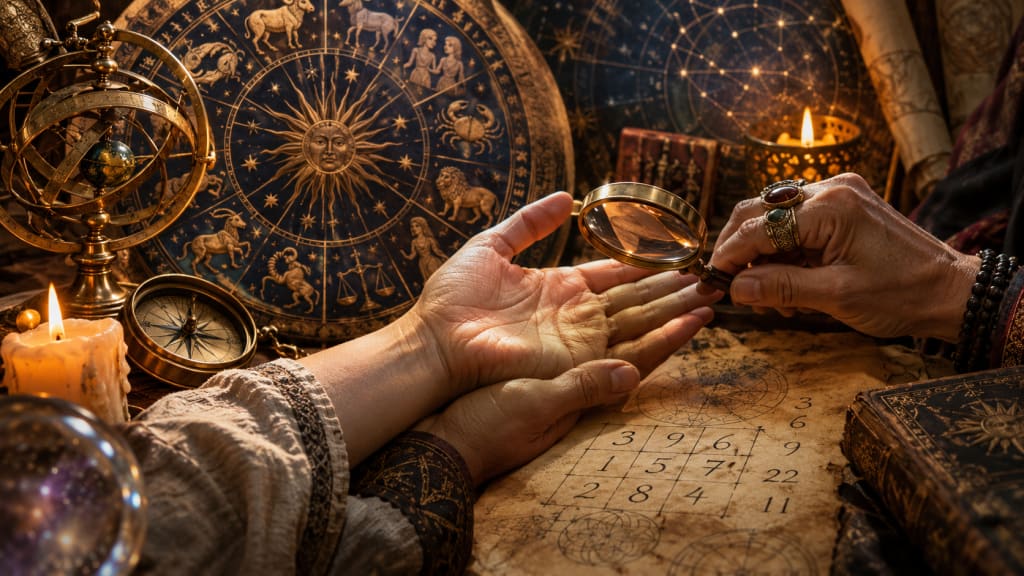
Palmistry, Astrology, Horoscopes and Numerology: Ancient Origins, Hidden Meanings, Mysteries and the Search for Destiny
For thousands of years, human beings have searched for signs that might reveal the mysteries of their existence. Some have looked toward the stars, believing that celestial movements hold clues about human destiny. Others have examined the lines of their palms, convinced that their hands contain a hidden map of personality, love, success, and longevity.
Still others have turned to numbers, interpreting birth dates and names as symbolic codes capable of revealing a person's purpose in life.
These traditions have survived empires, religious transformations, scientific revolutions, and extraordinary technological progress.
Today, palmistry, astrology, horoscopes, and numerology continue to fascinate millions of people around the world.
You may have encountered someone who believes that being born under Scorpio explains their mysterious personality. Perhaps you have watched a palm reader trace the lines of a hand while describing an unexpected future. Or maybe you have heard that certain numbers repeatedly appearing in your life carry special spiritual significance.
But an important question remains: Are these ancient systems revealing genuine patterns about human existence, or are we discovering meaning in symbols that have no proven predictive power?
The answer is more complicated—and considerably more interesting—than a simple argument between belief and skepticism.
To understand these practices, we must explore their origins, the civilizations that developed them, the differences between their methods, and the psychological and scientific questions surrounding their claims.
What Are Palmistry, Astrology, Horoscopes and Numerology?
Although these practices frequently appear together, they are not interchangeable.
Each uses a different symbolic system to interpret human personality, experience, or possible future events.
| Practice | Main Basis | Traditional Purpose |
|---|---|---|
| Palmistry | Lines, shapes, and features of the hands | Interpret character, relationships, and possible life developments |
| Astrology | Positions and movements of celestial bodies | Interpret personality, circumstances, and potential events |
| Horoscope | An astrological chart or its interpretation | Provide insights based on celestial positions at a particular time |
| Numerology | Numbers derived from names, dates, or other information | Interpret personality, life themes, and symbolic patterns |
The central difference is the information each system considers meaningful.
Palmistry looks at the human body.
Astrology looks at the sky.
Horoscopes apply astrological ideas to particular moments or individuals.
Numerology examines numbers and their assigned symbolic meanings.
None of these systems has been scientifically demonstrated to reliably predict an individual's future. Nevertheless, their cultural histories reveal a great deal about how people have tried to understand uncertainty and destiny.
The Ancient Origins of Astrology: When Humans Began Reading the Stars
Of these traditions, astrology has one of the most extensively documented ancient histories.
Its roots can be traced to Mesopotamia, particularly the civilizations of Babylonia, where sky observation became closely connected with religious beliefs, political decisions, and interpretations of divine signs.
Thousands of years before telescopes existed, Mesopotamian scholars carefully recorded the movements of the Sun, Moon, planets, and stars.
They observed eclipses, planetary appearances, seasonal cycles, and unusual celestial events.
Many believed these events could communicate messages about earthly affairs.
An eclipse might be interpreted as a warning concerning a ruler. A planetary movement could be associated with war, prosperity, or political instability.
This early form of celestial divination primarily concerned kingdoms and public events rather than the personality of ordinary individuals.
How Babylonian Astrology Evolved
Over centuries, Babylonian scholars developed sophisticated mathematical methods for describing and predicting celestial movements.
By approximately the fifth century BCE, the twelve-part zodiac was emerging as a standardized system for locating celestial bodies.
The zodiac divided the apparent path of the Sun across the sky into twelve equal sections.
These divisions later became associated with the familiar signs Aries, Taurus, Gemini, and the remaining zodiac symbols.
One of the oldest surviving Babylonian birth horoscopes dates to 410 BCE.
This represents an important shift from interpreting celestial events primarily for rulers or communities to recording the sky in connection with an individual's birth.
However, modern astrology did not emerge fully formed in a single civilization.
Greek, Egyptian and Indian Influences
Astrology developed further in the Hellenistic world, particularly through cultural exchanges involving Greek, Egyptian, and Babylonian traditions.
Greek-speaking scholars combined celestial calculations with philosophical ideas about the universe, fate, and the relationships between earthly and heavenly events.
Concepts such as astrological houses, planetary relationships, and detailed birth charts became increasingly elaborate.
Astrological knowledge also moved into India, where it interacted with existing traditions of celestial observation, calendars, and religious thought.
Indian astrology developed distinctive techniques and interpretations over time.
The history of astrology is therefore not the invention of one individual but a long process of cultural exchange and intellectual development.
What Is Astrology and How Does It Work?
Astrology is a system of interpretation built around the idea that celestial configurations have symbolic relationships with human experiences.
Practitioners examine the positions of the Sun, Moon, planets, and zodiac divisions.
Depending on the tradition, these positions are interpreted as indicators of personality, relationships, opportunities, challenges, or significant life periods.
Modern Western astrology commonly considers three major elements.
Sun Sign: The Familiar Zodiac Identity
A person's Sun sign refers to the zodiac division occupied by the Sun at the time of birth.
This is the sign most people mean when they say, "I'm a Leo," or "I'm a Pisces."
Astrological traditions associate each Sun sign with personality characteristics.
For example, Aries is commonly associated with initiative, Taurus with stability, and Gemini with curiosity.
These are traditional symbolic interpretations, not scientifically established personality categories.
Moon Sign: Emotions and Inner Experiences
Astrologers often interpret the Moon's placement as representing emotional tendencies, instincts, and private experiences.
Because the Moon moves relatively quickly through the zodiac, the date and time of birth can affect its calculated placement.
Rising Sign: The Ascendant
The rising sign, also called the ascendant, is the zodiac sign ascending over the eastern horizon at a particular time and location.
Astrologers commonly associate it with outward behavior, appearance, and how a person approaches new situations.
A full birth chart may also include planetary aspects, twelve houses, and several other interpretive elements.
This is why two people sharing the same Sun sign may receive different readings within a detailed astrological system.
The Twelve Zodiac Signs and Their Traditional Meanings
Western popular astrology organizes the zodiac into twelve signs.
Each is associated with a symbolic collection of characteristics.
| Zodiac Sign | Approximate Traditional Dates | Commonly Associated Traits |
|---|---|---|
| Aries | March 21–April 19 | Courage, initiative, enthusiasm |
| Taurus | April 20–May 20 | Stability, patience, determination |
| Gemini | May 21–June 20 | Curiosity, communication, adaptability |
| Cancer | June 21–July 22 | Sensitivity, loyalty, emotional depth |
| Leo | July 23–August 22 | Confidence, creativity, leadership |
| Virgo | August 23–September 22 | Practicality, analysis, attention to detail |
| Libra | September 23–October 22 | Balance, diplomacy, sociability |
| Scorpio | October 23–November 21 | Intensity, privacy, determination |
| Sagittarius | November 22–December 21 | Independence, optimism, exploration |
| Capricorn | December 22–January 19 | Discipline, ambition, responsibility |
| Aquarius | January 20–February 18 | Originality, independence, unconventional thinking |
| Pisces | February 19–March 20 | Imagination, empathy, sensitivity |
These date ranges are conventional approximations used in popular Western astrology. Exact boundaries can vary by year and astrological convention.
A common misconception is that zodiac personality descriptions have been scientifically validated.
They have not.
Still, these categories remain culturally influential because they offer familiar language for discussing human differences.
Astrology vs Horoscope: Why They Are Not Exactly the Same
People frequently use the words astrology and horoscope as though they mean the same thing.
Historically, however, there is an important distinction.
Astrology is the broader system of beliefs and interpretive techniques. A horoscope is a specific astrological chart or interpretation.
Originally, a horoscope represented the configuration of celestial bodies associated with a particular moment, especially the time of someone's birth.
Astrologers would construct a chart showing planetary positions and the horizon.
They then interpreted the chart according to the rules of their tradition.
How Modern Newspaper Horoscopes Developed
The familiar daily horoscope became especially popular through twentieth-century newspapers.
Instead of constructing a detailed birth chart for every reader, newspaper astrologers provided generalized predictions based on Sun signs.
A typical horoscope might say:
"An unexpected opportunity could arise today. Trust your judgment, but avoid rushing into an important decision."
Such statements can sound personal despite applying to an enormous population.
Millions of people share the same zodiac sign, making individualized predictions based solely on that sign inherently limited.
Newspaper horoscopes are therefore best understood as simplified popular interpretations of astrology rather than personalized birth-chart analysis.
Palmistry: The Ancient Art of Reading Human Hands
While astrology looks toward the heavens, palmistry searches for meaning in the physical structure of the human hand.
Also known as chiromancy, palmistry traditionally interprets the shape of the hands, fingers, major creases, and raised areas of the palm.
Practitioners believe these features may provide insights into personality, relationships, abilities, and possible life developments.
Palmistry has been practiced in various forms across Asia, the Middle East, and Europe.
Its precise historical origin remains uncertain.
Although popular accounts frequently describe palmistry as an Indian practice dating back thousands of years, the documentary evidence does not establish one definitive birthplace or uninterrupted historical lineage.
Historical references to interpreting hands exist in classical traditions, while more extensive palmistry literature circulated through medieval Arabic, Byzantine, and European cultures.
Palmistry in Medieval and Renaissance Europe
Palmistry became an established part of European divination literature.
During the Renaissance, printed diagrams illustrated different hand shapes and their supposed meanings.
Practitioners associated specific lines and regions with planetary influences, psychological qualities, and possible future events.
The U.S. National Library of Medicine preserves historical examples of palmistry texts, demonstrating how the practice developed alongside other attempts to classify human characteristics.
Its popularity also reflected a broader fascination with physiognomy—the belief that physical features could reveal inner character.
These systems were culturally influential, although their predictive assumptions are not supported by modern science.
The Major Palm Lines and Their Traditional Interpretations
Palm readers commonly focus on several prominent creases.
1. The Heart Line
The heart line generally runs across the upper palm beneath the fingers.
Traditional interpretations associate it with romantic relationships, emotional expression, and attachment.
A long, curved heart line may be described as indicating emotional openness, while other shapes receive different interpretations.
These meanings vary between practitioners and traditions.
2. The Head Line
The head line generally extends across the middle of the palm.
Palmists associate it with reasoning, communication, imagination, and approaches to decision-making.
Some interpretations suggest that straight lines symbolize practical thinking, whereas curved lines indicate creativity.
There is no reliable scientific evidence that these line shapes determine intelligence or personality.
3. The Life Line
The life line curves around the base of the thumb.
It is perhaps the most misunderstood feature in palmistry.
Popular folklore sometimes claims that a long life line predicts a long life, while a short one indicates early death.
There is no scientific basis for using the life line to predict lifespan.
Many palmists themselves interpret the line more broadly as a symbol of vitality or major life experiences rather than a literal measure of years remaining.
4. The Fate Line
The fate line, when visible, typically runs vertically through the palm.
Traditional interpretations associate it with career direction, ambition, external influences, and major changes.
Not everyone has a clearly defined fate line, and its absence has no established predictive meaning.
What Are the Mounts of the Palm?
Some palmistry traditions also examine the fleshy areas of the hand, known as mounts.
These areas are named after celestial figures or planets, including Venus, Jupiter, Saturn, Apollo, and Mercury.
For example, the region near the thumb is traditionally called the Mount of Venus and is associated with affection or vitality.
This illustrates an interesting connection between palmistry and astrology: both developed symbolic systems linking human experiences with planetary names.
Why Do Humans Have Palm Lines?
Modern anatomy provides a physical explanation for palm creases.
Palmar creases develop before birth, largely during early fetal development.
They form in association with the developing hand's structure and flexion patterns.
According to the U.S. National Library of Medicine, prominent palm creases typically develop during the first trimester.
Fingerprints and other skin-ridge patterns also develop prenatally through interactions involving genetics and developmental conditions.
These patterns are scientifically meaningful in fields such as anatomy, genetics, and forensic identification.
However, the fact that palm features contain biological information does not mean they reveal someone's future marriage, profession, financial success, or lifespan.
That is where scientific observation and traditional palmistry interpretation diverge.
Numerology: Can Numbers Reveal the Secrets of Human Existence?
Numerology approaches questions of identity and destiny through numbers.
Practitioners assign symbolic meanings to numerical values derived from birth dates, names, or other personal information.
Unlike conventional mathematics, which examines numerical relationships through logical and demonstrable principles, numerology interprets numbers as having spiritual or psychological significance.
For example, the number one may be associated with independence, two with cooperation, and seven with introspection.
These meanings belong to numerological traditions rather than experimentally established properties of the numbers.
The Historical Origins of Numerology
Number symbolism existed in numerous ancient civilizations.
The Pythagorean philosophical tradition of ancient Greece placed extraordinary importance on numerical relationships.
Pythagorean thinkers explored mathematical harmony, music, proportion, and the idea that numbers were fundamental to understanding the cosmos.
Other traditions developed methods of assigning numerical values to letters.
Examples include Greek isopsephy and Hebrew gematria, which have distinct historical and cultural backgrounds.
However, modern numerology should not simply be described as a system invented by Pythagoras.
The familiar methods for reducing modern names and birth dates into personality numbers were developed and popularized much later.
Writers such as L. Dow Balliett and Cheiro helped shape popular numerological systems during the late nineteenth and early twentieth centuries.
Modern numerology combines several historical influences rather than preserving one unchanged ancient method.
How to Calculate Your Life Path Number
One of the most popular numerological calculations is the Life Path Number.
It is usually derived from the digits of a person's birth date.
Consider someone born on July 15, 1992.
The calculation is:
1 + 5 + 0 + 7 + 1 + 9 + 9 + 2 = 34
Next, reduce the result:
3 + 4 = 7
According to this common method, the person's Life Path Number would be seven.
Numerologists traditionally associate seven with introspection, analysis, spirituality, and the pursuit of knowledge.
Other numbers are assigned different meanings.
| Number | Traditional Numerological Meaning |
|---|---|
| 1 | Independence and leadership |
| 2 | Cooperation and sensitivity |
| 3 | Creativity and expression |
| 4 | Structure and discipline |
| 5 | Freedom and change |
| 6 | Responsibility and care |
| 7 | Introspection and wisdom |
| 8 | Ambition and material achievement |
| 9 | Compassion and humanitarian ideals |
Some systems also give special treatment to numbers such as 11, 22, and 33, calling them master numbers rather than immediately reducing them.
Different numerological schools use different calculations and interpretations.
There is no established scientific evidence that a Life Path Number predicts someone's actual personality or future.
The Mystery of Repeating Numbers: 11:11, 222 and 777
Have you ever noticed the time 11:11 appearing repeatedly on your phone?
Perhaps you frequently encounter 222, 333, or 777 on receipts, clocks, or vehicle registrations.
Some modern spiritual communities describe these patterns as angel numbers.
They assign symbolic meanings such as:
- 111: New beginnings or focused intention.
- 222: Harmony, patience, or cooperation.
- 333: Creativity, growth, or encouragement.
- 777: Spiritual exploration or good fortune.
- 888: Abundance and material opportunity.
These interpretations differ across spiritual communities and are not standardized scientific meanings.
Psychology offers another explanation for why repeating numbers can feel unusually significant.
Once a pattern attracts attention, we may begin noticing it more frequently while ignoring ordinary numbers.
This phenomenon is connected to selective attention and the frequency illusion.
The experience of seeing a number repeatedly can be genuine, even when the belief that it carries a supernatural message is unsupported.
Western, Indian and Chinese Astrology: Are They the Same?
Astrology has never been a single worldwide system.
Different cultures developed distinctive approaches to interpreting celestial or calendrical patterns.
Western Astrology
Modern Western astrology commonly uses a tropical zodiac, defined in relation to the seasonal equinoxes.
It emphasizes twelve zodiac signs, planetary positions, houses, and various relationships between celestial bodies.
Indian Astrology or Jyotisha
Indian astrology, often called Jyotisha, includes traditions involving planetary calculations, zodiac divisions, lunar mansions known as nakshatras, and systems for interpreting periods of life.
Many Indian astrological methods use a sidereal zodiac, referenced to the stars rather than the seasonal framework of tropical Western astrology.
Consequently, a person's zodiac placement may differ between Western and Indian calculations.
The history of Jyotisha also reflects centuries of interaction between Indian astronomical traditions and influences from other ancient cultures.
Chinese Astrology
Chinese popular astrology is strongly associated with a repeating twelve-year cycle represented by animals.
These include the Rat, Ox, Tiger, Rabbit, Dragon, Snake, Horse, Goat, Monkey, Rooster, Dog, and Pig.
The familiar animal-year system is only one part of a broader set of Chinese calendrical and cosmological traditions.
More elaborate approaches incorporate elements, cycles, and time-based calculations.
The differences demonstrate that astrological symbolism has been shaped by cultural history rather than derived from one universally agreed method.
The Great Mystery: Why Do These Ancient Systems Sometimes Feel Accurate?
Perhaps the most fascinating question is not whether a horoscope can predict tomorrow's events.
It is why so many people experience palm readings, astrological descriptions, or numerology reports as surprisingly personal.
Psychologists have identified several processes that can help explain this feeling.
The Barnum Effect
The Barnum effect describes our tendency to accept broad personality descriptions as though they were uniquely tailored to us.
Consider this statement:
"You enjoy independence, but sometimes you need reassurance from people you trust. You have talents that others do not always recognize."
Many people could identify with this description.
It includes experiences that are common across different personalities, circumstances, and cultures.
Yet when presented as part of a personalized reading, it may feel remarkably accurate.
Confirmation Bias
Confirmation bias occurs when people give greater attention to information that supports existing beliefs.
Someone who believes their horoscope predicts career success may remember a favorable professional event and overlook several predictions that never materialized.
Over time, remembered successes can create the impression of consistent accuracy.
Cold Reading
Some fortune-tellers use conversational techniques known as cold reading.
These may involve observing appearance, behavior, age, reactions, and verbal cues to develop statements that seem personally revealing.
Not every spiritual practitioner consciously uses such techniques, and not every apparent insight involves deliberate deception.
Nevertheless, cold reading helps explain how impressive personal observations can sometimes arise without supernatural knowledge.
Our Natural Search for Patterns
Human beings are exceptionally skilled at detecting patterns.
That ability is essential for learning, survival, and understanding the world.
However, pattern recognition can sometimes produce meaningful-looking connections between unrelated events.
Finding a pattern and demonstrating that it predicts something are two different achievements.
Astrology vs Astronomy: The Crucial Scientific Difference
Astrology and astronomy share a history of observing the heavens, but they are fundamentally different today.
Astronomy is a science that studies celestial objects and physical processes using observation, mathematics, and testable explanations.
Astrology interprets celestial configurations as meaningful for individual human experiences.
Astronomy can calculate planetary positions, eclipses, orbital periods, and other phenomena with extraordinary precision.
Astrological calculations may use accurate astronomical information, but accuracy in locating a planet does not establish the validity of a personality prediction based on its position.
This distinction is essential.
A mathematical calculation can be correct while an interpretation attached to it remains unsupported.
The Thirteenth Zodiac Constellation Mystery
Another source of confusion involves Ophiuchus, a constellation lying along the Sun's apparent annual path.
The Sun passes through thirteen traditional astronomical constellations along that route, including Ophiuchus.
Yet conventional Western astrology uses twelve equal zodiac signs.
Why?
Because astrological zodiac signs are standardized symbolic divisions rather than identical representations of modern astronomical constellation boundaries.
Earth's axial precession also gradually changes the relationship between seasonal reference points and the background stars.
These astronomical facts do not mean that NASA secretly discovered a new zodiac sign.
They illustrate the difference between astronomical constellations and astrological sign systems.
Can Science Prove Palmistry, Astrology or Numerology?
Scientific evaluation depends on testable predictions.
If a method reliably predicts personality, career outcomes, relationships, or future events, its accuracy should be measurable under controlled conditions.
Researchers have examined astrological claims through different types of studies.
One frequently discussed investigation is physicist Shawn Carlson's 1985 double-blind test, published in the journal Nature.
The study evaluated astrologers' ability to match birth charts with psychological profiles under controlled conditions.
Its results did not establish the predictive accuracy claimed by astrology.
The study's methodology and interpretation have also been debated, but the broader scientific position remains that astrology has not demonstrated reliable predictive validity.
Palmistry faces a similar problem.
Palm lines have biological explanations, but there is no validated method for using them to forecast an individual's relationships, financial future, or lifespan.
Likewise, numerology has not demonstrated that calculations based on birth dates or names reliably determine personality or destiny.
Does That Make These Traditions Meaningless?
Not necessarily.
A practice can have cultural, historical, artistic, or personal significance without functioning as a scientifically reliable predictive tool.
For some people, astrology provides symbolic language for reflecting on relationships.
Palmistry may form part of family traditions or cultural storytelling.
Numerology can encourage philosophical curiosity about patterns and the meanings people attach to numbers.
The distinction is between finding personal meaning in a symbolic system and claiming that the system objectively predicts future events.
Those are different propositions.
Fate vs Free Will: The Philosophical Question Behind Divination
At the center of palmistry, astrology, horoscopes, and numerology lies a much older philosophical question:
Is our future predetermined, or do we create it through our choices?
Human civilizations have debated this problem for centuries.
Some philosophical and religious traditions emphasize fate, providence, or cosmic order.
Others place greater importance on agency, moral responsibility, and personal choice.
Divination practices often occupy the space between these ideas.
A prediction may appear to describe an unavoidable future, while another interpretation presents it as a warning that allows someone to change their behavior.
This raises a paradox.
If a prediction causes someone to make a different choice, was the original future ever inevitable?
The question cannot be settled simply by reading a birth chart or examining a palm.
But it illustrates why divination has remained intellectually fascinating even among people who do not believe in its supernatural claims.
Why Palmistry, Astrology and Numerology Still Fascinate People Today
Scientific progress has transformed human understanding of the universe, but it has not eliminated uncertainty.
People still wonder whether they will find love, succeed professionally, overcome personal difficulties, or discover a deeper purpose.
Ancient systems of divination offer narratives that appear to organize uncertainty into understandable patterns.
They can also create social connections.
Friends compare zodiac signs. Families discuss traditional beliefs about birth dates. Couples sometimes explore compatibility charts as a form of entertainment.
Digital platforms have made these practices even more accessible through online personality descriptions, automated birth-chart tools, and numerology calculators.
Their continued popularity does not demonstrate their predictive accuracy.
Instead, it highlights the enduring human desire to understand ourselves through stories, categories, and symbols.
How to Explore These Traditions Without Losing Critical Thinking
There is nothing inherently wrong with studying the history of astrology, learning traditional palmistry symbols, or experimenting with numerological calculations as cultural activities.
The important consideration is how those interpretations affect real decisions.
A sensible approach includes several principles:
- Treat predictions as interpretations, not established facts. A symbolic reading cannot guarantee future success or failure.
- Avoid fear-based claims. Be cautious of anyone demanding money to remove a curse, prevent a tragedy, or reverse a predicted disaster.
- Protect personal information. Birth details, relationship history, and other sensitive information should not be shared casually with unknown services.
- Do not substitute divination for professional advice. Medical, legal, and financial decisions require reliable evidence and appropriate expertise.
- Appreciate the cultural history. Understanding how these systems evolved can be more illuminating than accepting every prediction.
Curiosity and skepticism can coexist.
You can find ancient symbolism interesting while still asking whether specific claims have been demonstrated.
Frequently Asked Questions About Palmistry, Astrology and Numerology
What is the main difference between palmistry and astrology?
Palmistry interprets physical characteristics of the hands, including creases and shapes. Astrology interprets celestial positions and their supposed relationships with human experiences. They use different methods but share historical connections through divination and planetary symbolism.
Is a horoscope the same as astrology?
No. Astrology is the broader interpretive tradition. A horoscope traditionally refers to a chart of celestial positions for a particular moment or an interpretation based on that chart. Daily newspaper horoscopes are simplified popular versions.
Which is older: palmistry or astrology?
Astrology has a particularly well-documented history in ancient Mesopotamia. Palmistry also has ancient associations, but its exact origins are less securely documented. It is therefore difficult to establish which practice began first.
Did Pythagoras invent numerology?
Pythagoras and later Pythagorean thinkers influenced traditions of number symbolism. However, modern numerology methods involving birth dates, Latin-alphabet names, and Life Path Numbers were developed and popularized much later. Attributing the complete modern system to Pythagoras is historically misleading.
Can palmistry predict how long someone will live?
No reliable scientific evidence supports predicting lifespan from palm lines. The so-called life line is a naturally occurring palmar crease and should not be treated as a measure of longevity.
Are zodiac signs scientifically accurate?
Zodiac sign assignments can be calculated according to specific astrological conventions, but the personality traits and future predictions associated with them have not been reliably validated through scientific testing.
Why do horoscopes sometimes seem accurate?
General descriptions, the Barnum effect, selective memory, confirmation bias, and coincidence can make horoscope statements feel personally meaningful. Feeling that a prediction fits does not necessarily establish that it had predictive power.
What does 11:11 mean in numerology?
Some modern spiritual interpretations associate 11:11 with awareness, alignment, or new beginnings. These meanings are symbolic beliefs rather than scientifically established messages. Increased attention to a number can also make it seem to appear more frequently.
Is numerology related to astrology?
They are separate practices, but some traditions combine them. Astrology relies on celestial configurations, while numerology uses symbolic interpretations of numbers derived from names, dates, and other information.
Can astrology and palmistry determine marriage compatibility?
There is no reliable scientific evidence that zodiac signs or palm lines can determine whether a marriage will succeed. Communication, mutual respect, compatibility in values, behavior, and shared responsibilities are more practical considerations.
Conclusion: The Real Mystery Is Humanity's Search for Meaning
Palmistry, astrology, horoscopes, and numerology have survived for centuries because they address questions that remain deeply human.
Who am I?
Why do certain events happen?
Can I understand my future?
Is life governed by fate, chance, or personal choice?
From Babylonian observers recording planetary movements to Renaissance palm readers examining hand diagrams, these traditions reveal humanity's long fascination with patterns and uncertainty.
Modern science offers compelling explanations for planetary motion, palm formation, mathematical relationships, and several psychological experiences associated with divination.
It has not established that these symbolic systems can reliably predict individual destiny.
Yet their histories remain captivating.
They connect ancient civilizations with modern popular culture, mathematical ideas with spiritual philosophy, and personal curiosity with humanity's enduring desire for certainty.
Perhaps the greatest mystery is not whether the stars, our palms, or our birth dates contain a secret map of the future. It is why human beings have been so determined to find such a map throughout history.
The universe contains genuine wonders that science continues to uncover. Human cultures contain equally fascinating stories about how our ancestors tried to understand those wonders.
Studying both perspectives can deepen our appreciation of the past without requiring us to abandon critical thinking.
And whatever the future holds, the choices we make in the present remain profoundly important.
What fascinates you most: the hidden meanings of palm lines, the mysteries of the zodiac, or the symbolic power of numbers? Share your thoughts and join the conversation.
Sources and Further Reading
- Internet Encyclopedia of Philosophy — Hellenistic Astrology — Historical development of astrology and ancient birth-chart traditions.
- National Geographic — The Ancient Origins of Zodiac Signs — Cultural history of horoscopes and astrology.
- U.S. National Library of Medicine — The Palmistry Entertainment of Praetorius — Palmistry in Renaissance Europe.
- MedlinePlus — Single Palmar Crease — Medical explanation of palm creases.
- MedlinePlus Genetics — How Fingerprints Develop — Scientific background on skin-ridge formation.
- NASA/JPL — Constellations of the Zodiac — Astronomical constellations, precession, and the zodiac.
- Nature — A Double-Blind Test of Astrology — Scientific investigation of astrological claims.
- American Psychological Association — Barnum Effect — Psychological explanation for accepting general personality descriptions.
- American Mathematical Society — Numerology or What Pythagoras Wrought — Historical and mathematical examination of numerical mysticism.
Editorial note: This article examines divination traditions from historical, cultural, philosophical, and scientific perspectives. Traditional interpretations are presented as beliefs rather than verified predictive facts.