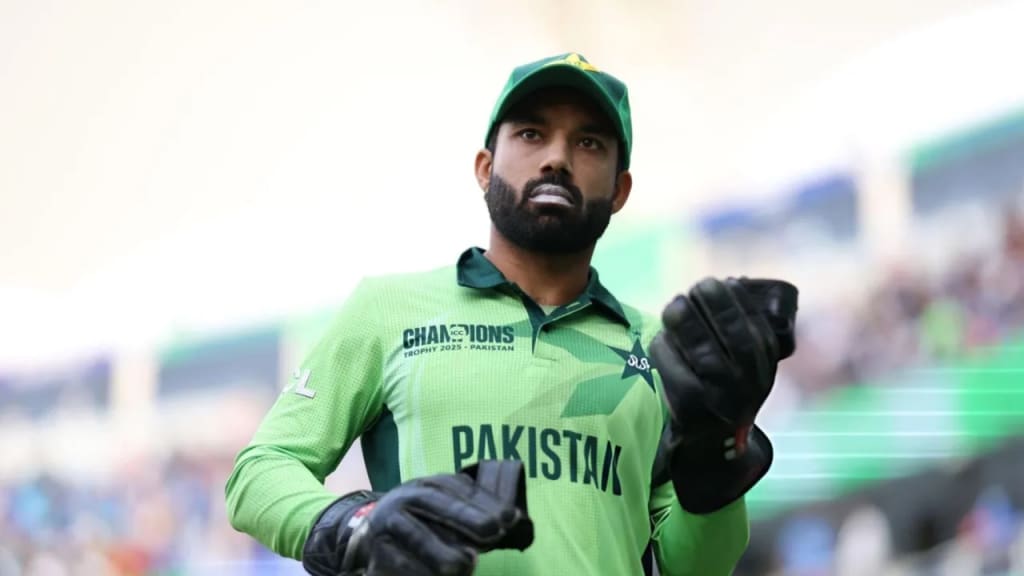
Mohammad Rizwan vs NCCIA: Why His Seized Phone Is at the Center of a Growing Pakistan Cricket Controversy
Three hours.
That, according to Mohammad Rizwan, was how long he believed investigators would need his mobile phone.
Instead, weeks later, the former Pakistan white-ball captain says he still does not have it back.
The device has now become the central object in an increasingly complicated dispute involving Rizwan, Pakistan's National Cyber Crime Investigation Agency (NCCIA), the Lahore High Court, the Pakistan Cricket Board and questions surrounding the ICC's Anti-Corruption framework.
Rizwan's latest correspondence with the NCCIA argues that he has already demonstrated his willingness to cooperate. He says he voluntarily provided access to his phone while in the United Kingdom despite believing he was under no legal obligation at that stage to surrender it, doing so after being assured it would be examined and returned within approximately three hours.
He is now asking for two basic things:
return his phone and tell him precisely what he is being investigated for.
The NCCIA presents a different picture.
Agency sources have told Pakistani media that investigators need Rizwan's cooperation to complete a forensic examination and have accused him of delaying the inquiry. They say repeated attempts have been made to contact him and that some outstanding questions can only be resolved with his assistance.
Rizwan's side disputes that characterization.
And that contradiction has become one of the most important unresolved elements of the case.
The Lahore High Court has already refused to stop the investigation. It instructed Rizwan to cooperate while simultaneously ordering the NCCIA to proceed according to law and avoid subjecting him to harassment or unnecessary inconvenience.
Crucially, no final finding of wrongdoing has been announced against Rizwan.
No publicly established charge proves that he was involved in betting, corruption, match-fixing or unlawful disclosure of team information.
At this stage, this remains an investigation.
That distinction is essential.
What Is the Mohammad Rizwan NCCIA Case About?
The controversy emerged during and immediately after Pakistan's 2026 Test tour of England.
Reports have connected the inquiry with several overlapping concerns, including:
- alleged leaks of information from the Pakistan dressing room
- online betting and gambling
- communications and contacts involving players
- financial transactions
- digital information contained on mobile devices
Rizwan and fellow Pakistan batter Imam-ul-Haq have both been questioned.
However, publicly available reporting has sometimes mixed together separate processes involving the PCB's internal disciplinary concerns and the NCCIA's investigation.
They should not automatically be treated as the same inquiry.
The NCCIA is a government cybercrime investigative agency.
The PCB separately has its own regulatory and disciplinary authority over contracted Pakistan cricketers.
And international cricket corruption issues can also fall within the jurisdiction of the ICC Anti-Corruption Unit.
That overlap helps explain why Rizwan's case became legally complicated so quickly.
It Began After the Lord's Test
According to Rizwan's court petition, the critical encounter occurred immediately after Pakistan's Test against England at Lord's, played from August 27 to August 30, 2026.
Rizwan said he was summoned to the lobby of Pakistan's team hotel at around 1 a.m.
An official was waiting.
Rizwan's account says he was questioned without receiving advance written notice explaining:
what allegation had been made,
what offence was under investigation,
why his phone was being requested,
or what legal authority permitted the request.
He says he initially resisted handing it over.
Eventually he agreed.
The understanding, according to his legal account, was that the phone would be examined and returned within approximately three hours.
It was not.
Rizwan Says He Voluntarily Gave Investigators Access
This point is now particularly important because the NCCIA has reportedly accused Rizwan of insufficient cooperation.
Rizwan's position is essentially the opposite.
He argues that he already provided extraordinary cooperation at the beginning of the episode.
According to his account, he:
provided the phone,
allowed access to the device,
provided information requested of him,
later appeared before the NCCIA in Lahore,
and submitted written responses.
His latest letter reportedly stresses that his decision to make the device available in Britain was voluntary.
Rizwan's argument is therefore not simply:
“I don't want to cooperate.”
It is closer to:
“Tell me clearly what lawful process I am supposed to cooperate with, and return the device I already voluntarily provided.”
That distinction is central to understanding his legal position.
The Phone Was Supposed to Come Back in Three Hours
The three-hour assurance has become one of the most striking details in the entire case.
Rizwan's lawyer repeated it before the Lahore High Court.
His petition maintained that the device was surrendered because he had been assured that investigators would check it and return it promptly.
Instead, it remained in official possession.
Weeks later, the dispute over the phone was still unresolved.
From Rizwan's perspective, that creates an obvious question:
If the original basis for cooperation involved a short examination, why has possession continued for so long?
Investigators, meanwhile, have said further forensic analysis is required.
The disagreement is no longer simply about possession of a phone.
It is about process, consent, authority and the scope of digital examination.
Rizwan Was Then Sent Back to Pakistan
Following the Lord's Test, Pakistan dramatically reshaped its touring squad.
Rizwan, Imam-ul-Haq and several other players were released from the Test squad before the series concluded.
Reporting around the episode became increasingly chaotic, with disciplinary questions, selection disputes and the cybercrime inquiry sometimes appearing together in headlines.
Rizwan and Imam subsequently appeared before the NCCIA in Lahore.
The agency's investigation continued after their return.
Rizwan then began formally demanding clearer information about why he was being investigated.
Rizwan Appeared Before the NCCIA on September 10
Despite later accusations of non-cooperation, Rizwan did appear before NCCIA investigators on September 10.
Imam-ul-Haq also appeared.
Reports said the players were questioned regarding matters connected with communications, alleged dressing-room information leaks and other issues being examined by investigators.
Rizwan later sent a written response asking the agency to explain:
why he had been summoned,
why his phone remained in official possession,
and what specific violation investigators believed might have occurred.
Those questions have remained central ever since.
 Probuddha Bhattacharjee
“Why Was I Called?”
The simplest question may also be the most important.
Rizwan wanted the NCCIA to identify the basis of the inquiry with greater specificity.
Media reports quoted his response asking, in substance:
Why did the NCCIA call me?
He also asked what rule or alleged offence investigators believed was relevant.
That matters legally because participation in an inquiry and being accused of committing an offence are not the same thing.
The Lahore High Court would later emphasize precisely that distinction.
Rizwan Went to the Lahore High Court
On September 16, Rizwan approached the Lahore High Court challenging the NCCIA proceedings.
His petition attacked both the agency's jurisdiction and the way the investigation had been conducted.
Among his arguments was the contention that corruption-related allegations involving an international cricketer should properly fall within the framework of the ICC Anti-Corruption Unit.
He also argued that the NCCIA notice was vague and did not identify a sufficiently specific offence.
The petition included his account of the late-night hotel questioning and retention of his mobile phone.
The Court Did Not Stop the NCCIA Investigation
Rizwan did not receive the broader relief he sought.
Lahore High Court Chief Justice Aalia Neelum allowed the investigation to continue.
The written order made an important point:
“A call-up notice is merely a procedural mechanism for gathering information.”
In other words, receiving an investigative notice does not itself establish that Rizwan committed wrongdoing.
The court directed him to cooperate with the inquiry.
But it also placed obligations on the NCCIA.
The Court Told NCCIA Not to Harass Rizwan
The order instructed the agency to avoid subjecting Rizwan to:
harassment or unnecessary inconvenience
and to conduct the inquiry strictly according to law.
That creates an important balance that can easily disappear from simplified headlines.
The court did not say:
“Rizwan is right and NCCIA must stop.”
Nor did it say:
“Rizwan has committed an offence.”
Instead, the court essentially allowed investigators to continue gathering information while requiring both sides to participate lawfully.
Rizwan must cooperate.
The agency must conduct the process properly.
What Did the Court Say About Rizwan's Phone?
Rizwan had also sought relief concerning the seized or retained items.
The court did not simply order that the phone be returned.
Instead, Chief Justice Neelum said Rizwan could pursue the appropriate legal remedy before the competent court regarding articles that had been seized or confiscated.
That leaves the phone dispute legally alive.
The High Court's refusal to return it directly should not be interpreted as a judicial finding that the NCCIA can retain it indefinitely.
It means the particular petition before the court did not produce that remedy.
Now the Two Sides Disagree Over Who Is Cooperating
This is where the case became even more unusual.
On September 27, reports citing NCCIA sources said Rizwan's alleged lack of cooperation was delaying the investigation.
According to those accounts, investigators said they had tried multiple times to contact him.
Sometimes contact allegedly failed.
At other times, according to the agency's version, Rizwan said he would consult his lawyer.
The agency reportedly planned another attempt to secure his cooperation.
Then came Rizwan's response.
His side says the description is misleading.
Rizwan Says the NCCIA Has Not Properly Contacted Him Since the Court Order
Rizwan's latest letter challenges the narrative that he has simply refused to assist investigators.
According to his position, the agency has not made contact with him in a way demonstrating appropriate compliance with the Lahore High Court's instructions.
He remains willing to participate, his side says, but wants the process to be properly documented.
That includes receiving clear written information explaining:
what investigators require from him,
the legal basis for the request,
the nature of the inquiry,
and what is expected regarding his phone.
The two narratives therefore conflict directly.
NCCIA sources: Rizwan is not cooperating sufficiently despite attempted contact.
Rizwan's position: he has already cooperated substantially and is waiting for proper written communication consistent with the court's directions.
At present, neither narrative should simply be presented as an established judicial fact.
Reports Say Rizwan Wants Written Notice Before Further Action
Reporting close to the cricketer's position says he has not rejected future cooperation.
Rather, he wants an appropriate written notice before appearing again.
One recent account said his position was that he would attend once contacted in accordance with law.
That distinction matters.
“Refusing an investigation” and “requesting formal written notice before further participation” are very different legal positions.
Whether Rizwan has already received sufficient lawful notice—or whether the agency must provide something further—is part of the continuing dispute.
Why Does NCCIA Say It Needs Rizwan Again?
According to agency sources, investigators want to conduct a deeper forensic examination of Rizwan's phone.
Reports have said the device uses security protections that make analysis difficult without cooperation from its owner.
Investigators reportedly fear that bypassing some security protections through other methods could risk data loss.
The NCCIA therefore says Rizwan's presence or assistance is needed.
The agency has also reportedly offered to send investigators to him if attending its office would create difficulty.
From the NCCIA's perspective, this supports its claim that it is attempting to make cooperation easier.
From Rizwan's perspective, however, the unanswered question remains:
Why has the device been held for weeks without the scope and basis of the investigation being clearly defined to him?
Imam-ul-Haq's Phone Has Also Been Examined
Rizwan is not the only Pakistan cricketer involved.
Imam-ul-Haq has also been questioned and had his device examined.
Recent reports citing agency sources say Imam is now cooperating with the forensic process, with analysis of his phone progressing.
That has inevitably led to comparisons between the two players.
But cooperation by one individual does not by itself determine what another person is legally required to do.
Each person's circumstances, legal advice and interactions with investigators may differ.
Nothing Has Yet Been Established Against Either Player
This is the most important fact in the story.
NCCIA sources themselves have said the inquiry remains at an early stage and that nothing has yet been established against any cricketer.
That means headlines should not describe Rizwan or Imam as though either has already been found guilty of:
betting,
gambling,
match-fixing,
corruption,
or leaking confidential information.
Investigators are trying to determine what happened.
That is precisely what an inquiry is for.
What Is the NCCIA?
The National Cyber Crime Investigation Agency is Pakistan's federal cybercrime investigative body.
Its mandate involves offences connected with digital activity and electronic systems.
In Rizwan's case, the agency has reportedly examined digital communications and financial information while investigating matters associated with alleged online betting or gambling and related concerns.
Rizwan challenged whether the specific allegations being discussed fell properly within the NCCIA's jurisdiction.
The Lahore High Court declined to stop the agency's investigation at this preliminary stage.
That means the jurisdictional argument did not succeed in terminating the inquiry.
But it does not automatically establish the truth of the underlying suspicions.
Why Did Rizwan Contact the ICC?
Rizwan separately approached the International Cricket Council's Anti-Corruption Unit.
His concern was procedural.
He reportedly sought clarification about whether:
the ICC knew his phone had been taken,
the England and Wales Cricket Board's anti-corruption authorities knew about it,
the transfer of the phone from Britain to Pakistan followed appropriate procedure,
and the forensic examination complied with relevant ICC Anti-Corruption rules.
That move should not be confused with the ICC opening a case against Rizwan.
It was Rizwan who approached the ICC seeking guidance.
The ICC Has Not Publicly Confirmed the Substance of Rizwan's Request
When asked about the correspondence, the ICC reportedly declined to confirm or deny details, consistent with its practice of not publicly commenting on anti-corruption matters.
That means speculation about what the ICC thinks of the case should be treated cautiously.
There has been no public ICC ruling declaring either that the NCCIA procedure was correct or that it violated ICC rules.
Does ICC Jurisdiction Prevent a Pakistani Agency From Investigating?
This was one of Rizwan's legal arguments.
His side maintained that cricket corruption falls within the specialized framework of the ICC Anti-Corruption Unit.
But the High Court did not accept the argument that the ICC framework automatically blocks domestic authorities.
The court referred to the ICC Anti-Corruption Code's own recognition that participants remain subject to applicable national laws.
Former PCB legal adviser Taffazul Rizvi made a similar point, telling Cricbuzz that ICC disciplinary rules do not remove a player's obligation to comply with lawful domestic investigations.
That is an important distinction.
A player could potentially face:
sporting rules under the ICC or PCB,
and separately,
domestic criminal or regulatory law.
The existence of one does not necessarily cancel the other.
But Lawful Investigation Still Requires Lawful Procedure
That does not mean investigators have unlimited powers.
Rizwan's challenge has increasingly focused less on whether authorities may investigate anything at all and more on how they have handled him and his phone.
Questions include:
Was proper notice provided?
What was the legal basis for taking possession of the phone in Britain?
What was Rizwan told before consenting?
Who transferred the device?
What data has been accessed?
What is the precise subject of the inquiry?
How long can investigators retain the phone?
What protections apply to unrelated personal data?
These are serious questions in any digital investigation.
A modern smartphone can contain far more than call records.
It may hold:
private family conversations,
financial information,
photographs,
health information,
professional communications,
authentication credentials,
location records,
and years of personal history.
Taking a phone is therefore not equivalent to borrowing a notebook.
Why the UK Location Makes the Story More Complicated
Rizwan says the initial request for his phone occurred in the United Kingdom.
That raises an unusual procedural question because the phone was apparently requested while he was outside Pakistan.
Rizwan says he agreed voluntarily rather than surrendering the device under a UK court order or warrant.
He has emphasized that he understood the arrangement to be temporary.
The device then ended up in Pakistan and became part of an NCCIA inquiry.
Rizwan has specifically asked the ICC whether the process of requesting, transferring and examining it was consistent with cricket's anti-corruption procedures.
The public record has not yet fully explained every step in that chain of custody.
The Case Is Also About Digital Consent
The word consent may become particularly important.
If a person voluntarily hands investigators a device for one stated purpose and one limited period, does that consent automatically authorize:
indefinite retention,
complete forensic imaging,
examination of all financial records,
analysis of every message,
or transfer between organizations?
That depends on the relevant law, facts and scope of consent.
Rizwan's position appears to be that his original cooperation should not be interpreted as unlimited authorization.
The NCCIA's legal position has not been fully detailed publicly.
That is one reason the case remains difficult to assess solely through media reports.
Why Has Rizwan Not Simply Spoken Publicly?
Apparently, he wanted to.
Reports say Rizwan asked the PCB twice for permission to address the controversy publicly.
Both requests were reportedly refused.
Under his central contract, public statements on certain cricket-related matters require PCB approval.
Sources close to Rizwan said he wanted to explain:
how his phone was obtained,
what allegations had been raised,
why he had contacted the ICC,
and his own sequence of events.
He was reportedly not seeking to accuse the PCB or another institution, but rather to place his version on record.
The lack of a full public statement from Rizwan has therefore created a strange situation.
Much of his side of the story is reaching the public through:
court documents,
letters,
lawyers,
and unnamed sources.
The PCB Has Kept Its Public Position Limited
The Pakistan Cricket Board has largely avoided giving a detailed public account of the investigation.
Cricbuzz reported a PCB statement saying internal procedures were being followed and warning against relying on speculative or unverified reports.
That caution is understandable.
Premature statements could:
prejudice an investigation,
damage players' reputations,
or create legal complications.
But the limited official information has also created an environment in which leaks and anonymous-source reports dominate the story.
That makes careful language especially important.
Was Rizwan Accused of Match-Fixing?
There is no publicly established finding that Mohammad Rizwan engaged in match-fixing.
Some reporting has connected the NCCIA inquiry with online betting and gambling.
Other reports have referred to possible dressing-room information leaks or suspicious transactions.
Those are not interchangeable accusations.
And an inquiry into them is not proof.
Cricbuzz quoted former PCB legal official Taffazul Rizvi emphasizing that a notice and questionnaire should not be interpreted as an accusation or admission of wrongdoing.
That is an important legal and journalistic principle.
Was Rizwan Charged With a Crime?
As of September 29, 2026, the publicly available reporting reviewed for this article does not show a final criminal charge or finding of guilt against Rizwan in this inquiry.
The Lahore High Court itself emphasized that the call-up notice was a mechanism for gathering information.
The investigation remains ongoing.
Unless that changes, descriptions such as “Rizwan betting scandal” should be treated cautiously because they can imply guilt that has not been established.
What Is NCCIA's Current Position?
Reports citing agency sources describe the NCCIA's position roughly as follows:
Investigators believe additional forensic work is necessary.
They say some questions remain unresolved.
They say Rizwan's cooperation is required to complete that work safely.
They say they have attempted to contact him.
They maintain their actions are lawful.
They say nothing has yet been proved against him.
And they say the goal is to establish the facts and clear players promptly if no violation is found.
That final point is significant.
Even according to investigators' own reported account, the case has not reached a conclusion.
What Is Rizwan's Current Position?
Rizwan's position can be summarized differently.
He says he has already cooperated.
He says he voluntarily handed over his phone in Britain.
He says he was told it would come back within hours.
He says it has not been returned.
He has appeared before investigators.
He has sent written responses.
He wants written clarification of the allegation or legal basis of the inquiry.
He disputes reports portraying him as simply refusing cooperation.
And he wants the NCCIA to comply with the procedural safeguards emphasized by the Lahore High Court.
In other words, both sides are publicly claiming to be seeking compliance with the law.
They disagree over what compliance currently requires.
That Is the Real Story Behind the Latest Letter
The latest development is easy to reduce to:
“Rizwan refuses NCCIA probe.”
But that is not an adequate summary.
The real dispute is more complicated.
Rizwan is not denying that the Lahore High Court told him to cooperate.
His letter reportedly invokes the same court order to argue that the NCCIA also has responsibilities.
The court told the agency:
follow the law,
avoid harassment,
avoid unnecessary inconvenience.
Rizwan's latest position is that he wants the agency to communicate with him formally within that framework.
The NCCIA, meanwhile, believes sufficient efforts to obtain his cooperation have already been made.
That is where the case currently stands.
The Phone May Ultimately Determine What Happens Next
The forensic examination appears central to the investigation.
Investigators want access.
Rizwan wants clarity and the return of his device.
If the parties agree on a lawful process for completing the examination, the technical investigation may move forward quickly.
If they do not, further legal action is possible.
Rizwan may seek another remedy regarding the retained device.
The NCCIA may issue another formal notice.
The PCB may eventually receive investigative findings.
And depending on what those findings show, the case may either expand—or end without wrongdoing being established.
At the moment, both outcomes remain possible.
What Could Happen Next?
Several possibilities remain.
The NCCIA could issue Rizwan a fresh written notice clearly defining what it requires.
Rizwan could attend and assist with the forensic examination.
His phone could be returned after investigators complete the required work.
Investigators could conclude that no violation occurred.
Alternatively, if investigators uncover evidence they believe establishes an offence, the matter could move into a more formal legal phase.
The PCB could also consider its own disciplinary process separately.
And Rizwan retains the option of returning to court if he believes investigators fail to follow the High Court's directions or if he seeks a specific remedy concerning the phone.
None of those possibilities should be presented as inevitable.
Why This Case Matters Beyond Mohammad Rizwan
The controversy raises issues much larger than one cricketer.
Professional athletes now carry enormous amounts of sensitive information on their phones.
A single device may contain:
team strategy,
player conversations,
medical details,
contract discussions,
banking information,
family messages,
and communication with agents or lawyers.
At the same time, corruption investigations sometimes legitimately require access to digital records.
Cricket's anti-corruption authorities have long relied on communication records when investigating betting and fixing allegations.
The challenge is balancing legitimate investigation with:
privacy,
due process,
clear consent,
proportionality,
and chain-of-custody safeguards.
Rizwan's case sits directly at that intersection.
It Also Shows Why Investigations Need Clear Communication
Investigations become especially damaging when nobody outside them understands what is being investigated.
Rumors fill the vacuum.
One headline says dressing-room leaks.
Another says gambling.
Another mentions suspicious transactions.
Another implies corruption.
Another focuses on discipline.
Before long, the public begins treating all those concepts as though they are the same allegation.
They are not.
If investigators believe a specific offence may have occurred, clarity helps protect both:
the integrity of the investigation,
and the reputation of people who may ultimately be cleared.
That is one of the strongest arguments behind Rizwan's repeated demand for specificity.
Reputation Matters Before a Verdict Too
Mohammad Rizwan has represented Pakistan for more than a decade.
That does not place him above investigation.
A famous athlete should not receive immunity unavailable to anyone else.
But the reverse is equally important.
Fame should not cause an investigation to be reported as guilt before evidence has been tested.
The presumption that a person remains unproven guilty is not a technical courtesy.
It protects the integrity of the entire investigative process.
At the moment, Rizwan is a cricketer under inquiry, not a cricketer publicly proven to have committed corruption.
The Court's Order May Be the Best Guide to Understanding the Case
The Lahore High Court's position remains remarkably useful.
Rizwan must cooperate.
The NCCIA may continue investigating.
But the agency must proceed according to law and should not harass or unnecessarily inconvenience him.
That balanced instruction cuts through much of the noise.
It rejects two extreme interpretations.
Rizwan cannot simply use the ICC framework to prevent a lawful domestic inquiry.
But investigators do not receive unlimited discretion merely because an inquiry exists.
Both obligations operate simultaneously.
For Now, the Central Questions Remain Unanswered
More than the allegations themselves, the unresolved procedural questions are now driving the story.
Why exactly is Mohammad Rizwan being investigated?
What offence or conduct does the NCCIA believe may have occurred?
What evidence triggered the inquiry?
Why was his phone initially requested at 1 a.m. in a London hotel?
Who authorized that request?
What did Rizwan consent to when he handed it over?
Why was he told it would take three hours?
Why has it remained in official possession for weeks?
What additional forensic access does the NCCIA require?
What written communication has been sent since the Lahore High Court order?
Has any evidence of wrongdoing actually been established?
Until those questions receive authoritative answers, certainty would be premature.
Mohammad Rizwan's Case Is Still an Inquiry, Not a Verdict
That may be the most important sentence in the entire story.
There is an investigation.
There is a disputed phone seizure or retention.
There is a court ruling.
There are conflicting accounts of cooperation.
There are reported concerns involving betting, gambling, financial activity and dressing-room information.
But there is not yet a publicly established finding proving wrongdoing by Mohammad Rizwan.
The latest letter makes his position clearer:
He says he is willing to cooperate, but he wants the investigation to be clearly defined, properly documented and conducted within the legal safeguards laid down by the court.
The NCCIA says it also wants cooperation so it can complete its forensic work and establish the facts.
For now, those two positions have not met in the middle.
And somewhere between them sits a mobile phone that was supposedly going to be gone for three hours.
Weeks later, it has become the most consequential phone in Pakistan cricket.
Frequently Asked Questions
What is the Mohammad Rizwan NCCIA case?
Pakistan's National Cyber Crime Investigation Agency is conducting an inquiry involving Mohammad Rizwan and Imam-ul-Haq. Reports have connected it to alleged online betting or gambling, digital information, financial activity and possible dressing-room information leaks. No final finding against Rizwan has been publicly announced.
What does NCCIA stand for?
NCCIA stands for the National Cyber Crime Investigation Agency, Pakistan's federal cybercrime investigative body.
Why does NCCIA have Mohammad Rizwan's phone?
According to Rizwan's account, he voluntarily handed the phone to an official after Pakistan's Lord's Test in England after being told it would be examined and returned within approximately three hours. The device later became part of the NCCIA inquiry.
Has Mohammad Rizwan's phone been returned?
As of the latest reports, Rizwan says the phone has not been returned.
Was Rizwan's phone taken in Pakistan?
According to Rizwan's legal account, the original request occurred at Pakistan's team hotel in the United Kingdom, shortly after the Lord's Test.
What time was Rizwan called to the hotel lobby?
His petition says he was called to the lobby at approximately 1 a.m.
Was Rizwan given a warrant when his phone was requested?
Rizwan's petition says he was not given a written notice, allegation, charge, warrant or document explaining why his phone was being requested at that point.
Did Rizwan voluntarily hand over his phone?
Rizwan's position is that he ultimately consented to provide it after initially expressing reluctance and after being assured it would be examined and returned within about three hours.
Why does NCCIA still want Rizwan's cooperation?
Agency sources say investigators need his assistance to complete further forensic analysis of the device without risking data loss.
Is Rizwan refusing to cooperate?
The two sides dispute this. NCCIA sources have accused him of insufficient cooperation, while Rizwan's side says he has already provided the phone, appeared for questioning and responded in writing, and now wants proper written communication before further participation.
Did Mohammad Rizwan appear before the NCCIA?
Yes. Rizwan and Imam-ul-Haq appeared before investigators in Lahore on September 10, 2026.
Why did Rizwan go to the Lahore High Court?
He challenged the NCCIA notice and investigation, questioned the agency's jurisdiction and raised concerns about how his phone had been obtained and retained.
Did the Lahore High Court stop the investigation?
No. The court allowed the inquiry to continue and directed Rizwan to cooperate.
Did the court rule that Rizwan was guilty?
No. The court specifically noted that a call-up notice is a procedural means of gathering information and does not itself constitute an accusation of wrongdoing.
What did the court tell the NCCIA?
The Lahore High Court directed the agency to conduct the inquiry according to law and not subject Rizwan to harassment or unnecessary inconvenience.
Did the court order Rizwan's phone to be returned?
No. Regarding seized or confiscated items, the court said Rizwan could pursue the appropriate remedy before a competent court.
Has Mohammad Rizwan been charged with match-fixing?
No publicly announced final charge or finding has established that Rizwan engaged in match-fixing.
Is Mohammad Rizwan being investigated for betting?
Reports have said the NCCIA inquiry concerns alleged online betting or gambling and related digital or financial matters. However, no final finding has been announced against him.
What are the alleged dressing-room leaks?
Reports have said investigators questioned Rizwan and Imam about possible disclosure of information from the Pakistan dressing room during the England Test series. The exact information allegedly disclosed and whether any unlawful leak occurred have not been publicly established.
Is Imam-ul-Haq also involved in the inquiry?
Yes. Imam has also been questioned and his phone has undergone forensic examination. Agency sources say he is cooperating with investigators.
Has anything been proved against Imam-ul-Haq or Mohammad Rizwan?
NCCIA sources said as recently as September 27 that the investigation remained at an initial stage and nothing had yet been established against either cricketer.
Why did Rizwan contact the ICC?
He sought guidance from the ICC Anti-Corruption Unit about whether the ICC or ECB knew about the handling of his phone and whether the process of requesting, transferring and examining it was consistent with anti-corruption procedures.
Did the ICC order the investigation?
There is no public evidence that the ICC ordered the NCCIA inquiry.
Has the ICC commented on Rizwan's letter?
Cricbuzz reported that the ICC would neither confirm nor deny the correspondence, citing its policy of not commenting publicly on anti-corruption matters.
Does the ICC Anti-Corruption Unit have exclusive jurisdiction?
The Lahore High Court did not accept the argument that the ICC's disciplinary framework prevents domestic authorities from investigating potential violations of Pakistani law.
Did Rizwan ask the PCB for permission to speak publicly?
Yes. Reports say he sought permission twice to explain his side of the controversy publicly, but the PCB did not grant approval.
Why does Rizwan need PCB permission to speak?
His central contract reportedly requires prior approval for certain public statements concerning matters covered by the agreement.
Has Rizwan said he will not cooperate?
His reported position is that he remains willing to cooperate with a lawful investigation but wants clear written communication defining what investigators require.
What does Rizwan want from the NCCIA now?
He wants greater clarity regarding the nature and legal basis of the inquiry, formal communication consistent with the Lahore High Court's directions and the return of his mobile phone.
What does NCCIA want from Rizwan?
Agency sources say investigators need him to assist with further forensic examination of his phone and answer outstanding questions.
Could Rizwan return to court?
Yes. The Lahore High Court's order itself left open the possibility of appropriate legal remedies regarding the eventual outcome of the investigation and the retained property.
What happens next in the Mohammad Rizwan case?
The most immediate issue is likely further communication between Rizwan and the NCCIA concerning the forensic examination of his phone. Investigators could issue additional formal notice, Rizwan could cooperate under agreed procedures, or further legal proceedings could follow if the dispute remains unresolved.
What is the most important fact to remember about the case?
No final finding of wrongdoing against Mohammad Rizwan has been publicly announced.
He is involved in an ongoing investigation, and the central dispute currently concerns the scope, procedure and legality of that investigation as much as the underlying allegations themselves.