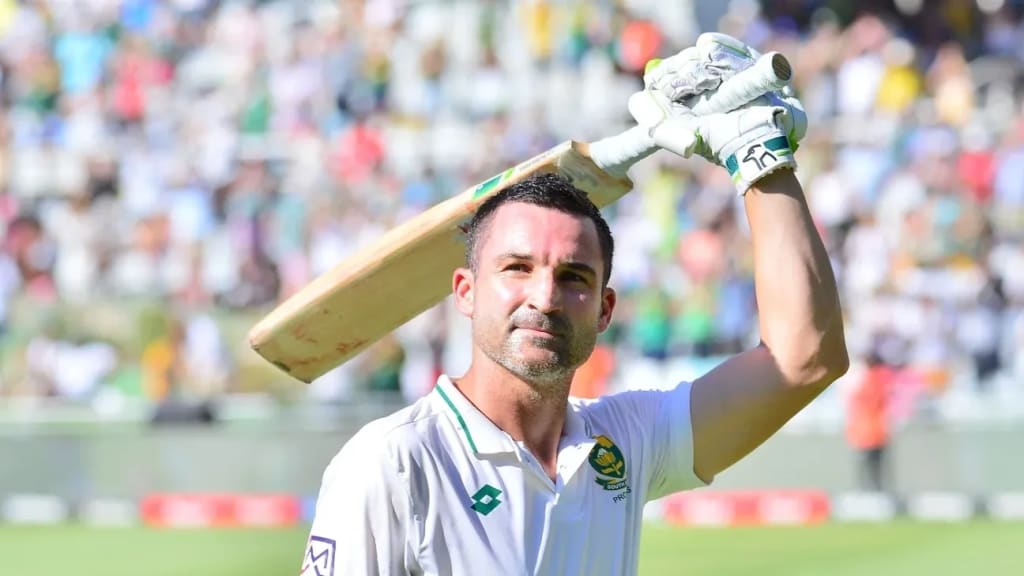
Dean Elgar Is Retiring: The Last Stand of One of Test Cricket’s Toughest Openers
Dean Elgar has spent most of his career doing the part of batting that modern cricket increasingly tries to escape.
Leaving balls.
Taking blows.
Surviving movement.
Making fast bowlers come back for another spell.
Turning an ugly 35 into something more valuable than a beautiful 20.
Now one of the defining Test openers of his generation is preparing to walk away.
On August 26, 2026, Essex confirmed that the 39-year-old former South Africa captain will retire from all professional cricket at the conclusion of the 2026 season, ending a career that has lasted 21 years and included more than 500 professional appearances.
Elgar's final chapter will be played in the County Championship.
Essex still have scheduled red-ball matches against Surrey, Sussex, Yorkshire, Warwickshire and Glamorgan, with their final Championship fixture beginning at Sophia Gardens on September 24.
His reason for stopping is strikingly ordinary compared with the brutality of the career that preceded it.
He wants to go home.
Elgar said his children are growing quickly and that, after spending so much of his life traveling for cricket, he wants to be more present for his partner and family. He also indicated that he would prefer to take a break from cricket rather than immediately move into another full-time role.
That makes the announcement feel less like a player being forced out and more like a player finally choosing what comes next.
Elgar has already retired once.
He ended his international career in January 2024 after 86 Tests for South Africa.
Then he went to Essex and proved that the old skills still worked.
Now there will be no second extension.
No extra overseas contract.
No attempt to hang on until 40 simply because somebody is willing to pay him.
At the end of this Championship campaign, Dean Elgar is done.
A 21-Year Professional Career Is Coming to an End
Essex describes Elgar's professional career as spanning more than two decades and more than 500 appearances across formats.
It began long before most cricket fans knew his name.
Born in Welkom, South Africa, Elgar captained his country at the 2006 ICC Under-19 World Cup before progressing through domestic cricket with Free State and the Knights.
There was nothing inevitable about an elite Test career.
Elgar was not a once-in-a-generation teenage batting prodigy.
He did not arrive in international cricket with a technique described as effortless.
He did not become famous for enormous sixes or extravagant strokeplay.
His career was built gradually.
Domestic runs.
Technical refinement.
Physical toughness.
And an increasingly valuable ability to remain at the crease when batting became uncomfortable.
By the time South Africa called him into the Test side in 2012, he was 25.
Then his international career started about as badly as possible.
Dean Elgar Made a Pair on Test Debut
Elgar's Test debut came against Australia at Perth in November 2012.
He scored:
0 in the first innings.
Then:
0 in the second innings.
A pair.
For a future opening batter who would eventually face 11,190 deliveries in Test cricket, the beginning could hardly have been more brutal. His final Test record would become 86 matches, 5,347 runs, 14 centuries and 23 fifties at an average of 37.92.
There is something almost perfect about Elgar beginning with failure.
His career never looked preordained.
It looked earned.
He Finished With 5,347 Test Runs
By January 2024, the two debut ducks had become almost irrelevant.
Elgar's final Test numbers were:
- 86 Tests
- 152 innings
- 5,347 runs
- 37.92 batting average
- 14 centuries
- 23 half-centuries
- 199 highest score
- 11,190 balls faced
Those are excellent numbers.
But they still do not completely explain his reputation.
A Test average around 38 does not immediately place someone beside the statistical giants of international batting.
Elgar's importance came partly from where he batted and under what conditions.
He opened.
Frequently in South Africa.
Against a new ball.
On surfaces that could reward fast bowling immediately.
In one of the most technically demanding jobs in cricket.
Opening the Batting in South Africa Is Not Designed to Inflate Averages
An opener can be dismissed before the pitch slows down.
Before the ball becomes soft.
Before the shine disappears.
Before the bowlers become tired.
And South African conditions can make every one of those disadvantages worse.
Fresh seamers can attack the stumps.
The ball can move off the surface.
Bounce can vary.
Edges carry.
The first 30 minutes can feel like an examination where every mistake ends the session permanently.
Elgar spent more than a decade volunteering for that examination.
That context is why his average requires interpretation rather than merely comparison.
His job was often to absorb the most dangerous overs available.
His Highest Test Score Was 199
In 2017, against Bangladesh at Potchefstroom, Elgar came within one run of one of cricket's great landmarks.
He made 199.
Not 200.
One short.
It remains his highest Test score.
For some players, being dismissed on 199 might become a career tragedy.
With Elgar, the number almost suits him better.
There was nothing aesthetically tidy about his career.
He was not built around perfect endings.
He was built around accumulation.
A 199 still forces an opposition to bowl at one man for hours.
A scorecard does not become less damaging because the batter missed a round number.
 Imrul
Imrul
2017 Showed How Good Elgar Had Become
By 2017, he was no longer simply South Africa's stubborn opener.
He was one of the team's central run-scorers.
His 199 against Bangladesh was the standout innings of a highly productive period and established him as a batter capable of enormous concentration.
That was the version of Elgar opposition bowlers came to dread.
If they failed to dismiss him early, the game could become irritating very quickly.
His method was not complicated.
Play late.
Know where off stump is.
Absorb pressure.
Wait for errors.
Repeat.
It sounds simple.
Very few international openers can do it for 11 years.
His 160 in India Proved He Could Adapt
Another important innings came at Visakhapatnam in 2019.
Facing India in Indian conditions, Elgar made 160 against an attack that included Ravichandran Ashwin and Ravindra Jadeja. The ICC later highlighted the innings as evidence of his ability to succeed beyond familiar South African conditions.
That performance mattered to his reputation.
He was not naturally associated with elegant subcontinental batting.
But Elgar's career was built around solving problems rather than looking comfortable while doing it.
He could use his feet.
He could sweep.
He could improvise.
If the conditions demanded ugly runs, he had no objection.
He Became One of Test Cricket’s Great Carry-the-Bat Openers
If one statistic explains Dean Elgar better than almost any other, it is this:
He carried his bat through a completed Test innings three times.
That means he opened the batting and remained unbeaten when the final teammate was dismissed.
His three instances were:
118 not out against England at Durban in 2015.
86 not out against India at Johannesburg in 2018.
141 not out against Australia at Cape Town in 2018.
At the time of the third instance, Elgar joined West Indies great Desmond Haynes with three such innings.
It is an endurance statistic.
A survival statistic.
A statistic about watching every other batter disappear and refusing to join them.
There may be no more Elgar-like record.
His 141 Not Out Against Australia Was Classic Elgar
The Cape Town innings in 2018 came during one of the most intense Test series of the modern era.
Elgar remained unbeaten on 141 while the rest of South Africa were dismissed.
The ICC noted that it was his third time carrying his bat, making him only the second opener at the time to achieve the feat three times.
South Africa ultimately won the series 3–1.
Elgar contributed 333 runs across the three Tests he played.
That series is remembered for controversy, hostility and elite fast bowling.
Elgar looked at home in it.
He Was an Old-School Opener in an Era Moving Away From Old-School Batting
Modern cricket increasingly rewards acceleration.
Intent.
Strike rate.
Boundary percentage.
Powerplay aggression.
Multi-format adaptability.
Franchise value.
Elgar built an international career around a different question:
Can you get me out?
He was not uninterested in scoring.
He simply understood that time itself could be an attacking weapon.
Make a fast bowler deliver six more overs.
Then six more.
Remove the shine.
Force the captain into the second spell.
Make the opposition spend energy without receiving wickets.
Opening batting has always contained this invisible economy.
Elgar understood it instinctively.
Calling Him Defensive Misses the Point
Elgar's cricket was aggressive in a different way.
He competed openly.
He could be confrontational.
He placed enormous value on winning.
His defensive batting was not passive surrender.
It was refusal.
Every ball left outside off stump told the bowler:
Try again.
Every bouncer survived told the bowler:
Still here.
Every session negotiated moved the game slightly toward the batting side.
This is why Chris Silverwood's description of Elgar as possessing an old-school appetite for occupying the crease feels so accurate.
South Africa Eventually Made Him Test Captain
In 2021, South Africa appointed Elgar their permanent Test captain.
The timing was significant.
The side was in transition.
Several great players from the previous era had departed.
South African cricket had endured administrative turbulence.
The Test schedule was becoming increasingly fragmented.
South Africa needed an identity.
Elgar's was obvious.
Compete.
Stay in the game.
Make the opposition work.
His Captaincy Helped Rebuild South Africa
Under Elgar's leadership, South Africa finished third in the 2021–23 World Test Championship cycle.
That period included:
- A home series win over India.
- A home series win over West Indies.
- A drawn away series in New Zealand.
The India series became particularly important.
South Africa lost the opening Test.
They then came back to win the series 2–1.
Elgar was central not only as captain but as a batter.
His unbeaten 96 in Johannesburg was one of the defining innings of that comeback.
Elgar Says Lord’s Was One of His Proudest Moments
When Essex announced his retirement in 2026, Elgar did not immediately point toward a personal century as the memory he treasured most.
He highlighted South Africa's Test victory over England at Lord's in 2022.
He remembered the transformation of the team around his captaincy and said South Africa had climbed substantially in the rankings during that period.
That answer tells us something important about him.
Elgar has always spoken like someone who thinks cricket's scoreboard begins with the team's result.
Personal numbers come afterward.
His Permanent Captaincy Ended in 2023
Temba Bavuma replaced Elgar as Test captain in February 2023.
Elgar remained available as a batter.
By then, however, the structure surrounding South African Test cricket was changing.
The country had relatively little red-ball cricket scheduled.
Elgar was approaching his late thirties.
And South Africa's coaching staff was planning for a different future.
ESPN later reported that red-ball coach Shukri Conrad had indicated Elgar was not part of the team's longer-term Test plans.
Elgar decided to leave international cricket on his terms.
His Penultimate Test Produced One Last Masterpiece
Then came Centurion.
December 2023.
South Africa against India.
Elgar had already announced that the two-Test series would be his last.
India made 245.
Elgar responded with 185.
It was his second-highest Test score.
His 14th Test century.
A seven-hour innings.
And it helped South Africa win by an innings and 32 runs.
He was Player of the Match.
There are better ways to describe a batting career than statistics.
But a 185 in the penultimate Test is difficult to improve upon.
He Was 36 and Still Making India Look Powerless
The significance of the Centurion innings was not merely emotional.
India had a high-quality fast-bowling attack.
Elgar was nearing retirement.
Yet he controlled the game.
It served as one final demonstration that his departure was not simply the result of becoming incapable of Test-level batting.
He could still produce a match-defining innings.
His career was ending because careers end.
Not because everything had already disappeared.
Temba Bavuma’s Injury Gave Elgar One Final Captaincy
During the Centurion Test, Bavuma suffered a hamstring injury.
Elgar took over on the field.
When Bavuma was ruled out of the second Test, Elgar was named captain for his final international appearance at Newlands.
The symmetry was perfect.
Newlands was Elgar's favorite ground.
He had said he wanted to finish there.
His final Test would now also return him to the captaincy.
The match itself did not provide a perfect ending.
India won.
But cricket rarely cooperates with farewell scripts.
Elgar Finished International Cricket With 86 Tests
When he walked away in January 2024, his final Test record stood at:
5,347 runs from 86 matches at 37.92, with 14 hundreds.
He had also played eight ODIs, scoring 104 runs.
But describing Elgar as a former international cricketer does not quite capture what happened next.
He did not stop.
He changed countries.
Essex Gave Elgar a Second Career
Before the 2024 season, Elgar signed a three-year contract with Essex.
The timing could hardly have been more symbolic.
Sir Alastair Cook had just retired.
Essex needed a senior opening batter.
Cook had represented a particular type of county professional:
Experienced.
Patient.
Reliable.
Comfortable batting for long periods.
Elgar was not Cook.
But he understood the same basic language of red-ball opening.
Essex identified him as the man to fill the gap.
Elgar Had Actually Dreamed of Finishing in County Cricket
In a 2024 interview, Elgar said playing county cricket at the end of his career had long been part of his vision.
His connection to England was also personal: he holds a British passport, and close family members live in Sussex.
So Essex was not merely somewhere to earn a final contract.
It was a destination he had imagined before international retirement arrived.
That matters when considering why he stayed three additional seasons.
County cricket was not an afterthought.
It was his intended final chapter.
He Felt the Pressure of Following Alastair Cook
Elgar has now acknowledged that replacing Cook created pressure.
Trying to imitate Cook would have been impossible.
Instead, he decided to bring his own version of opening batting to Essex.
The overlap was obvious enough.
Both were left-handed openers.
Both valued crease occupation.
Both built careers around concentration.
But their visual styles were different.
Cook could make accumulation look rhythmic.
Elgar often made batting look like a confrontation.
Essex did not receive another Cook.
They received exactly what they had signed.
His First Essex Season Was a Major Success
Elgar scored more than 1,000 County Championship runs in his first Essex season in 2024 and was named the club's Batter of the Year. He also contributed more than 300 runs in the Vitality Blast.
That immediately answered one question.
Had Essex simply signed a famous name nearing retirement?
No.
Elgar could still score.
And he could still carry a top order.
His First 25 First-Class Matches for Essex Produced 1,869 Runs
Essex's player profile records that Elgar scored 1,869 runs in his first 25 first-class appearances for the county, averaging 49.18.
His highest score in that period was 182 against Durham in September 2025.
Those are not nostalgia numbers.
They are elite county numbers.
Elgar's international career may have finished, but his red-ball batting remained highly productive.
Essex Awarded Him a County Cap
In June 2025, Elgar received his Essex County Cap.
He became the 170th player to receive the honor from the club.
For an overseas international who had joined relatively late in his career, that recognition reflected how quickly he had embedded himself in the side.
Essex's 2026 retirement announcement repeatedly emphasized not only his runs but his influence on younger players.
That may ultimately become as important to the club as his aggregate.
He Was Still Scoring Hundreds in 2026
Elgar entered his final professional season capable of producing substantial innings.
At The Oval in April 2026, Essex faced Surrey in the County Championship.
Elgar made 107 not out in the second innings.
It was the 55th first-class century of his career.
The innings helped Essex secure a draw.
The significance now looks different.
A player who would announce retirement four months later was still making hundreds against one of county cricket's strongest sides.
Retirement Is Not Arriving Because He Can No Longer Hold a Bat
This distinction matters.
Athletes sometimes retire when performance collapses so dramatically that selection effectively makes the decision for them.
Elgar's situation is different.
His 2026 season has not matched the heights of his strongest Essex periods, but he remains part of the side and has produced another first-class century.
His own explanation centers on life rather than technique.
He is 39.
He has young children.
He has spent most of adulthood on the road.
He wants to be present at home.
There is something refreshingly uncomplicated about that.
Professional Cricket Takes More Than the Public Sees
Cricket fans experience a player's career through matches.
A Test in Cape Town.
A Championship game at Chelmsford.
A hundred at The Oval.
For players, the career also consists of everything surrounding those matches.
Airports.
Hotels.
Training days.
Recovery.
Team buses.
Preseason tours.
Months away.
Missed family time.
Repeat for two decades.
Elgar's children did not experience his career as a batting average.
They experienced it partly as absence.
Eventually the calculation changes.
Elgar Wants a Sabbatical From Cricket
His retirement statement suggests he does not want to finish playing on Friday and begin coaching on Monday.
Elgar said he would ideally like a sabbatical.
After so many years on the road, he wants to return home and focus on being a father.
That does not mean he will never return to cricket.
His knowledge would make him an obvious candidate for:
- Batting coaching.
- Red-ball mentorship.
- Broadcasting.
- Leadership development.
- County or international consultancy.
But none of those decisions needs to be made immediately.
For once, cricket does not have to determine the calendar.
What Will Essex Lose?
Runs are the obvious answer.
But Essex's own description of Elgar suggests the bigger loss is expertise.
Chris Silverwood praised his longevity, resilience and value to younger players. He specifically highlighted the senior opener's traditional appetite for remaining at the crease and his competitive drive.
Chief executive Dan Feist similarly emphasized Elgar's leadership and mentorship within the squad.
Replacing an overseas player's average is one problem.
Replacing 86 Tests of accumulated knowledge is another.
Essex Already Faced This Problem When Cook Retired
When Cook left after the 2023 season, Essex lost one of the most experienced opening batters English cricket had ever produced.
Elgar provided continuity.
Now Elgar is leaving too.
That means Essex will again have to decide how the top order evolves.
The successor may be younger.
More aggressive.
Potentially homegrown.
But replacing Elgar's particular skill set will not be easy because traditional long-form opening specialists are becoming less common.
County Cricket Was an Ideal Final Home for Elgar
There is a pleasing logic to Elgar finishing in the County Championship.
Four-day cricket still rewards the qualities on which he built his identity.
Patience matters.
Time matters.
Batting through sessions matters.
Runs scored at 45 per hundred balls can be match-winning.
An opener can still make a major contribution simply by making the new ball older.
That format allowed Elgar to remain fully himself.
He did not need to reinvent his game for retirement.
He Was Never Really a Player Built for the Franchise Age
Elgar did play T20 cricket.
He could score in shorter formats.
But nobody will remember him primarily as a franchise cricketer.
His legacy belongs overwhelmingly to red-ball cricket.
That makes his retirement symbolically interesting in 2026.
Professional cricket is increasingly shaped by shorter formats, compressed schedules and global leagues.
Elgar's 21-year career represents something that may become rarer:
A player whose entire public identity rests primarily on first-class batting endurance.
The Numbers Behind That Endurance Are Enormous
Current statistical records put Elgar at roughly 18,900 first-class runs with 55 centuries, and those totals can still increase before his final match.
Think about what almost 19,000 first-class runs means.
Hundreds of innings.
Thousands upon thousands of deliveries.
Different countries.
Different pitches.
Different generations of bowlers.
A 21-year accumulation of small technical decisions.
Leave.
Defend.
Duck.
Drive.
Start again.
The number is not merely a measure of talent.
It measures durability.
He Faced 11,190 Balls in Test Cricket Alone
This statistic may be more Elgar than the run total.
11,190 Test deliveries faced.
Every ball is a separate chance to be dismissed.
An edge.
An lbw.
A bouncer.
A moment of poor judgment.
A delivery too good.
Elgar survived enough of them to build a 12-year international career.
For an opener, balls faced can function almost like mileage on an engine.
Elgar's odometer is enormous.
His Legacy Is Not About Being Pretty
Some great batters are remembered through shots.
Brian Lara's backlift.
Sachin Tendulkar's straight drive.
Kumar Sangakkara's cover drive.
Dean Elgar is remembered through resistance.
A ball passing outside off stump.
A glove being adjusted.
A bruise.
A worn cap.
A bowler turning around at the end of another unsuccessful over.
That does not make him less skilled.
It means the skill looked different.
Elgar’s Batting Was Based on Judgment
Elite leaving is one of cricket's least celebrated technical abilities.
A batter who knows where off stump is does not need to play every dangerous delivery.
That sounds obvious.
At international pace, with seam movement, it is extremely difficult.
Elgar built much of his game around judging which deliveries demanded a response.
His batting therefore depended on discipline.
The spectacular stroke exists for one second.
The decision not to play can shape an entire session.
He Also Accepted Physical Discomfort as Part of the Job
Elgar's own description of how he wants to be remembered is revealing.
He wants to be associated with hard work, competing to win, respecting opponents and being prepared to sacrifice physically for the team.
That is not empty branding.
His entire batting style was built around accepting discomfort.
Opening against fast bowling guarantees it.
You will be hit.
You will be beaten.
You will feel the ball in your hands.
The question is whether those moments change your next decision.
Elgar was unusually good at continuing.
He Was a Difficult Opponent Because He Enjoyed the Contest
Some batters want the contest to become easier.
Elgar often seemed to enjoy it becoming personal.
His best cricket frequently appeared in difficult situations.
Low scores.
Hostile attacks.
Series under pressure.
Conditions that forced technical discipline.
That temperament is part of why South Africa trusted him with the Test captaincy.
He represented the attitude the side wanted to project.
His Career Also Tracks the Changing Fortunes of South African Test Cricket
Elgar debuted during an extraordinary period.
South Africa still had players such as:
- Graeme Smith.
- Hashim Amla.
- Jacques Kallis.
- AB de Villiers.
- Dale Steyn.
- Vernon Philander.
- Morne Morkel.
He later became a senior player as that generation disappeared.
Eventually he became captain of a team rebuilding around newer players.
His career therefore connects two versions of South African Test cricket.
The dominant side of the early 2010s.
And the transitional side trying to remain competitive with fewer Tests and fewer established stars.
His Captaincy Came During an Especially Difficult Era
Elgar did not inherit Graeme Smith's South Africa.
He inherited a side facing institutional, scheduling and personnel uncertainty.
Yet South Africa still produced significant results under him.
The home comeback against India stands out.
So does the Lord's victory over England.
The WTC finish matters too.
His captaincy was not a golden era.
It was a stabilization era.
Sometimes that is harder.
Did Dean Elgar Get Enough Test Cricket?
This question will form part of his legacy.
South Africa's reduced Test schedule in the later part of his career meant fewer opportunities for a specialist red-ball batter.
When Elgar initially announced his international retirement, ESPN reported that South Africa had relatively little Test cricket scheduled and that he was outside the long-term plans of the red-ball setup.
He might have added more runs with a fuller schedule.
But this is true of an entire generation of South African Test players.
The format itself gave them fewer opportunities.
His 185 Against India Makes the Ending More Frustrating
That is why the Centurion hundred remains so memorable.
A player nearing retirement makes 185 against India.
Then leaves Test cricket one match later.
It creates an obvious question:
Could he still have contributed?
The answer is probably yes.
But selection planning, age, scheduling and personal timing matter too.
International cricket careers rarely end at the exact moment a player's final useful run is scored.
Essex Benefited From South Africa’s Loss
What South Africa no longer required, Essex immediately valued.
A seasoned Test opener.
A senior professional.
A player willing to commit to county cricket.
He arrived and scored more than 1,000 Championship runs in his first season.
That transition underlines one of county cricket's historic strengths.
It can offer international veterans a different kind of career.
Less national pressure.
More continuity.
And, for players like Elgar, a format perfectly suited to their skills.
The Final Five Fixtures Give Him a Proper Red-Ball Farewell
As of August 26, Essex's remaining Championship schedule is:
- Surrey at Chelmsford, beginning August 27.
- Sussex at Chelmsford, beginning September 2.
- Yorkshire at Headingley, beginning September 8.
- Warwickshire at Chelmsford, beginning September 15.
- Glamorgan at Sophia Gardens, beginning September 24.
Selection, fitness and match circumstances will determine whether Elgar appears in every fixture.
But the shape of the ending is now clear.
A few more first-class innings.
Then home.
There Is Still Time for One More Dean Elgar Innings
Cricket loves farewell fantasies.
A hundred in the final match.
A standing ovation.
A winning boundary.
Reality may provide none of those things.
A more appropriate Elgar ending might be less cinematic.
Essex lose an early wicket.
The ball seams.
The pitch is awkward.
Elgar gets hit.
He scores 58 from 147 balls.
Someone else makes the hundred.
Essex win on day four.
Elgar shakes hands.
That would almost be more fitting.
Why Dean Elgar Matters in the History of Test Opening
He was not statistically the greatest South African opener.
Graeme Smith's career was larger.
He was not the most naturally gifted batter South Africa produced.
He did not redefine batting technique.
His significance lies elsewhere.
Elgar became one of the clearest modern examples of a traditional Test opener surviving into an era increasingly hostile to specialization.
He proved there remained enormous value in:
- Judgment.
- Patience.
- Concentration.
- Physical courage.
- Making the new ball old.
- Refusing to donate a wicket.
Those qualities are not fashionable.
They remain useful.
He Made Survival Entertaining in Its Own Way
This is an important point.
Defensive batting is often described as boring by people who treat runs as the only event worth watching.
But survival against elite fast bowling contains its own tension.
A ball misses the edge by a centimeter.
The next hits the glove.
The next is left.
The bowler stares.
The batter looks away.
Another over begins.
A great defensive opener creates a conflict.
The bowler knows one perfect delivery can end everything.
The batter knows one bad decision can waste three hours of work.
Elgar lived inside that conflict for 86 Tests.
His Retirement Marks the End of More Than One Career
On paper, Essex are losing an overseas batter.
South Africa retired him internationally more than two years ago.
But culturally, something else is ending.
One of the last prominent members of a particular generation of Test specialists is leaving professional cricket entirely.
A player who could regard 90 from 250 balls as a successful day's work.
A player whose value was obvious even when nothing spectacular happened.
A player who understood that sometimes the most aggressive thing an opener can do is remain exactly where he is.
What Elgar Wants People to Remember
His retirement statement provides its own answer.
Not records.
Not statistical rankings.
He wants to be remembered as someone who played hard to win, respected opponents afterward and gave everything he had for his team.
That is probably how he will be remembered.
The battered opener.
The stubborn left-hander.
The captain.
The man who carried his bat three times.
The man who made 185 when international retirement was already announced.
The South African who replaced Alastair Cook at Essex without trying to become Alastair Cook.
The professional who stayed for 21 years.
Dean Elgar’s Career Was Built on Making Bowlers Earn Everything
There is an elegant way for a great batter to dominate cricket.
Score quickly.
Drive beautifully.
Make bowlers look helpless.
Elgar's version was less glamorous.
Make the bowler believe the wicket is close.
Then don't give it to him.
Repeat for hours.
That is why his retirement feels significant.
Cricket will produce more explosive openers.
It will produce more all-format stars.
It will produce players with better strike rates and larger commercial profiles.
What it may produce less frequently is a batter willing to build an entire professional identity around making dismissal as difficult as possible.
For 21 years, Dean Elgar made bowlers work.
At the end of September, they finally get to stop.
Frequently Asked Questions About Dean Elgar’s Retirement
Is Dean Elgar retiring from professional cricket?
Yes.
Essex announced on August 26, 2026 that Dean Elgar will retire from professional cricket at the conclusion of the 2026 season.
When will Dean Elgar retire?
His retirement will take effect after Essex's 2026 campaign.
Their currently scheduled final County Championship match begins against Glamorgan at Sophia Gardens on September 24.
How old is Dean Elgar?
Dean Elgar is 39.
He was born on June 11, 1987.
Why is Dean Elgar retiring?
Elgar said he believes the time is right and wants to return home to spend more time with his partner and his young children after many years of professional travel.
Is Dean Elgar already retired from international cricket?
Yes.
He retired from international cricket after South Africa's Test series against India in January 2024.
How many Tests did Dean Elgar play?
Elgar played 86 Tests for South Africa.
How many Test runs did Dean Elgar score?
He scored 5,347 Test runs.
What was Dean Elgar’s Test average?
His final Test batting average was 37.92.
How many Test centuries did Dean Elgar make?
He scored 14 Test hundreds.
How many Test fifties did he score?
Elgar made 23 Test half-centuries.
What was Dean Elgar’s highest Test score?
His highest Test score was 199 against Bangladesh at Potchefstroom in 2017.
Did Dean Elgar really score a pair on Test debut?
Yes.
He was dismissed for zero in both innings of his Test debut against Australia at Perth in 2012.
How many balls did Dean Elgar face in Test cricket?
He faced 11,190 deliveries across his Test career.
Did Dean Elgar captain South Africa?
Yes.
He served as South Africa's Test captain and was appointed permanent red-ball captain in 2021.
What was Elgar’s biggest success as captain?
A major achievement was South Africa's 2–1 home series comeback against India after losing the opening Test.
His side also finished third in the 2021–23 World Test Championship cycle.
Which victory does Elgar remember most proudly?
In his 2026 retirement announcement, Elgar highlighted South Africa's Test win over England at Lord's in 2022 as one of the proudest moments of his career.
Who replaced Dean Elgar as South Africa Test captain?
Temba Bavuma replaced him as the permanent Test captain in February 2023.
What happened in Dean Elgar’s penultimate Test?
He scored 185 against India at Centurion in December 2023.
South Africa won by an innings and 32 runs, and Elgar was Player of the Match.
Who captained South Africa in Elgar’s final Test?
Elgar himself did.
Temba Bavuma was ruled out with a hamstring injury, so Elgar captained South Africa at Newlands in his final international match.
How many times did Dean Elgar carry his bat?
He carried his bat through a completed Test innings three times.
What were Dean Elgar’s three carry-the-bat scores?
They were:
118 not out against England in 2015.
86 not out against India in 2018.
141 not out against Australia in 2018.
When did Dean Elgar join Essex?
He joined Essex ahead of the 2024 season after retiring from international cricket.
How long was Elgar’s Essex contract?
He signed a three-year contract, covering the 2024, 2025 and 2026 seasons.
Did Dean Elgar replace Alastair Cook?
He effectively took over the senior opening role after Sir Alastair Cook retired following the 2023 season.
Essex specifically identified Elgar as someone capable of providing similar experience and resilience at the top of the order.
How did Dean Elgar perform for Essex?
He immediately became an important red-ball player.
His first 25 first-class matches for Essex produced 1,869 runs at an average of 49.18, with a high score of 182.
Did Elgar score 1,000 Championship runs in his first Essex season?
Yes.
He passed 1,000 County Championship runs in 2024 and was named Essex's Batter of the Year.
Did Dean Elgar receive an Essex County Cap?
Yes.
Essex awarded him his County Cap in June 2025, making him the club's 170th capped player.
Has Dean Elgar scored a century in 2026?
Yes.
He made 107 not out against Surrey at The Oval in April 2026, his 55th first-class century.
How many first-class centuries has Dean Elgar scored?
He has 55 first-class hundreds as of August 2026, with several matches still remaining before retirement.
How many first-class runs has Dean Elgar scored?
Current statistical records place him at roughly 18,900 first-class runs, with that number still capable of increasing during the remainder of the season.
Did Dean Elgar play county cricket before Essex?
Yes.
He previously represented Somerset and Surrey before joining Essex.
What are Essex’s remaining County Championship fixtures?
As of August 26, Essex are scheduled to play Surrey, Sussex, Yorkshire, Warwickshire and Glamorgan before the Championship season ends.
Will Dean Elgar become a coach after retiring?
Not immediately, according to his retirement comments.
Elgar said he would ideally like to take a sabbatical from cricket and spend time with his family first.
Why is Dean Elgar called an old-school opener?
His batting emphasized patience, judgment, concentration and occupying the crease rather than aggressive scoring.
Essex Director of Cricket Chris Silverwood specifically praised his traditional appetite for staying at the wicket.
What is Dean Elgar’s greatest legacy?
His legacy is not one particular statistic.
It is a style of Test batting.
Elgar spent more than a decade taking the new ball when it was hardest, surviving fast bowling when conditions were most dangerous and treating every wicket as something the opposition had to earn.
He started Test cricket with two ducks.
He finished with 5,347 runs.
He became South Africa captain.
He carried his bat three times.
He made 185 against India when his international career had almost ended.
Then he joined Essex, crossed 1,000 Championship runs in his first season and continued making first-class hundreds into 2026.
Now, at 39, he is leaving because there is somewhere else he wants to be.
Home.
That is an unusually appropriate ending for Dean Elgar.
He spent 21 years refusing to leave the crease before he was ready.
He is leaving cricket the same way.