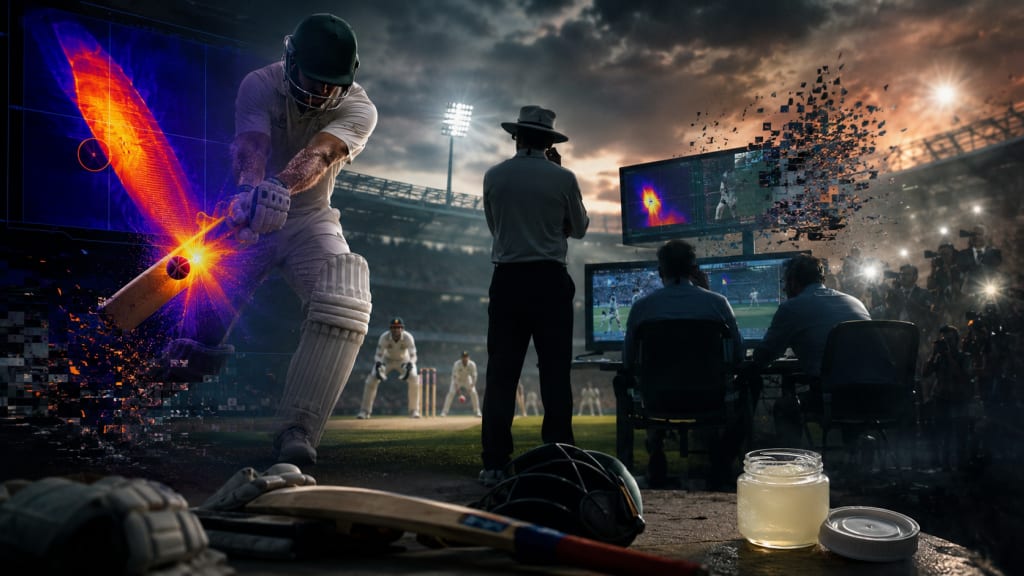
Why Is Hot Spot Technology No Longer Used in Cricket? The Real Reasons, Controversies, and Vaseline Conspiracy Theory
For cricket fans who watched international matches during the late 2000s and early 2010s, Hot Spot was once one of the most recognizable parts of the Decision Review System. A black-and-white thermal replay would appear on screen, and a bright white mark on the bat, pad, glove, or ground could help determine whether the ball had made contact.
Today, Hot Spot is rarely seen in international cricket. Most broadcasters and match officials instead rely on slow-motion video, ball tracking, UltraEdge, or Real-Time Snickometer. Its disappearance has led to questions about whether the technology failed, became obsolete, was deliberately abandoned, or could be manipulated by players.
The reality is less dramatic but more complicated. Hot Spot was not completely banned, nor was it exposed as fraudulent. Its decline resulted from a combination of high operating costs, specialized equipment, logistical restrictions, inconsistent detection of faint contact, broadcaster-controlled technology budgets, and the rapid improvement of audio-based edge-detection systems.
The technology was also surrounded by one of cricket’s strangest rumors: the claim that a batsman could apply Vaseline to the edge of a bat and become invisible to Hot Spot. Tests conducted by the technology’s developer found no meaningful evidence supporting that theory.
What Is Hot Spot Technology in Cricket?
Hot Spot is an infrared imaging system designed to detect the heat created by friction when a cricket ball makes contact with another surface.
When a fast-moving ball touches a bat, pad, glove, shoe, or the ground, the contact can produce a small and temporary increase in temperature. High-sensitivity infrared cameras capture that thermal change.
The resulting replay is usually displayed as a black-and-white negative image. A contact point may appear as a bright white mark, helping the third umpire identify where the ball struck.
Hot Spot was particularly useful when officials needed to determine whether:
- The ball touched the bat before being caught
- The ball hit the bat before the pad in an LBW decision
- The ball struck the pad without touching the bat
- A low catch bounced before reaching the fielder
- The ball touched a batter’s glove
- A bat made contact with the ground rather than the ball
Unlike ordinary television replays, Hot Spot did not depend solely on visual ball movement. It attempted to provide physical evidence of contact through thermal imaging.
How Does Hot Spot Work?
A complete Hot Spot setup traditionally used specialized infrared cameras positioned at opposite ends of the ground.
These cameras continuously recorded the batter and the area around the crease. When a disputed incident occurred, operators examined the relevant frames using image-processing techniques.
The technology worked through several steps:
- Infrared cameras recorded thermal information around the batter.
- The ball made contact with the bat, pad, glove, or another surface.
- Friction created a temporary temperature difference.
- The system processed consecutive frames to isolate the change.
- The point of contact appeared as a bright thermal mark.
The system was developed for cricket by Australian company BBG Sports using advanced infrared technology with origins in military surveillance and tracking applications.
Hot Spot made its high-profile international debut during the 2006–07 Ashes series in Australia and later became an important component of early DRS trials.
Why Was Hot Spot Considered So Useful?
Before technologies such as UltraEdge became fast and widely available, confirming faint edges was difficult.
Normal slow-motion video could show the ball passing extremely close to the bat, but it could not always prove contact. Traditional Snickometer analysis used sound recorded by stump microphones, but older versions took longer to process and were not initially suitable for immediate decision reviews.
Hot Spot offered several advantages.
It Provided Visual Evidence
A white mark on the bat gave viewers and officials something direct to examine.
This was easier to understand than an audio waveform, especially when several sounds occurred close together.
It Could Separate Bat and Pad Contact
In LBW reviews, the order of contact matters.
Hot Spot could sometimes show whether the ball hit the bat before striking the pad, potentially saving a batter from being incorrectly dismissed.
It Did Not Depend Entirely on Sound
Audio-based systems can be affected by:
- Bat hitting pad
- Bat scraping the ground
- Clothing movement
- Creaking equipment
- Crowd noise
- Multiple sounds occurring together
- Technical synchronization errors
Because Hot Spot analyzed thermal friction rather than audio, it acted as an independent source of evidence.
It Was Valuable When Used With Other Technologies
Hot Spot was rarely expected to decide every case on its own.
Its greatest strength came when combined with:
- Slow-motion replay
- UltraEdge or Snickometer
- Ball tracking
- The on-field umpire’s original decision
When several systems agreed, the third umpire could make a more confident decision.
Is Hot Spot Completely Banned From Cricket?
No. Hot Spot has not been universally banned by the International Cricket Council.
It is more accurate to say that the technology became uncommon and is no longer included in most international DRS packages.
The Decision Review System is not always delivered as one identical global product. Its exact components can depend on:
- The host cricket board
- The host broadcaster
- The technology provider
- The financial value of the series
- Equipment availability
- Production contracts
- Local regulations
- The level of the competition
As a result, one series may use ball tracking and UltraEdge, while another may use a different audio provider or a more limited review package.
Even in major international cricket, broadcasters have not always chosen to pay for Hot Spot alongside other technologies. During the 2025 Ashes, for example, Hot Spot was reportedly unavailable because broadcasters did not include its additional daily cost in the production package.
Therefore, saying that cricket “stopped using” Hot Spot is broadly understandable, but technically incomplete. The technology still exists; it has simply become too uncommon to be considered a standard part of modern DRS.
Why Is Hot Spot No Longer Commonly Used?
There was no single event that caused Hot Spot to disappear. Several practical and technical problems gradually reduced its role.
1. Hot Spot Is Expensive to Operate
Cost is one of the most important reasons.
Hot Spot requires specialized high-speed thermal cameras rather than ordinary broadcast cameras. These cameras must be transported, installed, calibrated, operated, protected, and maintained by trained specialists.
Historical reports showed that advanced DRS packages could cost cricket boards thousands of dollars per match day. Earlier debates around DRS also revealed disagreement between boards and the ICC over the total cost of supplying the technology.
More recently, Hot Spot’s additional cost was reported at approximately A$10,000 per day during discussions about its absence from the 2025 Ashes.
That expense may be manageable during a major Ashes series or global tournament. It is harder to justify for:
- Lower-profile bilateral series
- Associate-nation matches
- Domestic competitions
- Women’s domestic cricket
- Tours with smaller broadcast agreements
- Matches held at multiple venues in quick succession
When broadcasters can obtain an acceptable DRS package using UltraEdge and ball tracking, Hot Spot may be viewed as an expensive extra rather than an essential tool.
2. The Equipment Is Difficult to Transport and Install
Hot Spot is not a simple software feature that can be added to an existing television feed.
It depends on physical infrared cameras positioned correctly around the ground. Transporting sensitive equipment across countries creates logistical challenges.
Operators must consider:
- Customs clearance
- Import and export permits
- Insurance
- Equipment security
- Camera mounting positions
- Power and communication systems
- Weather protection
- Venue access
- Skilled personnel
These challenges become greater during tournaments involving many venues.
A broadcaster can more easily deploy audio-based edge detection using microphones and synchronized camera feeds already integrated into standard match production.
3. Its Military Technology Origins Created Restrictions
The infrared cameras associated with Hot Spot have links to technology developed for military applications, including the detection and tracking of tanks and aircraft.
That does not mean Hot Spot itself is a weapon or secret military system. However, certain advanced thermal-imaging components may be subject to export controls, licensing requirements, or restrictions on international transportation.
Former India captain Anil Kumble said in 2024 that Hot Spot was not used in India because it involved military technology.
This explanation should be interpreted carefully. It does not necessarily mean Indian authorities prohibited cricket from using thermal imaging altogether. Rather, the specialized cameras and their export classifications may have made deployment more complicated or impractical.
The logistical issue became another reason for broadcasters to choose technology that was easier to move between countries.
 Wisden Staff
4. Hot Spot Could Miss Very Fine Edges
Hot Spot was impressive, but it was not infallible.
For the technology to show a visible mark, contact must generate enough detectable friction and thermal change. A very faint or glancing edge may not produce a strong mark.
Possible causes of a missed edge include:
- Extremely light contact
- Contact at an unfavorable angle
- Insufficient friction
- Motion blur
- Low thermal contrast
- The ball brushing the bat rather than striking it
- Camera sensitivity
- Contact hidden by another object
- Processing limitations
This created difficult situations in which UltraEdge detected a sound but Hot Spot showed no mark, or television replay suggested deviation while neither system produced clear evidence.
The technology’s developers introduced more sensitive cameras in later versions to improve the detection of faint edges. Nevertheless, doubts created by earlier missed contacts affected public confidence.
5. Hot Spot Sometimes Created More Confusion
Decision-review technology is valuable only when officials understand how to interpret it.
Hot Spot could occasionally complicate decisions rather than resolve them. A white mark might appear on the bat, but officials still had to determine:
- Whether the mark came from the ball
- Whether it came from bat-pad contact
- Whether it was caused by the bat hitting the ground
- Whether the mark occurred during the disputed delivery
- Whether no visible mark truly meant no contact
The ICC’s leadership defended the absence of Hot Spot from the 2015 World Cup partly on the basis that it could sometimes create confusion rather than certainty.
Technology does not eliminate interpretation. It simply gives the third umpire additional evidence.
6. UltraEdge Became Faster and More Convenient
The biggest technological reason for Hot Spot’s decline was the improvement of audio-based edge detection.
Earlier versions of Snickometer could take too long to synchronize and process for real-time reviews. Hot Spot initially filled that gap because its images could be examined relatively quickly.
Modern systems such as UltraEdge and Real-Time Snickometer process sound far faster.
These systems combine:
- Audio from stump microphones
- Synchronized video
- A visual waveform
- Frame-by-frame ball position
When the ball passes the bat, the third umpire looks for a corresponding spike in the waveform.
UltraEdge has several commercial advantages:
- It integrates more easily with broadcast production
- It uses equipment already present around the field
- It is faster than older Snickometer systems
- It is easier to deploy internationally
- It generally costs less than adding specialized thermal cameras
- Viewers and officials are familiar with its display
Once real-time audio analysis became good enough for routine DRS use, Hot Spot was no longer the only practical option for detecting edges.
7. Broadcasters Control Much of the Technology Budget
Many fans assume the ICC directly supplies every camera and review tool at every international match.
That is not how the system always works.
The technology package is often influenced by the host broadcaster and cricket board. They decide which approved providers and tools are financially and operationally viable.
This creates inconsistency.
A wealthy series may receive:
- Full ball tracking
- UltraEdge or Snickometer
- Multiple super-slow-motion cameras
- Advanced replay systems
- Additional specialist tools
A smaller series may receive a more basic package.
Current and former players have questioned why the ICC does not fund and standardize a single technology system across international cricket. Following audio-detection controversies during the 2025 Ashes, Mitchell Starc publicly asked why every series did not use the same review technology.
The disappearance of Hot Spot is therefore partly a commercial decision, not simply a scientific judgment.
Hot Spot vs UltraEdge: What Is the Difference?
Hot Spot and UltraEdge attempt to answer similar questions using completely different forms of evidence.
Hot Spot
Hot Spot uses infrared cameras to identify heat created by friction.
It provides a visual thermal mark that may reveal contact between the ball and bat, glove, pad, or ground.
UltraEdge
UltraEdge analyzes sound captured by sensitive microphones.
It displays an audio waveform synchronized with slow-motion video.
Which Technology Is Better?
Neither system is perfect.
Hot Spot may detect contact that produces little or no audible sound. UltraEdge may detect a faint noise even when Hot Spot shows no thermal mark.
However, UltraEdge is usually more practical and economical, which explains why it became the standard choice.
The strongest review system would ideally use both technologies alongside high-quality replay. Cost and logistics make that combination uncommon.
The Famous Hot Spot and Vaseline Conspiracy Theory
One of the strangest controversies involving Hot Spot occurred during India’s 2011 tour of England.
The incident centered on Indian batter VVS Laxman during the second Test at Trent Bridge.
England appealed for a caught-behind dismissal, believing Laxman had edged the ball. Hot Spot did not display a clear mark on his bat, and he was not given out.
Former England captain Michael Vaughan then posted a message on social media asking whether Vaseline applied to the outside edge of Laxman’s bat had saved him.
The suggestion immediately attracted attention.
The theory claimed that applying petroleum jelly or Vaseline to the edge of a cricket bat could somehow suppress the heat signature generated by ball contact, preventing Hot Spot from detecting an edge.
The allegation quickly became known among fans as “Vaseline-gate.”
Why Did People Believe the Vaseline Rumor?
The theory spread because it sounded scientifically possible to people unfamiliar with thermal imaging.
Supporters of the rumor speculated that Vaseline could:
- Reduce friction between the ball and bat
- Absorb or distribute heat
- Insulate the bat’s surface
- Hide the thermal mark
- Confuse infrared cameras
The timing also made the allegation explosive.
England’s players appeared convinced there had been an edge, while Hot Spot showed no clear mark. For fans looking for an explanation, the Vaseline theory offered a dramatic answer.
The claim also fitted a familiar pattern in sports: when technology and human observation disagree, people sometimes suspect manipulation rather than technical limitation.
Did VVS Laxman Put Vaseline on His Bat?
There was no credible evidence that VVS Laxman applied Vaseline to his bat to defeat Hot Spot.
No official investigation proved cheating.
No substance was publicly identified on his bat.
The claim began as speculation and was amplified by media coverage and fan discussion.
Vaughan later indicated that his comment had not been intended as a formal cheating allegation. Nevertheless, the rumor had already spread internationally.
It remains one of the most frequently repeated conspiracy theories associated with cricket technology.
Could Vaseline Really Defeat Hot Spot?
According to BBG Sports, the company behind Hot Spot, ordinary application of Vaseline to a cricket bat had no discernible effect on the system.
The company conducted tests after the controversy and rejected the theory.
BBG Sports stated that a batsman would need to apply an unrealistically thick layer—reportedly close to one centimetre—before it might have a meaningful effect. Such a layer would be plainly visible and impractical during a match.
A thin coating of petroleum jelly did not prevent the infrared cameras from detecting friction in the company’s tests.
Therefore, the famous claim was never demonstrated as a workable method of cheating.
Why Did Hot Spot Fail to Show Some Genuine Edges?
The failure to display a mark did not require sabotage.
A light edge could simply generate too little thermal energy for the camera to detect clearly.
Consider the difference between two forms of contact:
- A firm impact produces significant friction and compression.
- A glancing touch may redirect the ball while producing minimal heat.
A ball can therefore touch a bat without creating a strong Hot Spot mark.
Similarly, audio technology can miss a glancing contact if the impact produces little sound. The developer of Snickometer acknowledged this limitation after a controversial dismissal involving Yashasvi Jaiswal during the 2024–25 Border-Gavaskar Trophy, noting that some glancing contacts may not register acoustically.
The absence of a Hot Spot mark should never be interpreted as absolute proof that contact did not occur.
Other Rumors About the Disappearance of Hot Spot
The Vaseline story was not the only theory surrounding the technology.
Rumor 1: Cricket Authorities Banned Hot Spot Because Players Defeated It
There is no established evidence that the ICC removed Hot Spot because players discovered a reliable way to manipulate it.
Claims involving Vaseline, silicone tape, bat coatings, and protective materials have circulated for years, but no widely accepted cheating technique was proven to have caused the technology’s decline.
Rumor 2: The BCCI Forced the ICC to Remove It
India’s cricket authorities historically expressed concerns about DRS reliability, and the BCCI resisted mandatory use of review technology for years.
However, Hot Spot’s decline occurred across many competitions and countries. It cannot be explained solely by one cricket board.
Cost, camera availability, export restrictions, broadcaster preferences, and the rise of UltraEdge all played larger practical roles.
Rumor 3: Hot Spot Was Too Accurate and Exposed Umpires
This theory suggests cricket officials disliked Hot Spot because it revealed too many umpiring mistakes.
There is no credible evidence supporting that claim.
The purpose of DRS is to correct clear errors. Cricket authorities continued expanding other review technologies even as Hot Spot became less common.
Rumor 4: Television Networks Removed It to Create Controversy
Some fans argue broadcasters prefer uncertain decisions because controversy generates discussion and viewing figures.
This is speculation.
Broadcasters have clear incentives to provide reliable coverage and protect confidence in major competitions. The more realistic explanation is that they compare the added value of Hot Spot against its considerable cost.
Rumor 5: Hot Spot Was Secret Military Technology That Could Not Be Shown Publicly
Hot Spot used infrared camera technology with military origins, but that does not mean the cricket system exposed secret military capabilities.
The relevant concern was more likely the movement, licensing, and export of controlled thermal equipment.
Military origin made deployment complicated; it did not make television broadcast of Hot Spot images inherently prohibited.
Was Hot Spot More Reliable Than UltraEdge?
Hot Spot and UltraEdge fail in different ways.
Hot Spot can miss a faint edge that does not generate enough heat.
UltraEdge can miss an impact that creates little sound. It can also produce confusing spikes when the bat hits the pad or ground near the moment the ball passes.
UltraEdge is not necessarily more scientifically definitive in every incident. It became dominant because it offers a better balance of:
- Cost
- Speed
- Availability
- Portability
- Integration
- Familiarity
- General usefulness
In difficult cases, Hot Spot would still be valuable as an independent second source of evidence.
That is why controversial decisions regularly lead players and commentators to ask whether it should return.
Could Hot Spot Return to International Cricket?
Yes, but a widespread return would require changes in economics and technology.
Hot Spot could become practical again if:
- Thermal cameras become cheaper
- Equipment becomes smaller and easier to transport
- Export restrictions become simpler
- Camera sensitivity improves
- Automated image analysis reduces staffing requirements
- The ICC funds a standardized global DRS package
- Broadcasters consider it commercially worthwhile
Recent controversies involving audio-based edge detection have renewed interest in complementary systems.
A future version of DRS could combine:
- UltraEdge
- Hot Spot
- High-frame-rate video
- Automated contact detection
- Artificial intelligence-assisted synchronization
- Improved ball tracking
The goal should not be to find one perfect technology. It should be to combine independent forms of evidence so that one system can compensate for another’s weaknesses.
Why Cricket Still Needs Multiple Technologies
No technology can perfectly reconstruct every split-second event in cricket.
A faint edge may produce:
- Visible deviation but no sound
- Sound but no visible deviation
- Heat but no clear audio signal
- Conflicting marks from bat, pad, and ground
Third umpires make better decisions when they can compare several independent sources.
For caught-behind and LBW reviews, an ideal system would include:
- High-quality slow-motion replay
- Synchronized audio analysis
- Thermal imaging
- Ball tracking
- Clear decision protocols
- Properly trained operators
Relying too heavily on one waveform or one camera angle can create false confidence.
The Real Reason Hot Spot Disappeared
Hot Spot did not disappear because of one scandal, secret ban, or successful cheating method.
Its decline was gradual.
The main reasons were:
- High daily operating costs
- Expensive specialist infrared cameras
- Difficult international transportation
- Possible export-control complications
- Inconsistent detection of extremely faint edges
- Occasional interpretive confusion
- The emergence of faster audio technology
- Broadcaster preference for cheaper DRS packages
- Lack of globally standardized technology
The Vaseline conspiracy theory became part of cricket folklore, but it did not prove that Hot Spot could easily be defeated. Tests by BBG Sports found that normal application of Vaseline had no discernible effect on the system.
Final Thoughts
Hot Spot remains one of the most visually compelling technologies ever introduced to cricket.
It gave viewers a clear and intuitive way to examine contact, helped resolve many difficult decisions, and offered evidence independent of sound. Yet its technical strengths were not enough to overcome its financial and logistical disadvantages.
UltraEdge became the preferred solution because it was faster, cheaper, easier to integrate, and more widely available. That does not mean it is perfect or that Hot Spot became useless.
Controversial decisions continue to show why combining technologies can be more reliable than depending on one system alone.
The famous Vaseline story may remain entertaining as a cricket conspiracy theory, but the available evidence does not support it. Hot Spot was not defeated by petroleum jelly. It was largely displaced by economics, logistics, technological competition, and the inconsistent way DRS is funded across international cricket.
Frequently Asked Questions
Why is Hot Spot no longer used in cricket?
Hot Spot is rarely used because its specialized infrared cameras are expensive, difficult to transport, and not always available internationally. Broadcasters generally prefer UltraEdge because it is cheaper and easier to integrate into DRS.
Has the ICC banned Hot Spot?
No. The ICC has not universally banned Hot Spot. It may still be used where equipment, providers, broadcasters, and budgets allow, but it is no longer a standard part of most international DRS systems.
What replaced Hot Spot in cricket?
UltraEdge and Real-Time Snickometer largely replaced Hot Spot for detecting faint edges. These technologies analyze sound from stump microphones and synchronize it with slow-motion video.
Is Hot Spot more accurate than UltraEdge?
Neither system is perfect. Hot Spot can miss very light contact that produces little heat, while UltraEdge can miss glancing contact that produces little sound. Using both together would provide stronger evidence.
Can Vaseline hide an edge from Hot Spot?
Tests conducted by BBG Sports found that a normal application of Vaseline had no discernible effect on Hot Spot. The company said an unrealistically thick layer would be required before it might interfere significantly.
Did VVS Laxman use Vaseline on his bat?
There is no credible evidence that VVS Laxman used Vaseline to deceive Hot Spot. The allegation originated from speculation during India’s 2011 Test series in England and was never proven.
Who started the Vaseline and Hot Spot rumor?
Former England captain Michael Vaughan raised the possibility on social media after a disputed appeal involving VVS Laxman in 2011. The comment triggered widespread speculation, although the theory was later rejected by Hot Spot’s developer.
How does Hot Spot detect an edge?
Hot Spot uses infrared cameras to identify heat generated by friction when the ball contacts the bat, glove, pad, shoe, or ground. The contact point appears as a bright mark in the processed image.
Why does Hot Spot sometimes show no mark after an edge?
A very faint or glancing edge may not generate enough friction and heat to create a detectable thermal mark. Camera angle, sensitivity, motion blur, and surrounding contact can also affect the result.
Is Hot Spot military technology?
The thermal-imaging equipment has origins in military tracking technology. Some specialized components may be subject to export controls, making international transportation and deployment more complicated.
How much does Hot Spot cost?
The exact price varies by provider, series, and equipment package. During discussions surrounding the 2025 Ashes, its additional cost was reported at approximately A$10,000 per match day.
Could Hot Spot return to cricket?
Yes. Hot Spot could return more widely if thermal equipment becomes cheaper, easier to transport, and better integrated with modern DRS. Greater ICC funding and standardized technology packages could also support its return.
Why is DRS technology different between cricket series?
The host board, broadcaster, production company, budget, and available technology providers influence which DRS tools are used. The ICC sets standards, but every series does not necessarily receive an identical technology package.
What is the best system for detecting cricket edges?
The most reliable approach is to combine high-quality replay, UltraEdge or Snickometer, and Hot Spot. Independent evidence from sound, video, and thermal imaging reduces dependence on the limitations of any single system.